


Genesis 41:1
- וַיְהִיvay·Hiand it wasH1961Conj-w ¦ V-Qal-ConsecImperf-3msVerb Qal Consecutive Imperfect 3rd Singular Masculineוַandיְהִיit was
- מִקֵּץmi·Ketzfrom [the] end ofH7093Prep-m ¦ N-mscNoun Singular Masculine Constructמִfromקֵּץ[the] end of
- שְׁנָתַיִםshe·na·Ta·yimtwo yearsH8141N-fdNoun Dual Feminine Absolute
- יָמִיםya·MimdaysH3117N-mpNoun Plural Masculine Absolute
- וּפַרְעֹהu·far·'Ohand PharaohH6547Conj-w ¦ N-msNoun Title Singular Masculine AbsoluteוּandפַרְעֹהPharaoh
- חֹלֵםcho·Lem[was] dreamingH2492V-Qal-Prtcpl-msVerb Qal Participle Singular Masculine Absolute
- וְהִנֵּהve·hi·Nehand there!H2009Conj-w ¦ PrtParticle Interjectionוְandהִנֵּהthere!
- עֹמֵד'o·Med[he was] standingH5975V-Qal-Prtcpl-msVerb Qal Participle Singular Masculine Absolute
- עַל'alatH5921PrepPreposition
- הַיְאֹרhay·'Orthe RiverH2975Art ¦ N-properNoun Proper LocationהַtheיְאֹרRiver
English is a literal word-by-word gloss of the Hebrew, not the KJV's wording. Why?
This is the original text the KJV's translators worked from — each Hebrew word with its own literal English meaning in this verse, prepared by scholars at Tyndale House, Cambridge. The KJV translates whole sentences, not word by word, so its wording differs: one Hebrew word can become several English words, and the KJV may choose “the LORD” where the gloss reads “Yahweh”. Both are faithful — they answer different questions. For the KJV's own rendering, switch to the KJV text.
Details
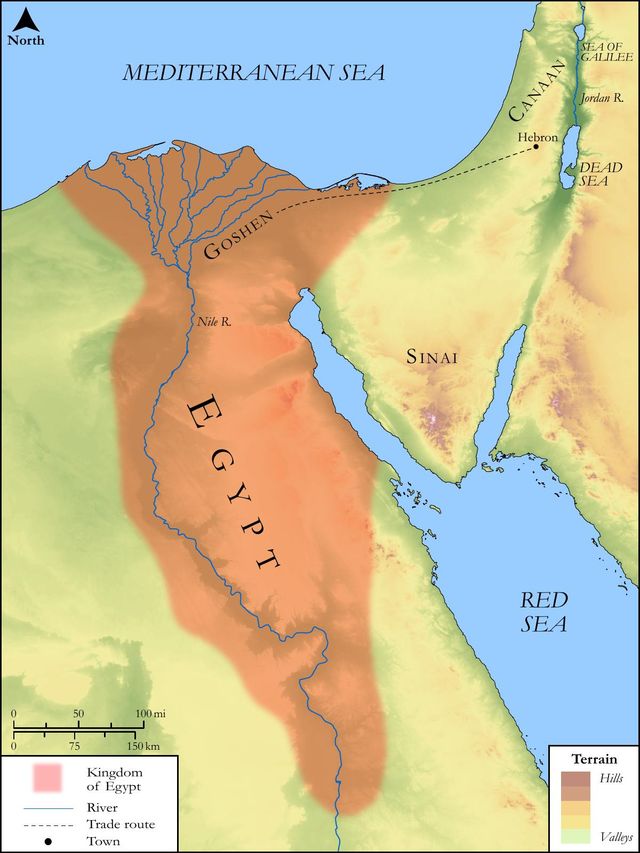
See on the biblical-era map


Study this verse
Public-domain commentary
Matthew Henry
From his Commentary on the Whole Bible. Henry comments on passages, not single verses — this entry covers Genesis 41:1–8.
Observe, 1. The delay of Joseph's enlargement. It was not till the end of two full years (Gen 41:1); so long he waited after he had entrusted the chief butler with his case and began to have some prospect of relief. Note, We have need of patience, not only bearing, but waiting, patience. Joseph lay in prison until the time that his word came, Psa 105:19. There is a time set for the deliverance of God's people; that time will come, though it seem to tarry; and, when it comes, it will appear to have been the best time, and therefore we ought to wait for it (Hab 2:3), and not think two full years too long to continue waiting. 2. The means of Joseph's enlargement, which were Pharaoh's dreams, here related. If we were to look upon them as ordinary dreams, we might observe from them the follies and absurdities of a roving working fancy, how it represents to itself tame cows as beasts of prey (nay, more ravenous than any, eating up those of their own kind), and ears of corn as devouring one another. Surely in the multitude of dreams, nay, even in one dream, there are divers vanities, Ecc 5:7. Now that God no longer speaks to us in that way, I think it is no matter how little we either heed them or tell them. Foolish dreams related can make no better than foolish talk. But these dreams which Pharaoh dreamed carried their own evidence with them that they were sent of God; and therefore, when he awoke, his spirit was troubled, Gen 41:8. It cannot but put us into a concern to receive any extraordinary message from heaven, because we are conscious to ourselves that we have no reason to expect any good tidings thence. His magicians were puzzled, the rules of their art failed them: these dreams of Pharaoh, it seems, did not fall within the compass of them, so that they could not offer at the interpretation of them. This was to make Joseph's performance by the Spirit of God the more admirable. Human reason, prudence, and foresight, must be nonplussed, that divine revelation may appear the more glorious in the contrivance of our redemption, Co1 2:13, Co1 2:14. Compare with this story, Dan 2:27; Dan 4:7; Dan 5:8. Joseph's own dreams were the occasion of his troubles, and now Pharaoh's dreams were the occasion of his enlargement.
Continue studying Genesis 41:1 across the web’s major study libraries — every link below opens this exact verse, chapter, or book on the destination site.
Read & Compare
 BibleGatewayThis verse in more than 200 translations and 70 languages.
 Bible.comThe YouVersion reader — hundreds of translations, reading plans, and highlights.
 ESV.orgCrossway's official English Standard Version reader.
 NET BibleThe NET translation with 60,000+ translators' notes on every rendering decision.
 STEP BibleTyndale House's free study tool — original text, vocabulary, and scholarly resources.
 BibliaLogos Bible Software's free web reader.
 USCCBThe New American Bible (Revised Edition) with the U.S. bishops' study notes.
Commentaries
 BibleHub CommentariesDozens of classic commentaries on this verse, gathered on one page.
 StudyLightMore than 100 commentary sets — the largest collection on the web.
 BibleRefPlain-English commentary on what this verse means, verse by verse.
 Enduring WordDavid Guzik's free commentary on this chapter, widely used by Bible teachers.
 Bible Study ToolsVerse commentary alongside Greek and Hebrew study aids.
Original Language & Research
- BibleHub InterlinearThe verse word by word — original language, transliteration, and English.
- BibleHub LexiconEvery word's original-language definition and Strong's entry.
 Blue Letter BibleDeep-study tools — Strong's numbers, concordance, and word studies.
 SefariaThe Hebrew text with Rashi and centuries of Jewish commentary.
Sermons, Hymns & Audio


TrulyRandomVerse is not affiliated with these sites and doesn’t control their content. They’re linked because they’re genuinely useful.
Summary
Genesis 41:1 marks a pivotal moment in Joseph's life and the unfolding of God's redemptive plan. After two full years of being seemingly forgotten in prison, following his accurate interpretation of the chief butler's dream, the narrative abruptly shifts to Pharaoh's mysterious dreams. These divinely orchestrated dreams serve as the catalyst, setting the stage for Joseph's remarkable elevation from prisoner to prime minister, thereby powerfully demonstrating God's perfect timing and sovereign control over all circumstances, even the seemingly mundane or delayed.
Context
ShowHideLiterary Context
This verse immediately follows the detailed account of Joseph's faithful service and accurate prophetic interpretations in Pharaoh's prison, particularly for the chief butler and baker in Genesis 40. Despite the chief butler's promise to remember Joseph upon his restoration to Pharaoh's service, two full years pass without action, creating a narrative tension that underscores human forgetfulness versus divine remembrance. The sudden introduction of Pharaoh's dreams in Genesis 41:1 serves as the dramatic turning point, shifting the focus from Joseph's passive waiting to the active intervention of God through the most powerful figure in the land. This transition highlights the sovereign hand of God orchestrating events to bring Joseph out of obscurity at precisely the right moment.
Historical & Cultural Context
Ancient Egypt was a highly centralized and powerful civilization, with the Pharaoh revered as a divine king, the earthly embodiment of Horus. Dreams were widely regarded as significant, often interpreted as messages from the gods or omens of future events, and there was a class of professional dream interpreters and magicians within the royal court. The "river" mentioned is unequivocally the Nile, the indispensable lifeblood of Egypt, whose annual inundation determined the nation's agricultural prosperity. The imagery of Pharaoh's subsequent dreams, involving cows and grain, is deeply rooted in this agrarian and ecological reality, making the divine message immediately relevant to the Egyptian worldview and economy. The power dynamics of the ancient Near East meant that Pharaoh's distress would have ripple effects throughout his kingdom, setting the stage for a national crisis that only divine wisdom could resolve.
Key Themes
ShowHideGenesis 41:1 introduces and reinforces several key themes prevalent in the book of Genesis and the broader biblical narrative. Firstly, it powerfully illustrates Divine Providence and Timing, showing that God works according to His perfect schedule, even when human plans or promises fail, as seen in the two-year delay after the butler's release (Genesis 40:23). Secondly, it emphasizes Dreams as a Vehicle for Divine Revelation, a recurring motif throughout Genesis, from Abraham's visions to Joseph's own prophetic dreams (Genesis 37:5-10). Thirdly, it highlights God's Universal Sovereignty, demonstrating His ability to use any person or circumstance, including a pagan king, to achieve His redemptive purposes (Isaiah 45:1-7). Finally, it foreshadows Elevation and Deliverance, as this moment marks the beginning of Joseph's dramatic rise from imprisonment to a position of immense power, ultimately for the salvation of many, echoing themes of God's faithfulness to His covenant promises.
Exposition and Analysis
ShowHideGenesis 41:1 introduces the pivotal moment that shifts Joseph's fortunes and sets the stage for a major turning point in the biblical narrative. The KJV text states, "¶ And it came to pass at the end of two full years, that Pharaoh dreamed: and, behold, he stood by the river." This concise statement is packed with theological and narrative significance.
Key Word Analysis
ShowHideThis primitive root properly means "to bind firmly," but by implication, it can mean "to be plump" or, through the figurative sense of "dumbness," "to dream." In this context, it refers to Pharaoh experiencing a divinely sent vision during sleep. The use of this word underscores that Pharaoh's experience was not merely a random psychological event but a purposeful communication from a higher power, intended to convey a message that would have profound implications for Egypt and beyond.
This primitive root signifies "to stand" in various relations, literal and figurative, including to abide, appoint, arise, cease, confirm, or be present. In this verse, it literally describes Pharaoh's posture in his dream, "he stood by the river." This seemingly simple detail grounds the dream's imagery in a physical, observable reality, making the vision vivid and relatable to Pharaoh's waking life and the subsequent events that will unfold around the Nile.
Of Egyptian origin, this term refers to a channel, fosse, canal, or shaft. Specifically, it denotes the Nile River, recognized as the singular, life-giving river of Egypt, including its collateral trenches. Its mention here immediately establishes the geographical and cultural context of the dream, foreshadowing the symbolic imagery of the fat and lean cows, and the full and blighted ears of grain, all intrinsically linked to the Nile's vital role in Egypt's prosperity and survival.
Verse Breakdown
ShowHide"And it came to pass at the end of two full years"
This precise temporal marker emphasizes the exact and complete duration of the period Joseph spent forgotten in prison after interpreting the butler's dream. The phrase "two full years" (שְׁנָתַיִם יָמִים, shenatayim yamim, literally "two years of days") highlights God's sovereign control over time and His meticulous timing. This extended period of waiting served to further refine Joseph's character, deepen his reliance on God, and ensure that his eventual elevation would be undeniably seen as a divine act, not a result of human effort or memory. It underscores the theme of divine patience and the preparation of individuals for God's greater purposes.
"that Pharaoh dreamed"
The fact that Pharaoh, the most powerful pagan ruler of his day, is the recipient of this crucial dream is highly significant. Dreams are a recurring motif and a primary vehicle for divine revelation throughout Genesis, used by God to communicate His will and reveal future events. Pharaoh's dream is not merely a psychological phenomenon but a divinely sent message, intended to initiate a chain of events that will preserve not only Egypt but also the nascent nation of Israel. This demonstrates God's universal sovereignty and His ability to use any means, and any individual, to accomplish His redemptive plan.
"and, behold, he stood by the river"
The immediate setting of Pharaoh's dream "by the river" (יְאֹר, ye'or, specifically the Nile) is crucial. The Nile was the lifeblood of ancient Egypt, its annual inundation dictating the nation's agricultural success and overall prosperity. This detail immediately grounds the divine revelation in the specific cultural and geographical reality of Egypt, making the dream's message immediately relevant and understandable to Pharaoh and his court. It also foreshadows the central imagery of the dreams themselves, which will involve elements directly dependent on the Nile's bounty.
Literary Devices
ShowHideGenesis 41:1 employs several literary devices to enhance its narrative and theological impact. Foreshadowing is prominent, as the mention of Pharaoh's dream and his standing by the Nile immediately hints at the nature of the dreams to follow, which will be deeply connected to Egypt's agricultural life and the Nile's significance. There is also a strong sense of Irony in the narrative: Joseph, the divinely gifted dream interpreter, remains forgotten in prison, while the most powerful man in the world, a pagan king, is troubled by dreams that only Joseph can interpret. This sets up the dramatic reversal of fortunes. Furthermore, the precise temporal marker, "at the end of two full years," underscores Divine Sovereignty as a narrative device, emphasizing God's meticulous timing and control over all circumstances, even the delays and apparent setbacks, to bring about His ultimate purposes. The Symbolism of the Nile, already hinted at, will become central to the dream's interpretation, representing the very life and prosperity of Egypt.
Theological and Thematic Connections
ShowHideGenesis 41:1 serves as a powerful testament to God's meticulous providence and His sovereign control over all of creation and human affairs. The two-year delay, far from being an oversight, underscores God's perfect timing, preparing Joseph for his immense responsibilities and ensuring that his elevation would be clearly attributed to divine intervention. This moment highlights God's ability to use unexpected means—even the dreams of a pagan king—to achieve His redemptive purposes, demonstrating that His plans transcend human limitations and expectations. It is a profound illustration of how God orchestrates seemingly disconnected events to bring about His ultimate will, not only for individuals but for the preservation of His chosen people and the advancement of His kingdom.
Reflection and Application
ShowHideGenesis 41:1 offers profound encouragement for those experiencing periods of waiting, delay, or forgottenness. Joseph's two years of continued imprisonment, despite his faithfulness and accurate interpretations, serve as a powerful reminder that God's timing is perfect, even when it seems slow or inexplicable from a human perspective. We are called to cultivate patience and unwavering trust in God's providence, understanding that trials and delays are often preparatory, refining our character and positioning us for greater purposes. This verse also underscores God's boundless creativity in accomplishing His will, demonstrating that He can use any means—even the dreams of a powerful, pagan ruler—to bring about His intended outcomes, not only for individuals but for nations and the advancement of His kingdom. It challenges us to look beyond immediate circumstances and trust in the unseen hand of God orchestrating events for our good and His glory.
Questions for Reflection
ShowHideFAQ
ShowHideWhy did God wait two full years to release Joseph?
ShowHideThe two-year delay highlights God's perfect timing and sovereign control. This period served multiple purposes: it further humbled Joseph, refined his character, and prepared him for the immense responsibilities he was about to undertake as prime minister of Egypt. Crucially, it also ensured that his release and elevation would be clearly seen as a divine act, not a result of human effort or memory (as the chief butler had forgotten him, as noted in Genesis 40:23), thereby magnifying God's glory in the narrative. God's delays are never denials but often preparations for a greater display of His power and wisdom.
Why did Pharaoh dream, and not Joseph, if it was a divine message?
ShowHideGod chose Pharaoh as the recipient of the dream to create a desperate situation in Egypt that only Joseph, empowered by God, could resolve. This method ensured Joseph's direct elevation to a position of immense power and influence, where he could then implement God's plan for the coming famine, which would ultimately preserve the lineage of Abraham and the nascent nation of Israel. It demonstrates God's ability to use anyone, even a pagan king, to accomplish His redemptive purposes, highlighting His universal sovereignty over all nations and rulers, as seen in passages like Daniel 2:21.
What is the significance of Pharaoh standing "by the river"?
ShowHideThe "river" is specifically the Nile, the lifeblood of ancient Egypt. Mentioning it immediately grounds the dream in the Egyptian context and foreshadows the imagery of the dream itself, which will involve the Nile and its produce (cows and grain). This detail makes the dream's message immediately relevant and understandable to Pharaoh and his court, emphasizing the practical implications of the divine revelation for Egypt's survival. The Nile was the source of Egypt's prosperity, and its prominence in the dream underscores that the coming crisis would be directly related to the very foundation of their national life, making the divine warning all the more impactful.
Christ-Centered Fulfillment
ShowHideJoseph's journey from forgotten prisoner to exalted deliverer, set in motion by the events of Genesis 41:1, powerfully prefigures the person and work of Jesus Christ. Like Joseph, Jesus was unjustly condemned and seemingly forgotten by many, enduring profound suffering and humiliation, even to the point of death on a cross (Philippians 2:8). Yet, in God's perfect timing, He was raised from the dead and exalted to the right hand of the Father, becoming the ultimate deliverer and Lord over all (Ephesians 1:20-23). Just as Joseph provided sustenance and salvation for Egypt and his own family during a time of severe famine, Christ, through His sacrificial death and glorious resurrection, provides spiritual sustenance and eternal salvation for all who believe, rescuing humanity from the famine of sin and death (John 6:35 and John 3:16-17). Joseph's elevation from the pit to the palace for the salvation of many mirrors Christ's journey from the cross to the throne, where He reigns as Lord and Savior, fulfilling God's grand redemptive plan for all nations and all time.