


Genesis 39:18
Bible text: King James Version (1769 Blayney text) · Public domain
Bible text: Berean Standard Bible · Public domain
Bible text: American Standard Version (1901) · Public domain
Bible text: World English Bible, Messianic edition · Public domain
Bible text: Geneva Bible (1599) · Public domain
Bible text: Young's Literal Translation · Public domain
- וַיְהִיvay·Hiand it wasH1961Conj-w ¦ V-Qal-ConsecImperf-3msVerb Qal Consecutive Imperfect 3rd Singular Masculineוַandיְהִיit was
- כַּהֲרִימִיka·ha·ri·Miwhen I raisedH7311Prep-k ¦ V-Hiphil-Inf ¦ 1csVerb Hiphil Infinitive ConstructכַּwhenהֲרִימִraisedיI
- קוֹלִיko·Limy voiceH6963N-msc ¦ 1csNoun Singular Masculine Constructקוֹלִvoiceיmy
- וָאֶקְרָאva·'ek·Ra'and I called outH7121Conj-w ¦ V-Qal-ConsecImperf-1csVerb Qal Consecutive Imperfect 1st Singular common genderוָandאֶקְרָאI called out
- וַיַּעֲזֹבvai·ya·'a·Zoand he leftH5800Conj-w ¦ V-Qal-ConsecImperf-3msVerb Qal Consecutive Imperfect 3rd Singular Masculineוַandיַּעֲזֹבhe left
- בִּגְדוֹbig·Dohis clothingH899N-msc ¦ 3msNoun Singular Masculine Constructבִּגְדclothingוֹhis
- אֶצְלִי'etz·Libeside meH681N-csc ¦ 1csNoun Singular common gender Constructאֶצְלִbesideיme
- וַיָּנָסvai·Ya·nosand he fledH5127Conj-w ¦ V-Qal-ConsecImperf-3msVerb Qal Consecutive Imperfect 3rd Singular Masculineוַandיָּנָסhe fled
- הַחוּצָהha·Chu·tzahthe outside towardsH2351Art ¦ N-ms ¦ SfxNoun Singular Masculine Absoluteהַtheחוּצָoutsideהtowards
English is a literal word-by-word gloss of the Hebrew, not the KJV's wording. Why?
This is the original text the KJV's translators worked from — each Hebrew word with its own literal English meaning in this verse, prepared by scholars at Tyndale House, Cambridge. The KJV translates whole sentences, not word by word, so its wording differs: one Hebrew word can become several English words, and the KJV may choose “the LORD” where the gloss reads “Yahweh”. Both are faithful — they answer different questions. For the KJV's own rendering, switch to the KJV text.
Details
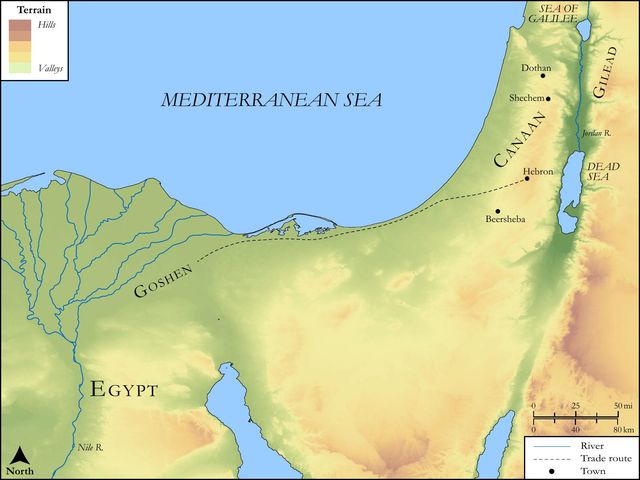
See on the biblical-era maps


Study this verse
Public-domain commentary
Matthew Henry
From his Commentary on the Whole Bible. Henry comments on passages, not single verses — this entry covers Genesis 39:13–18.
Joseph's mistress, having tried in vain to make him a criminal, now endeavours to represent him as one; so to be revenged on him for his virtue. Now was her love turned into the utmost rage and malice, and she pretends she cannot endure the sight of him whom awhile ago she could not endure out of her sight. Chaste and holy love will continue, though slighted; but sinful love, like Amnon's to Tamar, is easily changed into sinful hatred. 1. She accused him to his fellow servants (Gen 39:13-15) and gave him a bad name among them. Probably they envied him his interest in their master's favour, and his authority in the house; and perhaps found themselves aggrieved sometimes by his fidelity, which prevented their purloining; and therefore they were glad to hear any thing that might tend to his disgrace, and, if there was room for it, incensed their mistress yet more against him. Observe, When she speaks of her husband, she does not call him her husband, or her lord, but only he; for she had forgotten the covenant of her God, that was between them. Thus the adulteress (Pro 7:19) calls her husband the good man. Note, Innocence itself cannot secure a man's reputation. Not every one that keeps a good conscience can keep a good name. 2. She accused him to his master, who had power in his hand to punish him, which his fellow servants had not, Gen 39:17, Gen 39:18. Observe, (1.) What an improbable story she tells, producing his garment as an evidence that he had offered violence to her, which was a plain indication that she had offered violence to him. Note, Those that have broken the bonds of modesty will never be held by the bonds of truth. No marvel that she who had impudence enough to say, Lie with me, had front enough to say, "He would have lien with me." Had the lie been told to conceal her own crime it would have been bad enough, yet, in some degree, excusable; but it was told to be revenged upon his virtue, a most malicious lie. And yet, (2.) She manages it so as to incense her husband against him, reflecting upon him for bringing this Hebrew servant among them, perhaps at first against her mind, because he was a Hebrew. Note, It is no new thing for the best of men to be falsely accused of the worst of crimes by those who themselves are the worst of criminals. As this matter was represented, one would have thought chaste Joseph a very bad man and his wanton mistress a virtuous woman; it is well that there is a day of discovery coming, in which all shall appear in their true characters. This was not the first time that Joseph's coat was made use of as a false witness concerning him; his father had been deceived by it before, now his master.
Continue studying Genesis 39:18 across the web’s major study libraries — every link below opens this exact verse, chapter, or book on the destination site.
Read & Compare
 BibleGatewayThis verse in more than 200 translations and 70 languages.
 Bible.comThe YouVersion reader — hundreds of translations, reading plans, and highlights.
 ESV.orgCrossway's official English Standard Version reader.
 NET BibleThe NET translation with 60,000+ translators' notes on every rendering decision.
 STEP BibleTyndale House's free study tool — original text, vocabulary, and scholarly resources.
 BibliaLogos Bible Software's free web reader.
 USCCBThe New American Bible (Revised Edition) with the U.S. bishops' study notes.
Commentaries
 BibleHub CommentariesDozens of classic commentaries on this verse, gathered on one page.
 StudyLightMore than 100 commentary sets — the largest collection on the web.
 BibleRefPlain-English commentary on what this verse means, verse by verse.
 Enduring WordDavid Guzik's free commentary on this chapter, widely used by Bible teachers.
 Bible Study ToolsVerse commentary alongside Greek and Hebrew study aids.
Original Language & Research
- BibleHub InterlinearThe verse word by word — original language, transliteration, and English.
- BibleHub LexiconEvery word's original-language definition and Strong's entry.
 Blue Letter BibleDeep-study tools — Strong's numbers, concordance, and word studies.
 SefariaThe Hebrew text with Rashi and centuries of Jewish commentary.
Sermons, Hymns & Audio


TrulyRandomVerse is not affiliated with these sites and doesn’t control their content. They’re linked because they’re genuinely useful.
Summary
Genesis 39:18 vividly recounts the manipulative and false accusation leveled by Potiphar's wife against Joseph. In a calculated act of deceit, she presents a fabricated version of events to her household servants, leveraging Joseph's abandoned garment as "proof" of his supposed aggression, thereby orchestrating his unjust imprisonment and furthering her vengeful agenda.
Context
ShowHideLiterary Context
This verse is the climactic moment of Potiphar's wife's persistent, predatory advances toward Joseph, immediately following his resolute refusal and desperate flight. The preceding verses detail her daily attempts to seduce him and Joseph's unwavering commitment to both his master and, more profoundly, to God, as articulated in his declaration: "How then can I do this great wickedness, and sin against God?" Genesis 39:9. In her final, desperate attempt, she seized his outer garment, but Joseph, prioritizing his moral and spiritual purity, fled the house, leaving the clothing behind. Genesis 39:18 then serves as the cunning retelling of this incident by Potiphar's wife, designed to incriminate Joseph and protect her own reputation, setting the stage for Joseph's unjust suffering.
Historical & Cultural Context
In ancient Egypt, household dynamics were hierarchical, with the master holding absolute authority and slaves being considered property. A master's wife, while not holding the same authority as her husband, held significant power within the domestic sphere. Accusations of sexual assault, especially against a slave, would have been taken seriously, with the master's honor and household order at stake. Garments, particularly outer cloaks, were significant items of personal property and could serve as identifying markers or, as in this case, circumstantial evidence. The act of leaving a garment behind could be interpreted in various ways, but Potiphar's wife deliberately twisted its meaning to fit her narrative. Joseph, as a foreign slave, would have had little recourse or legal standing against such a powerful accusation, making him vulnerable to the injustice that followed.
Key Themes
ShowHideGenesis 39:18 contributes significantly to several overarching themes in the book of Genesis and the broader biblical narrative. It powerfully illustrates the theme of Integrity in Adversity, showcasing Joseph's unwavering commitment to righteousness even when it leads to severe personal cost, contrasting sharply with the moral corruption of Potiphar's wife. The verse also highlights the devastating impact of False Accusation and Injustice, a recurring motif in the lives of God's chosen servants, from Abel to Jesus. Furthermore, it subtly underscores the theme of Divine Providence, as this unjust suffering, though painful, becomes a pivotal step in God's sovereign plan to elevate Joseph and ultimately save his family and many nations from famine, echoing the later declaration in Genesis 50:20 that what was intended for evil, God intended for good.
Exposition and Analysis
ShowHideKey Word Analysis
ShowHideFrom an unused root meaning to call aloud; to call out to (i.e. properly, address by name, but used in a wide variety of applications). Potiphar's wife's "cry" is not a genuine expression of distress but a calculated, performative act intended to attract attention and lend credibility to her fabricated story. It is a "call out" for witnesses and sympathy, designed to frame Joseph's departure as an assault rather than a flight from sin.
From an unused root meaning to cover; a covering, i.e. clothing; also treachery or pillage. This word is crucial as the garment is the central piece of "evidence" in her false testimony. Joseph left it behind in his haste to escape, but she weaponized its presence, twisting its meaning from a symbol of his purity and flight to a supposed proof of his aggression. The dual meaning of the root (covering/clothing and treachery) is ironically poignant given her treacherous use of the garment.
A primitive root; to flit, i.e. vanish away (subside, escape; causatively, chase, impel, deliver). This verb accurately describes Joseph's swift and decisive action to escape the situation. While Potiphar's wife presents it as a flight from her after an alleged attack, the truth is Joseph fled from temptation and sin, prioritizing his integrity over his possessions, demonstrating his commitment to righteousness.
Verse Breakdown
ShowHide"And it came to pass, as I lifted up my voice and cried,"
This clause sets the scene for Potiphar's wife's dramatic and deceptive performance. Her "lifting up of voice and crying" is not a spontaneous reaction of a victim but a deliberate, calculated action designed to draw attention and create a false impression of distress and danger. It is a theatrical maneuver to establish her fabricated narrative.
"that he left his garment with me,"
This is the factual core of her accusation, yet it is presented out of context to serve a lie. Joseph indeed left his garment, but not as a sign of guilt or aggression. He abandoned it in his desperate haste to escape her clutches, prioritizing his purity and flight from sin over the retention of his property. She seizes upon this truth, transforming it into the central piece of "evidence" for her false claim.
"and fled out."
This final clause describes Joseph's action, but again, it is twisted to fit her narrative. Joseph did "flee out," but he fled from her sexual advances and the sin she represented, not from the scene of an attempted assault. Her statement implies flight from a crime, whereas Joseph's flight was an act of righteousness and self-preservation from temptation.
Literary Devices
ShowHideThe narrative in Genesis 39:18 masterfully employs several literary devices. Irony is prominent, as Potiphar's wife's "cry" is not one of genuine distress but a calculated performance of deceit, twisting Joseph's act of moral purity (fleeing sin) into an act of aggression. The Symbolism of the garment is central; what should have been a testament to Joseph's integrity (his willingness to abandon property to escape sin) becomes, in her manipulative hands, the very instrument of his false accusation. This manipulation of truth for malicious ends also highlights Foreshadowing, as Joseph's experience of unjust suffering and false accusation prefigures the greater suffering of Christ, who would also be falsely accused and condemned despite his innocence. The entire verse functions as a dramatic Monologue or Testimony, revealing the character of the speaker and the calculated nature of her deception.
Theological and Thematic Connections
ShowHideGenesis 39:18 serves as a stark biblical illustration of the destructive power of deceit and the profound injustice that can arise from false accusations. Potiphar's wife's deliberate twisting of a partial truth—the abandoned garment—into a complete falsehood underscores the ease with which human honor and reputation can be unjustly tarnished. Yet, within this narrative of betrayal, the verse implicitly magnifies Joseph's unwavering integrity and commitment to righteousness, even when faced with severe personal cost. The divine hand of providence is also subtly at work, as this seemingly devastating setback becomes a crucial, albeit painful, step in God's overarching plan for Joseph's elevation and the salvation of many. This incident reminds us that God can redeem even the most egregious acts of human evil for His ultimate good.
Reflection and Application
ShowHideGenesis 39:18 offers profound and enduring lessons for believers today. Joseph's steadfast example calls us to cultivate unwavering integrity and moral courage, even when faced with intense temptation or when choosing righteousness leads to personal suffering, misunderstanding, or unjust consequences. His decisive flight from sin, at the cost of his garment and subsequent imprisonment, serves as a powerful reminder that true purity often demands costly choices. The narrative also functions as a potent warning against the insidious dangers of deception and the ease with which truth can be twisted; it challenges us to cultivate discernment in evaluating claims, especially when "evidence" is presented without full context or with malicious intent. Moreover, in moments of profound injustice, like Joseph's wrongful imprisonment, the story reminds us that God remains sovereign. We are encouraged to trust that God can use even the most difficult and unfair circumstances to fulfill His ultimate good and divine purposes, shaping our character, refining our faith, and advancing His kingdom in ways we cannot always foresee.
Questions for Reflection
ShowHideFAQ
ShowHideWhy did Potiphar's wife lie about Joseph?
ShowHidePotiphar's wife's lie stemmed from a complex mix of thwarted sexual desire, deeply wounded pride, and a desperate need to protect her own reputation. Joseph's steadfast refusal to her advances, particularly his escape leaving his garment behind, was a humiliating rejection that exposed her illicit desires. To avoid the shame and potential repercussions of her failed seduction and to punish Joseph for his unwavering righteousness, she fabricated a story of assault, cunningly transforming herself into a victim and Joseph into the aggressor. Her actions reflect a common human tendency to blame others for one's own sin and to lash out when desires are frustrated, as seen in other biblical narratives like the story of Jezebel.
What is the significance of the garment Joseph left behind?
ShowHideThe garment (Hebrew: beged), an outer cloak, became the central and most tangible piece of "evidence" in Potiphar's wife's false accusation. Joseph left it behind in his desperate flight from sin, prioritizing his purity and escape from temptation over his personal possessions. However, Potiphar's wife shrewdly manipulated this fact, presenting the garment as irrefutable proof that Joseph had attempted to assault her, thereby twisting an act of integrity and moral courage into an act of aggression and guilt. This highlights how physical evidence, without proper context and discernment, can be easily misinterpreted or weaponized to support a fabricated narrative, leading to profound injustice.
How does God use this injustice in Joseph's life?
ShowHideWhile Joseph suffered profoundly and unjustly, God sovereignly used this betrayal and imprisonment as a crucial, divinely orchestrated step in His larger redemptive plan. This period of suffering in prison, rather than being an end, served to refine Joseph's character, deepen his dependence on God, and ultimately positioned him to interpret dreams for Pharaoh, leading to his miraculous elevation as second-in-command of all Egypt. From this position of power and influence, Joseph was able to save his family and countless nations from the devastating famine, demonstrating God's remarkable ability to turn human evil and injustice for His ultimate good and redemptive purposes, a truth powerfully articulated in Genesis 50:20.
Christ-Centered Fulfillment
ShowHideJoseph's experience in Genesis 39:18, marked by false accusation, unjust suffering, and ultimate vindication, serves as a profound and poignant type of Christ. Like Joseph, Jesus was utterly innocent, yet he was falsely accused, slandered, and condemned by those he served and came to save. He endured immense suffering, not for any sin of his own, but for the perfect righteousness he embodied and the greater redemptive purpose of God. Just as Joseph's imprisonment, a consequence of his faithfulness, ultimately led to his elevation and the salvation of many from physical death, Christ's crucifixion, the ultimate act of human injustice and suffering, led to His glorious resurrection, His exaltation to the right hand of God, and the spiritual salvation of all who believe. Both narratives powerfully illuminate the divine paradox where God, in His sovereign wisdom, uses human wickedness and profound injustice to accomplish His perfect redemptive plan, ultimately bringing immeasurable glory to Himself and eternal salvation to His people, fulfilling the prophetic words of Isaiah 53 and the triumphant declaration of Philippians 2:9-11.