


Genesis 31:8
Bible text: King James Version (1769 Blayney text) · Public domain
Bible text: King James Version with Strong's numbers · Public domain
Bible text: Berean Standard Bible · Public domain
Bible text: American Standard Version (1901) · Public domain
Bible text: World English Bible, Messianic edition · Public domain
Bible text: Geneva Bible (1599) · Public domain
Bible text: Young's Literal Translation · Public domain
- אִם'imifH518PrtParticle Conditional
- כֹּהkohthusH3541AdvAdverb
- יֹאמַרyo·Marhe saidH559V-Qal-Imperf-3msVerb Qal Imperfect 3rd Singular Masculine
- נְקֻדִּיםne·ku·Dimspeckled [ones]H5348Adj-mpAdjective Plural Masculine Absolute
- יִהְיֶהyih·Yehit will beH1961V-Qal-Imperf-3msVerb Qal Imperfect 3rd Singular Masculine
- שְׂכָרֶךָse·kha·Re·khayour wage[s]H7939N-msc ¦ 2msNoun Singular Masculine Constructשְׂכָרֶwage[s]ךָyour
- וְיָלְדוּve·yal·Duand they boreH3205Conj-w ¦ V-Qal-ConsecPerf-3cpVerb Qal Consecutive Perfect 3rd Plural common genderוְandיָלְדוּthey bore
- כָלkholallH3605N-mscNoun Singular Masculine Construct
- הַצֹּאןha·Tzonthe flockH6629Art ¦ N-csNoun Singular common gender Absoluteהַtheצֹּאןflock
- נְקֻדִּיםne·ku·Dimspeckled [ones]H5348Adj-mpAdjective Plural Masculine Absolute
- וְאִםve·'imand ifH518Conj-w ¦ PrtParticle Conditionalוְandאִםif
- כֹּהkohthusH3541AdvAdverb
- יֹאמַרyo·Marhe saidH559V-Qal-Imperf-3msVerb Qal Imperfect 3rd Singular Masculine
- עֲקֻדִּים'a·ku·Dimstriped [ones]H6124Adj-mpAdjective Plural Masculine Absolute
- יִהְיֶהyih·Yehit will beH1961V-Qal-Imperf-3msVerb Qal Imperfect 3rd Singular Masculine
- שְׂכָרֶךָse·kha·Re·khayour wage[s]H7939N-msc ¦ 2msNoun Singular Masculine Constructשְׂכָרֶwage[s]ךָyour
- וְיָלְדוּve·yal·Duand they boreH3205Conj-w ¦ V-Qal-ConsecPerf-3cpVerb Qal Consecutive Perfect 3rd Plural common genderוְandיָלְדוּthey bore
- כָלkholallH3605N-mscNoun Singular Masculine Construct
- הַצֹּאןha·Tzonthe flockH6629Art ¦ N-csNoun Singular common gender Absoluteהַtheצֹּאןflock
- עֲקֻדִּים'a·ku·Dimstriped [ones]H6124Adj-mpAdjective Plural Masculine Absolute
English is a literal word-by-word gloss of the Hebrew, not the KJV's wording. Why?
This is the original text the KJV's translators worked from — each Hebrew word with its own literal English meaning in this verse, prepared by scholars at Tyndale House, Cambridge. The KJV translates whole sentences, not word by word, so its wording differs: one Hebrew word can become several English words, and the KJV may choose “the LORD” where the gloss reads “Yahweh”. Both are faithful — they answer different questions. For the KJV's own rendering, switch to the KJV text.
Details
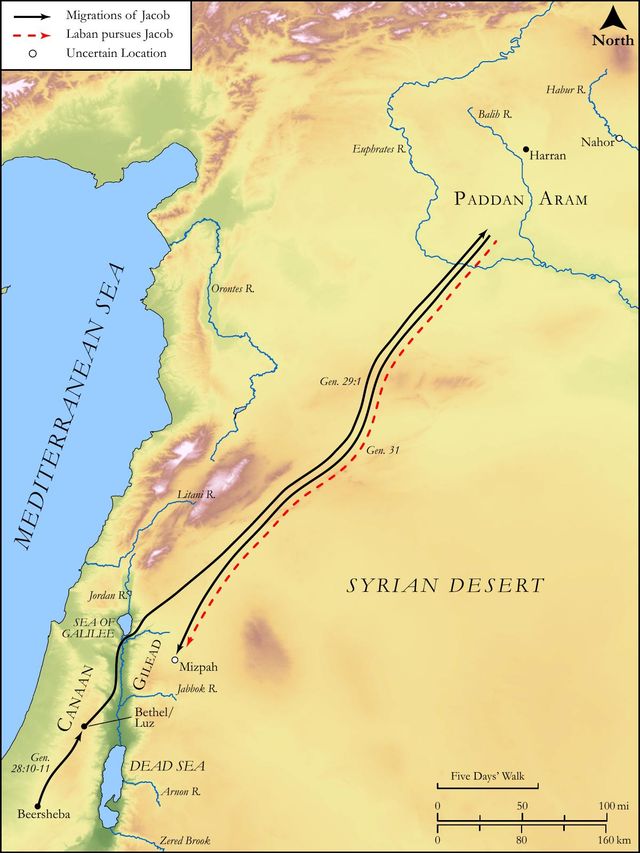
See on the biblical-era maps


Study this verse
Public-domain commentary
Matthew Henry
From his Commentary on the Whole Bible. Henry comments on passages, not single verses — this entry covers Genesis 31:1–16. His four-level outline is real structure in the source text, so it is rendered as structure.
Jacob is here taking up a resolution immediately to quit his uncle's service, to take what he had and go back to Canaan. This resolution he took up upon a just provocation, by divine direction, and with the advice and consent of his wives.
I.Upon a just provocation; for Laban and his sons had become very cross and ill-natured towards him, so that he could not stay among them with safety or satisfaction.
1.Laban's sons showed their ill-will in what they said, Gen 31:1. It should seem they said it in Jacob's hearing, with a design to vex him. The last chapter began with Rachel's envying Leah; this begins with Laban's sons envying Jacob. Observe,
(1.)How greatly they magnify Jacob's prosperity: He has gotten all this glory. And what was this glory that they made so much ado about? It was a parcel of brown sheep and speckled goats (and perhaps the fine colours made them seem more glorious), and some camels and asses, and such like trading; and this was all this glory. Note, Riches are glorious things in the eyes of carnal people, while to all those that are conversant with heavenly things they have no glory in comparison with the glory which excelleth. Men's over-valuing worldly wealth is that fundamental error which is the root of covetousness, envy, and all evil.
(2.)How basely they reflect upon Jacob's fidelity, as if what he had he had not gotten honestly: Jacob has taken away all that was our father's. Not all, surely. What had become of those cattle which were committed to the custody of Laban's sons, and sent three days' journey off? Gen 30:35, Gen 30:36. They mean all that was committed to him; but, speaking invidiously, they express themselves thus generally. Note,
[1.]Those that are ever so careful to keep a good conscience cannot always be sure of a good name.
[2.]This is one of the vanities and vexations which attend outward prosperity, that it makes a man to be envied of his neighbors (Ecc 4:4), and who can stand before envy? Pro 27:4. Whom Heaven blesses hell curses, and all its children on earth.
2.Laban himself said little, but his countenance was not towards Jacob as it used to be; and Jacob could not but take notice of it, Gen 31:2, Gen 31:5. He was but a churl at the best, but now he was more churlish than formerly. Note, Envy is a sin that often appears in the countenance; hence we read of an evil eye, Pro 23:6. Sour looks may do a great deal towards the ruin of peace and love in a family, and the making of those uneasy of whose comfort we ought to be tender. Laban's angry countenance lost him the greatest blessing his family ever had, and justly.
II.By divine direction and under the convoy of a promise:
The Lord said unto Jacob, Return, and I will be with thee, Gen 31:3. Though Jacob had met with very hard usage here, yet he would not quit his place till God bade him. He came thither by orders from Heaven, and there he would stay till he was ordered back. Note, It is our duty to set ourselves, and it will be our comfort to see ourselves, under God's guidance, both in our going out and in our coming in. The direction he had from Heaven is more fully related in the account he gives of it to his wives (Gen 31:10-13), where he tells them of a dream he had about the cattle, and the wonderful increase of those of his colour; and how the angel of God, in that dream (for I suppose the dream spoken of Gen 31:10 and that Gen 31:11 to be the same), took notice of the workings of his fancy in his sleep, and instructed him, so that it was not by chance, or by his own policy, that he obtained that great advantage; but, 1. by the providence of God, who had taken notice of the hardships Laban had put upon him, and took this way to recompense him: "For I have seen all the Laban doeth unto thee, and herein I have an eye to that." Note, There is more of equity in the distributions of the divine providence than we are aware of, and by them the injured are recompensed really, though perhaps insensibly. Nor was it only by the justice of providence that Jacob was thus enriched, but, 2. In performance of the promise intimated in what is said Gen 31:13, I am the God of Beth-el, This was the place where the covenant was renewed with him. Note, Worldly prosperity and success are doubly sweet and comfortable when we see them flowing, not from common providence, but from covenant-love, to perform the mercy promised - when we have them from God as the God of Beth-el, from those promises of the life which now is that belong to godliness. Jacob, even when he had this hopeful prospect of growing rich with Laban, must think of returning. When the world begins to smile upon us we must remember it is not our home. Now arise (Gen 31:13) and return, (1.) To thy devotions in Canaan, the solemnities of which had perhaps been much intermitted while he was with Laban. The times of this servitude God had winked at; but now, "Return to the place where thou anointedst the pillar and vowedst the vow. Now that thou beginnest to grow rich it is time to think of an altar and sacrifices again." (2.) To thy comforts in Canaan: Return to the land of thy kindred. He was here among his near kindred; but those only he must look upon as his kindred in the best sense, the kindred he must live and die with, to whom pertained the covenant. Note, The heirs of Canaan must never reckon themselves at home till they come thither, however they may seem to take root here.
III.With the knowledge and consent of his wives. Observe,
1.He sent for Rachel and Leah to him to the field (Gen 31:4), that he might confer with them more privately, or because one would not come to the other's apartment and he would willingly talk with them together, or because he had work to do in the field which he would not leave. Note, Husbands that love their wives will communicate their purposes and intentions to them. Where there is a mutual affection there will be a mutual confidence. And the prudence of the wife should engage the heart of her husband to trust in her, Pro 31:11. Jacob told his wives,
(1.)How faithfully he had served their father, Gen 31:6. Note, If others do not do their duty to us, yet we shall have the comfort of having done ours to them.
(2.)How unfaithfully their father had dealt with him Gen 31:7. He would never keep to any bargain that he made with him, but, after the first year, still as he saw Providence favour Jacob with the colour agreed on, every half year of the remaining five he changed it for some other colour, which made it ten times; as if he thought not only to deceive Jacob, but the divine Providence, which manifestly smiled upon him. Note, Those that deal honestly are not always honestly dealt with.
(3.)How God had owned him notwithstanding. He had protected him from Laban's ill-will: God suffered him not to hurt me. Note, Those that keep close to God shall be kept safely by him. He had also provided plentifully for him, notwithstanding Laban's design to ruin him: God has taken away the cattle of your father, and given them to me, Gen 31:9. Thus the righteous God paid Jacob for his hard service out of Laban's estate; as afterwards he paid the seed of Jacob for their serving the Egyptians, with their spoils. Note, God is not unrighteous to forget his people's work and labour of love, though men be so, Heb 6:10. Providence has ways of making those honest in the event that are not so in their design. Note, further, The wealth of the sinner is laid up for the just, Pro 13:22.
(4.)He told them of the command God had given him, in a dream, to return to his own country (Gen 31:13), that they might not suspect his resolution to arise from inconstancy, or any disaffection to their country or family, but might see it to proceed from a principle of obedience to his God, and dependence on him.
2.His wives cheerfully consented to his resolution. They also brought forward their grievances, complaining that their father had been not only unkind, but unjust, to them (Gen 31:14-16), that he looked upon them as strangers, and was without natural affection towards them; and, whereas Jacob had looked upon the wealth which God had transferred from Laban to him as his wages, they looked upon it as their portions; so that, both ways, God forced Laban to pay his debts, both to his servant and to his daughters. So then it seemed,
(1.)They were weary of their own people and their father's house, and could easily forget them. Note, This good use we should make of the unkind usage we meet with from the world, we should sit the more loose to it, and be willing to leave it and desirous to be at home.
(2.)They were willing to go along with their husband, and put themselves with him under the divine direction: Whatsoever God hath said unto thee do. Note, Those wives that ar their husband's meet helps will never be their hindrances in doing that to which God calls them.
Historical interpretation
Historical reception
1 surviving comment on this verse from the historical church.
(Chapter XXXI, verses 7 and 8) And your father deceived me and changed my wages ten times, and God did not allow him to harm me. If he said, 'Your wages will be the spotted flock,' then every flock was born spotted. And if he said, 'Your wages will be the solid-colored flock,' then every flock was born solid-colored. Because of this, he changed my wages ten times. The Seventy Interpreters have stated, driven by some unknown opinion, that 'moni' in the Hebrew language means 'number' rather than 'lambs.' Finally, the meaning is further confirmed by the fact that Laban always changed the condition of each offspring. If he saw mixed livestock being born, he would say after the birth, 'I want mixed offspring in the future.' Again, when he saw single-colored animals being born (because Jacob had heard this, he did not place rods in the canals), he would say that the future offspring should be of a single color for him. And what more? Laban changed the condition of his flock or Jacob up to ten times. And whatever color he had intended to be born as, it turned into the opposite color. And so that no one may think that in ten years twenty births are incredible, read Virgil (Georg. II), in which it is said:
The pregnant cattle twice. However, it is said that the nature of Italian and Mesopotamian sheep is the same.
Continue studying Genesis 31:8 across the web’s major study libraries — every link below opens this exact verse, chapter, or book on the destination site.
Read & Compare
 BibleGatewayThis verse in more than 200 translations and 70 languages.
 Bible.comThe YouVersion reader — hundreds of translations, reading plans, and highlights.
 ESV.orgCrossway's official English Standard Version reader.
 NET BibleThe NET translation with 60,000+ translators' notes on every rendering decision.
 STEP BibleTyndale House's free study tool — original text, vocabulary, and scholarly resources.
 BibliaLogos Bible Software's free web reader.
 USCCBThe New American Bible (Revised Edition) with the U.S. bishops' study notes.
Commentaries
 BibleHub CommentariesDozens of classic commentaries on this verse, gathered on one page.
 StudyLightMore than 100 commentary sets — the largest collection on the web.
 BibleRefPlain-English commentary on what this verse means, verse by verse.
 Enduring WordDavid Guzik's free commentary on this chapter, widely used by Bible teachers.
 Bible Study ToolsVerse commentary alongside Greek and Hebrew study aids.
Original Language & Research
- BibleHub InterlinearThe verse word by word — original language, transliteration, and English.
- BibleHub LexiconEvery word's original-language definition and Strong's entry.
 Blue Letter BibleDeep-study tools — Strong's numbers, concordance, and word studies.
 SefariaThe Hebrew text with Rashi and centuries of Jewish commentary.
Sermons, Hymns & Audio


TrulyRandomVerse is not affiliated with these sites and doesn’t control their content. They’re linked because they’re genuinely useful.
Summary
Genesis 31:8 vividly portrays God's direct and miraculous intervention on Jacob's behalf, ensuring his prosperity and vindication despite Laban's repeated attempts to defraud him. Each time Laban changed Jacob's wages by specifying certain animal patterns—whether "speckled" or "ringstraked"—God supernaturally caused the flocks to bear offspring precisely matching those patterns, thereby guaranteeing Jacob's rightful compensation and demonstrating divine faithfulness and justice in the face of human deceit.
Context
ShowHideLiterary Context
This verse is embedded within Jacob's detailed explanation to his wives, Leah and Rachel, for his decision to depart from Laban's household after two decades of service. The immediate preceding verses, Genesis 31:5-7, establish Jacob's growing disillusionment with Laban's shifting character and God's consistent favor towards Jacob. Specifically, Genesis 31:7 reveals Laban's ten-fold alteration of Jacob's wages, setting the stage for the miraculous divine intervention described in Genesis 31:8. This verse serves as a crucial piece of evidence for Jacob's claim that God, not his own cunning, was the source of his wealth, justifying his departure and reinforcing the narrative of God's covenant faithfulness to His chosen servant.
Historical & Cultural Context
Among the shepherd households of the patriarchs, livestock constituted the primary form of wealth and livelihood. Labor contracts, often familial, were common, but exploitation was also a pervasive risk. Laban's repeated manipulation of Jacob's wages reflects a common practice of the powerful exploiting the vulnerable, especially those without strong kinship ties in the immediate locale. The specific patterns of "speckled" and "ringstraked" animals were likely less common than solid-colored ones, making them a way for Laban to limit Jacob's potential gain. The narrative presupposes a patriarchal society where the head of the household (Laban) held significant power over his dependents (Jacob), making divine intervention all the more striking as it bypasses human systems of justice.
Key Themes
ShowHideGenesis 31:8 contributes significantly to several overarching themes within the book of Genesis and the broader biblical narrative. It powerfully illustrates Divine Providence, showcasing God's active and detailed involvement in the lives of His covenant people, even in the mundane details of animal husbandry. It highlights God's Faithfulness and Justice, demonstrating His commitment to upholding His promises to Jacob (e.g., Genesis 28:15) and ensuring justice for the oppressed, even when human systems fail. Furthermore, the verse underscores God's Sovereignty over Creation, as He supernaturally manipulates natural biological processes to achieve His divine will, turning Laban's schemes into opportunities for Jacob's blessing. This divine oversight is a recurring motif, emphasizing that Jacob's prosperity was ultimately a gift from God, not merely the result of human effort or trickery, echoing themes found throughout the patriarchal narratives.
Exposition and Analysis
ShowHideGenesis 31:8 presents a clear and emphatic account of God's direct intervention in the natural order to secure Jacob's rightful compensation. The verse states, "If he said thus, The speckled shall be thy wages; then all the cattle bare speckled: and if he said thus, The ringstraked shall be thy hire; then bare all the cattle ringstraked." This highlights a supernatural manipulation of animal genetics, ensuring Jacob's flocks produced exactly what Laban had designated as his payment, regardless of Laban's intent to defraud.
Key Word Analysis
ShowHideThis primitive root is used with great latitude, encompassing speaking, commanding, declaring, and determining. In this context, it refers to Laban's verbal declaration of the terms of Jacob's wages. The repetition of "If he said thus" emphasizes Laban's agency in setting the conditions, which God then sovereignly overrides.
Derived from an unused root meaning "to mark (by puncturing or branding)," this term refers to animals with distinct spots. Laban's choice of "speckled" or "ringstraked" (see below) was likely an attempt to limit Jacob's gain, as these patterns were less common among the general flock. God's intervention ensured that the rare became abundant for Jacob.
This primitive root means "to bear young" or "to bring forth." The verb's use here, particularly with the emphatic "all the cattle bare," signifies a miraculous and widespread biological event. It underscores that the offspring were born with the specified patterns, directly attributing the outcome to a divine act rather than natural breeding patterns or Jacob's later, more conventional, breeding techniques mentioned in Genesis 30:37-43.
Verse Breakdown
ShowHide"If he said thus, The speckled shall be thy wages;"
This clause sets the initial condition established by Laban. It highlights Laban's attempt to control and limit Jacob's earnings by specifying that only the "speckled" animals would constitute his payment, implying a scarcity of such animals in the flock.
"then all the cattle bare speckled:"
This is the miraculous divine response to Laban's stipulation. Despite the natural rarity of speckled animals, God supernaturally intervened in the breeding process, causing a universal outcome where "all the cattle" (or a significant, overwhelming majority) produced speckled offspring. This directly thwarted Laban's attempt at exploitation.
"and if he said thus, The ringstraked shall be thy hire;"
This clause presents the alternative condition, demonstrating Laban's repeated and varied attempts to defraud Jacob. "Ringstraked" refers to animals with bands or stripes, another specific and likely uncommon pattern. Laban's changing of the terms ("wages" vs. "hire" are synonymous here) underscores his persistent deceit.
"then bare all the cattle ringstraked."
Mirroring the previous outcome, this clause again emphasizes God's consistent and powerful intervention. Regardless of which pattern Laban chose, God ensured that the flocks miraculously produced offspring matching that specific pattern, thus guaranteeing Jacob's prosperity and exposing Laban's schemes as futile against divine will.
Literary Devices
ShowHideThe verse employs several significant literary devices. Repetition is prominent with the phrase "If he said thus... then all the cattle bare..." which occurs twice, emphasizing Laban's repeated attempts to defraud and God's consistent, matching response. This structural parallelism highlights the divine counter-action to every one of Laban's schemes. The narrative also utilizes Divine Intervention as a key plot device, where the supernatural act of God directly alters the natural course of events (animal breeding) to achieve His purposes. This underscores God's active role in the human drama. Furthermore, there is a clear Contrast between Laban's deceitful intentions and God's righteous and faithful provision, which turns Laban's attempts to diminish Jacob's wealth into the very means of his increase.
Theological and Thematic Connections
ShowHideGenesis 31:8 stands as a powerful testament to God's active and sovereign involvement in the lives of His people, particularly in situations of injustice and exploitation. It illustrates that God is not a distant observer but an intimate participant who ensures His covenant promises are fulfilled and His people are vindicated. This divine intervention in the natural order of animal breeding underscores God's absolute control over creation to accomplish His purposes, transforming Laban's manipulative schemes into instruments of Jacob's blessing. It reveals God's character as a righteous judge who defends the oppressed and upholds justice, even when human systems fail.
Reflection and Application
ShowHideThis verse offers profound encouragement that God is intimately aware of and actively involved in our personal and professional circumstances, even when we face unfair treatment, exploitation, or deceit. It reminds us to trust in God's provision and timing, knowing that He will ultimately bring about justice for His people, just as He did for Jacob. This passage encourages perseverance and faithfulness in our work, even under difficult or unjust circumstances, because our ultimate reward and true provision come from God, not solely from human employers or systems. God will honor our labor and make things right, as He did for Jacob, a principle echoed in Colossians 3:23, which encourages us to work heartily, as unto the Lord, knowing that from the Lord you will receive the inheritance as your reward.
Questions for Reflection
ShowHideFAQ
ShowHideHow did God supernaturally intervene in the breeding of the livestock?
ShowHideThe text describes a direct, miraculous intervention where the animals consistently bore offspring matching the specific patterns Laban designated as Jacob's wages. This was not due to Jacob's natural breeding techniques, which are mentioned elsewhere in Genesis 30:37-43, but God's sovereign control over creation, ensuring Jacob's rightful compensation despite Laban's deceit. The miracle lay in the consistent and overwhelming production of the desired patterns, regardless of the natural genetic odds.
Does this verse imply God will always make us prosperous in the face of injustice?
ShowHideWhile God often blesses His faithful, this verse primarily highlights His commitment to justice and His covenant promises. It assures us of God's active involvement and care, even in unfair situations, rather than guaranteeing a specific outcome of material prosperity in every instance. Our ultimate trust is in His character and provision, which may manifest in various ways, including spiritual strength, vindication, or eventual deliverance, not solely in the immediate removal of all difficulties or a specific material gain.
What is the significance of Laban changing Jacob's wages multiple times?
ShowHideLaban's repeated changing of Jacob's wages, explicitly mentioned in Genesis 31:7, underscores his deeply deceitful and exploitative character. It highlights the extent of Jacob's endurance under injustice and, more importantly, the depth of God's faithfulness. God intervened precisely because of Laban's persistent attempts to defraud Jacob, turning Laban's schemes into opportunities for Jacob's blessing and demonstrating that no human trickery can thwart God's divine plan for His people.
Christ-Centered Fulfillment
ShowHideGenesis 31:8, with its portrayal of God's faithful provision and justice for Jacob against Laban's deceit, points forward to the ultimate provision and vindication found in Jesus Christ. Just as God ensured Jacob received his due wages by miraculously altering the natural order, Christ, as the faithful Son, secures for His people an eternal inheritance and spiritual blessings that are beyond human manipulation or earthly injustice. He is the ultimate advocate who delivers His people from the oppression of sin and secures their true "wages"—not based on their merit or cleverness, but on His perfect atoning work and God's sovereign grace. In Christ, God's justice is fully satisfied through His sacrifice on the cross, and His covenant promises find their ultimate "yes and amen" in Him, as declared in 2 Corinthians 1:20. Through faith in Jesus, believers are granted a spiritual prosperity and an unshakable standing before God, a far greater reality than any earthly flock, as they are made heirs with Christ and assured of their place in His eternal kingdom, as promised in Ephesians 1:11.