


Genesis 31:20
Bible text: King James Version (1769 Blayney text) · Public domain
Bible text: Berean Standard Bible · Public domain
Bible text: American Standard Version (1901) · Public domain
Bible text: World English Bible, Messianic edition · Public domain
Bible text: Geneva Bible (1599) · Public domain
Bible text: Young's Literal Translation · Public domain
- וַיִּגְנֹבvai·yig·Noand he stoleH1589Conj-w ¦ V-Qal-ConsecImperf-3msVerb Qal Consecutive Imperfect 3rd Singular Masculineוַandיִּגְנֹבhe stole
- יַעֲקֹבya·'a·KoJacobH3290N-proper-mNoun Proper Masculine
- אֶת'et<obj.>H853DirObjMParticle Object Indicator
- לֵבlev[the] heart ofH3820N-mscNoun Singular Masculine Construct
- לָבָןla·VanLabanH3837N-proper-mNoun Proper Masculine
- הָאֲרַמִּיha·'a·ra·Mithe ArameanH761Art ¦ N-msNoun Gentilic Singular Masculine AbsoluteהָtheאֲרַמִּיAramean
- עַל'alonH5921PrepPreposition
- בְּלִיbe·LinotH1097N-msNoun Singular Masculine Absolute
- הִגִּידhi·Gidhe toldH5046V-Hiphil-Perf-3msVerb Hiphil Perfect 3rd Singular Masculine
- לוֹloto <the> himPrep-l ¦ 3msSuffix Personal 3rd Singular Masculineלto <the>וֹhim
- כִּיkithatH3588PrtParticle Conditional
- בֹרֵחַvo·Re·ach[was] fleeingH1272V-Qal-Prtcpl-msVerb Qal Participle Singular Masculine Absolute
- הוּאHu'heH1931Pro-3msPronoun Personal 3rd Singular Masculine
English is a literal word-by-word gloss of the Hebrew, not the KJV's wording. Why?
This is the original text the KJV's translators worked from — each Hebrew word with its own literal English meaning in this verse, prepared by scholars at Tyndale House, Cambridge. The KJV translates whole sentences, not word by word, so its wording differs: one Hebrew word can become several English words, and the KJV may choose “the LORD” where the gloss reads “Yahweh”. Both are faithful — they answer different questions. For the KJV's own rendering, switch to the KJV text.
Details
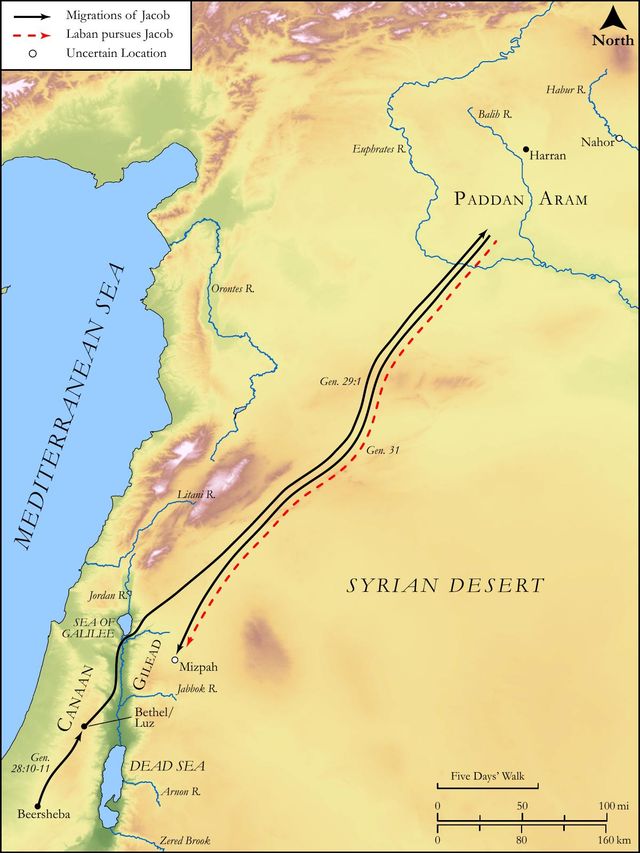
See on the biblical-era maps


Study this verse
Public-domain commentary
Matthew Henry
From his Commentary on the Whole Bible. Henry comments on passages, not single verses — this entry covers Genesis 31:17–24. His two-level outline is real structure in the source text, so it is rendered as structure.
Here is, I. Jacob's flight from Laban. We may suppose he had been long considering of it, and casting about in his mind respecting it; but when now, at last, God had given him positive orders to go, he made no delay, nor was he disobedient to the heavenly vision. The first opportunity that offered itself he laid hold of, when Laban was shearing his sheep (Gen 31:19), that part of his flock which was in the hands of his sons three days' journey off. Now, 1. It is certain that it was lawful for Jacob to leave his service suddenly, without giving a quarter's warning. It was not only justified by the particular instructions God gave him, but warranted by the fundamental law of self-preservation, which directs us, when we are in danger, to shift for our own safety, as far as we can do it without wronging our consciences. 2. It was his prudence to steal away unawares to Laban, lest, if Laban had known, he should have hindered him or plundered him. 3. It was honestly done to take no more than his own with him, the cattle of his getting, Gen 31:18. He took what Providence gave him, and was content with that, and would not take the repair of his damages into his own hands. Yet Rachel was not so honest as her husband; she stole her father's images (Gen 31:19) and carried them away with her. The Hebrew calls them teraphiam. Some think they were only little representations of the ancestors of the family, in statues or pictures, which Rachel had a particular fondness for, and was desirous to have with her, now that she was going into another country. It should rather seem that they were images for a religious use, penates, household-gods, either worshipped or consulted as oracles; and we are willing to hope (with bishop Patrick) that she took them away not out of covetousness of the rich metal they were made of, much less for her own use, or out of any superstitious fear lest Laban, by consulting his teraphim, might know which way they had gone (Jacob, no doubt, dwelt with his wives as a man of knowledge, and they were better taught than so), but out of a design hereby to convince her father of the folly of his regard to those as gods which could not secure themselves, Isa 46:1, Isa 46:2.
II.Laban's pursuit of Jacob.
Tidings were brought him, on the third day, that Jacob had fled; he immediately raises the whole clan, takes his brethren, that is, the relations of his family, that were all in his interests, and pursues Jacob (as Pharaoh and his Egyptians afterwards pursued the seed of Jacob), to bring him back into bondage again, or with design to strip him of what he had. Seven days' journey he marched in pursuit of him, Gen 31:23. He would not have taken half the pains to have visited his best friends. But the truth is bad men will do more to serve their sinful passions than good men will to serve their just affections, and are more vehement in their anger than in their love. Well, at length Laban, overtook him, and the very night before he came up with him God interposed in the quarrel, rebuked Laban and sheltered Jacob, charging Laban not to speak unto him either good or bad (Gen 31:24), that is, to say nothing against his going on with his journey, for that it proceeded from the Lord. The same Hebraism we have, Gen 24:50. Laban, during his seven day's march, had been full of rage against Jacob, and was now full of hopes that his lust should be satisfied upon him (Exo 15:9); but God comes to him, and with one word ties his hands, though he does not turn his heart. Note,
1.In a dream, and in slumberings upon the bed, God has ways of opening the ears of men, and sealing their instruction, Job 33:15, Job 33:16. Thus he admonishes men by their consciences, in secret whispers, which the man of wisdom will hear and heed.
2.The safety of good men is very much owing to the hold God has of the consciences of bad men and the access he has to them.
3.God sometimes appears wonderfully for the deliverance of his people when they are upon the very brink of ruin. The Jews were saved from Haman's plot when the king's decree drew hear to be put in execution, Est 9:1.
Continue studying Genesis 31:20 across the web’s major study libraries — every link below opens this exact verse, chapter, or book on the destination site.
Read & Compare
 BibleGatewayThis verse in more than 200 translations and 70 languages.
 Bible.comThe YouVersion reader — hundreds of translations, reading plans, and highlights.
 ESV.orgCrossway's official English Standard Version reader.
 NET BibleThe NET translation with 60,000+ translators' notes on every rendering decision.
 STEP BibleTyndale House's free study tool — original text, vocabulary, and scholarly resources.
 BibliaLogos Bible Software's free web reader.
 USCCBThe New American Bible (Revised Edition) with the U.S. bishops' study notes.
Commentaries
 BibleHub CommentariesDozens of classic commentaries on this verse, gathered on one page.
 StudyLightMore than 100 commentary sets — the largest collection on the web.
 BibleRefPlain-English commentary on what this verse means, verse by verse.
 Enduring WordDavid Guzik's free commentary on this chapter, widely used by Bible teachers.
 Bible Study ToolsVerse commentary alongside Greek and Hebrew study aids.
Original Language & Research
- BibleHub InterlinearThe verse word by word — original language, transliteration, and English.
- BibleHub LexiconEvery word's original-language definition and Strong's entry.
 Blue Letter BibleDeep-study tools — Strong's numbers, concordance, and word studies.
 SefariaThe Hebrew text with Rashi and centuries of Jewish commentary.
Sermons, Hymns & Audio


TrulyRandomVerse is not affiliated with these sites and doesn’t control their content. They’re linked because they’re genuinely useful.
Summary
Genesis 31:20 vividly portrays Jacob's clandestine departure from Laban, his uncle and father-in-law, marking a pivotal and secretive break from two decades of strained and often exploitative service in Haran. This deliberate act of stealth, driven by deep-seated distrust and Laban's manipulative character, enabled Jacob to initiate his long-awaited journey back to the Promised Land, revealing both his characteristic cunning and the overarching guidance of God amidst complex human dynamics.
Context
ShowHideLiterary Context
Genesis 31:20 is situated at a crucial turning point in Jacob's life, following twenty years of service to Laban, during which Jacob's family and wealth grew significantly. The immediate preceding verses detail God's direct command to Jacob to "return to the land of your fathers and to your kindred" (Genesis 31:3), a divine imperative that validates Jacob's desire to leave. Jacob then consults with Leah and Rachel, who express their profound disillusionment with their father Laban, asserting that he had "sold" them and "devoured" their wealth (Genesis 31:14-16). This collective agreement and divine mandate set the stage for Jacob's departure. Knowing Laban's avarice and manipulative tendencies, Jacob's decision to leave secretly, as described in verse 20, is a pragmatic response to anticipate and circumvent Laban's inevitable attempts to hinder his departure or reclaim his accumulated possessions and family.
Historical & Cultural Context
In the patriarchal society of Padanaram, family ties, especially between a father-in-law and son-in-law, were often governed by specific customs concerning dowries, inheritance, and labor agreements. Laban's repeated alteration of Jacob's wages ten times (Genesis 31:7 and Genesis 31:41) was a severe breach of customary law and trust, highlighting his exploitative nature. The designation "Laban the Syrian" (or Aramaean, from the Hebrew ha'Arami) is significant, emphasizing his distinct cultural and geographical identity from Jacob, who was a Hebrew returning to Canaan. This distinction underscores the foreignness of Laban's culture and the inherent tension between Jacob, the heir of the Abrahamic covenant, and his manipulative Aramaean relative. Jacob's secret flight was a desperate measure to escape a legally and socially entangled situation where open negotiation was likely to fail.
Key Themes
ShowHideGenesis 31:20 contributes to several overarching themes within the book of Genesis and the broader biblical narrative. Firstly, it highlights the theme of Divine Guidance and Providence, as God actively directs Jacob's return to the Promised Land, despite Jacob's flawed methods. Secondly, it underscores the persistent theme of Human Cunning and Deception, a trait often associated with Jacob himself (e.g., Genesis 27). Here, Jacob employs his shrewdness to escape Laban's control, mirroring the very deception Laban had practiced against him. Thirdly, the verse marks a crucial step in the Fulfillment of the Abrahamic Covenant, as Jacob's return to Canaan is essential for the continuation of the promised lineage and the eventual formation of the nation of Israel. Finally, it exemplifies the theme of Conflict and Reconciliation within Family, though in this instance, it's a necessary separation before a tense reconciliation, ultimately showcasing God's ability to work through fractured relationships to achieve His purposes.
Exposition and Analysis
ShowHideGenesis 31:20 precisely states that "And Jacob stole away unawares to Laban the Syrian, in that he told him not that he fled." This verse details Jacob's deliberate and surreptitious departure, emphasizing the stealth and secrecy of his actions. The Hebrew verb used, ganav (גָּנַב), literally means "to steal," but in this context, it conveys the act of slipping away secretly or clandestinely, underscoring that Jacob did not merely leave but actively concealed his movements from Laban. The designation "Laban the Syrian" (or Aramaean) serves to highlight the cultural and geographical distinction between him and Jacob, who was returning to Canaan, emphasizing the foreignness and potential threat Laban represented.
Key Word Analysis
ShowHideA primitive root meaning "to thieve (literally or figuratively); by implication, to deceive." In this context, it signifies Jacob's act of secretly removing himself and his family, effectively deceiving Laban by his unannounced departure. It emphasizes the clandestine nature of his actions, not necessarily a physical theft, but a stealthy evasion.
The KJV translates "unawares" from a combination of H3820 (lêb, "heart" or "mind") and H1097 (bᵉlîy, "without" or "not"). Literally, it means "without his heart" or "without his knowledge/mind," indicating that Laban was completely ignorant of Jacob's intentions and actions. This highlights the complete surprise and lack of consent on Laban's part, underscoring the depth of Jacob's secrecy.
A primitive root meaning "to bolt, i.e., figuratively, to flee suddenly." This word emphasizes the urgency and swiftness of Jacob's departure. It was not a leisurely journey but a rapid escape, driven by the need to gain a significant head start before Laban could discover his absence and pursue him.
Verse Breakdown
ShowHide"And Jacob stole away unawares to Laban the Syrian"
This clause establishes the central action of the verse: Jacob's secretive departure. The phrase "stole away unawares" highlights the deliberate deceit and stealth employed by Jacob, ensuring Laban had no knowledge or expectation of his flight. The identification of Laban as "the Syrian" serves to underscore his foreignness and perhaps to subtly justify Jacob's actions by emphasizing the cultural and ethical divide between them, given Laban's previous exploitation.
"in that he told him not that he fled"
This explanatory clause clarifies how Jacob stole away unawares—by deliberately withholding information. It explicitly states the omission that constituted the deception. Jacob's failure to inform Laban of his intention to flee was the direct cause of Laban's ignorance, emphasizing Jacob's active role in orchestrating this secret departure. This was a calculated move to prevent Laban from interfering with his plans or reclaiming what Jacob believed was rightfully his.
Literary Devices
ShowHideThe verse employs several literary devices. Characterization is prominent, revealing Jacob's enduring reliance on cunning and strategic deception, a trait evident since his procurement of Esau's birthright. This act, though divinely sanctioned in its ultimate goal, showcases Jacob's human tendency to achieve righteous ends through questionable means. There is also an element of Irony, as Jacob, who was himself deceived by Laban regarding Rachel and Leah, now employs deception against Laban. This reflects the cyclical nature of their strained relationship. Furthermore, the phrase "stole away unawares" uses Euphemism or Understatement for a full-scale, unannounced migration of an entire household and vast flocks, emphasizing the stealth over the magnitude. The specific naming of "Laban the Syrian" serves as a Foil, contrasting Laban's foreign, manipulative character with Jacob's destiny as the patriarch of Israel, highlighting the necessary separation for the covenant people.
Theological and Thematic Connections
ShowHideGenesis 31:20 profoundly illustrates the tension between divine sovereignty and human agency. While God had explicitly commanded Jacob to return to his homeland, Jacob chose a deceptive and secretive method to achieve this divinely ordained goal. This highlights that God often works through imperfect individuals and their flawed decisions, yet His ultimate purposes prevail. The verse also speaks to the nature of trust and betrayal within relationships, particularly family, demonstrating how self-interest and exploitation can erode fundamental bonds, necessitating drastic measures for liberation. It underscores God's faithfulness to His covenant promises, as He protects and prospers Jacob even amidst such ethically complex circumstances, guiding him back to the land promised to Abraham.
Reflection and Application
ShowHideGenesis 31:20 offers profound insights for believers navigating complex relationships and discerning God's will today. It reminds us that even biblical heroes, chosen by God for significant roles, were imperfect and sometimes employed questionable means to achieve their ends. While God can work through flawed individuals and difficult situations to advance His purposes, Jacob's method here is not presented as an ideal for integrity or transparency. The narrative highlights the complexities of navigating strained relationships, especially when one party is exploitative or manipulative; sometimes, a decisive break is necessary for spiritual, emotional, and personal freedom. However, the ideal pursuit of such separation should be marked by integrity and prayerful reliance on God for a clear and honorable path, rather than resorting to deception. Ultimately, this passage reassures us that God's plan for us can prevail even amidst human imperfections and challenging circumstances, guiding us toward our divine calling and purpose despite our own failings or the obstacles posed by others.
Questions for Reflection
ShowHideFAQ
ShowHideWas Jacob's deception in leaving Laban justified?
ShowHideWhile the text does not explicitly condemn Jacob's method, it portrays it as a strategic necessity given Laban's manipulative and exploitative nature. Jacob had received a clear divine command to return to his homeland (Genesis 31:3), and his wives agreed that Laban had treated them unjustly, effectively selling them and consuming their dowry (Genesis 31:14-16). Jacob's secret departure was a pragmatic response to a difficult and potentially dangerous situation, anticipating Laban's likely refusal or obstruction. From a moral standpoint, it reflects Jacob's ongoing struggle with relying on his own shrewdness rather than fully trusting God for a clear path, yet God still used his actions to fulfill His overarching plan.
What is the significance of calling Laban "the Syrian" (or Aramaean) in this verse?
ShowHideThe designation "Laban the Syrian" (Hebrew: ha'Arami) emphasizes his distinct ethnic and geographical identity, contrasting him with Jacob, who was returning to Canaan, the land of promise. It highlights Laban's foreignness and his position as an outsider to the covenant promises given to Abraham's lineage. This distinction underscores the cultural and spiritual separation that Jacob needed to make to fully embrace his destiny as the patriarch of Israel. It also subtly reinforces the idea of Jacob's liberation from a foreign, exploitative influence, marking the definitive end of his entanglement with the household of his mother's brother.
How does this verse illustrate God's use of imperfect people?
ShowHideGenesis 31:20 clearly shows Jacob, a pivotal figure in salvation history, employing deception to achieve his aims. Despite Jacob's flawed character and methods, God's plan to bring him back to the Promised Land and establish the nation of Israel continued to unfold. This illustrates that God's purposes are not contingent on human perfection. He sovereignly works through fallen individuals, using their strengths and even their weaknesses, to accomplish His will, demonstrating His grace and power to redeem and direct human actions towards His ultimate glory. This narrative reassures us that God can use anyone, regardless of their past or present imperfections, to accomplish His divine will.
Christ-Centered Fulfillment
ShowHideJacob's clandestine departure from Laban, a necessary break from servitude and exploitation to return to the promised land and fulfill God's covenant, profoundly prefigures the greater liberation and journey to the true inheritance accomplished by Jesus Christ. Just as Jacob was delivered from Laban's oppressive hand to pursue his divine destiny, Christ delivers humanity from the spiritual bondage of sin and death, leading His people into the promised rest and eternal inheritance of the New Covenant. While Jacob's method was flawed and born of human cunning, Christ's perfect obedience and sacrificial death provide the true, righteous means of escape from spiritual slavery, as declared in John 8:36, "So if the Son sets you free, you will be free indeed." Through His redemptive work, Christ "has delivered us from the domain of darkness and transferred us to the kingdom of his beloved Son" (Colossians 1:13), establishing a people who are truly free to follow God's call to their heavenly home. Jacob's journey was a shadow of the ultimate journey of faith that believers embark upon with Christ, finding their true rest and inheritance not in a geographical land, but in the presence of God through Him (Hebrews 4:9-10).