


Ezra 8:3
Bible text: King James Version (1769 Blayney text) · Public domain
Bible text: Berean Standard Bible · Public domain
Bible text: American Standard Version (1901) · Public domain
Bible text: World English Bible, Messianic edition · Public domain
Bible text: Geneva Bible (1599) · Public domain
Bible text: Young's Literal Translation · Public domain
- מִבְּנֵיmi·be·Neiof [the] descendants ofH1121Prep-m ¦ N-mpcNoun Plural Masculine Constructמִofבְּנֵי[the] descendants of
- שְׁכַנְיָהshe·khan·YahShecaniahH7935N-proper-mNoun Proper Masculine
- מִבְּנֵיmi·be·Neiof [the] descendants ofH1121Prep-m ¦ N-mpcNoun Plural Masculine Constructמִofבְּנֵי[the] descendants of
- פַרְעֹשׁfar·'OshParoshH6551N-proper-mNoun Proper Masculine
- זְכַרְיָהze·khar·YahZechariahH2148N-proper-mNoun Proper Masculine
- וְעִמּוֹve·'i·Moand with himH5973Conj-w ¦ Prep ¦ 3msPrepositionוְandעִמּwithוֹhim
- הִתְיַחֵשׂhit·ya·Chesa genealogical listH3187V-Hithpael-InfVerb Hithpael Infinitive Construct
- לִזְכָרִיםliz·kha·Rimof malesH2145Prep-l ¦ Adj-mpAdjective Plural Masculine Absoluteלִofזְכָרִיםmales
- מֵאָהme·'Ahone hundredH3967Adj-fsAdjective Numerical Singular Feminine Absolute
- וַחֲמִשִּׁיםva·cha·mi·Shimand fiftyH2572Conj-w ¦ Adj-mpAdjective Numerical Plural Masculine Absoluteוַandחֲמִשִּׁיםfifty
English is a literal word-by-word gloss of the Hebrew, not the KJV's wording. Why?
This is the original text the KJV's translators worked from — each Hebrew word with its own literal English meaning in this verse, prepared by scholars at Tyndale House, Cambridge. The KJV translates whole sentences, not word by word, so its wording differs: one Hebrew word can become several English words, and the KJV may choose “the LORD” where the gloss reads “Yahweh”. Both are faithful — they answer different questions. For the KJV's own rendering, switch to the KJV text.
Details
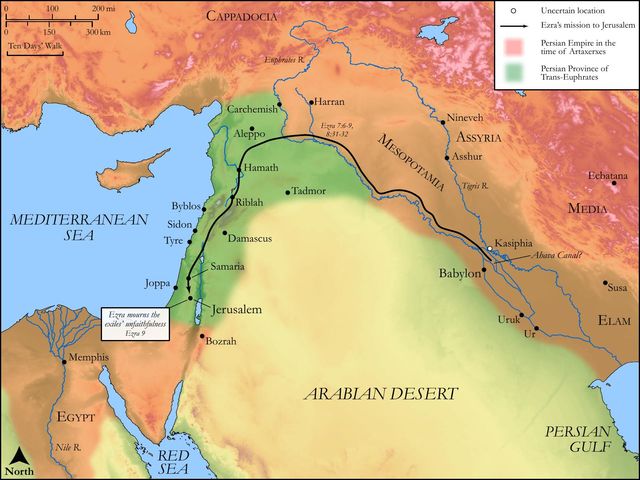
See on the biblical-era map
Study this verse
Public-domain commentary
Matthew Henry
From his Commentary on the Whole Bible. Henry comments on passages, not single verses — this entry covers Ezra 8:1–20. His two-level outline is real structure in the source text, so it is rendered as structure.
Ezra, having received his commission from the king, beats up for volunteers, as it were, sets up an ensign to assemble the outcasts of Israel and the dispersed of Judah, Isa 11:12. "Whoever of the sons of Sion, that swell with the daughters of Babylon, is disposed to go to Jerusalem, now that the temple there is finished and the temple-service set a-going, now is their time." Now one would think that under such a leader, with such encouragements, all the Jews should at length have shaken themselves from their dust, and loosed the bands of their neck, according to that call, Isa 52:1, Isa 52:2, etc. I wonder how any of them could read that chapter and yet stay behind. But multitudes did. They loved their ease better than their religion, thought themselves well off where they were, and either believed not that Jerusalem would better their condition or durst not go thither through any difficulties. But here we are told,
I.That some offered themselves willingly to go with Ezra.
The heads of the several families are here named, for their honour, and the numbers of the males that each brought in, amounting in all to 1496. Two priests are named (Ezr 8:2) and one of the sons of David; but, it should seem, they came without their families, probably intending to see how they liked Jerusalem and then either to send for their families or return to them as they saw cause. Several of their families, or clans, here named, we had before, ch. 2. Some went up from them at that time, more went up now, as God inclined their hearts; some were called into the vineyard at the third hour, others not till the eleventh, yet even those were not rejected. But here we read of the last sons of Adonikam (Ezr 8:13), which some understand to their dispraise, that they were the last that enlisted themselves under Ezra; I rather understand it to their honour, that now all the sons of that family returned and none staid behind.
II.That the Levites who went in this company were in a manner pressed into the service.
Ezra appointed a general rendezvous of all his company at a certain place upon new-year's day, the first day of the first month. Ezr 7:9. Then and there he took a view of them, and mustered them, and (which was strange) found there none of the sons of Levi, Ezr 8:15. Some priests there were, but no others that were Levites. Where was the spirit of that sacred tribe? Ezra, a priest, like Moses proclaims, Who is on the Lord's side? They, unlike to Levi, shrink, and desire to abide among the sheep-folds to hear the bleatings of the flock. Synagogues we suppose they had in Babylon, in which they prayed, and preached, and kept sabbaths (and, when they could not have better, they had reason to be thankful for them); but now that the temple at Jerusalem was opened, to the service of which they were ordained, they ought to have preferred the gates of Zion before all those synagogues. It is upon record here, to their reproach; but tell it not in Gath. Ezra, when he observed that he had no Levites in his retinue, was much at a loss. He had money enough for the service of the temple, but wanted men. The king and princes had more than done their part, but the sons of Levi had not half done theirs. Eleven men, chief men, and men of understanding, he chooses out of his company, to be employed for the filling up of this lamentable vacancy; and here we are informed,
1.Of their being sent. Ezra sent them to a proper place, where there as a college of Levites, the place Casiphia, probably a street or square in Babylon allowed for that purpose - Silver Street one may call it, for ceseph signifies silver. He sent them to a proper person, to Iddo, the chief president of the college, not to urge him to come himself (we will suppose him to be old and unfit for such a remove), but to send some of the juniors, ministers for the house of our God, Ezr 8:17. The furnishing of God's house with good ministers is a good work, which will redound to the comfort and credit of all that have a hand in it.
2.Of their success. They did not return without their errand, but, though the warning was short, they brought about forty Levites to attend Ezra, Sherebiah, noted as a very intelligent man, and eighteen with him (Ezr 8:18). Hashabiah, and Jeshaiah, and twenty with them, Ezr 8:19. By this it appears that they were not averse to go, but were slothful and inattentive, and only wanted to be called upon and excited to go. What a pity it is that good men should omit a good work, merely for want of being spoken to! What a pity that they should need it, but, if they do, what a pity that they should be left without it! Of the Nethinim, the servitors of the sacred college, the species infima - the lowest order of the temple ministers, more appeared forward to go than of the Levites themselves. Of them 220, upon this hasty summons, enlisted themselves, and had the honour to be expressed by name in Ezra's muster-roll, Ezr 8:20. "Thus," says Ezra, "were we furnished with Levites, by the good hand of our God upon us." If, where ministers have been wanting, the vacancies are well supplied, let God have the glory, and his good hand be acknowledged as qualifying them for the service, inclining them to it, and then opening a door of opportunity for them.
Continue studying Ezra 8:3 across the web’s major study libraries — every link below opens this exact verse, chapter, or book on the destination site.
Read & Compare
 BibleGatewayThis verse in more than 200 translations and 70 languages.
 Bible.comThe YouVersion reader — hundreds of translations, reading plans, and highlights.
 ESV.orgCrossway's official English Standard Version reader.
 NET BibleThe NET translation with 60,000+ translators' notes on every rendering decision.
 STEP BibleTyndale House's free study tool — original text, vocabulary, and scholarly resources.
 BibliaLogos Bible Software's free web reader.
 USCCBThe New American Bible (Revised Edition) with the U.S. bishops' study notes.
Commentaries
 BibleHub CommentariesDozens of classic commentaries on this verse, gathered on one page.
 StudyLightMore than 100 commentary sets — the largest collection on the web.
 BibleRefPlain-English commentary on what this verse means, verse by verse.
 Enduring WordDavid Guzik's free commentary on this chapter, widely used by Bible teachers.
 Bible Study ToolsVerse commentary alongside Greek and Hebrew study aids.
Original Language & Research
- BibleHub InterlinearThe verse word by word — original language, transliteration, and English.
- BibleHub LexiconEvery word's original-language definition and Strong's entry.
 Blue Letter BibleDeep-study tools — Strong's numbers, concordance, and word studies.
 SefariaThe Hebrew text with Rashi and centuries of Jewish commentary.
Sermons, Hymns & Audio


TrulyRandomVerse is not affiliated with these sites and doesn’t control their content. They’re linked because they’re genuinely useful.
Summary
Ezra 8:3 meticulously records a specific family unit, the "sons of Shechaniah, of the sons of Pharosh," led by Zechariah, who joined Ezra's return from Babylonian exile to Jerusalem. This verse, part of a comprehensive register in Ezra 8, underscores the precise and divinely ordered nature of this second major repatriation, emphasizing the critical importance of verifiable lineage and God's faithful preservation of a devout remnant. It stands as a testament to divine providence in gathering His people and establishing order for the monumental task of rebuilding the community and restoring proper worship in Jerusalem.
Context
ShowHideLiterary Context
Ezra 8:3 is embedded within a detailed roster of family heads and their accompanying numbers who journeyed with Ezra from Babylon to Jerusalem (Ezra 8:1-14). This chapter immediately follows King Artaxerxes' comprehensive commission to Ezra (Ezra 7), which delineates his authority and the substantial resources allocated for the return. The meticulous enumeration of individuals and families in Ezra 8 serves multiple critical functions: it unequivocally validates the legitimacy of the returnees, ensures precise accountability for the invaluable temple vessels entrusted to their care, and profoundly emphasizes the organized, divinely orchestrated nature of this pivotal movement. These lists transcend mere historical footnotes; they are profound theological declarations, demonstrating God's unwavering faithfulness in preserving and gathering His covenant people, even down to the specific family units.
Historical & Cultural Context
The return detailed in Ezra 8 took place approximately 458 BC, during the reign of Artaxerxes I of Persia, roughly 80 years after the initial return led by Zerubbabel and Joshua (c. 538 BC). For the Jewish people, who had endured generations of exile in Babylon, the preservation and verification of genealogical records were of paramount importance. Lineage was the foundational determinant for tribal affiliation, land inheritance, and, most critically, eligibility for priestly and Levitical service. Following the profound disruption caused by the exile, re-establishing and verifying ancestry was absolutely essential for reconstructing the social, religious, and political structures of the community in Judah. The Persian Empire, renowned for its administrative efficiency and meticulous record-keeping, would have further encouraged such detailed documentation, aligning perfectly with Ezra's own profound commitment to order and the strict adherence to the Law of God.
Key Themes
ShowHideThis verse, as an integral part of Ezra 8, contributes significantly to several overarching themes present within the book of Ezra and the broader post-exilic narrative. Firstly, it powerfully underscores the theme of Divine Preservation and Restoration, vividly demonstrating God's unwavering faithfulness in gathering a "remnant" of His people despite the devastating impact of exile, enabling them to return and fulfill His ancient covenant promises. Secondly, the explicit emphasis on individuals being "reckoned by genealogy" highlights the profound Importance of Purity, Order, and Accountability within the covenant community. This meticulousness was absolutely vital for re-establishing proper worship, ensuring the integrity and legitimacy of the priesthood, and maintaining the distinct identity of Israel. The detailed lists, akin to those meticulously recorded in Ezra 2 and Nehemiah 7, underscore the Jewish people's deep reverence for their heritage and tribal identity, which was crucial for maintaining tribal land allocations and priestly roles, especially after generations in exile, as seen with the strict requirements for priestly lineage in Ezra 2:62. Finally, it speaks powerfully to the Sovereignty of God in orchestrating historical events, even utilizing pagan kings like Artaxerxes to facilitate the return and restoration of His cherished people.
Exposition and Analysis
ShowHideKey Word Analysis
ShowHideThis phrase translates the Hebrew verb יָחַשׂ (H3187, yâchas'), which is a primitive root meaning "to sprout," but used here as a denominative from יַחַשׂ, meaning "to enroll by pedigree" or "to be reckoned by genealogies." It denotes a formal, official, and meticulously documented process of counting and verifying individuals based on their ancestral records. This was not a casual tally but an authoritative, meticulous enrollment, crucial for establishing legitimacy, particularly for those claiming roles within the restored community or priestly service. It profoundly underscores the importance of identity and belonging rooted in verifiable lineage.
The specification "of the males" (לַזְּכָרִים, la-z'kharim) translates the Hebrew word זָכָר (H2145, zâkâr'), meaning "a male (of man or animals, as being the most noteworthy sex)." This detail highlights the patriarchal structure of ancient Israelite society and the primary role of male heads of households in genealogical records and public rolls. While women and children were undoubtedly part of the returning families, the official census and public accounting focused on the men, who represented their households, bore legal and communal responsibilities, and were counted for military service. This detail emphasizes the formal and structured nature of the census.
Verse Breakdown
ShowHide"Of the sons of Shechaniah, of the sons of Pharosh; Zechariah:"
This clause precisely identifies Zechariah through a dual lineage. He is first identified as belonging to the "sons of Shechaniah," indicating a direct paternal line or a prominent family branch. The further specification "of the sons of Pharosh" clarifies that Shechaniah himself belonged to the larger, foundational family of Pharosh, which was one of the significant families who had returned from exile. This detailed identification underscores the meticulous nature of the genealogical record-keeping, ensuring that each individual's heritage was clearly documented and verifiable, establishing their place within the returned community.
"and with him were reckoned by genealogy of the males an hundred and fifty."
This part of the verse provides the numerical count associated with Zechariah's specific family group. The phrase "reckoned by genealogy" powerfully reinforces the idea of an official, verified, and authoritative census. The number "an hundred and fifty" refers specifically to the adult males, who would have been the heads of households, eligible for military service, and capable of contributing to the rebuilding efforts. This precise accounting was vital for logistical planning, assigning responsibilities, and ensuring the accountability of the returning exiles as they embarked on the challenging and divinely mandated task of rebuilding Jerusalem and re-establishing the nation.
Literary Devices
ShowHideThe primary literary device at play in Ezra 8:3 and the surrounding list is Enumeration or Cataloging. The detailed listing of names, family heads, and specific numbers is not merely historical reporting but a deliberate literary choice that serves several profound functions. It powerfully emphasizes the Precision and Order inherent in God's work of restoration, demonstrating that the return was not chaotic but meticulously planned and divinely executed. The Repetition of the phrase "of the sons of" throughout the chapter highlights the profound importance of Genealogy and lineage in establishing identity, legitimacy, and continuity for the post-exilic community. This detailed accounting also conveys a sense of Completeness and Divine Oversight, suggesting that every individual, no matter how seemingly small their contribution, was known, valued, and accounted for in God's grand redemptive plan.
Theological and Thematic Connections
ShowHideEzra 8:3, though a concise historical record, resonates with profound theological and thematic connections throughout the entirety of Scripture. It powerfully showcases God's unwavering faithfulness to His covenant promises, particularly His steadfast commitment to preserving a remnant of His people and bringing them back to the land He graciously promised. The meticulous recording of names and numbers reflects God's own infinite attention to detail and His intimate, personal knowledge of those who belong to Him. This divine care for individual identity within the larger community profoundly foreshadows the New Testament emphasis on every believer being intimately known by God and having an indispensable place in His spiritual household. The careful verification of lineage also speaks to the profound biblical theme of purity, holiness, and accountability, which are absolutely essential for a people called to represent a holy and righteous God.
Reflection and Application
ShowHideEzra 8:3, despite its seemingly dry enumeration of names and numbers, offers enduring and deeply relevant lessons for contemporary believers. Just as the ancient Israelites meticulously tracked their heritage to establish identity and belonging within their covenant community, we are called to understand and embrace our spiritual lineage as an integral part of God's eternal family, adopted through the redemptive work of Christ. This verse profoundly reminds us that every individual, no matter how seemingly insignificant in the grand scheme, is counted, valued, and known in God's magnificent plan of redemption. It powerfully highlights the importance of order, accountability, and intentionality in our personal spiritual lives and our communal ministries. God consistently works through organized and purposeful efforts, and our participation, whether in diligent personal spiritual growth or dedicated collective ministry, is an essential part of a larger, divinely orchestrated movement. We are therefore called to live with profound purpose, recognizing our irreplaceable place within the body of Christ, diligently contributing to the ongoing work of building His kingdom with unwavering diligence, integrity, and spiritual precision.
Questions for Reflection
ShowHideFAQ
ShowHideWhy were genealogies so important in post-exilic Israel?
ShowHideGenealogies were critically important in post-exilic Israel for several interconnected and vital reasons. Firstly, they definitively established identity and tribal affiliation, which was crucial for land inheritance and maintaining the distinct social and economic structure of the twelve tribes. After generations in exile, many records were lost or fragmented, making verification absolutely essential for re-establishing order. Secondly, and perhaps most importantly, genealogies determined eligibility for priestly and Levitical service. Only those who could prove direct, verifiable descent from Aaron (for priests) or Levi (for Levites) were permitted to serve in the rebuilt temple, ensuring the purity, legitimacy, and continuity of worship (as seen with the exclusion of those who could not verify their lineage in Ezra 2:62). Finally, these records helped to confirm covenant membership and the preservation of the "seed" through whom God's ultimate promises would be fulfilled.
What was the significance of "reckoned by genealogy" in this context?
ShowHideThe phrase "reckoned by genealogy" signifies far more than a simple headcount; it indicates an official, verified, and meticulously documented registration based on ancestral records. This precise process underscored the legitimacy and authenticity of the returning exiles. It ensured meticulous accountability for the substantial resources entrusted to Ezra and the people, and it validated their divine right to participate in the rebuilding of Jerusalem and the restoration of temple worship. It powerfully highlights God's meticulous attention to detail and His providential hand in gathering a specific, identifiable remnant, ensuring that the return was orderly, purposeful, and not a random, unorganized migration.
Christ-Centered Fulfillment
ShowHideWhile Ezra 8:3 meticulously details a physical genealogy and a historical return from physical exile, it finds its profound Christ-centered fulfillment in the New Testament. The meticulous recording of lineages in Ezra powerfully foreshadows the ultimate importance of the genealogy of Jesus Christ, which definitively establishes His rightful claim as the promised Messiah, the Son of David, and the Son of Abraham, thereby fulfilling all ancient covenant promises (e.g., Matthew 1:1-17 and Luke 3:23-38). The concept of a "remnant" returning from exile finds its spiritual culmination in the church, which is the new Israel, gathered by Christ not by physical descent but by saving faith in Him (Romans 9:6-8). Just as Ezra led a people back to rebuild a physical temple, Christ is the ultimate builder of His spiritual temple, the church, composed of believers from every nation, tribe, and tongue, united in Him (Ephesians 2:19-22). The emphasis on purity and divine order in Ezra's return points directly to Christ's sanctifying work in purifying His church, making her holy and blameless through His sacrificial and atoning death (Ephesians 5:25-27). Ultimately, the divine preservation and meticulous counting of individuals in Ezra 8:3 prefigure God's intimate knowledge and profound valuing of every single believer, whose names are eternally written in the Lamb's Book of Life, demonstrating His sovereign, personal, and unfailing care for His redeemed people (Matthew 10:30).