


Ezra 6:11
Bible text: King James Version (1769 Blayney text) · Public domain
Bible text: King James Version with Strong's numbers · Public domain
Bible text: Berean Standard Bible · Public domain
Bible text: American Standard Version (1901) · Public domain
Bible text: World English Bible, Messianic edition · Public domain
Bible text: Geneva Bible (1599) · Public domain
Bible text: Young's Literal Translation · Public domain
- וּמִנִּיu·mi·Niand from meH4481Conj-w ¦ Prep ¦ 1csPrepositionוּandמִנִּfromיme
- שִׂיםsimit is madeH7761V-Peil-Perf-3msVerb Peil Perfect 3rd Singular Masculine
- טְעֵםte·'Ema decreeH2942N-csNoun Singular common gender Absolute
- דִּיdithatH1768ConjConjunction
- כָלkholeveryH3606N-cscNoun Singular common gender Construct
- אֱנָשׁ'e·NashpersonH606N-csNoun Singular common gender Absolute
- דִּיdiwhoH1768ConjConjunction
- יְהַשְׁנֵאye·hash·Ne'he will violateH8133V-Haphel-Imperf-3msVerb Haphel Imperfect 3rd Singular Masculine
- פִּתְגָמָאpit·ga·Ma'command theH6600N-cs ¦ ArtNoun Singular common gender Definiteפִּתְגָמָcommandאthe
- דְנָהde·NahthisH1836PrtParticle Demonstrative
- יִתְנְסַחyit·ne·Sachlet it be pulled awayH5256V-Hitpael-Imperf-3msVerb Hitpael Imperfect 3rd Singular Masculine
- אָע'a'a beamH636N-csNoun Singular common gender Absolute
- מִןminfromH4481PrepPreposition
- בַּיְתֵהּbay·Tehhis houseH1005N-csc ¦ 3fsNoun Singular common gender Constructבַּיְתֵhouseהּhis
- וּזְקִיףu·ze·Kifand [he will] be lifted upH2211Conj-w ¦ V-Peil-Prtcpl-msVerb Peil Participle Singular Masculine Absoluteוּandזְקִיף[he will] be lifted up
- יִתְמְחֵאyit·me·Che'let him be impaledH4223V-Hitpael-Imperf-3msVerb Hitpael Imperfect 3rd Singular Masculine
- עֲלֹהִי'a·Lo·hion itH5922Prep ¦ 3msPrepositionעֲלֹonהִיit
- וּבַיְתֵהּu·vay·Tehand his houseH1005Conj-w ¦ N-csc ¦ 3fsNoun Singular common gender Constructוּandבַיְתֵhouseהּhis
- נְוָלוּne·va·Lua refuse-heapH5122N-csNoun Singular common gender Absolute
- יִתְעֲבֵדyit·'a·Vedlet it be madeH5648V-Hitpael-Imperf-3msVerb Hitpael Imperfect 3rd Singular Masculine
- עַל'alonH5922PrepPreposition
- דְּנָהde·NahthisH1836PrtParticle Demonstrative
English is a literal word-by-word gloss of the Hebrew, not the KJV's wording. Why?
This is the original text the KJV's translators worked from — each Hebrew word with its own literal English meaning in this verse, prepared by scholars at Tyndale House, Cambridge. The KJV translates whole sentences, not word by word, so its wording differs: one Hebrew word can become several English words, and the KJV may choose “the LORD” where the gloss reads “Yahweh”. Both are faithful — they answer different questions. For the KJV's own rendering, switch to the KJV text.
Details
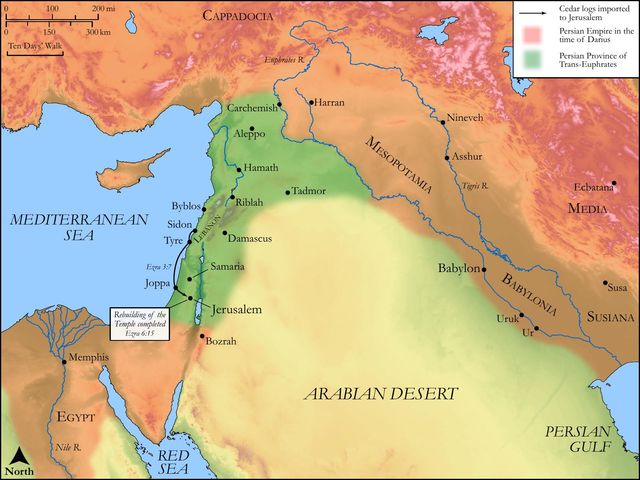
See on the biblical-era map
Study this verse
Public-domain commentary
Matthew Henry
From his Commentary on the Whole Bible. Henry comments on passages, not single verses — this entry covers Ezra 6:1–12. His four-level outline is real structure in the source text, so it is rendered as structure.
We have here, I. The decree of Cyrus for the building of the temple repeated. To this the Samaritans referred because the Jews pleaded it, and perhaps hoped it would not be found, and then their plea would be over-ruled and a stop put to their work. Search was ordered to be made for it among the records; for, it seems, the tribes had not taken care to provide themselves with an authentic copy of it, which might have stood them in good stead, but they must appeal to the original. It was looked for in Babylon (Ezr 6:1), where Cyrus was when he signed it. But, when it was not found there, Darius did not make that a pretence to conclude that therefore there was no such decree, and thereupon to give judgment against the Jews; but it is probable, having himself heard that such a decree was certainly made, he ordered the rolls in other places to be searched, and at length it was found at Achmetha, in the province of the Medes, Ezr 6:2. Perhaps some that durst not destroy it, yet hid it there, out of ill will to the Jews, that they might lose the benefit of it. But Providence so ordered that it came to light; and it is here inserted, Ezr 6:3-5. 1. Here is a warrant for the building of the temple: Let the house of God at Jerusalem, yea, let that house be built (so it may be read), within such and such dimensions, and with such and such materials. 2. A warrant for the taking of the expenses of the building out of the king's revenue, Ezr 6:4. We do not find that they had received what was here ordered them, the face of things at court being soon changed. 3. A warrant for the restoring of the vessels and utensils of the temple, which Nebuchadnezzar had taken away (Ezr 6:5), with an order that the priests, the Lord's ministers, should return them all to their places in the house of God.
II.The confirmation of it by a decree of Darius, grounded upon it and in pursuance of it.
1.The decree of Darius is very explicit and satisfactory.
(1.)He forbids his officers to do any thing in opposition to the building of the temple. The manner of expression intimates that he knew they had a mind to hinder it: Be you far hence (Ezr 6:6); let the work of this house of God alone, Ezr 6:7. Thus was the wrath of the enemy made to praise God and the remainder thereof did he restrain.
(2.)He orders them out of his own revenue to assist the builders with money,
[1.]For carrying on the building, Ezr 6:8. Herein he pursues the example of Cyrus, Ezr 6:4.
[2.]For maintaining the sacrifices there when it was built, Ezr 6:9. He ordered that they should be supplied with every thing they wanted both for burnt-offerings and meat-offerings. He was content it should be a rent-charge upon his revenue, and ordered it to be paid every day, and this without fail, that they might offer sacrifices and prayers with them (for the patriarchs, when they offered sacrifice, called on the name of the Lord, so did Samuel, Elijah, and others) for the life (that is, the happiness and prosperity) of the king and his sons, Ezr 6:10. See here how he gives honour, First, To Israel's God, whom he calls once and again the God of heaven. Secondly, To his ministers, in ordering his commissioners to give out supplies for the temple service at the appointment of the priests. Those that thought to control them must now be, in this matter, at their command. It was a new thing for God's priests to have such an interest in the public money. Thirdly, To prayer: That they may pray for the life of the king. He knew they were a praying people, and had heard that God was nigh to them in all that which they called upon him for. He was sensible he needed their prayers and might receive benefit by them, and was kind to them in order that he might have an interest in their prayers. It is the duty of God's people to pray for those that are in authority over them, not only for the good and gentle, but also for the forward; but they are particularly bound in gratitude to pray for their protectors and benefactors; and it is the wisdom of princes to desire their prayers, and to engage them. Let not the greatest princes despise the prayers of the meanest saints; it is desirable to have them for us, and dreadful to have them against us.
(3.)He enforces his decree with a penalty (Ezr 6:11): "Let none either oppose the work and service of the temple or withhold the supports granted to it by the crown upon pain of death. If any alter this decree, let him be (hanged before his own door as we say), hanged upon a beam of his own house, and, as an execrable man, let his house be made a dunghill."
(4.)He entails a divine curse upon all those kings and people that should ever have any hand in the destruction of this house, Ezr 6:12. What he would not do himself for the protection of the temple he desired that God, to whom vengeance belongs, would do. This bespeaks him zealous in the cause; and though this temple was, at length, most justly destroyed by the righteous hand of God, yet perhaps the Romans, who were the instruments of that destruction, felt the effects of this curse, for that empire sensibly declined ever after.
2.From all this we learn,
(1.)That the heart of kings is in the hand of God, and he turns it which way soever he pleases; what they are he makes them to be, for he is King of kings.
(2.)That when God's time has come for the accomplishing of his gracious purposes concerning his church he will raise up instruments to promote them from whom such good service was not expected. The earth sometimes helps the woman (Rev 12:16), and those are made use of for the defence of religion who have little religion themselves.
(3.)That what is intended for the prejudice of the church has often, by the overruling providence of God, been made serviceable to it, Phi 1:12. The enemies of the Jews, in appealing to Darius, hoped to get an order to suppress them, but, instead of that, they got an order to supply them. Thus out of the eater comes forth meat. The apocryphal Esdras (or Ezra), Book 1 ch. 3 and 4, gives another account of this decree in favour of the Jews, that Darius had vowed that if ever he came to the kingdom he would build the temple at Jerusalem, and that Zerubbabel, who was one of his attendants (whereas it is plain here that he was now at Jerusalem), for making an ingenious discourse before him on that subject (Great is the truth and will prevail), was told to ask what recompence he would, and asked only for this order, in pursuance of the king's vow.
Historical interpretation
Historical reception
1 surviving comment on this verse from the historical church.
Therefore, a decree was established by me, etc. The sense of the letter is clear: because he wished to impose the most severe punishment, if anyone attempted to change the decree of his religion; that is, the loss of everything he could possess and his soul, which he would lose even confined to a cross, with the torment of prolonged suffering. The spiritual understanding is also clear, because our works are all compared to wood: good indeed to fruitful trees, but bad to barren and worthy of fire. The wood is taken from his house, who tried to oppose the Lord's burnt offerings; and it is raised, and he himself is nailed to it, when the works of those who resist the peace of the universal holy Church are manifest to all as useless and perverse; and they are shown to have sought not the joy of life in these works, but rather a snare of death. The house of such people is also made public, that is, written into public record, when even their bodies in which they remained longer in this life are handed over to the most savage exactors to be punished perpetually at the resurrection, that is, to spirits. However, Darius rightly and faithfully desires that his decree be confirmed with the help of divine power, as he abruptly adds in prayer, saying: "May the God who caused His name to dwell there scatter all kingdoms and people who stretch out their hand to oppose and destroy that house of God which is in Jerusalem."
Continue studying Ezra 6:11 across the web’s major study libraries — every link below opens this exact verse, chapter, or book on the destination site.
Read & Compare
 BibleGatewayThis verse in more than 200 translations and 70 languages.
 Bible.comThe YouVersion reader — hundreds of translations, reading plans, and highlights.
 ESV.orgCrossway's official English Standard Version reader.
 NET BibleThe NET translation with 60,000+ translators' notes on every rendering decision.
 STEP BibleTyndale House's free study tool — original text, vocabulary, and scholarly resources.
 BibliaLogos Bible Software's free web reader.
 USCCBThe New American Bible (Revised Edition) with the U.S. bishops' study notes.
Commentaries
 BibleHub CommentariesDozens of classic commentaries on this verse, gathered on one page.
 StudyLightMore than 100 commentary sets — the largest collection on the web.
 BibleRefPlain-English commentary on what this verse means, verse by verse.
 Enduring WordDavid Guzik's free commentary on this chapter, widely used by Bible teachers.
 Bible Study ToolsVerse commentary alongside Greek and Hebrew study aids.
Original Language & Research
- BibleHub InterlinearThe verse word by word — original language, transliteration, and English.
- BibleHub LexiconEvery word's original-language definition and Strong's entry.
 Blue Letter BibleDeep-study tools — Strong's numbers, concordance, and word studies.
 SefariaThe Hebrew text with Rashi and centuries of Jewish commentary.
Sermons, Hymns & Audio


TrulyRandomVerse is not affiliated with these sites and doesn’t control their content. They’re linked because they’re genuinely useful.
Summary
Ezra 6:11 records a formidable decree issued by King Darius I of Persia, unequivocally affirming the royal mandate for the rebuilding of the Second Temple in Jerusalem. This verse details exceptionally severe penalties for any individual who would dare to obstruct, alter, or interfere with the king's command regarding the sacred temple project, thereby underscoring the absolute authority backing the divine work and the king's commitment to its completion.
Context
ShowHideLiterary Context
Ezra 6:11 stands within a pivotal section in the book of Ezra where the Persian king Darius I confirms and expands upon the earlier decree of King Cyrus. Following years of opposition and a cessation of temple construction, the Jewish leaders Zerubbabel and Jeshua resumed the work, prompting local Persian governors to question their authority. An appeal was made to Darius, who ordered a search of the royal archives. The original decree of Cyrus, authorizing the temple's reconstruction and providing for its expenses, was discovered in Ecbatana, as detailed in Ezra 6:1-5. Darius not only ratified Cyrus's decree but also issued his own powerful edict, commanding the governors to cease interference, provide funds from the royal treasury, and supply necessary sacrifices, as recorded in Ezra 6:6-10. Verse 11, therefore, serves as the climactic and most forceful deterrent within Darius's decree, ensuring that the temple work would proceed unimpeded by instilling fear of extreme consequences for any opposition.
Historical & Cultural Context
The Persian Empire was renowned for its administrative efficiency and the absolute authority of its monarchs. Royal decrees, once issued, were considered immutable and carried the full weight of imperial law. Darius I (522-486 BC) was a powerful and organized ruler who consolidated the empire and generally respected local customs and religions as long as they did not threaten imperial stability. The type of capital punishment described—being "hanged thereon"—likely refers to impalement or crucifixion, a brutal form of execution practiced by various empires of that day, including the Persians, designed for maximum public deterrence. The act of tearing down timber from one's own house and using it for their execution was a profound act of public shaming and a symbolic inversion of one's own security. Furthermore, making a house a "dunghill" (a refuse heap) was the ultimate act of defilement and public disgrace, rendering the property uninhabitable and a permanent monument to the owner's ignominy, serving as a powerful warning to others.
Key Themes
ShowHideThis verse powerfully contributes to several overarching themes within Ezra and the broader biblical narrative. Foremost is the theme of Divine Sovereignty and Providence, demonstrating how God orchestrates global events and uses even pagan rulers like Darius to accomplish His redemptive purposes, ensuring the restoration of His people and the re-establishment of temple worship in Jerusalem. Darius's decree, with its severe penalties, highlights God's protective hand over His chosen people and His unwavering commitment to His plans, aligning with the truth that "the king's heart is in the hand of the LORD, like channels of water; he turns it wherever he will". Secondly, it underscores the Absolute Nature of Royal Authority and Law in the Persian Empire; the king's word was law, and challenging it invited dire consequences. This mirrors, in a human sense, the unchallengeable authority of God's own decrees. Finally, the verse emphasizes the Protection of God's Work and People, as the harsh penalties serve as a potent deterrent against any opposition to the temple's construction, signifying the immense divine importance placed on the temple as the center of worship and the dwelling place of God's presence among His people, a theme echoed in Psalm 127:1.
Exposition and Analysis
ShowHideKey Word Analysis
ShowHideThis verb, stemming from the root meaning "to alter," "to change," or "to be diverse," signifies any attempt to modify, deviate from, or violate the king's decree concerning the temple's rebuilding. In this context, it implies not merely a minor adjustment but a fundamental subversion of the royal command, highlighting the non-negotiable nature of the edict and, by extension, the divine will it served.
This term means "to hang" or "to impale," and also "to set up." In the context of capital punishment, it refers to a brutal form of execution, likely impalement or crucifixion, where the condemned was "set up" or lifted onto a stake or cross. This method was designed not only to end life but also to inflict public humiliation and serve as a stark warning to others.
This word denotes "a sink" or "dunghill," referring to a place of refuse, waste, or utter defilement. To make a house a dunghill signifies its complete degradation, rendering it permanently uninhabitable, ritually impure, and a public symbol of contempt and disgrace. It was the ultimate act of desecration and a permanent mark of shame, ensuring that the offender's legacy would be one of utter vileness and rejection.
Verse Breakdown
ShowHide"Also I have made a decree,"
This opening phrase establishes the absolute authority of Darius's pronouncement. It is a formal, legal declaration from the highest power in the empire, signifying that what follows is not merely a suggestion but an unalterable, binding law with the full force of the Persian state behind it. The use of "I" emphasizes the personal commitment and power of the king.
"that whosoever shall alter this word,"
This clause defines the specific offense: any attempt to change, violate, or obstruct the king's "word" or decree. The term "whosoever" indicates that the decree applies universally to anyone, regardless of status or position, who dares to interfere with the temple project. This highlights the sacredness of the royal command and, implicitly, the divine work it facilitates.
"let timber be pulled down from his house, and being set up, let him be hanged thereon;"
This specifies the first part of the severe punishment. The offender's own house, a symbol of security, family, and legacy, is to be dismantled, and its very timbers used as the instrument of their public execution (impalement/crucifixion). This is a profound act of public shaming and a symbolic reversal of fortune, where one's own resources are turned against them, ensuring a humiliating and painful death.
"and let his house be made a dunghill for this."
This outlines the second, equally devastating, part of the penalty. The remainder of the offender's property is to be utterly defiled and turned into a public refuse heap. This ensures not only the destruction of the individual but also the permanent disgrace of their family and property, rendering it ritually impure, uninhabitable, and a lasting symbol of their ignominy and the consequences of opposing royal (and divine) will.
Literary Devices
ShowHideEzra 6:11 employs several powerful Literary Devices to convey the absolute authority and severe consequences of Darius's decree. The most prominent is Hyperbole, where the extreme nature of the punishment—dismantling one's house, using its timber for execution, and turning the remainder into a dunghill—is used to emphasize the gravity of the offense and the king's unwavering resolve. This exaggeration serves as a potent Deterrent, designed to instill fear and prevent any future interference with the temple project. The verse also uses powerful Symbolism: the "timber pulled down from his house" symbolizes the self-destruction and ironic reversal of fortune for those who oppose God's work, as their own security becomes their undoing. The "dunghill" is a stark symbol of utter disgrace, defilement, and public contempt, ensuring that the offender's legacy is one of impurity and rejection. The formal, declarative tone of the "decree" itself reflects Legal Language and the absolute nature of a Royal Edict, leaving no room for negotiation or misunderstanding.
Theological and Thematic Connections
ShowHideEzra 6:11 provides a powerful testament to God's unwavering commitment to His purposes and His sovereign hand in orchestrating human affairs, even through the decrees of pagan kings. The severity of Darius's edict, far from being merely a display of human tyranny, serves as a dramatic illustration of how God can use earthly authorities to protect and advance His divine agenda. It underscores the seriousness with which God views any opposition to His work, whether it comes from human adversaries or spiritual forces. This verse reminds us that God is actively involved in history, ensuring that His plans for His people and His kingdom will ultimately prevail, even against formidable obstacles. It encourages believers to trust in God's providence, knowing that He will defend His church and ensure the completion of His redemptive work, just as He protected the rebuilding of His temple.
Reflection and Application
ShowHideWhile we no longer live under the direct decrees of Persian kings, Ezra 6:11 offers profound spiritual lessons for believers today. It calls us to reflect on the absolute sovereignty of God, who is able to use any means, even the stern decrees of secular rulers, to accomplish His will. This should instill in us a deep confidence that God's purposes for His church and His kingdom will ultimately prevail, regardless of the opposition we face. It also serves as a sobering reminder of the seriousness with which God views interference with His work. For us, this means faithfully participating in the building of God's spiritual temple—the Church—through evangelism, discipleship, and service, knowing that our labor is not in vain and that God Himself protects His work. It challenges us to examine our own hearts for any attitudes or actions that might inadvertently "alter" or obstruct God's will in our lives or communities, encouraging us to align ourselves fully with His divine purposes and trust in His protective hand.
Questions for Reflection
ShowHideFAQ
ShowHideWhy was Darius's decree so exceptionally harsh, particularly the part about the house becoming a dunghill?
ShowHideDarius's decree was exceptionally harsh for several reasons, reflecting both Persian imperial policy and the profound importance of the temple project. First, it underscored the absolute and unalterable nature of a royal edict in the Persian Empire; any deviation was seen as a direct challenge to the king's authority. Second, the severity was intended as a powerful deterrent to ensure no one would dare to interfere with the temple's rebuilding again, after previous delays. Third, the specific punishments—being hanged on timber from one's own house and having the house turned into a dunghill—were designed for maximum public humiliation, disgrace, and defilement. Making a house a "dunghill" meant it was rendered permanently uninhabitable, ritually impure, and a public monument to the offender's ignominy, serving as a lasting warning to others about the dire consequences of opposing the king's (and implicitly, God's) will. This extreme measure highlights the strategic importance Darius placed on maintaining order and fulfilling imperial decrees, especially those concerning religious structures that could affect regional stability and the king's reputation, as seen in Ezra 6.
Christ-Centered Fulfillment
ShowHideEzra 6:11, with its severe penalties for those who would "alter" the decree and its mention of being "hanged on timber," finds profound Christ-centered fulfillment in the New Testament. The image of one being "hanged thereon" powerfully foreshadows the ultimate execution of Jesus Christ, who was "hanged on a tree" (Acts 5:30; Galatians 3:13), bearing the curse of the Law for humanity. While Darius's decree brought judgment upon those who opposed the building of a physical temple, Christ's crucifixion was the ultimate act of God's justice and mercy, where He bore the "dunghill" of our sin and shame, becoming a curse for us so that we might become the righteousness of God (2 Corinthians 5:21). Furthermore, just as Darius's decree protected the rebuilding of the physical temple, God's ultimate purpose is to build His spiritual temple, the Church, of which Christ is the cornerstone (Ephesians 2:20-22). Any attempt to "alter" God's ultimate "word"—His Son, Jesus Christ, and the gospel message—will face eternal consequences, for Christ is the unalterable truth and the final revelation of God's will (Hebrews 1:1-3). The severity of judgment in Ezra 6:11 thus points to the even greater judgment awaiting those who reject or pervert the work of God in Christ, who is the true temple and the one through whom all of God's purposes are perfectly fulfilled.