


Ezekiel 3:16
Bible text: King James Version (1769 Blayney text) · Public domain
Bible text: Berean Standard Bible · Public domain
Bible text: American Standard Version (1901) · Public domain
Bible text: World English Bible, Messianic edition · Public domain
Bible text: Geneva Bible (1599) · Public domain
Bible text: Young's Literal Translation · Public domain
- וַיְהִיvay·Hiand it wasH1961Conj-w ¦ V-Qal-ConsecImperf-3msVerb Qal Consecutive Imperfect 3rd Singular Masculineוַandיְהִיit was
- מִקְצֵהmik·Tzehfrom [the] end ofH7097Prep-m ¦ N-mscNoun Singular Masculine Constructמִfromקְצֵה[the] end of
- שִׁבְעַתshiv·'AtsevenH7651Adj-cscAdjective Numerical Singular common gender Construct
- יָמִיםya·MimdaysH3117N-mpNoun Plural Masculine Absolute
- וַיְהִיvay·Hiand it cameH1961Conj-w ¦ V-Qal-ConsecImperf-3msVerb Qal Consecutive Imperfect 3rd Singular Masculineוַandיְהִיit came
- דְבַרde·var[the] word ofH1697N-mscNoun Singular Masculine Construct
- יְהוָהYah·wehYahwehH3068N-properNoun Proper Title
- אֵלַי'e·Laito meH413Prep ¦ 1csPrepositionאֵלַtoיme
- לֵאמֹרle·Mor<to> sayingH559Prep-l ¦ V-Qal-InfVerb Qal Infinitive Constructלֵ<to>אמֹרsaying
English is a literal word-by-word gloss of the Hebrew, not the KJV's wording. Why?
This is the original text the KJV's translators worked from — each Hebrew word with its own literal English meaning in this verse, prepared by scholars at Tyndale House, Cambridge. The KJV translates whole sentences, not word by word, so its wording differs: one Hebrew word can become several English words, and the KJV may choose “the LORD” where the gloss reads “Yahweh”. Both are faithful — they answer different questions. For the KJV's own rendering, switch to the KJV text.
Details
See on the biblical-era map
Study this verse
Public-domain commentary
Matthew Henry
From his Commentary on the Whole Bible. Henry comments on passages, not single verses — this entry covers Ezekiel 3:16–21. His four-level outline is real structure in the source text, so it is rendered as structure.
These further instructions God gave to the prophet at the end of seven days, that is, on the seventh day after the vision he had; and it is very probably that both that and this were on the sabbath day, which the house of Israel, even in their captivity, observed as well as they could in those circumstances. We do not find that their conquerors and oppressors tied them to any constant service, as their Egyptian task-masters had formerly done, but that they might observe the sabbath-rest for a sign to distinguish between them and their neighbours; but for the sabbath-work they had not the convenience of temple or synagogue, only it should seem they had a place by the river side where prayer was wont to be made (as Act 16:13); there they met on the sabbath day; there their enemies upbraided them with the songs of Zion (Psa 137:1, Psa 137:3); there Ezekiel met them, and the word of the Lord then and there came to him. He that had been musing and meditating on the things of God all the week was fit to speak to the people in God's name on the sabbath day, and disposed to hear God speak to him. This sabbath day Ezekiel was not so honoured with visions of the glory of God as he had been the sabbath before; but he is plainly, and by a very common similitude, told his duty, which he is to communicate to the people. Note, Raptures and transports of joy are not the daily bread of God's children, however they may upon special occasions be feasted with them. We must not deny but that we have truly communion with God (Jo1 1:3) though we have it not always so sensibly as at some times. And, though the mysteries of the kingdom of heaven may sometimes be looked into, yet ordinarily it is plain preaching that is most for edification. God here tells the prophet what his office was, and what the duty of that office; and this (we may suppose) he was to tell the people, that they might attend to what he said and improve it accordingly. Note, It is good for people to know and consider what a charge their ministers have of them and what an account they must shortly give of that charge. Observe,
I.What the office is to which the prophet is called:
Son of man, I have made thee a watchman to the house of Israel, Eze 3:17. The vision he saw astonished him: he knew not what to make of that, and therefore God used this plain comparison, which served better to lead him to the understanding of his work and so to reconcile him to it. he sat among the captives, and said little, but God comes to him, and tells him that will not do; he is a watchman, and has something to say to them; he is appointed to be as a watchman in the city, to guard against fire, robbers, and disturbers of the peace, as a watchman over the flock, to guard against thieves and beasts of prey, but especially as a watchman in the camp, in an invaded country or a besieged town, that is to watch the motions of the enemy, and to sound an alarm upon the approach, nay, upon the first appearance, of danger. This supposes the house of Israel to be in a military state, and exposed to enemies, who are subtle and restless in their attempts upon it; yea, and each of the particular members of that house to be in danger and concerned to stand upon their guard. Note, Ministers are watchmen on the church's walls (Isa 62:6), watchmen that go about the city, Sol 3:3. It is a toilsome office. Watchmen must keep awake, be they ever so sleepy, and keep abroad, be it ever so cold; they must stand all weathers upon the watch-tower, Isa 21:8; Gen 31:40. It is a dangerous office. Sometimes they cannot keep their post, but are in peril of death from the enemy, who gain their point if they kill the sentinel; and yet they dare not quit their post upon pain of death from their general. Such a dilemma are the church's watchmen in; men will curse them if they be faithful, and God will curse them if they be false. But it is a needful office; the house of Israel cannot be safe without watchmen, and yet, except the Lord keep it, the watchman waketh but in vain, Psa 127:1, Psa 127:2.
II.What is the duty of this office. The work of a watchman is to take notice and to give notice.
1.The prophet, as a watchman, must take notice of what God said concerning this people, not only concerning the body of the people, to which the prophecies of Jeremiah and other prophets had most commonly reference, but concerning particular persons, according as their character was. He must not, as other watchmen, look round to spy danger and gain intelligence, but he must look up to God, and further he need not look: Hear the word at my mouth, Eze 3:17. Note, Those that are to preach must first hear; for how can those teach others who have not first learned themselves?
2.He must give notice of what he heard. As a watchman must have eyes in his head, so he must have a tongue in his head; if he be dumb, it is as bad as if he were blind, Isa 56:10. Thou shalt give them warning from me, sound an alarm in the holy mountain; not in his own name, or as from himself, but in God's name, and from him. Ministers are God's mouth to the children of men. The scriptures are written for our admonition. By them is thy servant warned, Psa 19:11. But, because that which is delivered viv voce - by the living voice, commonly makes the deepest impression, God is pleased, by men like ourselves, who are equally concerned, to enforce upon us the warnings of the written word. Now the prophet, in his preaching, must distinguish between the wicked and the righteous, the precious and the vile, and in his applications must suit his alarms to each, giving every one his portion; and, if he did this, he should have the comfort of it, whatever the success was, but, if not, he was accountable.
(1.)Some of those he had to do with were wicked, and he must warn them not to go on in their wickedness, but to turn from it, Eze 3:18, Eze 3:19. We may observe here,
[1.]That the God of heaven has said, and does say, to every wicked man, that if he go on still in his trespasses he shall surely die. His iniquity shall undoubtedly be his ruin; it tends to ruin and will end in ruin. Dying thou shalt die, thou shalt die so great a death, shalt die eternally, be ever dying, but never dead. The wicked man shall die in his iniquity, shall fie under the guilt of it, die under the dominion of it.
[2.]That if a wicked man turn from his wickedness, and from his wicked way, he shall live, and the ruin he is threatened with shall be prevented; and, that he may do so, he is warned of the danger he is in. The wicked man shall die if he go on, but shall live if he repent. Observe, he is to turn from his wickedness and from his wicked way. It is not enough for a man to turn from his wicked way by an outward reformation, which may be the effect of his sins leaving him rather than of his leaving his sins, but he must turn from his wickedness, from the love of it and the inclination to it, by an inward regeneration; if he do not so much as turn from his wicked way, there is little hope that he will turn from his wickedness.
[3.]That it is the duty of ministers both to warn sinners of the danger of sin and to assure them of the benefit of repentance, to set before them how miserable they are if they go on in sin, and how happy they may be if they will but repent and reform. Note, The ministry of the word is concerning matters of life and death, for those are the things it sets before us, the blessing and the curse, that we may escape the curse and inherit the blessing.
[4.]That, though ministers do not warn wicked people as they ought of their misery and danger, yet that shall not be admitted as an excuse for those that go on still in their trespasses; for, though the watchman did not give them warning, yet they shall die in their iniquity, for they had sufficient warning given them by the providence of God and their own consciences; and, if they would have taken it, they might have saved their lives.
[5.]That if ministers be not faithful to their trust, if they do not warn sinners of the fatal consequences of sin, but suffer them to go on unreproved, the blood of those that perish through their carelessness will be required at their hand. It shall be charged upon them in the day of account that it was owing to their unfaithfulness that such and such precious souls perished in sin; for who knows but if they had had fair warning given them they might have fled in time from the wrath to come? And, if it contract so heinous a guilt as it does to be accessory to the murder of a dying body, what is it to be accessory to the ruin of an immortal soul?
[6.]That if ministers do their duty in giving warning to sinners, though the warning be not taken, yet they may have this satisfaction, that they are clear from their blood, and have delivered their own souls, though they cannot prevail to deliver theirs. Those that are faithful shall have their reward, though they be not successful.
(2.)Some of those he had to deal with were righteous, at least he had reason to think, in a judgment of charity, that they were so; and he must warn them not to apostatize and turn away from their righteousness, Eze 3:20, Eze 3:21. We may observe here,
[1.]That the best men in the world have need to be warned against apostasy, and to be told of the danger they are in of it and the danger they are in by it. God's servants must be warned (Psa 19:11) that they do not neglect his work and quit his service. One good means to keep us from falling is to keep up a holy fear of falling, Heb 4:1. Let us therefore fear; and (Rom 11:20) even those that stand by faith must not be high-minded, but fear, and must therefore be warned.
[2.]There is a righteousness which a man may turn from, a seeming righteousness, and, if men turn from this, it thereby appears that it was never sincere, how passable, nay, how plausible soever it was; for, if they had been of us, they would no doubt have continued with us, Jo1 2:19. There are many that begin in the spirit, but end in the flesh, that set their faces heavenward, but look back; that had a first love, but have lost it, and turned from the holy commandment.
[3.]When men turn from their righteousness they soon learn to commit iniquity. When they grow careless and remiss in the duties of God's worship, neglect them, or a re negligent in them, they become an easy prey to the tempter. Omissions make way for commissions.
[4.]When men turn from their righteousness, and commit iniquity, it is just with God to lay stumbling-blocks before them, that they may grow worse and worse, till they are ripened for destruction. When Pharaoh hardened his heart God hardened it. When sinners turn their back upon God, desert his service, and so cast a reproach upon it, he does, in a way of righteous judgment, not only withdraw his restraining grace and give them up to their own hearts' lusts, but order them by his providence into such circumstances as occasion their sin and hasten their ruin. There are those to whom Christ himself is a stone of stumbling and a rock of offence, Pe1 2:8.
[5.]The righteousness which men relinquish shall never be remembered to their honour or comfort; it will stand them in no stead in this world or the other. Apostates lose all that they have wrought; their services and sufferings are all in vain, and shall never be brought to an account, because not continued in. It is a rule in the law, Factum non dicitur, quod non perseverat - We are said to do only that which we do perseveringly, Gal 3:3, Gal 3:4.
[6.]If ministers do no give fair warning, as they ought, of the weakness of the best, their aptness to stumble and fall, the particular temptations they are in and the fatal consequences of apostasy, the ruin of those that do apostatize will be laid at their door, and they shall answer for it. Not but that there are those who are warned against it, and yet turn from their righteousness; but that case is not put here, as was concerning the wicked man, but, on the contrary, that a righteous man, being warned, takes the warning and does not sin (Eze 3:21); for, if you give instruction to a wise man, he will be yet wiser. We must not only not flatter the wicked, but not flatter even the righteous as if they were perfectly safe any where on this side heaven.
[7.]If ministers give warning, and people take it, it is well for both. Nothing is more beautiful than a wise reprover upon an obedient ear; the one shall live because he is warned and the other has delivered his soul. What can a good minister desire more than to save himself and those that hear him? Ti1 4:16.
Historical interpretation
Two Centuries of Reception
3 surviving comments on this verse. Each one is dated, so this reads as a timeline rather than a list.
Select a marker to jump to its quote. Markers stagger vertically where authors wrote within a few decades of each other.
(Verse 16, 17.) But after seven days, the word of the Lord came to me, saying: Son of man, I have made you a watchman for the house of Israel, and you will hear a word from my mouth and will declare it to them from me. The watchman, who is to be the messenger of God's words to the people, must rest for a long time and be sorrowful for the things he sees. And he must have no personal guilt for the sins he will rebuke in others.
He who was to be a sentinel and to tell the words of God to the people had to be quiet for some time, and to grieve at the things he saw and have nothing in his consciousness in respect of which he would be reproved in other things.
In that he sat mourning for seven days, and after the seventh day received the words of the Lord's command that he ought to speak, he clearly indicates that during those same days he had been silent while mourning. Now he had been sent to preach, and yet sitting for seven days he was silent. What is it that the holy prophet suggests to us in this silence of his, except that he truly knows how to speak who has first learned how to be silent well? For the discipline of silence is, as it were, a kind of nourishment for speech. And rightly does he receive the gift of speaking through increasing grace, who first keeps silent in an orderly manner through humility. Hence it is said through Solomon: "A time to be silent, and a time to speak." For he did not say, "A time to speak, and a time to be silent," but he puts the time for silence first, and afterwards adds that for speaking, because we ought to learn to speak not by speaking but by being silent. If therefore the holy prophet who had been sent to speak was first silent for a long time, so that afterwards he might speak rightly, we must consider how great a fault it is for him not to be silent whom no necessity compels to speak.
Continue studying Ezekiel 3:16 across the web’s major study libraries — every link below opens this exact verse, chapter, or book on the destination site.
Read & Compare
 BibleGatewayThis verse in more than 200 translations and 70 languages.
 Bible.comThe YouVersion reader — hundreds of translations, reading plans, and highlights.
 ESV.orgCrossway's official English Standard Version reader.
 NET BibleThe NET translation with 60,000+ translators' notes on every rendering decision.
 STEP BibleTyndale House's free study tool — original text, vocabulary, and scholarly resources.
 BibliaLogos Bible Software's free web reader.
 USCCBThe New American Bible (Revised Edition) with the U.S. bishops' study notes.
Commentaries
 BibleHub CommentariesDozens of classic commentaries on this verse, gathered on one page.
 StudyLightMore than 100 commentary sets — the largest collection on the web.
 BibleRefPlain-English commentary on what this verse means, verse by verse.
 Enduring WordDavid Guzik's free commentary on this chapter, widely used by Bible teachers.
 Bible Study ToolsVerse commentary alongside Greek and Hebrew study aids.
Original Language & Research
- BibleHub InterlinearThe verse word by word — original language, transliteration, and English.
- BibleHub LexiconEvery word's original-language definition and Strong's entry.
 Blue Letter BibleDeep-study tools — Strong's numbers, concordance, and word studies.
 SefariaThe Hebrew text with Rashi and centuries of Jewish commentary.
Sermons, Hymns & Audio


TrulyRandomVerse is not affiliated with these sites and doesn’t control their content. They’re linked because they’re genuinely useful.
Summary
Ezekiel 3:16 marks a pivotal moment in the prophet Ezekiel's ministry, signifying the conclusion of a seven-day period of profound spiritual processing and preparation following his initial, overwhelming vision and divine commission. This verse serves as a precise divine appointment, indicating that God's authoritative word is once again about to be delivered to His chosen servant, transitioning from a period of awe-filled silence to the specific, actionable instructions for his prophetic role as a watchman for Israel.
Context
ShowHideLiterary Context
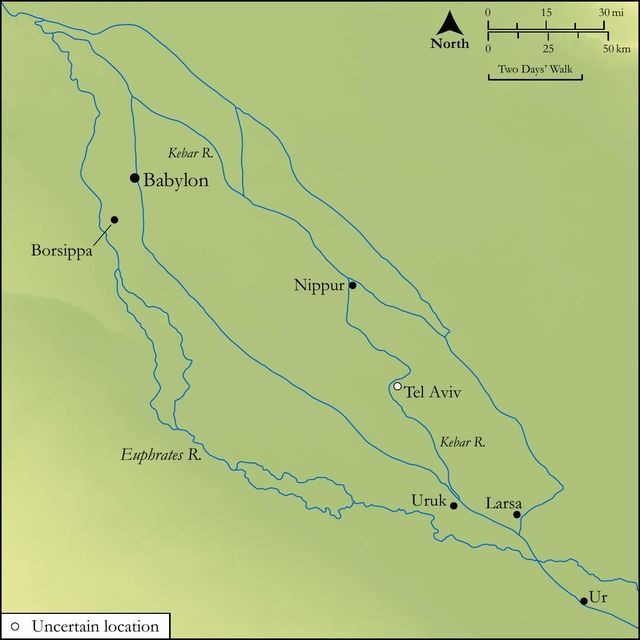
This verse immediately follows Ezekiel's initial call and profound commission, detailed in Ezekiel 1-3:15. Having experienced a breathtaking vision of God's glory by the Chebar River (Ezekiel 1), been given a scroll to eat symbolizing the assimilation of God's word (Ezekiel 2:8-10 and Ezekiel 3:1-3), and commissioned as a prophet to a "rebellious house" (Ezekiel 2:3-7), Ezekiel then spent seven days in a state of stunned silence or intense contemplation (Ezekiel 3:15). Ezekiel 3:16 breaks this silence, signaling the end of this preparatory phase and the imminent commencement of his active prophetic duties, particularly his charge to be a "watchman" for Israel, which is detailed in the very next verses (Ezekiel 3:17-21). This verse acts as a crucial narrative hinge, moving from the prophet's internal processing to his external proclamation.
Historical & Cultural Context
Ezekiel was an exiled priest living among the Jewish captives in Babylon, specifically by the Chebar River. This period of exile (beginning in 597 BCE) was a time of profound national crisis and spiritual disorientation for the Israelites. They struggled to reconcile their covenant relationship with God with their current subjugation and the impending destruction of Jerusalem and the Temple. Prophets like Ezekiel were crucial for interpreting these catastrophic events through a divine lens, calling the people to repentance, and offering glimmers of hope amidst severe judgment. The concept of a "watchman" was well-understood in the cities of Israel, where guards stood on city walls or towers to warn of approaching danger, whether military threats or natural disasters. This familiar cultural role made Ezekiel's subsequent commission as a spiritual watchman a highly resonant and immediately comprehensible metaphor for his audience.
Key Themes
ShowHideEzekiel 3:16 contributes significantly to several overarching themes in the book of Ezekiel. Firstly, it underscores Divine Timing and Sovereignty, emphasizing that God's revelations and instructions are not arbitrary but come at His perfectly appointed moment, often after a period of divine preparation. Secondly, it highlights the theme of Preparation for Ministry, illustrating that even a prophet as profoundly called as Ezekiel required a period of internal processing and spiritual equipping before undertaking his weighty task. This period of silence in Ezekiel 3:15 was not merely a pause but a purposeful part of his divine training. Thirdly, the phrase "the word of the LORD came unto me" powerfully reinforces the Authority and Directness of Divine Communication, establishing that Ezekiel's messages were not his own insights but direct, undeniable transmissions from Yahweh Himself. This divine authority is foundational to the prophet's often unpopular and confrontational messages to a stubborn people (Ezekiel 2:3-7). Finally, this verse marks a crucial Transition from Commission to Specific Mandate, moving Ezekiel from the general call to prophesy to the detailed instructions for his specific role as a watchman, a theme central to the early chapters of the book (Ezekiel 3:17).
Exposition and Analysis
ShowHideKey Word Analysis
ShowHideThis cardinal number carries profound symbolic weight in biblical numerology, often representing completeness, perfection, or divine fullness. The "seven days" here are not merely a temporal measurement but suggest a divinely ordained, full, and sufficient period of preparation and assimilation for Ezekiel. It implies that God allowed a complete cycle of processing before further revelation was given, underscoring the sacred and purposeful nature of this waiting period. The period was complete, signifying readiness for the next phase.
This versatile Hebrew term encompasses not just spoken utterance but also a matter, thing, affair, decree, or even an act. When used in the phrase "the word of the LORD," it signifies God's active, authoritative, and often performative communication. It is not a mere suggestion or idea, but a powerful, living declaration that carries the weight of divine will and often brings about what it declares. Here, it is the direct, unmediated communication from God to Ezekiel, carrying the full authority and intent of the Almighty.
This is the Tetragrammaton, the sacred covenant name of God, often transliterated as Yahweh. It derives from the Hebrew verb "to be" (from which it is formed), signifying God's self-existence, eternal nature, and covenant faithfulness. The use of "Yᵉhôvâh" emphasizes that the message coming to Ezekiel is from the sovereign, self-existent God who is faithful to His covenant with Israel, even in their rebellion and exile. It underscores the ultimate authority, reliability, and covenantal significance of the message.
Verse Breakdown
ShowHide"And it came to pass at the end of seven days,"
This clause establishes the precise timing of the divine revelation. It indicates a significant temporal marker, signifying the completion of a specific, divinely appointed period that followed Ezekiel's initial overwhelming vision and commission. This "seven days" is widely understood as a period of intense spiritual assimilation, contemplation, or even a state of being overwhelmed, during which Ezekiel processed the profound encounter with God's glory and the weighty nature of his calling. It highlights God's deliberate and ordered timing in His dealings with His prophet, ensuring Ezekiel was fully prepared for the next phase of his ministry.
"that the word of the LORD came unto me,"
This is a classic prophetic formula found throughout the Old Testament, denoting a direct, undeniable, and authoritative communication from God to His chosen messenger. It emphasizes that Ezekiel's subsequent messages are not his own thoughts, interpretations, or human insights, but rather a direct transmission of divine revelation. The phrase "came unto me" suggests a personal, intimate, and often forceful encounter with the divine message, underscoring the prophet's role as a recipient and conveyor, not an originator, of God's truth. This signifies the commencement of active prophetic engagement.
"saying,"
This simple yet crucial word indicates that the communication from the LORD is not merely a presence or a feeling, but an articulated message with specific content. It serves as an immediate transition to the direct speech of God that follows, preparing the reader for the detailed instructions and pronouncements that God is about to impart to Ezekiel regarding his duties as a watchman to the house of Israel. It signals the shift from a general commission to specific, actionable divine directives.
Literary Devices
ShowHideEzekiel 3:16 employs several literary devices that enhance its meaning and impact. The most prominent is Formulaic Language, specifically the phrase "the word of the LORD came unto me." This is a recurring prophetic formula throughout the Old Testament (e.g., in Jeremiah, Isaiah, Hosea), serving as an unmistakable indicator of divine authority and direct revelation. Its use here immediately signals to the audience that what follows is not human opinion but an authoritative message from Yahweh Himself. There is also an element of Divine Chronology, as the verse explicitly states "at the end of seven days," emphasizing God's sovereign control over time and His deliberate ordering of events in the prophet's life. This specific temporal marker creates a sense of Anticipation and Transition, as the silence of the preceding seven days is broken, preparing the reader for the weighty instructions that are about to be delivered to Ezekiel, particularly his crucial role as a watchman. The precise timing underscores the purposeful nature of God's interaction with His prophet.
Theological and Thematic Connections
ShowHideEzekiel 3:16 underscores a profound theological truth: God is actively engaged in human history, communicating His will and purpose to His chosen servants at His appointed time. This verse highlights the divine initiative in revelation, where God breaks through human silence and prepares His messengers for weighty tasks. It speaks to the necessity of waiting on God, allowing Him to equip and clarify before sending forth. The authority of God's word, as conveyed directly to the prophet, becomes the bedrock for all subsequent messages of judgment and hope, emphasizing that true prophetic ministry is rooted in faithful transmission of divine truth, not human ingenuity or personal ambition.
Reflection and Application
ShowHideEzekiel's experience in this verse offers timeless lessons for believers today. The "seven days" of silence and contemplation remind us that God often uses periods of waiting, quiet reflection, or even spiritual disorientation to prepare us for new seasons of ministry, challenges, or deeper understanding. In a world that constantly demands immediate action and instant gratification, Ezekiel's pause teaches us the value of patience and allowing God to work in His own timing, equipping us internally before external demands are placed upon us. This preparatory phase is not wasted time but essential formation. Furthermore, the directness of "the word of the LORD came unto me" challenges us to cultivate a posture of attentiveness to God's voice, whether through diligent engagement with Scripture, devoted prayer, or the discerning guidance of the Holy Spirit. Our effectiveness in serving God is not primarily rooted in our own strength, wisdom, or eloquence, but in our faithful reception and obedient response to His authoritative word. This verse calls us to trust God's preparatory process and to be ready to act with conviction when His word is clearly revealed.
Questions for Reflection
ShowHideFAQ
ShowHideWhat is the significance of "seven days" in this verse?
ShowHideThe "seven days" in Ezekiel 3:16 likely represents a divinely appointed and complete period of preparation for Ezekiel. In biblical numerology, the number seven often symbolizes completeness, perfection, or divine fullness (e.g., the seven days of creation in Genesis 1). For Ezekiel, it was a crucial time for him to process his overwhelming vision of God's glory and his profound commission, to internalize the gravity of his calling, and to be spiritually prepared before God delivered the specific instructions for his prophetic ministry. It was a period of silence and assimilation, a sacred pause, before the active phase of his prophetic work began, ensuring he was ready to receive and deliver the weighty divine message.
How does this verse relate to Ezekiel's overall prophetic ministry?
ShowHideEzekiel 3:16 is a pivotal transitional verse that marks a crucial turning point in Ezekiel's ministry. It signifies the end of Ezekiel's initial period of receiving his commission and preparing for it, and the beginning of his active prophetic duties. Immediately following this verse, God gives Ezekiel the detailed instructions for his critical role as a "watchman" for the house of Israel (Ezekiel 3:17-21). Therefore, this verse is the gateway from the prophet's call and internal preparation to the specific, actionable mandate that defines much of his subsequent ministry of warning, judgment, and eventual hope to the exiled people.
Is "the word of the LORD came unto me" a common phrase in the Bible?
ShowHideYes, "the word of the LORD came unto me" (or similar variations like "the word of the LORD came to...") is a highly common and significant prophetic formula found throughout the Old Testament. It serves as a clear and unmistakable indication that the message being delivered is not from human origin or imagination but is a direct, authoritative, and undeniable revelation from God Himself. This formula authenticates the prophet's message and emphasizes its divine source, underscoring that the prophet is merely a vessel for God's truth. Examples can be found in the calls and ministries of other major and minor prophets, such as Jeremiah 1:4 and Hosea 1:1.
Christ-Centered Fulfillment
ShowHideEzekiel 3:16, with its emphasis on the "word of the LORD" coming to the prophet after a period of divine preparation, finds its ultimate and perfect fulfillment in Jesus Christ. While Old Testament prophets, like Ezekiel, were chosen vessels through whom God spoke in "various times and in various ways," in the "last days," God has spoken to us definitively "by His Son" (Hebrews 1:1-2). Jesus perfectly embodies the divine message; He is not merely a deliverer of God's word, but the eternal Logos, the Word of God incarnate, who was with God and was God from the very beginning (John 1:1). His entire life, teachings, redemptive death, and glorious resurrection are the ultimate, complete, and final expression of God's will and purpose for humanity. Just as the "word of the LORD" activated Ezekiel's ministry, so too did the Father's word perfectly empower and direct Jesus' earthly ministry, as He declared, "The words that I speak to you I do not speak on My own authority; but the Father who dwells in Me does the works" (John 14:10). Jesus is the final, living Word, through whom all of God's promises and purposes are brought to their glorious "Yes" and "Amen" (2 Corinthians 1:20), perfectly fulfilling the divine communication foreshadowed in the prophets.