


Exodus 40:6
Bible text: King James Version (1769 Blayney text) · Public domain
Bible text: King James Version with Strong's numbers · Public domain
Bible text: Berean Standard Bible · Public domain
Bible text: American Standard Version (1901) · Public domain
Bible text: World English Bible, Messianic edition · Public domain
Bible text: Geneva Bible (1599) · Public domain
Bible text: Young's Literal Translation · Public domain
- וְנָתַתָּהve·Na·ta·Tahand you will putH5414Conj-w ¦ V-Qal-ConsecPerf-2msVerb Qal Consecutive Perfect 2nd Singular Masculineוְandנָתַתָּהyou will put
- אֵת'et<obj.>H853DirObjMParticle Object Indicator
- מִזְבַּחmiz·Bach[the] altar ofH4196N-mscNoun Singular Masculine Construct
- הָעֹלָהha·'o·Lahthe burnt offeringH5930Art ¦ N-fsNoun Singular Feminine Absoluteהָtheעֹלָהburnt offering
- לִפְנֵיlif·Nei<to> beforeH6440Prep-l ¦ N-mpcNoun Plural Masculine Constructלִ<to>פְנֵיbefore
- פֶּתַחPe·tach[the] entrance ofH6607N-mscNoun Singular Masculine Construct
- מִשְׁכַּןmish·Kan[the] tabernacle ofH4908N-mscNoun Singular Masculine Construct
- אֹהֶל'o·hel[the] tent ofH168N-mscNoun Singular Masculine Construct
- מוֹעֵדmo·'EdmeetingH4150N-msNoun Singular Masculine Absolute
English is a literal word-by-word gloss of the Hebrew, not the KJV's wording. Why?
This is the original text the KJV's translators worked from — each Hebrew word with its own literal English meaning in this verse, prepared by scholars at Tyndale House, Cambridge. The KJV translates whole sentences, not word by word, so its wording differs: one Hebrew word can become several English words, and the KJV may choose “the LORD” where the gloss reads “Yahweh”. Both are faithful — they answer different questions. For the KJV's own rendering, switch to the KJV text.
Details
See on the biblical-era maps

Study this verse
Public-domain commentary
Matthew Henry
From his Commentary on the Whole Bible. Henry comments on passages, not single verses — this entry covers Exodus 40:1–15.
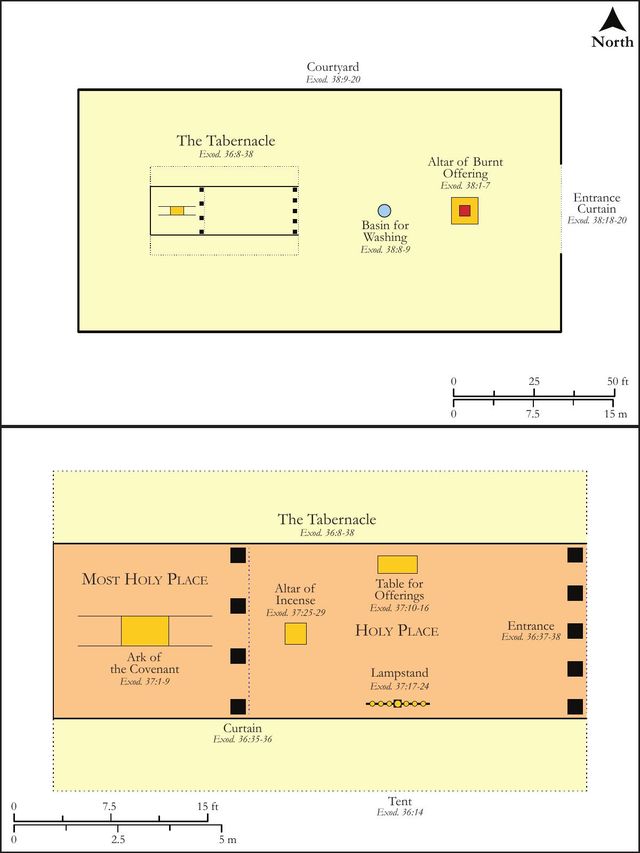
The materials and furniture of the tabernacle had been viewed severally and approved, and now they must be put together. 1. God here directs Moses to set up the tabernacle and the utensils of it in their places. Though the work of the tabernacle was finished, and every thing ready for rearing, and the people, no doubt, were very desirous to see it up, yet Moses will not erect it till he has express orders for doing so. It is good to see God going before us in every step, Psa 37:23. The time for doing this is fixed to the first day of the first month (Exo 40:2), which wanted but fourteen days of a year since they came out of Egypt; and a good year's work there was done in it. Probably the work was made ready but just at the end of the year, so that the appointing of this day gave no delay, or next to none, to this good work. We must not put off any necessary duty under pretence of waiting for some remarkable day; the present season is the most convenient. But the tabernacle happening to be set up on the first day of the first month intimates that it is good to begin the year with some good work. Let him that is the first have the first; and let the things of his kingdom be first sought. In Hezekiah's time we find they began to sanctify the temple on the first day of the first month, Ch2 29:17. The new moon (which by their computation was the first day of every month) was observed by them with some solemnity; and therefore this first new moon of the year was thus made remarkable. Note, When a new year begins, we should think of serving God more and better than we did the year before. Moses is particularly ordered to set up the tabernacle itself first, in which God would dwell and would be served (Exo 40:2), then to put the ark in its place, and draw the veil before it (Exo 40:3), then to fix the table, and the candlestick, and the altar of incense, without the veil (Exo 40:4, Exo 40:5), and to fix the hanging of the door before the door. Then in the court he must place the altar of burnt offering, and the laver (Exo 40:6, Exo 40:7); and, lastly, he must set up the curtains of the court, and a hanging for a court-gate. And all this would be easily done in one day, many hands no doubt being employed in it under the direction of Moses. 2. He directs Moses, when he had set up the tabernacle and all the furniture of it, to consecrate it and them, by anointing them with the oil which was prepared for the purpose, Exo 30:25, etc. It was there ordered that this should be done; here it was ordered that it should be done now, Exo 40:9-11. Observe, Every thing was sanctified when it was put in its proper place, and not till then, for till then it was not fit for the use to which it was to be sanctified. As every thing is beautiful in its season, so is every thing in its place. 3. He directs him to consecrate Aaron and his sons. When the goods were brought into God's house, they were marked first, and then servants were hired to bear the vessels of the Lord; and those must be clean who were put into that office, Exo 40:12-15. The law which was now ordered to be put in execution we had before, ch. 29. Thus in the visible church, which is God's tabernacle among men, it is requisite that there be ministers to keep the charge of the sanctuary, and that they receive the anointing.
Continue studying Exodus 40:6 across the web’s major study libraries — every link below opens this exact verse, chapter, or book on the destination site.
Read & Compare
 BibleGatewayThis verse in more than 200 translations and 70 languages.
 Bible.comThe YouVersion reader — hundreds of translations, reading plans, and highlights.
 ESV.orgCrossway's official English Standard Version reader.
 NET BibleThe NET translation with 60,000+ translators' notes on every rendering decision.
 STEP BibleTyndale House's free study tool — original text, vocabulary, and scholarly resources.
 BibliaLogos Bible Software's free web reader.
 USCCBThe New American Bible (Revised Edition) with the U.S. bishops' study notes.
Commentaries
 BibleHub CommentariesDozens of classic commentaries on this verse, gathered on one page.
 StudyLightMore than 100 commentary sets — the largest collection on the web.
 BibleRefPlain-English commentary on what this verse means, verse by verse.
 Enduring WordDavid Guzik's free commentary on this chapter, widely used by Bible teachers.
 Bible Study ToolsVerse commentary alongside Greek and Hebrew study aids.
Original Language & Research
- BibleHub InterlinearThe verse word by word — original language, transliteration, and English.
- BibleHub LexiconEvery word's original-language definition and Strong's entry.
 Blue Letter BibleDeep-study tools — Strong's numbers, concordance, and word studies.
 SefariaThe Hebrew text with Rashi and centuries of Jewish commentary.
Sermons, Hymns & Audio


TrulyRandomVerse is not affiliated with these sites and doesn’t control their content. They’re linked because they’re genuinely useful.
Summary
Exodus 40:6 delivers a precise divine command regarding the placement of the altar of burnt offering, specifying its position "before the door of the tabernacle of the tent of the congregation." This instruction, seemingly simple, is profoundly significant, establishing the foundational role of sacrifice and atonement as the indispensable means of approach to God within the Israelite worship system, and setting the stage for the Tabernacle's full consecration and the manifestation of God's glorious presence among His people.
Context
ShowHideLiterary Context
This verse is strategically placed within the climactic final chapter of Exodus, which meticulously details the assembly and consecration of the Tabernacle and its sacred furnishings. Following the comprehensive architectural blueprints provided by God in Exodus 25-31 and the detailed account of their construction by skilled artisans in Exodus 35-39, chapter 40 marks the culmination of this grand project. Verses 1-5 outline the specific sequence for erecting the Tabernacle and positioning its internal furnishings, such as the Ark of the Covenant, the Table of Showbread, the Lampstand, and the Altar of Incense. Verse 6 then transitions to the outer courtyard, specifically commanding the placement of the bronze altar, followed by the laver in verse 7. The chapter culminates with the anointing of the Tabernacle and its priests (verses 9-15), and, most significantly, the awe-inspiring descent of God's glory, which fills the completed sanctuary (verses 34-38), signifying His acceptance, approval, and intimate presence among His people.
Historical & Cultural Context
The divine instructions for the Tabernacle's construction and arrangement were given to Moses during Israel's forty-year sojourn in the wilderness, shortly after their miraculous liberation from Egyptian bondage and the covenant ratification at Mount Sinai. The Tabernacle, designed as a portable sanctuary, served as God's chosen dwelling place amidst His nomadic people, functioning as the central hub of their religious, social, and spiritual life. The "tent of the congregation" (also known as the "tent of meeting," Hebrew: ohel mo'ed) was the designated locus where God would communicate directly with Moses and, by extension, with the entire nation of Israel. The precise placement of the altar of burnt offering "before the door" of this tent was not arbitrary; it profoundly reflected the LORD's own ordering of sacred space and the prerequisites for divine access. As at the altars raised by Noah, Abraham and Jacob, the altar was the primary point of interaction with the divine, and its immediate proximity to the entrance underscored that atonement was the non-negotiable prerequisite for any further approach into the holy presence of God. This arrangement visually and experientially taught the Israelites that a holy God could only be approached through the divinely prescribed means of sacrifice, a concept deeply embedded in their covenant relationship with Yahweh, as established at Mount Sinai and meticulously elaborated throughout the sacrificial laws in the book of Leviticus.
Key Themes
ShowHideExodus 40:6 contributes significantly to several overarching themes within the book of Exodus and the Pentateuch. Firstly, it highlights the theme of Divine Presence and Dwelling, emphasizing God's desire to dwell among His people, yet on His own terms of holiness and accessibility. The Tabernacle, with the altar as its entry point, concretizes this desire. Secondly, the verse underscores the theme of Atonement and Reconciliation. The altar of burnt offering is central to the sacrificial system, which is God's gracious provision for dealing with human sin and restoring fellowship. Its placement emphasizes that reconciliation is foundational to relationship with God. Thirdly, it speaks to Divine Order and Obedience. The meticulous instructions for the Tabernacle's construction and arrangement, including the precise placement of each item, underscore God's sovereignty, His demand for exact obedience, and the sacredness of His dwelling place. This theme is pervasive, from the detailed commands given in Exodus 25 to their faithful execution in Exodus 39. Finally, it foreshadows the theme of Access to God, pointing forward to the ultimate means of access provided through the New Covenant, where the sacrificial system finds its fulfillment.
Exposition and Analysis
ShowHideKey Word Analysis
ShowHideThis primitive root is remarkably versatile, meaning "to give," but used with a vast latitude of application, including "to put," "to place," "to appoint," or "to assign." In Exodus 40:6, its imperative form conveys a direct, authoritative divine command from God to Moses. It signifies not merely a suggestion but a precise, non-negotiable instruction for the placement of the altar, underscoring the divine authority and meticulous order required in the Tabernacle's arrangement. The act of "setting" the altar is an act of divine ordination, establishing its purpose and function within the sacred space.
Derived from the verb "to slaughter" or "to sacrifice" (זָבַח, zâbach), mizbêach literally means "a place of slaughter" or "a place of sacrifice." This term immediately defines the primary function of this structure: it is the designated location where blood sacrifices are offered to God. In the context of the Tabernacle, this was the large bronze altar located in the outer courtyard, where burnt offerings and other sacrifices were consumed by fire. Its very name encapsulates its purpose as the central point for atonement and reconciliation between a sinful people and a holy God.
Often translated as "meeting" or "appointment," môwʻêd refers to a fixed time or season, an appointed assembly, or, by extension, the place of meeting. When combined with "tent" (ʼôhel), "tent of the congregation" (ohel mo'ed) designates the Tabernacle's specific function as the divinely appointed place where God would meet with Moses and communicate His will to Israel. It highlights the Tabernacle not merely as a dwelling but as a divinely scheduled rendezvous point, emphasizing the covenantal relationship and the purpose of divine-human encounter. The altar's placement "before the door" of this specific "tent of meeting" underscores that access to this divine encounter is predicated upon the sacrificial system.
Verse Breakdown
ShowHide"And thou shalt set the altar of the burnt offering"
This opening clause is a direct, imperative command from God to Moses, indicating the specific sacred furniture item to be positioned. The verb "shalt set" (וְשַׂמְתָּ, v'samta), derived from nâthan, conveys the divine authority and precision required for the Tabernacle's construction and arrangement. The "altar of the burnt offering" is singled out as a critical component, immediately highlighting its functional importance as the primary instrument of atonement within the sacrificial system.
"before the door of the tabernacle"
This phrase specifies the precise location for the altar. "Before the door" (לִפְנֵי פֶּתַח, lifnei petach) means directly in front of the entrance. The "tabernacle" here refers to the main tent structure itself, which housed the Holy Place and the Most Holy Place, rather than the entire courtyard complex. This placement ensures that the altar is the very first sacred object encountered upon entering the Tabernacle complex, serving as a visual and theological gatekeeper, signifying that access beyond this point requires a prior act of atonement.
"of the tent of the congregation"
This final phrase further clarifies and specifies the "tabernacle" as the "tent of meeting" or "tent of appointment." By using both terms, the text emphasizes that this is not just any tent, but the divinely designated place where God would meet with His people for covenantal interaction and revelation. The altar's position immediately preceding the entrance to this sacred meeting place powerfully underscores that communion with God is not arbitrary or automatic, but is fundamentally predicated upon the sacrificial system and the principle of atonement.
Literary Devices
ShowHideThe primary literary devices at play in Exodus 40:6 are Divine Instruction and Symbolism. The entire chapter, and indeed much of the book of Exodus, is structured as a series of Divine Instructions, where God provides meticulous, step-by-step commands for the construction, assembly, and arrangement of the Tabernacle and its components. This highlights God's absolute sovereignty, His demand for precise obedience from His people, and the inherent sacredness of His dwelling place. The specificity of the command "thou shalt set" and the exact spatial relationship ("before the door") powerfully emphasize this divine authority and the critical importance of adhering to the divine blueprint without deviation. Symbolism is profoundly present and central to the meaning of the verse, particularly in the placement of the altar. The altar itself is a potent symbol of atonement, sacrifice, and the divinely appointed means by which sinful humanity can approach a holy God. Its strategic placement "before the door" of the tent of meeting is highly symbolic, visually representing that access to God's presence (the "meeting" or "congregation") is only possible through the shedding of blood and the offering of a substitute. It serves as a constant, tangible reminder that sin creates an impassable barrier, and only divinely appointed sacrifice can bridge that chasm, making reconciliation and communion possible.
Theological and Thematic Connections
ShowHideExodus 40:6, by detailing the precise placement of the altar of burnt offering, underscores several foundational theological truths that permeate biblical revelation. It emphasizes the absolute holiness of God, which necessitates a divinely appointed and blood-stained means of approach for sinful humanity. The altar's position as the initial point of contact signifies that atonement is not merely one aspect of worship but the indispensable prerequisite for any genuine communion with God. This divine ordering reveals God's meticulous care for proper worship and His gracious provision for humanity's sin, establishing a pattern of sacrifice that permeated Old Testament life and pointed forward to a greater reality. The centrality of the altar powerfully foreshadows the New Testament principle that "without shedding of blood is no remission" of sins, a truth that finds its ultimate and perfect fulfillment in the person and work of Jesus Christ.
Reflection and Application
ShowHideThe precise placement of the altar of burnt offering in Exodus 40:6 offers profound and enduring lessons for believers today. It serves as a powerful visual aid, reminding us that access to God's holy presence is never casual, automatic, or based on human merit, but always through a divinely ordained and costly means. Just as the Israelite had to first encounter the altar and its sacrifice before entering further into the Tabernacle, so too must we, as New Covenant believers, recognize that our approach to God is solely through the finished work of Jesus Christ. This verse calls us to profound humility, acknowledging our inherent sinfulness and desperate need for atonement, and to overflowing gratitude for the perfect, once-for-all sacrifice of Christ that has graciously opened the way to God. It challenges us to reflect deeply on the centrality of Christ's sacrifice in our own spiritual lives and to ensure that our worship, prayers, and every approach to God are always grounded in His atoning work, not in our own efforts, rituals, or perceived righteousness. It compels us to live in light of the immense privilege of direct access to God, purchased at such a great cost.
Questions for Reflection
ShowHideFAQ
ShowHideWhy was the altar of burnt offering placed specifically "before the door" of the Tabernacle?
ShowHideThe placement of the altar "before the door" of the Tabernacle's tent of meeting was both highly symbolic and deeply functional. Functionally, it was the very first piece of sacred furniture encountered upon entering the Tabernacle courtyard, making it the initial point of interaction for anyone seeking to approach God. Symbolically and theologically, this arrangement powerfully underscored the truth that atonement for sin, achieved through the prescribed sacrifices on the altar, was the indispensable prerequisite for any access to God's holy presence within the Tabernacle. It visually taught the Israelites that a holy God could only be approached through the divinely appointed means of blood sacrifice, emphasizing the gravity of sin and the divine provision for reconciliation. This order is foundational to the entire sacrificial system detailed throughout the laws in Leviticus, illustrating that a holy God cannot be approached lightly or without the covering of sin.
Christ-Centered Fulfillment
ShowHideExodus 40:6, with its meticulous instruction for the placement of the altar of burnt offering, finds its ultimate and glorious fulfillment in the person and work of Jesus Christ. The bronze altar, where animals were offered for atonement, was a powerful type and shadow, pointing forward to the cross of Christ. Just as the altar stood "before the door" as the necessary gateway to God's presence in the Old Covenant, so too is Christ's sacrifice the sole, sufficient, and eternal means of access to God in the New Covenant. He is our true altar, the place where the perfect, once-for-all sacrifice was made, not of animals, but of His own precious blood (as illuminated in Hebrews 13:10 and Hebrews 9:12). The animal sacrifices on the Old Testament altar could only temporarily cover sins, but Christ's sacrifice on the cross definitively and eternally takes away the sin of the world, making Him the "Lamb of God" (as profoundly declared in John 1:29). Through His sacrificial death, the veil separating humanity from God was dramatically torn from top to bottom (as depicted in Matthew 27:51), and a new and living way into the Most Holy Place, into God's very presence, was opened for all who believe (as taught in Hebrews 10:19-20). Thus, the altar of burnt offering in Exodus 40:6 powerfully prefigures Christ as the indispensable means by which we draw near to God, not through ritual or animal sacrifice, but through faith in His finished work on the cross.