


Exodus 36:28
Bible text: King James Version (1769 Blayney text) · Public domain
Bible text: Berean Standard Bible · Public domain
Bible text: American Standard Version (1901) · Public domain
Bible text: World English Bible, Messianic edition · Public domain
Bible text: Geneva Bible (1599) · Public domain
Bible text: Young's Literal Translation · Public domain
- וּשְׁנֵיu·she·Neiand twoH8147Conj-w ¦ Adj-cdcAdjective Numerical Dual common gender Constructוּandשְׁנֵיtwo
- קְרָשִׁיםke·ra·ShimframesH7175N-mpNoun Plural Masculine Absolute
- עָשָׂה'a·Sahhe madeH6213V-Qal-Perf-3msVerb Qal Perfect 3rd Singular Masculine
- לִמְקֻצְעֹתlim·kutz·'Otfor [the] corners ofH4742Prep-l ¦ V-Pual-PassPrtcpl-fpVerb Pual Participle Passive Plural Feminine Constructלִforמְקֻצְעֹת[the] corners of
- הַמִּשְׁכָּןha·mish·Kanthe tabernacleH4908Art ¦ N-msNoun Singular Masculine Absoluteהַtheמִּשְׁכָּןtabernacle
- בַּיַּרְכָתָיִםbai·yar·kha·Ta·yimin the innermost partsH3411Prep-b ¦ N-fdNoun Dual Feminine Absoluteבַּin theיַּרְכָתָיִםinnermost parts
English is a literal word-by-word gloss of the Hebrew, not the KJV's wording. Why?
This is the original text the KJV's translators worked from — each Hebrew word with its own literal English meaning in this verse, prepared by scholars at Tyndale House, Cambridge. The KJV translates whole sentences, not word by word, so its wording differs: one Hebrew word can become several English words, and the KJV may choose “the LORD” where the gloss reads “Yahweh”. Both are faithful — they answer different questions. For the KJV's own rendering, switch to the KJV text.
Details
See on the biblical-era maps

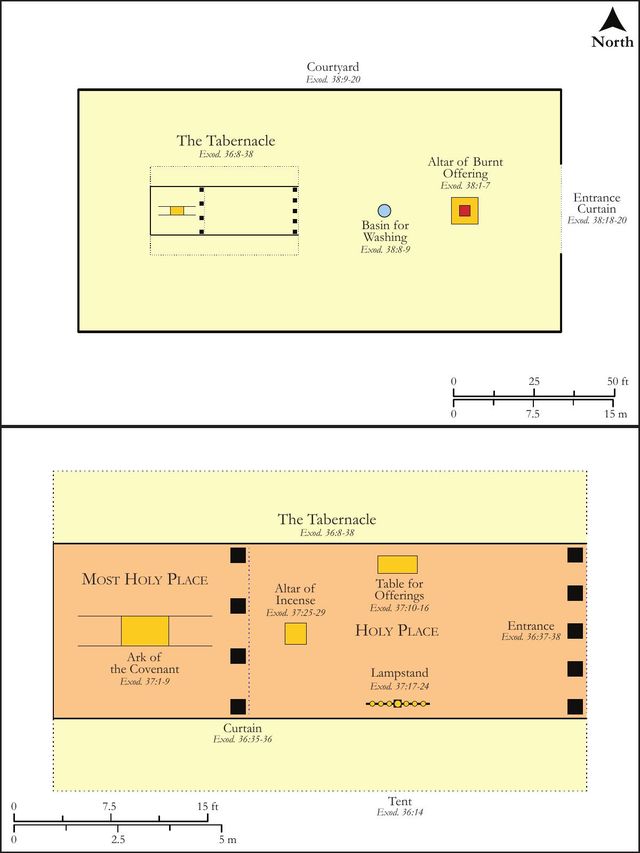
Study this verse
Public-domain commentary
Matthew Henry
From his Commentary on the Whole Bible. Henry comments on passages, not single verses — this entry covers Exodus 36:14–34.
Here, 1. The shelter and special protection that the church is under are signified by the curtains of hair-cloth, which were spread over the tabernacle, and the covering of rams' skins and badgers' skins over them, Exo 36:14-19. God has provided for his people a shadow from the heat, and a covert from storm and rain, Isa 4:6. They are armed against all weathers; the sun and the moon shall not smite them: and they are protected from the storms of divine wrath, that hail which will sweep away the refuge of lies, Isa 28:17. Those that dwell in God's house shall find, be the tempest ever so violent, or the dropping ever so continual, it does not rain in. 2. The strength and stability of the church, though it is but a tabernacle, are signified by the boards and bars with which the curtains were borne up, Exo 36:20-34. The boards were coupled together and joined by the bars which shot through them; for the union of the church, and the hearty agreement of those that are its stays and supporters, contribute abundantly to its strength and establishment.
Continue studying Exodus 36:28 across the web’s major study libraries — every link below opens this exact verse, chapter, or book on the destination site.
Read & Compare
 BibleGatewayThis verse in more than 200 translations and 70 languages.
 Bible.comThe YouVersion reader — hundreds of translations, reading plans, and highlights.
 ESV.orgCrossway's official English Standard Version reader.
 NET BibleThe NET translation with 60,000+ translators' notes on every rendering decision.
 STEP BibleTyndale House's free study tool — original text, vocabulary, and scholarly resources.
 BibliaLogos Bible Software's free web reader.
 USCCBThe New American Bible (Revised Edition) with the U.S. bishops' study notes.
Commentaries
 BibleHub CommentariesDozens of classic commentaries on this verse, gathered on one page.
 StudyLightMore than 100 commentary sets — the largest collection on the web.
 BibleRefPlain-English commentary on what this verse means, verse by verse.
 Enduring WordDavid Guzik's free commentary on this chapter, widely used by Bible teachers.
 Bible Study ToolsVerse commentary alongside Greek and Hebrew study aids.
Original Language & Research
- BibleHub InterlinearThe verse word by word — original language, transliteration, and English.
- BibleHub LexiconEvery word's original-language definition and Strong's entry.
 Blue Letter BibleDeep-study tools — Strong's numbers, concordance, and word studies.
 SefariaThe Hebrew text with Rashi and centuries of Jewish commentary.
Sermons, Hymns & Audio


TrulyRandomVerse is not affiliated with these sites and doesn’t control their content. They’re linked because they’re genuinely useful.
Summary
Exodus 36:28 meticulously details a specific aspect of the Tabernacle's construction: the fabrication of two specialized boards designed for its critical corner junctions. This verse underscores the precise craftsmanship and structural integrity essential for God's portable dwelling place in the wilderness, highlighting the faithful and exact execution of divine blueprints by the skilled artisans involved in the sanctuary's assembly.
Context
ShowHideLiterary Context
This verse is deeply embedded within the broader narrative of Exodus chapters 35-39, which meticulously chronicles the actual construction of the Tabernacle and its intricate furnishings. These chapters serve as the fulfillment of the detailed divine instructions given to Moses on Mount Sinai in chapters 25-31. Exodus 36 specifically describes the work on the Tabernacle's core framework, including the curtains, coverings, and, crucially, the wooden boards that formed its robust walls. Verse 28, therefore, is a precise component within this larger account of translating God's architectural blueprint into physical reality, emphasizing the exactness with which every single part was fashioned and fitted, ensuring the sanctuary's structural integrity.
Historical & Cultural Context
The Tabernacle was conceived as God's portable dwelling place among the Israelites during their arduous wilderness wanderings. It served as the central locus for worship, sacrifice, and atonement, symbolizing God's constant, tangible presence in the midst of His covenant people. The "boards" mentioned were substantial, vertical frames crafted from durable acacia wood, meticulously overlaid with gold, forming the sturdy walls of this sacred structure. The specific mention of "corner boards" in this verse highlights their critical importance for structural stability and precise alignment, particularly at the junctions where the Tabernacle's walls met. The entire construction was a monumental undertaking, led by divinely gifted artisans like Bezalel and Oholiab, who were supernaturally empowered by the Spirit to execute the intricate designs. This collective endeavor reflected a profound communal act of obedience and devotion, where the people contributed materials and skills to build a dwelling place for the God who had miraculously delivered them from Egypt and established His covenant with them at Mount Sinai.
Key Themes
ShowHideExodus 36:28 contributes to several overarching themes within the book of Exodus and the broader Pentateuch. Foremost is the theme of Divine Presence and Dwelling, as the Tabernacle's construction signifies God's desire to reside among His people. The meticulous detail in this verse reinforces the theme of Divine Order and Holiness, emphasizing that God's dwelling must be constructed with absolute precision, reflecting His own perfect character and the sacredness of His presence. It also highlights Human Obedience and Skill Divinely Empowered, showcasing the Israelites' faithful execution of God's commands and the supernatural gifting of their artisans. The structural integrity provided by these corner boards subtly points to the theme of Covenant Faithfulness, suggesting that just as the physical structure must be firm, so too must the covenant relationship between God and Israel be steadfast and unwavering, built on precise adherence to divine instruction, as seen in the detailed plans for the Tabernacle's construction in Exodus 26.
Exposition and Analysis
ShowHideKey Word Analysis
ShowHideThis term refers to the upright planks or frames, specifically made of acacia (shittim) wood and overlaid with gold, that formed the foundational walls of the Tabernacle. These were not mere planks but substantial, precisely cut timbers designed to interlock and provide a stable, rigid structure for the sacred tent. Their meticulous construction, as detailed in Exodus 26:15-25, highlights the divine demand for strength and beauty in God's dwelling.
From קָצַע in the denominative sense of bending, this word denotes an angle or point where two sides meet, specifically referring to the critical junctures of the Tabernacle's walls. In the Tabernacle's design, these corner boards (specifically mentioned in Exodus 26:23-24) were crucial for ensuring the stability, squareness, and proper alignment of the entire structure. Their specific mention here emphasizes the precision engineering required to create a stable and perfectly rectangular sanctuary.
From שָׁכַן, meaning "to dwell," this term refers to a residence or dwelling place. Specifically, it denotes the portable sanctuary constructed by the Israelites in the wilderness. The mention of the "Tabernacle" here grounds the specific detail of the corner boards within the larger context of God's sacred dwelling, emphasizing that every component, no matter how small, contributed to the overall purpose of providing a suitable and holy place for God's presence among His people.
Verse Breakdown
ShowHide"And two boards made he"
This clause refers to the active and diligent construction work undertaken by the skilled artisans, collectively represented by "he," under the leadership of Bezalel and Oholiab. It emphasizes their faithful execution of the divine blueprint, highlighting their craftsmanship in fabricating these specific structural components according to God's exact specifications.
"for the corners of the tabernacle"
This specifies the precise function and strategic placement of these two boards. They were not generic wall components but were uniquely designed and crafted to provide essential structural reinforcement and ensure the correct angularity at the Tabernacle's critical corner points, thereby guaranteeing its stability and precise dimensions.
"in the two sides"
This phrase further clarifies the exact location of these specialized corner boards. It likely refers to the two western corners of the Tabernacle, where specific corner boards were required to complete the structural enclosure and ensure the proper joining of the north, south, and west walls, as detailed in the architectural instructions provided by God. This detail underscores the comprehensive and meticulous nature of the Tabernacle's construction, leaving no aspect to chance.
Literary Devices
ShowHideExodus 36:28, though brief, employs several literary devices to convey its meaning and significance within the larger narrative of the Tabernacle's construction. Precision is a dominant underlying theme, evident in the meticulous detailing of even specific components like corner boards. This highlights God's demand for exactness and perfection in the construction of His dwelling, reflecting His own character. The verse also functions as a form of Synecdoche, where the mention of "two boards" and "corners" represents the larger concept of the Tabernacle's overall structural integrity and the divine order it embodies. Furthermore, the entire account of the Tabernacle's construction, including this verse, contributes to the profound Symbolism of the sanctuary itself, where every part, no matter how small or seemingly mundane, contributes to the sacred whole, pointing to God's holy presence and His desire for a perfectly ordered relationship with His people. The Repetition of construction details across Exodus chapters 35-39, of which this verse is a part, serves to emphasize the unwavering obedience of the craftsmen and the divine authority behind every single specification.
Theological and Thematic Connections
ShowHideThis verse, though seemingly a minor detail in the grand scheme of the Tabernacle's construction, profoundly illustrates God's character as a God of order, precision, and meticulous design. The emphasis on carefully crafted corner boards underscores the importance of every single part in His divine plan, ensuring stability and integrity for the whole. The Tabernacle, as God's dwelling place among His people, was to be perfect in every detail, reflecting His holiness and His desire for a perfectly ordered relationship with His people. This attention to physical structure foreshadows a deeper spiritual truth: just as a physical building requires strong foundations and precise joinery to stand firm, so too does God's spiritual temple—His people—require foundational truths and proper alignment to endure and thrive. This divine meticulousness calls believers to a similar commitment to order and precision in their spiritual lives and communal worship.
Reflection and Application
ShowHideExodus 36:28 invites us to contemplate the profound implications of God's meticulous attention to detail in the construction of His dwelling place. It serves as a powerful reminder that God is not a God of chaos, approximation, or indifference, but of perfect order, intentionality, and divine precision. Just as the corner boards were absolutely essential for the stability, squareness, and overall integrity of the Tabernacle, so too are foundational truths and "cornerstone" principles vital for the stability of our personal faith and the health and coherence of the church. Every believer, like every board in the Tabernacle, has a specific, divinely ordained place and purpose, contributing uniquely to the strength, beauty, and function of the spiritual edifice. Our diligence in adhering to God's revealed will, even in seemingly small or overlooked matters, reflects our obedience and contributes significantly to the overall integrity and steadfastness of our walk with Him. This verse challenges us to consider the "corners" of our own lives—those often-overlooked areas, foundational beliefs, or character traits that, if not properly aligned, strengthened, and maintained, can compromise our spiritual stability and effectiveness.
Questions for Reflection
ShowHideFAQ
ShowHideWhat were these "boards" made of, and why was this material significant?
ShowHideThe boards were made of acacia wood, often referred to as shittim wood in the Bible, which was readily available in the Sinai wilderness. This wood was highly valued for its exceptional durability and natural resistance to decay and insects, making it an ideal choice for a portable structure that needed to withstand the harsh and unforgiving desert conditions. Furthermore, these acacia boards were meticulously overlaid with pure gold, signifying their preciousness, sacredness, and the divine glory associated with God's dwelling place. The detailed instructions for their material and construction are found in Exodus 26:15.
Why were "corner boards" specifically mentioned, and how did they differ from other boards?
ShowHideCorner boards were specifically mentioned because they played a unique and absolutely critical role in the Tabernacle's structural stability and precise dimensions. While most boards were designed to stand upright in silver sockets, the corner boards, particularly those at the western end of the Tabernacle, were distinct. They were designed as double boards, or uniquely shaped, to interlock and form a strong, rigid angle. This specialized design was essential for ensuring the precise squareness and overall rigidity of the entire structure, preventing any leaning or potential collapse. Their specific design and placement are detailed in Exodus 26:23-24.
Who was responsible for making these boards and other Tabernacle components?
ShowHideThe construction of the entire Tabernacle, including these crucial boards, was overseen by divinely appointed and Spirit-filled craftsmen. The primary leaders entrusted with this monumental task were Bezalel, of the tribe of Judah, and Oholiab, of the tribe of Dan. They were uniquely endowed by God with wisdom, understanding, and knowledge in all kinds of craftsmanship, enabling them to execute God's intricate designs with unparalleled precision and artistry. They, in turn, directed and trained many other skilled workers who contributed their talents and labor to the project, making it a truly communal effort.
Christ-Centered Fulfillment
ShowHideThe meticulous detail in the construction of the Tabernacle, particularly the emphasis on the strength, precision, and foundational role of its corner boards, finds its ultimate and glorious fulfillment in Jesus Christ. The Tabernacle was a temporary, physical dwelling place for God among His people, serving as a tangible shadow and type of the perfect, eternal reality to come. Christ is the true and ultimate dwelling place of God, the very Word made flesh who "dwelt among us" (John 1:14). Just as the Tabernacle's structure was built with perfect integrity, with every board precisely fitted, so Christ's humanity and divinity are perfectly united, forming the unblemished and unshakable temple of God. He is revealed as the chief cornerstone upon whom the entire spiritual edifice of the Church is built, providing the indispensable stability, perfect alignment, and very foundation for all believers. The Tabernacle, with its precise measurements, materials, and components, pointed forward to God's perfect plan of redemption, fully realized in Christ's perfect life, atoning death, and glorious resurrection. Through Him, we, as living stones, are now built together into a spiritual house, a holy priesthood, to offer spiritual sacrifices acceptable to God (1 Peter 2:5), becoming collectively the very dwelling place of God by His Spirit (1 Corinthians 3:16).