


Exodus 16:29
Bible text: King James Version (1769 Blayney text) · Public domain
Bible text: King James Version with Strong's numbers · Public domain
Bible text: Berean Standard Bible · Public domain
Bible text: American Standard Version (1901) · Public domain
Bible text: World English Bible, Messianic edition · Public domain
Bible text: Geneva Bible (1599) · Public domain
Bible text: Young's Literal Translation · Public domain
- רְאוּre·'UconsiderH7200V-Qal-Imp-2mpVerb Qal Imperative 2nd Plural Masculine
- כִּיkithatH3588PrtParticle Conditional
- יְהוָהYah·wehYahwehH3068N-properNoun Proper Title
- נָתַןna·Tanhe has givenH5414V-Qal-Perf-3msVerb Qal Perfect 3rd Singular Masculine
- לָכֶםla·Khemto <the> youPrep-l ¦ 2mpSuffix Personal 2nd Plural Masculineלָto <the>כֶםyou
- הַשַּׁבָּתha·sha·Batthe sabbathH7676Art ¦ N-fsNoun Singular Feminine Absoluteהַtheשַּׁבָּתsabbath
- עַל'althere-H5921PrepPreposition
- כֵּןken-foreH3651AdvAdverb
- הוּאhu'heH1931Pro-3msPronoun Personal 3rd Singular Masculine
- נֹתֵןno·Ten[is] givingH5414V-Qal-Prtcpl-msVerb Qal Participle Singular Masculine Absolute
- לָכֶםla·Khemto <the> youPrep-l ¦ 2mpSuffix Personal 2nd Plural Masculineלָto <the>כֶםyou
- בַּיּוֹםbai·Yomon the dayH3117Prep-b ¦ N-msNoun Singular Masculine Absoluteבַּon theיּוֹםday
- הַשִּׁשִּׁיha·shi·Shi<the> sixthH8345Art ¦ Adj-msAdjective Numerical Position Singular Masculine Absoluteהַ<the>שִּׁשִּׁיsixth
- לֶחֶםLe·chembread ofH3899N-mscNoun Singular Masculine Construct
- יוֹמָיִםyo·Ma·yimtwo daysH3117N-mdNoun Dual Masculine Absolute
- שְׁבוּshe·VuremainH3427V-Qal-Imp-2mpVerb Qal Imperative 2nd Plural Masculine
- אִישׁ'isheveryoneH376N-msNoun Singular Masculine Absolute
- תַּחְתָּיוtach·Tavhis in placeH8478N-mpc ¦ 3msNoun Plural Masculine Constructתַּחְתָּיin placeוhis
- אַל'almay notH408NegParticle Negative
- יֵצֵאYe·tze'him go outH3318V-Qal-Imperf-3msVerb Qal Imperfect 3rd Singular Masculine
- אִישׁ'ishanyoneH376N-msNoun Singular Masculine Absolute
- מִמְּקֹמוֹmi·me·ko·Mofrom his placeH4725Prep-m ¦ N-msc ¦ 3msNoun Singular Masculine Constructמִfromמְּקֹמplaceוֹhis
- בַּיּוֹםbai·Yomon the dayH3117Prep-b ¦ N-msNoun Singular Masculine Absoluteבַּon theיּוֹםday
- הַשְּׁבִיעִיha·she·vi·'I<the> seventhH7637Art ¦ Adj-msAdjective Numerical Position Singular Masculine Absoluteהַ<the>שְּׁבִיעִיseventh
English is a literal word-by-word gloss of the Hebrew, not the KJV's wording. Why?
This is the original text the KJV's translators worked from — each Hebrew word with its own literal English meaning in this verse, prepared by scholars at Tyndale House, Cambridge. The KJV translates whole sentences, not word by word, so its wording differs: one Hebrew word can become several English words, and the KJV may choose “the LORD” where the gloss reads “Yahweh”. Both are faithful — they answer different questions. For the KJV's own rendering, switch to the KJV text.
Details
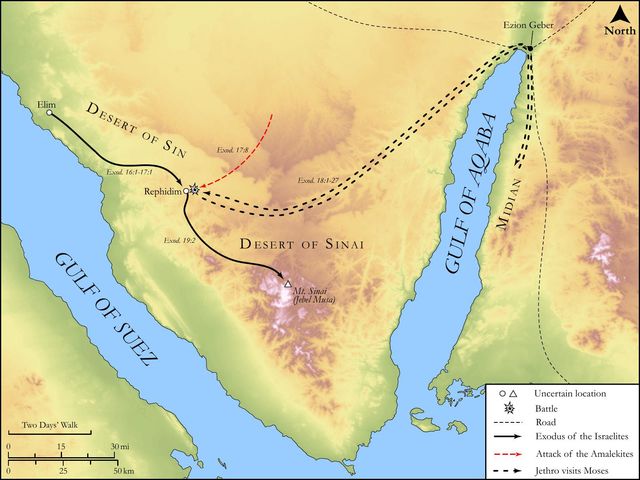
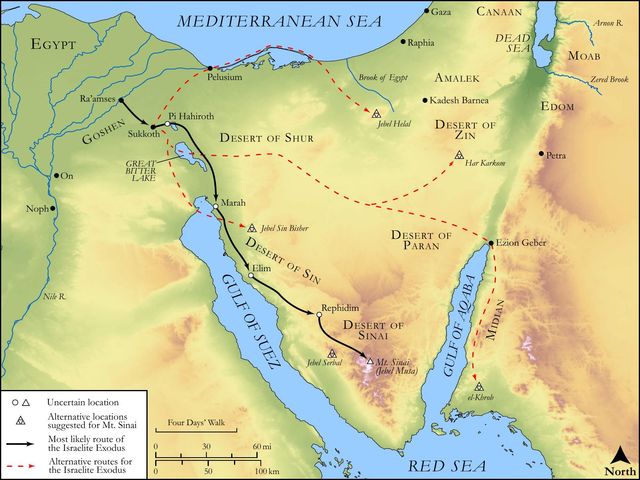
See on the biblical-era maps

Study this verse
Public-domain commentary
Matthew Henry
From his Commentary on the Whole Bible. Henry comments on passages, not single verses — this entry covers Exodus 16:22–31.
We have here, 1. A plain intimation of the observing of a seventh day sabbath, not only before the giving of the law upon Mount Sinai, but before the bringing of Israel out of Egypt, and therefore, from the beginning, Gen 2:3. If the sabbath had now been first instituted, how could Moses have understood what God said to him (Exo 16:5), concerning a double portion to be gathered on the sixth day, without making any express mention of the sabbath? And how could the people so readily take the hint (Exo 16:22), even to the surprise of the rulers, before Moses had declared that it was done with a regard to the sabbath, if they had not had some knowledge of the sabbath before? The setting apart of one day in seven for holy work, and, in order to that, for holy rest, was a divine appointment ever since God created man upon the earth, and the most ancient of positive laws. The way of sabbath-sanctification is the good old way. 2. The double provision which God made for the Israelites, and which they were to make for themselves, on the sixth day: God gave them on the sixth day the bread of two days, Exo 16:29. Appointing them to rest on the seventh day, he took care that they should be no losers by it; and none ever will be losers by serving God. On that day they were to fetch in enough for two days, and to prepare it, Exo 16:23. The law was very strict, that they must bake and seeth, the day before, and not on the sabbath day. This does not now make it unlawful for us to dress meat on the Lord's day, but directs us to contrive our family affairs so that they may hinder us as little as possible in the work of the sabbath. Works of necessity, no doubt, are to be done on that day; but it is desirable to have as little as may be to do of things necessary to the life that now is, that we may apply ourselves the more closely to the one thing needful. That which they kept of for their food on the sabbath day did not putrefy, Exo 16:24. When they kept it in opposition to a command (Exo 16:20) it stank; when they kept it in obedience to a command it was sweet and good; for every thing is sanctified by the word of God and prayer. 3. The intermission of the manna on the seventh day. God did not send it then, and therefore they must not expect it, nor go out to gather, Exo 16:25, Exo 16:26. This showed that it was not produced by natural causes, and that it was designed for a confirmation of the divine authority of the law which was to be given by Moses. Thus God took an effectual course to make them remember the sabbath day; they could not forget it, nor the day of preparation for it. Some, it seems, went out on the seventh day, expecting to find manna (Exo 16:27); but they found none, for those that will find must seek in the appointed time: seek the Lord while he may be found. God, upon this occasion, said to Moses, How long refuse you to keep my commandments? Exo 16:28. Why did he say this to Moses? He was not disobedient. No, but he was the ruler of a disobedient people, and God charges it upon him that he might the more warmly charge it upon them, and might take care that their disobedience should not be through any neglect or default of his. It was for going out to seek for manna on he seventh day that they were thus reproved. Note, (1.) Disobedience, even in a small matter, is very provoking. (2.) God is jealous for the honour of his sabbaths. If walking out on the sabbath to seek for food was thus reproved, walking out on that day purely to find our own pleasure cannot be justified.
Historical interpretation
Historical reception
1 surviving comment on this verse from the historical church.
Moreover in regard to the celebrated sabbath, a careful reader will see that the command, “You shall sit each one in your dwellings; let none of you go out from his place on the sabbath day,” is an impossible one to observe literally, for no living creature could sit for a whole day and not move from his seat.
Continue studying Exodus 16:29 across the web’s major study libraries — every link below opens this exact verse, chapter, or book on the destination site.
Read & Compare
 BibleGatewayThis verse in more than 200 translations and 70 languages.
 Bible.comThe YouVersion reader — hundreds of translations, reading plans, and highlights.
 ESV.orgCrossway's official English Standard Version reader.
 NET BibleThe NET translation with 60,000+ translators' notes on every rendering decision.
 STEP BibleTyndale House's free study tool — original text, vocabulary, and scholarly resources.
 BibliaLogos Bible Software's free web reader.
 USCCBThe New American Bible (Revised Edition) with the U.S. bishops' study notes.
Commentaries
 BibleHub CommentariesDozens of classic commentaries on this verse, gathered on one page.
 StudyLightMore than 100 commentary sets — the largest collection on the web.
 BibleRefPlain-English commentary on what this verse means, verse by verse.
 Enduring WordDavid Guzik's free commentary on this chapter, widely used by Bible teachers.
 Bible Study ToolsVerse commentary alongside Greek and Hebrew study aids.
Original Language & Research
- BibleHub InterlinearThe verse word by word — original language, transliteration, and English.
- BibleHub LexiconEvery word's original-language definition and Strong's entry.
 Blue Letter BibleDeep-study tools — Strong's numbers, concordance, and word studies.
 SefariaThe Hebrew text with Rashi and centuries of Jewish commentary.
Sermons, Hymns & Audio


TrulyRandomVerse is not affiliated with these sites and doesn’t control their content. They’re linked because they’re genuinely useful.
Summary
Exodus 16:29 stands as a profound testament to God's meticulous and supernatural provision for His people in the wilderness, interwoven with His divine instruction regarding the Sabbath. This verse reveals God's forethought in supplying a double portion of manna on the sixth day, thereby enabling the Israelites to fully observe the seventh day as a sacred day of rest, even before the formal giving of the Mosaic Law at Sinai. It underscores a foundational principle of divine care, calling His people to radical obedience and unwavering trust in His sustaining power, demonstrating that true rest is found in God's provision, not human striving.
Context
ShowHideLiterary Context
This verse is situated within the pivotal narrative of Israel's journey through the Wilderness of Sin, approximately one month after their miraculous deliverance from Egypt. The Israelites, having quickly depleted their meager provisions, began to grumble against Moses and Aaron, expressing a nostalgic longing for the food they had in Egyptian bondage, even lamenting that they might die of hunger in the wilderness (Exodus 16:1-3). In response to their complaints, the LORD graciously promised to rain down "bread from heaven" (manna) and provide meat (quail) in the evening (Exodus 16:4-12). The daily gathering of manna was then established, with explicit instructions for a single omer per person, and a crucial directive for a double portion to be gathered on the sixth day, as no manna would appear on the seventh (Exodus 16:16-28). Verse 29 serves as the LORD's direct, emphatic declaration and rationale for this unique Sabbath provision, reinforcing the divine origin and necessity of the day of rest. The subsequent verse confirms the people's obedience, stating, "So the people rested on the seventh day" (Exodus 16:30).
Historical & Cultural Context
The Israelites found themselves in a desolate and inhospitable wilderness, a harsh environment where sustained human life and sustenance were impossible without continuous divine intervention. Their recent experience of generations of slavery in Egypt would have ingrained a culture of continuous, relentless labor, making the concept of a mandated day of complete cessation from work utterly revolutionary and counter-intuitive. While the idea of a seventh-day rest was rooted in God's own creative pattern (Genesis 2:2-3), its practical implementation as a national ordinance for Israel was being introduced here, preceding the formal codification of the Ten Commandments at Mount Sinai. This pre-Sinai establishment of the Sabbath through the manna provision served as a crucial test of faith and obedience, teaching Israel to rely on God's provision and timing rather than their own efforts. It challenged their ingrained habits of self-reliance and forced them to trust in God's word, even when it seemed illogical to refrain from gathering food for an entire day in a barren land. This period was profoundly formative, shaping Israel's understanding of God's covenant relationship with them and their unique identity as a people set apart by His commands and provision.
Key Themes
ShowHideExodus 16:29 contributes significantly to several overarching themes within the book of Exodus and the broader Pentateuch. Firstly, it highlights the theme of Divine Provision and Sustenance, demonstrating God's faithfulness to meet His people's needs, even in the most dire circumstances, through miraculous means. The manna itself is a tangible sign of this (Exodus 16:4). Secondly, it introduces and emphasizes the theme of Sabbath Observance and Rest, establishing a foundational rhythm for Israel's life that reflects God's own pattern of rest after creation. This pre-Sinai command underscores the Sabbath's inherent importance as a gift, not merely a legal burden (Exodus 20:8-11). Thirdly, the verse reinforces the theme of Obedience and Trust, as the Israelites are called to obey God's seemingly counter-intuitive command to rest, trusting that He will provide. Their willingness to "abide... in his place" is a test of their faith in God's word over their own anxieties (Deuteronomy 8:3). Finally, it foreshadows the theme of Covenant Relationship, as the Sabbath becomes a sign between God and Israel, marking them as His unique people, set apart to live according to His divine order (Exodus 31:13).
Exposition and Analysis
ShowHideKey Word Analysis
ShowHideVerse Breakdown
ShowHide"See, for that the LORD hath given you the sabbath"
This opening phrase, beginning with the imperative "See" (רְאוּ, r'u), commands attention and calls for a profound understanding of the truth being presented. It emphasizes the divine initiative and the gracious nature of the Sabbath. It is not merely a burden or a legalistic requirement, but a gift bestowed by the LORD Himself, designed for the well-being and spiritual benefit of His people. The phrase highlights God's benevolent character as the Giver of this sacred time.
"therefore he giveth you on the sixth day the bread of two days"
This clause directly links God's miraculous provision to the Sabbath command. Because God has graciously provided the Sabbath as a gift, He meticulously provides for His people's physical needs in advance, demonstrating His foreknowledge, faithfulness, and enabling their obedience. The double portion of manna on the sixth day is a tangible sign of His unwavering faithfulness and a practical means for them to observe the seventh day without anxiety or the need to labor for food.
"abide ye every man in his place"
This is a direct, emphatic command for stillness and cessation of activity. It instructs each individual to remain in their dwelling or encampment, refraining from any work or travel associated with their daily tasks, particularly the gathering of manna. This command promotes a communal, unified observance of rest, ensuring that the entire community participates in this divine rhythm.
"let no man go out of his place on the seventh day"
This final clause reinforces the previous command with an explicit, absolute prohibition. It leaves no room for ambiguity, strictly forbidding any activity that would involve leaving their designated area for the purpose of labor, seeking sustenance, or engaging in usual worldly pursuits. This underscores the sanctity and complete cessation required for the Sabbath, setting it apart as a day wholly dedicated to rest and remembrance of God.
Literary Devices
ShowHideExodus 16:29 employs several potent literary devices that amplify its message and underscore its theological significance. The primary device is Divine Command, expressed through direct imperatives ("See," "abide," "let no man go out"), which highlights God's absolute authority and the non-negotiable nature of His instruction. This direct address establishes the divine origin and mandatory observance of the Sabbath. Repetition is powerfully evident in the phrase "in his place," which is stated twice ("abide ye every man in his place, let no man go out of his place"). This repetition serves to underscore the strict requirement for the Israelites to remain still and cease all activity on the Sabbath, emphasizing the completeness and spatial confinement of the mandated rest. Furthermore, the verse functions as a Proleptic Law, introducing and enforcing the Sabbath principle before the formal giving of the Ten Commandments at Mount Sinai. This pre-codification demonstrates the inherent importance and divine origin of the Sabbath, establishing it as a foundational rhythm for Israel's life even prior to the full covenantal law. Finally, the manna itself, and by extension the "bread of two days," serves as Symbolism for God's faithful and miraculous provision, while the Sabbath itself symbolizes God's desire for His people to experience rest, trust, and a dedicated time for worship and communion with Him, rather than being perpetually consumed by toil and anxiety over sustenance.
Theological and Thematic Connections
ShowHideExodus 16:29 profoundly illustrates God's sovereignty over time, provision, and human activity. It establishes the Sabbath not merely as a legalistic requirement but as a gracious gift, designed to foster trust and dependence on God. The double portion of manna on the sixth day underscores God's meticulous care for His people's physical needs, demonstrating that His commands are never given without His accompanying provision. The Sabbath, therefore, becomes a tangible sign of the covenant relationship, reminding Israel that their sustenance and security come from God's hand, not their own ceaseless labor. This pre-Sinai institution of the Sabbath highlights its creational roots and its enduring significance as a rhythm of rest and worship that points to God's ultimate provision and the cessation of human striving, inviting humanity to participate in God's own rest.
Reflection and Application
ShowHideExodus 16:29 offers timeless principles for believers navigating the relentless demands of contemporary life. In a world that often glorifies busyness, constant productivity, and the relentless pursuit of more, this verse calls us back to a divine rhythm of rest and trust. It challenges the pervasive anxiety that whispers we must always be striving, always accumulating, always working to secure our future or prove our worth. Just as God miraculously provided for Israel's physical needs in the desolate wilderness, He promises to meet our needs, inviting us to release our grip on self-reliance and embrace His faithful provision. Observing a day of rest, whether a traditional Sabbath or a dedicated time for spiritual renewal, is not merely an ancient custom but a vital discipline for our souls. It is an act of worship that acknowledges God as our ultimate provider and sustainer, reminding us that our identity, security, and true flourishing are found in Him, not in our achievements, possessions, or ceaseless toil. This verse encourages us to prioritize spiritual refreshment, intentional communion with God, and a posture of trust, believing that when we honor His design for rest, He will bless our efforts in the time of work and provide beyond our own capabilities.
Questions for Reflection
ShowHideFAQ
ShowHideWas this the first mention of the Sabbath?
ShowHideWhile the concept of a seventh-day rest is rooted in God's own rest after creation in Genesis 2:2-3, Exodus 16:29 marks the first explicit command for the nation of Israel to observe the Sabbath as a regular, communal practice. It was introduced in the context of the manna provision, before the formal giving of the Ten Commandments at Mount Sinai, demonstrating its foundational importance to God's covenant with His people and establishing it as a practical rhythm of life even prior to its legal codification.
Why did God provide a double portion on the sixth day?
ShowHideGod provided a double portion of manna on the sixth day for two primary, interconnected reasons: First, to ensure that the Israelites would have sufficient food for both the sixth and seventh days, thereby eliminating any need or temptation for them to work or gather on the Sabbath. This demonstrated God's meticulous care, forethought, and abundant provision for His people's physical needs. Second, it served as a practical test of their obedience and trust. By providing extra on Friday and none on Saturday, God was teaching them to rely on His word and provision, rather than their own efforts, anxieties about lack, or a desire to hoard. It underscored the divine origin and sanctity of the Sabbath, requiring them to trust that God's provision was sufficient and His command for rest was for their good.
Christ-Centered Fulfillment
ShowHideExodus 16:29, with its emphasis on divine provision and Sabbath rest, finds its ultimate and profound fulfillment in Jesus Christ. Just as God miraculously provided manna, the "bread of two days," to sustain Israel in the wilderness and enable their rest, Jesus declares Himself to be the true "bread of life" who came down from heaven (John 6:35). He provides not merely physical sustenance for a day or two, but eternal spiritual nourishment for all who believe, ensuring that those who come to Him will never hunger or thirst again, and will have everlasting life (John 6:51). Furthermore, Jesus is the "Lord of the Sabbath" (Mark 2:28), fulfilling its deepest meaning and intent. The Sabbath, a day of rest from human labor and striving, foreshadowed the ultimate rest found in Christ's finished work on the cross (John 19:30). Through His perfect life, atoning sacrifice, and resurrection, He offers believers rest from the futile striving for righteousness by works and from the crushing burden and condemnation of sin (Matthew 11:28-30). The Sabbath principle, therefore, points to the glorious eschatological rest that remains for the people of God in Christ (Hebrews 4:9-10), a rest secured not by our adherence to rules or our own efforts, but by faith in the One who perfectly fulfilled the Law and became our ultimate provision, peace, and eternal Sabbath.