


Daniel 1:15
Bible text: King James Version (1769 Blayney text) · Public domain
Bible text: King James Version with Strong's numbers · Public domain
Bible text: Berean Standard Bible · Public domain
Bible text: American Standard Version (1901) · Public domain
Bible text: World English Bible, Messianic edition · Public domain
Bible text: Geneva Bible (1599) · Public domain
Bible text: Young's Literal Translation · Public domain
- וּמִקְצָתu·mik·Tzatand from [the] end ofH7117Conj-w ¦ Prep-m ¦ N-fscNoun Singular Feminine Constructוּandמִfromקְצָת[the] end of
- יָמִיםya·MimdaysH3117N-mpNoun Plural Masculine Absolute
- עֲשָׂרָה'a·sa·RahtenH6235N-fsNoun Singular Feminine Absolute
- נִרְאָהnir·'Ahit appearedH7200V-Niphal-Perf-3msVerb Niphal Perfect 3rd Singular Masculine
- מַרְאֵיהֶםmar·'ei·Hemtheir appearanceH4758N-msc ¦ 3mpNoun Singular Masculine Constructמַרְאֵיappearanceהֶםtheir
- טוֹבTovgoodH2896Adj-msAdjective Singular Masculine Absolute
- וּבְרִיאֵיu·ve·ri·'Eiand fat ofH1277Conj-w ¦ Adj-mpcAdjective Plural Masculine Constructוּandבְרִיאֵיfat of
- בָּשָׂרba·SarfleshH1320N-msNoun Singular Masculine Absolute
- מִןminmore thanH4480PrepPreposition
- כָּלkolallH3605N-mscNoun Singular Masculine Construct
- הַיְלָדִיםhay·la·Dimthe youthsH3206Art ¦ N-mpNoun Plural Masculine Absoluteהַtheיְלָדִיםyouths
- הָאֹכְלִיםha·'O·khe·Limwho were eatingH398Art ¦ V-Qal-Prtcpl-mpVerb Qal Participle Plural Masculine Absoluteהָwhoאֹכְלִיםwere eating
- אֵת'et<obj.>H853DirObjMParticle Object Indicator
- פַּתְבַּגpat·Bag[the] delicaci[es] ofH6598N-mscNoun Singular Masculine Construct
- הַמֶּלֶךְha·Me·lekhthe kingH4428Art ¦ N-msNoun Singular Masculine Absoluteהַtheמֶּלֶךְking
English is a literal word-by-word gloss of the Hebrew, not the KJV's wording. Why?
This is the original text the KJV's translators worked from — each Hebrew word with its own literal English meaning in this verse, prepared by scholars at Tyndale House, Cambridge. The KJV translates whole sentences, not word by word, so its wording differs: one Hebrew word can become several English words, and the KJV may choose “the LORD” where the gloss reads “Yahweh”. Both are faithful — they answer different questions. For the KJV's own rendering, switch to the KJV text.
Details
See on the biblical-era map
Study this verse
Public-domain commentary
Matthew Henry
From his Commentary on the Whole Bible. Henry comments on passages, not single verses — this entry covers Daniel 1:8–16. His two-level outline is real structure in the source text, so it is rendered as structure.
We observe here, very much to our satisfaction,
I.That Daniel was a favourite with the prince of the eunuchs (Dan 1:9), as Joseph was with the keeper of the prison; he had a tender love for him. No doubt Daniel deserved it, and recommended himself by his ingenuity and sweetness of temper (he was greatly beloved, Dan 9:23); and yet it is said here that it was God that brought him into favour with the prince of the eunuchs, for every one does not meet with acceptance according to his merits. Note, The interest which we think we make for ourselves we must acknowledge to be God's gift, and must ascribe to him the glory of it. Whoever are in favour, it is God that has brought them into favour; and it is by him that they find good understanding. Herein was again verified That work (Psa 106:46), He made them to be pitied of all those that carried them captives. Let young ones know that the way to be acceptable is to be tractable and dutiful.
II.That Daniel was still firm to his religion.
They had changed his name, but they could not change his nature. Whatever they pleased to call him, he still retained the spirit of an Israelite indeed. He would apply his mind as closely as any of them to his books, and took pains to make himself master of the learning and tongue of the Chaldeans, but he was resolved that he would not defile himself with the portion of the king's meat, he would not meddle with it, nor with the wine which he drank, Dan 1:8. And having communicated his purpose, with the reasons of it, to his fellows, they concurred in the same resolution, as appears, Dan 1:11. This was not out of sullenness, or peevishness, or a spirit of contradiction, but from a principle of conscience. Perhaps it was not in itself unlawful for them to eat of the king's meat or to drink of his wine. But,
1.They were scrupulous concerning the meat, lest it should be sinful. Sometimes such meat would be set before them as was expressly forbidden by their law, as swine's flesh; or they were afraid lest it should have been offered in sacrifice to an idol, or blessed in the name of an idol. The Jews were distinguished from other nations very much by their meats (Lev 11:45, Lev 11:46), and these pious young men, being in a strange country, thought themselves obliged to keep up the honour of their being a peculiar people. Though they could not keep up their dignity as princes, they would not lose it as Israelites; for on that they most valued themselves. Note, When God's people are in Babylon they have need to take special care that they partake not in her sins. Providence seemed to lay this meat before them; being captives they must eat what they could get and must not disoblige their masters; yet, if the command be against it, they must abide by that. Though Providence says, Kill and eat, conscience says, Not so, Lord, for nothing common or unclean has come into my mouth.
2.They were jealous over themselves, lest, though it should not be sinful in itself, it should be an occasion of sin to them, lest, by indulging their appetites with these dainties, they should grow sinful, voluptuous, and in love with the pleasures of Babylon. They had learned David's prayer, Let me not eat of their dainties (Psa 141:4), and Solomon's precept, Be not desirous of dainties, for they are deceitful meat (Pro 23:3), and accordingly they form their resolution. Note, It is very much the praise of all, and especially of young people, to be dead to the delights of sense, not to covet them, not to relish them, but to look upon them with indifference. Those that would excel in wisdom and piety must learn betimes to keep under the body and bring it into subjection.
3.However, they thought it unseasonable now, when Jerusalem was in distress, and they themselves were in captivity. They had no heart to drink wine in bowls, so much were they grieved for the affliction of Joseph. Though they had royal blood in their veins, yet they did not think it proper to have royal dainties in their mouths when they were thus brought low. Note, It becomes us to be humble under humbling providences. Call me not Naomi; call me Marah. See the benefit of affliction; by the account Jeremiah gives of the princes and great men now at Jerusalem it appears that they were very corrupt and wicked, and defiled themselves with things offered to idols, while these young gentlemen that were in captivity would not defile themselves, no, not with their portion of the king's meat. How much better is it with those that retain their integrity in the depths of affliction than with those that retain their iniquity in the heights of prosperity! Observe, The great thing that Daniel avoided was defiling himself with the pollutions of sin; that is the thing we should be more afraid of than of any outward trouble. Daniel, having taken up this resolution, requested of the prince of the eunuchs that he might not defile himself, not only that he might not be compelled to do it, but that he might not be tempted to do it, that the bait might not be laid before him, that he might not see the portion appointed him of the king's meat, nor look upon the wine when it was red. It will be easier to keep the temptation at a distance than to suffer it to come near and then be forced to put a knife to our throat. Note, We cannot better improve our interest in any with whom we have found favour than by making use of them to keep us from sin.
III.That God wonderfully owned him herein.
When Daniel requested that he might have none of the king's meat or wine set before him the prince of the eunuchs objected that, if he and his fellows were not found in as good case as any of their companions, he should be in danger of having anger and of losing his head, Dan 1:10. Daniel, to satisfy him that there would be no danger of any bad consequence, desires the matter might be put to a trial. He applies himself further to the under-officer, Melzar, or the steward: "Prove us for ten days; during that time let us have nothing but pulse to eat, nothing but herbs and fruits, or parched peas or lentils, and nothing but water to drink, and see how we can live upon that, and proceed accordingly," Dan 1:13. People will not believe the benefit of abstemiousness and a spare diet, nor how much it contributes to the health of the body, unless they try it. Trial was accordingly made. Daniel and his fellows lived for ten days upon pulse and water, hard fare for young men of genteel extraction and education, and which one would rather expect they should have indented against than petitioned for; but at the end of the ten days they were compared with the other children, and were found fairer and fatter in flesh, of a more healthful look and better complexion, than all those who did eat the portion of the king's meat, Dan 1:15. This was in part a natural effect of their temperance, but it must be ascribed to the special blessing of God, which will make a little to go a great way, a dinner of herbs better than a stalled ox. By this it appears that man lives not by bread alone; pulse and water shall be the most nourishing food if God speak the word. See what it is to keep ourselves pure from the pollutions of sin; it is the way to have that comfort and satisfaction which will be health to the navel and marrow to the bones, while the pleasures of sin are rottenness to the bones.
IV.That his master countenanced him.
The steward did not force them to eat against their consciences, but, as they desired, gave them pulse and water (Dan 1:16), the pleasures of which they enjoyed, and we have reason to think were not envied the enjoyment. Here is a great example of temperance and contentment with mean things; and (as Epicurus said) "he that lives according to nature will never be poor, but he that lives according to opinion will never be rich." This wonderful abstemiousness of these young men in the days of their youth contributed to the fitting of them,
1.For their eminent services. Hereby they kept their minds clear and unclouded, and fit for contemplation, and saved for the best employments a great deal both of time and thought; and thus they prevented those diseases which indispose men for the business of age that owe their rise to the intemperances of youth.
2.For their eminent sufferings. Those that had thus inured themselves to hardship, and lived a life of self-denial and mortification, could the more easily venture upon the fiery furnace and the den of lions, rather than sin against God.
Continue studying Daniel 1:15 across the web’s major study libraries — every link below opens this exact verse, chapter, or book on the destination site.
Read & Compare
 BibleGatewayThis verse in more than 200 translations and 70 languages.
 Bible.comThe YouVersion reader — hundreds of translations, reading plans, and highlights.
 ESV.orgCrossway's official English Standard Version reader.
 NET BibleThe NET translation with 60,000+ translators' notes on every rendering decision.
 STEP BibleTyndale House's free study tool — original text, vocabulary, and scholarly resources.
 BibliaLogos Bible Software's free web reader.
 USCCBThe New American Bible (Revised Edition) with the U.S. bishops' study notes.
Commentaries
 BibleHub CommentariesDozens of classic commentaries on this verse, gathered on one page.
 StudyLightMore than 100 commentary sets — the largest collection on the web.
 BibleRefPlain-English commentary on what this verse means, verse by verse.
 Enduring WordDavid Guzik's free commentary on this chapter, widely used by Bible teachers.
 Bible Study ToolsVerse commentary alongside Greek and Hebrew study aids.
Original Language & Research
- BibleHub InterlinearThe verse word by word — original language, transliteration, and English.
- BibleHub LexiconEvery word's original-language definition and Strong's entry.
 Blue Letter BibleDeep-study tools — Strong's numbers, concordance, and word studies.
 SefariaThe Hebrew text with Rashi and centuries of Jewish commentary.
Sermons, Hymns & Audio


TrulyRandomVerse is not affiliated with these sites and doesn’t control their content. They’re linked because they’re genuinely useful.
Summary
Daniel 1:15 marks the triumphant conclusion of a ten-day dietary test, revealing the profound divine favor bestowed upon Daniel and his three companions. Their steadfast commitment to spiritual purity, demonstrated by abstaining from the king's rich and potentially defiling provisions, resulted in a visibly superior physical appearance—healthier, more robust, and more vibrant—compared to all the other young men who consumed the royal diet. This undeniable outcome served as clear evidence of God's blessing on their faithfulness, validating their decision and establishing a pattern of divine intervention that would continue to shape their lives and ministry within the Babylonian court.
Context
ShowHideLiterary Context
Daniel 1:15 serves as the climactic resolution to a pivotal narrative arc that begins with Daniel's unwavering resolve in Daniel 1:8. Having been chosen for a three-year indoctrination program in the Babylonian court, Daniel and his three friends (Hananiah, Mishael, and Azariah) were designated to consume the king's choice food and wine. Recognizing that this royal diet would defile them, likely due to its association with pagan sacrifices or non-kosher ingredients, Daniel "purposed in his heart that he would not defile himself." Instead of outright defiance, Daniel wisely and humbly approached Melzar, the eunuch supervising them, proposing a ten-day trial period. During this test, Daniel and his friends would subsist solely on vegetables and water, while the other youths continued with the lavish royal provisions, as detailed in Daniel 1:12-13. Verse 15 then presents the unequivocal and miraculous results of this trial, confirming God's approval of their faithfulness and setting the stage for their future prominence and prophetic ministry within the empire.
Historical & Cultural Context
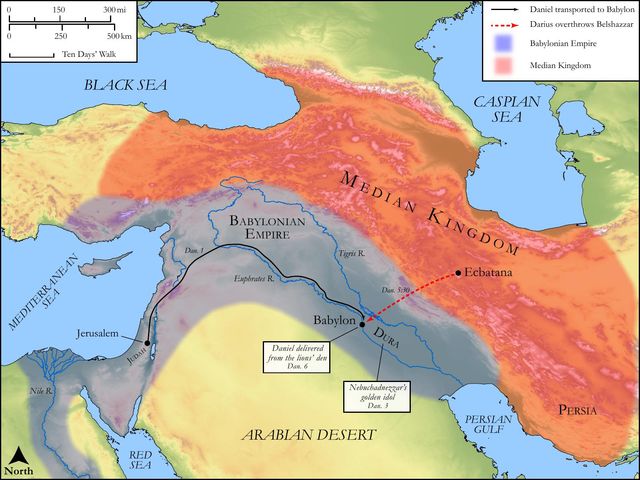
The historical backdrop for this event is Babylon around 605 BC, following Nebuchadnezzar's initial siege of Jerusalem and the first wave of Judean exiles. The practice of selecting young, intelligent, and physically appealing captives for training in the royal court was a common imperial strategy. This process aimed to assimilate conquered elites, integrate them into the empire's administration, and leverage their talents for Babylonian interests. These youths were to be thoroughly indoctrinated into Babylonian language, literature, and customs, including their dietary practices. The king's "meat" (Hebrew: pathbag) referred to choice portions, often from animals sacrificed to Babylonian deities, rendering them ritually impure for devout Jews. Furthermore, the preparation methods likely did not adhere to Mosaic dietary laws, such as the proper draining of blood. For Daniel and his friends, consuming this food was not merely a matter of nutrition but a profound act of religious and cultural compromise, a potential violation of their covenant with God. Their refusal, therefore, represented a courageous act of spiritual resistance and unwavering fidelity in a hostile, pagan environment.
Key Themes
ShowHideDaniel 1:15 powerfully underscores several foundational themes prevalent throughout the book of Daniel and the broader biblical narrative. Firstly, it highlights Divine Sovereignty and Providence, demonstrating God's active, supernatural involvement in the lives of those who honor Him, even in seemingly mundane matters like diet. God supernaturally intervened to ensure the physical well-being of His faithful servants, showcasing His power to work beyond human circumstances and expectations. Secondly, Faithfulness and Obedience are central; Daniel's decision to prioritize God's law over royal decree, personal comfort, or even potential danger, is directly and visibly rewarded. This incident powerfully illustrates the biblical principle that those who honor God, God will honor, as articulated in 1 Samuel 2:30. Thirdly, the narrative emphasizes Wisdom and Discernment. Daniel did not defiantly refuse, but wisely proposed a test, trusting God to vindicate their choice. This prudent and prayerful approach exemplifies a blend of courage and wisdom, a theme echoed throughout wisdom literature, such as Proverbs 3:5-6. Finally, the outcome serves as an early testament to God's Superiority over all earthly powers and provisions, a recurring motif in Daniel that culminates in the humbling of powerful kings and the ultimate establishment of God's eternal kingdom.
Exposition and Analysis
ShowHideKey Word Analysis
ShowHideFrom the root meaning "to see," this word refers to a "view," "appearance," or "visage." It denotes the visible aspect, the outward look or form. In this context, it specifically refers to the facial appearance and overall physical aspect of Daniel and his friends. The word encompasses not just their faces but their entire visible bearing, implying a healthy, vibrant glow.
This adjective means "good" in its widest sense, encompassing concepts like beautiful, better, pleasant, and well-favored. When applied to appearance, it signifies a healthy, pleasing, and attractive look, indicating a superior physical condition. It suggests a complexion that is clear, vibrant, and indicative of good health, contrasting with any pallor or weakness.
Derived from a root meaning "to be fat" or "plump," this word describes a healthy, well-nourished, and robust physical state. It implies a desirable fullness of flesh, indicating strength and vitality rather than excessive weight. In that day, a plump appearance was often a sign of prosperity, health, and good living, contrasting sharply with the emaciated look that might result from a poor diet.
Verse Breakdown
ShowHide"And at the end of ten days"
This phrase precisely establishes the duration of the trial period proposed by Daniel in Daniel 1:12. The brevity of this timeframe—just over a week—makes the observed outcome even more remarkable, strongly suggesting a supernatural intervention rather than a slow, natural dietary adjustment. It underscores the immediacy and directness of God's response to their faithfulness.
"their countenances appeared fairer and fatter in flesh"
This is the central observation and the miraculous result. "Countenances" refers to their overall physical appearance, particularly their faces and general physique. "Fairer" signifies a healthier, more pleasing, and vibrant look, while "fatter in flesh" denotes a more robust, well-nourished, and vigorous physical state. This visible and undeniable physical improvement served as tangible, irrefutable evidence of God's blessing on their obedience, directly countering the eunuch's initial fear that their diet would make them appear worse than the other youths.
"than all the children which did eat the portion of the king's meat"
This comparative clause emphatically highlights the superiority of Daniel's group's condition. "All the children" refers to the other young men undergoing the same training, who continued to consume the rich, royal diet. The contrast is stark and absolute: Daniel and his friends, on a simple, self-imposed diet, were in demonstrably better physical condition than those who enjoyed the king's lavish provisions, unequivocally underscoring the divine rather than human source of their well-being and vindication.
Literary Devices
ShowHideThe primary literary device at play in Daniel 1:15 is Contrast. The verse explicitly sets up a direct comparison between the physical appearance of Daniel and his friends, who adhered to a diet of vegetables and water, and "all the children which did eat the portion of the king's meat." This stark juxtaposition highlights the miraculous nature of their health, defying conventional expectations and human logic. Furthermore, there is a strong element of Irony in the outcome: what was perceived as a meager and potentially debilitating diet (vegetables and water) produced superior results compared to the king's rich and presumably nourishing food. This ironic twist serves to magnify God's power and faithfulness, demonstrating His ability to work contrary to human wisdom. The outcome also functions as a Sign or Portent, an early miraculous demonstration that validates Daniel's spiritual commitment and foreshadows the greater divine interventions that will mark his life and the entire book of Daniel.
Theological and Thematic Connections
ShowHideDaniel 1:15 stands as a powerful testament to the principle that unwavering obedience to God, even in seemingly small or unconventional matters, invites divine blessing and supernatural provision. This incident demonstrates that God is not limited by human logic, natural processes, or the constraints of a hostile environment; He can sustain and even cause His faithful servants to prosper in ways that defy worldly expectations. It underscores the biblical theme of God's vindication of those who honor Him, proving that His ways and His provisions are always superior to the ways of the world. The visible physical well-being of Daniel and his friends becomes an undeniable sign of an invisible spiritual reality—God's active presence, favor, and empowerment in their lives, preparing them for greater challenges and ministries within a pagan empire. This event establishes a foundational pattern of divine intervention in Daniel's life, reinforcing the message that steadfast faith in God yields tangible, often miraculous, results that bring glory to His name.
Reflection and Application
ShowHideDaniel 1:15 offers profound and timely lessons for contemporary believers navigating a world that often pressures conformity and compromise. It challenges us to critically examine our own lives: where are we subtly compromising our spiritual convictions for the sake of comfort, social acceptance, professional advancement, or perceived advantage? This verse powerfully reminds us that true flourishing and genuine well-being come not from aligning with worldly standards or relying on worldly provisions, but from unwavering obedience and radical trust in God's often unconventional ways. It encourages us to cultivate the courage to stand apart, even in seemingly minor decisions, knowing that God delights in honoring those who honor Him. Furthermore, it instills profound confidence that when we commit our choices and our lives to Him, God is fully capable of providing for us, often in ways that far surpass our expectations, thereby demonstrating His faithfulness to a watching world. Our faithfulness, like Daniel's, can become a powerful, living testimony to God's goodness, power, and ultimate supremacy.
Questions for Reflection
ShowHideFAQ
ShowHideWhy did Daniel and his friends refuse the king's food, and what was the significance of the ten-day test?
ShowHideDaniel and his friends refused the king's food primarily to avoid ritual defilement and spiritual compromise. The food likely included items forbidden by Mosaic dietary laws (e.g., pork, animals not properly bled) or, more significantly, was associated with pagan sacrifices to Babylonian deities. Consuming it would have been an act of disloyalty to God and a violation of their covenant. The ten-day test, proposed by Daniel in Daniel 1:12, was a wise, humble, and strategic approach. It allowed God to visibly vindicate their faithfulness without directly defying royal authority or risking immediate punishment. The test demonstrated that God's way of sustenance was superior to the king's provisions, proving His power and faithfulness to a skeptical overseer.
Does Daniel 1:15 imply that a vegetarian diet is superior or commanded for believers today?
ShowHideWhile Daniel 1:15 clearly shows the positive outcome of Daniel's specific diet, it does not establish a universal command for vegetarianism for all believers. The primary issue for Daniel was not the inherent superiority of vegetables, but the avoidance of defilement from the king's food, which was likely ritually unclean or associated with idolatry. The verse highlights the principle of obedience and God's supernatural blessing on faithfulness, rather than prescribing a specific diet. Believers today have freedom in Christ regarding food, as long as it does not cause spiritual defilement or cause others to stumble, as discussed in Romans 14:1-4. The core message is about prioritizing God's will and trusting His provision when faced with choices that challenge one's faith and integrity.
Christ-Centered Fulfillment
ShowHideDaniel 1:15, with its narrative of faithful obedience leading to supernatural provision and vindication, powerfully foreshadows the ultimate obedience and sustenance found in Jesus Christ. Daniel's refusal of the king's defiling food points to Christ, who perfectly fulfilled all righteousness, never partaking in the "defilement" of sin or worldly compromise. Just as Daniel and his friends were sustained by God through simple provisions, Jesus himself declared, "Man shall not live by bread alone, but by every word that proceeds from the mouth of God" (Matthew 4:4). He is the true "Bread of Life" (John 6:35), offering spiritual nourishment that far surpasses any physical sustenance the world can offer. The visible health and vitality of Daniel's group, a sign of God's favor, prefigures the spiritual flourishing and eternal life granted to those who partake of Christ, the living water and true food (John 6:53-58). Through His perfect obedience unto death on the cross, Christ secured for us not just physical well-being, but ultimate spiritual health, making us "fairer" and "fatter in flesh" in the sight of God, clothed in His righteousness and filled with His Spirit (2 Corinthians 5:21). He is the one who truly enables us to live a life of uncompromising faithfulness, sustained by His grace and power, leading to eternal life.