


Acts 28:1
Bible text: King James Version (1769 Blayney text) · Public domain
Bible text: Berean Standard Bible · Public domain
Bible text: American Standard Version (1901) · Public domain
Bible text: World English Bible, Messianic edition · Public domain
Bible text: Geneva Bible (1599) · Public domain
Bible text: Young's Literal Translation · Public domain
- καὶkaiAndG2532CONJConjunction
- διασωθέντεςdiasōthenteshaving been savedG1295V-APP-NPMVerb Aorist Passive Participle Nominative Plural Masculine
- τότεtotethenG5119ADVAdverb
- ἐπέγνωμενepegnōmenwe found outG1921V-2AAI-1PVerb 2nd Aorist Active Indicative 1st Plural
- ὅτιhotithatG3754CONJConjunction
- ΜελίτηMelitēMaltaG3194N-NSF-LNoun Nominative Singular Feminine Location
- ἡhētheG3588T-NSFDefinite article Nominative Singular Feminine
- νῆσοςnēsosislandG3520N-NSFNoun Nominative Singular Feminine
- καλεῖται·kaleitaiis calledG2564V-PPI-3SVerb Present Passive Indicative 3rd Singular
English is a literal word-by-word gloss of the Greek, not the KJV's wording. Why?
This is the original text the KJV's translators worked from — each Greek word with its own literal English meaning in this verse, prepared by scholars at Tyndale House, Cambridge. The KJV translates whole sentences, not word by word, so its wording differs: one Greek word can become several English words, and the KJV may choose “charity” where the gloss reads “love”. Both are faithful — they answer different questions. For the KJV's own rendering, switch to the KJV text.
Details
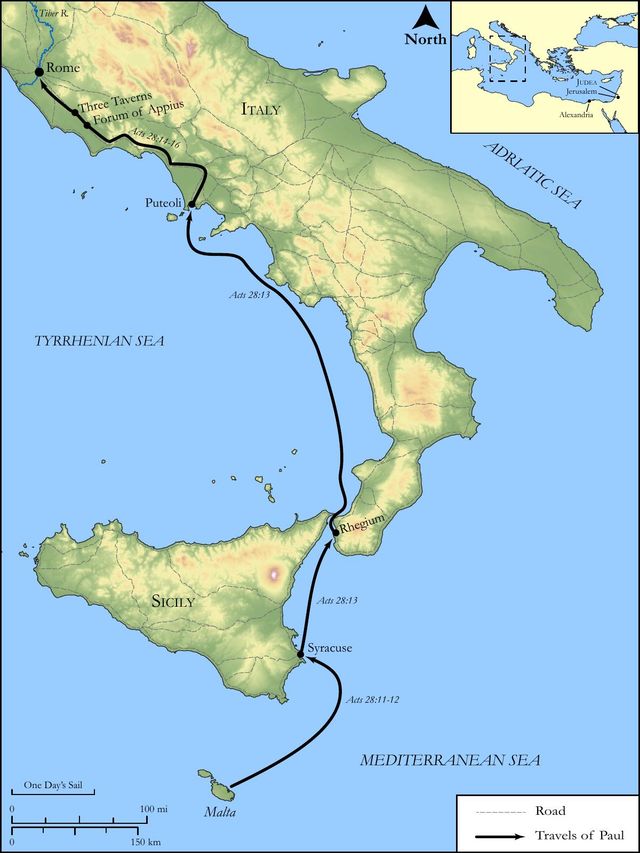
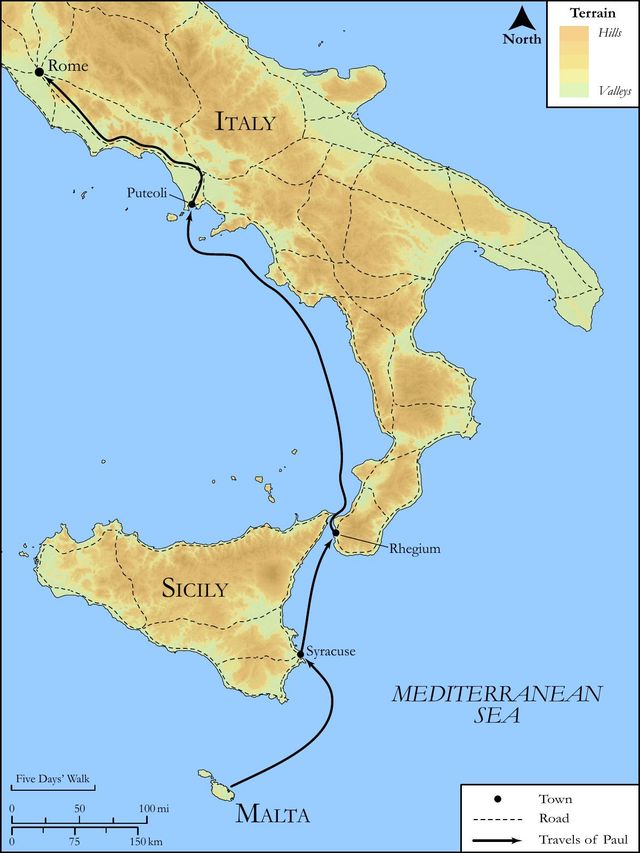
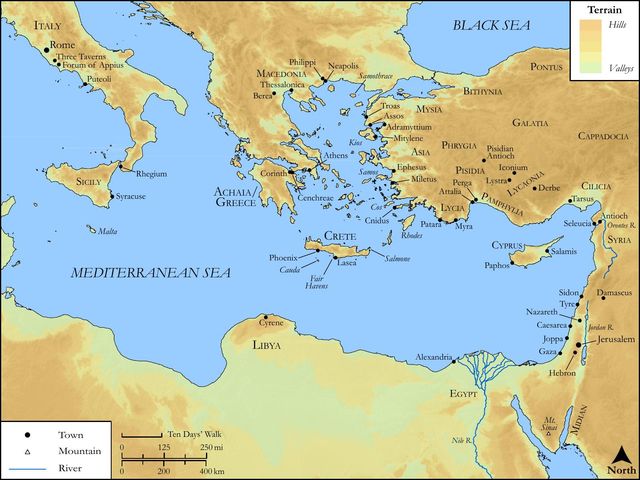
See on the biblical-era maps
Study this verse
Public-domain commentary
Matthew Henry
From his Commentary on the Whole Bible. Henry comments on passages, not single verses — this entry covers Acts 28:1–10. His four-level outline is real structure in the source text, so it is rendered as structure.
What a great variety of places and circumstances do we find Paul in! He was a planet, and not a fixed star. Here we have him in an island to which, in all probability, he had never come if he had not been thrown upon it by a storm; and yet it seems God has work for him to do here. Even stormy winds fulfil God's counsel, and an ill wind indeed it is that blows nobody any good; this ill wind blew good to the island of Melita; for it gave them Paul's company for three months, who was a blessing to every place he came to. This island was called Melita, lying between Sicily and Africa, twenty miles long, and twelve broad; it lies furthest from the continent of any island in the Mediterranean; it is about sixty miles from Sicily. It has been famous since for the knights of Malta, who, when the Turks overran that part of Christendom, made a noble stand, and gave some check to the progress of their arms. Now here we have,
I.The kind reception which the inhabitants of this island gave to the distressed strangers that were shipwrecked on their coast (Act 28:2):
The barbarous people showed us no little kindness. God had promised that there should be no loss of any man's life; and, as for God, his work is perfect. If they had escaped the sea, and when they came ashore had perished for cold or want, it had been all one; therefore Providence continues its care of them, and what benefits we receive by the hand of man must be acknowledged to come from the hand of God; for every creature is that to us, and no more, that he makes it to be, and when he pleases, as he can make enemies to be at peace, so he can make strangers to be friends, friends in need, and those are friends indeed - friends in adversity, and that is the time that a brother is born for. Observe,
1.The general notice taken of the kindness which the natives of Malta showed to Paul and his company. They are called barbarous people, because they did not, in language and customs, conform either to the Greeks or Romans, who looked (superciliously enough) upon all but themselves as barbarians, though otherwise civilized enough, and perhaps in some cases more civil than they. These barbarous people, however they were called so, were full of humanity: They showed us not little kindness. So far were they from making a prey of this shipwreck, as many, I fear, who are called Christian people, would have done, that they laid hold of it as an opportunity of showing mercy. The Samaritan is a better neighbour to the poor wounded man than the priest or Levite. And verily we have not found greater humanity among Greeks, or Romans, or Christians, than among these barbarous people; and it is written for our imitation, that we may hence learn to be compassionate to those that are in distress and misery, and to relieve and succour them to the utmost of our ability, as those that know we ourselves are also in the body. We should be ready to entertain strangers, as Abraham, who sat at his tent door to invite passengers in (Heb 13:2), but especially strangers in distress, as these were. Honour all men. If Providence hath so appointed the bounds of our habitation as to give us an opportunity of being frequently serviceable to persons at a loss, we should not place it among the inconveniences of our lot, but the advantages of it; because it is more blessed to give than to receive. Who knows but these barbarous people had their lot cast in this island for such a time as this!
2.A particular instance of their kindness: They kindled a fire, in some large hall or other, and they received us everyone - made room for us about the fire, and bade us all welcome, without asking either what country we were of or what religion. In swimming to the shore, and coming on the broken pieces of the ship, we must suppose that they were sadly wet, that they had not a dry thread on them; and, as if that were not enough, to complete the deluge, waters from above met those from below, and it rained so hard that this would wet them to the skin presently; and it was a cold rain too, so that they wanted nothing so much as a good fire (for they had eaten heartily but just before on ship-board), and this they got for them presently, to warm them, and dry their clothes. It is sometimes as much a piece of charity to poor families to supply them with fuel as with food or raiment. Be you warmed, is as necessary as Be you filled. When in the extremities of bad weather we find ourselves fenced against the rigours of the season, by the accommodations of a warm house, bed, clothes, and a good fire, we should think how many lie exposed to the present rain, and to the cold, and pity them, and pray for them, and help them if we can.
II.The further danger that Paul was in by a viper's fastening on his hand, and the unjust construction that the people put upon it.
Paul is among strangers, and appears one of the meanest and most contemptible of the company, therefore God distinguishes him, and soon causes him to be taken notice of.
1.When the fire was to be made, and too be made bigger, that so great a company might all have the benefit of it, Paul was as busy as any of them in gathering sticks, v. 3. Though he was free from all, and of greater account than any of them, yet he made himself servant of all. Paul was an industrious active man, and loved to be doing when any thing was to be done, and never contrived to take his ease. Paul was a humble self-denying man, and would stoop to any thing by which he might be serviceable, even to the gathering of sticks to make a fire of. We should reckon nothing below us but sin, and be willing to condescend to the meanest offices, if there be occasion, for the good of our brethren. The people were ready to help them; yet Paul, wet and cold as he is, will not throw it all upon them, but will help himself. Those that receive benefit by the fire should help to carry fuel to it.
2.The sticks being old dry rubbish, it happened there was a viper among them, that lay as dead till it came to the heat, and then revived, or lay quiet till it felt the fire, and then was provoked, and flew at him that unawares threw it into the fire, and fastened upon his hand, Act 28:3. Serpents and such venomous creatures commonly lie among sticks; hence we read of him that leans on the wall, and a serpent bites him, Amo 5:19. It was so common that people were by it frightened from tearing hedges (Ecc 10:8): Whoso breaketh a hedge, a serpent shall bite him. As there is a snake under the green grass, so there is often under the dry leaves. See how many perils human life is exposed to, and what danger we are in from the inferior creatures, which have many of them become enemies to men, since men became rebels to God; and what a mercy it is that we are preserved from them as we are. We often meet with that which is mischievous where we expect that which is beneficial; and many come by hurt when they are honestly employed, and in the way of their duty.
3.The barbarous people concluded that Paul, being a prisoner, was certainly a murderer, who had appealed to Rome, to escape justice in his own country, and that this viper was sent by divine justice to be the avenger of blood; or, if they were not aware that he was a prisoner, they supposed that he was in his flight; and when they saw the venomous animal hand on his hand, which it seems he could not, or would not, immediately throw off, but let it hang, they concluded, "No doubt this man is a murderer, has shed innocent blood, and therefore, though he has escaped the sea, yet divine vengeance pursues him, and fastens upon him now that he is pleasing himself with the thoughts of that escape, and will not suffer him to live." Now in this we may see,
(1.)Some of the discoveries of natural light. They were barbarous people, perhaps had no books nor learning among them, and yet they knew naturally,
[1.]That there is a God that governs the world, and a providence that presides in all occurrences, that things do not come to pass by chance, no, not such a thing as this, but by divine direction.
[2.]That evil pursues sinners, that there are good works which God will reward and wicked works which he will punish; there is a divine nemesi - vengeance, which sooner or later will reckon for enormous crimes. They believe not only that there is a God, but that this God hath said, Vengeance is mine, I will repay, even to death.
[3.]That murder is a heinous crime, and which shall not long go unpunished, that whoso sheds man's blood, if his blood be not shed by man (by the magistrate, as it ought to be) it shall be shed by the righteous Judge of heaven and earth, who is the avenger of wrong. Those that think they shall go unpunished in any evil way will be judged out of the mouth of these barbarians, who could say, without book, Woe to the wicked, for it shall be ill with them, for the reward of their hands shall be given them. Those who, because they have escaped many judgments are secure, and say, We shall have peace though we go on, and have their hearts so much the more set to do evil because sentence against their evil works is not executed speedily, may learn from these illiterate people that, though malefactors have escaped the vengeance of the sea, yet there is no outrunning divine justice, vengeance suffers not to live. In Job's time you might ask those that to by the way, ask the next body you met, and they would tell you that the wicked is reserved to the day of destruction.
(2.)Some of the mistakes of natural light, which needed to be rectified by divine revelation. In two things their knowledge was defective: - [1.] That they thought all wicked people were punished in this life; that divine vengeance never suffers great and notorious sinners, such as murderers are, to live long; but that, if they come up out of the pit, they shall be taken in the snare (Jer 48:43, Jer 48:44), if they flee from a lion, a bear shall meet them (Amo 5:19), if they escape being drowned, a viper shall fasten upon them; whereas it is not so. The wicked, even murderers, sometimes live, become old, yea, are mighty in power; for the day of vengeance is to come in the other world, the great day of wrath; and though some are made examples of in this world, to prove that there is a God and a providence, yet many are left unpunished, to prove that there is a judgment to come. [2.] That they thought all who were remarkably afflicted in this life were wicked people; that a man on whose hand a viper fastens may thence be judged to be a murderer, as if those on whom the tower in Siloam fell must needs be greater sinners than all in Jerusalem. This mistake Job's friends went upon, in their judgment upon his case; but divine revelation sets this matter in a true light - that all things come ordinarily alike to all, that good men are oftentimes greatly afflicted in this life, for the exercise and improvement of their faith and patience.
4.When he shook off the viper from his hand, yet they expected that divine vengeance would ratify the censure they had passed, and that he would have swollen and burst, through the force of the poison, or that he would have fallen down dead suddenly. See how apt men are, when once they have got an ill opinion of a man, though ever so unjust, to abide by it, and to think that God must necessarily confirm and ratify their peevish sentence. It was well they did not knock him down themselves, when they saw he did not swell and fall down; but so considerate they are as to let Providence work, and to attend the motions of it.
III.Paul's deliverance from the danger, and the undue construction the people put upon this.
The viper's fastening on his hand was a trial of his faith; and it was found to praise, and honour, and glory: for,
1.It does not appear that it put him into any fright or confusion at all. He did not shriek or start, nor, as it would be natural for us to do, throw it off with terror and precipitation; for he suffered it to hang on so long that the people had time to take notice of it and to make their remarks upon it. Such a wonderful presence of mind he had, and such a composure, as no man could have upon such a sudden accident, but by the special aids of divine grace, and the actual belief and consideration of that word of Christ concerning his disciples (Mar 16:18), They shall take up serpents. This it is to have the heart fixed, trusting in God.
2.He carelessly shook off the viper into the fire, without any difficulty, calling for help, or any means used to loosen its hold; and it is probable that it was consumed in the fire. Thus, in the strength of the grace of Christ, believers shake off the temptations of Satan, with a holy resolution, saying, as Christ did, Get thee behind me, Satan; The Lord rebuke thee; and thus they keep themselves, that the wicked one toucheth them not, so as to fasten upon them, Jo1 5:18. When we despise the censures and reproaches of men, and look upon them with a holy contempt, having the testimony of conscience for us, then we do, as Paul here, shake off the viper into the fire. It does us no harm, except we fret at it, or be deterred by it from our duty, or be provoked to render railing for railing.
3.He was none the worse. Those that thought it would have been his death looked a great while, but saw no harm at all come to him. God hereby intended to make him remarkable among these barbarous people, and so to make way for the entertainment of the gospel among them. It is reported that after this no venomous creature would live in that island, any more than in Ireland; but I do not find that the matter of fact is confirmed, though the popish writers speak of it with assurance.
4.They then magnified him as much as before they had vilified him: They changed their minds, and said that he was a god - an immortal god; for they thought it impossible that a mortal man should have a viper hang on his hand so long and be never the worse. See the uncertainty of popular opinion, how it turns with the wind, and how apt it is to run into extremes both ways; from sacrificing to Paul and Barnabas to stoning them; and here, from condemning him as a murderer to idolizing him as a god.
IV.The miraculous cure of an old gentleman that was ill of a fever, and of others that were otherwise diseased, by Paul.
And, with these confirmations of the doctrine of Christ, no doubt there was a faithful publication of it. Observe,
1.The kind entertainment which Publius, the chief man of the island, gave to these distressed strangers; he had a considerable estate in the island, and some think was governor, and he received them and lodged them three days very courteously, that they might have time to furnish themselves in other places at the best hand. It is happy when God gives a large heart to those to whom he has given a large estate. It became him, who was the chief man of the island, to be most hospitable and generous, - who was the richest man, to be rich in good works.
2.The illness of the father of Publius: He lay sick of a fever and a bloody flux, which often go together, and, when they do, are commonly fatal. Providence ordered it that he should be ill just at this time, that the cure of him might be a present recompence to Publius for his generosity, and the cure of him by miracle a recompence particularly for his kindness to Paul, whom he received in the name of a prophet, and had this prophet's reward.
3.His cure: Paul took cognizance of his case, and though we do not find he was urged to it, for they had no thought of any such thing, yet he entered in, not as a physician to heal him by medicines, but as an apostle to heal him by miracle; and he prayed to God, in Christ's name, for his cure, and then laid his hands on him, and he was perfectly well in an instant. Though he must needs be in years, yet he recovered his health, and the lengthening out of his life yet longer would be a mercy to him.
4.The cure of many others, who were invited by this cure to apply to Paul. If he can heal diseases so easily, so effectually, he shall soon have patients enough; and he bade them all welcome, and sent them away with what they came for. He did not plead that he was a stranger there, thrown accidentally among them, under no obligations to them and waiting to be gone by the first opportunity, and therefore might be excused from receiving their applications. No, a good man will endeavour to do good wherever the providence of God casts him. Paul reckoned himself a debtor, not only to the Greeks, but to the Barbarians, and thanked God for an opportunity of being useful among them. Nay, he was particularly obliged to these inhabitants of Malta for the seasonable shelter and supply they had afforded him, and hereby he did in effect discharge his quarters, which should encourage us to entertain strangers, for some thereby have entertained angels and some apostles unawares. God will not be behind-hand with any for kindness shown to his people in distress. We have reason to think that Paul with these cures preached the gospel to them, and that, coming thus confirmed and recommended, it was generally embraced among them. And, if so, never were any people so enriched by a shipwreck on their coasts as these Maltese were.
V.The grateful acknowledgement which even these barbarous people made of the kindness Paul had done them, in preaching Christ unto them.
They were civil to him, and to the other ministers that were with him, who, it is likely, were assisting to him in preaching among them, Act 28:10.
1.They honoured us with many honours. They showed them all possible respect; they saw God honoured them, and therefore they justly thought themselves obliged to honour them, and thought nothing too much by which they might testify the esteem they had for them. Perhaps they made them free of their island by naturalizing them, and admitted them members of their guilds and fraternities. The faithful preachers of the gospel are worthy of a double honour, especially when they succeeded in their labours.
2.When we departed, they loaded us with such things as were necessary; or, they put on board such things as we had occasion for. Paul could not labour with his hands here, for he had nothing to work upon, and therefore accepted the kindness of the good people of Melita, not as a fee for his cures (freely he had received, and freely he gave), but as the relief of his wants, and theirs that were with him. And, having reaped of their spiritual things, it was but just they should make them those returns, Co1 9:11.
Historical interpretation
Two Centuries of Reception
3 surviving comments on this verse. Each one is dated, so this reads as a timeline rather than a list.
Select a marker to jump to its quote. Markers stagger vertically where authors wrote within a few decades of each other.
“And they shall be scattered on the merchant ships of foreigners and together plunder the sea.” For they, in their wanderings among the nations, had to make use of the passage through the sea, just as though they were flying on it, they made a swift course through the sea so that they might proclaim the gospel to most nations in a short time. Sometimes they went by foot, sometimes through the sea, but instead of employing Jewish ship captains, they hired those who had received the message of Christ. At the same time, they plundered the sea, that is the islands, through which they passed and made known to their inhabitants the salvific teaching. So you may understand this passage, here is one example. The apostle Paul, being one of those whom this passage prophesies, took a course through the sea on his way to Rome, and when he was shipwrecked on the island called Malta he worked a miracle of great astonishment to the inhabitants, and by healing the physically ill, he so amazed the onlookers that he plundered many and drew them to the salvific teaching.
Do you mark what good came of the storm? Why then it was no mark of their being forsaken, that the storm came upon them. Now this that happened was in consequence of the season of the year; but the wonder is greater, that at such a season they were saved from the midst of the dangers, both he, and for his sake the rest, and this too in the Hadriatic.
"But the barbarians showed us no small courtesy," etc. Everyone being now on the shore, as terrible cold was upon them and they were weakened by long fasting, the barbarian inhabitants of the place supplied them with the provisions of courtesy. And when Paul had gathered together a bundle of sticks, and had put them on the fire, a viper that happened to be there bit and clung to his hand. As it hung on his flesh, the inhabitants of the place first thought he was a murderer who, after the danger of the sea, had, they imagined, finally met the outcome of vengeance. When he was seen, however, to be safe, they believed he was a god, as venom had done him no harm. Then, they were also courteously received by a certain Publius. His father suffered from fever and diarrhea, and Paul cured him by saying a prayer. As a result, there was a concourse of many people who lived on the same island, and people afflicted with various conditions were cured.
Continue studying Acts 28:1 across the web’s major study libraries — every link below opens this exact verse, chapter, or book on the destination site.
Read & Compare
 BibleGatewayThis verse in more than 200 translations and 70 languages.
 Bible.comThe YouVersion reader — hundreds of translations, reading plans, and highlights.
 ESV.orgCrossway's official English Standard Version reader.
 NET BibleThe NET translation with 60,000+ translators' notes on every rendering decision.
 STEP BibleTyndale House's free study tool — original text, vocabulary, and scholarly resources.
 BibliaLogos Bible Software's free web reader.
 USCCBThe New American Bible (Revised Edition) with the U.S. bishops' study notes.
Commentaries
 BibleHub CommentariesDozens of classic commentaries on this verse, gathered on one page.
 StudyLightMore than 100 commentary sets — the largest collection on the web.
 BibleRefPlain-English commentary on what this verse means, verse by verse.
 Enduring WordDavid Guzik's free commentary on this chapter, widely used by Bible teachers.
 Bible Study ToolsVerse commentary alongside Greek and Hebrew study aids.
Original Language & Research
- BibleHub InterlinearThe verse word by word — original language, transliteration, and English.
- BibleHub LexiconEvery word's original-language definition and Strong's entry.
 Blue Letter BibleDeep-study tools — Strong's numbers, concordance, and word studies.
 CNTR CollationThe earliest Greek manuscripts of this verse, collated letter by letter.
Sermons, Hymns & Audio


TrulyRandomVerse is not affiliated with these sites and doesn’t control their content. They’re linked because they’re genuinely useful.
Summary
Acts 28:1 marks a profound transition in the Apostle Paul's journey to Rome, signaling the miraculous conclusion of a harrowing shipwreck and the unexpected beginning of a new chapter on an unfamiliar island. This verse succinctly captures the moment of realization for the 276 survivors, confirming their safe escape from the sea and identifying their providential refuge as Melita, setting the stage for subsequent divine encounters and ministry.
Context
ShowHideLiterary Context
This verse serves as the immediate aftermath and climactic resolution of the dramatic events detailed in Acts chapter 27. The preceding chapter meticulously recounts Paul's perilous voyage as a prisoner to Rome, the sudden and violent storm (a "Euroclydon"), the ship's destruction, and Paul's divine assurance that despite the loss of the vessel, not a single life would be lost (Acts 27:22-26). Acts 28:1, therefore, is the triumphant fulfillment of this prophecy, marking the moment the survivors, having clung to debris, finally reached solid ground. It transitions the narrative from the chaos of the sea to the unexpected calm of an island, setting the stage for Paul's continued ministry and miraculous works among the islanders.
Historical & Cultural Context
The Mediterranean Sea was a vital but dangerous thoroughfare for trade and travel in the Roman Empire. Shipwrecks were common, often resulting in significant loss of life, making the survival of all 276 individuals on board truly extraordinary. Melita, universally identified as modern-day Malta, is a strategic island located south of Sicily, roughly 60 miles from the nearest point of Sicily. In the 1st century AD, it was a Roman province, known for its strategic harbor and its inhabitants, often referred to as "barbarians" by the Greeks and Romans, not in a derogatory sense of savagery, but simply meaning they did not speak Greek or Latin. The indigenous population likely spoke a Punic dialect. The arrival of such a large group of shipwrecked individuals would have been a significant event for the islanders, initiating a period of interaction and hospitality, as seen in the subsequent verses.
Key Themes
ShowHideActs 28:1 contributes significantly to several overarching themes within the book of Acts and the broader biblical narrative. Foremost among these is Divine Providence and Sovereignty, showcasing God's meticulous control over seemingly chaotic circumstances. The survival of all on board, despite the complete destruction of the ship, underscores God's faithfulness to His promises, particularly those made to Paul concerning his safe arrival in Rome to testify before Caesar (Acts 23:11). The verse also highlights the theme of Deliverance and Salvation, not only in the physical sense of rescue from the sea but also foreshadowing the spiritual deliverance that Paul would bring through the gospel. Furthermore, it exemplifies Unexpected Opportunities for Ministry, as this unplanned detour to Melita becomes a new mission field where Paul, even as a prisoner, continues to bear witness to Christ, performing miracles and healing the sick, as detailed in Acts 28:7-10.
Exposition and Analysis
ShowHideKey Word Analysis
ShowHideMeaning "to save thoroughly," "to bring safe," or "to rescue." This word emphasizes a complete and successful deliverance from extreme peril. It highlights that their survival was not merely fortunate but a comprehensive act of preservation, underscoring the miraculous nature of their arrival on land after the shipwreck.
Meaning "to know upon some mark," "to recognize," or "to become fully acquainted with." This term implies a process of discovery and recognition. After the chaos of the storm and the immediate relief of reaching land, the survivors gained a clear understanding of their geographical location, moving from disorientation to certainty.
Referring to the island universally identified as modern-day Malta. The naming of the island is crucial, providing a specific geographical anchor for the narrative and setting the stage for the unique interactions and events that would unfold there.
Verse Breakdown
ShowHide"And when they were escaped"
This phrase immediately conveys the culmination of the perilous journey described in the previous chapter. The use of "escaped" (diasṓzō) underscores the miraculous and complete nature of their deliverance from the sea. It implies a successful passage through extreme danger, highlighting the divine protection that ensured the survival of all 276 individuals.
"then they knew"
This indicates a moment of realization and understanding following the immediate relief of reaching land. After the disorientation and struggle of the shipwreck, the survivors were able to ascertain their location. This "knowing" (epiginṓskō) suggests a clear recognition of their surroundings, moving from uncertainty to a definite awareness of where they had landed.
"that the island was called Melita"
This provides the specific geographical identification of their unexpected refuge. The naming of "Melita" (Malta) is a crucial detail that grounds the narrative in historical reality and sets the scene for the subsequent interactions with the island's inhabitants, as well as Paul's continued ministry and miraculous works in this new, unplanned environment.
Literary Devices
ShowHideActs 28:1 employs several literary devices to enhance its narrative impact. The verse serves as a pivotal Narrative Transition, abruptly shifting the setting from the tumultuous, life-threatening sea to the unexpected safety of solid ground. This abrupt change emphasizes the dramatic conclusion of the shipwreck and prepares the reader for a new phase of Paul's journey. There is also a strong sense of Divine Providence woven into the fabric of this verse; while not explicitly stated, the miraculous survival of all 276 people and their landing on a hospitable island, rather than a desolate shore, subtly points to God's guiding hand, fulfilling Paul's earlier prophecy. The specific naming of "Melita" provides Geographical Specificity, grounding the extraordinary events in a verifiable location and lending credibility to Luke's historical account. Finally, the phrase "then they knew" implies a moment of Epiphany or Recognition, where the survivors' initial disorientation gives way to a clear understanding of their unexpected refuge.
Theological and Thematic Connections
ShowHideActs 28:1 powerfully illustrates the theme of divine preservation and God's unwavering faithfulness in the midst of extreme adversity. The safe arrival of all on board, despite the ship's complete destruction, serves as a tangible demonstration of God's sovereign control over nature and His commitment to fulfilling His purposes, particularly concerning Paul's mission to bear witness in Rome. This physical deliverance from the sea resonates with the broader biblical narrative of God's redemptive work, where He consistently rescues His people from peril, both physical and spiritual, demonstrating His power and love. It reminds us that even when circumstances seem utterly chaotic and hopeless, God's plan remains on course, often leading us to unexpected places where His grace can be further revealed.
Reflection and Application
ShowHideActs 28:1 offers a profound message of hope and trust in God's unfailing providence, even after enduring the most severe trials. Just as the survivors of the shipwreck reached a place of safety and unexpected opportunity, we too can find assurance that God is actively at work in our lives, guiding us through our personal storms and leading us to our next destination, whether planned or unforeseen. This verse encourages us to recognize that deliverance often comes with a period of recovery and reorientation, where God's hand is still evident, providing comfort, clarity, and new avenues for His purposes to unfold. It challenges us to embrace these unexpected detours as significant chapters for spiritual growth, ministry, and deeper reliance on His sovereign care, knowing that even in the aftermath of chaos, He brings peace and new beginnings.
Questions for Reflection
ShowHideFAQ
ShowHideWhat is the significance of the island being named Melita?
ShowHideThe naming of the island as Melita (modern-day Malta) is significant for several reasons. First, it provides a crucial geographical anchor, grounding Luke's historical account in a verifiable location and adding to its credibility. Second, it sets the stage for the specific events that follow, as the narrative details Paul's interactions with the islanders, their hospitality, and the miracles he performs there, particularly the healing of Publius's father (Acts 28:7-8). This unplanned stop became a new, unexpected mission field for Paul, demonstrating how God can use detours to further His gospel message in new territories.
Christ-Centered Fulfillment
ShowHideActs 28:1, while describing a physical deliverance, powerfully foreshadows the ultimate spiritual salvation found in Jesus Christ. Just as the 276 souls were miraculously "escaped" (diasṓzō) from the raging sea and brought safely to the shores of Melita, humanity, lost in the storm of sin and death, finds its complete and thorough rescue in Christ. He is the divine "anchor" who holds us firm amidst life's tempests, and through His atoning sacrifice, He delivers us from the ultimate shipwreck of eternal judgment. The "knowing" (epiginṓskō) of Melita's identity points to the profound spiritual recognition that occurs when one truly comes to "know" Christ—not just intellectually, but experientially—as the Lamb of God who takes away the sin of the world. His resurrection from the grave is the ultimate "escape" from death, offering new life and a secure landing place in God's eternal kingdom for all who believe (Romans 6:4). Thus, the physical rescue on Melita serves as a tangible parable of the greater spiritual rescue accomplished by Christ, our sovereign Lord who calms every storm and brings us safely to our heavenly home (Hebrews 2:14-15).