


2 Samuel 3:30
Bible text: King James Version (1769 Blayney text) · Public domain
Bible text: Berean Standard Bible · Public domain
Bible text: American Standard Version (1901) · Public domain
Bible text: World English Bible, Messianic edition · Public domain
Bible text: Geneva Bible (1599) · Public domain
Bible text: Young's Literal Translation · Public domain
- וְיוֹאָבve·yo·'Avand JoabH3097Conj-w ¦ N-proper-mNoun Proper MasculineוְandיוֹאָבJoab
- וַאֲבִישַׁיva·'a·vi·Shaiand AbishaiH52Conj-w ¦ N-proper-mNoun Proper MasculineוַandאֲבִישַׁיAbishai
- אָחִיו'a·Chivhis brotherH251N-msc ¦ 3msNoun Singular Masculine Constructאָחִיbrotherוhis
- הָרְגוּha·re·Guthey killedH2026V-Qal-Perf-3cpVerb Qal Perfect 3rd Plural common gender
- לְאַבְנֵרle·'av·Ner<to> AbnerH74Prep-l ¦ N-proper-mNoun Proper Masculineלְ<to>אַבְנֵרAbner
- עַל'alonH5921PrepPreposition
- אֲשֶׁר'a·SherthatH834RelParticle Relative
- הֵמִיתhe·Mithe had killedH4191V-Hiphil-Perf-3msVerb Hiphil Perfect 3rd Singular Masculine
- אֶת'et<obj.>H853DirObjMParticle Object Indicator
- עֲשָׂהאֵל'a·sa·h·'ElAsahelH6214N-proper-mNoun Proper Masculine
- אֲחִיהֶם'a·chi·Hemtheir brotherH251N-msc ¦ 3mpNoun Singular Masculine Constructאֲחִיbrotherהֶםtheir
- בְּגִבְעוֹןbe·giv·'onat GibeonH1391Prep-b ¦ N-properNoun Proper LocationבְּatגִבְעוֹןGibeon
- בַּמִּלְחָמָהba·mil·cha·Mahin the battleH4421Prep-b ¦ N-fsNoun Singular Feminine Absoluteבַּin theמִּלְחָמָהbattle
English is a literal word-by-word gloss of the Hebrew, not the KJV's wording. Why?
This is the original text the KJV's translators worked from — each Hebrew word with its own literal English meaning in this verse, prepared by scholars at Tyndale House, Cambridge. The KJV translates whole sentences, not word by word, so its wording differs: one Hebrew word can become several English words, and the KJV may choose “the LORD” where the gloss reads “Yahweh”. Both are faithful — they answer different questions. For the KJV's own rendering, switch to the KJV text.
Details
See on the biblical-era maps
Study this verse
Public-domain commentary
Matthew Henry
From his Commentary on the Whole Bible. Henry comments on passages, not single verses — this entry covers 2 Samuel 3:22–39. His three-level outline is real structure in the source text, so it is rendered as structure.
We have here an account of the murder of Abner by Joab, and David's deep resentment of it.
I.Joab very insolently fell foul upon David for treating with Abner.
He happened to be abroad upon service when Abner was with David, pursuing a troop, either of Philistines or of Saul's party; but, upon his return, he was informed that Abner was just gone (Sa2 3:22, Sa2 3:23), and that a great many kind things had passed between David and him. He had all the reason in the world to be satisfied of David's prudence and to acquiesce in the measures he took, knowing him to be a wise and good man himself and under a divine conduct in all his affairs; and yet, as if he had the same sway in David's cause that Abner had in Ish-bosheth's, he chides David, and reproaches him to his face as impolitic (Sa2 3:24, Sa2 3:25): What hast thou done? As if David were accountable to him for what he did: "Why hast thou sent him away, when thou mightest have made him a prisoner? He came as a spy, and will certainly betray thee." I know not whether to wonder more that Joab had impudence enough to give such an affront to his prince or that David had patience enough to take it. He does, in effect, call David a fool when he tells him he knew Abner came to deceive him and yet he trusted him. We find no answer that David gave him, not because he feared him, as Ish-bosheth did Abner (Sa2 3:11), but because he despised him, or because Joab had not so much good manners as to stay for an answer.
II.He very treacherously sent for Abner back, and, under colour of a private conference with him, barbarously killed him with his own hand.
That he made use of David's name, under pretence of giving him some further instructions, is intimated in that, but David knew it not, Sa2 3:26. Abner, designing no harm, feared none, but very innocently returned to Hebron, and, when he found Joab waiting for him at the gate, turned aside with him to speak with him privately, forgetting what he himself had said when he slew Asahel, How shall I hold up my face to Joab thy brother? (Sa2 2:22), and there Joab murdered him (Sa2 3:27), and it is intimated (Sa2 3:30) that Abishai was privy to the design, and was aiding and abetting, and would have come in to his brother's assistance if there had been occasion; he is therefore charged as an accessary: Joab and Abishai slew Abner, though perhaps he only knew it who is privy to the thoughts and intents of men's hearts. Now in this,
1.It is certain that the Lord was righteous. Abner had maliciously, and against the convictions of his conscience, opposed David. He had now basely deserted Ish-bosheth, and betrayed him, under pretence of regard to God and Israel, but really from a principle of pride, and revenge, and impatience of control. God will not therefore use so bad a man, though David might, in so good a work as the uniting of Israel. Judgments are prepared for such scorners as Abner was. But,
2.It is as certain that Joab was unrighteous, and, in what he did, did wickedly. David was a man after God's own heart, but could not have those about him, no, not in places of the greatest trust, after his own heart. Many a good prince, and a good master, has been forced to employ bad men.
(1.)Even the pretence for doing this was very unjust. Abner had indeed slain his brother Asahel, and Joab and Abishai pretended herein to be the avengers of his blood (Sa2 3:27, Sa2 3:30); but Abner slew Asahel in an open war, wherein Abner indeed had given the challenge, but Joab himself had accepted it and had slain many of Abner's friends. He did it likewise in his own defence, and not till he had given him fair warning (which he would not take), and he did it with reluctancy; but Joab here shed the blood of war in peace, Kg1 2:5.
(2.)That which we have reason to think was at the bottom of Joab's enmity to Abner made it much worse. Joab was now general of David's forces; but, if Abner should come into his interest, he would possibly be preferred before him, being a senior officer, and more experienced in the art of war. This Joab was jealous of, and could better bear the guilt of blood than the thoughts of a rival.
(3.)He did it treacherously, and under pretence of speaking peaceably to him, Deu 27:24. Had he challenged him, he would have done like a soldier; but to assassinate him was done villainously and like a coward. His words were softer than oil, yet were they drawn swords, Psa 55:21. Thus he basely slew Amasa, Sa2 20:9, Sa2 20:10.
(4.)The doing of it was a great affront and injury to David, who was now in treaty with Abner, as Joab knew. Abner was now actually in his master's service, so that, through his side, he struck at David himself.
(5.)It was a great aggravation of the murder that he did it in the gate, openly and avowedly, as one that was not ashamed, nor could blush. The gate was the place of judgment and the place of concourse, to that he did it in defiance of justice, both the just sentence of the magistrates and the just resentment of the crowd, as one that neither feared God nor regarded men, but thought himself above all control: and Hebron was a Levites' city and a city of refuge.
III.David laid deeply to heart and in many ways expressed his detestation of this execrable villany.
1.He washed his hands from the guilt of Abner's blood. Lest any should suspect that Joab had some secret intimation from David to do as he did (and the rather because he went so long unpunished), he here solemnly appeals to God concerning his innocency: I and my kingdom are guiltless (and my kingdom is so because I am so) before the Lord for ever, Sa2 3:28. It is a comfort to be able to say, when any bad thing is done, that we had no hand in it. We have not shed this blood, Deu 21:7. However we may be censured or suspected, our hearts shall not reproach us.
2.He entailed the curse for it upon Joab and his family (Sa2 3:29): "Let it rest on the head of Joab. Let the blood cry against him, and let divine vengeance follow him. Let the iniquity be visited upon his children and children's children, in some hereditary disease or other. The longer the punishment is delayed, the longer let it last when it shall come. Let his posterity be stigmatized, blemished with an issue or a leprosy, which will shut them out from society; let them be beggars, or cripples, or come to some untimely end, that it may be said, He is one of Joab's race." This intimates that the guilt of blood brings a curse upon families; if men do not avenge it, God will, and will lay up the iniquity for the children. But methinks a resolute punishment of the murderer himself would better have become David than this passionate imprecation of God's judgments upon his posterity.
3.He called upon all about him, even Joab himself, to lament the death of Abner (Sa2 3:31): Rend your clothes and mourn before Abner, that is, before the hearse of Abner, as Abraham is said to mourn before his dead (Gen 23:2, Gen 23:3), and he gives a reason why they should attend his funeral with sincere and solemn mourning (Sa2 3:38), because there is a prince and a great man fallen this day in Israel. His alliance to Saul, his place as general, his interest, and the great services he had formerly done, were enough to denominate him a prince and a great man. When he could not call him a saint or a good man, he said nothing of that, but what was true he gave him the praise of, though he had been his enemy, that he was a prince and a great man. "Such a man has fallen in Israel, and fallen this day, just when he was doing the best deed he ever did in his life, this day, when he was likely to be so serviceable to the public peace and welfare and could so ill be spared." (1.) Let them all lament it. The humbling change death puts all men under is to be lamented, especially as affecting princes and great men. Alas! alas! (see Rev 18:10) how mean, how little, are those made by death who made themselves the terror of the mighty in the land of the living! But we are especially obliged to lament the fall of useful men in the midst of their usefulness and when there is most need of them. A public loss must be every man's grief, for every man shares in it. Thus David took care that honour should be done to the memory of a man of merit, to animate others. (2.) Let Joab, in a particular manner, lament it, which he has less heart but more reason to do than any of them. If he could be brought to do it sincerely, it would be an expression of repentance for his sin in slaying him. If he did it in show only, as it is likely he did, yet it was a sort of penance imposed upon him, and a present commutation of the punishment. If he do not as yet expiate the murder with his blood, let him do something towards it with tears. This, perhaps, Joab submitted to with no great reluctancy, now he had gained his point. Now that he is on the bier, no matter in what pomp he lies. Sit divus, modo non sit vivus - Let him be canonized, so that he be but killed.
4.David himself followed the corpse as chief mourner, and made a funeral oration at the grave. He attended the bier (Sa2 3:31) and wept at the grave, Sa2 3:32. Though Abner had been his enemy, and might possibly have proved no very firm friend, yet because he had been a man of bravery in the field, and might have done great service in the public counsels at this critical juncture, all former quarrels are forgotten and David is a true mourner for his fall. What he said over the grave fetched fresh floods of tears from the eyes of all that were present, when they thought they had already paid the debt in full (Sa2 3:33, Sa2 3:34): Died Abner as a fool dieth?
(1.)He speaks as one vexed that Abner was fooled out of his life, that so great a man as he, so famed for conduct and courage, should be imposed upon by a colour of friendship, slain by surprise, and so die as a fool dies. The wisest and stoutest of men have no fence against treachery. To see Abner, who thought himself the main hinge on which the great affairs of Israel turned, so considerable as himself to be able to turn the scale of a trembling government, his head full of great projects and great prospects, to see him made a fool of by a base rival, and falling on a sudden a sacrifice to his ambition and jealousy - this stains the pride of all glory, and should put one out of conceit with worldly grandeur. Put not your trust in princes, Psa 146:3, Psa 146:4. And let us therefore make that sure which we cannot be fooled out of. A man may have his life, and all that is dear to him, taken from him, and not be able to prevent it with all his wisdom, care, and integrity; but there is that which no thief can break through to steal. See here how much more we are beholden to God's providence than to our own prudence for the continuance of our lives and comforts. Were it not for the hold God has of the consciences of bad men, how soon would the weak and innocent become an easy prey to the strong and merciless and the wisest die as fools! Or,
(2.)He speaks as one boasting that Abner did not fool himself out of his life: "Died Abner as a fool dies? No, he did not, not as a criminal, a traitor or felon, that forfeits his life into the hands of public justice; his hands were not pinioned, nor his feet fettered, as those of malefactors are: Abner falls not before just men, by a judicial sentence; but as a man, an innocent man, falleth before wicked men, thieves and robbers, so fellest thou." Died Abner as Nabal died? so the Septuagint reads it. Nabal died as he lived, like himself, like a sot; but Abner's fate was such as might have been the fate of the wisest and best man in the world. Abner did not throw away his life as Asahel did, who wilfully ran upon the spear, after fair warning, but he was struck by surprise. Note, It is a sad thing to die like a fool, as those do that in any way shorten their own days, and much more those that make no provision for another world.
5.He fasted all that day, and would by no means be persuaded to eat any thing till night, Sa2 3:35. It was then the custom of great mourners to refrain for the time from bodily refreshments, as Sa2 1:12; Sa1 31:13. How incongruous is it then to turn the house of mourning into a house of feasting! This respect which David paid to Abner was very pleasing to the people and satisfied them that he was not, in the least, accessory to the murder (Sa2 3:36, Sa2 3:37), of which he was solicitous to avoid the suspicion, lest Joab's villany should make him odious, as that of Simeon and Levi did Jacob, Gen 34:30. On this occasion it is said, Whatever the king did pleased all the people. This intimates,
(1.)His good affection to them. He studied to please them in every thing and carefully avoided what might be disobliging.
(2.)Their good opinion of him. They thought every thing he did well done. Such a mutual willingness to please, and easiness to be pleased, will make every relation comfortable.
6.He bewailed it that he could not with safety do justice on the murderers, Sa2 3:30. He was weak, his kingdom was newly planted, and a little shake would overthrow it. Joab's family had a great interest, were bold and daring, and to make them his enemies now might be of bad consequence. These sons of Zeruiah were too hard for him, too big for the law to take hold of; and therefore, though by man, by the magistrate, the blood of a murderer should be shed (Gen 9:6), David bears the sword in vain, and contents himself, as a private person, to leave them to the judgment of God: The Lord shall reward the doer of evil according to his wickedness. Now this is a diminution,
(1.)To David's greatness. He is anointed king, and yet is kept in awe by his own subjects, and some of them are too hard for him. Who would be fond of power when a man may have the name of it, and must be accountable for it, and yet be hampered in the use of it?
(2.)To David's goodness. He ought to have done his duty, and trusted God with the issue. Fiat justitia, ruat coelum - Let justice be done, though the heavens should fall asunder. If the law had had its course against Joab, perhaps the murder of Ishbosheth, Amnon, and others, would have been prevented. It was carnal policy and cruel pity that spared Joab. Righteousness supports the throne and will never shake it. Yet it was only a reprieve that David gave to Joab; on his death-bed he left it to Solomon (who could the better wield the sword of justice because he had no occasion to draw the sword of war) to avenge the blood of Abner. Evil pursues sinners, and will overtake them at last. David preferred Abner's son Jaasiel, Ch1 27:21.
Continue studying 2 Samuel 3:30 across the web’s major study libraries — every link below opens this exact verse, chapter, or book on the destination site.
Read & Compare
 BibleGatewayThis verse in more than 200 translations and 70 languages.
 Bible.comThe YouVersion reader — hundreds of translations, reading plans, and highlights.
 ESV.orgCrossway's official English Standard Version reader.
 NET BibleThe NET translation with 60,000+ translators' notes on every rendering decision.
 STEP BibleTyndale House's free study tool — original text, vocabulary, and scholarly resources.
 BibliaLogos Bible Software's free web reader.
 USCCBThe New American Bible (Revised Edition) with the U.S. bishops' study notes.
Commentaries
 BibleHub CommentariesDozens of classic commentaries on this verse, gathered on one page.
 StudyLightMore than 100 commentary sets — the largest collection on the web.
 BibleRefPlain-English commentary on what this verse means, verse by verse.
 Enduring WordDavid Guzik's free commentary on this chapter, widely used by Bible teachers.
 Bible Study ToolsVerse commentary alongside Greek and Hebrew study aids.
Original Language & Research
- BibleHub InterlinearThe verse word by word — original language, transliteration, and English.
- BibleHub LexiconEvery word's original-language definition and Strong's entry.
 Blue Letter BibleDeep-study tools — Strong's numbers, concordance, and word studies.
 SefariaThe Hebrew text with Rashi and centuries of Jewish commentary.
Sermons, Hymns & Audio


TrulyRandomVerse is not affiliated with these sites and doesn’t control their content. They’re linked because they’re genuinely useful.
Summary
2 Samuel 3:30 recounts the treacherous assassination of Abner by Joab and Abishai, commanders in David's army. This act of cold-blooded revenge was ostensibly carried out to avenge the death of their brother Asahel, whom Abner had killed in self-defense during a previous battle at Gibeon. This pivotal and tragic event tragically underscores the deep-seated grievances, political machinations, and destructive cycles of violence that plagued Israel during its civil war, significantly complicating David's earnest efforts to unite the kingdom under his righteous rule and highlighting the devastating consequences of personal retribution.
Context
ShowHideLiterary Context
This verse serves as a grim and pivotal climax to the complex narrative unfolding in 2 Samuel 3. Immediately preceding this event, Abner, the formidable commander of Saul's former army and the de facto leader of Ish-bosheth's northern kingdom, has made a decisive move to defect to David. David, with strategic foresight and a genuine desire for unity, has welcomed Abner, established a covenant with him, and sent him away in peace, recognizing Abner's indispensable role in bringing all Israel under David's kingship. Joab, David's fiercely loyal but often ruthless chief commander, was absent during these crucial negotiations. Upon his return and learning of Abner's presence and departure, Joab is enraged. He perceives Abner not only as a significant political threat to his own influence but, more profoundly, as the killer of his beloved younger brother, Asahel, in the earlier battle at Gibeon. Joab, employing deceit, lures Abner aside at the city gate and, with the complicity of his brother Abishai, brutally murders him. The verses immediately following (2 Samuel 3:31-39) vividly detail David's profound grief, his public mourning for Abner, and his strong, public condemnation of Joab's heinous act, meticulously emphasizing his own complete innocence in the matter.
Historical & Cultural Context
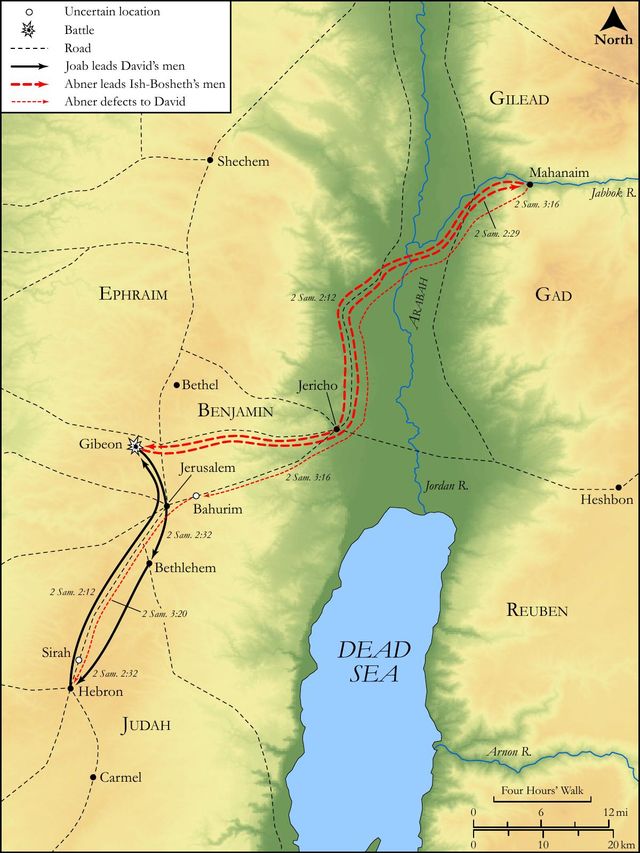
The narrative of 2 Samuel 3:30 is set against the tumultuous backdrop of a protracted civil war between the northern tribes loyal to the house of Saul (under Ish-bosheth and Abner) and the southern tribe of Judah (under David). In ancient Israelite society, the concept of "blood vengeance" was a deeply ingrained and powerful social obligation. The go'el haddam (avenger of blood) held the right, and indeed the perceived duty, to kill someone who had slain a kinsman. However, the Mosaic Law, demonstrating God's justice and mercy, meticulously provided for "cities of refuge" (Numbers 35 and Deuteronomy 19) specifically for those who killed accidentally or in self-defense, carefully distinguishing such cases from premeditated murder. Abner's killing of Asahel, as described in 2 Samuel 2:18-23, was unequivocally an act of self-defense after Asahel's relentless and reckless pursuit. This context makes Joab's act a deliberate, premeditated murder rather than a lawful execution of blood vengeance. Joab's actions also powerfully reflect the intense political rivalries and power struggles endemic within David's nascent kingdom, where deeply personal grievances often intertwined with strategic considerations for power and position.
Key Themes
ShowHideThis verse powerfully illustrates several crucial themes woven throughout the book of 2 Samuel and the broader historical narrative of Israel. Most prominent is the destructive cycle of vengeance and its stark contrast with divine justice. Joab's act, though culturally framed by the desire for revenge, is consistently portrayed in the biblical text as unjust, treacherous, and ultimately detrimental, perpetuating bloodshed precisely at a moment when peace was being painstakingly forged. This highlights the profound cost of civil war, demonstrating how deeply entrenched animosities and personal grievances can fundamentally undermine sincere efforts toward national unity and stability. Furthermore, this event illuminates Joab's complex and often ruthless character, showcasing his fierce, unwavering loyalty to David alongside his chilling willingness to commit brutal acts for personal gain or perceived strategic advantage. His independent and violent decision-making here serves as a dark foreshadowing of later instances, such as his calculated involvement in the death of Uriah (2 Samuel 11:14-17) and his decisive, unauthorized killing of Absalom (2 Samuel 18:9-15).
Exposition and Analysis
ShowHideKey Word Analysis
ShowHideThis primitive root verb, הָרַג (hârag), is a general but potent term for "to smite with deadly intent," "to kill," or "to slay." In the context of Joab and Abishai's action, it carries the full weight of a deliberate, intentional act of taking a life, emphasizing the premeditated nature of their attack on Abner. The use of this verb underscores that their act was a calculated murder, not an accidental killing or a death in the heat of battle, thereby distinguishing it sharply from the circumstances of Asahel's death.
This primitive root verb, מוּת (mûwth), means "to die" or, causatively, "to kill." In the phrase "because he had slain their brother Asahel," it refers to Abner's act. The narrative clearly indicates that Abner's killing of Asahel was in self-defense, a necessary action to preserve his own life after Asahel's relentless and reckless pursuit. The use of mûwth here describes the outcome of that encounter, but the broader narrative context clarifies that Abner's action was defensive, not malicious, highlighting the injustice of Joab's retaliatory act.
The Hebrew word אָח (ʼâch) is a fundamental term signifying a brother, but it is used in the widest sense to denote literal familial relationship and metaphorical affinity. In this verse, its repeated mention ("his brother" referring to Abishai, and "their brother" referring to Asahel) powerfully emphasizes the close familial bond between Joab, Abishai, and Asahel. This familial relationship is presented as the primary, deeply personal justification for their act of vengeance, highlighting the profound sense of obligation and grief that drove their actions, even if their chosen method of retribution was unlawful and morally reprehensible.
Verse Breakdown
ShowHide"So Joab and Abishai his brother"
This opening clause immediately identifies the perpetrators of the heinous act. The explicit inclusion of "his brother" emphasizes their joint action, shared familial tie to the deceased Asahel, and a coordinated, deliberate effort rather than an impulsive, individual outburst. It sets the stage for an act of calculated vengeance.
"slew Abner,"
This is the core, shocking action of the verse: the assassination of Abner. The directness and bluntness of the statement convey the finality and brutality of the act. Abner, a powerful and influential figure who had just secured a pivotal covenant with David and was instrumental in uniting Israel, is brought down by an act of profound treachery, undermining the very peace he sought to establish.
"because he had slain their brother Asahel"
This crucial clause provides the explicit, stated motive for the killing: revenge for Asahel's death. It frames the act within the cultural context of blood vengeance, yet the narrative subtly critiques this justification. While culturally understood, the circumstances of Asahel's death (self-defense in battle) would have typically exempted Abner from such retribution under Mosaic Law. This "because" clause reveals the deeply personal vendetta and perceived grievance driving Joab and Abishai.
"at Gibeon in the battle."
This final phrase specifies the exact location and context of Asahel's original death. It serves as a vital reminder to the reader of the detailed circumstances described in 2 Samuel 2:18-23, where Abner repeatedly warned Asahel to cease his relentless pursuit before reluctantly killing him in self-defense to save his own life. This specific detail subtly but powerfully underscores the profound injustice of Joab's revenge, as Abner's original act was not one of malice or premeditation.
Literary Devices
ShowHideThe narrative of 2 Samuel 3:30 is rich with several powerful literary devices. There is a profound and tragic irony in Abner, who had just successfully negotiated peace with David and was actively working to unite the fractured kingdom, being brutally murdered by David's own chief commanders. This act of treachery not only undermines the very peace and unity Abner sought to establish but also casts a dark shadow over David's reign from its very inception. The verse also serves as a crucial point of character development for Joab, solidifying his portrayal as a fiercely loyal but deeply ruthless, independently acting, and morally ambiguous commander. His actions here foreshadow his later controversial and often brutal decisions, such as his involvement in the death of Uriah and his unauthorized killing of Absalom. Furthermore, the entire episode functions as a poignant tragedy, vividly demonstrating the devastating, self-perpetuating nature of violence and personal vendettas, even in the midst of earnest efforts to build a unified and stable kingdom, showing how human sin can thwart divine purposes.
Theological and Thematic Connections
ShowHideThe assassination of Abner by Joab and Abishai in 2 Samuel 3:30 stands as a stark biblical commentary on the destructive nature of personal vengeance and the complexities of justice within a fallen world. While the cultural context of blood vengeance (go'el haddam) is acknowledged as a societal norm, the narrative implicitly and powerfully critiques Joab's act as a profound violation of true justice and a perpetuation of bloodshed. Abner's killing of Asahel was unequivocally an act of self-defense, a situation for which the Mosaic Law precisely provided "cities of refuge," thereby establishing a legal framework to prevent the endless cycle of retribution. Joab's act, therefore, was not a righteous execution of divine justice but a premeditated murder, driven by a volatile mix of personal grievance and political ambition. This event highlights the perennial tension between human attempts at justice, which are often flawed by sin, self-interest, and short-sightedness, and God's perfect righteousness and ultimate sovereignty. It underscores the biblical call to trust God for ultimate justice and to refrain from taking vengeance into one's own hands, recognizing that such acts invariably lead to further chaos, sorrow, and moral compromise rather than true resolution or peace.
Reflection and Application
ShowHideThe tragic events of 2 Samuel 3:30 offer profound and enduring lessons for believers today, challenging our natural inclinations toward retaliation. Joab's act of vengeance, though rooted in a deeply personal and painful loss, ultimately brought further complication, sorrow, and moral stain to David's nascent kingdom, powerfully demonstrating the destructive power of unforgiveness and the relentless pursuit of personal retribution. When we harbor bitterness, cling to resentment, or seek to "get even" with those who have wronged us, we often inadvertently perpetuate cycles of pain, not only for others but also for ourselves, hindering true healing and reconciliation. This passage calls us to resist the powerful, innate urge for personal payback and instead to place our trust firmly in God's perfect justice and sovereign control. It challenges us to embrace the difficult but ultimately liberating path of forgiveness and reconciliation, even when it feels counter-intuitive, undeserved, or when the wrong committed against us feels immense. Our response to injustice should consistently align with God's character, seeking peace and righteousness through appropriate, God-honoring channels, and leaving ultimate judgment and recompense to Him. This requires profound humility, rigorous self-control, and a deep, moment-by-moment reliance on the Holy Spirit to transform our natural inclinations toward retaliation into desires for grace, mercy, and genuine healing.
Questions for Reflection
ShowHideFAQ
ShowHideWas Joab justified in killing Abner according to biblical law or custom?
ShowHideNo, Joab was emphatically not justified in killing Abner, despite the prevailing custom of blood vengeance (go'el haddam) in ancient Israel. The Mosaic Law, reflecting God's higher standard of justice, provided clear and crucial distinctions. Abner had killed Asahel in self-defense during battle, after repeatedly warning Asahel to cease his relentless and reckless pursuit, which would have led to Abner's own death (2 Samuel 2:18-23). For accidental killings or deaths in self-defense, the law explicitly stipulated "cities of refuge" where the slayer could find asylum from the avenger of blood, preventing such cycles of retribution (Numbers 35 and Deuteronomy 19). Joab's act was a premeditated ambush and an act of treachery, not a lawful execution of justice, and it was widely condemned by David as a wicked act that brought a curse upon Joab's house (2 Samuel 3:28-29). His motives were likely a complex blend of personal revenge and the calculated elimination of a significant political rival.
How did David react to Abner's death, and what does this reveal about his character?
ShowHideDavid reacted with profound grief, public mourning, and vehement dissociation from Joab's treacherous act. He tore his clothes, fasted, publicly lamented Abner's death, and commanded all his people to mourn, even declaring a day of fasting for the entire nation (2 Samuel 3:31-35). He also publicly cursed Joab and his house for the treacherous murder, expressing his powerlessness to immediately punish Joab due to the political climate, but entrusting the ultimate judgment to God (2 Samuel 3:28-29). This reveals David's character as a man who genuinely sought peace and unity for Israel, despite the ongoing civil war and the deep personal losses he endured. He understood that Abner's death, though perpetrated by his own commanders, was a tragic setback to his earnest efforts to unify the kingdom and a grave violation of the covenant he had just made with Abner. David's strong and public reaction also served to reassure the people that he was not complicit in the murder, thereby maintaining his legitimacy and moral authority as a just king in the eyes of all Israel.
Christ-Centered Fulfillment
ShowHideThe tragic cycle of violence, vengeance, and human-driven retribution depicted in 2 Samuel 3:30 finds its ultimate resolution, profound antithesis, and divine fulfillment in the person and work of Jesus Christ. The Old Testament law, while instituting "cities of refuge" to mitigate the destructive escalation of blood feuds, still operated within a system that recognized and, at times, regulated human vengeance. In stark contrast, Christ inaugurates a new covenant founded not on retribution but on divine forgiveness, costly grace, and self-sacrificial love, thereby decisively breaking the endless, destructive cycle of "an eye for an eye." He teaches His followers to love their enemies and pray for those who persecute them, embodying this revolutionary principle through His own innocent, sacrificial death. Unlike Abner, whose death was a tragic outcome of human treachery and vengeful acts, Christ's death was a deliberate, redemptive act, the ultimate sacrifice that perfectly atones for human sin and brings true, lasting peace, not through bloodshed and retribution, but through the shedding of His own innocent blood (Hebrews 9:22). He is the true Prince of Peace, whose kingdom is established not by the sword, political power plays, or human might, but by the transformative power of God's reconciling love (Colossians 1:19-20). Where Joab's act perpetuated division and sorrow, Christ's work on the cross unites all who believe, offering profound forgiveness for sins and decisively breaking the power of death and the destructive grip of human vengeance, ushering in an era of grace and reconciliation.