


2 Samuel 2:32
Bible text: King James Version (1769 Blayney text) · Public domain
Bible text: King James Version with Strong's numbers · Public domain
Bible text: Berean Standard Bible · Public domain
Bible text: American Standard Version (1901) · Public domain
Bible text: World English Bible, Messianic edition · Public domain
Bible text: Geneva Bible (1599) · Public domain
Bible text: Young's Literal Translation · Public domain
- וַיִּשְׂאוּvai·yis·'Uand people lifted upH5375Conj-w ¦ V-Qal-ConsecImperf-3mpVerb Qal Consecutive Imperfect 3rd Plural Masculineוַandיִּשְׂאוּpeople lifted up
- אֶת'et<obj.>H853DirObjMParticle Object Indicator
- עֲשָׂהאֵל'a·sa·h·'ElAsahelH6214N-proper-mNoun Proper Masculine
- וַיִּקְבְּרֻהוּvai·yik·be·Ru·huand they buried himH6912Conj-w ¦ V-Qal-ConsecImperf-3mp ¦ 3msVerb Qal Consecutive Imperfect 3rd Plural Masculineוַandיִּקְבְּרֻthey buriedהוּhim
- בְּקֶבֶרbe·Ke·verin [the] tomb ofH6913Prep-b ¦ N-mscNoun Singular Masculine Constructבְּinקֶבֶר[the] tomb of
- אָבִיו'a·Vivhis fatherH1N-msc ¦ 3msNoun Singular Masculine Constructאָבִיfatherוhis
- אֲשֶׁר'a·SherwhichH834RelParticle Relative
- בֵּיתbeit[was] Beth-H1035N-properNoun Proper Location
- לָחֶםLa·chem-lehemH1035N-properNoun Proper Location
- וַיֵּלְכוּvai·ye·le·Khuand they wentH1980Conj-w ¦ V-Qal-ConsecImperf-3mpVerb Qal Consecutive Imperfect 3rd Plural Masculineוַandיֵּלְכוּthey went
- כָלkholallH3605N-mscNoun Singular Masculine Construct
- הַלַּיְלָהha·Lay·lahthe nightH3915Art ¦ N-msNoun Singular Masculine Absoluteהַtheלַּיְלָהnight
- יוֹאָבyo·'AvJoabH3097N-proper-mNoun Proper Masculine
- וַאֲנָשָׁיוva·'a·na·Shavand his menH582Conj-w ¦ N-mpc ¦ 3msNoun Plural Masculine Constructוַandאֲנָשָׁיmenוhis
- וַיֵּאֹרvai·ye·'Orand it became lightH215Conj-w ¦ V-Qal-ConsecImperf-3msVerb Qal Consecutive Imperfect 3rd Singular Masculineוַandיֵּאֹרit became light
- לָהֶםla·Hemfor <the> themPrep-l ¦ 3mpSuffix Personal 3rd Plural Masculineלָfor <the>הֶםthem
- בְּחֶבְרוֹןbe·chev·Ronat HebronH2275Prep-b ¦ N-properNoun Proper LocationבְּatחֶבְרוֹןHebron
English is a literal word-by-word gloss of the Hebrew, not the KJV's wording. Why?
This is the original text the KJV's translators worked from — each Hebrew word with its own literal English meaning in this verse, prepared by scholars at Tyndale House, Cambridge. The KJV translates whole sentences, not word by word, so its wording differs: one Hebrew word can become several English words, and the KJV may choose “the LORD” where the gloss reads “Yahweh”. Both are faithful — they answer different questions. For the KJV's own rendering, switch to the KJV text.
Details
See on the biblical-era maps

Study this verse
Public-domain commentary
Matthew Henry
From his Commentary on the Whole Bible. Henry comments on passages, not single verses — this entry covers 2 Samuel 2:25–32.
Here, I. Abner, being conquered, meanly begs for a cessation of arms. He rallied the remains of his forces on the top of a hill (Sa2 2:25), as if he would have made head again, but becomes a humble supplicant to Joab for a little breathing-time, Sa2 2:26. He that was most forward to fight was the first that had enough of it. He that made a jest of bloodshed (Let the young men arise and play before us, Sa2 2:14) is now shocked at it, when he finds himself on the losing side, and the sword he made so light of drawing threatening to touch himself. Observe how his note is changed. Then it was but playing with the sword; now, Shall the sword devour for ever? It had devoured but one day, yet to him it seemed forever, because it went against him; and very willing he is now that the sun should not go down upon the wrath. Now he can appeal to Joab himself concerning the miserable consequences of a civil war: Knowest thou not that it will be bitterness in the latter end? It will be reflected upon with regret when the account comes to be made up; for, whoever gets in a civil war, the community is sure to lose. Perhaps he refers to the bitterness that there was in the tribes of Israel, in the end of their war with Benjamin, when they wept sorely for the desolations which they themselves had made, Jdg 21:2. Now he begs of Joab to sound a retreat, and pleads that they were brethren, who ought not thus to bite and devour one another. He that in the morning would have Joab bid the people fall upon their brethren now would have him bid them lay down their arms. See here, 1. How easy it is for men to use reason when it makes for them who would not use it if it made against them. If Abner had been the conqueror, we should not have had him complaining of the voraciousness of the sword and the miseries of a civil war, nor pleading that both sides were brethren; but, finding himself beaten, all these reasonings are mustered up and improved for the securing of his retreat and the saving of his scattered troops from being cut off. 2. How the issue of things alters men's minds. The same thing which looked pleasant in the morning at night looked dismal. Those that are forward to enter into contention will perhaps repent it before they have done with it, and therefore had better leave it off before it be meddled with, as Solomon advises. It is true of every sin (O that men would consider it in time!) that it will be bitterness in the latter end. At the last it bites like a serpent those on whom it fawned.
II.Joab, though a conqueror, generously grants it, and sounds a retreat, knowing very well his master's mind and how averse he was to the shedding of blood. He does indeed justly upbraid Abner with his forwardness to engage, and lays the blame upon him that there had been so much bloodshed as there was (Sa2 2:27): "Unless thou hadst spoken," that is, "hadst given orders to fight, hadst bidden the young men arise and play before us, none of us would have struck a stroke, nor drawn a sword against our brethren. Thou complainest that the sword devours, but who first unsheathed it? Who began? Now thou wouldst have the people parted, but remember who set them on to fight. We should have retired in the morning if thou hadst not given the challenge." Those that are forward to make mischief are commonly the first to complain of it. This might have served to excuse Joab if he had pushed on his victory, and made a full end of Abner's forces; but like one that pitied the mistake of his adversaries, and scorned to make an army of Israelites pay dearly for the folly of their commander, he very honourably, by sound of trumpet, put a stop to the pursuit (Sa2 2:28) and suffered Abner to make an orderly retreat. It is good husbandry to be sparing of blood. As the soldiers were here very obsequious to the general's orders, so he, no doubt, observed the instructions of his prince, who sought the welfare of all Israel and therefore not the hurt of any.
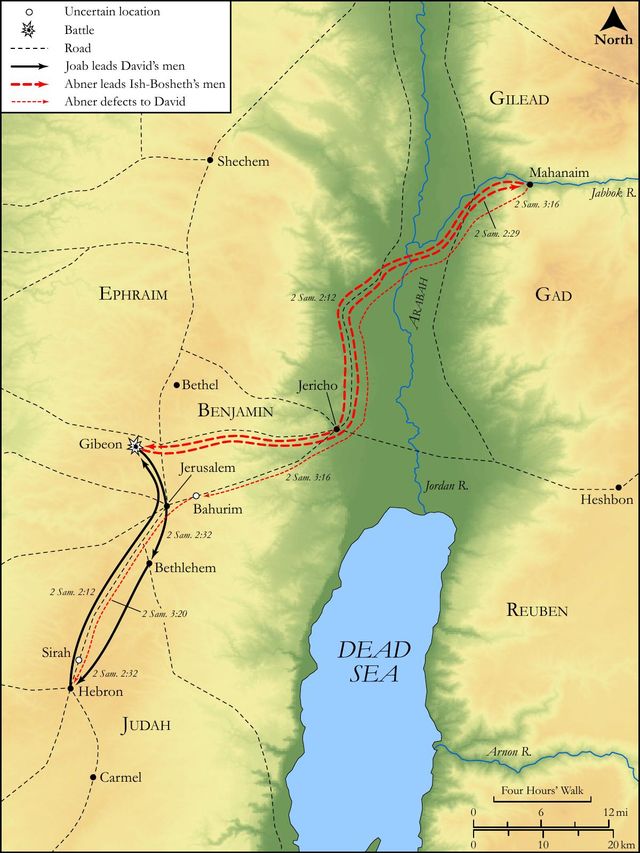
III.The armies being separated, both retired to the places whence they came, and both marched in the night, Abner to Mahanaim, on the other side Jordan (Sa2 2:29), and Joab to Hebron, where David was, Sa2 2:32. The slain on both sides are computed. On David's side only nineteen men were missing, besides Asahel (Sa2 2:30), who was worth more than all; on Abner's side 360, Sa2 2:31. In civil wars formerly great slaughters had been made (as Jdg 12:6; Jdg 20:44), in comparison with which this was nothing. It is to be hoped that they had grown wiser and more moderate. Asahel's funeral is here mentioned; the rest they buried in the field of battle, but he was carried to Bethlehem, and buried in the sepulchre of his father, Sa2 2:32. Thus are distinctions made between the dust of some and that of others; but in the resurrection no other difference will be made but that between godly and ungodly, which will remain for ever.
Continue studying 2 Samuel 2:32 across the web’s major study libraries — every link below opens this exact verse, chapter, or book on the destination site.
Read & Compare
 BibleGatewayThis verse in more than 200 translations and 70 languages.
 Bible.comThe YouVersion reader — hundreds of translations, reading plans, and highlights.
 ESV.orgCrossway's official English Standard Version reader.
 NET BibleThe NET translation with 60,000+ translators' notes on every rendering decision.
 STEP BibleTyndale House's free study tool — original text, vocabulary, and scholarly resources.
 BibliaLogos Bible Software's free web reader.
 USCCBThe New American Bible (Revised Edition) with the U.S. bishops' study notes.
Commentaries
 BibleHub CommentariesDozens of classic commentaries on this verse, gathered on one page.
 StudyLightMore than 100 commentary sets — the largest collection on the web.
 BibleRefPlain-English commentary on what this verse means, verse by verse.
 Enduring WordDavid Guzik's free commentary on this chapter, widely used by Bible teachers.
 Bible Study ToolsVerse commentary alongside Greek and Hebrew study aids.
Original Language & Research
- BibleHub InterlinearThe verse word by word — original language, transliteration, and English.
- BibleHub LexiconEvery word's original-language definition and Strong's entry.
 Blue Letter BibleDeep-study tools — Strong's numbers, concordance, and word studies.
 SefariaThe Hebrew text with Rashi and centuries of Jewish commentary.
Sermons, Hymns & Audio


TrulyRandomVerse is not affiliated with these sites and doesn’t control their content. They’re linked because they’re genuinely useful.
Summary
2 Samuel 2:32 encapsulates the poignant aftermath of a fierce battle, depicting the solemn burial of Asahel, Joab's swift brother, in his ancestral tomb in Bethlehem. Immediately following this act of familial reverence and duty to the deceased, the narrative transitions to the urgent, strategic overnight march of Joab and his weary troops, pressing on from the battlefield to reach Hebron, David's capital, by the first light of day. This verse masterfully weaves together themes of personal grief, military pragmatism, and the relentless demands of a nascent civil war in ancient Israel.
Context
ShowHideLiterary Context
This verse serves as the concluding resolution to the intense and tragic confrontation that began at the pool of Gibeon. The preceding verses (2 Samuel 2:18-23) detail Asahel's relentless pursuit of Abner, Saul's general, and his subsequent death when Abner, in self-defense, struck him with a spear. Following Asahel's fall, a truce was called, and Abner's forces retreated. Verse 32 thus provides closure to this specific skirmish, focusing on the respectful disposition of the fallen and the strategic withdrawal of David's forces back to their stronghold. It sets the immediate stage for the ongoing, protracted civil war between the house of Saul and the house of David, highlighting the personal cost of the conflict.
Historical & Cultural Context
The events unfold during the early stages of the civil war that erupted after Saul's death, pitting the northern tribes loyal to Ish-Bosheth (Saul's son) under Abner's command against the southern tribe of Judah, which had crowned David king in Hebron. Burial practices held immense significance in ancient Israelite culture, reflecting profound respect for the deceased and a strong emphasis on family lineage and continuity. To be interred in the "sepulchre of his father" (an ancestral tomb) was a mark of honor and proper closure, affirming one's belonging within the family and tribal structure. Bethlehem, though a modest town, carried immense significance as the birthplace of King David (1 Samuel 16:1) and the ancestral home of his family, including Asahel's mother, Zeruiah, who was David's sister. Hebron, conversely, served as David's capital for seven and a half years (2 Samuel 2:11), functioning as his strategic base for consolidating power in Judah prior to the eventual unification of all Israel under his rule. The overnight march underscores the urgency and disciplined movement required in a time of active warfare.
Key Themes
ShowHideThis verse encapsulates several profound themes prevalent throughout 2 Samuel. Firstly, it starkly illustrates the personal cost of civil war, as the death of Asahel, a prominent figure and Joab's brother, underscores the deep sorrow and familial fragmentation wrought by the conflict between Saul's and David's houses. Secondly, it highlights the importance of honor and proper burial rites in ancient Israel, demonstrating the profound reverence for human life and the deceased, even amid the brutality of armed conflict. Thirdly, Joab's actions exemplify loyal and pragmatic leadership; despite personal grief, he ensures his brother's respectful burial while simultaneously executing a swift and strategic military withdrawal back to David's capital. Finally, the mention of Bethlehem and Hebron subtly reinforces the unfolding of God's sovereign plan through David, connecting the Davidic lineage and his emerging kingdom to places of profound future theological significance in the redemptive narrative.
Exposition and Analysis
ShowHideKey Word Analysis
ShowHideThis term (H6913) denotes a tomb or burial place, typically a natural cave or a rock-cut chamber used for family interments. The phrase "his father's sepulchre" emphasizes not merely a place of burial, but an ancestral resting place, underscoring the profound importance of family lineage and the honorable disposition of the deceased within their kin group. It reflects a deep cultural value placed on belonging and continuity, even in death.
This verb (H3212) signifies "to walk" or "to go," often implying movement with purpose or determination. In the context of Joab and his men, it conveys their deliberate and arduous journey. Coupled with "all night," it emphasizes a forced, sustained march, highlighting their military discipline, strategic urgency, and the physical endurance demanded by their mission to return to Hebron.
This noun (H3915) refers to the period of darkness between sunset and sunrise. Here, "all night" emphasizes the duration and arduousness of Joab's march. Figuratively, "night" can also represent adversity, and indeed, this overnight journey follows a day of intense battle and personal loss, underscoring the relentless and challenging nature of the civil war.
Verse Breakdown
ShowHide"And they took up Asahel, and buried him in the sepulchre of his father, which [was in] Bethlehem."
This initial clause details the solemn and immediate act following Asahel's death. The "they" likely refers to Joab's men or a specific detachment, signifying a collective act of respect and duty. The burial in his ancestral tomb in Bethlehem underscores the profound significance of familial ties and proper burial rites in ancient Israel. Bethlehem, David's hometown, serves as a poignant backdrop for the death of a member of David's extended family, linking this personal tragedy to the broader Davidic narrative.
"And Joab and his men went all night, and they came to Hebron at break of day."
This second clause shifts from the somber act of burial to the strategic reality of military command. Joab, having ensured his brother's respectful interment, immediately resumed his duties as general. The overnight march signifies the urgency of their return to Hebron, David's capital. This rapid movement was crucial for reporting the battle's outcome to David, assessing casualties, and preparing for future engagements. It powerfully showcases Joab's leadership—balancing profound personal grief with professional responsibility and military necessity.
Literary Devices
ShowHideThe verse effectively employs Juxtaposition by placing the solemn act of Asahel's burial (a moment of stillness, grief, and closure) immediately alongside the urgent, strategic movement of Joab and his men (a dynamic act of military necessity and ongoing conflict). This stark contrast highlights the dual realities of war: its profound personal cost and its relentless strategic demands. Pathos is subtly woven into the description of Asahel's burial, evoking sympathy for the fallen and the sorrow of his kinsmen. The mention of Bethlehem, while a geographical detail, carries a degree of Foreshadowing, subtly linking this moment of death and conflict to the future birthplace of the Messiah, the ultimate Prince of Peace from David's line. The narrative's Pacing is swift, moving from the specific, individual act of burial to the broader, rapid movement of the army, emphasizing the urgency and continuous nature of the unfolding conflict.
Theological and Thematic Connections
ShowHideThis verse, though seemingly a simple narrative detail, resonates with deeper theological truths. The emphasis on Asahel's burial underscores the biblical value of human life and the dignity afforded to the deceased, even in the brutal context of war. Proper burial was a significant act of respect and a testament to the belief in a person's continued existence, even if the full theology of resurrection was still developing. The civil war itself, marked by fratricide and division, serves as a stark reminder of the destructive power of sin and disunity, contrasting sharply with God's ultimate desire for shalom and reconciliation. Yet, even amidst this chaos, God's sovereign plan for the Davidic dynasty continues to unfold, with key locations like Bethlehem and Hebron playing their part in the larger redemptive narrative, subtly pointing to the ultimate King and His eternal kingdom.
Reflection and Application
ShowHide2 Samuel 2:32 offers a poignant glimpse into the harsh realities of leadership and loyalty amidst conflict. Joab's actions—ensuring his brother's respectful burial before immediately returning to his strategic duties—present a powerful lesson in balancing personal grief with professional responsibility. It reminds us that even in the most challenging circumstances, honoring the fallen and maintaining discipline are crucial. This narrative encourages us to reflect on the human cost of division and the importance of seeking reconciliation, both personally and corporately. It also challenges us to consider how we navigate our own responsibilities when faced with personal sorrow or loss, striving to act with both compassion and clear-headed purpose. Ultimately, it invites us to trust in God's overarching plan, even when human events seem chaotic and tragic, knowing that His purposes will prevail despite human folly.
Questions for Reflection
ShowHideFAQ
ShowHideWhy was Asahel buried in Bethlehem if his father wasn't Jesse?
ShowHideAsahel's mother was Zeruiah, who was David's sister. While Jesse was David's direct father, the term "his father" in this context refers to Asahel's paternal lineage or ancestral family burial ground. Bethlehem was indeed the ancestral home of David's wider family and clan, including Zeruiah and her sons. Therefore, it was both natural and honorable for Asahel to be buried there, connecting him to the deep roots of David's family and the significant town of Bethlehem, even if his direct father was not Jesse himself. This practice reinforced the strong familial and tribal bonds prevalent in ancient Israel.
What was the significance of Joab and his men traveling all night to Hebron?
ShowHideThe overnight march to Hebron was strategically vital for several reasons. Firstly, it demonstrated Joab's military discipline and urgency after a major engagement. He needed to report the battle's outcome, including Asahel's death, to King David without delay. Secondly, it allowed them to regroup and secure David's capital, Hebron, which was his primary base of operations at the time. This swift return prevented any potential counter-attack from Abner's forces and allowed David's army to recover and prepare for the ongoing civil war. It underscores Joab's pragmatic leadership, prioritizing military necessity even amidst profound personal grief.
Christ-Centered Fulfillment
ShowHideThe somber scene of Asahel's burial in Bethlehem and the subsequent strategic march to Hebron, David's capital, finds profound Christ-centered fulfillment. Asahel's death is a tragic consequence of the civil war, a poignant reminder of the cost of sin and division in a fallen world. Yet, it is in Bethlehem, the very place of Asahel's burial, that the true Prince of Peace, Jesus Christ, would later be born (Matthew 2:1). His birth in David's city signals the coming of a King who would not merely reign over a fractured earthly kingdom, but would establish an eternal reign of peace and reconciliation. Furthermore, the respectful burial of Asahel, though a human act, foreshadows the honorable burial of Jesus himself after His crucifixion (John 19:38-42), a necessary step before His glorious resurrection and triumph over death. Joab's urgent journey to Hebron, David's capital, points to the ultimate spiritual journey towards Christ, who is the true King and the head of His eternal kingdom, the New Jerusalem (Revelation 21:2). Unlike the temporary peace and continued conflict seen in 2 Samuel, Christ's sacrifice on the cross brings ultimate reconciliation between God and humanity (Colossians 1:20), ending the spiritual civil war and establishing a kingdom of righteousness and everlasting peace.