


2 Samuel 10:3
Bible text: King James Version (1769 Blayney text) · Public domain
Bible text: King James Version with Strong's numbers · Public domain
Bible text: Berean Standard Bible · Public domain
Bible text: American Standard Version (1901) · Public domain
Bible text: World English Bible, Messianic edition · Public domain
Bible text: Geneva Bible (1599) · Public domain
Bible text: Young's Literal Translation · Public domain
- וַיֹּאמְרוּvai·yo·me·Ruand they saidH559Conj-w ¦ V-Qal-ConsecImperf-3mpVerb Qal Consecutive Imperfect 3rd Plural Masculineוַandיֹּאמְרוּthey said
- שָׂרֵיsa·Rei[the] leaders ofH8269N-mpcNoun Plural Masculine Construct
- בְנֵיve·nei[the] people ofH1121N-mpcNoun Plural Masculine Construct
- עַמּוֹןa·MonAmmonH5983N-proper-mNoun Proper Masculine
- אֶל'eltoH413PrepPreposition
- חָנוּןcha·NunHanunH2586N-proper-mNoun Proper Masculine
- אֲדֹנֵיהֶם'a·do·nei·Hemtheir lord<s>H113N-mpc ¦ 3mpNoun Plural Masculine Constructאֲדֹנֵיlord<s>הֶםtheir
- הַמְכַבֵּדham·kha·Bed¿ honoringH3513Interrog ¦ V-Piel-Prtcpl-msVerb Piel Participle Singular Masculine Absoluteהַ¿מְכַבֵּדhonoring
- דָּוִדda·Vid[is] DavidH1732N-proper-mNoun Proper Masculine
- אֶת'et<obj.>H853DirObjMParticle Object Indicator
- אָבִיךָ'a·Vi·khayour fatherH1N-msc ¦ 2msNoun Singular Masculine Constructאָבִיfatherךָyour
- בְּעֵינֶיךָbe·'ei·Nei·khain your viewH5869Prep-b ¦ N-fdc ¦ 2msNoun Dual Feminine Constructבְּinעֵינֶיviewךָyour
- כִּיkiforH3588PrtParticle Conditional
- שָׁלַחsha·Lachhe has sentH7971V-Qal-Perf-3msVerb Qal Perfect 3rd Singular Masculine
- לְךָle·Khato <the> youPrep-l ¦ 2msSuffix Personal 2nd Singular Masculineלְto <the>ךָyou
- מְנַחֲמִיםme·na·cha·MimcomfortersH5162V-Piel-Prtcpl-mpVerb Piel Participle Plural Masculine Absolute
- הֲלוֹאHa·lo'¿ notH3808Interrog ¦ NegParticle Negativeהֲ¿לוֹאnot
- בַּעֲבוּרba·'a·Vurin orderH5668Prep-b ¦ N-msNoun Singular Masculine Absoluteבַּinעֲבוּרorder
- חֲקוֹרcha·Korto exploreH2713V-Qal-InfVerb Qal Infinitive Construct
- אֶת'et<obj.>H853DirObjMParticle Object Indicator
- הָעִירha·'Irthe cityH5892Art ¦ N-fsNoun Singular Feminine Absoluteהָtheעִירcity
- וּלְרַגְּלָהּu·le·ra·ge·Lahand to spy on itH7270Conj-w ¦ Prep-l ¦ V-Piel-Inf ¦ 3fsVerb Piel Infinitive Constructוּandלְtoרַגְּלָspy onהּit
- וּלְהָפְכָהּu·le·ha·fe·Khahand to overthrow itH2015Conj-w ¦ Prep-l ¦ V-Qal-Inf ¦ 3fsVerb Qal Infinitive Constructוּandלְtoהָפְכָoverthrowהּit
- שָׁלַחsha·Lachhas he sentH7971V-Qal-Perf-3msVerb Qal Perfect 3rd Singular Masculine
- דָּוִדda·VidDavidH1732N-proper-mNoun Proper Masculine
- אֶת'et<obj.>H853DirObjMParticle Object Indicator
- עֲבָדָיו'a·va·Davhis servantsH5650N-mpc ¦ 3msNoun Plural Masculine Constructעֲבָדָיservantsוhis
- אֵלֶיךָ'e·Lei·khato youH413Prep ¦ 2msPreposition Definiteאֵלֶיtoךָyou
English is a literal word-by-word gloss of the Hebrew, not the KJV's wording. Why?
This is the original text the KJV's translators worked from — each Hebrew word with its own literal English meaning in this verse, prepared by scholars at Tyndale House, Cambridge. The KJV translates whole sentences, not word by word, so its wording differs: one Hebrew word can become several English words, and the KJV may choose “the LORD” where the gloss reads “Yahweh”. Both are faithful — they answer different questions. For the KJV's own rendering, switch to the KJV text.
Details
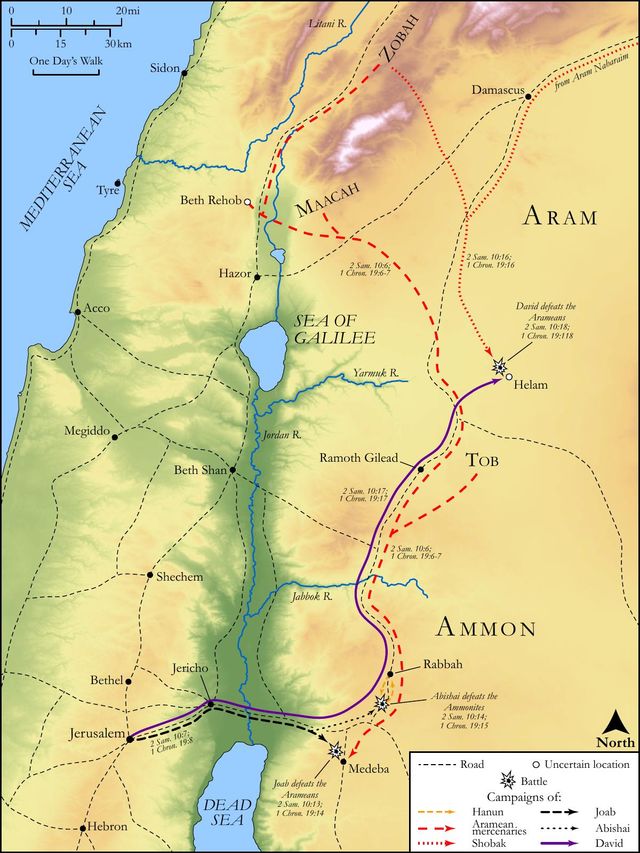
See on the biblical-era maps

Study this verse
Public-domain commentary
Matthew Henry
From his Commentary on the Whole Bible. Henry comments on passages, not single verses — this entry covers 2 Samuel 10:1–5. His two-level outline is real structure in the source text, so it is rendered as structure.
Here is, I. The great respect David paid to his neighbour, the king of the Ammonites, Sa2 10:1, Sa2 10:2. 1. The inducement to it was some kindness he had formerly received from Nahash the deceased king. He showed kindness to me, says David (Sa2 10:2), and therefore (having lately had satisfaction in showing kindness to Mephibosheth for his father's sake) he resolves to show kindness to his son, and to keep up a friendly correspondence with him. Thus the pleasure of doing one kind and generous action should excite us to another. Nahash had been an enemy to Israel, a cruel enemy (Sa1 11:2), and yet had shown kindness to David, perhaps only in contradiction to Saul, who was unkind to him: however, if David receives kindness, he is not nice in examining the grounds and principles of it, but resolves gratefully to return it. If a Pharisee give alms in pride, though God will not reward him, yet he that receives the alms ought to return thanks for it. God knows the heart, but we do not. 2. The particular instance of respect was sending an embassy to condole with him on his father's death, as is common among princes in alliance with each other: David sent to comfort him. Note, It is a comfort to children, when their parents are dead, to find that their parents' friends are theirs, and that they intend to keep up an acquaintance with them. It is a comfort to mourners to find that there are those who mourn with them, are sensible of their loss and share with them in it. It is a comfort to those who are honouring the memory of their deceased relations to find there are others who likewise honour it and who had a value for those whom they valued.
II.The great affront which Hanun the king of the Ammonites put upon David in his ambassadors.
1.He hearkened to the spiteful suggestions of his princes, who insinuated that David's ambassadors, under pretence of being comforters, were sent as spies, Sa2 10:3. False men are ready to think others as false as themselves; and those that bear ill-will to their neighbours are resolved not to believe that their neighbours bear any good-will to them. They would not thus have imagined that David dissembled but that they were conscious to themselves that they could have dissembled, to serve a turn. Unfounded suspicion argues a wicked mind. Bishop Patrick's note on this is that "there is nothing so well meant but it may be ill interpreted, and is wont to be so by men who love nobody but themselves." Men of the greatest honour and virtue must not think it strange if they be thus misrepresented. Charity thinketh no evil.
2.Entertaining this vile suggestion, he basely abused David's ambassadors, like a man of a sordid villainous spirit, that was fitter to rake a kennel than to wear a crown. If he had any reason to suspect that David's messengers came on a bad design, he would have done prudently enough to be upon the reserve with them, and to dismiss them as soon as he could; but it is plain he only sought an occasion to put the utmost disgrace he could upon them, out of an antipathy to their king and their country. They were themselves men of honour, and much more so as they represented the prince that sent them; they and their reputation were under the special protection of the law of nations; they put a confidence in the Ammonites, and came among them unarmed; yet Hanun used them like rogues and vagabonds, and worse, shaved off the one half of their beards, and cut off their garments in the midst, to expose them to the contempt and ridicule of his servants, that they might make sport with them and that these men might seem vile.
III.David's tender concern for his servants that were thus abused.
He sent to meet them, and to let them know how much he interested himself in their quarrel and how soon he would avenge it, and directed them to stay at Jericho, a private place, where they would not have occasion to come into company, till that half of their beards which was shaved off had grown to such a length that the other half might be decently cut to it, Sa2 10:5. The Jews wore their beards long, reckoning it an honour to appear aged and grave; and therefore it was not fit that persons of their rank and figure should appear at court unlike their neighbours. Change of raiment, it is likely, they had with them, to put on, instead of that which was cut off; but the loss of their beards would not be so soon repaired; yet in time these would grow again, and all would be well. Let us learn not to lay too much to heart unjust reproaches; after awhile they will wear off of themselves, and turn only to the shame of their authors, while the injured reputation in a little time grows again, as these beards did. God will bring forth thy righteousness as the light, therefore wait patiently for him, Psa 37:6, Psa 37:7.
Some have thought that David, in the indignity he received from the king of Ammon, was but well enough served for courting and complimenting that pagan prince, whom he knew to be an inveterate enemy to Israel, and might now remember how, when he would have put out the right eyes of the men of Jabesh-Gilead, he designed that, as he did this, for a reproach upon all Israel, 1 Sam. Psa 11:2. What better usage could he expect from such a spiteful family and people? Why should he covet the friendship of a people whom Israel must have so little to do with as that an Ammonite might not enter into the congregation of the Lord, even to the tenth generation? Deu 23:3.
Continue studying 2 Samuel 10:3 across the web’s major study libraries — every link below opens this exact verse, chapter, or book on the destination site.
Read & Compare
 BibleGatewayThis verse in more than 200 translations and 70 languages.
 Bible.comThe YouVersion reader — hundreds of translations, reading plans, and highlights.
 ESV.orgCrossway's official English Standard Version reader.
 NET BibleThe NET translation with 60,000+ translators' notes on every rendering decision.
 STEP BibleTyndale House's free study tool — original text, vocabulary, and scholarly resources.
 BibliaLogos Bible Software's free web reader.
 USCCBThe New American Bible (Revised Edition) with the U.S. bishops' study notes.
Commentaries
 BibleHub CommentariesDozens of classic commentaries on this verse, gathered on one page.
 StudyLightMore than 100 commentary sets — the largest collection on the web.
 BibleRefPlain-English commentary on what this verse means, verse by verse.
 Enduring WordDavid Guzik's free commentary on this chapter, widely used by Bible teachers.
 Bible Study ToolsVerse commentary alongside Greek and Hebrew study aids.
Original Language & Research
- BibleHub InterlinearThe verse word by word — original language, transliteration, and English.
- BibleHub LexiconEvery word's original-language definition and Strong's entry.
 Blue Letter BibleDeep-study tools — Strong's numbers, concordance, and word studies.
 SefariaThe Hebrew text with Rashi and centuries of Jewish commentary.
Sermons, Hymns & Audio


TrulyRandomVerse is not affiliated with these sites and doesn’t control their content. They’re linked because they’re genuinely useful.
Summary
In 2 Samuel 10:3, the advisors to Hanun, the newly crowned king of Ammon, present a deeply cynical and hostile interpretation of King David's diplomatic overture. David had dispatched envoys to express condolences to Hanun following the death of his father, Nahash, with whom David had maintained a respectful relationship. However, the suspicious counsel of these Ammonite princes convinces Hanun that David's true intention is not genuine comfort or honor, but rather a deceptive reconnaissance mission designed to gather intelligence for an eventual military invasion and subjugation of their capital city. This grave misjudgment by Hanun, fueled by paranoia and poor counsel, tragically sets the stage for a significant and devastating conflict between Israel and Ammon.
Context
ShowHideLiterary Context
This verse marks a critical turning point in the narrative of 2 Samuel, immediately following David's act of kindness towards Hanun in 2 Samuel 10:2. David's gesture, rooted in a past covenantal relationship with Nahash, is presented as an act of genuine compassion and diplomatic respect, reflecting the character of David's reign as described in 2 Samuel 8. However, the cynical interpretation offered by the Ammonite princes in 2 Samuel 10:3 directly leads to the egregious humiliation of David's envoys in 2 Samuel 10:4, which then precipitates a major war between Israel and Ammon, detailed in the remainder of 2 Samuel 10. This sequence vividly illustrates how misjudgment and poor counsel can escalate into devastating conflict, standing in stark contrast to David's initial peaceful and honorable intent.
Historical & Cultural Context
In David's day, the nations round about Israel were a volatile geopolitical landscape characterized by shifting alliances, constant maneuvering for power, and frequent warfare. While diplomatic courtesies, such as sending condolences upon the death of a monarch, were known and often expected, they could also be viewed with profound suspicion, especially between kingdoms with a history of conflict or rivalry. The Ammonites, descendants of Lot, had a long-standing antagonistic relationship with Israel, dating back to the Exodus, where they were forbidden from entering the assembly of the Lord (Deuteronomy 23:3-6). Nahash, Hanun's father, had previously oppressed Israelite towns (1 Samuel 11:1-2), though he later showed some favor to David. In this environment, trust was a rare commodity, and foreign overtures, even seemingly benign ones, were often scrutinized for ulterior motives. The counsel of court advisors held significant sway, and a new king like Hanun, perhaps insecure in his nascent position, would be particularly susceptible to such advice, especially if it played into existing nationalistic fears or historical grievances.
Key Themes
ShowHideThis verse powerfully illustrates several key themes prevalent in 2 Samuel. Foremost is the theme of mistrust and suspicion, where a genuine act of kindness is maliciously twisted into a hostile plot, leading to tragic consequences. It also underscores the dangers of poor counsel, as Hanun's decision to heed his suspicious advisors rather than exercising discernment or investigating David's true intentions leads directly to devastating war. The theme of diplomacy and its breakdown is vividly evident, as David's attempt at peaceful engagement is met with hostility and a blatant disregard for international norms of hospitality. This breakdown highlights the fragility of peace when paranoia takes root. Ultimately, the verse serves as a catalyst for conflict, demonstrating how human folly, paranoia, and misjudgment can ignite devastating wars, a recurring motif in the historical narratives of Israel and a sobering reminder of the consequences of rejecting peace for suspicion, a theme echoed in the broader narrative of the kings of Israel.
Exposition and Analysis
ShowHideKey Word Analysis
ShowHideThis verb (חָקַר, H2713) means "to search out, examine intimately, investigate, explore." It implies a thorough and systematic inquiry, often with the intent of uncovering hidden information or vulnerabilities. In this context, the Ammonite princes suggest David's servants are not merely observing but actively probing for weaknesses, strategic details about the city's defenses, or resources, indicating a deeper, more invasive form of intelligence gathering.
The verb (רָגַל, H7270) specifically means "to spy, to act as a spy." It carries a strong connotation of hostile reconnaissance, gathering intelligence for military purposes or for slander. This word leaves no doubt about the princes' accusation: they believe David's "comforters" are covert agents, not benevolent diplomats, engaged in espionage with an ulterior, malevolent motive.
This verb (הָפַךְ, H2015) means "to turn about or over; by implication, to change, overturn, return, pervert." It signifies a complete reversal, destruction, or subjugation. The princes' ultimate accusation is that David's true aim is not just to gather information, but to use that information to conquer and utterly destroy the city of Rabbah, the Ammonite capital. This word reveals the depth of their paranoia and their belief in David's aggressive, destructive intentions.
Verse Breakdown
ShowHide"And the princes of the children of Ammon said unto Hanun their lord,"
This opening clause establishes the source of the destructive counsel. It highlights the significant influence of Hanun's advisors, who, as "princes" (שָׂר, sar, H8269), held positions of power and likely represented the established political and military elite of Ammon. Their collective voice, presented as unified and authoritative, carries significant weight with the newly crowned king, Hanun (חָנוּן, Chânûwn, H2586), who is still finding his footing.
"Thinkest thou that David doth honour thy father, that he hath sent comforters unto thee?"
This rhetorical question is laden with sarcasm, cynicism, and a fundamental challenge to Hanun's perception of David's motives. It implies that David's gesture of sending "comforters" (מְנַחֲמִים, from nâcham, H5162, "to comfort" or "to pity") is inherently suspicious and cannot be taken at face value. The princes dismiss the very idea of David's good intentions, immediately framing his action as a deceptive ploy rather than a genuine act of respect or mourning for Hanun's father (אָב, ʼâb, H1).
"hath not David [rather] sent his servants unto thee, to search the city, and to spy it out, and to overthrow it?"
This second rhetorical question reveals the princes' alternative, hostile interpretation, presenting it as the only logical conclusion. They propose that David's true objective is reconnaissance ("to search the city, and to spy it out") with the ultimate goal of military conquest and utter destruction ("to overthrow it"). This accusation not only grossly misrepresents David's character and stated purpose but also imputes the most malevolent intentions to his seemingly benign act, directly leading to Hanun's disastrous decision and the ensuing war.
Literary Devices
ShowHideThe verse employs several potent literary devices to convey the malicious counsel and its impact. Rhetorical Question is central, as the Ammonite princes use two successive questions to manipulate Hanun's perception, guiding him towards their cynical conclusion rather than allowing him to consider David's genuine intent. This creates a powerful sense of Dramatic Irony, as the reader is fully aware of David's benevolent motives (established in 2 Samuel 10:2), while Hanun, influenced by his advisors, remains tragically ignorant of the truth. The princes' accusation itself is an act of Calumny or Slander, falsely attributing malicious intent to David and poisoning Hanun's mind against him. Furthermore, the progression from "search" to "spy out" to "overthrow" builds a sense of escalating threat, using Climax to emphasize the perceived danger and justify their extreme, hostile reaction. This skillful use of language effectively portrays the deep-seated mistrust and paranoia that will ignite a major conflict.
Theological and Thematic Connections
ShowHideThis pivotal verse serves as a stark reminder of the destructive power of suspicion and the profound consequences of misjudgment. It illustrates how readily human hearts, particularly when influenced by fear, historical animosity, or a lack of discernment, can interpret even benevolent actions through a lens of hostility, leading to a breakdown of peace and the eruption of conflict. The Ammonite princes' counsel, driven by their own preconceived notions and perhaps a history of animosity, demonstrates the pervasive danger of listening to voices that sow discord and distrust, rather than seeking wisdom and discernment. The narrative highlights the moral responsibility of leaders to weigh counsel carefully, as Hanun's failure to do so results in devastating war, underscoring the biblical principle that "where there is no guidance, a people falls, but in an abundance of counselors there is safety" (Proverbs 11:14). The tragic outcome reveals how human folly can disrupt divine purposes, even as God ultimately works through such events to accomplish His sovereign will.
Reflection and Application
ShowHideThe tragic miscalculation by Hanun and his advisors in 2 Samuel 10:3 offers a profound and timeless lesson for contemporary life. It challenges us to critically examine the lens through which we view the actions and intentions of others. How often do we, like the Ammonite princes, jump to cynical conclusions, assuming the worst motives in situations that might genuinely be benevolent or neutral? This verse urges us to cultivate a spirit of discernment, not naive gullibility, but a willingness to consider alternative interpretations and to seek truth rather than immediately defaulting to suspicion. It also underscores the critical importance of the counsel we receive and, equally, the counsel we give. Are we surrounded by voices that promote trust, understanding, and reconciliation, or those that habitually sow discord, fear, and division? Our decisions, both personal and communal, are profoundly shaped by the advice we accept and the perspectives we embrace. Hanun's story is a sobering reminder that rash judgments based on paranoia can lead to unnecessary conflict, broken relationships, and devastating consequences, both individually and collectively, highlighting the enduring relevance of wisdom in decision-making.
Questions for Reflection
ShowHideFAQ
ShowHideWhy did the Ammonite princes suspect David's motives, given his seemingly kind gesture?
ShowHideThe Ammonite princes' suspicion stemmed from a complex interplay of factors common among the nations of that day. Firstly, the prevailing geopolitical climate was one of constant rivalry and distrust between kingdoms; any overture from a powerful neighbor like David could be viewed as a veiled threat. Secondly, there was a long-standing historical animosity between Ammon and Israel, dating back centuries, which fostered deep-seated distrust (Deuteronomy 23:3-6). Despite David's specific act of kindness in sending "comforters" (as described in 2 Samuel 10:2), they likely viewed his actions through a lens of potential military or political threat. They interpreted his "comforters" as a Trojan horse, believing David was using the guise of diplomacy to "search the city, and to spy it out, and to overthrow it," as stated in 2 Samuel 10:3. Their counsel reflects a default to paranoia over trust, leading to a tragic miscalculation of David's genuine intentions.
Christ-Centered Fulfillment
ShowHideThe narrative of David's benevolent gesture being met with cynical suspicion in 2 Samuel 10:3 finds a profound Christ-centered fulfillment in the life and mission of Jesus. Just as David, the king of Israel, sent messengers of comfort and peace, only to be tragically misunderstood and reviled, so too did God send His Son, Jesus, as the ultimate messenger of peace and reconciliation to a world steeped in suspicion and hostility. Jesus came not to "search the city, and to spy it out, and to overthrow it" in a destructive, conquering sense, but rather to seek and to save the lost (Luke 19:10) and to establish a kingdom of peace and righteousness. Yet, His true intentions were frequently misinterpreted by the religious and political leaders of His day, who saw Him as a threat to their authority and a potential revolutionary, ultimately leading to His unjust crucifixion (John 11:47-48). The world, blinded by sin and fear, often rejects the divine overtures of grace, just as Hanun rejected David's kindness. However, unlike the earthly conflict that ensued in 2 Samuel, Christ's "overthrow" was of sin and death, establishing a new covenant of peace through His sacrificial death and resurrection (Romans 5:10-11). The Holy Spirit, the "Comforter" or "Advocate" promised by Jesus (John 14:26), is sent not to spy out our weaknesses for condemnation, but to guide us into all truth, bring genuine peace, and empower us for life, fulfilling the true intent of divine comfort that the Ammonites so tragically misunderstood.