


2 Kings 6:4
Bible text: King James Version (1769 Blayney text) · Public domain
Bible text: Berean Standard Bible · Public domain
Bible text: American Standard Version (1901) · Public domain
Bible text: World English Bible, Messianic edition · Public domain
Bible text: Geneva Bible (1599) · Public domain
Bible text: Young's Literal Translation · Public domain
- וַיֵּלֶךְvai·Ye·lekhand he wentH1980Conj-w ¦ V-Qal-ConsecImperf-3msVerb Qal Consecutive Imperfect 3rd Singular Masculineוַandיֵּלֶךְhe went
- אִתָּם'i·Tamwith themH854Prep ¦ 3mpPrepositionאִתָּwithםthem
- וַיָּבֹאוּvai·ya·Vo·'uand they cameH935Conj-w ¦ V-Qal-ConsecImperf-3mpVerb Qal Consecutive Imperfect 3rd Plural Masculineוַandיָּבֹאוּthey came
- הַיַּרְדֵּנָהhai·yar·De·nahthe Jordan towardsH3383Art ¦ N-proper ¦ SfxNoun Proper LocationהַtheיַּרְדֵּנָJordanהtowards
- וַיִּגְזְרוּvai·yig·ze·Ruand they cut downH1504Conj-w ¦ V-Qal-ConsecImperf-3mpVerb Qal Consecutive Imperfect 3rd Plural Masculineוַandיִּגְזְרוּthey cut down
- הָעֵצִיםha·'e·Tzim<the> treesH6086Art ¦ N-mpNoun Plural Masculine Absoluteהָ<the>עֵצִיםtrees
English is a literal word-by-word gloss of the Hebrew, not the KJV's wording. Why?
This is the original text the KJV's translators worked from — each Hebrew word with its own literal English meaning in this verse, prepared by scholars at Tyndale House, Cambridge. The KJV translates whole sentences, not word by word, so its wording differs: one Hebrew word can become several English words, and the KJV may choose “the LORD” where the gloss reads “Yahweh”. Both are faithful — they answer different questions. For the KJV's own rendering, switch to the KJV text.
Details
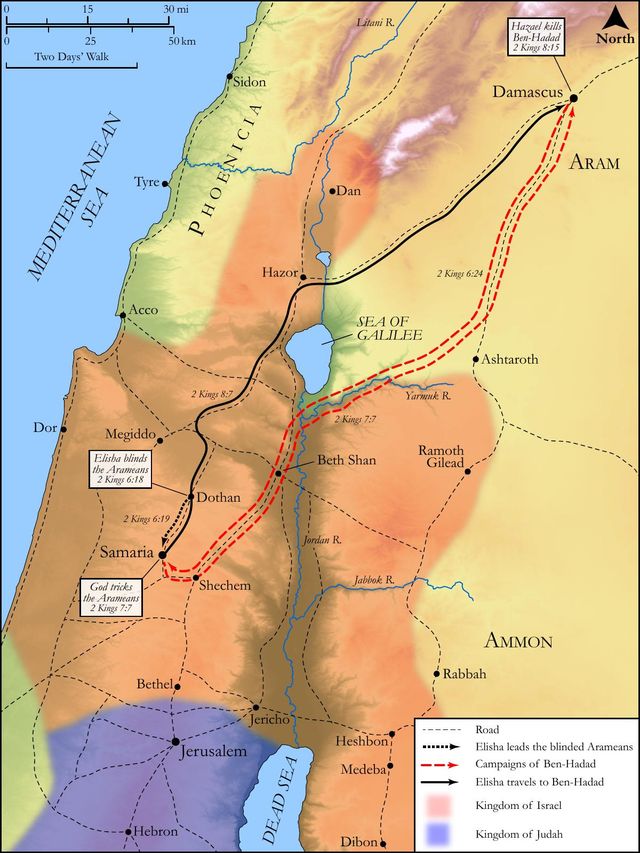
See on the biblical-era map
Study this verse
Public-domain commentary
Matthew Henry
From his Commentary on the Whole Bible. Henry comments on passages, not single verses — this entry covers 2 Kings 6:1–7. His three-level outline is real structure in the source text, so it is rendered as structure.
Several things may be observed here,
I.Concerning the sons of the prophets, and their condition and character.
The college here spoken of seems to be that at Gilgal, for there Elisha was (Kg2 4:38), and it was near Jordan; and, probably, wherever Elisha resided as many as could of the sons of the prophets flocked to him for the advantage of his instructions, counsels, and prayers. Every one would covet to dwell with him and be near him. Those that would be teachers should lay out themselves to get the best advantages for learning. Now observe,
1.Their number increased so that they wanted room: The place is too strait for us (Kg2 6:1) - a good hearing, for it is a sign many are added to them. Elisha's miracles doubtless drew in many. Perhaps they increased the more now that Gehazi was cashiered, and, it is likely, an honester man put in his room, to take care of their provisions; for it should seem (by that instance, Kg2 4:43) that Naaman's case was not the only one in which he grudged his master's generosity.
2.They were humble men and did not affect that which was gay or great. When they wanted room they did not speak of sending for cedars, and marble stones, and curious artificers, but only of getting every man a beam, to run up a plain hut or cottage with. It becomes the sons of the prophets, who profess to look for great things in the other world, to be content with mean things in this.
3.They were poor men, and men that had no interest in great ones It was a sign that Joram was king, and Jezebel ruled too, or the sons of the prophets, when they wanted room, would have needed only to apply to the government, not to consult among themselves about the enlargement of their buildings. God's prophets have seldom been the world's favourites. Nay, so poor were they that they had not wherewithal to hire workmen (but must leave their studies, and work for themselves), no, nor to buy tools, but must borrow of their neighbours. Poverty then is no bar to prophecy.
4.They were industrious men, and willing to take pains. They desired not to live, like idle drones (idle monks, I might have said), upon the labours of others, but only desired leave of their president to work for themselves. As the sons of the prophets must not be so taken up with contemplation as to render themselves unfit for action, so much less must they so indulge themselves in their ease as to be averse to labour. He that must eat or die must work or starve, Th2 3:8, Th2 3:10. Let no man think an honest employment either a burden or disparagement.
5.They were men that had a great value and veneration for Elisha; though they were themselves prophets, they paid much deference to him.
(1.)They would not go about to build at all without his leave, Kg2 6:2. It is good for us all to be suspicious of our own judgment, even when we think we have most reason for it, and to be desirous of the advice of those who are wiser and more experienced; and it is especially commendable in the sons of the prophets to take their fathers along with them, and to act in all things of moment under their direction, permissu superiorum - by permission of their superiors.
(2.)They would not willingly go to fell timber without his company: "Go with thy servants (Kg2 6:3), not only to advise us in any exigence, but to keep good order among us, that, being under they eye, we may behave as becomes us." Good disciples desire to be always under good discipline.
6.They were honest men, and men that were in care to give all men their own. When one of them, accidentally fetching too fierce a stroke (as those that work seldom are apt to be violent), threw off his axe-head into the water, he did not say, "It was a mischance, and who can help it? It was the fault of the helve, and the owner deserved to stand to the loss." No, he cries out with deep concern, Alas, master! For it was borrowed, Kg2 6:5. Had the axe been his own, it would only have troubled him that he could not be further serviceable to his brethren; but now, besides that, it troubles him that he cannot be just to the owner, to whom he ought to be not only just but grateful. Note, We ought to be as careful of that which is borrowed as of that which is our own, that it receives no damage, because we must love our neighbour as ourselves and do as we would be done by. It is likely this prophet was poor, and had not wherewithal to pay for the axe, which made the loss of it so much the greater trouble. To those that have an honest mind the sorest grievance of poverty is not so much their own want or disgrace as their being by it rendered unable to pay their just debts.
II.Concerning the father of the prophets, Elisha.
1.That he was a man of great condescension and compassion; he went with the sons of the prophets to the woods, when they desired his company, Kg2 6:3. Let no man, especially no minister, think himself to great to stoop to do good, but be tender to all.
2.That he was a man of great power; he could make iron to swim, contrary to its nature (Kg2 6:6), for the God of nature is not tied up to its laws. He did not throw the helve after the hatchet, but cut down a new stick, and cast it into the river. We need not double the miracle by supposing that the stick sunk to fetch up the iron, it was enough that it was a signal of the divine summons to the iron to rise. God's grace can thus raise the stony iron heart which has sunk into the mud of this world, and raise up affections naturally earthly, to things above.
Historical interpretation
Four Centuries of Reception
4 surviving comments on this verse. Each one is dated, so this reads as a timeline rather than a list.
Select a marker to jump to its quote. Markers stagger vertically where authors wrote within a few decades of each other.
Elisha, by casting a stick into the river Jordan, recovered the iron part of the axe with which the sons of the prophets had gone to cut down trees to build the house in which they wished to read and study the law and commandments of God; even as our Christ, by being crucified on the tree, and by purifying us with water, has redeemed us, though plunged in the direst offences which we have committed, and has made us a house of prayer and adoration.
And accordingly Elisha, having taken “wood” and cast it into that place where the iron had been submerged, forthwith it rose and swam on the surface, and the “wood” sank, which the sons of the prophets recovered. Thus they understood that the spirit of Elijah was presently conferred on him. What is more manifest than the mystery of this wood: that the obduracy of this world had been sunk in the profundity of error and is freed in baptism by the wood of Christ, that is, of his passion, in order that what had formerly perished through the tree in Adam should be restored through the tree in Christ?
This is a symbol signifying the fall of Adam. For water represents the type of sin. Indeed, through water, sin was redeemed by the deluge at the time of Noah and at the fulfillment of times. It was washed in the water of holy baptism by our Lord when he was baptized in the Jordan by John, when he was received and ate with sinners and in his passion was counted among the reprobates. The wood descended, the iron has emerged, because Emmanuel died, was buried and went down to the infernal regions of earth, and from there he has come back, and in his ascension he has lifted up Adam from the deep towards the heights.
When the divine lesson was read now, dearly beloved, we heard that as blessed Elisha was going to the river Jordan with the sons of the prophets to cut some wood, an ax fell into the water, and the man from whose hand it slipped cried out to blessed Elisha, “Alas, my lord, for this was borrowed.” After this blessed Elisha threw a piece of wood into the place where the ax had fallen, and the iron swam. Elisha typified our Lord and Savior, dearly beloved, as we have frequently mentioned to your charity. Moreover, in the boy who was from the sons of the prophets and from whose hand the ax slipped, we not unfittingly understand Christ our Lord. That ax that fell seems to signify Adam or the whole human race. Therefore, the son of the prophets held the ax in his hand, because our Lord and Savior had in the hand of his power the human race, which he had created. Just as the ax fell out of the prophet’s hand into the water, so the human race through pride shook off itself free from the hand of almighty God, fell and plunged itself into the river of dissipation and the waters of every sin. So the ax lay in the water, because the human race had fallen into the abyss of all vices in miserable ruin. As it is written: “I am sunk in the abysmal swamp,” and again: “I have reached the watery depths; the flood overwhelms me.” That river where the ax fell signifies the pleasure or dissipation of this world, which is passing, fleeting and descending into the abyss. A river derives its name from the idea of flowing; since all sinners are said to flow along clinging to transitory pleasures, for this reason that ax lay sunk in the river and mud.At his coming Elisha threw in a piece of wood, and the iron swam. What does it mean to cast the piece of wood and bring the iron to light, except to ascend the gibbet of the cross, to lift up the human race from the depth of hell and to free it from the mud of all sins by the mystery of the cross? After the iron floated, the prophet put in his hand to recover it, and it returned to the useful service of its master. Thus it also happened to us, dearly beloved brothers. We who had fallen from the Lord’s hand through pride merited to return again to his hand and power through the wood of the cross. Therefore, with his help, let us strive as much as we can not to fall again from his hand through pride. Without any preceding good merits of ours we have been brought from darkness to light, recalled from death to life and brought back to the right path from many errors. For this reason let us run while we still possess the light of life and not neglect the passing times of salvation. Let not the unwholesomely sweet and exceedingly dangerous joy of this world delight us, lest we again fall away from good works and the path of justice as from the hand of the Lord and hasten to the wicked river of this world. Let us not be submerged again in the mud of all sins in unhappy destruction, but let us listen to the apostle say, “If you have risen with Christ, mind the things that are above, where Christ is seated at the right hand of God. Seek the things that are above.” Why does he say “if you have risen,” unless because we had fallen? Elsewhere the same apostle says, “Awake, sleeper, and arise from among the dead, and Christ will enlighten you.” Does it not seem to you as though he is shouting to the ax, which is lying in the mud? Awake, he says, you who sleep in the deep waters, and Christ will enlighten you through the mystery of the cross. All these truths have already been fulfilled in us, beloved brothers, through the sacrament of baptism.
Continue studying 2 Kings 6:4 across the web’s major study libraries — every link below opens this exact verse, chapter, or book on the destination site.
Read & Compare
 BibleGatewayThis verse in more than 200 translations and 70 languages.
 Bible.comThe YouVersion reader — hundreds of translations, reading plans, and highlights.
 ESV.orgCrossway's official English Standard Version reader.
 NET BibleThe NET translation with 60,000+ translators' notes on every rendering decision.
 STEP BibleTyndale House's free study tool — original text, vocabulary, and scholarly resources.
 BibliaLogos Bible Software's free web reader.
 USCCBThe New American Bible (Revised Edition) with the U.S. bishops' study notes.
Commentaries
 BibleHub CommentariesDozens of classic commentaries on this verse, gathered on one page.
 StudyLightMore than 100 commentary sets — the largest collection on the web.
 BibleRefPlain-English commentary on what this verse means, verse by verse.
 Enduring WordDavid Guzik's free commentary on this chapter, widely used by Bible teachers.
 Bible Study ToolsVerse commentary alongside Greek and Hebrew study aids.
Original Language & Research
- BibleHub InterlinearThe verse word by word — original language, transliteration, and English.
- BibleHub LexiconEvery word's original-language definition and Strong's entry.
 Blue Letter BibleDeep-study tools — Strong's numbers, concordance, and word studies.
 SefariaThe Hebrew text with Rashi and centuries of Jewish commentary.
Sermons, Hymns & Audio


TrulyRandomVerse is not affiliated with these sites and doesn’t control their content. They’re linked because they’re genuinely useful.
Summary
This seemingly simple verse serves as a pivotal setup for the miraculous recovery of the axe head, powerfully illustrating Elisha's compassionate pastoral care for the growing community of prophets and underscoring God's intimate involvement in the practical, even mundane, aspects of His servants' lives as they diligently labor to expand their ministry and dwelling.
Context
ShowHideLiterary Context
This verse is deeply embedded within the opening narrative of 2 Kings 6, directly following the request of the "sons of the prophets" to Elisha in 2 Kings 6:1-3. Recognizing their dwelling had become too small for their increasing numbers, they propose relocating to the Jordan to cut timber for a larger residence. Their insistence on Elisha's personal presence, culminating in his agreement, "So he went with them," highlights their profound reliance on his spiritual authority and his exemplary, empathetic leadership. The verse then meticulously sets the scene for the subsequent miraculous recovery of the axe head in 2 Kings 6:5-7, demonstrating God's meticulous care even amidst a seemingly minor, practical mishap.
Historical & Cultural Context
The "sons of the prophets," also known as "companies of prophets," represent a vital spiritual movement in Israel, particularly prominent during the ministries of Elijah and Elisha. These were not necessarily biological offspring but rather disciples, apprentices, or members of prophetic guilds, often living in communal settings, as evidenced in 1 Samuel 10:5 and 2 Kings 4:38. Their expanding numbers signify a period of spiritual revival and sustained prophetic activity in an era when Israel frequently deviated from God's covenant. The Jordan River, a central geographical feature of the land, served as a common source of timber and holds immense biblical significance, being the site of the Israelites' entry into the Promised Land (Joshua 3) and later, John the Baptist's ministry (Matthew 3). The act of "cutting down wood" was a common, arduous, and essential task, reflecting the practical, self-sufficient nature of these communities, who often engaged in manual labor to sustain themselves.
Key Themes
ShowHideThis verse contributes significantly to several overarching themes within the book of 2 Kings. It profoundly illustrates Divine Presence in Daily Life, showcasing Elisha's willingness to engage in the mundane activities of his disciples, thereby implying God's comprehensive concern for every facet of His people's existence, not merely grand spiritual manifestations. The narrative also emphasizes Community and Growth, as the burgeoning numbers of the prophetic company necessitate a larger dwelling, signaling spiritual vitality and the tangible impact of Elisha's ministry. Furthermore, it subtly introduces the theme of God's Provision and Care, meticulously setting the stage for the miraculous intervention that immediately follows. This demonstrates that even in their diligent labor, God remains intimately attentive to their needs and challenges, foreshadowing His unwavering care for His servants in all circumstances, a truth beautifully echoed in passages like Philippians 4:19.
Exposition and Analysis
ShowHideKey Word Analysis
ShowHideThis primitive root signifies "to walk" or "to go" in a broad sense, encompassing literal movement as well as figurative progression or accompaniment. In this context, Elisha's "going with them" highlights his active participation and solidarity, not merely a passive agreement. It underscores his willingness to physically accompany his disciples into their practical labor.
Derived from a root meaning "to descend," this proper noun refers to the Jordan River, the principal river of Palestine. Its mention here grounds the narrative in a specific, well-known geographical landmark, which carries significant historical and spiritual weight in biblical narratives, often associated with divine acts and transitions, such as the miraculous crossing by the Israelites in Joshua 3:15-17.
This primitive root means "to cut down or off," "to divide," or "to snatch." Here, it specifically denotes the laborious physical act of felling trees for timber. It emphasizes the practical, demanding nature of the task undertaken by the sons of the prophets, highlighting their diligence and physical effort in providing for their communal needs.
Verse Breakdown
ShowHide"So he went with them."
This opening clause powerfully conveys Elisha's compassionate and exemplary pastoral leadership. Despite his elevated spiritual authority as God's prophet, he willingly and personally accompanies the sons of the prophets in their manual labor. This act demonstrates profound solidarity, personal investment in their well-being, and active engagement in their practical endeavors, reinforcing his role as a true shepherd who walks alongside his flock.
"And when they came to Jordan,"
This phrase precisely establishes the geographical setting for the subsequent events. The Jordan River, a location steeped in historical and spiritual significance within Israelite history, becomes the stage where both the ordinary act of diligent labor and the extraordinary display of divine power will unfold. It marks the successful completion of their journey to the chosen site for their construction project, indicating their readiness to begin work.
"they cut down wood."
This final clause describes the primary, purposeful activity undertaken by the prophetic community. It highlights their diligence, self-sufficiency, and practical effort in providing for their own needs through physical labor. This seemingly mundane, physical task forms the essential backdrop against which the subsequent miracle will occur, underscoring the profound truth that God's intervention often happens within the context of human effort and genuine need.
Literary Devices
ShowHideThe verse primarily employs Narrative Progression and Setting Description. It efficiently moves the story forward by detailing Elisha's agreement to join the prophets and their collective arrival at the Jordan, thereby establishing the crucial scene for the subsequent miracle. The precise Setting Description of "Jordan" immediately grounds the reader in a familiar and profoundly significant biblical location, adding layers of realism, historical context, and spiritual resonance to the narrative. The seemingly mundane act of "cutting down wood" functions as a subtle form of Foreshadowing, preparing the reader for the extraordinary event that will soon interrupt this ordinary labor, thereby highlighting the dramatic contrast between diligent human effort and sudden divine intervention. The simple, direct, and unadorned language used throughout the verse also contributes to a strong sense of Verisimilitude, making the account feel authentic, relatable, and deeply connected to the everyday experiences of the audience.
Theological and Thematic Connections
ShowHideThis seemingly straightforward verse is remarkably rich with theological implications, primarily emphasizing God's profound immanence and His meticulous care for the practical, even minute, needs of His people. Elisha's willingness to personally accompany the sons of the prophets in their physical labor powerfully underscores the timeless principle that divine presence is not exclusively confined to grand spiritual acts or miraculous displays but extends intimately to the mundane, everyday efforts and challenges of believers. It vividly illustrates a God who is deeply involved in the ordinary lives of His servants, attentively concerned with their growth, their daily challenges, and even the tools they use. This narrative prefigures the New Testament emphasis on God's comprehensive, all-encompassing care and the inherent dignity of labor, reminding us that all work done in His name, no matter how ordinary or humble, can be sanctified by His presence and infused with His divine purpose.
Reflection and Application
ShowHideThis verse offers a profound and practical reminder that authentic spiritual leadership and vibrant communal life are not solely about grand pronouncements, lofty theological discussions, or spectacular miraculous displays. Instead, they often involve humble, empathetic, and practical engagement with the daily realities and needs of life. Elisha's deliberate decision to "go with them" teaches us the invaluable virtues of solidarity, compassionate presence, and active participation in the lives of those we lead, serve, or are in community with. It challenges each of us to embrace diligence, faithfulness, and intentionality in all our work, recognizing that God is intimately present even in our most ordinary tasks—whether that involves building a physical structure, performing our professional duties, or diligently caring for our families. The subsequent miracle, prompted by a lost tool during this very work, serves as a powerful assurance that God's meticulous care extends to our practical needs, our challenges, and even our seemingly minor mishaps. We are called to labor faithfully and diligently, trusting that God will meet us in our efforts and, when necessary, intervene supernaturally to provide, restore, or redeem what is lost.
Questions for Reflection
ShowHideFAQ
ShowHideWhy did the "sons of the prophets" need to cut down wood, and why was Elisha's presence so important to them?
ShowHideThe "sons of the prophets" were a community of disciples or members of prophetic guilds, and their numbers had grown significantly to the point where their existing dwelling was no longer adequate, as explicitly stated in 2 Kings 6:1. They needed to cut down wood to acquire the necessary timber for constructing a larger, more suitable dwelling to accommodate their expanding community. Elisha's presence was profoundly important for several compelling reasons. First, it powerfully demonstrated his pastoral care, humility, and solidarity with his disciples, showing that he was not aloof or detached but actively and personally involved in their practical concerns and physical labor. Second, his presence provided crucial spiritual assurance, blessing, and validation for their endeavor, as they deeply respected his prophetic authority and recognized God's anointing upon him. Third, and most critically, as the narrative swiftly unfolds, his presence proved absolutely essential for the miraculous intervention that would soon take place when an axe head was lost in the Jordan River (2 Kings 6:5-7). His willingness to accompany them underscored the timeless principle that God's leaders are called to be present with their people, even in their most ordinary and manual labors, affirming the dignity of all work done in faith.
Christ-Centered Fulfillment
ShowHideThe seemingly simple act of Elisha accompanying the sons of the prophets to "cut down wood" at the Jordan River finds its profound and ultimate Christ-centered fulfillment in the Incarnation and the earthly ministry of Jesus. Just as Elisha, God's chosen prophet, humbly entered into the mundane labor and practical needs of his disciples, so too did God Himself, in the person of Jesus Christ, condescend to dwell among humanity (John 1:14). Jesus, the ultimate Prophet, High Priest, and Son of God, did not remain distant in heavenly glory but actively participated in human life, even engaging in the humble trade of a carpenter (Mark 6:3) before embarking on His public ministry. His miracles, such as the miraculous feeding of the five thousand (Matthew 14:13-21), directly addressed the practical, physical needs of the people, demonstrating God's comprehensive and compassionate care for every aspect of human existence. Furthermore, the Jordan River, where the wood was cut, later became the pivotal site of Jesus' baptism (Matthew 3:13-17), marking the solemn beginning of His redemptive work and His profound identification with humanity in its fallen state. The narrative of the lost axe head, prompting divine intervention amidst human labor and need, powerfully foreshadows Christ's ultimate act of restoration: recovering what was eternally lost to sin through His sacrificial death on the cross (Luke 19:10). Thus, 2 Kings 6:4, through Elisha's empathetic leadership and God's attentiveness to practical needs, points forward to the greater reality of Christ's tangible presence, compassionate service, and complete redemption for His beloved people.