


2 Kings 17:14
Bible text: King James Version (1769 Blayney text) · Public domain
Bible text: Berean Standard Bible · Public domain
Bible text: American Standard Version (1901) · Public domain
Bible text: World English Bible, Messianic edition · Public domain
Bible text: Geneva Bible (1599) · Public domain
Bible text: Young's Literal Translation · Public domain
- וְלֹאve·Lo'and notH3808Conj-w ¦ NegParticle Negativeוְandלֹאnot
- שָׁמֵעוּsha·Me·'uthey listenedH8085V-Qal-Perf-3cpVerb Qal Perfect 3rd Plural common gender
- וַיַּקְשׁוּvai·yak·Shuand they stiffenedH7185Conj-w ¦ V-Hiphil-ConsecImperf-3mpVerb Hiphil Consecutive Imperfect 3rd Plural Masculineוַandיַּקְשׁוּthey stiffened
- אֶת'et<obj.>H853DirObjMParticle Object Indicator
- עָרְפָּם'a·re·Pamtheir neckH6203N-msc ¦ 3mpNoun Singular Masculine Constructעָרְפָּneckםtheir
- כְּעֹרֶףke·'O·reflike [the] neck ofH6203Prep-k ¦ N-mscNoun Singular Masculine Constructכְּlikeעֹרֶף[the] neck of
- אֲבוֹתָם'a·vo·Tamtheir ancestorsH1N-fpc ¦ 3mpNoun Plural Feminine Constructאֲבוֹתָancestorsםtheir
- אֲשֶׁר'a·SherwhoH834RelParticle Relative
- לֹאlo'notH3808NegParticle Negative
- הֶאֱמִינוּhe·'e·Mi·nuthey trustedH539V-Hiphil-Perf-3cpVerb Hiphil Perfect 3rd Plural common gender
- בַּיהוָהba·Yah·wehin YahwehH3068Prep-b ¦ N-properNoun Proper TitleבַּinיהוָהYahweh
- אֱלֹהֵיהֶם'e·lo·hei·Hemtheir GodH430N-mpc ¦ 3mpNoun Plural Masculine ConstructאֱלֹהֵיGodהֶםtheir
English is a literal word-by-word gloss of the Hebrew, not the KJV's wording. Why?
This is the original text the KJV's translators worked from — each Hebrew word with its own literal English meaning in this verse, prepared by scholars at Tyndale House, Cambridge. The KJV translates whole sentences, not word by word, so its wording differs: one Hebrew word can become several English words, and the KJV may choose “the LORD” where the gloss reads “Yahweh”. Both are faithful — they answer different questions. For the KJV's own rendering, switch to the KJV text.
Details
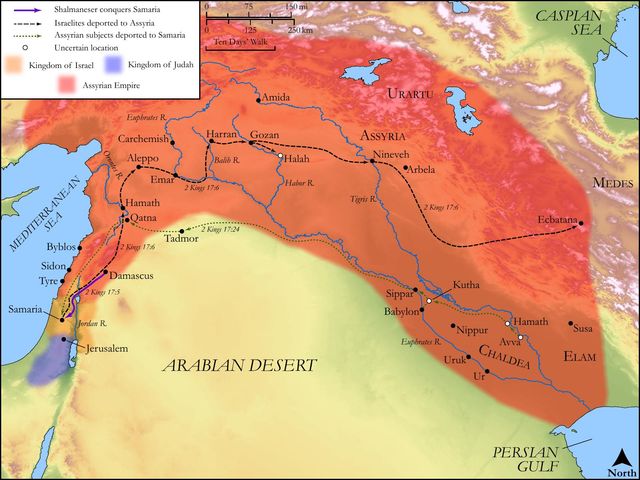
See on the biblical-era map
Study this verse
Public-domain commentary
Matthew Henry
From his Commentary on the Whole Bible. Henry comments on passages, not single verses — this entry covers 2 Kings 17:7–23. His three-level outline is real structure in the source text, so it is rendered as structure.
Though the destruction of the kingdom of the ten tribes was but briefly related, it is in these verses largely commented upon by our historian, and the reasons of it assigned, not taken from the second causes - the weakness of Israel, their impolitic management, and the strength and growing greatness of the Assyrian monarch (these things are overlooked) - but only from the First Cause. Observe, 1. It was the Lord that removed Israel out of his sight; whoever were the instruments, he was the author of this calamity. It was destruction from the Almighty; the Assyrian was but the rod of his anger, Isa 10:5. It was the Lord that rejected the seed of Israel, else their enemies could not have seized upon them, Kg2 17:20. Who gave Jacob for a spoil, and Israel to the robbers? Did not the Lord? Isa 43:24. We lose the benefit of national judgments if we do not eye the hand of God in them, and the fulfilling of the scripture, for that also is taken notice of here (Kg2 17:23): The Lord removed Israel out of his favour, and out of their own land, as he had said by all his servants the prophets. Rather shall heaven and earth pass than one tittle of God's word fall to the ground. When God's word and his works are compared, it will be found not only that they agree, but that they illustrate each other. But why would God ruin a people that were raised and incorporated, as Israel was, by miracles and oracles? Why would he undo that which he himself had done at so vast an expense? Was it purely an act of sovereignty? No, it was an act of necessary justice. For, 2. They provoked him to do this by their wickedness. Was it God's doing? Nay, it was their own; by their way and their doings they procured all this to themselves, and it was their own wickedness that did correct them. This the sacred historian shows here at large, that it might appear that God did them no wrong and that others might hear and fear. Come and see what it was that did all this mischief, that broke their power and laid their honour in the dust; it was sin; that, and nothing else, separated between them and God. This is here very movingly laid open as the cause of all the desolations of Israel. He here shows,
I.What God had done for Israel, to engage them to serve him.
1.He gave them their liberty (Kg2 17:7): He brought them from under the hand of Pharaoh who oppressed them, asserted their freedom (Israel is my son), and effected their freedom with a high hand. Thus they were bound in duty and gratitude to be his servants, for he had loosed their bonds; nor would he that rescued them out of the hand of the king of Egypt have contradicted himself so far as to deliver them into the hand of the king of Assyria, as he did, if they had not, by their iniquity, betrayed their liberty and sold themselves.
2.He gave them their law, and was himself their king. They were immediately under a divine regimen. They could not plead ignorance of good and evil, sin and duty, for God had particularly charged them against those very things which here he charges them with (Kg2 17:15), That they should not do like the heathen. Nor could they be in any doubt concerning their obligation to observe the laws which they are here charged with rejecting, for they were the commandments and statutes of the Lord their God (Kg2 17:13), so that no room was left to dispute whether they should keep them or no. He had not dealt so with other nations, Psa 147:19, Psa 147:20.
3.He gave them their land, for he cast out the heathen from before them (Kg2 17:8), to make room for them; and the casting out of them for their idolatries was as fair a warning as could be given to Israel not to do like them.
II.What they had done against God, notwithstanding these engagements which he had laid upon them.
1.In general. They sinned against the Lord their God (Kg2 17:7), they did those things that were not right (Kg2 17:9), but secretly. So wedded were they to their evil practices that when they could not do them publicly, could not for shame or could not for fear, they would do them secretly - an evidence of their atheism, that they thought what was done in secret was from under the eye of God himself and would not be required. Again, they wrought wicked things in such a direct contradiction to the divine law that they seemed as if they were done on purpose to provoke the Lord to anger (Kg2 17:11), in contempt of his authority and defiance of his justice. They rejected God's statutes and his covenant (Kg2 17:15), would not be bound up either by his command or the consent they themselves had given to the covenant, but threw off the obligations of both, and therefore God justly rejected them, Kg2 17:20. See Hos 4:6. They left all the commandments of the Lord their God (Kg2 17:16), left the way, left the work, which those commandments prescribed them and directed them in. Nay, lastly, they sold themselves to do evil in the sight of the Lord, that is, they wholly addicted themselves to sin, as slaves to the service of those to whom they are sold, and, by their obstinately persisting in sin, so hardened their own hearts that at length it had become morally impossible for them to recover themselves, as one that has sold himself has put his liberty past recall.
2.In particular. Though they were guilty (no doubt) of many immoralities, and violated all the commands of the second table, yet nothing is here specified, but their idolatry. This was the sin that did most easily beset them; this was, of all sins, most provoking to God: it was the spiritual adultery that broke the marriage-covenant, and was the inlet of all other wickedness. Hence it is again and again mentioned here as the sin that ruined them.
(1.)They feared other gods (Kg2 17:7), that is, worshipped them and paid their homage to them, as if they feared their displeasure.
(2.)They walked in the statutes of the heathen, which were contrary to God's statutes (Kg2 17:8), did as did the heathen (Kg2 17:11), went after the heathen that were round about them (Kg2 17:15), so prostituting the honour of their peculiarity, and defeating God's design concerning them, which was that they should be distinguished from the heathen. Must those that were taught of God go to school to the heathen - those that were appropriated to God take their measures from the nations that were abandoned by him?
(3.)They walked in the statutes of the idolatrous kings of Israel (Kg2 17:8), in all the sins of Jeroboam, Kg2 17:22. When their kings assumed a power to alter and add to the divine institutions they submitted to them, and thought the command of their kings would bear them out in disobedience to the command of their God.
(4.)They built themselves high places in all their cities, Kg2 17:9. If in any place there was but the tower of the watchmen (a country tower that had no walls, but only a tower to shelter the watch in time of danger), or but a lodge for shepherds, it must be honoured with a high place, and that with an altar. If there was a fenced city, it must be further fortified with a high place. Having forsaken God's only place, they knew no end of high places, in which every man followed his own fancy and directed his devotion to what god he pleased. Sacred things were hereby profaned and laid common, when their altars were as heaps in the furrows of the field, Hos 12:11.
(5.)They set them up images and groves - Asherim (even wooden images, so some think the term, which we translate groves, should be rendered) or Ashtaroth (so others) - directed contrary to the second commandment, Kg2 17:10. They served idols (Kg2 17:12), the works of their own hands and creatures of their own fancy, though God had warned them particularly not to do this thing.
(6.)They burnt incense in all the high places, to the honour of strange gods, for it was to the dishonour of the true God, Kg2 17:11.
(7.)They followed vanity. Idols are called so, because they could do neither good nor evil, but were the most insignificant things that could be; those that worshipped them were like unto them, and so they became vain and good for nothing (Kg2 17:16), vain in their devotions, which were brutish and ridiculous, and so became vain in their whole conversation.
(8.)Besides the molten images, even the two calves, they worshipped all the host of heaven - the sun, moon, and stars: for it is not meant of the heavenly host of angels; they could not rise so far above sensible things as to think of them. And, withal, they served Baal, the deified heroes of the Gentiles, Kg2 17:16.
(9.)They caused their children to pass through the fire, in token of their dedicating them to their idols.
(10.)They used divinations and enchantments, that they might receive directions from the gods to whom they paid their devotions.
III.What means God used with them, to bring them off from their idolatries, and to how little purpose.
He testified against them, showed them their sins and warned them of the fatal consequences of them by all the prophets and all the seers (for so the prophets had been formerly called), and pressed them to turn from their evil ways, Kg2 17:13. We have read of prophets, more or less, in every reign. Though they had forsaken God's family of priests, he did not leave them without a succession of prophets, who made it their business to teach them the good knowledge of the Lord, but all in vain (Kg2 17:14); they would not hear, but hardened their necks, persisted in their idolatries, and were like their fathers, that would not bow their necks to God's yoke, because they did not believe in him, did not receive his truths, nor would venture upon his promises: it seems to refer to their fathers in the wilderness; the same sin that kept them out of Canaan turned these out, and that was unbelief.
IV.How God punished them for their sins.
He was very angry with them (Kg2 17:18); for, in the matter of his worship, he is a jealous God, and resents nothing more deeply than giving that honour to any creature which is due to himself only. He afflicted them (Kg2 17:20) and delivered them into the hand of spoilers, in the days of the judges and of Saul, and afterwards in the days of most of their kings, to see if they would be awakened by the judgments of God to consider and amend their ways; but, when all these corrections did not prevail to drive out the folly, God first rent Israel from the house of David, under which they might have been happy. As Judah was hereby weakened, so Israel was hereby corrupted; for they made a man king who drove them from following the Lord and caused them to sin a great sin, Kg2 17:21. This was a national judgment, and the punishment of their former idolatries; and, at length, he removed them quite out of his sight (Kg2 17:18, Kg2 17:23), without giving them any hopes of a return out of their captivity.
Lastly, Here is a complaint against Judah in the midst of all (Kg2 17:19): Also Judah kept not the commandments of God; though they were not as yet quite so bad as Israel, yet they walked in the statutes of Israel; and this aggravated the sin of Israel, that they communicated the infection of it to Judah; see Eze 23:11. Those that bring sin into a country or family bring a plague into it and will have to answer for all the mischief that follows.
Continue studying 2 Kings 17:14 across the web’s major study libraries — every link below opens this exact verse, chapter, or book on the destination site.
Read & Compare
 BibleGatewayThis verse in more than 200 translations and 70 languages.
 Bible.comThe YouVersion reader — hundreds of translations, reading plans, and highlights.
 ESV.orgCrossway's official English Standard Version reader.
 NET BibleThe NET translation with 60,000+ translators' notes on every rendering decision.
 STEP BibleTyndale House's free study tool — original text, vocabulary, and scholarly resources.
 BibliaLogos Bible Software's free web reader.
 USCCBThe New American Bible (Revised Edition) with the U.S. bishops' study notes.
Commentaries
 BibleHub CommentariesDozens of classic commentaries on this verse, gathered on one page.
 StudyLightMore than 100 commentary sets — the largest collection on the web.
 BibleRefPlain-English commentary on what this verse means, verse by verse.
 Enduring WordDavid Guzik's free commentary on this chapter, widely used by Bible teachers.
 Bible Study ToolsVerse commentary alongside Greek and Hebrew study aids.
Original Language & Research
- BibleHub InterlinearThe verse word by word — original language, transliteration, and English.
- BibleHub LexiconEvery word's original-language definition and Strong's entry.
 Blue Letter BibleDeep-study tools — Strong's numbers, concordance, and word studies.
 SefariaThe Hebrew text with Rashi and centuries of Jewish commentary.
Sermons, Hymns & Audio


TrulyRandomVerse is not affiliated with these sites and doesn’t control their content. They’re linked because they’re genuinely useful.
Summary
Second Kings 17:14 profoundly encapsulates the tragic and persistent spiritual rebellion of the Northern Kingdom of Israel, highlighting their unyielding refusal to heed God's repeated warnings and their deep-seated unbelief. This verse serves as a pivotal explanation for the divine judgment that culminated in their Assyrian exile, emphasizing a stubborn defiance that mirrored the generational unbelief of their ancestors, ultimately sealing their fate due to a hardened heart against the LORD their God.
Context
ShowHideLiterary Context
This verse is situated within a somber and pivotal narrative detailing the downfall and eventual exile of the Northern Kingdom of Israel (Samaria) at the hands of the Assyrians. The preceding verses, specifically 2 Kings 17:7-13, provide a comprehensive and damning indictment of Israel's sins, meticulously listing their idolatry, rejection of God's statutes, adoption of pagan practices, and disregard for prophetic warnings. Verse 14 serves as a climactic summary of the people's response to these divine overtures—a resolute and unyielding refusal to repent. It directly follows the enumeration of their transgressions and precedes the final description of their deportation, thereby functioning as a theological explanation for the inevitability of God's judgment and the justice of their punishment. The narrative flow underscores a divine patience that was met with persistent human obstinacy, culminating in the irreversible consequences of their choices.
Historical & Cultural Context
The period leading up to 2 Kings 17 describes a turbulent era for Israel, caught between the rising imperial power of Assyria and their own internal spiritual decay. By the 8th century BCE, the Assyrian Empire was a dominant force, systematically conquering and deporting populations as a strategy to prevent rebellion and assimilate conquered peoples. Israel, particularly under kings like Hoshea, vacillated between alliances with Egypt and Assyria, demonstrating a profound lack of trust in the LORD and a failure to seek His guidance. Culturally, the concept of a "hardened neck" or "stiff-necked" people was a well-understood Hebrew idiom, as when the LORD said of Israel at Horeb, "it is a stiffnecked people," vividly portraying an ox refusing to submit to the yoke or a person unwilling to bow in submission. This imagery underscored a profound act of defiance against authority, which, in Israel's case, was a direct affront to their covenant Lord. Their adoption of Canaanite fertility cults and Baal worship, despite the explicit prohibitions of the Mosaic Law, illustrated a deep-seated cultural drift away from the monotheistic worship of Yahweh.
Key Themes
ShowHideSecond Kings 17:14 powerfully contributes to several overarching themes within the book of Kings and the broader Deuteronomistic History. The primary theme is the consequences of covenant disobedience. The verse explicitly states Israel's refusal to "hear" and their "hardened necks," which are direct violations of the covenant stipulations that demanded obedience and faithfulness to the LORD. This persistent rebellion, despite God's repeated warnings through prophets (a theme emphasized in 2 Kings 17:13), underscores the theme of divine justice and judgment. God's actions are not arbitrary but a righteous response to sustained and willful rejection. Furthermore, the comparison to "their fathers" highlights the tragic theme of generational sin and unbelief, suggesting a deeply entrenched spiritual malaise that transcended individual reigns and became a defining characteristic of the Northern Kingdom. This verse also implicitly reinforces the theme of God's sovereignty and patience, as He sent numerous prophets before finally executing judgment, demonstrating His long-suffering even in the face of such profound obstinacy.
Exposition and Analysis
ShowHideKey Word Analysis
ShowHideThis word is far more profound than simply perceiving sound. In biblical usage, shâmaʻ' implies not just listening, but also understanding, heeding, and obeying. When Israel "would not hear," it signifies a deliberate and active refusal to respond obediently to God's commands, warnings, and prophetic messages. It denotes a rejection of the divine word as authoritative and binding, indicating a deep-seated spiritual deafness and a failure to discern or give ear to His truth.
This is a powerful and frequently used idiom in the Old Testament, literally meaning "stiff of neck." It vividly describes an animal, particularly an ox, that resists the yoke, refusing to be led or guided by its master. Spiritually, it signifies extreme obstinacy, stubbornness, and defiance. It portrays a people unwilling to submit to God's authority, to humble themselves, or to turn from their wicked ways. This imagery underscores an unyielding will set against the divine will, a refusal to bend or repent, making them "stiff-necked."
To "believe" in the biblical sense (from which we get "Amen") means to be firm, trustworthy, or faithful. When Israel "did not believe in the LORD their God," it indicates a profound lack of trust, reliance, and faithfulness towards Yahweh. It's not merely intellectual assent but a failure to depend on God, to find security in Him, or to live in accordance with His covenant. This unbelief is the root cause of their disobedience and the ultimate expression of their hardened hearts, failing to be firm or faithful in Him.
Verse Breakdown
ShowHide"Notwithstanding they would not hear,"
This phrase immediately establishes the core problem: Israel's deliberate and willful rejection of God's voice. Despite the numerous warnings, appeals, and prophetic pronouncements detailed in the preceding verses, the people consistently chose to ignore and disregard divine instruction. This was not a failure of communication on God's part, but a failure of reception and obedience on Israel's part, demonstrating a conscious and persistent refusal to listen intelligently.
"but hardened their necks,"
This clause elaborates on the nature of their refusal, employing a powerful metaphor. Their "hardened necks" signify an unyielding, stubborn, and defiant posture towards God. They were unwilling to submit to His authority, to humble themselves, or to change their ways, much like a stubborn animal resisting its master's lead. This spiritual obstinacy was a conscious choice to resist divine guidance and discipline, making them stiff-necked against their Creator.
"like to the neck of their fathers,"
This comparison highlights a tragic and persistent pattern of rebellion. Israel's current generation was not an isolated case of disobedience but was mirroring the deep-seated stubbornness and unfaithfulness that characterized previous generations, particularly during the wilderness wanderings. This analogy underscores the deep historical roots of their spiritual problem, indicating a generational legacy of defiance against God and a perpetuation of their ancestors' stiff-necked behavior.
"that did not believe in the LORD their God."
This final clause identifies the fundamental spiritual issue underlying their hardened necks and refusal to hear. The ultimate problem was a lack of faith or trust in Yahweh (the LORD), their covenant God (Elohim). Their unbelief manifested as a failure to rely on Him, to obey His commands, and to acknowledge His unique sovereignty. This foundational unbelief was the wellspring from which all their disobedience flowed, sealing their fate due to their failure to be firm or faithful in Him.
Literary Devices
ShowHideSecond Kings 17:14 masterfully employs several literary devices to convey its profound theological message. The most prominent is Metaphor, specifically in the phrase "hardened their necks." This vivid image, drawn from the agricultural world, powerfully communicates the people's stubborn and unyielding resistance to God's authority, likening them to an ox that refuses to submit to the yoke. This metaphor is further amplified by Analogy (or simile, though more deeply embedded than a simple "like a") as their behavior is explicitly compared to "the neck of their fathers." This analogy establishes a continuity of rebellion across generations, emphasizing a tragic, inherited spiritual disposition. The verse also utilizes Juxtaposition, implicitly contrasting God's persistent efforts to warn and guide His people (as detailed in the surrounding verses) with their equally persistent and willful refusal to listen. This stark contrast underscores the gravity of Israel's sin and the justice of God's subsequent judgment. Finally, the verse is an example of Repetition of Themes, echoing the pervasive biblical theme of Israel's stubbornness and unbelief found throughout the Pentateuch and prophetic literature, reinforcing its significance as a core aspect of their national identity and ultimate downfall.
Theological and Thematic Connections
ShowHideSecond Kings 17:14 serves as a profound theological statement on the nature of human rebellion and divine justice. It underscores that God's judgment is not arbitrary but a direct consequence of persistent, willful disobedience rooted in unbelief. The "hardened neck" is a spiritual condition of the heart, a refusal to submit to God's will and wisdom, which ultimately leads to a rejection of His very being. This verse highlights the covenantal relationship between God and Israel, where faithfulness was expected, and disobedience carried severe consequences. It also speaks to the cumulative effect of sin, illustrating how generational patterns of unbelief can deepen spiritual blindness, making repentance increasingly difficult and judgment inevitable. The tragic narrative of the Northern Kingdom serves as a perpetual warning against spiritual apathy and the dangers of neglecting God's word.
Reflection and Application
ShowHideThe stark reality presented in 2 Kings 17:14 offers timeless lessons for all who seek to walk with God. It serves as a potent reminder that God's grace and patience, though vast, are not infinite, and persistent rejection of His word inevitably leads to severe consequences. For believers today, this verse underscores the critical importance of cultivating a humble, receptive, and obedient heart. We are called to actively "hear" God's voice, not merely with our ears, but with our entire being, allowing His truth to penetrate and transform us. The danger of a "hardened neck" remains ever-present, manifesting as spiritual apathy, intellectual pride, or a stubborn refusal to yield to biblical truth in areas of our lives. Furthermore, the generational aspect challenges us to consider the spiritual legacy we are building. Are we passing on a heritage of faith and obedience, or are we inadvertently contributing to a pattern of unbelief for future generations? Our choices today have ripple effects that extend far beyond ourselves, urging us to choose humility, repentance, and unwavering trust in the LORD our God, lest we repeat the tragic errors of the past.
Questions for Reflection
ShowHideFAQ
ShowHideWhat does "hardened their necks" mean in a spiritual sense?
ShowHideIn a spiritual sense, "hardened their necks" (Hebrew: qasheh 'oreph) is a powerful metaphor signifying extreme stubbornness, obstinacy, and defiance against God's authority and commands. It portrays a person or people who are unwilling to submit, humble themselves, or turn from their sinful ways, much like a stubborn animal refusing to be led or yoked. This spiritual condition indicates a willful resistance to divine guidance and a refusal to repent, even in the face of clear warnings and consequences, as seen throughout Israel's history in passages like Exodus 32:9 and Deuteronomy 9:6.
Why does the verse mention "their fathers" in relation to their unbelief?
ShowHideThe mention of "their fathers" highlights a tragic and persistent pattern of generational unbelief and rebellion within Israel's history. It suggests that the Northern Kingdom's stubbornness was not an isolated incident but a deep-seated spiritual problem that had been passed down through generations. This connection underscores the cumulative nature of sin and the profound impact of spiritual choices on future generations. It serves as a reminder that the people of 2 Kings 17 were repeating the very mistakes of their ancestors, who also "did not believe in the LORD their God," as evidenced by their repeated acts of disobedience during the wilderness wanderings and subsequent periods of apostasy, such as those described in Numbers 14:11.
Christ-Centered Fulfillment
ShowHideWhile 2 Kings 17:14 vividly portrays the tragic consequences of Israel's persistent rebellion and unbelief, it also implicitly points to the profound need for a radical transformation of the human heart, a need ultimately fulfilled in Christ. Israel's "hardened necks" and refusal to "believe in the LORD their God" highlight humanity's inherent inability to perfectly obey God's law and the deep-seated spiritual sickness of sin. Jesus, however, stands in stark contrast as the perfectly obedient Son, whose entire life was characterized by a humble submission to the Father's will, even to the point of death on a cross (Philippians 2:8). He embodies the ultimate "hearing" and "believing" in God. Furthermore, the New Covenant, inaugurated through Christ's sacrifice, addresses the very problem of the "hardened neck" by promising a new heart and a new spirit, where God's law is written not on stone tablets but on human hearts (Ezekiel 36:26 and Hebrews 8:10). Through faith in Christ, believers receive the Holy Spirit, enabling them to truly hear God's voice, to soften their hearts, and to live in obedience, thereby overcoming the very generational cycle of unbelief and stubbornness that plagued ancient Israel. He is the Lamb of God who takes away the sin of the world, offering forgiveness and a path to a restored relationship with the God whom Israel so stubbornly rejected (John 1:29), and in Him, we find the grace to believe and obey.