


2 Chronicles 4:10
Bible text: King James Version (1769 Blayney text) · Public domain
Bible text: Berean Standard Bible · Public domain
Bible text: American Standard Version (1901) · Public domain
Bible text: World English Bible, Messianic edition · Public domain
Bible text: Geneva Bible (1599) · Public domain
Bible text: Young's Literal Translation · Public domain
- וְאֶתve·'Etand <obj.>H853Conj-w ¦ DirObjMParticle Object Indicatorוְandאֶת<obj.>
- הַיָּםhai·Yamthe seaH3220Art ¦ N-msNoun Singular Masculine Absoluteהַtheיָּםsea
- נָתַןna·Tanhe putH5414V-Qal-Perf-3msVerb Qal Perfect 3rd Singular Masculine
- מִכֶּתֶףmi·Ke·teffrom [the] side ofH3802Prep-m ¦ N-fscNoun Singular Feminine Constructמִfromכֶּתֶף[the] side of
- הַיְמָנִיתhay·ma·Nit<the> southH3233Art ¦ Adj-fsAdjective Singular Feminine Absoluteהַ<the>יְמָנִיתsouth
- קֵדְמָהKe·de·maheast -wardH6924N-ms ¦ SfxNoun Singular Masculine Absoluteקֵדְמָeastה-ward
- מִמּוּלmi·Mulfrom in front ofH4136Prep-m ¦ N-mscNoun Singular Masculine Constructמִfromמּוּלin front of
- נֶגְבָּהNeg·bah[the] south <towards>H5045N-ms ¦ SfxNoun Singular Masculine Absoluteנֶגְבָּ[the] southה<towards>
English is a literal word-by-word gloss of the Hebrew, not the KJV's wording. Why?
This is the original text the KJV's translators worked from — each Hebrew word with its own literal English meaning in this verse, prepared by scholars at Tyndale House, Cambridge. The KJV translates whole sentences, not word by word, so its wording differs: one Hebrew word can become several English words, and the KJV may choose “the LORD” where the gloss reads “Yahweh”. Both are faithful — they answer different questions. For the KJV's own rendering, switch to the KJV text.
Details
See on the biblical-era maps
Study this verse
Public-domain commentary
Matthew Henry
From his Commentary on the Whole Bible. Henry comments on passages, not single verses — this entry covers 2 Chronicles 4:1–10. His three-level outline is real structure in the source text, so it is rendered as structure.
David often speaks with much affection both of the house of the Lord and of the courts of our God. Both without doors and within there was that which typified the grace of the gospel and shadowed out good things to come, of which the substance is Christ.
I.There were those things in the open court, in the view of all the people, which were very significant.
1.There was the brazen altar, Ch2 4:1. The making of this was not mentioned in the Kings. On this all the sacrifices were offered, and it sanctified the gift. This altar was much larger than that which Moses made in the tabernacle; that was five cubits square, this was twenty cubits square. Now that Israel had become both numerous and more rich, and it was to be hoped more devout (for every age should aim to be wiser and better than that which went before it), it was expected that there would be a greater abundance of offerings brought to God's altar than had been. It was therefore made such a capacious scaffold that it might hold them all, and none might excuse themselves from bringing those temptations of their devotion by alleging that there was not room to receive them. God had greatly enlarged their borders; it was therefore fit that they should enlarge his altars. Our returns should bear some proportion to our receivings. It was ten cubits high, so that the people who worshipped in the courts might see the sacrifice burnt, and their eye might affect their heart with sorrow for sin: "It is of the Lord's mercies that I am not thus consumed, and that this is accepted as an expiation of my guilt." They might thus be led to consider the great sacrifice which should be offered in the fulness of time to take away sin and abolish death, which the blood of bulls and goats could not possibly do. And with the smoke of the sacrifices their hearts might ascend to heaven in holy desires towards God and his favour. In all our devotions we must keep the eye of faith fixed upon Christ, the great propitiation. How they went up to this altar, and carried the sacrifices up to it, we are not told; some think by a plain ascent like a hill: if by steps, doubtless they were so contrived as that the end of the law (mentioned Exo 20:26) might be answered.
2.There was the molten sea, a very large brass pan, in which they put water for the priests to wash in, Ch2 4:2, Ch2 4:6. It was put just at the entrance into the court of the priests, like the font at the church door. If it were filled to the brim, it would hold 3000 baths (as here, Ch2 4:5), but ordinarily there were only 2000 baths in it, Kg1 7:26. The Holy Ghost by this signified,
(1.)Our great gospel privilege, that the blood of Christ cleanseth from all sin, Jo1 1:7. To us there is a fountain opened for all believers (who are spiritual priests, Rev 1:5, Rev 1:6), nay, for all the inhabitants of Jerusalem to wash in, from sin, which is uncleanness. There is a fulness of merit in Jesus Christ for all those that by faith apply to him for the purifying of their consciences, that they might serve the living God, Heb 9:14.
(2.)Our great gospel duty, which is to cleanse ourselves by true repentance from all the pollutions of the flesh and the corruption that is in the world. Our hearts must be sanctified, or we cannot sanctify the name of God. Those that draw nigh to God must cleanse their hands, and purify their hearts, Jam 4:8. If I was thee not, thou hast no part with me; and he that is washed still needs to wash his feet, to renew his repentance, whenever he goes in to minister, Joh 13:10.
3.There were ten lavers of brass, in which they washed such things as they offered for the burnt-offerings, Ch2 4:6. As the priests must be washed, so must the sacrifices. We must not only purify ourselves in preparation for our religious performances, but carefully put away all those vain thoughts and corrupt aims which cleave to our performances themselves and pollute them.
4.The doors of the court were overlaid with brass (Ch2 4:9), both for strength and beauty, and that they might not be rotted with the weather, to which they were exposed. Gates of brass we read of, Psa 107:16.
II.There were those things in the house of the Lord (into which the priests alone went to minister) that were very significant.
All was gold there. The nearer we come to God the purer we must be, the purer we shall be.
1.There were ten golden candlesticks, according to the form of that one which was in the tabernacle, Ch2 4:7. The written word is a lamp and a light, shining in a dark place. In Moses's time they had but one candlestick, the Pentateuch; but the additions which, in process of time, were to be made of other books of scripture might be signified by this increase of the number of the candlesticks. Light was growing. The candlesticks are the churches, Rev 1:20. Moses set up but one, the church of the Jews; but, in the gospel temple, not only believers, but churches, are multiplied.
2.There were ten golden tables (Ch2 4:8), tables whereon the show-bread was set, Ch2 4:19. Perhaps every one of the tables had twelve loaves of show-bread on it. As the house was enlarged, the house-keeping was. In my father's house there is bread enough for the whole family. To those tables belonged 100 golden basins, or dishes; for God's table is well furnished.
3.There was a golden altar (Ch2 4:19), on which they burnt incense. It is probable that this was enlarged in proportion to the brazen altar. Christ, who once for all made atonement for sin, ever lives, making intercession, in virtue of that atonement.
Continue studying 2 Chronicles 4:10 across the web’s major study libraries — every link below opens this exact verse, chapter, or book on the destination site.
Read & Compare
 BibleGatewayThis verse in more than 200 translations and 70 languages.
 Bible.comThe YouVersion reader — hundreds of translations, reading plans, and highlights.
 ESV.orgCrossway's official English Standard Version reader.
 NET BibleThe NET translation with 60,000+ translators' notes on every rendering decision.
 STEP BibleTyndale House's free study tool — original text, vocabulary, and scholarly resources.
 BibliaLogos Bible Software's free web reader.
 USCCBThe New American Bible (Revised Edition) with the U.S. bishops' study notes.
Commentaries
 BibleHub CommentariesDozens of classic commentaries on this verse, gathered on one page.
 StudyLightMore than 100 commentary sets — the largest collection on the web.
 BibleRefPlain-English commentary on what this verse means, verse by verse.
 Enduring WordDavid Guzik's free commentary on this chapter, widely used by Bible teachers.
 Bible Study ToolsVerse commentary alongside Greek and Hebrew study aids.
Original Language & Research
- BibleHub InterlinearThe verse word by word — original language, transliteration, and English.
- BibleHub LexiconEvery word's original-language definition and Strong's entry.
 Blue Letter BibleDeep-study tools — Strong's numbers, concordance, and word studies.
 SefariaThe Hebrew text with Rashi and centuries of Jewish commentary.
Sermons, Hymns & Audio


TrulyRandomVerse is not affiliated with these sites and doesn’t control their content. They’re linked because they’re genuinely useful.
Summary
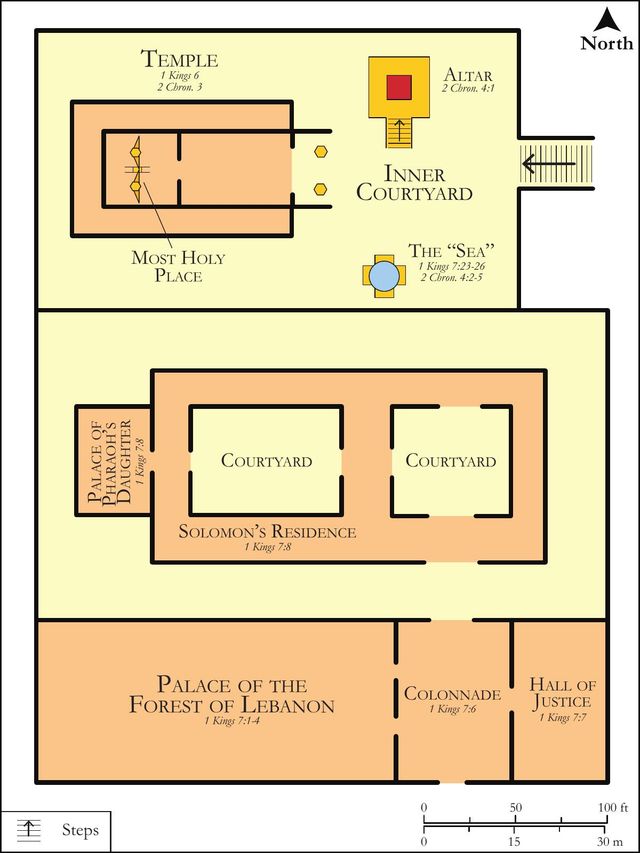
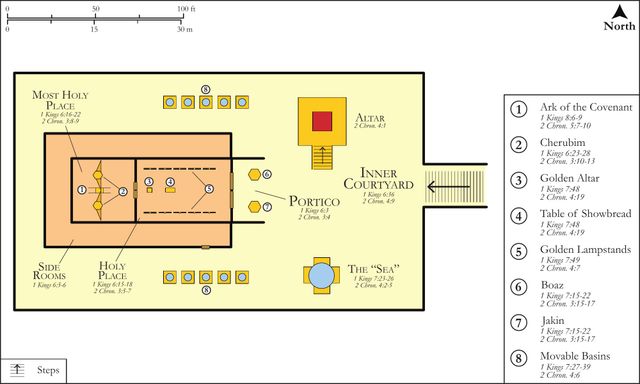
Second Chronicles 4:10 meticulously details the precise placement of the "molten sea," a monumental bronze basin within the outer courtyard of Solomon's Temple. This immense vessel, designed for the ritual washing of priests, was strategically positioned on the south side of the Temple's eastern entrance. Its exact location underscores the meticulous nature of the Temple's construction, reflecting the divine instructions given for God's dwelling place and emphasizing the critical importance of purity in approaching a holy God.
Context
ShowHideLiterary Context
This verse is deeply embedded within the Chronicler's detailed account of the construction and furnishing of Solomon's Temple, specifically spanning 2 Chronicles 3 and 2 Chronicles 4. Chapter 3 provides the architectural overview of the Temple structure itself, while Chapter 4 meticulously enumerates and describes the various bronze and gold furnishings, including the altar, the ten lavers, the lampstands, and the showbread tables. The "molten sea" stands out as one of the most prominent items, receiving significant descriptive attention in 2 Chronicles 4:2-5 and its parallel account in 1 Kings 7:23-26. The specific placement detailed in 2 Chronicles 4:10 highlights the Chronicler's profound interest in the precise order, divine blueprint, and functional precision of Temple worship, ensuring every element contributed to the sacred liturgy.
Historical & Cultural Context
The construction of Solomon's Temple marked a pivotal epoch in Israelite history, signifying a transition from the portable Tabernacle to a permanent, magnificent dwelling place for God in Jerusalem. This grand architectural endeavor, undertaken by King Solomon, was not only a testament to Israel's newfound wealth and political power but also the central hub of Israelite worship, where God's presence was believed to dwell among His people. Within this context, ritual purity was an absolute prerequisite in ancient Israelite religion, a concept deeply rooted in the Mosaic Law. Priests, functioning as mediators between God and His people, were stringently required to undergo ceremonial washings before performing their sacred duties, a practice inherited from the Tabernacle's bronze laver, as meticulously outlined in Exodus 30:17-21. Therefore, the "molten sea" was not merely an ornate furnishing but an indispensable piece of equipment for maintaining the necessary holiness and ritual readiness for priestly service in the presence of a holy God.
Key Themes
ShowHideThe detailed description of the molten sea's placement in 2 Chronicles 4:10 contributes significantly to several overarching themes within 2 Chronicles and the broader biblical narrative. Firstly, it emphatically underscores the precision and intentionality of divine design. God's instructions for His dwelling place, whether the Tabernacle or the Temple, were remarkably specific, emphasizing that worship must be conducted according to His revealed will, not human invention or convenience. Secondly, the primary function of the molten sea highlights the pervasive theme of ritual purity and sanctification. Access to God, even under the Old Covenant, necessitated thorough cleansing and separation from defilement, serving as a constant, tangible reminder of God's absolute holiness and humanity's inherent sinfulness. Finally, the vast quantity of water contained within this "sea" points to the enduring symbolism of water as an agent of cleansing and renewal. This profound symbolism permeates Scripture, from the life-giving waters of creation to the judgment and new beginning of the flood, and ultimately to the waters of baptism and the "living water" offered by Christ, as beautifully articulated in John 4:10-14.
Exposition and Analysis
ShowHideKey Word Analysis
ShowHideWhile literally meaning "sea" or "large body of water," here yâm is used metaphorically to describe the immense size of the bronze basin. This "sea" was a colossal, circular vessel, approximately 15 feet in diameter and 7.5 feet deep, capable of holding an enormous amount of water (2,000 baths, or over 11,000 gallons, according to 1 Kings 7:26). Its scale was so impressive that it evoked the imagery of a vast body of water, distinguishing it from the smaller lavers also present in the Temple courtyard. The term underscores its unparalleled capacity for cleansing.
Derived from the root meaning "to be on the right," yᵉmânîy signifies the right side. In ancient Hebrew directional conventions, particularly when facing east (the primary orientation of the Temple), "right" consistently referred to the south. This precise directional detail underscores the meticulous planning and execution of the Temple's layout, ensuring every element was placed according to a specific, divinely ordained order, reflecting the sacred geometry of God's dwelling.
This term, negeb, refers to the southern direction or region, often associated with dryness or drought. Its explicit mention here, in conjunction with "right side of the east end," serves to unequivocally confirm the molten sea's exact placement. This redundancy emphasizes the absolute precision required in the Temple's construction, leaving no ambiguity about the location of this vital piece of cultic equipment.
Verse Breakdown
ShowHide"And he set the sea"
This clause identifies King Solomon as the agent, who, under divine guidance and with the skilled craftsmanship of Hiram of Tyre, oversaw the construction and placement of all the Temple furnishings. The "sea" refers to the colossal bronze basin, a central and visually dominant feature of the outer court, designed for a specific ritual purpose.
"on the right side of the east end"
This phrase specifies the location relative to the Temple's main orientation. The "east end" designates the eastern side of the Temple courtyard, which served as the primary entrance for worshippers and priests. "On the right side" of this eastern entrance, from the perspective of one facing the Temple, would invariably be towards the south, aligning with ancient Hebrew directional conventions.
"over against the south"
This concluding phrase serves as a clarifying and reinforcing statement, leaving no doubt about the molten sea's precise orientation. It explicitly confirms that the basin was positioned on the southern side of the Temple complex. This emphatic reiteration highlights the exactness of the placement, underscoring the divine blueprint's demand for absolute precision in every aspect of God's sacred dwelling.
Literary Devices
ShowHideThe verse primarily employs Precision and Detailing in its description, which are characteristic of the Chronicler's meticulous account of the Temple's construction. The exact directional specifications—"right side of the east end" and "over against the south"—leave no room for ambiguity, highlighting the paramount importance of order, adherence to divine blueprint, and functional exactness in sacred architecture. Furthermore, the use of Metaphor is evident in calling the large bronze basin a "sea." This vivid imagery effectively conveys its immense size and vast capacity for water, distinguishing it from the smaller lavers and elevating its significance within the Temple complex. This detailed, almost architectural, language underscores the sacredness and profound significance of every component within God's dwelling place, reflecting divine intentionality.
Theological and Thematic Connections
ShowHideThe placement of the molten sea, a vessel for ritual cleansing, on the southern side of the Temple's eastern entrance, carries profound theological weight. It served as a constant visual and functional reminder that access to God's holy presence required purification. This principle of purity was not merely ceremonial but pointed to a deeper spiritual reality: a holy God cannot be approached by unholy people. The vastness of the "sea" symbolized the abundant provision for cleansing needed by the numerous priests who daily served in the Temple, underscoring the pervasive need for sanctification in the presence of the divine. This Old Testament practice foreshadowed the ultimate and complete purification offered through Christ, who provides a spiritual cleansing far beyond any physical ritual.
Reflection and Application
ShowHideWhile the physical molten sea and the elaborate Temple rituals are no longer practiced, having been perfectly fulfilled in Christ, the profound spiritual truths they embodied remain eternally relevant for believers today. The meticulous placement of the sea reminds us of God's inherent character—His desire for order, intentionality, and reverence in our worship and approach to Him. Just as the Old Testament priests needed to be cleansed to serve, so too are believers, who are now a "royal priesthood" (1 Peter 2:9), called to live lives of spiritual purity. This purity, however, is not achieved through ritualistic washing but through the complete and atoning work of Jesus Christ on the cross. The molten sea serves as a powerful, enduring reminder of our ongoing need for cleansing from sin and the abundant, gracious provision God has made for our sanctification through His Son. It calls us to regularly examine our hearts, confess our sins, and walk in the holiness that befits those who bear the name of Christ, ensuring our lives are a continuous act of worship, marked by reverence, intentionality, and a fervent desire to honor God in every detail.
Questions for Reflection
ShowHideFAQ
ShowHideWhat was the "molten sea" and what was its purpose?
ShowHideThe "molten sea" was a colossal bronze basin, approximately 15 feet in diameter and 7.5 feet deep, supported by twelve bronze oxen. It was not an actual sea but a massive laver designed to hold a vast quantity of water. Its primary purpose was for the ritual washing of the priests' hands and feet before they performed their sacred duties in the Temple. This washing was essential for maintaining ceremonial purity, a practice that originated with the bronze laver in the Tabernacle, as described in Exodus 30:18-21. It symbolized the absolute necessity of holiness and cleanliness in approaching a holy God.
Why was its placement so specific?
ShowHideThe specific placement of the molten sea—on the south side of the Temple's eastern entrance—underscores the meticulous nature of the Temple's design and construction, which followed divine blueprints. Every detail, including the orientation and location of furnishings, held profound theological significance and was intended to reflect God's order, holiness, and the precise requirements for worship. This precision ensured that the Temple functioned exactly as God intended for the sacred rituals and the worship of His people. It also highlighted the practical importance of accessible water for priestly purification as they entered and served in the courtyard.
Does this ritual washing apply to Christians today?
ShowHideWhile the physical ritual washing of the Old Testament priests does not literally apply to Christians today, the spiritual principles it represents are profoundly relevant and eternally true. The fundamental need for cleansing before approaching God remains. However, in the New Covenant, this cleansing is not achieved through ceremonial water but through the atoning blood of Jesus Christ. As believers, we are declared righteous by faith in Christ, and we are continually purified by His Spirit. The washing of the molten sea powerfully foreshadowed the ultimate and complete purification that Christ provides, enabling us to draw near to God with confidence, as articulated in Hebrews 10:19-22. We are called to live lives of spiritual purity, continually confessing our sins (1 John 1:9) and walking in the Spirit, reflecting the holiness of God who has called us.
Christ-Centered Fulfillment
ShowHideThe molten sea, with its vast capacity for water and its indispensable purpose of priestly purification, serves as a powerful Old Testament type pointing directly and profoundly to Jesus Christ. Just as the priests needed to be ritually cleansed by water before ministering in the Temple, humanity, defiled by sin, requires a far more profound and spiritual cleansing to approach a holy God. Jesus is the ultimate and perfect "sea" of purification, not of water, but of His own precious blood. He is the Lamb of God who takes away the sin of the world, whose sacrifice provides a complete, eternal, and once-for-all cleansing that no amount of ritual washing could ever achieve. Through His death and resurrection, Christ has opened a new and living way into the very presence of God, making us clean and holy. We no longer need a physical basin for purification, for we have been washed, sanctified, and justified in the name of the Lord Jesus Christ and by the Spirit of our God (1 Corinthians 6:11). He is the source of living water, and through Him, we are not merely cleansed for service but are made new creations, fully reconciled to God and empowered to live lives of holiness and worship. The meticulous placement of the molten sea in the Old Testament foreshadowed the precise and perfect plan of God to provide ultimate cleansing through His Son, Jesus Christ, making us fit to enter into His glorious presence, a church without spot or wrinkle (Ephesians 5:25-27).