


1 Samuel 31:12
Bible text: King James Version (1769 Blayney text) · Public domain
Bible text: King James Version with Strong's numbers · Public domain
Bible text: Berean Standard Bible · Public domain
Bible text: American Standard Version (1901) · Public domain
Bible text: World English Bible, Messianic edition · Public domain
Bible text: Geneva Bible (1599) · Public domain
Bible text: Young's Literal Translation · Public domain
- וַיָּקוּמוּvai·ya·Ku·muand they aroseH6965Conj-w ¦ V-Qal-ConsecImperf-3mpVerb Qal Consecutive Imperfect 3rd Plural Masculineוַandיָּקוּמוּthey arose
- כָּלkoleveryH3605N-mscNoun Singular Masculine Construct
- אִישׁ'ishman ofH376N-mscNoun Singular Masculine Construct
- חַיִלcha·YilstrengthH2428N-msNoun Singular Masculine Absolute
- וַיֵּלְכוּvai·ye·le·Khuand they wentH1980Conj-w ¦ V-Qal-ConsecImperf-3mpVerb Qal Consecutive Imperfect 3rd Plural Masculineוַandיֵּלְכוּthey went
- כָלkholallH3605N-mscNoun Singular Masculine Construct
- הַלַּיְלָהha·lay·Lahthe nightH3915Art ¦ N-msNoun Singular Masculine Absoluteהַtheלַּיְלָהnight
- וַיִּקְחוּvai·yik·Chuand they tookH3947Conj-w ¦ V-Qal-ConsecImperf-3mpVerb Qal Consecutive Imperfect 3rd Plural Masculineוַandיִּקְחוּthey took
- אֶת'et<obj.>H853DirObjMParticle Object Indicator
- גְּוִיַּתge·vi·Yat[the] corpse ofH1472N-fscNoun Singular Feminine Construct
- שָׁאוּלsha·'UlSaulH7586N-proper-mNoun Proper Masculine
- וְאֵתve·'Etand <obj.>H853Conj-w ¦ DirObjMParticle Object Indicatorוְandאֵת<obj.>
- גְּוִיֹּתge·vi·Yot[the] corpses ofH1472N-fpcNoun Plural Feminine Construct
- בָּנָיוba·Navhis sonsH1121N-mpc ¦ 3msNoun Plural Masculine Constructבָּנָיsonsוhis
- מֵחוֹמַתme·cho·Matfrom [the] wall ofH2346Prep-m ¦ N-fscNoun Singular Feminine Constructמֵfromחוֹמַת[the] wall of
- בֵּיתbeitBethH1052N-properNoun Proper Location
- שָׁןShanShanH1052N-properNoun Proper Location
- וַיָּבֹאוּvai·ya·Vo·'uand they wentH935Conj-w ¦ V-Qal-ConsecImperf-3mpVerb Qal Consecutive Imperfect 3rd Plural Masculineוַandיָּבֹאוּthey went
- יָבֵשָׁהya·Ve·shahJabesh towardsH3003N-proper ¦ SfxNoun Proper LocationיָבֵשָׁJabeshהtowards
- וַיִּשְׂרְפוּvai·yis·re·Fuand they burnedH8313Conj-w ¦ V-Qal-ConsecImperf-3mpVerb Qal Consecutive Imperfect 3rd Plural Masculineוַandיִּשְׂרְפוּthey burned
- אֹתָם'o·Tam<obj.> themH853DirObjM ¦ 3mpParticle Object Indicatorאֹתָ<obj.>םthem
- שָׁםShamthereH8033AdvAdverb
English is a literal word-by-word gloss of the Hebrew, not the KJV's wording. Why?
This is the original text the KJV's translators worked from — each Hebrew word with its own literal English meaning in this verse, prepared by scholars at Tyndale House, Cambridge. The KJV translates whole sentences, not word by word, so its wording differs: one Hebrew word can become several English words, and the KJV may choose “the LORD” where the gloss reads “Yahweh”. Both are faithful — they answer different questions. For the KJV's own rendering, switch to the KJV text.
Details
See on the biblical-era map
Study this verse
Public-domain commentary
Matthew Henry
From his Commentary on the Whole Bible. Henry comments on passages, not single verses — this entry covers 1 Samuel 31:8–13. His three-level outline is real structure in the source text, so it is rendered as structure.
The scripture makes no mention of the souls of Saul and his sons, what became of them after they were dead (secret things belong not to us), but of their bodies only.
I.How they were basely abused by the Philistines.
The day after the battle, when they had recovered their fatigue, they came to strip the slain, and, among the rest, found the bodies of Saul and his three sons, Sa1 31:8. Saul's armour-bearer perhaps intended to honour his master by following the example of his self-murder, and to show thereby how well he loved him; but, if he had consulted his reason more than his passions, he would have spared that foolish compliment, not only in justice to his own life, but in kindness to his master, to whom, by the opportunity of survivorship, he might have done all the service that could be done him by any man after he was dead; for he might, in the night, have conveyed away his body, and those of his sons, and buried them decently. But such false and foolish notions these vain men have (though they would be wise) of giving and receiving honour. Nay, it should seem, Saul might have saved himself the fatal thrust and have made his escape: for the pursuers (in fear of whom he slew himself) came not to the place where he was till the next day. But whom God will destroy he infatuates and utterly consumes with his terrors. See Job 18:5, etc. Finding Saul's body (which now that it lay extended on the bloody turf was distinguishable from the rest by its length, as it was, while erect, by its height, when he proudly overlooked the surrounding crowd), they will, in that, triumph over Israel's crown, and meanly gratify a barbarous and brutish revenge by insulting the deserted corpse, which, when alive, they had stood in awe of.
1.They cut off his head. Had they designed in this to revenge the cutting off of Goliath's head they would rather have cut off the head of David, who did that execution, when he was in their country. They intended it, in general, for a reproach to Israel, who promised themselves that a crowned and an anointed head would save them from the Philistines, and a particular reproach to Saul, who was taller by the head than other men (which perhaps he was wont to boast of), but was now shorter by the head.
2.They stripped him of his armour (Sa1 31:9), and sent that to be set up as a trophy of their victory, in the house of Ashtaroth their goddess (Sa1 31:10); and we are told, Ch1 10:10 (though it is omitted here), that they fastened his head in the temple of Dagon. Thus did they ascribe the honour of their victory, not as they ought to have done to the real justice of the true God, but to the imaginary power of their false gods, and by this respect paid to pretended deities shame those who give not the praise of their achievements to the living God. Ashtaroth, the idol that Israel had many a time gone a whoring after, now triumphs over them.
3.They sent expresses throughout their country, and ordered public notice to be given in the houses of their gods of the victory they had obtained (Sa1 31:9), that public rejoicings might be made and thanks given to their gods. This David regretted sorely, Sa2 1:20. Tell it not in Gath.
4.They fastened his body and the bodies of his sons (as appears, Sa1 31:12) to the wall of Bethshan, a city that lay not far from Gilboa and very near to the river Jordan. Hither the dead bodies were dragged and here hung up in chains, to be devoured by the birds of prey. Saul slew himself to avoid being abused by the Philistines, and never was royal corpse so abused as his was, perhaps the more if they understood that he slew himself for that reason. He that thinks to save his honour by sin will certainly lose it. See to what a height of insolence the Philistines had arrived just before David was raised up, who perfectly subdued them. Now that they had slain Saul and his sons they thought the land of Israel was their own for ever, but they soon found themselves deceived. When God has accomplished his whole work by them he will accomplish it upon them. See Isa 10:6, Isa 10:7.
II.How they were bravely rescued by the men of Jabesh-Gilead.
Little more than the river Jordan lay between Beth-shan and Jabesh-Gilead, and Jordan was in that place passable by its fords; a bold adventure was therefore made by the valiant men of that city, who in the night passed the river, took down the dead bodies, and gave them decent burial, Sa1 31:11, Sa1 31:13. This they did,
1.Out of a common concern for the honour of Israel, or the land of Israel, which ought not to be defiled by the exposing of any dead bodies, and especially of the crown of Israel, which was thus profaned by the uncircumcised.
2.Out of a particular sense of gratitude to Saul, for his zeal and forwardness to rescue them from the Ammonites when he first came to the throne, Sa1 11:1-15. It is an evidence of a generous spirit and an encouragement to beneficence when the remembrance of kindnesses is thus retained, and they are thus returned in an extremity. The men of Jabesh-Gilead would have done Saul better service if they had sent their valiant men to him sooner, to strengthen him against the Philistines. But his day had come to fall, and now this is all the service they can do him, in honour to his memory. We find not that any general mourning was made for the death of Saul, as was for the death of Samuel (Sa1 25:1), only those Gileadites of Jabesh did him honour at his death; for,
(1.)They made a burning for the bodies, to perfume them. So some understand the burning of them. They burnt spices over them, Sa1 11:12. And that it was usual thus to do honour to their deceased friends, at least their princes, appears by the account of Asa's funeral (Ch2 16:14), that they made a very great burning for him. Or (as some think) they burnt the flesh, because it began to putrefy.
(2.)They buried the bodies, when, by burning over them, they had sweetened them (or, if they burnt them, they buried the bones and ashes), under a tree, which served for a grave-stone and monument. And,
(3.)They fasted seven days, that is, each day of the seven they fasted till the evening; thus they lamented the death of Saul and the present distracted state of Israel, and perhaps joined prayers with their fasting for the re-establishment of their shattered state. Though, when the wicked perish there is shouting (that is, it is to be hoped a better state of things will ensue, which will be matter of joy), yet humanity obliges us to show a decent respect to dead bodies, especially those of princes.
This book began with the birth of Samuel, but now it ends with the burial of Saul, the comparing of which two together will teach us to prefer the honour that comes from God before any of the honours which this world pretends to have the disposal of.
Historical interpretation
Historical reception
2 surviving comments on this verse. Each one is dated, so this reads as a timeline rather than a list.
And they walked all night, etc. When the inhabitants of the city of Christ situated on the mountain, Judea, from which they recollected heralds and ministers of salvation had come to them in patriarchs, prophets, and apostles, were treated with contempt and ridicule by the gentiles, they rose to the work of the word, all zealously rejoicing to act; and amidst the darkness of erring ones themselves walking the path of virtues, they forbade rejoicing in the public insultation of those whose fault brought salvation to the gentiles as if pertaining to the house of the devil. They say, if the first fruit be holy, so also is the lump; and if the root be holy, so also are the branches. But if some of the branches have been broken off, and you, being a wild olive tree, were grafted in among them, and made a partaker of the root and fatness of the olive tree, do not boast against the branches (Rom. XI), and the other things which the Apostle miraculously and elaborately addressed to the Romans.
They came to Jabesh and burned them there, etc. The corpses, carnal or fleshly bones, signify the strongest and the works of virtues. Therefore, they burned the corpses of Saul and his sons, who left the weaknesses of the downfall of the Jews to divine judgment, so that they might understand that these things were done or permitted according to the depths of the riches of the wisdom and knowledge of God (Rom. XII), according to the inscrutable counsel of His will. Indeed, we must understand the burning in this place according to that which is commanded regarding the receiving and searching of the sacraments of the Lord's passion under the type of eating the lamb: If anything remains, you shall burn it with fire (Exod. XII). They buried the bones in the forest of Jabesh, as when they found any strength and firmness in the weak, they did not despise them as worthless, but preferred to add them to the fruitful works of the saints; if they knew any among the carnal and frail to strive for the virtues of the soul, they took care to number them with the fellowship of the saints. For indeed, the fruit of good works is known to be expressed through the forest, which in reading Genesis, understands what or what kind of forest Abraham planted in Beersheba. Otherwise, Saul, dead and ridiculed for his sins, is rescued from public disgrace by the men of Jabesh, whom he saved. The corpse is burned, and the bones are placed in the forest; for it is indeed fitting, that if any of the faithful and great men, overcome by sin, incur spiritual death, they may be helped especially by those whom he benefited in goodness, so that he may be able to revive, and that his carnal [deeds] may be revealed by their most fervent prayers in compunction, and his spiritual deeds may be commended to their Creator, worthy of His kindness.
Continue studying 1 Samuel 31:12 across the web’s major study libraries — every link below opens this exact verse, chapter, or book on the destination site.
Read & Compare
 BibleGatewayThis verse in more than 200 translations and 70 languages.
 Bible.comThe YouVersion reader — hundreds of translations, reading plans, and highlights.
 ESV.orgCrossway's official English Standard Version reader.
 NET BibleThe NET translation with 60,000+ translators' notes on every rendering decision.
 STEP BibleTyndale House's free study tool — original text, vocabulary, and scholarly resources.
 BibliaLogos Bible Software's free web reader.
 USCCBThe New American Bible (Revised Edition) with the U.S. bishops' study notes.
Commentaries
 BibleHub CommentariesDozens of classic commentaries on this verse, gathered on one page.
 StudyLightMore than 100 commentary sets — the largest collection on the web.
 BibleRefPlain-English commentary on what this verse means, verse by verse.
 Enduring WordDavid Guzik's free commentary on this chapter, widely used by Bible teachers.
 Bible Study ToolsVerse commentary alongside Greek and Hebrew study aids.
Original Language & Research
- BibleHub InterlinearThe verse word by word — original language, transliteration, and English.
- BibleHub LexiconEvery word's original-language definition and Strong's entry.
 Blue Letter BibleDeep-study tools — Strong's numbers, concordance, and word studies.
 SefariaThe Hebrew text with Rashi and centuries of Jewish commentary.
Sermons, Hymns & Audio


TrulyRandomVerse is not affiliated with these sites and doesn’t control their content. They’re linked because they’re genuinely useful.
Summary
First Samuel 31:12 recounts the extraordinary and perilous act of the valiant men of Jabesh-gilead, who, driven by profound gratitude and loyalty, embarked on an arduous, all-night journey to retrieve the desecrated bodies of King Saul and his sons from the wall of Bethshan. This courageous mission culminated in the burning of the bodies at Jabesh, an unconventional but necessary measure to prevent further indignity and ensure a measure of respectful closure for the fallen monarch and his heirs in the aftermath of a devastating national defeat.
Context
ShowHideLiterary Context
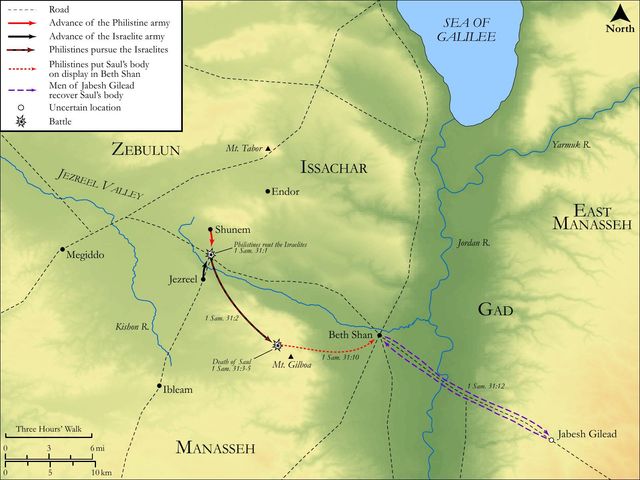
This verse serves as a crucial epilogue to the tragic demise of King Saul and his sons, detailed in 1 Samuel 31:1-10. The preceding narrative vividly portrays Israel's catastrophic defeat by the Philistines on Mount Gilboa, culminating in Saul's suicide and the deaths of his three sons, including the beloved Jonathan. The Philistines, in a display of ruthless triumph and psychological warfare, decapitated Saul, stripped his armor, and then publicly displayed his body and those of his sons on the wall of Bethshan. This act of extreme humiliation was designed to demoralize Israel and solidify Philistine dominance. Verse 12 then introduces the unexpected and heroic counter-action by the men of Jabesh-gilead, setting the stage for the subsequent burial of their bones in 1 Samuel 31:13, which effectively closes the book of 1 Samuel with a poignant act of loyalty amidst national despair.
Historical & Cultural Context
The Philistines' mutilation and public display of enemy bodies were common practices among the nations of that day, serving as potent symbols of conquest, terror, and the denial of proper burial rites, which was considered a profound indignity. Bethshan (H1052, Bêyth Shᵉʼân), a key Canaanite city later occupied by the Philistines, was strategically located at the eastern end of the Jezreel Valley, controlling vital trade and military routes. The men of Jabesh-gilead (H3003, Yâbêsh), situated across the Jordan River in Gilead, held a unique and enduring bond with Saul. Early in his reign, Saul had dramatically rescued them from the brutal siege and threatened mutilation by the Ammonite king Nahash, as recounted in 1 Samuel 11:1-11. This act of deliverance forged a deep and lasting loyalty, which now compelled them to undertake this dangerous, night-time mission, risking their lives to honor their former deliverer and defy the Philistine desecration.
Key Themes
ShowHideThis verse powerfully encapsulates several significant themes. Foremost is Loyalty and Gratitude, demonstrating the enduring impact of past kindness. The men of Jabesh-gilead's perilous journey underscores a profound sense of obligation and gratitude for Saul's earlier deliverance, illustrating the biblical principle of remembering and honoring those who have shown favor, even when circumstances change or the recipient has fallen from grace, a theme echoed in Proverbs 27:10. Second, it emphasizes Respect for the Dead, even for a king who had ultimately failed and been rejected by God. Their mission was to prevent further indignity and ensure a measure of proper care for the fallen monarch and his sons, reflecting a deep-seated cultural value and the importance of dignified burial, as seen in Deuteronomy 21:22-23. Third, their act represents Defiance Against Desecration, serving as a quiet but potent act of resistance against the Philistine attempt to publicly shame Israel and its former king. Finally, the narrative introduces the theme of Unconventional Burial. The burning of the bodies, while not a typical Israelite burial practice (which usually involved interment, as illustrated by Abraham's burial of Sarah in Genesis 23:19), was likely employed out of necessity to prevent further desecration, to ensure all scattered remains were gathered, or perhaps as a form of extreme purification in a dire situation. 1 Samuel 31:13 confirms that the bones were then buried, indicating the burning was a preliminary, pragmatic step.
Exposition and Analysis
ShowHideKey Word Analysis
ShowHideMeaning "force," "strength," "valor," or "might." When combined with "men" (H376, ʼîysh), as in the phrase "valiant men" (H381, ʼÎysh-Chayil), it denotes individuals of exceptional courage, capability, and fortitude. In this context, it highlights the moral and physical strength of the men of Jabesh-gilead, who undertook a dangerous, night-long journey not for personal gain, but out of a profound sense of loyalty and duty to honor their fallen king, demonstrating a resolve that transcends the immediate military defeat.
Meaning "a body, whether alive or dead; carcase, corpse." The repetition of "body" (for Saul) and "bodies" (for his sons) emphasizes the physical remains that were subjected to Philistine desecration. The men of Jabesh-gilead's mission was specifically to retrieve these physical forms, which carried immense cultural and personal significance, underscoring the deep indignity inflicted by their public display and the urgent need for their respectful handling.
A primitive root meaning "to be (causatively, set) on fire; to burn (up), kindle, utterly." The use of this verb is highly significant because cremation was not the standard Israelite burial custom; interment was the norm. This unusual act was likely a pragmatic and necessary response to the dire circumstances. It served to prevent further desecration of the bodies by the Philistines, to ensure that all scattered or mutilated remains were collected and given a collective, albeit unconventional, form of dignified treatment, or perhaps as a means of ritual purification in a moment of extreme national shame and defilement. The subsequent burial of the bones (1 Samuel 31:13) confirms that the burning was a preliminary step to secure the remains for a proper, if modified, burial.
Verse Breakdown
ShowHide"All the valiant men arose, and went all night"
This opening clause immediately establishes the heroic and urgent nature of the mission. The "valiant men" (referring to the men of Jabesh-gilead, motivated by their earlier deliverance by Saul) are portrayed as decisive and courageous (H6965, qûwm, "arose"). Their immediate action and the arduous, dangerous journey "all night" (H3915, layil, "night"), involving travel through potentially hostile territory (H3212, yâlak, "went"), underscore their unwavering commitment and the peril involved in traversing enemy territory under the cover of darkness.
"and took the body of Saul and the bodies of his sons from the wall of Bethshan"
This describes the daring and successful objective of their mission. Bethshan (H1052, Bêyth Shᵉʼân) was a heavily fortified Philistine city, and the bodies were displayed on its "wall" (H2346, chôwmâh), making the retrieval a highly risky endeavor. The act of "took" (H3947, lâqach) the bodies (H1472, gᵉvîyâh) from the wall directly reverses the Philistines' act of desecration, reclaiming a measure of dignity for the fallen king and his sons (H1121, bên).
"and came to Jabesh, and burnt them there"
This final clause details the return to their home city, Jabesh (H3003, Yâbêsh), and the unconventional method of disposal. Upon safely reaching Jabesh-gilead (H935, bôwʼ, "came"), the men performed the act of "burnt" (H8313, sâraph). As noted in the Key Word Analysis, this was an unusual practice for Israelites, likely chosen out of necessity to prevent further indignity, to ensure all remains were collected, and to provide a form of closure in a desperate situation before the subsequent burial of the bones.
Literary Devices
ShowHideThe narrative of 1 Samuel 31:12 is rich with literary devices that amplify its emotional and thematic impact. It functions as a Heroic Narrative, elevating the men of Jabesh-gilead to a status of valor and unwavering loyalty, contrasting sharply with the general despair and defeat of Israel in the preceding verses. There is a profound Irony in this act: Saul, who began his reign as a deliverer, receives his final honor and proper, albeit unconventional, burial not from his own tribe or the nation he led, but from a small city he had rescued at the very beginning of his kingship, as recounted in 1 Samuel 11. This highlights the enduring power of gratitude and the unexpected sources of faithfulness. The act of retrieving and burning the bodies also carries potent Symbolism: it is a symbolic act of reclaiming dignity and asserting a final, quiet defiance against Philistine humiliation, transforming a public spectacle of shame into a private act of respect. The "all night" journey itself symbolizes the dedicated, arduous, and sacrificial nature of true loyalty. Furthermore, the narrative employs Foreshadowing by setting the stage for the subsequent burial of the bones in 1 Samuel 31:13, indicating that the burning was a necessary, intermediate step towards a final, dignified resting place.
Theological and Thematic Connections
ShowHideThe unwavering loyalty and sacrificial courage of the men of Jabesh-gilead in honoring Saul, despite his tragic end and God's rejection of him as king, offer profound theological insights. Their act transcends mere political allegiance, rooted instead in a deep-seated gratitude for past deliverance. It underscores the enduring value of faithfulness and compassion, even when the recipient of that faithfulness has fallen from grace or power. This narrative reminds us that acts of compassion and respect for the dead, even those deemed unworthy by human standards or divine judgment, are a testament to the character of the living. It also highlights the importance of proper burial and the cultural abhorrence of desecration, reflecting a broader biblical concern for the dignity of the human body, even in death, and the need for closure.
Reflection and Application
ShowHideThe account of the men of Jabesh-gilead is a powerful testament to the enduring power of gratitude, loyalty, and courage in the face of adversity and loss. In a world often quick to abandon those who fail, are unpopular, or fall from favor, their actions stand as a stark reminder of the importance of honoring past kindness and extending dignity even to the fallen. It challenges us to consider how we respond to those who have helped us, even when their circumstances change or their reputation is tarnished. Are we willing to act sacrificially and courageously to uphold respect and provide closure, even when it is difficult, dangerous, or unconventional? This narrative also speaks to the profound human need for proper closure and the honoring of the dead, emphasizing that even in defeat and loss, acts of love and respect can provide a vital measure of peace and a bridge to future hope, as it did for Israel before the rise of King David. It encourages us to cultivate a spirit of remembering and repaying kindness, demonstrating that true character is revealed not in fair-weather friendships, but in steadfast loyalty during times of trial and disgrace.
Questions for Reflection
ShowHideFAQ
ShowHideWhy did the men of Jabesh-gilead burn the bodies of Saul and his sons, instead of burying them directly?
ShowHideThe burning of the bodies was an unusual practice for Israelites, whose typical custom was interment (burial in the ground), as seen in countless Old Testament accounts. This unconventional act was likely a pragmatic and necessary decision driven by the dire circumstances. First, it prevented further desecration of the bodies by the Philistines, who had already mutilated and publicly displayed them on the wall of Bethshan. Burning would ensure that no further indignities could be inflicted upon the remains. Second, it allowed for the collection of all scattered or mutilated remains, ensuring a more complete and dignified handling of the bodies. Third, it might have been seen as a form of purification or a way to deal with bodies that had been defiled by their public display. After burning, the bones were then properly buried (1 Samuel 31:13), indicating that the burning was a necessary preliminary step to secure the remains for a final, respectful burial.
What motivated the men of Jabesh-gilead to undertake such a dangerous mission?
ShowHideTheir motivation stemmed from a profound and enduring sense of gratitude and loyalty to King Saul. Early in his reign, Saul had heroically delivered Jabesh-gilead from the brutal siege and threatened mutilation by the Ammonite king Nahash, who had threatened to gouge out the right eye of every man in the city (1 Samuel 11:1-11). This decisive act of rescue had fostered an unbreakable bond and a deep sense of obligation among the people of Jabesh-gilead. Upon hearing of the Philistine's desecration of Saul's body, they felt compelled to repay his earlier kindness, even at great personal risk, demonstrating a loyalty that transcended Saul's ultimate failure and rejection by God. Their actions exemplify the principle of remembering and honoring those who have shown significant favor, even when circumstances change dramatically.
Christ-Centered Fulfillment
ShowHideThe selfless and courageous act of the men of Jabesh-gilead, risking their lives to redeem the dignity of their fallen king, offers a poignant foreshadowing of the ultimate act of redemption found in Christ. While Saul's reign ended in defeat and rejection, and his body suffered public humiliation, the men's loyalty points to a deeper truth: that true love and honor extend even to the undeserving and the fallen. In a far greater sense, Jesus Christ, the true King of Israel and the Son of God, willingly laid down His life, not for those who were loyal, but for those who were His enemies and utterly undeserving (Romans 5:8). He endured the ultimate public humiliation and desecration on the cross, not to be rescued by valiant men, but to rescue humanity from the dominion of sin and death (Colossians 2:13-15). Just as the men of Jabesh-gilead sought to provide a measure of dignity for Saul's body, Christ's death and resurrection ensure not merely a dignified burial, but the ultimate resurrection of all who believe in Him, transforming our perishable bodies into imperishable ones (1 Corinthians 15:53-54). The loyalty displayed in 1 Samuel 31:12, though noble, pales in comparison to the divine loyalty and sacrificial love of God in Christ, who secures eternal dignity and life for His people, even in the face of their spiritual death, offering a hope that transcends any earthly defeat or humiliation (John 3:16).