


1 Chronicles 14:6
Bible text: King James Version (1769 Blayney text) · Public domain
Bible text: American Standard Version (1901) · Public domain
Bible text: World English Bible, Messianic edition · Public domain
Bible text: Geneva Bible (1599) · Public domain
Bible text: Young's Literal Translation · Public domain
- וְנֹגַהּve·No·gahand NogahH5052Conj-w ¦ N-proper-mNoun Proper MasculineוְandנֹגַהּNogah
- וְנֶפֶגve·Ne·fegand NephegH5298Conj-w ¦ N-proper-mNoun Proper MasculineוְandנֶפֶגNepheg
- וְיָפִיעַve·ya·Fi·a'and JaphiaH3309Conj-w ¦ N-proper-mNoun Proper MasculineוְandיָפִיעַJaphia
English is a literal word-by-word gloss of the Hebrew, not the KJV's wording. Why?
This is the original text the KJV's translators worked from — each Hebrew word with its own literal English meaning in this verse, prepared by scholars at Tyndale House, Cambridge. The KJV translates whole sentences, not word by word, so its wording differs: one Hebrew word can become several English words, and the KJV may choose “the LORD” where the gloss reads “Yahweh”. Both are faithful — they answer different questions. For the KJV's own rendering, switch to the KJV text.
Details
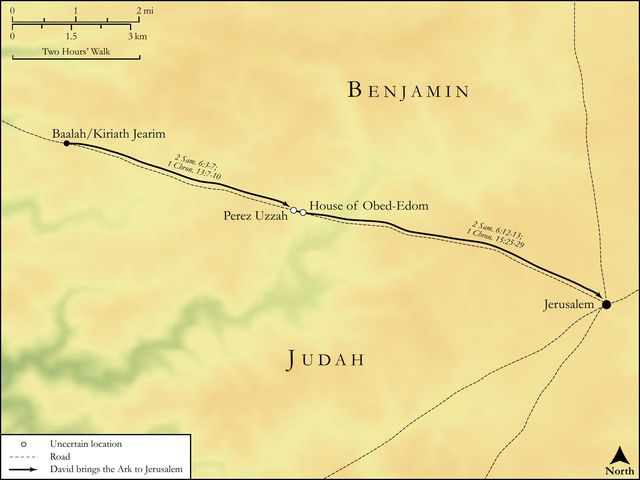
See on the biblical-era map
Study this verse
Public-domain commentary
Matthew Henry
From his Commentary on the Whole Bible. Henry comments on passages, not single verses — this entry covers 1 Chronicles 14:1–7.
We may observe here, 1. There is no man that has such a sufficiency in himself but he has need of his neighbours and has reason to be thankful for their help: David had a very large kingdom, Hiram a very little one; yet David could not build himself a house to his mind unless Hiram furnished him with both workmen and materials, Ch1 14:1. This is a reason why we should despise none, but, as we have opportunity, be obliging to all. 2. It is a great satisfaction to a wise man to be settled, and to a good man to see the special providences of God in his settlement. The people had made David king; but he could not be easy, nor think himself happy, till he perceived that the Lord had confirmed him king over Israel, Ch1 14:2. "Who shall unfix me if God hath fixed me?" 3. We must look upon all our advancements as designed for our usefulness. David's kingdom was lifted up on high, not for his own sake, that he might look great, but because of his people Israel, that he might be a guide and protector to them. We are blessed in order that we may be blessings. See Gen 12:2. We are not born, nor do we live, for ourselves. 4. It is difficult to thrive without growing secure and indulgent to the flesh. It was David's infirmity that when he settled in his kingdom he took more wives (Ch1 14:3), yet the numerous issue he had added to his honour and strength. Lo, children are a heritage of the Lord. We had an account of David's children, not only in Samuel, but in this book (Ch1 3:1, etc.) and now here again; for it was their honour to have such a father.
Continue studying 1 Chronicles 14:6 across the web’s major study libraries — every link below opens this exact verse, chapter, or book on the destination site.
Read & Compare
 BibleGatewayThis verse in more than 200 translations and 70 languages.
 Bible.comThe YouVersion reader — hundreds of translations, reading plans, and highlights.
 ESV.orgCrossway's official English Standard Version reader.
 NET BibleThe NET translation with 60,000+ translators' notes on every rendering decision.
 STEP BibleTyndale House's free study tool — original text, vocabulary, and scholarly resources.
 BibliaLogos Bible Software's free web reader.
 USCCBThe New American Bible (Revised Edition) with the U.S. bishops' study notes.
Commentaries
 BibleHub CommentariesDozens of classic commentaries on this verse, gathered on one page.
 StudyLightMore than 100 commentary sets — the largest collection on the web.
 BibleRefPlain-English commentary on what this verse means, verse by verse.
 Enduring WordDavid Guzik's free commentary on this chapter, widely used by Bible teachers.
 Bible Study ToolsVerse commentary alongside Greek and Hebrew study aids.
Original Language & Research
- BibleHub InterlinearThe verse word by word — original language, transliteration, and English.
- BibleHub LexiconEvery word's original-language definition and Strong's entry.
 Blue Letter BibleDeep-study tools — Strong's numbers, concordance, and word studies.
 SefariaThe Hebrew text with Rashi and centuries of Jewish commentary.
Sermons, Hymns & Audio


TrulyRandomVerse is not affiliated with these sites and doesn’t control their content. They’re linked because they’re genuinely useful.
Summary
1 Chronicles 14:6 presents a concise yet significant genealogical entry, listing three of King David's sons born in Jerusalem: Nogah, Nepheg, and Japhia. Far from being a mere enumeration, this verse powerfully testifies to God's abundant blessing upon David's reign and household. It highlights the expansion and stability of the Davidic family, which was foundational to the establishment of his kingdom in Jerusalem and served as a tangible sign of the divine covenant promising an enduring dynasty. The Chronicler's deliberate inclusion of these names underscores the legitimacy, prosperity, and divinely sanctioned nature of the Davidic line, setting the stage for the unfolding of God's redemptive plan.
Context
ShowHideLiterary Context
This verse is strategically positioned within a pivotal section of 1 Chronicles 14. The chapter opens with David's successful consolidation of power in Jerusalem, including the construction of his palace with the assistance of Hiram, King of Tyre, signifying his established authority and divine favor as detailed in 1 Chronicles 14:1-2. Immediately following this, the narrative shifts to David's personal life, explicitly stating that he took more wives and begot additional sons and daughters in Jerusalem, as noted in 1 Chronicles 14:3. Verses 4-7 then provide a comprehensive list of these children, with verse 6 specifically naming Nogah, Nepheg, and Japhia. This detailed enumeration of David's progeny serves as a powerful indicator of divine blessing and the secure foundation of his kingdom, preceding the accounts of his significant military victories against the Philistines in the latter half of the chapter, found in 1 Chronicles 14:8-17. The Chronicler's inclusion of this list underscores the critical importance of a stable and divinely blessed lineage as a prerequisite for national strength and continued divine favor.
Historical & Cultural Context
In Israelite society, the proliferation of a king's offspring, especially sons, was universally understood as a direct manifestation of divine favor, a symbol of prosperity, and a guarantee of dynastic stability. A large family ensured clear succession and continuity, thereby mitigating internal and external threats to the throne. David's establishment in Jerusalem marked a new epoch for Israel, centralizing both political and religious authority. The practice of polygamy, common among rulers of that era, facilitated the birth of numerous heirs, further reinforcing the king's power and the perception of God's blessing upon his rule. For the Chronicler, writing centuries after David's time to a post-exilic community, this meticulous record served a crucial legitimizing function for the Davidic line, emphasizing God's unwavering commitment to His covenant with David—a covenant that promised an enduring house and kingdom, as recounted in 2 Samuel 7:12-16. The geographical setting of Jerusalem, now the spiritual and political heart of Israel, amplified the significance of these births as integral to God's unfolding plan for His chosen people.
Key Themes
ShowHideThe meticulous listing of David's sons in 1 Chronicles 14 significantly contributes to several overarching themes pervasive throughout the book of Chronicles. Firstly, it prominently highlights Divine Blessing and Expansion, serving as tangible evidence of God's active hand in prospering David's household and, by extension, his burgeoning kingdom. The numerous offspring signify God's favor and the flourishing of the Davidic line, which is central to the Chronicler's theological agenda of emphasizing God's faithfulness to His covenant. Secondly, it underscores Lineage and Succession, emphasizing the critical importance of a clear and robust royal succession. The detailed genealogy reinforces the continuity and legitimacy of the Davidic dynasty, a theme that consistently points forward to the ultimate fulfillment of God's promises in the Messiah. The Chronicler's profound focus on lineage is a consistent motif, meticulously tracing the thread of God's redemptive plan through successive generations. Finally, the birth of these sons in Jerusalem establishes a Foundation for Future Success. A stable and blessed home life, marked by the growth of David's family, is presented as foundational to his subsequent military triumphs and the overall prosperity of his reign, suggesting that God's blessing in the private sphere often precedes public accomplishments. This reflects the broader biblical principle that faithfulness in personal life often undergirds public leadership and success, as seen in passages like Psalm 127:3-5.
Exposition and Analysis
ShowHideKey Word Analysis
ShowHideThis Hebrew word (נֹגַהּ, H5052) means "brightness," "splendor," or "radiance." Its inclusion among David's sons subtly reinforces the overarching theme of divine favor and the flourishing of his dynasty. The name itself evokes imagery of light and glory, suggesting a period of prosperity and God's shining presence upon David's house. While Nogah is not prominent in later biblical narratives, his name contributes to the overall impression of a blessed and expanding royal line, reflecting the glory bestowed upon David's kingdom.
The name Nepheg (נֶפֶג, H5298) translates to "sprout," "bud," or "offshoot." This meaning is profoundly symbolic, particularly in the context of lineage and dynastic continuity. It speaks to new growth, vitality, and the promise of future generations. In a broader theological sense, the concept of a "sprout" or "branch" is often used in prophetic literature to refer to the coming Messiah, a new shoot from the root of Jesse (Isaiah 11:1). While not directly messianic in this immediate context, the name contributes significantly to the overarching theme of the Davidic line's enduring and ever-renewing nature, highlighting the promise of continued life and succession.
Derived from a root meaning "to shine" or "to appear," Japhia (יָפִיעַ, H3309) also carries the connotation of "brightness" or "radiance," similar to Nogah. The repetition of this luminous theme through the names of David's sons emphasizes the divine blessing and the glorious nature of the Davidic kingdom. It suggests a period of visibility, prominence, and undeniable divine favor for David's family and reign, reinforcing the Chronicler's consistently positive portrayal of David as God's chosen king.
Verse Breakdown
ShowHide"And Nogah"
The listing begins with Nogah, whose name, meaning "brightness" or "radiance," immediately contributes to the overall impression of a divinely blessed and flourishing household for King David. His birth in Jerusalem signifies the expansion of David's family after the successful establishment of his capital, serving as a clear and tangible sign of God's favor and the secure stability of his reign.
"and Nepheg"
Following Nogah, the name Nepheg, meaning "sprout" or "bud," further emphasizes the theme of new growth, vitality, and the promise of continuity within the Davidic lineage. The inclusion of this name highlights the ongoing and indeed burgeoning nature of David's family, which was absolutely crucial for dynastic succession and the ultimate fulfillment of God's promises regarding an enduring royal house.
"and Japhia"
The final name in this triplet, Japhia, meaning "shining" or "bright," reiterates and reinforces the motif of divine blessing and glory associated with David's progeny. Together, these three names, with their collective connotations of light, growth, and divine favor, paint a vivid picture of a divinely sustained and expanding family, essential for the secure and prosperous foundation of the Davidic kingdom in Jerusalem.
Literary Devices
ShowHideThe primary literary device at play in 1 Chronicles 14:6 is Enumeration, the simple and direct listing of names. While seemingly straightforward, this enumeration serves a crucial purpose for the Chronicler: it provides a detailed and verifiable record of David's expanding family, thereby reinforcing the legitimacy and divine blessing upon his reign. Beyond mere listing, there is subtle yet profound Symbolism embedded in the very names themselves. As explored in the key word analysis, "Nogah" (brightness), "Nepheg" (sprout), and "Japhia" (shining) collectively evoke powerful themes of growth, light, promise, and divine favor. This choice of names, whether intentionally chosen by David or simply reflecting the cultural naming conventions of the time, subtly yet effectively reinforces the Chronicler's overarching theological message about the flourishing and divinely favored nature of the Davidic dynasty. The meticulous record-keeping also functions as a form of Historical Validation, meticulously ensuring the accuracy and integrity of the lineage that would eventually lead to the Messiah.
Theological and Thematic Connections
ShowHideThe listing of David's sons in 1 Chronicles 14:6, though brief, carries immense theological weight. It speaks directly to God's unwavering covenant faithfulness and His steadfast commitment to establishing a lasting dynasty for David. The birth of numerous sons, especially in the newly established capital of Jerusalem, was understood as a tangible sign of God's abundant blessing and the secure foundation of David's kingdom. This profound emphasis on lineage is paramount in biblical theology, as it meticulously traces the unfolding of God's redemptive plan through specific families and generations, ultimately pointing towards the promised Messiah. The Chronicler, writing to a post-exilic community, used these genealogies to powerfully remind them of God's enduring promises and the enduring hope invested in the Davidic line, even in times of apparent decline or national hardship. It underscores the profound truth that God's plans are meticulously detailed, extending even to the seemingly minor individuals within a grand historical narrative, demonstrating His sovereign oversight of all things.
Reflection and Application
ShowHideEven a seemingly simple list of names in Scripture, such as Nogah, Nepheg, and Japhia, invites us to profound reflection on God's character and His intricate ways with humanity. It serves as a powerful reminder that God is intimately involved in the minute details of human history, meticulously recording the lives of individuals, even those whose primary contribution is their place within a larger lineage. This highlights God's meticulous sovereignty and His long-term perspective, as He orchestrates events and generations to fulfill His overarching redemptive purposes. For us today, it underscores the profound truth that every life, no matter how seemingly "minor" or uncelebrated in the grand scheme, holds immense significance in God's eyes and plays an indispensable part in His unfolding narrative. It also teaches us about the nature of divine blessing: sometimes God's greatest works and most impactful interventions are built upon quiet, foundational blessings like family stability, spiritual growth, and the diligent raising of children, often preceding more public accomplishments or dramatic interventions. We are therefore called to recognize, value, and steward these foundational blessings in our own lives, understanding that faithfulness in the "small" and often unseen things often prepares the way for greater impact and participation in God's grand design.
Questions for Reflection
ShowHideFAQ
ShowHideWhy are these specific names listed in the Bible, and what is their significance?
ShowHideThese names (Nogah, Nepheg, and Japhia) are listed in 1 Chronicles 14:6 as sons born to King David in Jerusalem, following his establishment of the capital. Their inclusion serves several important purposes within the Chronicler's narrative. Firstly, it provides a crucial historical record, validating the expansion of David's family and the stability of his reign. In Israel, numerous offspring, especially sons, were universally seen as a direct sign of divine blessing and a secure, enduring dynasty. Secondly, the very meanings of their names—"brightness" (Nogah), "sprout" (Nepheg), and "shining" (Japhia)—subtly reinforce the overarching theme of God's favor, growth, and the flourishing of the Davidic line. While these particular sons do not play prominent individual roles in later biblical narratives, their presence in this list contributes significantly to the overall picture of a divinely blessed and enduring royal house, which is absolutely crucial for the Chronicler's emphasis on the Davidic covenant and the ultimate lineage of the Messiah.
Christ-Centered Fulfillment
ShowHideThe seemingly simple listing of David's sons in 1 Chronicles 14:6, including Nogah, Nepheg, and Japhia, finds its ultimate and glorious Christ-centered fulfillment in the person and redemptive work of Jesus Christ. The meticulous biblical genealogies, particularly those found in Chronicles, Matthew, and Luke, serve a singular, profound purpose: to meticulously establish the legitimate Davidic lineage through which the promised Messiah would come. Jesus is the ultimate "sprout" (Nepheg) from the root of Jesse and David, as prophesied in Isaiah 11:1, who brings true "brightness" and "radiance" (Nogah, Japhia) into a world shrouded in spiritual darkness. He is the "Light of the World" (John 8:12) and the "bright and morning star" (Revelation 22:16), perfectly fulfilling the symbolic implications embedded within these ancient names. The stability and expansion of David's earthly kingdom, evidenced by his numerous sons, served as a powerful foreshadowing of the eternal and ever-expanding spiritual kingdom established by Christ, the true Son of David, whose reign "will have no end" (Luke 1:32-33). Thus, even these briefly mentioned sons contribute to the grand, unfolding narrative of God's unwavering faithfulness in meticulously preserving a lineage that would ultimately bring forth the Savior of the world.