


Romans 7:20
- εἰeiIfG1487CONDConjunction
- δὲdenowG1161CONJConjunction
- ὃhowhatG3739R-ASNRelative pronoun Accusative Singular Neuter
- οὐounotG3756PRT-NNegative Particle Negative
- θέλωthelōI do wantG2309V-PAI-1SVerb Present Active Indicative 1st Singular
- ἐγὼegōI myselfG1473P-1NSPersonal pronoun Nominative 1st Singular
- τοῦτοtoutothisG3778D-ASNDemonstrative pronoun Accusative Singular Neuter
- ποιῶpoiōdoG4160V-PAI-1SVerb Present Active Indicative 1st Singular
- οὐκέτιouketino longerG2089PRT-N + G2089=ADV
- ἐγὼegōI myselfG1473P-1NSPersonal pronoun Nominative 1st Singular
- κατεργάζομαιkatergazomaiwho doG2716V-PNI-1SVerb Present Middle Or Passive Deponent Indicative 1st Singular
- αὐτὸautoitG846P-ASNPersonal pronoun Accusative Singular Neuter
- ἀλλ᾽all᾽butG235CONJConjunction
- ἡhēthat whichG3588T-NSFDefinite article Nominative Singular Feminine
- οἰκοῦσαoikousais dwellingG3611V-PAP-NSFVerb Present Active Participle Nominative Singular Feminine
- ἐνeninG1722PREPPreposition
- ἐμοὶemoime myselfG1473P-1DSPersonal pronoun Dative 1st Singular
- ἁμαρτίαhamartiasinG266N-NSFNoun Nominative Singular Feminine
English is a literal word-by-word gloss of the Greek, not the KJV's wording. Why?
This is the original text the KJV's translators worked from — each Greek word with its own literal English meaning in this verse, prepared by scholars at Tyndale House, Cambridge. The KJV translates whole sentences, not word by word, so its wording differs: one Greek word can become several English words, and the KJV may choose “charity” where the gloss reads “love”. Both are faithful — they answer different questions. For the KJV's own rendering, switch to the KJV text.
Details
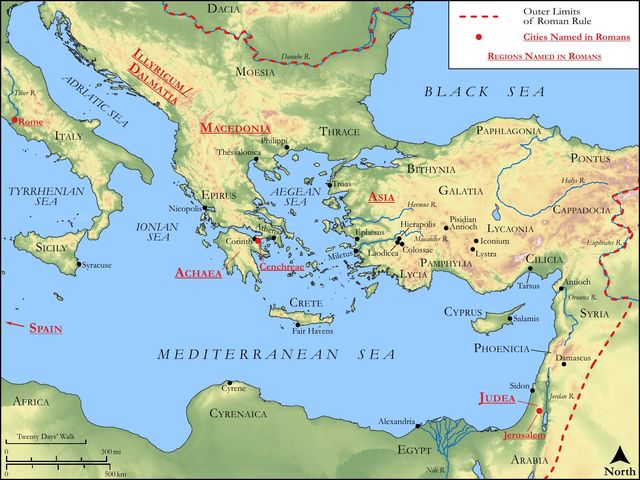
See on the biblical-era map

Study this verse
Public-domain commentary
Matthew Henry
From his Commentary on the Whole Bible. Henry comments on passages, not single verses — this entry covers Romans 7:14–25. His four-level outline is real structure in the source text, so it is rendered as structure.
Here is a description of the conflict between grace and corruption in the heart, between the law of God and the law of sin. And it is applicable two ways: - 1. To the struggles that are in a convinced soul, but yet unregenerate, in the person of whom it is supposed, by some, that Paul speaks. 2. To the struggles that are in a renewed sanctified soul, but yet in a state of imperfection; as other apprehend. And a great controversy there is of which of these we are to understand the apostle here. So far does the evil prevail here, when he speaks of one sold under sin, doing it, not performing that which is good, that it seems difficult to apply it to the regenerate, who are described to walk not after the flesh, but after the Spirit; and yet so far does the good prevail in hating sin, consenting to the law, delighting in it, serving the law of God with the mind, that it is more difficult to apply it to the unregenerate that are dead in trespasses and sins.
I.Apply it to the struggles that are felt in a convinced soul, that is yet in a state of sin, knows his Lord's will, but does it not, approves the things that are more excellent, being instructed out of the law, and yet lives in the constant breach of it, Rom 2:17-23. Though he has that within him that witnesses against the sin he commits, and it is not without a great deal of reluctancy that he does commit it, the superior faculties striving against it, natural conscience warning against it before it is committed and smiting for it afterwards, yet the man continues a slave to his reigning lusts. It is not thus with every unregenerate man, but with those only that are convinced by the law, but not changed by the gospel. The apostle had said (Rom 6:14), Sin shall not have dominion, because you are not under the law, but under grace, for the proof of which he here shows that a man under the law, and not under grace, may be, and is, under the dominion of sin. The law may discover sin, and convince of sin, but it cannot conquer and subdue sin, witness the predominancy of sin in many that are under very strong legal convictions. It discovers the defilement, but will not wash it off. It makes a man weary and heavy laden (Mat 11:28), burdens him with his sin; and yet, if rested in, it yields no help towards the shaking off of that burden; this is to be had only in Christ. The law may make a man cry out, O wretched man that I am! who shall deliver me? and yet leave him thus fettered and captivated, as being too weak to deliver him (Rom 8:3), give him a spirit of bondage to fear, Rom 8:15. Now a soul advanced thus far by the law is in a fair way towards a state of liberty by Christ, though many rest here and go no further. Felix trembled, but never came to Christ. It is possible for a man to go to hell with his eyes open (Num 24:3, Num 24:4), illuminated with common convictions, and to carry about with him a self-accusing conscience, even in the service of the devil. He may consent to the law that it is good, delight to know God's ways (as they, Isa 58:2), may have that within him that witnesses against sin and for holiness; and yet all this overpowered by the reigning love of sin. Drunkards and unclean persons have some faint desires to leave off their sins, and yet persist in them notwithstanding, such is the impotency and such the insufficiency of their convictions. Of such as these there are many that will needs have all this understood, and contend earnestly for it: though it is very hard to imagine why, if the apostle intended this, he should speak all along in his own person; and not only so, but in the present tense. Of his own state under conviction he had spoken at large, as of a thing past (Rom 7:7, etc.): I died; the commandment I found to be unto death; and if here he speaks of the same state as his present state, and the condition he was now in, surely he did not intend to be so understood: and therefore,
II.It seems rather to be understood of the struggles that are maintained between grace and corruption in sanctified souls.
That there are remainders of indwelling corruption, even where there is a living principle of grace, is past dispute; that this corruption is daily breaking forth in sins of infirmity (such as are consistent with a state of grace) is no less certain. If we say that we have no sin, we deceive ourselves, Jo1 1:8, Jo1 1:10. That true grace strives against these sins and corruptions, does not allow of them, hates them, mourns over them, groans under them as a burden, is likewise certain (Gal 5:17): The flesh lusteth against the spirit, and the spirit against the flesh; and these are contrary the one to the other, so that you cannot do the things that you would. These are the truths which, I think, are contained in this discourse of the apostle. And his design is further to open the nature of sanctification, that it does not attain to a sinless perfection in this life; and therefore to quicken us to, and encourage us in, our conflicts with remaining corruptions. Our case is not singular, that which we do sincerely strive against, shall not be laid to our charge, and through grace the victory is sure at last. The struggle here is like that between Jacob and Esau in the womb, between the Canaanites and Israelites in the land, between the house of Saul and the house of David; but great is the truth and will prevail. Understanding it thus, we may observe here,
1.What he complains of - the remainder of indwelling corruptions, which he here speaks of, to show that the law is insufficient to justify even a regenerate man, that the best man in the world hath enough in him to condemn him, if God should deal with him according to the law, which is not the fault of the law, but of our own corrupt nature, which cannot fulfil the law. The repetition of the same things over and over again in this discourse shows how much Paul's heart was affected with what he wrote, and how deep his sentiments were. Observe the particulars of this complaint.
(1.)I am carnal, sold under sin, Rom 7:14. He speaks of the Corinthians as carnal, Co1 3:1. Even where there is spiritual life there are remainders of carnal affections, and so far a man may be sold under sin; he does not sell himself to work wickedness, as Ahab did (Kg1 21:25), but he was sold by Adam when he sinned and fell - sold, as a poor slave that does his master's will against his own will - sold under sin, because conceived in iniquity and born in sin.
(2.)What I would, that I do not; but what I hate, that do I, Rom 7:15. And to the same purport, Rom 7:19, Rom 7:21, When I would do good, evil is present with me. Such was the strength of corruptions, that he could not attain that perfection in holiness which he desired and breathed after. Thus, while he was pressing forward towards perfection, yet he acknowledges that he had not already attained, neither was already perfect, Phi 3:12. Fain he would be free from all sin, and perfectly do the will of God, such was his settled judgment; but his corrupt nature drew him another way: it was like a clog, that checked and kept him down when he would have soared upward, like the bias in a bowl, which, when it is thrown straight, yet draws it aside.
(3.)In me, that is in my flesh, dwelleth no good, Rom 7:18. Here he explains himself concerning the corrupt nature, which he calls flesh; and as far as that goes there is no good to be expected, any more than one would expect good corn growing upon a rock, or on the sand which is by the sea-side. As the new nature, as far as that goes, cannot commit sin (Jo1 3:9), so the flesh, the old nature, as far as that goes, cannot perform a good duty. How should it? For the flesh serveth the law of sin (Rom 7:25), it is under the conduct and government of that law; and, while it is so, it is not likely to do any good. The corrupt nature is elsewhere called flesh (Gen 6:3, Joh 3:6); and, though there may be good things dwelling in those that have this flesh, yet, as far as the flesh goes, there is no good, the flesh is not a subject capable of any good.
(4.)I see another law in my members warring against the law of my mind, Rom 7:23. The corrupt and sinful inclination is here compared to a law, because it controlled and checked him in his good motions. It is said to be seated in his members, because, Christ having set up his throne in his heart, it was only the rebellious members of the body that were the instruments of sin - in the sensitive appetite; or we may take it more generally for all that corrupt nature which is the seat not only of sensual but of more refined lusts. This wars against the law of the mind, the new nature; it draws the contrary way, drives on a contrary interest, which corrupt disposition and inclination are as great a burden and grief to the soul as the worst drudgery and captivity could be. It brings me into captivity. To the same purport (Rom 7:25), With the flesh I serve the law of sin; that is, the corrupt nature, the unregenerate part, is continually working towards sin.
(5.)His general complaint we have in Rom 7:24, O wretched man that I am! who shall deliver me from the body of this death? The thing he complains of is a body of death; either the body of flesh, which is a mortal dying body (while we carry this body about with us, we shall be troubled with corruption; when we are dead, we shall be freed from sin, and not before), or the body of sin, the old man, the corrupt nature, which tends to death, that is, to the ruin of the soul. Or, comparing it to a dead body, the touch of which was by the ceremonial law defiling, if actual transgressions be dead works (Heb 9:14), original corruption is a dead body. It was as troublesome to Paul as if he had had a dead body tied to him, which he must have carried about with him. This made him cry out, O wretched man that I am! A man that had learned in every state to be content yet complains thus of his corrupt nature. Had I been required to speak of Paul, I should have said, "O blessed man that thou art, an ambassador of Christ, a favourite of heaven, a spiritual father of thousands!" But in his own account he was a wretched man, because of the corruption of nature, because he was not so good as he fain would be, had not yet attained, neither was already perfect. Thus miserably does he complain. Who shall deliver me? He speaks like one that was sick of it, that would give any thing to be rid of it, looks to the right hand and to the left for some friend that would part between him and his corruptions. The remainders of indwelling sin are a very grievous burden to a gracious soul.
2.What he comforts himself with. The case was sad, but there were some allays. Three things comforted him: -
(1.)That his conscience witnessed for him that he had a good principle ruling and prevailing in him, notwithstanding. It is well when all does not go one way in the soul. The rule of this good principle which he had was the law of God, to which he here speaks of having a threefold regard, which is certainly to be found in all that are sanctified, and no others.
[1.]I consent unto the law that it is good, Rom 7:16, sumphēmi - I give my vote to the law; here is the approbation of the judgment. Wherever there is grace there is not only a dread of the severity of the law, but a consent to the goodness of the law. "It is a good in itself, it is good for me." This is a sign that the law is written in the heart, that the soul is delivered into the mould of it. To consent to the law is so far to approve of it as not to wish it otherwise constituted than it is. The sanctified judgment not only concurs to the equity of the law, but to the excellency of it, as convinced that a conformity to the law is the highest perfection of human nature, and the greatest honour and happiness we are capable of.
[2.]I delight in the law of God after the inward man, Rom 7:22. His conscience bore witness to a complacency in the law. He delighted not only in the promises of the word, but in the precepts and prohibitions of the word; sunēdomai expresses a becoming delight. He did herein concur in affection with all the saints. All that are savingly regenerate or born again do truly delight in the law of God, delight to know it, to do it - cheerfully submit to the authority of it, and take a complacency in that submission, never better pleased than when heart and life are in the strictest conformity to the law and will of God. After the inward man; that is, First, The mind or rational faculties, in opposition to the sensitive appetites and wills of the flesh. The soul is the inward man, and that is the seat of gracious delights, which are therefore sincere and serious, but secret; it is the renewing of the inward man, Co2 4:16. Secondly, The new nature. The new man is called the inner man (Eph 3:16), the hidden man of the heart, Pe1 3:4. Paul, as far as he was sanctified, had a delight in the law of God.
[3.]With the mind I myself serve the law of God, Rom 7:25. It is not enough to consent to the law, and to delight in the law, but we must serve the law; our souls must be entirely delivered up into the obedience of it. Thus it was with Paul's mind; thus it is with every sanctified renewed mind; this is the ordinary course and way; thitherward goes the bent of the soul. I myself - autos egō, plainly intimating that he speaks in his own person, and not in the person of another.
(2.)That the fault lay in that corruption of his nature which he did really bewail and strive against: It is no more I that do it, but sin that dwelleth in me. This he mentions twice (Rom 7:17, Rom 7:20), not as an excuse for the guilt of his sin (it is enough to condemn us, if we were under the law, that the sin which does the evil dwelleth in us), but as a salvo for his evidences, that he might not sink in despair, but take comfort from the covenant of grace, which accepts the willingness of the spirit, and has provided pardon for the weakness of the flesh. He likewise herein enters a protestation against all that which this indwelling sin produced. Having professed his consent to the law of God, he here professes his dissent from the law of sin. "It is not I; I disown the fact; it is against my mind that it is done." As when in the senate the major part are bad, and carry every thing the wrong way, it is indeed the act of the senate, but the honest party strive against it, bewail what is done, and enter their protestation against it; so that it is no more they that do it. - Dwelleth in me, as the Canaanites among the Israelites, though they were put under tribute: dwelleth in me, and is likely to dwell there, while I live.
(3.)His great comfort lay in Jesus Christ (Rom 7:25): I thank God, through Jesus Christ our Lord. In the midst of his complaints he breaks out into praises. It is a special remedy against fears and sorrows to be much in praise: many a poor drooping soul hath found it so. And, in all our praises, this should be the burden of the son, "Blessed be God for Jesus Christ." Who shall deliver me? says he (Rom 7:24), as one at a loss for help. At length he finds an all-sufficient friend, even Jesus Christ. When we are under the sense of the remaining power of sin and corruption, we shall see reason to bless God through Christ (for, as he is the mediator of all our prayers, so he is of all our praises) - to bless God for Christ; it is he that stands between us and the wrath due to us for this sin. If it were not for Christ, this iniquity that dwells in us would certainly be our ruin. He is our advocate with the Father, and through him God pities, and spares, and pardons, and lays not our iniquities to our charge. It is Christ that has purchased deliverance for us in due time. Through Christ death will put an end to all these complaints, and waft us to an eternity which we shall spend without sin or sigh. Blessed be God that giveth us this victory through our Lord Jesus Christ!
Historical interpretation
Two Centuries of Reception
5 surviving comments on this verse. Each one is dated, so this reads as a timeline rather than a list.
Select a marker to jump to its quote. Markers stagger vertically where authors wrote within a few decades of each other.
In what follows he continues, "But if I do that which I do not wish to do, it is no longer I that do it, but sin which dwells in me," which being at war with the law of God and "of my mind," he says, "makes me captive by the law of sin which is in my members. O wretched man that I am, who shall deliver me from this body of death."
"For what the law could not do, in that it was weak through the flesh, God sending His own Son in the likeness of sinful flesh, and through sin condemned sin in the flesh " -not the flesh in sin, for the house is not to be condemned with its inhabitant. He said, indeed, that "sin dwelleth in our body." But the condemnation of sin is the acquittal of the flesh, just as its non-condemnation subjugates it to the law of sin and death.
Is the sinner compelled to sin by a power outside himself? Not at all. For it was by his own fault that these evil things began, for whoever binds himself to sin voluntarily is ruled by its law. Sin persuades him first, and when it has conquered him it takes control.
Do you see, how he acquits the essence of the soul, as well as the essence of the flesh, from accusation, and removes it entirely to sinful actions? For if the soul willeth not the evil, it is cleared: and if he does not work it himself, the body too is set free, and the whole may be charged upon the evil moral choice. For willing is indeed natural, and is from God: but willing on this wise is our own, and from our own mind.
What was once an act of will has become so habitual that now it is involuntary.
Continue studying Romans 7:20 across the web’s major study libraries — every link below opens this exact verse, chapter, or book on the destination site.
Read & Compare
 BibleGatewayThis verse in more than 200 translations and 70 languages.
 Bible.comThe YouVersion reader — hundreds of translations, reading plans, and highlights.
 ESV.orgCrossway's official English Standard Version reader.
 NET BibleThe NET translation with 60,000+ translators' notes on every rendering decision.
 STEP BibleTyndale House's free study tool — original text, vocabulary, and scholarly resources.
 BibliaLogos Bible Software's free web reader.
 USCCBThe New American Bible (Revised Edition) with the U.S. bishops' study notes.
Commentaries
 BibleHub CommentariesDozens of classic commentaries on this verse, gathered on one page.
 StudyLightMore than 100 commentary sets — the largest collection on the web.
 BibleRefPlain-English commentary on what this verse means, verse by verse.
 Enduring WordDavid Guzik's free commentary on this chapter, widely used by Bible teachers.
 Bible Study ToolsVerse commentary alongside Greek and Hebrew study aids.
Original Language & Research
- BibleHub InterlinearThe verse word by word — original language, transliteration, and English.
- BibleHub LexiconEvery word's original-language definition and Strong's entry.
 Blue Letter BibleDeep-study tools — Strong's numbers, concordance, and word studies.
 CNTR CollationThe earliest Greek manuscripts of this verse, collated letter by letter.
Sermons, Hymns & Audio


TrulyRandomVerse is not affiliated with these sites and doesn’t control their content. They’re linked because they’re genuinely useful.
Summary
Romans 7:20 encapsulates the Apostle Paul's profound articulation of the internal spiritual struggle faced by the believer, where the renewed will desires to obey God's law, yet an indwelling principle of sin actively works against that desire, leading to actions contrary to one's true, sanctified self. This verse distinguishes the believer's core identity in Christ from the persistent, albeit dethroned, influence of sin residing within the mortal body, setting the stage for the glorious liberation found in Christ.
Context
ShowHideLiterary Context
Romans 7:20 is situated within Paul's extended discourse in Romans chapter 7 concerning the Law's role in revealing sin and the ongoing conflict experienced by those under grace. The preceding verses, particularly Romans 7:14-19, detail Paul's personal anguish over his inability to consistently perform the good he desires and his tendency to do the evil he hates. Verse 20 serves as a crucial explanation for this paradoxical experience, attributing the unwanted actions not to his true, redeemed self, but to the pervasive power of indwelling sin. This passage then climaxes in the cry of Romans 7:24 before finding its resolution in the freedom of Romans chapter 8.
Historical & Cultural Context
Paul's audience in Rome comprised both Jewish and Gentile Christians, grappling with the implications of the Gospel for their lives, particularly concerning the Mosaic Law. For Jewish believers, the Law had been central to their identity and righteousness, making Paul's argument about its inability to sanctify, and its role in revealing sin, particularly challenging. For all believers, the concept of an internal struggle against sin was a universal human experience, but Paul's theological framework provided a new lens through which to understand it – not as a failure of the Law, but as a manifestation of humanity's fallen nature, now confronted by God's holiness. The Greco-Roman world also had philosophical traditions that recognized a tension between human reason/will and bodily desires, though Paul's explanation is distinctly theological, rooted in the biblical understanding of sin and redemption.
Key Themes
ShowHideThis verse powerfully contributes to several overarching themes in Romans. Firstly, it underscores the pervasiveness and power of sin as an active, indwelling force, not merely a series of individual acts. Paul personifies sin as an entity that "dwells" and "works" within him, highlighting its deep-seated nature in fallen humanity, even for the regenerated. Secondly, it illuminates the internal conflict of the believer, demonstrating the ongoing tension between the new nature, which delights in God's law (Romans 7:22), and the persistent influence of the flesh. Thirdly, it introduces a critical distinction between the "I" and "sin," emphasizing that the true, redeemed self, aligned with God's will, is distinct from the sin that still operates within the mortal body. This distinction is vital for understanding Christian sanctification, where sin's power is broken, but its presence remains a reality to be contended with, ultimately pointing to the need for divine intervention and the power of the Holy Spirit for victory, as explored in Romans 8.
Exposition and Analysis
ShowHideKey Word Analysis
ShowHideTo make or do (in a very wide application, more or less direct), implying action or performance. In this context, it refers to the actual performance of the unwanted actions, highlighting the stark contrast between Paul's inner desire and his outward behavior.
A sin (properly abstract), denoting an offense or moral failing. Here, Paul personifies "sin" as an active, almost independent force or principle that resides within him, rather than merely a specific transgression. This emphasizes its pervasive and indwelling nature.
To occupy a house, i.e., reside (figuratively, inhabit, remain, inhere), implying a settled presence. This word underscores the persistent, established presence of sin within the human being, even after conversion. It is not a fleeting guest but an inhabitant, though its dominion has been broken.
Verse Breakdown
ShowHide"Now if I do that I would not"
This clause re-states the paradoxical struggle articulated in the preceding verses. Paul acknowledges that he performs actions that are contrary to his genuine desire and will. The "I" here represents his true, renewed self, which aligns with God's righteous standards.
"it is no more I that do it"
This is a crucial theological statement. Paul asserts that the primary agent of the unwanted action is not his core, redeemed identity. This is not an excuse for sin, but a profound distinction between the believer's new nature in Christ and the persistent influence of the old, fallen nature. His true self, in Christ, does not desire to sin.
"but sin that dwelleth in me"
This final clause identifies the active, indwelling principle responsible for the unwanted actions. "Sin" is personified as a powerful, residing force within the believer's mortal body, which exerts its influence against the renewed will. This highlights the ongoing spiritual warfare within the Christian life, where the believer contends with a persistent internal adversary.
Literary Devices
ShowHidePaul employs several powerful literary devices in Romans 7:20 to convey his profound theological point. The most prominent is Personification, where "sin" is treated not merely as an abstract concept or a series of actions, but as an active, almost sentient entity that "dwells" and "does" things. This gives sin a tangible, formidable presence, emphasizing its pervasive and insidious nature within the human being. Additionally, Paul utilizes Antithesis by contrasting "I" (his true, renewed self) with "sin that dwelleth in me." This sharp juxtaposition highlights the internal conflict and the distinction between the believer's authentic desires and the unwanted actions prompted by indwelling sin. This rhetorical strategy serves to both validate the believer's struggle and clarify the source of the unwanted behavior, ultimately pointing to a solution beyond self-effort.
Theological and Thematic Connections
ShowHideRomans 7:20 is a pivotal verse that profoundly shapes our understanding of the Christian life, revealing the ongoing reality of spiritual warfare within the believer. It teaches us that while justification declares us righteous in Christ, and sanctification is a progressive work of the Holy Spirit, the presence of sin (though not its dominion) remains in our mortal bodies. This internal conflict is not a sign of a lack of faith, but rather an indicator of a genuine spiritual battle between the flesh and the Spirit, a battle that highlights our absolute dependence on God's grace and power for victory. It sets the stage for the glorious truth of Romans 8:1-4, where the Law of the Spirit of life in Christ Jesus sets us free from the law of sin and death.
Reflection and Application
ShowHideRomans 7:20 offers profound comfort and practical guidance for every believer. It validates the often-frustrating experience of desiring to do good yet finding oneself succumbing to temptation or failing to live up to God's standards. This verse assures us that this internal struggle is a normal, albeit challenging, part of the Christian walk, not an indication of a lack of genuine faith. Understanding that "sin that dwelleth in me" is the active agent, rather than our true, redeemed self, helps us avoid despair and self-condemnation. Instead, it directs us to the true source of power for overcoming sin: not greater self-effort, but deeper reliance on the Holy Spirit and the finished work of Christ. It calls us to continually yield to the Spirit, to put to death the deeds of the body, and to walk in the newness of life, recognizing that while sin still indwells, it no longer reigns. This perspective fosters humility, compassion for others, and an abiding trust in God's sanctifying grace.
Questions for Reflection
ShowHideFAQ
ShowHideDoes Romans 7:20 provide an excuse for sinning?
ShowHideNo, Romans 7:20 does not provide an excuse for sinning, but rather an explanation of the internal spiritual dynamic at play in the believer's life. Paul is not advocating for passive acceptance of sin, but is deeply lamenting its persistent influence. The distinction he makes—"it is no more I that do it, but sin that dwelleth in me"—is meant to highlight that the true, regenerated self, which desires to obey God, is distinct from the principle of sin that still resides in the mortal body. This understanding leads not to complacency, but to a deeper reliance on Christ for deliverance, as evidenced by Paul's cry in Romans 7:24 and the subsequent triumph declared in Romans 8:1-4. The purpose is to demonstrate the absolute necessity of God's grace and the Spirit's power for sanctification, not to absolve personal responsibility.
Christ-Centered Fulfillment
ShowHideRomans 7:20, with its stark portrayal of the believer's internal struggle against indwelling sin, powerfully underscores the absolute necessity and glorious sufficiency of Jesus Christ. Paul's anguished cry, "O wretched man that I am! who shall deliver me from the body of this death?" in Romans 7:24, finds its immediate and triumphant answer in the very next verse: "I thank God through Jesus Christ our Lord!" This transition reveals that Christ is the sole deliverer from the tyranny of sin. He is the one who, through His atoning sacrifice, broke sin's power and condemned sin in the flesh (Romans 8:3). Furthermore, the indwelling Holy Spirit, given by Christ, empowers believers to walk "not according to the flesh but according to the Spirit" (Romans 8:4), enabling them to put to death the deeds of the body (Romans 8:13). Thus, Romans 7:20, far from leaving us in despair, serves as a crucial theological setup, magnifying the redemptive work of Christ and the sanctifying power of the Spirit, without whom victory over indwelling sin would be impossible. He is our hope, our righteousness, and our strength in this ongoing spiritual warfare (1 Corinthians 1:30).