


Revelation 21:20
Bible text: King James Version (1769 Blayney text) · Public domain
Bible text: King James Version with Strong's numbers · Public domain
Bible text: Berean Standard Bible · Public domain
Bible text: American Standard Version (1901) · Public domain
Bible text: World English Bible, Messianic edition · Public domain
Bible text: Geneva Bible (1599) · Public domain
Bible text: Young's Literal Translation · Public domain
- ὁhotheG3588T-NSMDefinite article Nominative Singular Masculine
- πέμπτοςpemptosfifthG3991A-NSMAdjective Nominative Singular Masculine
- σαρδόνυξsardonuxsardonyxG4557N-NSMNoun Nominative Singular Masculine
- ὁhotheG3588T-NSMDefinite article Nominative Singular Masculine
- ἕκτοςhektossixthG1623A-NSMAdjective Nominative Singular Masculine
- σάρδιονsardionsardiusG4556N-NSNNoun Nominative Singular Neuter
- ὁhotheG3588T-NSMDefinite article Nominative Singular Masculine
- ἕβδομοςhebdomosseventhG1442A-NSMAdjective Nominative Singular Masculine
- χρυσόλιθοςchrusolithoschrysoliteG5555N-NSMNoun Nominative Singular Masculine
- ὁhotheG3588T-NSMDefinite article Nominative Singular Masculine
- ὄγδοοςogdooseighthG3590A-NSMAdjective Nominative Singular Masculine
- βήρυλλοςbērullosberylG969N-NSMNoun Nominative Singular Masculine
- ὁhotheG3588T-NSMDefinite article Nominative Singular Masculine
- ἔνατοςenatosninthG1766A-NSMAdjective Nominative Singular Masculine
- τοπάζιονtopaziontopazG5116N-NSNNoun Nominative Singular Neuter
- ὁhotheG3588T-NSMDefinite article Nominative Singular Masculine
- δέκατοςdekatostenthG1182A-NSMAdjective Nominative Singular Masculine
- χρυσόπρασοςchrusoprasoschrysopraseG5556N-NSMNoun Nominative Singular Masculine
- ὁhotheG3588T-NSMDefinite article Nominative Singular Masculine
- ἑνδέκατοςhendekatoseleventhG1734A-NSMAdjective Nominative Singular Masculine
- ὑάκινθοςhu'akinthosjacinthG5192N-NSMNoun Nominative Singular Masculine
- ὁhotheG3588T-NSMDefinite article Nominative Singular Masculine
- δωδέκατοςdōdekatostwelfthG1428A-NSMAdjective Nominative Singular Masculine
- ἀμέθυστοςamethustosamethystG271N-NSFNoun Nominative Singular Feminine
English is a literal word-by-word gloss of the Greek, not the KJV's wording. Why?
This is the original text the KJV's translators worked from — each Greek word with its own literal English meaning in this verse, prepared by scholars at Tyndale House, Cambridge. The KJV translates whole sentences, not word by word, so its wording differs: one Greek word can become several English words, and the KJV may choose “charity” where the gloss reads “love”. Both are faithful — they answer different questions. For the KJV's own rendering, switch to the KJV text.
Details
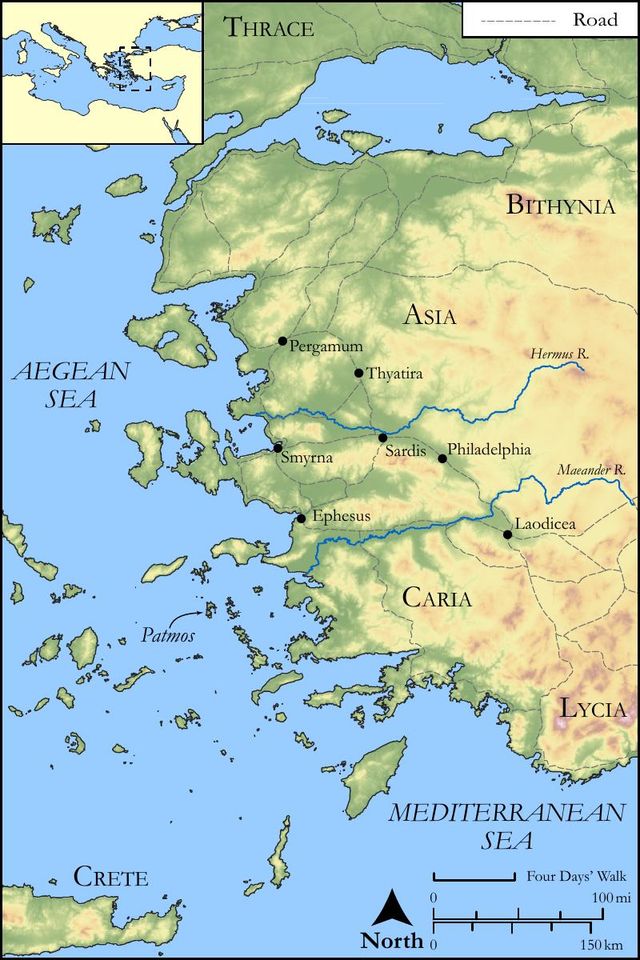
See on the biblical-era maps

Study this verse
Public-domain commentary
Matthew Henry
From his Commentary on the Whole Bible. Henry comments on passages, not single verses — this entry covers Revelation 21:9–27. His four-level outline is real structure in the source text, so it is rendered as structure.
We have already considered the introduction to the vision of the new Jerusalem in a more general idea of the heavenly state; we now come to the vision itself, where observe,
I.The person that opened the vision to the apostle - one of the seven angels, that had the seven vials full of the seven last plagues, Rev 21:9. God has a variety of work and employment for his holy angels. Sometimes they are to sound the trumpet of divine Providence, and give fair warning to a careless world; sometimes they are to pour out the vials of God's anger upon impenitent sinners; and sometimes to discover things of a heavenly nature to those that are the heirs of salvation. They readily execute every commission they receive from God; and, when this world shall be at an end, yet the angels shall be employed by the great God in proper pleasant work to all eternity.
II.The place from which the apostle had this glorious view and prospect.
He was taken, in ecstasy, into a high mountain. From such situations men usually have the most distinct views of adjacent cities. Those who would have clear views of heaven must get as near heaven as they can, into the mount of vision, the mount of meditation and faith, whence, as from the top of Pisgah, they may behold the goodly land of the heavenly Canaan.
III.The subject-matter of the vision - the bride, the Lamb's wife (Rev 21:10); that is, the church of God in her glorious, perfect, triumphant state, under the resemblance of Jerusalem, having the glory of God shining in its lustre, as uxor splendit radiis mariti - the bride comely through the comeliness put on her by her husband; glorious in her relation to Christ, in his image now perfected in her, and in his favour shining upon her. And now we have a large description of the church triumphant under the emblem of a city, far exceeding in riches and splendour all the cities of this world; and this new Jerusalem is here represented to us both in the exterior and the interior part of it.
1.The exterior part of the city - the wall and the gates, the wall for security and the gates for entrance.
(1.)The wall for security. Heaven is a safe state; those that are there are enclosed with a wall, that separates them and secures them from all evils and enemies: now here, in the account of the wall, we observe,
[1.]The height of it, which, we are told, is very high, seventy yards (Rev 21:17), sufficient both for ornament and security.
[2.]The matter of it: It was as jasper; a wall all built of the most precious stones, for firmness and lustre, Rev 21:11. This city has a wall that is impregnable as well as precious.
[3.]The form of it was very regular and uniform: It was four-square, the length as large as the breadth. In the new Jerusalem all shall be equal in purity and perfection. There shall be an absolute uniformity in the church triumphant, a thing wanted and wished for on earth, but not to be expected till we come to heaven.
[4.]The measure of the wall (Rev 21:15, Rev 21:16): Twelve thousand furlongs each way, each side, which is forty-eight thousand furlongs in the whole compass, or fifteen hundred German miles. Here is room sufficient for all the people of God - many mansions in their Father's house.
[5.]The foundation of the wall, for heaven is a city that hath her foundations (Rev 21:19); the promise and power of God, and the purchase of Christ, are the strong foundations of the church's safety and happiness. The foundations are described by their number - twelve, alluding to the twelve apostles (Rev 21:14), whose gospel doctrines are the foundations upon which the church is built, Christ himself being the chief corner-stone; and, as to the matter of these foundations, it was various and precious, set forth by twelve sorts of precious stones, denoting the variety and excellency of the doctrines of the gospel, or of the graces of the Holy Spirit, or the personal excellencies of the Lord Jesus Christ.
(2.)The gates for entrance. Heaven is not inaccessible; there is a way opened into the holiest of all; there is a free admission to all those that are sanctified; they shall not find themselves shut out. Now, as to these gates, observe,
[1.]Their number - twelve gates, answering to the twelve tribes of Israel. All the true Israel of God shall have entrance into the new Jerusalem, as every tribe had into the earthly Jerusalem.
[2.]Their guards which were placed upon them - twelve angels, to admit and receive the several tribes of the spiritual Israel and keep out others.
[3.]The inscription on the gates - the names of the twelve tribes, to show that they have a right to the tree of life, and to enter through the gates into the city.
[4.]The situation of the gates. As the city had four equal sides, answering to the four quarters of the world, east, west, north, and south, so on each side there were three gates, signifying that from all quarters of the earth there shall be some who shall get safely to heaven and be received there, and that there is as free entrance from one part of the world as from the other; for in Christ there is neither Jew nor Greek, Barbarian, Scythian, bond, nor free. Men of all nations, and languages, who believe on Christ, have by him access to God in grace here and in glory hereafter.
[5.]The materials of these gates - they were all of pearls, and yet with great variety: Every gate one pearl, either one single pearl of that vast bigness, or one single sort of pearl. Christ is the pearl of great price, and he is our way to God. There is nothing magnificent enough in this world fully to set forth the glory of heaven. Could we, in the glass of a strong imagination, contemplate such a city as is here described, even as to the exterior part of it, such a wall, and such gates, how amazing, how glorious, would the prospect be! And yet this is but a faint and dim representation of what heaven is in itself.
2.The interior part of the new Jerusalem, Rev 21:22-27. We have seen its strong wall, and stately gates, and glorious guards; now we are to be led through the gates into the city itself; and the first thing which we observe there is the street of the city, which is of pure gold, like transparent glass, Rev 21:21. The saints in heaven tread upon gold. The new Jerusalem has its several streets. There is the most exact order in heaven: every saint has his proper mansion. There is converse in heaven: the saints are then at rest, but it is not a mere passive rest; it is not a state of sleep and inactivity, but a state of delightful motion: The nations that are saved walk in the light of it. They walk with Christ in white. They have communion not only with God, but with one another; and all their steps are firm and clean. They are pure and clear as gold and transparent glass. Observe,
(1.)The temple of the new Jerusalem, which was no material temple, made with men's hands, as that of Solomon and Zerubbabel, but a temple altogether spiritual and divine; for the Lord God Almighty, and the Lamb, are the temple thereof. There the saints are above the need of ordinances, which were the means of their preparation for heaven. When the end is attained the means are no longer useful. Perfect and immediate communion with God will more than supply the place of gospel institutions.
(2.)The light of this city. Where there is no light, there can be no lustre nor pleasure. Heaven is the inheritance of the saints in light. But what is that light? There is no sun nor moon shining there, Rev 21:23. Light is sweet, and a pleasant thing it is to behold the sun. What a dismal world would this be if it were not for the light of the sun! What is there in heaven that supplies the want of it? There is no want of the light of the sun, for the glory of God lightens that city, and the Lamb is the light thereof. God in Christ will be an everlasting fountain of knowledge and joy to the saints in heaven; and, if so, there is no need of the sun or moon, any more than we here need to set up candles at noon day, when the sun shineth in its strength.
(3.)The inhabitants of this city. They are described here several ways.
[1.]By their numbers - whole nations of saved souls; some out of all nations, and many out of some nations. All those multitudes who were sealed on earth are saved in heaven.
[2.]By their dignity - some of the kings and princes of the earth: great kings. God will have some of all ranks and degrees of men to fill the heavenly mansions, high and low; and when the greatest kings come to heaven they will see all their former honour and glory swallowed up of this heavenly glory that so much excels.
[3.]Their continual accession and entrance into this city: The gates shall never be shut. There is no night, and therefore no need of shutting up the gates. Some one or other is coming in every hour and moment, and those that are sanctified always find the gates open; they have an abundant entrance into the kingdom.
(4.)The accommodations of this city: All the glory and honour of the nations shall be brought into it. Whatever is excellent and valuable in this world shall be there enjoyed in a more refined kind, and to a far greater degree - brighter crowns, a better and more enduring substance, more sweet and satisfying feasts, a more glorious attendance, a truer sense of honour and far higher posts of honour, a more glorious temper of mind, and a form and a countenance more glorious than ever were known in this world.
(5.)The unmixed purity of all who belong to the new Jerusalem, Rev 21:27.
[1.]There the saints shall have no impure thing remaining in them. In the article of death they shall be cleansed from every thing that is of a defiling nature. Now they feel a sad mixture of corruption with their graces, which hinders them in the service of God, interrupts their communion with him, and intercepts the light of his countenance; but, at their entrance into the holy of holies, they are washed in the laver of Christ's blood, and presented to the Father without spot.
[2.]There the saints shall have no impure persons admitted among them. In the earthly Jerusalem there will be a mixed communion, after all the care that can be taken. Some roots of bitterness will spring up to trouble and defile Christian societies; but in the new Jerusalem there is a society perfectly pure. First, Free from such as are openly profane. There are none admitted into heaven who work abominations. In the churches on earth sometimes abominable things are done, solemn ordinances profaned and prostituted to men openly vicious, for worldly ends; but no such abominations can have place in heaven. Secondly, Free from hypocrites, such as make lies, say they are Jews, and are not, but do lie. These will creep into the churches of Christ on earth, and may lie concealed there a long time, perhaps all their days; but they cannot intrude into the new Jerusalem, which is wholly reserved for those that are called, and chosen, and faithful, who are all written, not only in the register if the visible church, but in the Lamb's book of life.
Historical interpretation
Eight Centuries of Reception
25 surviving comments on this verse. Each one is dated, so this reads as a timeline rather than a list.
Select a marker to jump to its quote. Markers stagger vertically where authors wrote within a few decades of each other.
Tradition assures us that the heavenly Jerusalem that is above is built up of holy gems, and we know that the twelve gates of the heavenly city, which signify the wonderful beauty of the apostolic teaching, are compared with precious jewels. These priceless stones are described as possessing certain colors that are themselves precious, while the rest is left of an earthly substance. To say that the city of the saints is built of such jewels, even though it is a spiritual edifice, is a cogent symbol indeed. By the incomparable brilliance of the gems is understood the spotless and holy brilliance of the substance of the spirit.
But we do confess that a kingdom is promised to us upon the earth, although before heaven, only in another state of existence; inasmuch as it will be after the resurrection for a thousand years in the divinely-built city of Jerusalem, "let down from heaven," [Revelation 21:2] which the apostle also calls "our mother from above;" [Galatians 4:26] and, while declaring that our πολίτευμα, or citizenship, is in heaven, he predicates of it that it is really a city in heaven. This both Ezekiel had knowledge of [Ezekiel 48:30-35] and the Apostle John beheld. [Revelation 21:10-23] And the word of the new prophecy which is a part of our belief, attests how it foretold that there would be for a sign a picture of this very city exhibited to view previous to its manifestation. This prophecy, indeed, has been very lately fulfilled in an expedition to the East. For it is evident from the testimony of even heathen witnesses, that in Judæa there was suspended in the sky a city early every morning for forty days. As the day advanced, the entire figure of its walls would wane gradually, and sometimes it would vanish instantly. We say that this city has been provided by God for receiving the saints on their resurrection, and refreshing them with the abundance of all really spiritual blessings, as a recompense for those which in the world we have either despised or lost; since it is both just and God-worthy that His servants should have their joy in the place where they have also suffered affliction for His name's sake. Of the heavenly kingdom this is the process. After its thousand years are over, within which period is completed the resurrection of the saints, who rise sooner or later according to their deserts there will ensue the destruction of the world and the conflagration of all things at the judgment: we shall then be changed in a moment into the substance of angels, even by the investiture of an incorruptible nature, and so be removed to that kingdom in heaven of which we have now been treating, just as if it had not been predicted by the Creator, and as if it were proving Christ to belong to the other god and as if he were the first and sole revealer of it.
And in that he says that the sun is not necessary in the city, he shows, evidently, that the Creator as the immaculate light shines in the midst of it, whose brightness no mind has been able to conceive, nor tongue to tell. In that he says there are three gates placed on each of the four sides, of single pearls, I think that these are the four virtues, to wit, prudence, fortitude, justice, temperance, which are associated with one another. And, being involved together, they make the number twelve. But the twelve gates we believe to be the number of the apostles, who, shining in the four virtues as precious stones, manifesting the light of their doctrine among the saints, cause it to enter the celestial city, that by intercourse with them the choir of angels may be gladdened. And that the gates cannot be shut, it is evidently shown that the doctrine of the apostles can be separated from rectitude by no tempest of contradiction. Even though the floods of the nations and the vain superstitions of heretics should revolt against their true faith, they are overcome, and shall be dissolved as the foam, because Christ is the Rock by which, and on which, the Church is founded. And thus it is overcome by no traces of maddened men.
The city which he says is squared, he says also is resplendent with gold and precious stones, and has a sacred street, and a river through the midst of it, and the tree of life on either side, bearing twelve manner of fruits throughout the twelve months; and that the light of the sun is not there, because the Lamb is the light of it; and that its gates were of single pearls; and that there were three gates on each of the four sides, and that they could not be shut. I say, in respect of the square city, he shows forth the united multitude of the saints, in whom the faith could by no means waver. As Noah is commanded to make the ark of squared beams, that it might resist the force of the deluge, by the precious stones he sets forth the holy men who cannot waver in persecution, who could not be moved either by the tempest of persecutors, or be dissolved from the true faith by the force of the rain, because they are associated of pure gold, of whom the city of the great King is adorned. Moreover, the streets set forth their hearts purified from all uncleanness, transparent with glowing light, that the Lord may justly walk up and down in them.
He mentions the names of the various gems in the foundations so that he might show the various gifts of grace that have been given to the apostles, as was spoken concerning the Holy Spirit, “who apportions to each one individually as he wills.”
In the song of Tobit we read, “All your walls will be precious stones,” and also in Isaiah, “Behold, I will set your stones in order and lay your foundations with sapphires, and I will place jasper for your buttresses, and I will put your gates in formed stones, and all your borders will be in precious stones.” And as though explaining what he had said, lest you think materially of an earthly edifice, he added, “All your sons will be taught by the Lord, and there shall be great peace for your children.” The blessed Paul also concurs with these thoughts: “Built upon the foundation of the apostles and prophets, Christ Jesus himself being the cornerstone, in whom the whole structure is joined together and grows into a holy temple in the Lord.” … Having said that the foundation was from every precious stone, he now names them in turn.… By the images of all these stones the beauty and support of the virtues are signified by which each one of the saints is spiritually decorated. Moreover, the entire city itself is described as adorned with these same stones, both in their strength and in the elegance of their variety.
These foundations of the city are understood to be the apostolic faith and the preaching of the apostles, upon which our Lord Jesus Christ constructs his city. For he who is the Foundation of foundations is himself the builder who upon the faith in his own most blessed name builds the holy church, which consists of those who were the very first and of those who follow after them until the end of the world, which is unknown to us. The various precious stones signify the apostles because in each of them shine the gifts and miracles that belong to the Holy Spirit. Moreover, that the brightness of the unified light is seen within them indicates that what shines outward from them never ceases to exist within.
It seems likely that the hyacinth, which is deep blue, that is, like the sky, symbolizes Simon. For he was zealous for the gifts of Christ and possessed a heavenly wisdom.
This stone, which has the color of a shining human fingernail, symbolizes the person of James. For before the others he received the bodily death of martyrdom for the sake of Christ, which the nail characterizes, for when cut it experiences no feelings.
The twelve “foundations” were twelve precious stones, eight of which were worn in ancient times on the breastplate of the high priest, and four have been added to show the agreement of the new [covenant] with the old [covenant] and the superiority of the things brought to light in it. And so, the apostles are decorated with every virtue, which is made clear through the precious stones.
By means of the topaz, which is deep red and like charcoal, and which, as they say, sends forth a milk-like juice that relieves the pain of those suffering from eye disease, it is possible that the soul of Matthew is indicated. For he was inflamed by divine zeal and was adorned by the pouring out of his own blood for the sake of Christ. Through the Gospel he also healed those who were blind in their hearts and gave milk to drink to those newly born in the faith.
Sardion has a shiny red color and possesses therapeutic power for swellings and wounds from iron. For this reason I believe that this stone represents the beauty of the virtue of Philip. For by the fire of the divine Spirit this makes bright and heals the spiritual wounds of those who are deceived, which they received from the attacks of the devil.
This stone [beryl] has the color of the sea and of the air and is close to that of the hyacinth. Beryl very likely represents Thomas, for he was sent on journeys far beyond the sea, even to India, for their salvation.
Chrysolite glitters like gold and perhaps symbolizes Bartholomew, for he was made glorious by his precious virtues and by his divine preaching.
It seems to me that through the amethyst, which is somewhat like fire in appearance, Matthias is indicated. He was accounted worthy of the divine fire at the distribution of the tongues and he filled the place of him who had fallen away, for by a fiery desire he wished to please him who elected him.
Chrysoprase is deeper in color than gold itself, and through it I think that Thaddeus is indicated. For to Abgar, king of Edessa, he proclaimed the kingdom of Christ, which is signified by gold, and his death, which is indicated by ashes.
The tenth is chrysoprase. Chrysoprase is a mixture of green and gold, also drawing a certain purple glow with golden specks interspersed. It originates in India. It signifies those who, by the brightness of perfect charity, earn the greenness of the eternal homeland, and reveal it to others with the purple light of their martyrdom. When they despise the present life and prefer eternal glory, they follow the examples of the Lord appearing in the flesh, showing the brightness of their merits as if in India, that is, near the rising of the sun. And because they expect to shine like the sun in the kingdom of the Father and to reign with their King, with whom they now suffer, they are rightly placed in the tenth position. For through the denarius with which the workers of the Lord's vineyard are rewarded, the image of the eternal King to be received is symbolized, where what was not possible in the ninth rank is fulfilled through perfect love of God and neighbor in all things by the Decalogue.
The twelfth is amethyst. Amethyst is purple with a mixed violet color, and a certain shine like that of a rose, gently emitting small flames. Yet there is something in its purple that is not entirely fiery, but rather like red wine. Therefore, the purple decoration signifies the habit of the heavenly kingdom, while the rosy and violet colors signify the humble modesty of the saints and their precious death. The minds of these saints are principally elevated to the highest things, even when they are seen outwardly suffering in lowly circumstances, always mindful of the Lord’s promise amidst adversities: "Do not be afraid, little flock, for it is your Father's good pleasure to give you the kingdom" (Luke XII). They spread the flame of charity not only towards one another but also towards their persecutors, kneeling and imploring: "Lord, do not hold this sin against them." And while drinking the cup of suffering, they are intoxicated by the constant memory of that wine which gladdens the heart of man (Ps. CIII), which the Lord promised to drink new with his disciples in the kingdom of the Father (Matt. XXVI). Thus, in jasper, the greenness of faith; in sapphire, the height of heavenly hope; in chalcedony, the flame of internal charity is represented. In emerald, the steadfast confession of the same faith amidst adversities. In sardonyx, the humility of the saints among virtues. In sardius, the revered blood of martyrs is expressed. In chrysolite, the spiritual preaching amid miracles. In beryl, the perfect operation of the preachers. In topaz, their burning contemplation is shown. Moreover, in chrysoprase, the work and reward of the blessed martyrs. In hyacinth, the heavenly elevation of the doctors and their humble descent to human matters for the sake of the weak. In amethyst, the constant memory of the heavenly kingdom in the minds of the humble is signified. Each precious stone is assigned to its respective foundation. For although all the perfect ones, with whom the city of our God on his holy mountain is adorned and founded, shine with the light of spiritual grace, to some through the Spirit is given the word of wisdom, to another the word of knowledge, to another the grace of healing, to another kinds of tongues, to another faith in the same Spirit, etc. (I Cor. XII). The designer and builder of which is God, who is the foundation of foundations, and also deigned to become our high priest, so that by the sacrifice of his own blood he might wash and consecrate the walls of the same city, possessing as his own all that the Father has. Hence, the same stones were ordered to be placed on the breastplate of the high priest inscribed with the names of the patriarchs, so that the most beautiful mystery might be revealed, that all the spiritual anointings which each of the saints individually and in part received, were fully and perfectly completed in the mediator between God and men, the man Jesus Christ. I seem to have expounded these things about the precious stones perhaps more copiously than the concise mode of interpretation warranted. For it was necessary to carefully explain their natures and origin, then to investigate the sacrament more diligently, and to follow the order and numbers. As far as the depth of the matter itself is concerned, I seem to have said very little, and that briefly and cursorily. And I humbly beseech the reader, if he sees that I have proceeded on the right path, to give thanks to God. But if he finds that things have turned out differently than I wished, let him ask the Lord for pardon for my error. But so much for this, let us also look at the rest.
The seventh is chrysolite. Chrysolite shines like gold, having burning sparks. Its appearance represents those who, shining with the understanding of supreme and true wisdom, pour out words of exhortation to their neighbors, or even signs of virtues, like sparks of fire. As Arator says: "Love stands firm in their minds, ardor burns in their words," which, since it is carried out by the gift of spiritual grace alone, very fittingly chrysolite is found in the seventh foundation. For the grace of the Holy Spirit is often represented by the number seven, of which it is said above: "And from the seven spirits who are before his throne" (Rev. I). This meaning also agrees with the fact that a kind of this stone is found in a blue and green color. Therefore, among the Hebrews, it is called tharsis, from its similarity to the color of the sea. Green indeed refers to the integrity of faith, which is called the beginning of wisdom, while water metaphorically pertains to the Holy Spirit, as the Lord attests when he says: "He who believes in me, as the Scripture has said, out of his belly shall flow rivers of living water." Now, he said this about the Spirit, whom those who believed in him were to receive (John VII).
The eighth is beryl. Beryl, when you consider water struck by the brilliance of the sun, acquires a reddish and beautiful color. But it does not shine unless it is polished into a hexagonal shape. For the reflected brilliance of the angles sharpens its brightness. It signifies men who are indeed keen in intellect, but shine even more with the light of heavenly grace. For that water designates the depth of understanding, Solomon is a witness, who says: "Deep waters are the words from a man's mouth" (Proverbs XVIII). But neither human nor divine wisdom is of perfect brilliance unless the completion of works is also joined. For the number six frequently signifies the perfection of action, especially since the work of this world was completed in this number. And that it is said to burn the hand of the holder, it is undoubtedly clear that whoever is joined to a holy man is indeed revived by the fire of his good conversation.
The fifth is sardonyx. This draws whiteness from onyx and redness from sardius, and it gets its name from both, being called sardonyx. However, there are many types of it. One kind has the appearance of red earth. Another appears two-colored, as if blood shines through a human nail. Another consists of three colors: black underneath, white in the middle, and vermilion on top. Men are compared to this: red in the suffering of the body, white in the purity of spirit, but despicable in the humility of mind, proclaiming with the apostle: "Though our outer man is decaying, yet our inner man is being renewed day by day" (II Cor. IV). And again: "I am conscious of nothing against myself, yet I am not by this acquitted" (I Cor. IV). Also the Psalmist: "Although man walks in the image of God" (Ps. XXXVIII), that is, in the virtue of the mind, "nevertheless he is vainly disturbed" (Ibid.), that is, by the weakness of the flesh. And since this suffering is indeed involved in the weakness of the body: "For they who kill the body cannot kill the soul" (Luke XII); and humility comes from the frailty of the same body, when it is said: "Wretched man that I am! Who will deliver me from the body of this death?" (Rom. VII). Rightly is sardonyx inserted in the fifth foundation, for it is certain that our body subsists through the five senses.
The eleventh is hyacinth. Hyacinth is found in Ethiopia, having a blue color; the best is neither rare nor dulled by density, but shines with a balanced temperament, drawing out a sweetly purified bloom. However, it does not shine uniformly but changes with the face of the sky. For it is clear and pleasing when the sky is clear, but fades and withers when it is cloudy. It signifies souls always dedicated to heavenly contemplation and approaching angelic conversation as much as is possible for mortals. They are commanded to keep their hearts with all vigilance and discretion, lest by the excessive subtlety of the mind they dare to seek higher things and scrutinize things beyond their strength (Eccl. III). For the glory of the Lord is to conceal a word, that is, to philosophize cautiously about God or Christ as man; or, conversely, they might relapse into the weak beginnings of faith and the elementary principles of the oracles of God due to sluggishness. Rather, walking the royal road, they proceed protected by the arms of righteousness on the right and on the left (II Cor. VI), and, adapting their behavior to the occasion, they change their appearance with the sky, saying to their observers: "For whether we are beside ourselves, it is for God; or whether we are of sound mind, it is for you" (II Cor. V). Like the hyacinth surrounded by clouds, it speaks: "You are not restricted by us, but you are restricted by your own affections" (II Cor. VI). And again: "For I determined not to know anything among you except Jesus Christ and Him crucified" (I Cor. II). And as if seen in serene light, it says: "However, we speak wisdom among those who are mature" (Ibid.).
The sixth is sardius. Sardius, which is entirely of a blood-red color, signifies the glory of the martyrs, of which it is said: "Precious in the sight of the Lord is the death of his saints" (Ps. CXV). Rightly placed in the sixth position, since our Lord was incarnate in the sixth age of the world, and was crucified on the sixth day for the salvation of the whole world.
The ninth is topaz. Topaz, as rare in finding as it is precious in value, is said to have two colors: one of the purest gold and the other shining with ethereal clarity. Its rosy fatness and modest purity, close to the chrysoprase in size or color, surpasses the brilliance of all gems when struck by the sunlight, singularly attracting the eager pleasure of the eyes. If you wish to polish it, you darken it; if you leave it to its natural state, it radiates. It is said to be marvelous even to kings, so that among their riches they recognize they possess nothing similar. The most beautiful quality of its nature is most worthily compared to the splendor of contemplative life. For holy kings, whose hearts are in the hand of God, rightly prefer this to all riches of good works and all the gems of virtues, directing the gaze and sharpness of their pure minds to it, embracing the sweetness of heavenly life all the more ardently, as they are more frequently struck by the splendor of heavenly grace. Therefore, holy men have a golden color from the inner flame of charity, and an ethereal one from the sweetness of heavenly contemplation. Which often grows dim from the turbulence of the present age, like the attrition of a file. For the mind cannot easily at one and the same moment be distressed by earthly labors, troubles, cares, and pains, and be delighted by the joys of that heavenly life in the state of a tranquil mind; rather, it proclaims with a sigh: "My eye is troubled with anger, I have grown old among all my enemies" (Ps. VI). The fact that it is said to be found on the island of Topazion, from which it also takes its name, is to be understood in two ways: both because that region, especially that of Egypt, abounds with flocks of monks, and because whoever dwells near the Sun of Righteousness is undoubtedly colored by the splendor of ethereal light. And beautifully, just as in the eighth order the gem of the perfection of active life is placed, so in the ninth the gem of the sweetness of contemplative life is placed. Either because nine orders of angels are found in Holy Scripture, whose life it imitates, or because it is only one, so to speak, step away from the tenfold number of perfect beatitude. To which the prophet, sighing with utmost desire, said: "Therefore I have loved your commandments above gold and topaz" (Ps. CXVIII), that is, above all the brightness of proven action, and above all the sublimity of contemplative joy that can occur in this world, delighting in the sweetest love of your commandments. The first and greatest of which is: "You shall love the Lord your God with all your heart, with all your soul, with all your strength" (Matt. XXII), which can be fully perfected only in the summit of that heavenly kingdom.
And he says the foundations of the wall of that city are adorned with every precious stone. As for the foundation of the wall, the Lord is a wall, as has been said many times. We have spoken of the holy apostles in the foregoing. As though Christ rests in their teaching and has mounted upon them according to the promise given, in which he also says, "and behold, I am with you all the days until the end of the age." (Matt. 28:20) Therefore these are the foundations, that is, the apostles, in every excellence; for the precious stones denote excellence, they are adorned; for by deed they became pure through the preaching and through the struggles for Christ and by their favorable nature toward him even unto blood.
And if anyone will wish to be precise even about the stones, such a kind of vision may be found, but a little from above will be enough. The high priests according to the law of Moses were variously attired with a kind of tunic and a shoulder-covering and a mitre and a breastplate, girded and surrounded by other things (see Ex. 29:5-6), both awe and astonishment, moreover exhibiting a secret symbolism through their form. And among them was also the saying of judgment (see Ex. 28:15), which was carried upon the shoulder-covering by a woven work in various fashion. The form of the saying was a double breastplate, a small and square thing (Ex. 28:16), in which twelve stones were set in four rows with the names of the sons of Israel; some of these stones indeed were also placed in the foundations of the wall there, others were corner-stones and not placed in those. For in the breastplate of judgments there are borne eight stones corresponding to the foundations there: jacinth; sapphire; emerald; sardius; chrysolite; beryl; topaz; amethyst; and four of the stones in the foundations are not numbered with those in the breastplate of judgment. They are these: sardonyx; chrysoprase; hyacinth.
Continue studying Revelation 21:20 across the web’s major study libraries — every link below opens this exact verse, chapter, or book on the destination site.
Read & Compare
 BibleGatewayThis verse in more than 200 translations and 70 languages.
 Bible.comThe YouVersion reader — hundreds of translations, reading plans, and highlights.
 ESV.orgCrossway's official English Standard Version reader.
 NET BibleThe NET translation with 60,000+ translators' notes on every rendering decision.
 STEP BibleTyndale House's free study tool — original text, vocabulary, and scholarly resources.
 BibliaLogos Bible Software's free web reader.
 USCCBThe New American Bible (Revised Edition) with the U.S. bishops' study notes.
Commentaries
 BibleHub CommentariesDozens of classic commentaries on this verse, gathered on one page.
 StudyLightMore than 100 commentary sets — the largest collection on the web.
 BibleRefPlain-English commentary on what this verse means, verse by verse.
 Enduring WordDavid Guzik's free commentary on this chapter, widely used by Bible teachers.
 Bible Study ToolsVerse commentary alongside Greek and Hebrew study aids.
Original Language & Research
- BibleHub InterlinearThe verse word by word — original language, transliteration, and English.
- BibleHub LexiconEvery word's original-language definition and Strong's entry.
 Blue Letter BibleDeep-study tools — Strong's numbers, concordance, and word studies.
 CNTR CollationThe earliest Greek manuscripts of this verse, collated letter by letter.
Sermons, Hymns & Audio


TrulyRandomVerse is not affiliated with these sites and doesn’t control their content. They’re linked because they’re genuinely useful.
Summary
Revelation 21:20 continues the breathtaking description of the New Jerusalem, specifically detailing the foundational layers of its immense wall. This verse enumerates the fifth through twelfth precious stones—sardonyx, sardius, chrysolite, beryl, topaz, chrysoprasus, jacinth, and amethyst—each contributing to the city's unparalleled splendor and symbolizing the divine glory, perfection, and secure dwelling place God prepares for His people. It paints a vivid picture of the ultimate, incorruptible beauty of God's eternal kingdom.
Context
ShowHideLiterary Context
Revelation 21 marks a pivotal shift in John's vision, moving from judgment and the end of the old order to the establishment of the new heaven and new earth. Following the Great White Throne Judgment and the passing away of the first heaven and earth, the New Jerusalem descends from God, signifying the eternal dwelling of God with humanity (Revelation 21:3). Verses 15-18 describe the city's immense dimensions, its cubic shape, and the material of its wall (jasper) and city (pure gold, like clear glass). Revelation 21:19 then begins the enumeration of the twelve foundational stones, with verse 20 completing this list. This detailed description emphasizes the city's divine origin, its perfection, and its role as the ultimate fulfillment of God's covenant promises.
Historical & Cultural Context
In that day, precious stones were highly valued not only for their beauty and rarity but also for their symbolic properties. They were often associated with royalty, divinity, wealth, and protection. The concept of twelve foundational stones would immediately evoke the twelve tribes of Israel, particularly through the imagery of the high priest's breastplate, which bore twelve stones engraved with the names of the tribes. This connection is explicitly made in Revelation 21:14, stating the city's wall had "twelve foundations, and in them the names of the twelve apostles of the Lamb." The specific stones listed in Revelation 21:19-20, while some are difficult to identify precisely with modern mineralogy, were known among the Greeks and Romans and would have conveyed a sense of immense value, diverse beauty, and divine order to John's original audience.
Key Themes
ShowHideThe enumeration of these precious stones contributes significantly to several overarching themes in Revelation 21. First, it underscores the Divine Splendor and Perfection of the New Jerusalem, portraying it as a place of unparalleled beauty, purity, and holiness, reflecting the glory of God Himself. Second, the Completeness and Order of God's eternal plan are highlighted by the precise number of twelve foundations, linking the Old Testament imagery of the twelve tribes with the New Testament reality of the twelve apostles, signifying the unity and totality of God's redemptive work. Third, these foundational stones symbolize the Security and Stability of God's eternal dwelling. They are not merely decorative but form the very bedrock of the city, ensuring its immutable strength and eternal protection for those who dwell within its gates, a stark contrast to the transient and unstable kingdoms of the world.
Exposition and Analysis
ShowHideKey Word Analysis
ShowHideFrom the base of σάρδιος (sardius) and (the nail of a finger; hence the "onyx" stone); a "sardonyx", i.e. the gem so called. This stone is a variety of onyx with parallel layers of sard (reddish-brown) and white, highly prized in antiquity for carving cameos. Its inclusion as the fifth foundation stone suggests a continuation of the theme of beauty and value, building upon the previous stones.
Properly, an adjective from an uncertain base; sardian (3037 being implied), i.e. (as noun) the gem so called. Also known as carnelian, this reddish-brown translucent stone was one of the most common and highly valued gemstones of that day, often associated with fire and life. Its presence among the foundations reinforces the imagery of light, warmth, and the vibrant life found in the New Jerusalem.
From Α (as a negative particle) and a derivative of μεθύω (to be drunken); the "amethyst" (supposed to prevent intoxication). This purple or violet quartz was believed by some to ward off drunkenness. Its placement as the twelfth and final foundation stone completes the magnificent array, symbolizing the full spectrum of divine glory and the ultimate spiritual clarity and sobriety of God's eternal kingdom.
Verse Breakdown
ShowHide"The fifth, sardonyx;"
This introduces the fifth of the twelve foundational layers, adorned with sardonyx, a stone known for its banded reddish and white layers. Its inclusion signifies the continued revelation of the city's immense value and diverse beauty, each stone adding a unique facet to its overall splendor.
"the sixth, sardius;"
The sixth foundation is composed of sardius (carnelian), a deep red, translucent stone. This stone's fiery color contributes to the dazzling array of light and color, symbolizing vitality and the radiant glory emanating from God's presence in the city.
"the seventh, chrysolite;"
The seventh layer is chrysolite, a golden-yellow gem. This stone's luminous quality further enhances the city's brilliance, reflecting the divine light and purity that characterize the New Jerusalem, where there is no need for sun or moon.
"the eighth, beryl;"
The eighth foundation is beryl, typically a greenish-blue or sea-green stone. Its serene color adds another dimension to the city's aesthetic, perhaps hinting at the tranquility and peace that will pervade God's eternal dwelling.
"the ninth, a topaz;"
The ninth layer is topaz, likely referring to a yellowish-green or golden-yellow stone in ancient times. This stone continues the theme of radiant light and preciousness, emphasizing the immeasurable worth of the city and its inhabitants.
"the tenth, a chrysoprasus;"
The tenth foundation is chrysoprasus, a greenish-yellow gem. The blend of green and gold further enriches the visual tapestry of the city's foundations, symbolizing the richness and vibrancy of life in God's presence.
"the eleventh, a jacinth;"
The eleventh layer is jacinth (hyacinth), a deep blue or reddish-orange stone. Its deep hue adds a profound depth to the spectrum of colors, possibly representing the heavenly and majestic nature of the New Jerusalem.
"the twelfth, an amethyst."
The final, twelfth foundation is amethyst, a purple or violet stone. This stone completes the magnificent array, symbolizing the ultimate fulfillment, royalty, and spiritual clarity found in the city where God Himself dwells.
Literary Devices
ShowHideRevelation 21:20, as part of the broader description of the New Jerusalem, makes significant use of Imagery and Symbolism. The detailed enumeration of specific precious stones creates a vivid mental picture of unparalleled beauty, opulence, and divine glory. Each stone, with its unique color and luster, contributes to a collective image of a city bathed in multifaceted light, reflecting the very glory of God. The act of listing these stones is a form of Enumeration, which serves to emphasize the completeness, precision, and meticulous design of God's eternal dwelling place. Beyond their literal beauty, these stones are deeply Symbolic. They represent the preciousness of God's people, the unshakeable foundation of His redemptive plan built upon the apostles, and the incorruptible, perfect nature of the eternal kingdom. The sheer number and variety of these rare gems also convey a sense of Hyperbole, underscoring that the reality of the New Jerusalem far surpasses any earthly splendor or human imagination.
Theological and Thematic Connections
ShowHideRevelation 21:20, by listing the specific gemstones of the New Jerusalem's foundations, profoundly connects to the biblical themes of divine glory, covenantal faithfulness, and the preciousness of God's people. Just as the high priest's breastplate bore twelve stones representing the twelve tribes of Israel, these twelve foundational stones bear the names of the twelve apostles, signifying the continuity of God's redemptive plan from Old Covenant to New. The dazzling array of colors and the inherent value of these gems reflect the multifaceted glory of God and the immeasurable worth of the eternal city He prepares. It underscores that God's ultimate dwelling place is one of perfect beauty, purity, and security, built upon the solid foundation of apostolic teaching and divine truth.
Reflection and Application
ShowHideThe meticulous detail with which John describes the foundations of the New Jerusalem in Revelation 21:20 offers profound encouragement and a call to live with an eternal perspective. This vision of unparalleled beauty, stability, and divine presence serves as a powerful reminder of the glorious future awaiting those who are in Christ. It assures us that God's plans are perfect and His promises are true; He is meticulously preparing an eternal home free from sorrow, pain, and death (Revelation 21:4). This detailed imagery should ignite our hope, deepen our trust in God's faithfulness, and motivate us to prioritize the enduring realities of His kingdom over the transient allure of this world. The very foundations of our eternal home are precious, secure, and divinely appointed, inviting us to live lives that reflect the beauty and holiness of the God who dwells among us.
Questions for Reflection
ShowHideFAQ
ShowHideWhy are these specific stones listed, and do they have individual meanings?
ShowHideWhile each stone in Revelation 21:19-20 has distinct colors and properties, the Bible does not explicitly assign individual symbolic meanings to them in this context. The primary significance lies in their collective presence as a complete set of twelve, forming the foundational layers of the New Jerusalem. This collection of precious, radiant stones primarily symbolizes the city's immense value, divine glory, purity, and the multifaceted splendor of God's presence. The emphasis is on the overall effect of dazzling light and incorruptible beauty, rather than a specific meaning for each gem. The list also echoes the twelve stones on the high priest's breastplate, reinforcing the theme of God's covenant people.
How does the imagery of precious stones relate to believers today?
ShowHideThe imagery of precious stones in the New Jerusalem can be seen as reflecting the preciousness of believers in God's eyes and their integral role in His eternal plan. Just as these stones form the secure and beautiful foundation of the city, believers are described as "living stones" being built into a spiritual house (1 Peter 2:5). The beauty and value of the foundations suggest the glory and worth of those who are redeemed by Christ and form part of His eternal dwelling. Furthermore, the diverse colors of the stones can symbolize the diverse gifts, callings, and backgrounds of believers, all united in Christ to form a complete and beautiful dwelling place for God.
Christ-Centered Fulfillment
ShowHideThe magnificent description of the New Jerusalem's foundations in Revelation 21:20 finds its ultimate Christ-centered fulfillment in the person and work of Jesus Christ. While the foundations bear the names of the twelve apostles (Revelation 21:14), these apostles themselves are founded upon Christ, the "chief cornerstone" (Ephesians 2:20). The radiant beauty and incorruptible nature of these precious stones are a reflection of Christ's own glory, purity, and eternal perfection. He is the one through whom God's dwelling with humanity is made possible, the Lamb who is the light of the city (Revelation 21:23). The security and stability conveyed by these foundations are rooted in Christ's finished work on the cross, which secures an eternal inheritance for all who believe (Hebrews 9:12). Thus, the splendor of the New Jerusalem, with its precious stone foundations, ultimately points to the unparalleled glory and foundational truth of Jesus Christ, the one through whom all things are made new and eternally secure.