


Numbers 17:9
Bible text: King James Version (1769 Blayney text) · Public domain
Bible text: Berean Standard Bible · Public domain
Bible text: American Standard Version (1901) · Public domain
Bible text: World English Bible, Messianic edition · Public domain
Bible text: Geneva Bible (1599) · Public domain
Bible text: Young's Literal Translation · Public domain
- וַיֹּצֵאvai·yo·Tze'and he brought outH3318Conj-w ¦ V-Hiphil-ConsecImperf-3msVerb Hiphil Consecutive Imperfect 3rd Singular Masculineוַandיֹּצֵאhe brought out
- מֹשֶׁהmo·ShehMosesH4872N-proper-mNoun Proper Masculine
- אֶת'et<obj.>H853DirObjMParticle Object Indicator
- כָּלkolallH3605N-mscNoun Singular Masculine Construct
- הַמַּטֹּתha·ma·Totthe rodsH4294Art ¦ N-fpNoun Plural Feminine Absoluteהַtheמַּטֹּתrods
- מִלִּפְנֵיmi·lif·Neifrom to beforeH6440Prep-m ¦ Prep-l ¦ N-mpcNoun Plural Masculine Constructמִfromלִּtoפְנֵיbefore
- יְהוָהYah·wehYahwehH3068N-properNoun Proper Title
- אֶל'eltoH413PrepPreposition
- כָּלkolallH3605N-mscNoun Singular Masculine Construct
- בְּנֵיbe·Nei[the] people ofH1121N-mpcNoun Plural Masculine Construct
- יִשְׂרָאֵלYis·ra·'ElIsraelH3478N-properNoun Proper Location
- וַיִּרְאוּvai·yir·'Uand they sawH7200Conj-w ¦ V-Qal-ConsecImperf-3mpVerb Qal Consecutive Imperfect 3rd Plural Masculineוַandיִּרְאוּthey saw
- וַיִּקְחוּvai·yik·Chuand they tookH3947Conj-w ¦ V-Qal-ConsecImperf-3mpVerb Qal Consecutive Imperfect 3rd Plural Masculineוַandיִּקְחוּthey took
- אִישׁ'isheach oneH376N-msNoun Singular Masculine Absolute
- מַטֵּהוּma·Te·huhis rodH4294N-msc ¦ 3msNoun Singular Masculine Constructמַטֵּrodהוּhis
English is a literal word-by-word gloss of the Hebrew, not the KJV's wording. Why?
This is the original text the KJV's translators worked from — each Hebrew word with its own literal English meaning in this verse, prepared by scholars at Tyndale House, Cambridge. The KJV translates whole sentences, not word by word, so its wording differs: one Hebrew word can become several English words, and the KJV may choose “the LORD” where the gloss reads “Yahweh”. Both are faithful — they answer different questions. For the KJV's own rendering, switch to the KJV text.
Details
See on the biblical-era map
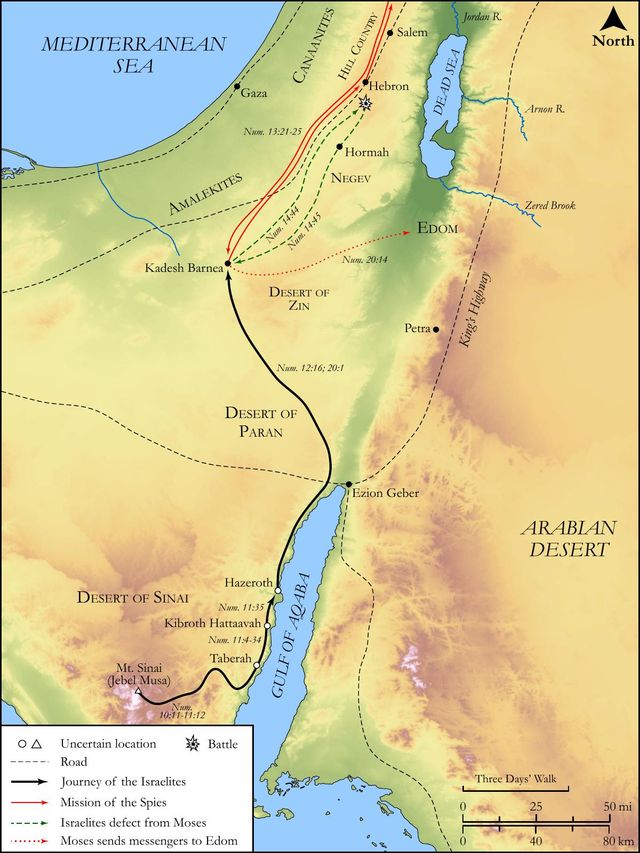
Study this verse
Public-domain commentary
Matthew Henry
From his Commentary on the Whole Bible. Henry comments on passages, not single verses — this entry covers Numbers 17:8–13. His three-level outline is real structure in the source text, so it is rendered as structure.
Here is, I. The final determination of the controversy concerning the priesthood by a miracle, Num 17:8, Num 17:9. The rods or staves were brought out from the most holy place where they were laid up, and publicly produced before the people; and, while all the rest of the rods remained as they were, Aaron's rod only, of a dry stick, became a living branch, budded, and blossomed, and yielded almonds. In some places there were buds, in others blossoms, in others fruit, at the same time. This was miraculous, and took away all suspicion of a fraud, as if in the night Moses had taken away Aaron's rod, and put a living branch of an almond tree in the room of it; for no ordinary branch would have buds, blossoms, and fruits upon it, all at once. Now,
1.This was a plain indication to the people that Aaron was chosen to the priesthood, and not any other of the princes of the tribes. Thus he was distinguished from them and manifested to be under the special blessing of heaven, which sometimes yields increase where there is neither planting nor watering by the hand of man. Bishop Hall here observes that fruitfulness is the best evidence of a divine call, and that the plants of God's setting, and the boughs cut off from them, will flourish. See Psa 92:12-14. The trees of the Lord, though they seem dry trees, are full of sap.
2.It was a very proper sign to represent the priesthood itself, which was hereby confirmed to Aaron.
(1.)That it should be fruitful and serviceable to the church of God. It produced not only blossoms, but almonds; for the priesthood was designed, not only for an honour to Aaron, but for a blessing to Israel. Thus Christ ordained his apostles and ministers that they should go and bring forth fruit, and that their fruit should remain, Joh 15:16.
(2.)That there should be a succession of priests. Here were not only almonds for the present, but buds and blossoms promising more hereafter. Thus has Christ provided in his church that a seed should serve him from generation to generation.
(3.)That yet this priesthood should not be perpetual, but in process of time, like the branches and blossoms of a tree, should fail and wither. The flourishing of the almond-tree is mentioned as one of the signs of old age, Ecc 12:5. This character was betimes put upon the Mosaic priesthood, which soon became old and ready to vanish away, Heb 8:13.
3.It was a type and figure of Christ and his priesthood: for he is the man, the branch, that is to be a priest upon his throne, as it follows (Zac 6:12); and he was to grow up before God, as this before the ark, like a tender plant, and a root out of a dry ground, Isa 53:2.
II.The record of this determination, by the preserving of the rod before the testimony, in perpetuam rei memoriam - that it might be had in perpetual remembrance, Num 17:10, Num 17:11. It is probable that the buds, and blossoms, and fruit, continued fresh; the same divine power that produced them in a night preserved them for ages, at least so long as it was necessary for a token against the rebels. So it was a standing miracle, and the continuance of it was an undeniable proof of the truth of it. Even the leaf of God's trees shall not wither, Psa 1:3. This rod was preserved, as the censers were, to take away their murmurings, that they die not. Note,
1.The design of God in all his providences, both mercies and judgments, and in the memorials of them, is to take away sin, and to prevent it. These things are done, these things written, that we sin not, Jo1 2:1. Christ was manifested to take away sin.
2.What God does for the taking away of sin is done in real kindness to us, that we die not. All the bitter potions he gives, and all the sharp methods he uses with us, are for the cure of a disease which otherwise would certainly be fatal. Bishop Hall observes here that the tables of the law, the pot of manna, and Aaron's rod, were preserved together in or about the ark (the apostle takes notice of them all three together, Heb 9:4), to show to after-ages how the ancient church was taught, and fed, and ruled; and he infers how precious the doctrine, sacraments, and government, of the church are to God and should be to us. The rod of Moses was used in working many miracles, yet we do not find that this was preserved, for the keeping of it would serve only to gratify men's curiosity; but the rod of Aaron, which carried its miracle along with it, was carefully preserved, because that would be of standing use to convince men's consciences, to silence all disputes about the priesthood, and to confirm the faith of God's Israel in his institutions. Such is the difference between the sacraments which Christ has appointed for edification and the relics which men have devised for superstition.
III.The outcry of the people hereupon (Num 17:12, Num 17:13):
Behold, we die, we perish, we all perish. Shall we be consumed with dying? This may be considered as the language either,
1.Of a repining people quarrelling with the judgments of God, which, by their own pride and obstinacy, they had brought upon themselves. They seem to speak despairingly, as if God was a hard Master, that sought advantage against them, and took all occasions to pick quarrels with them, so that if they trod every so little awry, if they stepped ever so little beyond their bounds, they must die, they must perish, they must all perish, basely insinuating that God would never be satisfied with their blood and ruin, till he had made an end of them all and they were consumed with dying. Thus they seem to be like a wild bull in a net, full of the fury of the Lord (Isa 51:20), fretting that God was too hard for them and that they were forced to submit, which they did only because they could not help it. Note, It is a very wicked thing to fret against God when we are in affliction, and in our distress thus to trespass yet more. If we die, if we perish, it is owing to ourselves, and the blame will lie upon our own heads. Or,
2.Of a repenting people. Many interpreters take it as expressing their submission: "Now we see that it is the will of God we should keep our distance, and that it is at our peril if we draw nearer than is appointed. We submit to the divine will in this appointment; we will not contend any more, lest we all perish:" and they engage Moses to intercede for them, that they may not be all consumed with dying. Thus the point was gained, and in this matter God quite took away their murmurings, and henceforward they acquiesced. Note, When God judges he will overcome, and, one way or other, will oblige the most obstinate gainsayers to confess their folly sooner or later, and that wherein they dealt proudly he was above them. Vicisti Galilaee - O Galilaean, thou hast conquered!
Continue studying Numbers 17:9 across the web’s major study libraries — every link below opens this exact verse, chapter, or book on the destination site.
Read & Compare
 BibleGatewayThis verse in more than 200 translations and 70 languages.
 Bible.comThe YouVersion reader — hundreds of translations, reading plans, and highlights.
 ESV.orgCrossway's official English Standard Version reader.
 NET BibleThe NET translation with 60,000+ translators' notes on every rendering decision.
 STEP BibleTyndale House's free study tool — original text, vocabulary, and scholarly resources.
 BibliaLogos Bible Software's free web reader.
 USCCBThe New American Bible (Revised Edition) with the U.S. bishops' study notes.
Commentaries
 BibleHub CommentariesDozens of classic commentaries on this verse, gathered on one page.
 StudyLightMore than 100 commentary sets — the largest collection on the web.
 BibleRefPlain-English commentary on what this verse means, verse by verse.
 Enduring WordDavid Guzik's free commentary on this chapter, widely used by Bible teachers.
 Bible Study ToolsVerse commentary alongside Greek and Hebrew study aids.
Original Language & Research
- BibleHub InterlinearThe verse word by word — original language, transliteration, and English.
- BibleHub LexiconEvery word's original-language definition and Strong's entry.
 Blue Letter BibleDeep-study tools — Strong's numbers, concordance, and word studies.
 SefariaThe Hebrew text with Rashi and centuries of Jewish commentary.
Sermons, Hymns & Audio


TrulyRandomVerse is not affiliated with these sites and doesn’t control their content. They’re linked because they’re genuinely useful.
Summary
Numbers 17:9 marks the public and definitive culmination of God's validation of Aaron's priesthood, following a period of intense rebellion and grumbling against Moses and Aaron's divinely appointed leadership. After the rods of the tribal leaders, including Aaron's, were placed before the Ark of the Covenant as a divine test, Moses brought them forth to the assembled Israelites. This verse vividly describes the moment the people observed the miraculous sign on Aaron's rod—which had budded, blossomed, and produced almonds—and subsequently retrieved their own barren rods, thereby witnessing God's undeniable choice and bringing a decisive end to the contention regarding legitimate priestly authority.
Context
ShowHideLiterary Context
Numbers 17:9 serves as the pivotal moment in a narrative arc that begins with the severe challenges to leadership and priesthood detailed in Numbers 16. The rebellion led by Korah, Dathan, and Abiram, along with 250 prominent men, directly questioned Moses' authority and Aaron's divinely ordained priestly role, resulting in swift and devastating divine judgment. Despite this, the Israelites continued to murmur against Moses and Aaron, leading to another plague (Numbers 16:41). To permanently silence this persistent contention and unequivocally affirm Aaron's exclusive priestly authority, God commanded each tribal leader to present a rod, with Aaron's rod representing the tribe of Levi (Numbers 17:1-4). These rods were placed "before the LORD" in the Tabernacle. The immediate preceding verse, Numbers 17:8, describes the miraculous outcome: Aaron's rod alone had not only budded but also brought forth blossoms and yielded ripe almonds, a clear and undeniable sign of divine life and favor. Numbers 17:9 then details the public unveiling and reception of this miracle, solidifying God's choice before the entire congregation.
Historical & Cultural Context
The setting for this event is the wilderness encampment of Israel, a fledgling nation still grappling with its identity and God's covenant structure after their liberation from Egyptian slavery. In such a nomadic society, clear and unchallengeable authority structures were paramount for maintaining order, unity, and spiritual integrity. The challenge against Moses and Aaron was not merely a political power struggle but a profound theological crisis, directly questioning God's sovereign appointment of leaders. In Israel, staffs or rods were ubiquitous symbols of authority, leadership, and tribal representation. The act of placing these rods "before the LORD" in the Tabernacle signified a divine arbitration, a common cultural practice where disputes were brought before deities for resolution. The miraculous transformation of a dry, lifeless piece of wood into a vibrant, fruit-bearing branch would have been an utterly undeniable, visible, and culturally resonant sign, far beyond any human manipulation. This served as a powerful, tangible testament to God's direct intervention and choice, leaving no room for further doubt among a people prone to skepticism and rebellion.
Key Themes
ShowHideNumbers 17:9 powerfully contributes to several overarching themes woven throughout the book of Numbers and the Pentateuch. Primarily, it underscores the Divine Validation of Priesthood, establishing Aaron and his descendants as the exclusively chosen priestly line through an irrefutable supernatural sign. This act decisively ends the ongoing Disputation and Rebellion against God's appointed leadership, demonstrating that true spiritual office is by divine election, not human popular opinion or self-assertion. The public nature of the event also highlights God's provision of Tangible and Visible Evidence to confirm His will, leaving no ambiguity for the Israelites. This aligns with God's consistent pattern of providing signs to confirm His chosen servants and His message, as seen in His commissioning of Moses in Exodus 4:8. Furthermore, the miracle of life from a seemingly dead rod profoundly foreshadows themes of Resurrection and New Life, which find their ultimate and glorious fulfillment in the person and work of Jesus Christ.
Exposition and Analysis
ShowHideKey Word Analysis
ShowHideThis word (מַטֶּה, H4294) refers to a staff, stick, or branch. It is often a symbol of authority, as carried by leaders, or a practical tool, like a shepherd's staff. Crucially, the Strong's data indicates it can also figuratively represent a "tribe," as seen in Numbers 1:4. In this context, the rods symbolize both the individual tribal leaders and the tribes they represent. The fact that these were "dry" rods, yet Aaron's miraculously brought forth life, underscores the supernatural nature of God's intervention, transforming a symbol of dormancy or death into one of vibrant fruitfulness and divine favor.
The divine name (יְהוָה, H3068), derived from the root "to be," signifies "the self-Existent or Eternal." It is the Jewish national name of God, emphasizing His covenant faithfulness and sovereign presence. The phrase "before the LORD" (which includes this word) signifies placement in God's immediate, sacred presence, specifically within the Tabernacle near the Ark of the Covenant, as indicated in Numbers 17:4. This location highlights that the test and its miraculous outcome were under direct divine arbitration and witness, removing any possibility of human manipulation or deceit and underscoring God's direct endorsement of the result.
The verb (רָאָה, H7200) denotes an active act of seeing, observing, and perceiving. It is not a passive glance but an intentional examination. The public display of the rods and the people's direct observation ensured that the miracle was verifiable by all. This tangible, empirical proof was designed to silence all further skepticism and murmuring, establishing the truth of God's choice through undeniable visual evidence. The people were compelled to "behold" and "discern" the divine hand at work.
Verse Breakdown
ShowHide"And Moses brought out all the rods from before the LORD"
This clause details Moses' obedient and mediatorial action. As God's divinely appointed agent, he retrieves the rods from the sacred space where God had performed the miracle. The phrase "all the rods" is crucial, emphasizing that every tribal rod was presented alongside Aaron's, allowing for direct comparison and undeniable verification of the unique transformation of Aaron's rod. This act publicly unveils God's verdict.
"unto all the children of Israel"
This phrase underscores the public and universal nature of the revelation. The display was not intended for a select few but for the entire community of Israel, ensuring that the divine validation of Aaron's priesthood was witnessed by every segment of the nation. This maximized the impact of the miracle and established the authority of the Levitical priesthood on an unassailable foundation before the entire congregation.
"and they looked"
This signifies the people's active engagement in the verification process. They were not merely informed of the miracle; they were given the opportunity to see it with their own eyes, to gaze upon the evidence. This visual confirmation was absolutely crucial for a people who had repeatedly doubted God's chosen leaders and demanded tangible proof, leaving no room for rationalization or denial.
"and took every man his rod"
This final action signifies the conclusion of the test and the people's acknowledgment of its outcome. Each tribal representative retrieved their own rod, which remained barren, confirming that only Aaron's had undergone the miraculous transformation. This act of retrieval implicitly acknowledges the divine decision and the finality of God's choice, bringing a decisive end to the contention and establishing the legitimacy of Aaron's priesthood.
Literary Devices
ShowHideNumbers 17:9 effectively employs several literary devices to convey its profound message and underscore the significance of the event. Symbolism is paramount, with the dry rods representing the authority of the twelve tribes, and Aaron's rod, specifically, symbolizing divine election, life-giving power, and the unique anointing of the priesthood. The miraculous budding, blossoming, and fruiting of a dead branch serves as a powerful metaphor for God's ability to bring life out of death and to supernaturally validate His chosen servants. The public display of the rods and the people's direct observation create a sense of dramatic revelation, where the truth is unveiled before a captive audience, designed to evoke awe, submission, and an end to all murmuring. The narrative also uses stark contrast between the other barren rods and Aaron's fertile one, powerfully highlighting the unique divine favor and anointing upon the Levitical priesthood.
Theological and Thematic Connections
ShowHideNumbers 17:9 serves as a foundational text for understanding God's method of establishing and confirming spiritual authority within His covenant community. It powerfully demonstrates that true leadership in God's economy is divinely appointed, not humanly elected or self-proclaimed. The miraculous sign was God's direct, undeniable intervention to settle a deep-seated theological dispute, underscoring His commitment to order, His sovereign will, and His unwavering support for those He chooses to serve Him. This event teaches that God will provide clear, undeniable evidence for His will when it is essential for the stability, unity, and spiritual well-being of His people, thereby silencing doubt and fostering submission to His established order. The rod's transformation from dead wood to life-bearing fruit also carries profound implications for God's power to bring life where there is none, a theme echoed throughout Scripture concerning His redemptive work and the spiritual fruitfulness He produces.
Reflection and Application
ShowHideThe public display of Aaron's budded rod in Numbers 17:9 offers timeless and profound lessons for believers today concerning divine authority, the nature of God's confirmation, and our appropriate response to His sovereign will. It challenges us to look beyond human credentials, popular opinion, or charismatic appeal when discerning true spiritual leadership, recognizing that God alone appoints those He desires for specific roles and ministries within His church. While we may not witness physical miracles like a budding rod today, God continues to confirm His chosen servants through the spiritual fruit of their lives, their unwavering faithfulness to His Word, the anointing of the Holy Spirit evident in their ministry, and the transformative impact they have on others. This passage calls us to cultivate a spirit of humility, trust, and submission to God's established order and His chosen instruments, trusting in His perfect wisdom even when His choices may not align with our expectations or desires. It serves as a powerful reminder that rebellion against God's appointed authority is, at its core, rebellion against God Himself, and that true peace, order, and spiritual flourishing come from aligning ourselves wholeheartedly with His sovereign plan for His people.
Questions for Reflection
ShowHideFAQ
ShowHideWhy was it necessary for Moses to bring out "all the rods" and for "every man [to take] his rod"?
ShowHideIt was absolutely crucial for "all the rods" to be brought out and for "every man [to take] his rod" to ensure public, undeniable, and universally verifiable proof of the miracle. This meticulous process allowed each tribal representative and the assembled Israelites to personally witness that only Aaron's rod had budded, blossomed, and produced ripe almonds (Numbers 17:8), while all the others remained barren. This left no room for doubt, accusations of trickery, or future contention regarding the legitimacy of the priesthood. It was a tangible, empirical demonstration designed by God to silence all murmuring and definitively settle the dispute over the legitimate priestly authority, confirming His choice before the entire community in an irrefutable manner.
Christ-Centered Fulfillment
ShowHideNumbers 17:9, with its dramatic display of divine validation and life from death, finds profound Christ-centered fulfillment in the person and redemptive work of Jesus Christ, our ultimate and eternal High Priest. Just as Aaron's rod, a dead piece of wood, miraculously brought forth life, so too did Jesus, the "root out of dry ground" (Isaiah 53:2), emerge from apparent insignificance and death to bring forth eternal life for all who believe. The ultimate and irrefutable sign of God the Father's validation of Jesus' unique priesthood and supreme authority was His resurrection from the dead. While the Israelites "looked" at Aaron's rod as proof, the world is called to "look" upon the resurrected Christ, the ultimate and undeniable proof that He was indeed the Son of God declared with power (Romans 1:4) and the appointed Savior. Jesus' authority was not self-proclaimed or based on human election or popular vote, but divinely appointed and confirmed by the Father, for He always did what pleased the Father (John 5:30, John 8:29). He is the true and living Branch, the source from whom all spiritual fruitfulness flows for those who abide in Him (John 15:5). The miraculous sign of Aaron's rod foreshadows the ultimate, once-for-all validation of Christ's eternal priesthood, which forever silenced all contention regarding access to God through Him, establishing a perfect and permanent way to the Father (Hebrews 7:24-27).