


Nehemiah 3:3
Bible text: King James Version (1769 Blayney text) · Public domain
Bible text: King James Version with Strong's numbers · Public domain
Bible text: Berean Standard Bible · Public domain
Bible text: American Standard Version (1901) · Public domain
Bible text: World English Bible, Messianic edition · Public domain
Bible text: Geneva Bible (1599) · Public domain
Bible text: Young's Literal Translation · Public domain
- וְאֵתve·'Etand <obj.>H853Conj-w ¦ DirObjMParticle Object Indicatorוְandאֵת<obj.>
- שַׁעַרSha·'ar[the] gate ofH8179N-mscNoun Singular Masculine Construct
- הַדָּגִיםha·da·Gimthe fishH1709Art ¦ N-mpNoun Plural Masculine Absoluteהַtheדָּגִיםfish
- בָּנוּba·Nuthey rebuiltH1129V-Qal-Perf-3cpVerb Qal Perfect 3rd Plural common gender
- בְּנֵיbe·Nei[the] sons ofH1121N-mpcNoun Plural Masculine Construct
- הַסְּנָאָהha·se·na·'Ah<the> SenaahH5570Art ¦ N-msNoun Gentilic Singular Masculine Absoluteהַ<the>סְּנָאָהSenaah
- הֵמָּהHe·mahtheyH1992Pro-3mpPronoun Personal 3rd Plural Masculine
- קֵרוּהוּke·Ru·huthey made beams for itH7136V-Piel-Perf-3cp ¦ 3msVerb Piel Perfect 3rd Plural common genderקֵרוּthey made beams forהוּit
- וַיַּעֲמִידוּvai·ya·'a·Mi·duand they set upH5975Conj-w ¦ V-Hiphil-ConsecImperf-3mpVerb Hiphil Consecutive Imperfect 3rd Plural Masculineוַandיַּעֲמִידוּthey set up
- דַּלְתֹתָיוdal·to·Tavits doorsH1817N-fpc ¦ 3msNoun Plural Feminine Constructדַּלְתֹתָיdoorsוits
- מַנְעוּלָיוman·'u·Lavits boltsH4514N-mpc ¦ 3msNoun Plural Masculine Constructמַנְעוּלָיboltsוits
- וּבְרִיחָיוu·ve·ri·Chavand its barsH1280Conj-w ¦ N-mpc ¦ 3msNoun Plural Masculine Constructוּandבְרִיחָיbarsוits
English is a literal word-by-word gloss of the Hebrew, not the KJV's wording. Why?
This is the original text the KJV's translators worked from — each Hebrew word with its own literal English meaning in this verse, prepared by scholars at Tyndale House, Cambridge. The KJV translates whole sentences, not word by word, so its wording differs: one Hebrew word can become several English words, and the KJV may choose “the LORD” where the gloss reads “Yahweh”. Both are faithful — they answer different questions. For the KJV's own rendering, switch to the KJV text.
Details
See on the biblical-era map
Study this verse
Public-domain commentary
Matthew Henry
From his Commentary on the Whole Bible. Henry comments on passages, not single verses — this entry covers Nehemiah 3:1–32. His two-level outline is real structure in the source text, so it is rendered as structure.
The best way to know how to divide this chapter is to observe how the work was divided among the undertakers, that every one might know what he had to do, and mind it accordingly with a holy emulation, and desire to excel, yet without any contention, animosity, or separate interest. No strife appears among them but which should do most for the public good. Several things are observable in the account here given of the building of the wall about Jerusalem: -
I.That Eliashib the high priest, with his brethren the priests, led the van in this troop of builders, Neh 3:1.
Ministers should be foremost in every good work; for their office obliges them to teach and quicken by their example, as well as by their doctrine. If there be labour in it, who so fit as they to work? if danger, who so fit as they to venture? The dignity of the high priest was very great, and obliged him to signalize himself in this service. The priests repaired the sheep-gate, so called because through it were brought the sheep that were to be sacrificed in the temple; and therefore the priests undertook the repair of it because the offerings of the Lord made by fire were their inheritance. And of this gate only it is said that they sanctified it with the word and prayer, and perhaps with sacrifices perhaps,
1.Because it led to the temple; or,
2.Because with this the building of the wall began, and it is probable (though they were at work in all parts of the wall at the same time) that this was first finished, and therefore at this gate they solemnly committed their city and the walls of it to the divine protection; or,
3.Because the priests were the builders of it; and it becomes ministers above others, being themselves in a peculiar manner sanctified to God, to sanctify to him all their performances, and to do even their common actions after a godly sort.
II.That the undertakers were very many, who each took his share, some more and some less, in this work, according as their ability was.
Note, What is to be done for the public good every one should assist in, and further, to the utmost of his place and power. United force will conquer that which no individual dares venture on. Many hands will make light work.
III.That many were active in this work who were not themselves inhabitants of Jerusalem, and therefore consulted purely the public welfare and not any private interest or advantage of their own. Here are the men of Jericho with the first (Neh 3:2), the men of Gibeon and Mizpah (Neh 3:7), and Zanoah, Neh 3:13. Every Israelite should lend a hand towards the building up of Jerusalem.
IV.That several rulers, both of Jerusalem and of other cities, were active in this work, thinking themselves bound in honour to do the utmost that their wealth and power enabled them to do for the furtherance of this good work. But it is observable that they are called rulers of part, or the half part, of their respective cities. One was ruler of the half part of Jerusalem (Neh 3:12), another of part of Beth-haccerem (Neh 3:14), another of part of Mizpah (Neh 3:15), another of the half part of Beth-zur (Neh 3:16), one was ruler of one half part, and another of the other half part, of Keilah, Neh 3:17, Neh 3:18. Perhaps the Persian government would not entrust any one with a strong city, but appointed two to be a watch upon each other. Rome had two consuls.
V.Here is a just reproach fastened upon the nobles of Tekoa, that they put not their necks to the work of their Lord (Neh 3:5), that is, they would not come under the yoke of an obligation to this service; as if the dignity and liberty of their peerage were their discharge from serving God and doing good, which are indeed the highest honour and the truest freedom. Let not nobles think any thing below them by which they may advance the interests of their country; for what else is their nobility good for but that it puts them in a higher and larger sphere of usefulness than that in which inferior persons move?
VI.Two persons joined in repairing the old gate (Neh 3:6), and so were co-founders, and shared the honour of it between them.
The good work which we cannot compass ourselves we must be thankful to those that will go partners with us in. Some think that this is called the old gate because it belonged to the ancient Salem, which was said to be first built by Melchizedek.
VII.Several good honest tradesmen, as well as priests and rulers, were active in this work - goldsmiths, apothecaries, merchants, Neh 3:8, Neh 3:32. They did not think their callings excused them, nor plead that they could not leave their shops to attend the public business, knowing that what they lost would certainly be made up to them by the blessing of God upon their callings.
VIII.Some ladies are spoken of as helping forward this work - Shallum and his daughters (Neh 3:12), who, though not capable of personal service, yet having their portions in their own hands, or being rich widows, contributed money for buying materials and paying workmen. St. Paul speaks of some good women that laboured with him in the gospel, Phi 4:3.
IX.Of some it is said that they repaired over against their houses (Neh 3:10, Neh 3:23, Neh 3:28, Neh 3:29), and of one (who, it is likely, was only a lodger) that he repaired over against his chamber, Neh 3:30. When a general good work is to be done each should apply himself to that part of it that falls nearest to him and is within his reach. If every one will sweep before his own door, the street will be clean; if every one will mend one, we shall be all mended. If he that has but a chamber will repair before that, he does his part.
X.Of one it is said that he earnestly repaired that which fell to his share (Neh 3:20) - he did it with an inflamed zeal; not that others were cold or indifferent, but he was the most vigorous of any of them and consequently made himself remarkable. It is good to be thus zealously affected in a good thin; and it is probable that this good man's zeal provoked very many to take the more pains and make the more haste.
XI.Of one of these builders it is observed that he was the sixth son of his father, Neh 3:30.
His five elder brethren, it seems, laid not their hand to this work, but he did. In doing that which is good we need not stay to see our elders go before us; if they decline it, it does not therefore follow that we must. Thus the younger brother, if he be the better man, and does God and his generation better service, is indeed the better gentleman; those are most honourable that are most useful.
XII.Some of those that had first done helped their fellows, and undertook another share where they saw there was most need.
Meremoth repaired, Neh 3:4. and again, Neh 3:21. And the Tekoites, besides the piece they repaired (Neh 3:5), undertook another piece (Neh 3:27), which is the more remarkable because their nobles set them a bad example by withdrawing from the service, which, instead of serving them for an excuse to sit still, perhaps made them the more forward to do double work, that by their zeal they might either shame or atone for the covetousness and carelessness of their nobles.
Lastly, Here is no mention of any particular share that Nehemiah himself had in this work. A name-sake of his is mentioned, Neh 3:16. But did he do nothing? Yes, though he undertook not any particular piece of the wall, yet he did more than any of them, for he had the oversight of them all; half of his servants worked where there was most need, and the other half stood sentinel, as we find afterwards (Neh 4:16), while he himself in his own person walked the rounds, directed and encouraged the builders, set his hand to the work where he saw occasion, and kept a watchful eye upon the motions of the enemy, as we shall find in the next chapter. The pilot needs not haul at a rope: it is enough for him to steer.
Historical interpretation
Historical reception
2 surviving comments on this verse. Each one is dated, so this reads as a timeline rather than a list.
They themselves wove it and set up the gates, etc. Returning also to the others which are said to have been built, the gate is repeatedly mentioned frequently; because it is evidently necessary that whoever has begun the construction of good action, should continue adhering to their beginnings up to the peak of perfection, and being alert, should set up the gates, bars, and locks. For gates are set in doors so that, being opened at a fitting time, the citizens may have the ability to enter or exit. Locks and bars are set so that, with the doors stopped up and closed, the enemy may not be able to enter. Thus, in our good works, gates of kind provision are to be set up so that fellow citizens, that is, our neighbors, seeing these, may glorify our Father who is in heaven, and they themselves too learn to follow our examples and walk with us through the walls of virtues. Also, locks and bars are to be set up against the plots and invasions of the enemies, so that we may be diligently fortified on all sides, lest perhaps the ancient enemy, having been unwisely let in, might take our stronghold of virtue by force. Hence it is well said in Proverbs: "A brother helped by his brother is like a fortified city, and judgments are like the bars of cities" (Prov. XII). When indeed both peoples, that is, the Jews and the Gentiles, agree in brotherly love in Christ, they build one Church, namely the city of their Creator. And just as the bars strengthen the gates of cities, so the doctrines of truth defend the Churches throughout the world, which make one Catholic Church, from the incursion of the unbelievers. Likewise, we set up locks and bars on our gates, when we carefully guard against disclosing the secrets of our faith to pigs and dogs, that is, to impure minds, or performing our righteousness for the sake of human favor, and admitting through our good works those who bring more danger by their praise than a helpful support by their observation.
The fish gate was built by the sons of Asnah. He called it the fish gate, which looked towards Joppa and Diospolis, that is, Lydda, and it was closer to the sea among all the routes to Jerusalem, which now is said to be called the gate of David, and is the first of the gates to the west of Mount Zion. To this opinion seem to agree the words of the Chronicles, in which it is written about King Manasseh of Judah: “After this, he built a wall outside the city of David to the west of Gihon in the valley, from the entrance of the fish gate, around to Ophel, and raised it very high” (2 Chr. 33). In a typological sense, just as the flock of the Lord's faithful is so often called fish, hence as He said to Peter, “Feed my sheep” (John 21); so also He promised the same to Andrew and the other apostles, saying: “Come after me, and I will make you fishers of men” (Matt. 4). Again, He spoke of these fishermen through a parable, saying: “They chose the good fish and put them into vessels, but threw the bad away” (Matt. 13). Therefore, they built the fish gate in Jerusalem when those steps are ordained in the Church by which the elect are separated from the reprobate, like good fish from bad, to be brought into the fellowship of eternal peace. The fish gate is built when, by the works of virtues, the faithful serve those who see themselves, having been rescued from the waves of turbulence and worldly desire, led into the tranquility and peace of spiritual life. Zephaniah the prophet remembers this gate, saying: “A sound of crying from the fish gate, and wailing from the second” (Zeph. 1). Because what he added, the second, signifies a gate of the second wall in the same area. For in the times of Hezekiah, the wall of the city was doubled, the Chronicles narrate, where it is written: “He built diligently all the wall that had been broken, and raised up towers upon it, and outside another wall” (2 Chr. 32). These things about the literal sense. But according to the allegory of the law, Zephaniah heard the voice of crying from the fish gate and wailing from the second, because he foresaw that both would be thrown down by enemies: for he saw that the faith and works of teachers, by which it was proper for others to be saved from the waves of corruptible life and led into the holy Church, would be overthrown by the snares of the ancient enemy, that is, by the desire for earthly pleasures which would deprive them of heavenly joys. Rightly, indeed, he heard a voice of crying and wailing from both the first and second gate, both from the outer and inner, because he saw that both outward works and the hearts of the negligent within would be overthrown by the devil's attack; but since the Lord lifts up those who are cast down (Ps. 145:14), Nehemiah records that the same fish gate was restored after a long ruin: for even if some of the preachers fall by sinning, there will not be lacking those who, up until the end of the world, succeeding in the place of their predecessors, with the Lord's help, open the gates of righteousness by preaching and living rightly. Rightly, however, it is added about those who destroyed this gate:
Continue studying Nehemiah 3:3 across the web’s major study libraries — every link below opens this exact verse, chapter, or book on the destination site.
Read & Compare
 BibleGatewayThis verse in more than 200 translations and 70 languages.
 Bible.comThe YouVersion reader — hundreds of translations, reading plans, and highlights.
 ESV.orgCrossway's official English Standard Version reader.
 NET BibleThe NET translation with 60,000+ translators' notes on every rendering decision.
 STEP BibleTyndale House's free study tool — original text, vocabulary, and scholarly resources.
 BibliaLogos Bible Software's free web reader.
 USCCBThe New American Bible (Revised Edition) with the U.S. bishops' study notes.
Commentaries
 BibleHub CommentariesDozens of classic commentaries on this verse, gathered on one page.
 StudyLightMore than 100 commentary sets — the largest collection on the web.
 BibleRefPlain-English commentary on what this verse means, verse by verse.
 Enduring WordDavid Guzik's free commentary on this chapter, widely used by Bible teachers.
 Bible Study ToolsVerse commentary alongside Greek and Hebrew study aids.
Original Language & Research
- BibleHub InterlinearThe verse word by word — original language, transliteration, and English.
- BibleHub LexiconEvery word's original-language definition and Strong's entry.
 Blue Letter BibleDeep-study tools — Strong's numbers, concordance, and word studies.
 SefariaThe Hebrew text with Rashi and centuries of Jewish commentary.
Sermons, Hymns & Audio


TrulyRandomVerse is not affiliated with these sites and doesn’t control their content. They’re linked because they’re genuinely useful.
Summary
Nehemiah 3:3 meticulously details the communal effort in rebuilding Jerusalem's walls, specifically highlighting the "sons of Hassenaah" and their crucial work on the Fish Gate. This verse, part of a comprehensive chapter listing the various groups and their assigned sections, underscores the diligent and thorough nature of the post-exilic restoration project. It illustrates the principle of shared responsibility, where each family or guild contributed their specific skills to reconstruct vital infrastructure, ensuring the city's security and functionality.
Context
ShowHideLiterary Context
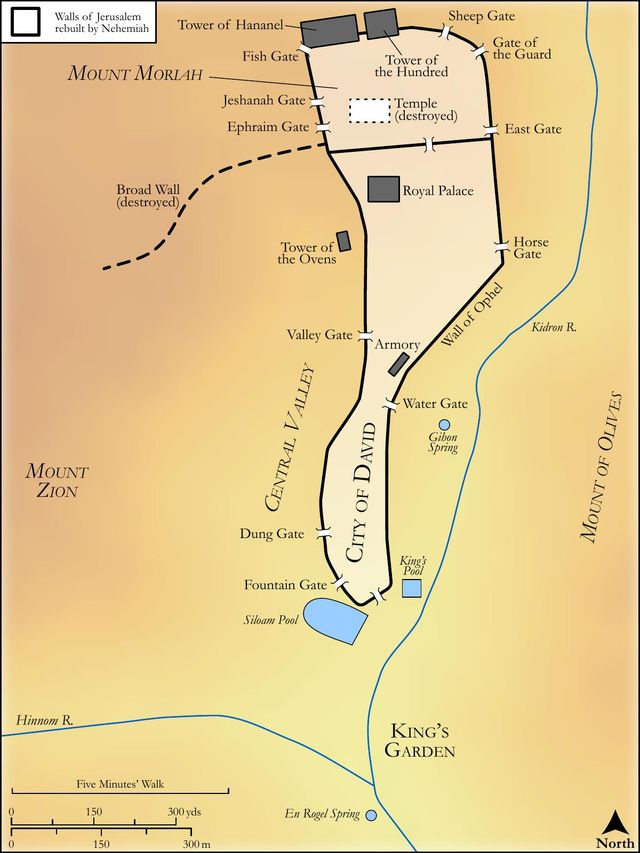
Nehemiah 3 serves as a remarkable "roll call" or roster, meticulously itemizing the various individuals, families, and guilds who participated in the monumental task of rebuilding Jerusalem's walls. Following Nehemiah's initial arrival, his secret night inspection of the broken walls (Nehemiah 2:11-16) and his inspiring call to action (Nehemiah 2:17-18), chapter 3 immediately dives into the practical execution of the work. It moves systematically around the city, starting from the Sheep Gate in the north and proceeding counter-clockwise, assigning specific sections and gates to different groups. This detailed enumeration not only provides historical record but also emphasizes the organized, collaborative, and pervasive nature of the rebuilding effort, demonstrating that no single group bore the entire burden but rather a united community, all under the guiding hand of God and Nehemiah's leadership, as seen throughout the book of Nehemiah.
Historical & Cultural Context
The rebuilding of Jerusalem's walls occurred in the mid-5th century BCE, during the Persian Empire's dominion. After decades of desolation following the Babylonian exile, Jerusalem lay vulnerable, its walls shattered, and its gates burned. This state of disrepair was not merely an architectural problem but a profound spiritual and psychological wound for the returning exiles. Walls and gates were paramount for a city's security, defense against marauders, and control of trade and movement. The Fish Gate, specifically, was likely located on the northern side of the city, a primary entry point, and its name suggests its proximity to a market where fish, perhaps from the Mediterranean Sea or the Jordan River, were sold. Its reconstruction, including its critical components like beams, doors, locks, and bars, was therefore essential not only for physical defense but also for the economic vitality and symbolic restoration of Jerusalem as a secure, functioning city, reflecting the broader post-exilic efforts to restore the nation.
Key Themes
ShowHideNehemiah 3, and Nehemiah 3:3 in particular, powerfully illustrates several core themes. First, shared responsibility is paramount, as the chapter meticulously lists diverse groups—priests, Levites, goldsmiths, perfumers, merchants, and various families—each taking ownership of a specific segment, demonstrating that God's work thrives on collective effort and individual contribution, as seen throughout the book of Nehemiah. Second, diligence and thoroughness are highlighted by the meticulous detail of the work: not just building the gate, but also laying its beams, setting its doors, and installing robust locks and bars. This attention to detail underscores the importance of completing tasks with excellence and ensuring lasting security, a principle echoed in Colossians 3:23. Third, the theme of restoration and security is evident in the emphasis on fully functional gates, which were crucial for the city's defense and symbolized Jerusalem's renewed stability and protection after decades of vulnerability, echoing the broader theme of God's faithfulness in restoring His people and their land, as promised in passages like Jeremiah 30:18. Finally, the entire endeavor represents faith in action, as the physical rebuilding of the wall was a tangible expression of the people's obedience and trust in God's leading through Nehemiah.
Exposition and Analysis
ShowHideKey Word Analysis
ShowHideThis name, meaning "thorny," likely refers to a specific family or clan rather than an individual. Its inclusion here, alongside other named groups, underscores the communal and familial nature of the rebuilding project. It signifies that the effort was not just a governmental decree but a deeply personal commitment from various segments of the post-exilic community, with specific family lines taking responsibility for particular sections of the wall. The very specificity of such names highlights the meticulous record-keeping and the deep sense of ownership each group felt for their assigned task.
This word refers to "a fish (as prolific)" or "a fish (often used collectively)." When combined with "gate" (shaʻar), it designates the "Fish Gate," a strategically important entry point into Jerusalem, likely located on the northern side of the city. Its name suggests its proximity to a market where fish, perhaps from the Mediterranean Sea or the Jordan River, were sold. Its reconstruction was vital for both defense and commerce, emphasizing its significance as a key entry point controlling access and facilitating trade, thereby contributing to the city's economic and physical well-being.
From a root meaning "to flee" or "to bolt," this term refers to a "bolt" or "bar." In the context of a gate, bars were massive wooden or metal beams used to secure the doors from the inside, providing substantial defense against intruders. The mention of "bars" alongside "locks" highlights the builders' commitment to thoroughness and robust security. It wasn't enough to simply erect a gate; it had to be impenetrable, capable of providing genuine protection for the city against external threats.
Verse Breakdown
ShowHide"But the fish gate did the sons of Hassenaah build"
This opening clause immediately identifies the specific section of the wall and the group responsible for its construction. The "Fish Gate" is singled out as a significant point of entry, and the "sons of Hassenaah" are credited, emphasizing the organized division of labor. This highlights the principle that large, daunting tasks are accomplished through the focused efforts of many individuals or groups, each taking ownership of a manageable portion.
"who [also] laid the beams thereof"
This phrase details the initial structural work involved in constructing the gate. Laying the beams refers to installing the foundational horizontal and vertical supports that would bear the weight and provide the framework for the gate. This indicates a methodical and foundational approach to the work, ensuring the structural integrity of the gate before other components were added, underscoring the importance of sound construction from the ground up.
"and set up the doors thereof, the locks thereof, and the bars thereof"
This concluding clause completes the description of the gate's construction, focusing on its functional and security elements. "Setting up the doors" means installing the actual movable panels. The addition of "locks" and "bars" is crucial, as these mechanisms transformed a mere opening into a secure barrier. This detail underscores the commitment to not just superficial completion but to ensuring the gate was fully operational, providing the necessary defense and control for the city, reflecting a dedication to excellence and lasting security.
Literary Devices
ShowHideNehemiah 3:3, along with the entire chapter, prominently employs Enumeration and Detailing. The verse lists specific components of the gate (beams, doors, locks, bars), which is a form of Enumeration that emphasizes the thoroughness and precision of the work. This detailed listing serves to underscore the meticulous nature of the rebuilding project and the dedication of the workers. Furthermore, the focus on the functional elements of the gate—its locks and bars—uses Merism, where two contrasting or complementary parts (locks and bars) represent a complete whole (the entire security system of the gate). The repetition of "thereof" (referring to the gate) also subtly reinforces the singular focus on the completion and functionality of this vital structure. The very naming of "the sons of Hassenaah" and "the Fish Gate" also serves as Specific Naming, lending historical authenticity and highlighting the individual contributions within the larger collective effort, grounding the narrative in concrete reality.
Theological and Thematic Connections
ShowHideNehemiah 3:3 beautifully encapsulates the theological principles of communal responsibility, diligent service, and the importance of spiritual and physical security. The detailed account of each group's contribution to a specific section of the wall illustrates that God's work is often accomplished through the unified, diverse efforts of His people, where every individual's contribution, no matter how seemingly small or specialized, is indispensable to the greater whole. The emphasis on installing beams, doors, locks, and bars speaks to the necessity of thoroughness and excellence in our endeavors for God, ensuring that what is built is not merely functional but robust and secure. This physical rebuilding of Jerusalem's defenses served as a tangible expression of faith and obedience, demonstrating a commitment to restoring not just bricks and mortar, but the very identity and security of God's chosen people, reflecting a deep trust in divine provision and guidance.
Reflection and Application
ShowHideNehemiah 3:3, set within the larger context of the chapter, offers profound lessons for contemporary believers and communities. It calls us to recognize the value of every individual's contribution to the collective work of God's kingdom, whether in the local church, a ministry, or broader societal impact. Just as the sons of Hassenaah diligently worked on their assigned section of the Fish Gate, we are called to identify our unique gifts, skills, and resources and apply them with diligence and excellence to the tasks God has placed before us. The emphasis on installing "locks and bars" reminds us that true spiritual and communal security comes not from superficial efforts but from thorough, dedicated work that is completed with integrity and designed for lasting effectiveness. In a world often prone to division, this verse champions unity, shared vision, and the power of collaboration in overcoming daunting challenges and building up what is broken, serving as a powerful model for collective spiritual endeavor and resilience.
Questions for Reflection
ShowHideFAQ
ShowHideWhy is Nehemiah 3 so detailed with names and sections?
ShowHideNehemiah 3 is meticulously detailed with names and specific sections of the wall for several crucial reasons. First, it serves as a historical record, authenticating the massive undertaking and giving credit to the diverse groups and individuals who participated. This level of detail underscores the reality and magnitude of the effort. Second, it highlights the principle of shared responsibility and unity; no single person or group built the entire wall, but rather a collective effort where everyone had a specific, manageable task. This fostered a sense of ownership and accountability. Third, the enumeration of names and locations emphasizes the comprehensive nature of the restoration—every part of the wall and every gate was addressed. Finally, it serves as an enduring testament to God's ability to mobilize His people for a common purpose, demonstrating that even seemingly mundane details of labor are important in His grand plan, as seen in the call to rebuild Jerusalem's walls after decades of desolation (Nehemiah 2:17-18).
What was the significance of the "Fish Gate"?
ShowHideThe Fish Gate was a significant entry point into Jerusalem, likely located on the northern side of the city. Its name suggests its proximity to a market where fish, possibly from the Mediterranean Sea or the Jordan River, were brought in for sale. As a primary gate, its reconstruction was vital for both the physical security and the economic vitality of Jerusalem. Gates were not just openings; they were fortified structures essential for controlling access, defending against enemies, and facilitating trade. The meticulous rebuilding of the Fish Gate, including its beams, doors, locks, and bars, underscored the commitment to restoring Jerusalem's defenses and re-establishing its functionality as a thriving city, symbolizing the return to order and security for the post-exilic community. Its strategic importance is further highlighted by its mention in other biblical texts, such as Zephaniah 1:10, indicating its established presence and role in the city's life.
Christ-Centered Fulfillment
ShowHideThe physical rebuilding of Jerusalem's walls and gates in Nehemiah 3, exemplified by the work on the Fish Gate, finds its ultimate Christ-centered fulfillment in the spiritual building of God's eternal kingdom and the Church. Just as the sons of Hassenaah diligently secured the physical gate with locks and bars, Christ is the ultimate "gate" and source of security for His people (John 10:9). He is the foundation and cornerstone upon whom the spiritual edifice of the Church is built (Ephesians 2:20-22). The communal effort of rebuilding the wall foreshadows the New Testament Church, where every believer, empowered by the Holy Spirit, contributes their unique gifts to build up the body of Christ, working together in unity and purpose (Ephesians 4:16). The completed and secured gates of Jerusalem pointed to a restored city; similarly, Christ's finished work on the cross provides complete and eternal security for believers, against which "the gates of Hades will not prevail" (Matthew 16:18). Ultimately, the physical restoration of Jerusalem anticipates the New Jerusalem, where the gates are never shut, signifying perfect peace and security in God's eternal presence, all made possible through Christ, the Lamb who is its light (Revelation 21:25).