


Zephaniah 1:10
Bible text: King James Version (1769 Blayney text) · Public domain
Bible text: King James Version with Strong's numbers · Public domain
Bible text: Berean Standard Bible · Public domain
Bible text: American Standard Version (1901) · Public domain
Bible text: World English Bible, Messianic edition · Public domain
Bible text: Geneva Bible (1599) · Public domain
Bible text: Young's Literal Translation · Public domain
- וְהָיָהve·ha·Yahand it will beH1961Conj-w ¦ V-Qal-ConsecPerf-3msVerb Qal Consecutive Perfect 3rd Singular Masculineוְandהָיָהit will be
- בַיּוֹםvai·Yomon the dayH3117Prep-b ¦ N-msNoun Singular Masculine Absoluteבַon theיּוֹםday
- הַהוּאha·Hu'<the> thatH1931Art ¦ Pro-3msPronoun Personal 3rd Singular Masculineהַ<the>הוּאthat
- נְאֻםne·'um[the] utterance ofH5002N-mscNoun Singular Masculine Construct
- יְהוָהYah·wehYahwehH3068N-properNoun Proper Title
- קוֹלKol[the] sound ofH6963N-mscNoun Singular Masculine Construct
- צְעָקָהtze·'a·Kaha cry of distressH6818N-fsNoun Singular Feminine Absolute
- מִשַּׁעַרmi·Sha·'arfrom [the] gate ofH8179Prep-m ¦ N-mscNoun Singular Masculine Constructמִfromשַּׁעַר[the] gate of
- הַדָּגִיםha·da·Gimthe fish<es>H1709Art ¦ N-mpNoun Plural Masculine Absoluteהַtheדָּגִיםfish<es>
- וִילָלָהvi·la·Lahand wailingH3215Conj-w ¦ N-fsNoun Singular Feminine Absoluteוִandילָלָהwailing
- מִןminfromH4480PrepPreposition
- הַמִּשְׁנֶהha·mish·Nehthe second districtH4932Art ¦ N-msNoun Singular Masculine Absoluteהַtheמִּשְׁנֶהsecond district
- וְשֶׁבֶרve·She·verand a crashingH7667Conj-w ¦ N-msNoun Singular Masculine Absoluteוְandשֶׁבֶרa crashing
- גָּדוֹלga·DolgreatH1419Adj-msAdjective Singular Masculine Absolute
- מֵהַגְּבָעוֹתme·ha·ge·va·'otfrom the hillsH1389Prep-m ¦ Art ¦ N-fpNoun Plural Feminine Absoluteמֵfromהַtheגְּבָעוֹתhills
English is a literal word-by-word gloss of the Hebrew, not the KJV's wording. Why?
This is the original text the KJV's translators worked from — each Hebrew word with its own literal English meaning in this verse, prepared by scholars at Tyndale House, Cambridge. The KJV translates whole sentences, not word by word, so its wording differs: one Hebrew word can become several English words, and the KJV may choose “the LORD” where the gloss reads “Yahweh”. Both are faithful — they answer different questions. For the KJV's own rendering, switch to the KJV text.
Details
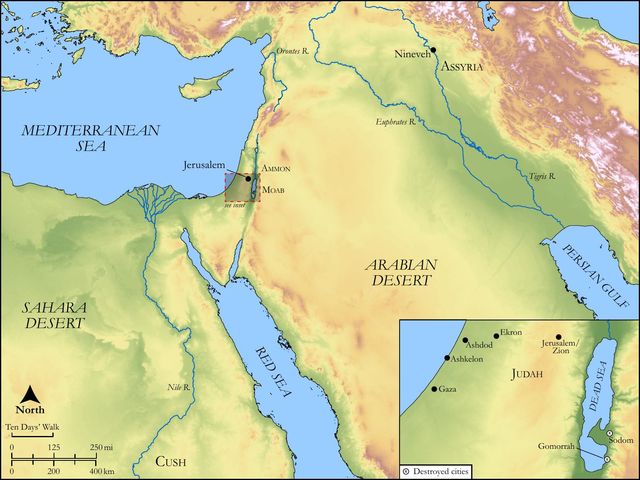
See on the biblical-era map
Study this verse
Public-domain commentary
Matthew Henry
From his Commentary on the Whole Bible. Henry comments on passages, not single verses — this entry covers Zephaniah 1:7–13. His three-level outline is real structure in the source text, so it is rendered as structure.
Notice is here given to Judah and Jerusalem that God is coming forth against them, and will be with them shortly; his presence, as a just avenger, his day, the day of his judgment and his wrath, are not far off, Zep 1:7. Those that improve not the presence of God with them as a Father, but sin away that presence, may expect his presence with them as a Judge, to call them to an account for the contempt put upon his grace. The day of the Lord will come. Men have their day now, when they take a liberty to do what they please; but God's day is at hand; it is here called his sacrifice, a sacrifice of his preparing, for the punishing of presumptuous sinners is a sacrifice to the justice of God, some reparation to his injured honour. Those that brought their offerings to other gods were themselves justly made victims to the true God. On a day of sacrifice great slaughter was made; so shall there be in Jerusalem; men shall be killed up as fast as lambs for the altar, with as little regret, with as much pleasure: The slain of the Lord shall be many. On a day of sacrifice great feasts were made upon the sacrifices; so the inhabitants of Judah and Jerusalem shall be feasted upon by their enemies the Chaldeans; these are the guests God has prepared and invited to come and glut themselves - their revenge with slaughter and their covetousness with plunder. Now observe,
I.Who those are that are marked to be sacrificed, that shall be visited and punished in this day of reckoning, and what it is they shall be called to an account for.
1.The royal family, because of the dignity of their place, shall be first reckoned with for their pride, and vanity, and affectation (Zep 1:8): I will punish the princes, and the king's children, who think themselves accountable to God, and that, high as they are, he is above them. They shall be punished, and all such as, like them, are clothed with strange apparel, such as, in contempt of their own country (where, probably, it was the custom to go in a very plain dress, as became the seed of Jacob that plain man), affected to appear in the fashion of other nations and introduced their modes in apparel, studying to resemble those from whom God had appointed them, even in their clothes, industriously to distinguish themselves. The princes and the king's children scorned to wear any home-made stuffs, though God had provided them fine linen and silks (Eze 16:10), but they must send abroad to strange countries for their clothes, which would not please unless they were far-fetched and dear-bought; and even those of inferior rank affected to imitate the princes and the king's children. Pride in apparel is displeasing to God, and a symptom of the degeneracy of a people.
2.The noblemen, and their stewards and servants, come next to be reckoned with (Zep 1:9): In the same day will I punish those that leap on the threshold, a phrase, no doubt, well understood then, and which probably signified the invading of their neighbour's rights. Entering their houses by force and violence, and seizing their possessions, they leap on the threshold, as much as to say that the house is their own and they will keep their hold of it; and, accordingly, they make all in it their own that they can lay their hands on, and so fill their masters' houses with goods gotten by violence and deceit and with all the guilt thereby contracted. Nor shall it suffice them to say that the ill-gotten gains were not for themselves but for their masters, and that what they did was by their order; for the obligations we lie under to keep God's commandments are prior and superior to the obligations we lie under to serve the interests of any master on earth.
3.The trading people, and the rich merchants, are next called to account. Iniquity is found in their end of the town, among the inhabitants of Maktesh, a low part of Jerusalem, deep like a mortar (for so the word signifies); the goldsmiths lived there (Neh 3:32) and the merchants; and they are now cut down (they are broken, and have shut up their shops, and become bankrupts); nay, All those that bear silver are cut off, in the first place, by the invaders, for the sake of the silver they carry, which is so far from being a protection to them that it will expose and betray them. The conquerors aimed at the wealthy men, and carried them off first, while the poor of the land escaped. Or it may be meant of a general decay of trade, which was a preface and introduction to the general destruction of the land. It is the token of a declining state when great dealers are cut down, and great bankers are cut off and become bankrupts, who cannot fall alone, but with themselves ruin many.
4.All the secure and careless people, the sons of pleasure, that live a loose idle life, are next reckoned with (Zep 1:12); they come from all parts of the country, to take up their quarters in the head-quarters of the kingdom, where they take private lodgings, and indulge themselves in ease and luxury; but God will find them out, and punish them: At that time I will search Jerusalem with candles, to discover them, that they may be brought out to condign punishment. This intimates that they conceal themselves, as being either ashamed of the sin or afraid of the punishment of it; when the judgments of God are abroad they hope to escape by absconding and getting out of the way, but God will search Jerusalem, as search is made for a malefactor in disguise, that is harboured by his accomplices. God's hand will find out all his enemies, wherever they lie hid, and will punish not only the secret idolaters, but the secret epicures and profane; and those are the persons that are here described, and marks are given by which they will be discovered when strict search is made for them.
(1.)Their dispositions are sensual: They are settled on their lees, intoxicated with their pleasures, strengthening themselves in their wealth and wickedness; they are secure and easy, and, because they have had no changes, they fear none, as Moab, Jer 48:11. They have not been emptied from vessel to vessel. They fill themselves with wine and strong drink, and banish all thought, saying, Tomorrow shall be as this day, Isa 56:12. Their being settled on their lees signifies the same with being enclosed in their own fat, Psa 17:10.
(2.)Their notions are atheistical. They could not live such loose lives but that they say in their heart, The Lord will not do good, neither will he do evil; that is, He will do nothing. They deny his providential government of the world: "What good and evil there is in the world comes by the wheel of fortune, and not by the disposal of a wise and supreme director." They deny his moral government, and his dispensing rewards and punishments: "The Lord will not do good to those that serve him, nor do evil to those that rebel against him; and therefore there is nothing got by religion, nor lost by sin." This was the effect of their sensuality; if they were not drowned in sense, they could not be thus senseless, nor could they be so stupid if they had not stupefied themselves with the love of pleasure. It was also the cause of their sensuality; men would not make a god of their belly if they had not at first become so vain, so vile, in their imaginations, as to think the God that made them altogether such a one as themselves. But God will punish them; their end is destruction, Phi 3:19.
II.What the destruction will be with which God will punish these sinners, and what course he will take with them.
1.He will silence them (Zep 1:7): Hold thy peace at the presence of the Lord. He will force them to hold their peace, will strike them dumb with horror and amazement. They shall be speechless. All the excuses of their sin, and exceptions against the sentence, will be overruled, and they shall not have a word to say for themselves.
2.He will sacrifice them, for it is the day of the Lord's sacrifice (Zep 1:8); he will give them into the hands of their enemies, and glorify himself thereby.
3.He will fill both city and country with lamentation (Zep 1:10): In that day there shall be a noise of a cry from the fish-gate, so called because near either to the fish-ponds or to the fish-market. It belonged to the city of David (Ch2 33:14; Neh 3:3); perhaps the same with that which is called the first gate (Zac 14:10), and, if so, it will explain what follows here, And a howling from the second, that is, the second gate, which was next to that fish-gate. The alarm shall go round the walls of Jerusalem from gate to gate; and there shall be a great crashing from the hills, a mighty noise from the mountains round about Jerusalem, from the acclamations of the victorious invaders, or from the lamentations of the timorous invaded, or from both. The inhabitants of the city, even of the closest safest part of the city, shall howl (Zep 1:11), so clamorous shall the grief be.
4.They shall be stripped of all they have; it shall be a prey to the enemy (Zep 1:13): Their household goods, and shop-goods, shall become a booty, and a rich booty they shall be; their houses shall be levelled with the ground and be a desolation; those of them that have built new houses shall not inherit them, but the invaders shall get and keep possession of them. And the vineyards they have planted they shall not drink the wine of, but, instead of having it for the relief of their friends that faint among them, they shall part with it for the animating of their foes that fight against them, Deu 28:30.
Historical interpretation
Fourteen Centuries of Reception
2 surviving comments on this verse. Each one is dated, so this reads as a timeline rather than a list.
Select a marker to jump to its quote. Markers stagger vertically where authors wrote within a few decades of each other.
(Verse 10.) And it shall come to pass in that day, says the Lord, there shall be a voice of crying from the fish gate, and a wailing from the Second Quarter, and a great crashing from the hills. LXX: And it shall come to pass in that day, says the Lord, there shall be a voice of crying from the gate of the mourners, and a wailing from the Second Quarter, and a great crashing from the hills. In the day of the sacrifice of the Lord, when he stretches out his hand over Judah and over all the inhabitants of Jerusalem, and the enemy army surrounds them, there shall be a voice of crying from the fish gate and a wailing from the Second Quarter, and a great crashing from the hills. They called it the Fish Gate, which leads to Diospolis and Joppa, and it was closer to the sea than all the roads to Jerusalem, as Ezra also relates: They built the Fish Gate, the sons of Assena, they covered it and set up doors, bolts, and bars (2 Nehemiah 3:3). But what he says, and the wailing from the second, signifies the gate of the second wall in the same region, as it is also written in the book of Kings: Then went Hilkiah the high priest, and Ahikam, and Achbor, and Shaphan, and Asaiah, to Huldah the prophetess, the wife of Shallum the son of Tikvah, the son of Harhas, keeper of the wardrobe, who dwelt in Jerusalem in the second (2 Kings 22:14). But great contrition speaks from the hills of the mind of Zion and the higher part of the city: for when the higher and fortified parts of the city were occupied, it is easier to descend the slope. But if we want to accept that day which the Lord threatens, the day of judgment as mentioned above, at that time when the Ancient of Days will be seated, and the books will be opened, and the conscience of each person will be laid bare, then the voice of the cry of those repenting will be fulfilled from the gate (Dan. VII). For the first gate of the eyes will be the one through which sins will be presented before our eyes, and all the splendor and image of ancient crimes and vices and excesses will be brought forth into the open. Then that which is written will be true: Behold the man and his works before his face. Therefore, conscience will torment him, and after he has been struck with remorse and cried out at the first gate of the eyes, he will also howl at the second one, which we can understand with our ears. For through these very senses, by which vices had crept in, their punishment will be felt, when we see what we have done and, being instructed by words, listening to the entire order of sins, we will be compelled to wail, and in us whatever had been exalted will be crushed, and because of our blindness and deaf ears, it was unknown to us. Or certainly, when lofty words and erudition coming from on high crush and break us, and are fulfilled in action: I groaned with the groaning of my heart (Ps. 39:9), so that the sacrifice of a broken spirit may be pleasing to God (Ps. 50); in us, who are humans, and have not committed such great sins to be compared to mountains, the hills are broken. However, in the devil and his angels, the heights of the mountains will be crushed. Many believe, according to the history that we have recounted to the times of the Babylonians, that this should be understood as referring to the first coming of the Savior, when because of excessive sins and the clamor of the people: 'His blood be on us and on our children' (Matt. XXVII, 25), Jerusalem was surrounded by an army and consumed by a crowd of mocking children, namely Vespasian and Titus, the two bears (IV Kings II). Indeed, this understanding is more in line with our faith, but in such a way that we know it can also be consistent with the previous history, or at least be a type of the second and perfect destruction of Jerusalem. Moreover, it must also be noted (for the proverb () clearly means in Hebrew not the gate of those who wound, but the gate of the fish) allegorically, that the gate of the fish is in Jerusalem, through which good fish are brought in, having been separated from the bad, and they mourn while the others enter who remained outside. Certainly, at the end of the world and in the consummation, those who did not observe their baptism will mourn from the first gate of fishes; those who did not perform worthy penance will mourn from the second; there will be great sorrow over the hills, which were not bent down for sins to submit their necks and bewail their crimes. Through these two gates, the gate of baptism and the gate of penance, one enters or returns to Jerusalem, that is, to the Church of God.
The Second: A part of the city so called.
Continue studying Zephaniah 1:10 across the web’s major study libraries — every link below opens this exact verse, chapter, or book on the destination site.
Read & Compare
 BibleGatewayThis verse in more than 200 translations and 70 languages.
 Bible.comThe YouVersion reader — hundreds of translations, reading plans, and highlights.
 ESV.orgCrossway's official English Standard Version reader.
 NET BibleThe NET translation with 60,000+ translators' notes on every rendering decision.
 STEP BibleTyndale House's free study tool — original text, vocabulary, and scholarly resources.
 BibliaLogos Bible Software's free web reader.
 USCCBThe New American Bible (Revised Edition) with the U.S. bishops' study notes.
Commentaries
 BibleHub CommentariesDozens of classic commentaries on this verse, gathered on one page.
 StudyLightMore than 100 commentary sets — the largest collection on the web.
 BibleRefPlain-English commentary on what this verse means, verse by verse.
 Enduring WordDavid Guzik's free commentary on this chapter, widely used by Bible teachers.
 Bible Study ToolsVerse commentary alongside Greek and Hebrew study aids.
Original Language & Research
- BibleHub InterlinearThe verse word by word — original language, transliteration, and English.
- BibleHub LexiconEvery word's original-language definition and Strong's entry.
 Blue Letter BibleDeep-study tools — Strong's numbers, concordance, and word studies.
 SefariaThe Hebrew text with Rashi and centuries of Jewish commentary.
Sermons, Hymns & Audio


TrulyRandomVerse is not affiliated with these sites and doesn’t control their content. They’re linked because they’re genuinely useful.
Summary
Zephaniah 1:10 vividly portrays the imminent and devastating judgment descending upon Jerusalem, depicting a scene of widespread panic and destruction through powerful auditory imagery. This prophetic declaration, delivered by the Lord Himself, details the specific locations within the city that will experience the terror, underscoring the inescapable and comprehensive nature of divine wrath against Judah's unfaithfulness.
Context
ShowHideLiterary Context
Zephaniah 1:10 is situated within the opening chapter of the prophet Zephaniah's oracle, which primarily focuses on the impending "Day of the Lord." The preceding verses (Zephaniah 1:2-9) describe a universal judgment that will sweep away all things from the face of the earth, narrowing its focus to Judah and Jerusalem. Verse 10 specifically hones in on the capital city, detailing the sounds of its destruction, following the Lord's declaration to punish those who have turned away from Him and worshipped idols (Zephaniah 1:4-6). This verse serves as a concrete manifestation of the abstract warnings, setting the stage for further descriptions of the city's downfall and the subsequent call to repentance.
Historical & Cultural Context
Zephaniah prophesied during the reign of King Josiah (c. 640-609 BC), a period marked by a brief but significant religious revival following decades of idolatry under Manasseh and Amon. Despite Josiah's reforms, deep-seated spiritual corruption and syncretism persisted among the populace, as evidenced by Zephaniah's condemnation of Baal worship, the worship of the host of heaven, and those who swore by Molech (Zephaniah 1:4-5). Jerusalem, as the religious and political center, was particularly implicated. The "fish gate" (likely in the northern wall) and "the second" (or "Mishneh," referring to the Second Quarter, a newer, densely populated district of the city) were specific, recognizable locations, emphasizing that no part of the city, from its entry points to its inner residential areas, would escape the coming calamity. The "hills" likely refer to the surrounding heights from which an invading army would approach or the elevated parts of the city itself.
Key Themes
ShowHideZephaniah 1:10 powerfully contributes to several key themes prevalent in the book. Foremost is the theme of Divine Judgment and the Day of the Lord, which is the central motif of Zephaniah's prophecy, described as a "day of wrath, a day of trouble and distress, a day of wasteness and desolation, a day of darkness and gloominess, a day of clouds and thick darkness" (Zephaniah 1:15). The verse also highlights God's Sovereignty and Authority, as the judgment is explicitly declared to be "saith the LORD," emphasizing that these events are not random but divinely orchestrated consequences of Judah's sin and rebellion against His covenant. Furthermore, the geographical specificity underscores the theme of Inescapable Consequence, demonstrating that the judgment will be comprehensive and pervasive, affecting every corner of the unfaithful city, echoing the broader message of judgment that extends even to surrounding nations as seen in Zephaniah 2.
Exposition and Analysis
ShowHideKey Word Analysis
ShowHideFrom an unused root meaning "to call aloud," this word signifies a voice or sound. In this context, it denotes a loud, alarming sound, emphasizing the audible nature of the distress and chaos that will engulf Jerusalem. It's not just a quiet lament but a clamorous, public expression of terror.
This feminine noun, derived from a root meaning "to howl," refers to a mournful cry, a lamentation, or wailing. It conveys deep grief, despair, and anguish, indicating the profound emotional suffering experienced by the inhabitants as their city faces destruction.
This term, often paired with "great" (H1419, gâdôwl), means a fracture, ruin, or breaking. It vividly describes the physical devastation—the shattering of structures, the collapse of buildings, and the widespread destruction that will accompany the divine judgment, possibly from military assault or the sheer force of the calamity.
Verse Breakdown
ShowHide"And it shall come to pass in that day, saith the LORD"
This opening clause firmly establishes the divine origin and certainty of the prophecy. "In that day" (H3117, yôwm) is a common prophetic idiom referring to a specific, decisive time of divine intervention, often associated with judgment or salvation. The phrase "saith the LORD" (H5002, nᵉʼum and H3068, Yᵉhôvâh) underscores God's absolute authority and the inevitability of His declared will.
"that there shall be the noise of a cry from the fish gate"
The "fish gate" (H1709, dâg and H8179, shaʻar) was located in the northern wall of Jerusalem, a vulnerable point and a common entry for invaders. The "noise of a cry" (H6963, qôwl and H6818, tsaʻăqâh) signifies a loud, desperate shout—a cry of alarm, distress, or terror emanating from the very entrance of the city, indicating the initial point of invasion or the first sounds of panic.
"and an howling from the second"
"The second" (H4932, mishneh) most likely refers to the "Second Quarter" or "Mishneh" district of Jerusalem, a newer, possibly more affluent residential area. The "howling" (H3215, yᵉlâlâh) indicates a deep, mournful wail or lamentation, suggesting that the judgment will penetrate beyond the city's defenses into its populated inner regions, bringing profound sorrow and despair to its inhabitants.
"and a great crashing from the hills"
The "hills" (H1389, gibʻâh) could refer to the hills surrounding Jerusalem from which an attacking army would descend, or the elevated parts of the city itself. "A great crashing" (H1419, gâdôwl and H7667, sheber) describes widespread and forceful destruction—the sound of buildings collapsing, walls breaking, and general ruin. This imagery completes the picture of total devastation, encompassing both the city's periphery and its core, and possibly indicating the source of the destructive force.
Literary Devices
ShowHideZephaniah 1:10 is rich in Auditory Imagery, using "noise of a cry," "howling," and "great crashing" to create a vivid soundscape of impending doom. This sensory detail immerses the listener/reader in the chaotic reality of the judgment. The verse also employs Geographical Specificity, naming the "fish gate," "the second," and "the hills" to ground the prophecy in concrete, recognizable locations within Jerusalem, making the threat feel immediate and inescapable. This specificity enhances the sense of Imminence and Pervasiveness of the judgment. Furthermore, the repetitive structure of the sounds emanating from different locations creates a sense of Climax and escalating terror, moving from an initial cry to a mournful wail, culminating in the overwhelming sound of physical destruction. The declaration "saith the LORD" functions as a Prophetic Oracle Formula, lending divine authority and absolute certainty to the pronouncement.
Theological and Thematic Connections
ShowHideZephaniah 1:10 stands as a stark testament to God's unwavering justice and His commitment to hold His people accountable for their covenant unfaithfulness. The vivid depiction of Jerusalem's impending destruction serves as a powerful reminder that divine judgment is not merely a theological concept but a terrifying reality for those who persist in rebellion and idolatry. This judgment is not arbitrary but a righteous response to the deep-seated spiritual apostasy and oppression prevalent in Judah, demonstrating God's holiness and His intolerance for sin. Yet, even within this severe warning, there is an implicit call to repentance, as the very act of prophecy aims to turn hearts back to the Lord before the full force of "that day" arrives. The specificity of the destruction highlights that God's judgment is precise, reaching every corner of human activity and every individual.
Reflection and Application
ShowHideZephaniah 1:10 serves as a profound and sobering reminder that God's warnings are not idle threats but declarations of inevitable consequences for persistent sin and rebellion. For us today, this verse underscores the critical importance of heeding God's voice and aligning our lives with His righteous standards. Just as Judah faced a "day" of reckoning for their idolatry and unfaithfulness, so too will all humanity ultimately face the just judgment of God. This should not instill fear in the believer who walks in Christ, but rather a healthy reverence for God's holiness and a renewed commitment to living a life that honors Him. It calls us to examine our own hearts for any idols—anything that takes God's rightful place—and to actively pursue repentance and obedience. The specificity of the judgment on Jerusalem reminds us that God sees our actions, our choices, and even the hidden corners of our lives, calling us to live authentically before Him.
Questions for Reflection
ShowHideFAQ
ShowHideWhat is the significance of the "fish gate" and "the second" in Zephaniah 1:10?
ShowHideThe mention of the "fish gate" and "the second" (or "Mishneh") provides geographical specificity to the impending judgment on Jerusalem, making the prophecy concrete and relatable to its original audience. The Fish Gate was located in the northern wall of Jerusalem, a common point of entry and often the first area to be attacked by invaders approaching from the north. Its mention signifies the initial point of the city's vulnerability and the entry of chaos. "The second" refers to the Second Quarter or Mishneh district, a newer, perhaps more populated or affluent part of the city, indicating that the judgment would penetrate beyond the initial defenses into the heart of the city's residential areas. Together, these specific locations emphasize the comprehensive and inescapable nature of the destruction, affecting every part of Jerusalem from its periphery to its core. This detail highlights that no one and no place would be spared from the divine wrath.
Christ-Centered Fulfillment
ShowHideWhile Zephaniah 1:10 vividly portrays the historical judgment upon Jerusalem, its ultimate fulfillment and theological resonance point powerfully to Christ. The "Day of the LORD" that Zephaniah prophesied finds its ultimate and universal expression in the final judgment that will accompany the glorious return of Jesus Christ, as described in passages like Matthew 24:29-31 and Revelation 6:12-17. The "noise of a cry," "howling," and "great crashing" from Zephaniah's prophecy foreshadow the universal lamentation and terror that will grip those who have rejected God when faced with the unmitigated wrath of the Lamb, as seen in Revelation 1:7. Yet, Christ also fulfills the promise of deliverance from this judgment for those who are "hidden" in Him, transforming the "Day of the Lord" from a day of unmitigated wrath into a day of salvation and vindication for His elect (1 Thessalonians 5:9-10). Through His atoning sacrifice, Jesus bore the full weight of God's judgment for sin, offering a way of escape from the "crashing" and "howling" of divine wrath, so that those who believe in Him might find refuge and eternal life (John 3:16). Thus, Zephaniah's warning, while dire, ultimately points to the necessity and sufficiency of Christ as the only true deliverer from the impending "Day" of ultimate judgment.