


Matthew 27:6
Bible text: King James Version (1769 Blayney text) · Public domain
Bible text: King James Version with Strong's numbers · Public domain
Bible text: Berean Standard Bible · Public domain
Bible text: American Standard Version (1901) · Public domain
Bible text: World English Bible, Messianic edition · Public domain
Bible text: Geneva Bible (1599) · Public domain
Bible text: Young's Literal Translation · Public domain
- ΟἱHoi<the>G3588T-NPMDefinite article Nominative Plural Masculine
- δὲdeAndG1161CONJConjunction
- ἀρχιερεῖςarchiereisthe chief priestsG749N-NPMNoun Nominative Plural Masculine
- λαβόντεςlabonteshaving takenG2983V-2AAP-NPMVerb 2nd Aorist Active Participle Nominative Plural Masculine
- τὰtatheG3588T-APNDefinite article Accusative Plural Neuter
- ἀργύριαarguriapieces of silverG694N-APNNoun Accusative Plural Neuter
- εἶπαν·eipansaidG2036V-2AAI-3PVerb 2nd Aorist Active Indicative 3rd Plural
- οὐκoukNotG3756PRT-NNegative Particle Negative
- ἔξεστινexestinit is lawfulG1832V-PAI-3SVerb Present Active Indicative 3rd Singular
- βαλεῖνbaleinto putG906V-2AANVerb 2nd Aorist Active Infinitive
- αὐτὰautathemG846P-APNPersonal pronoun Accusative Plural Neuter
- εἰςeisintoG1519PREPPreposition
- τὸνtontheG3588T-ASMDefinite article Accusative Singular Masculine
- κορβανᾶνkorbanantreasuryG2878N-ASMNoun Accusative Singular Masculine
- ἐπεὶepeisince [the]G1893CONJConjunction
- τιμὴtimēpriceG5092N-NSFNoun Nominative Singular Feminine
- αἵματόςaimatosof bloodG129N-GSNNoun Genitive Singular Neuter
- ἐστινestinit isG1510V-PAI-3SVerb Present Active Indicative 3rd Singular
English is a literal word-by-word gloss of the Greek, not the KJV's wording. Why?
This is the original text the KJV's translators worked from — each Greek word with its own literal English meaning in this verse, prepared by scholars at Tyndale House, Cambridge. The KJV translates whole sentences, not word by word, so its wording differs: one Greek word can become several English words, and the KJV may choose “charity” where the gloss reads “love”. Both are faithful — they answer different questions. For the KJV's own rendering, switch to the KJV text.
Details
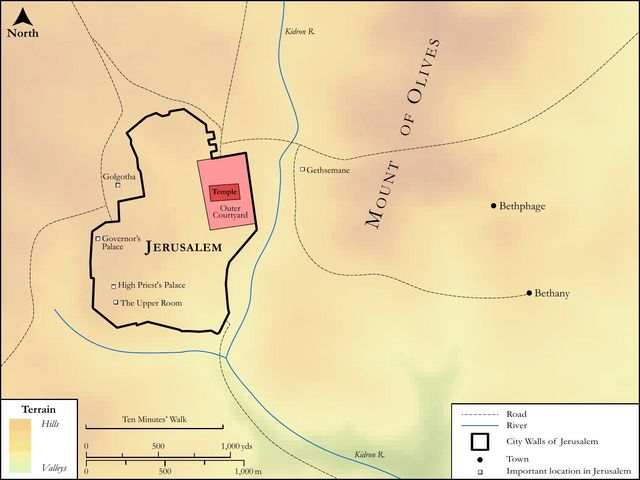
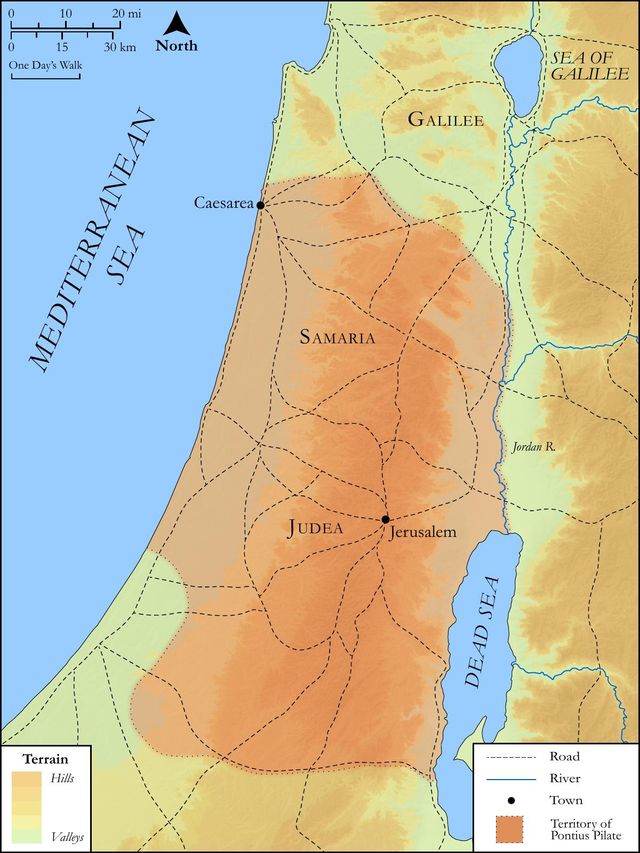
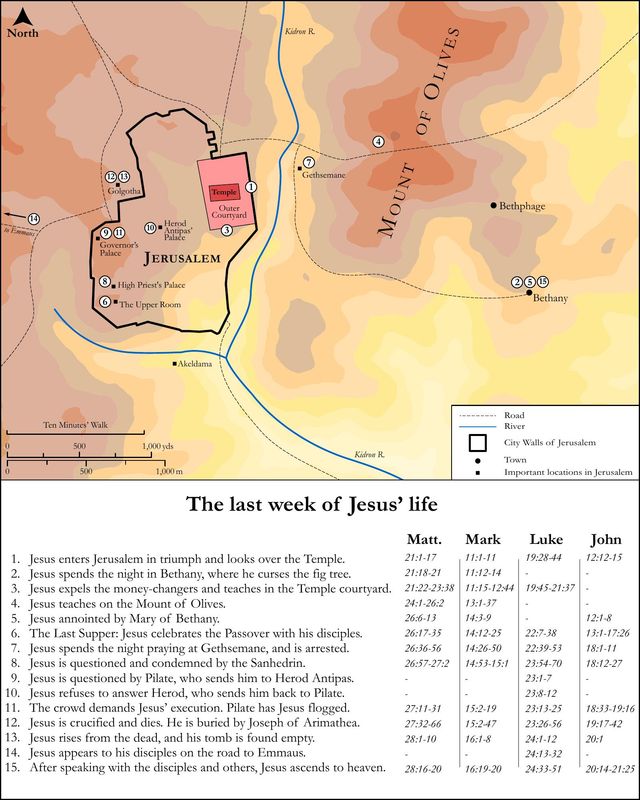
See on the biblical-era maps
Study this verse
Historical interpretation
Eleven Centuries of Reception
9 surviving comments on this verse. Each one is dated, so this reads as a timeline rather than a list.
Select a marker to jump to its quote. Markers stagger vertically where authors wrote within a few decades of each other.
(Hil. Quæst. V. et N. Test. q. 94.) Since the Chief Priests were employed about the murder of the Lord from the morning to the ninth hour, how is this proved that before the crucifixion Judas returned them the money he had received, and said to them in the temple, I have sinned, in that I have betrayed innocent blood? Whereas it is manifest that the Chief Priests and Elders were never in the temple before the Lord's crucifixion, seeing that when He was hanging on the Cross they were there to insult Him. Nor indeed can this be proved hence, because it is related before the Lord's Passion, for many things which were manifestly done before, are related after, that, and the reverse. It might have been done after the ninth hour, when Judas, seeing the Saviour dead and the veil of the temple rent, the earthquake, the bursting of the rocks, and the elements terrified, was seized with fear and sorrow thereupon. But after the ninth hour the Chief Priests and Elders were occupied, as I suppose, in the celebration of the Passover; and on the Sabbath, the Law would not have allowed him to bring money. Therefore it is to me as yet unproved on what day or at what time Judas ended his life by hanging.
Judas did not die by hanging, but lived on, having been cut down before he was suffocated. And the acts of the apostles show this, that falling head long he burst asunder in the midst, and all his bowels gushed out. This fact is related more clearly by Papias, the disciple of John, and the fourth book of the Expositions of the Oracles of the Lord as follows:
Judas walked about in this world a terrible example of impiety; his flesh swollen to such an extent that, where hay wagon can pass with ease, he was not able to pass, no, not even the mass of his head merely. They say that his eyelids swelled to such an extent that he could not see the light at all, while as for his eyes they were not visible even by a physician looking through an instrument, so far have they sunk from the surface.
His genitals appeared entirely disfigured, nauseous and large. When he carried himself about discharge and worms flowed from his entire body through his private areas only, on account of his outrages. After many agonies and punishments, he died in his own place. And on account of this the place is desolate and uninhabited even now. And to this day no one is able to go by that place, except if they block their noses with their hands. Such judgment was spread through his body and upon the earth.
They thought it meet to spend upon the dead that money which was the price of blood. But as there are differences even in burial places, they used the price of Jesus' blood in the purchase of some potter's field, where foreigners might be buried, not as they desired in the sepulchres of their fathers.
Or, the foreigners are they who to the end are aliens from God, for the righteous are buried with Christ in a new tomb hewn out in the rock. But they who are aliens from God, even to the end, are buried in the field of a potter, a worker in clay, which being bought by the price of blood, is called the field of blood.
Because the quality of resting places for the dead varies (for many are buried in their ancestral tombs which were secured by a pledge, but those who suffer misfortune are often buried in the graves of the homeless), those who received payment in exchange for the blood of Jesus used it to acquire a potter’s field for the purpose of having a place in which to bury those foreigners who could not supply a pledge to secure a proper tomb. If it is suitable to interpret these foreigners typologically, we can consider those persons to be foreigners who remained strangers to God until the end and alien to his covenants. Vagabonds such as these meet their end buried in a potter’s field acquired with blood money. The righteous are able to say, “We are buried with Christ in a new tomb cut from the rock in which no dead body had yet been laid,” but those foreigners who remain finally estranged from Christ and alien to God will have to say, “We are buried with strangers in the field which is called the ‘Field of Blood.’ ”
The Chief Priests knowing that they had purchased a murder were condemned by their own conscience; they said, It is the price of blood.
What then did that man? When he saw that he was laboring to no profit, and that they would not consent to receive the pieces of silver, "he cast them down in the temple, and went and hanged himself. And the chief priests took the pieces of silver, and said, it is not lawful for to put them into the treasury, because it is the price of blood. And they took counsel, and bought with them the potter's field to bury strangers in. Wherefore that field was called, the field of blood, unto this day. Then was fulfilled that which was spoken by Jeremy the prophet, saying, and they took the thirty pieces of silver, the price of Him that was valued, and gave them for the potter's field, as the Lord appointed me."
Seest thou them again self-condemned by their conscience? For because they knew that they had been buying the murder, they put them not into the treasury, but bought a field to bury strangers in. And this also became a witness against them, and a proof of their treason. For the name of the place more clearly than a trumpet proclaimed their blood-guiltiness. Neither did they it at random, but having taking counsel, and in every case in like manner, so that no one should be clear of the deed, but all guilty. But these things the prophecy foretold from of old. Seest thou not the apostles only, but the prophets also declaring exactly those things which were matters of reproach, and every way proclaiming the passion, and indicating it beforehand?
This was the case with the Jews without their being conscious of it. For if they had cast it into the treasury, the thing would not have been so clearly discovered; but now having bought a piece of ground, they made it all manifest even to subsequent generations.
Hear ye as many as think to do good works out of murders, and take a reward for the lives of men. These almsgiving are Judaical, or rather they are Satanical. For there are, there are now also they, that take by violence countless things belonging to others, and think that an excuse is made for all if they cast in some ten or a hundred gold pieces.
(Verse 6.) But the chief priests, having received the silver, said: It is not lawful to put them into the treasury, because it is the price of blood. Truly straining out a gnat and swallowing a camel. For if they do not put money into the treasury, that is, into the storeroom for gifts to God, because it is the price of blood, why is the blood itself being spilled?
Truly straining out the gnat, and swallowing the camel; for if they would not put the money into the treasury, because it was the price of blood, why did they shed the blood at all?
Also we, who were strangers to the Law and the Prophets, have profited by the perverse temper of the Jews to obtain salvation for ourselves.
This is not found at all in Hieremias; but in Zacharias (Zech. 11:13.), who is the last but one of the twelve Prophets, something like it is told, and though the sense is not very different, yet the arrangement and the words are different.
(ad Pam. Ep. lvii. 7.) Far be it then from a follower of Christ to suppose him guilty of falsehood, whereas his business was not to pry into words and syllables, but to lay down the staple of doctrine.
(in loc.) I have lately read in a Hebrew book given me by a Hebrew of the Nazarene sect, an apocryphal Hieremias, in which I find the very words here quoted. After all, I am rather inclined to think that the passage was taken by Matthew out of Zacharias, in the usual manner of the Apostles and Evangelists when they quote from the Old Testament, neglecting the words, and attending only to the sense.
(non occ.) To this day means to the time when the Evangelist was then writing. He then confirms the event by the testimony of the Prophet; Then was fulfilled that which was spoken by Jeremy the Prophet, &c.
Continue studying Matthew 27:6 across the web’s major study libraries — every link below opens this exact verse, chapter, or book on the destination site.
Read & Compare
 BibleGatewayThis verse in more than 200 translations and 70 languages.
 Bible.comThe YouVersion reader — hundreds of translations, reading plans, and highlights.
 ESV.orgCrossway's official English Standard Version reader.
 NET BibleThe NET translation with 60,000+ translators' notes on every rendering decision.
 STEP BibleTyndale House's free study tool — original text, vocabulary, and scholarly resources.
 BibliaLogos Bible Software's free web reader.
 USCCBThe New American Bible (Revised Edition) with the U.S. bishops' study notes.
Commentaries
 BibleHub CommentariesDozens of classic commentaries on this verse, gathered on one page.
 StudyLightMore than 100 commentary sets — the largest collection on the web.
 BibleRefPlain-English commentary on what this verse means, verse by verse.
 Enduring WordDavid Guzik's free commentary on this chapter, widely used by Bible teachers.
 Bible Study ToolsVerse commentary alongside Greek and Hebrew study aids.
Original Language & Research
- BibleHub InterlinearThe verse word by word — original language, transliteration, and English.
- BibleHub LexiconEvery word's original-language definition and Strong's entry.
 Blue Letter BibleDeep-study tools — Strong's numbers, concordance, and word studies.
 CNTR CollationThe earliest Greek manuscripts of this verse, collated letter by letter.
Sermons, Hymns & Audio


TrulyRandomVerse is not affiliated with these sites and doesn’t control their content. They’re linked because they’re genuinely useful.
Summary
Matthew 27:6 records the chief priests' dilemma after Judas Iscariot returned the thirty pieces of silver he received for betraying Jesus. Confronted with the blood money, they declared it unlawful to deposit into the temple treasury, recognizing its defiled nature as "the price of blood" even as they themselves had orchestrated the unjust condemnation of an innocent man. This verse starkly highlights their meticulous adherence to ritual purity laws while simultaneously demonstrating profound moral and spiritual blindness.
Context
ShowHideLiterary Context
This verse immediately follows Judas's profound remorse and desperate act of throwing the thirty pieces of silver into the temple (Matthew 27:3-5 "Matthew 27:3-5 - Judas's Remorse and Suicide"). His actions present the chief priests with a practical problem: what to do with the returned money. The narrative then proceeds to describe their decision to use the money to purchase the Potter's Field, fulfilling an ancient prophecy (Matthew 27:7-10 "Matthew 27:7-10 - The Purchase of the Potter's Field"). This sequence underscores the unfolding divine plan, even amidst human treachery and religious hypocrisy, leading directly to Jesus's crucifixion.
Historical & Cultural Context
The temple treasury, known in Greek as korbanas (κορβανᾶς), was a sacred fund used for temple maintenance, sacrifices, and other religious expenses. Jewish law and tradition, particularly as interpreted by the Pharisees and Sadducees, placed great emphasis on ritual purity. Money obtained through illicit means, such as murder or betrayal, was considered "blood money" (timē haimatos) and was deemed ritually unclean. Such funds could not be consecrated or used for sacred purposes, as they would defile the holy treasury. This strict adherence to ritual law, even in the context of their profound moral failure in condemning Jesus, reveals the legalistic mindset prevalent among the religious leaders of the time.
Key Themes
ShowHideThis verse powerfully contributes to several overarching themes in Matthew's Gospel. It highlights the religious hypocrisy of the chief priests, who meticulously observe external ritual purity while perpetrating the gravest injustice against God's Son, a theme consistently critiqued by Jesus (e.g., Matthew 23:23-28). The concept of "the price of blood" underscores the defilement of ill-gotten gain and its inability to be sanctified for holy purposes. Furthermore, the handling of the silver pieces, initially paid for betrayal (Matthew 26:15 "Matthew 26:15 - The Betrayal Agreement"), then returned, and finally used to buy the Potter's Field, serves as a poignant illustration of divine sovereignty working through human sin to fulfill prophetic scripture (Zechariah 11:12-13 "Zechariah 11:12-13 - The Thirty Pieces of Silver").
Exposition and Analysis
ShowHideKey Word Analysis
ShowHideRefers to the leading priestly families, often Sadducees, who held significant religious and political power in Jerusalem. They were responsible for the temple operations and were key figures in the Sanhedrin, the Jewish high court. Their decision here reflects their collective authority and legalistic interpretation of the Mosaic Law.
Impersonally, "it is right" or "it is permitted." This word indicates a legal or moral permissibility. The chief priests are appealing to a principle of religious law, specifically regarding the proper handling of funds designated for the temple treasury. Their declaration emphasizes that, according to their understanding of purity laws, the money was forbidden from entering the sacred coffers.
Derived from a Hebrew/Chaldee word meaning "a votive offering" or "a consecrated present." In this context, it refers to the sacred temple fund or the specific room where these contributions were kept. The chief priests' concern was preventing the defilement of this holy fund by money obtained through a morally illicit act, specifically the betrayal and condemnation of an innocent life.
Denotes a value, money paid, or valuables. Here, it specifically refers to the monetary value exchanged for a life, particularly one unjustly taken. The phrase "price of blood" emphasizes that the money is tainted by its association with a life that was unlawfully taken, rendering it ritually impure and unsuitable for sacred use.
Verse Breakdown
ShowHide"And the chief priests took the silver pieces,"
This clause describes the immediate action of the religious leaders after Judas cast the money into the temple. They physically retrieved the coins, acknowledging their responsibility for them and the dilemma they presented.
"and said, It is not lawful for to put them into the treasury,"
This is the chief priests' collective declaration and decision. They immediately recognize the ritual impurity of the money. Their concern is not the moral culpability of their actions in condemning Jesus, but the legalistic adherence to temple purity laws. The word "lawful" (ἔξεστιν) highlights their appeal to religious statutes.
"because it is the price of blood."
This final clause provides the justification for their decision. The money is deemed "the price of blood" (τιμὴ αἵματος), signifying that it was gained through an act that resulted in the shedding of innocent blood. This designation made the money ritually defiled and therefore unsuitable for the sacred temple treasury.
Literary Devices
ShowHideThe verse employs several significant literary devices. Irony is powerfully present: the religious leaders, who have just orchestrated the unjust condemnation of Jesus, meticulously adhere to a ritual purity law concerning the money used for the betrayal. Their concern for the temple treasury's purity stands in stark contrast to their profound moral impurity in shedding innocent blood. This highlights their hypocrisy, a recurring theme in Matthew's Gospel. The phrase "price of blood" functions as a potent metaphor, vividly conveying the defilement and moral stain associated with the money. It is not merely money, but money inextricably linked to a heinous act. This also serves as foreshadowing, as the subsequent use of this "blood money" to purchase the Potter's Field will fulfill ancient prophecy, demonstrating God's sovereign hand even in human sin.
Theological and Thematic Connections
ShowHideMatthew 27:6 profoundly illustrates the tragic irony of religious legalism divorced from true righteousness and justice. The chief priests' scrupulous adherence to ritual purity laws regarding "blood money" stands in stark contrast to their profound moral culpability in orchestrating the unjust execution of Jesus. This highlights a recurring biblical theme: God values internal righteousness and mercy over external religious observance. Their actions expose a spiritual blindness that prioritizes ceremonial cleanliness over the sanctity of human life and divine truth. The defilement of the money also underscores the principle that ill-gotten gain, especially that stained with injustice, cannot be sanctified or used for truly holy purposes.
Reflection and Application
ShowHideMatthew 27:6 serves as a powerful and sobering mirror for all who claim religious devotion. The chief priests, meticulous in their external adherence to ritual law, were utterly blind to the profound moral depravity of their actions against Jesus. Their concern for the "price of blood" in the temple treasury, while their hands were stained with the blood of the innocent Messiah, exposes a dangerous spiritual disconnect. This challenges us to examine our own lives: Are we more concerned with outward appearances, religious rituals, or the letter of the law, while neglecting the "weightier matters" of justice, mercy, and genuine love for God and neighbor? The verse reminds us that true holiness begins in the heart and manifests in righteous actions, not merely in avoiding ritual impurity. It also prompts us to consider the source of our resources and the integrity of our dealings. Money obtained through unethical means, even if given to a good cause, carries a spiritual defilement that cannot be easily washed away. We are called to live lives of integrity, where our outward practices align with an inward transformation that prioritizes God's heart over mere rules.
Questions for Reflection
ShowHideFAQ
ShowHideWhy was the money considered "the price of blood" and therefore unlawful to put into the treasury?
ShowHideThe money was considered "the price of blood" because it was the payment for the betrayal and subsequent condemnation of an innocent man, Jesus. According to Jewish law and tradition, money obtained through illicit or violent means, particularly through the shedding of blood or taking a life, was deemed ritually impure. This concept is rooted in Old Testament principles that prohibit bringing defiled offerings into the temple. For example, Deuteronomy 23:18 forbids bringing the "hire of a whore" or "price of a dog" into the house of the Lord, establishing a precedent that certain types of gain are an "abomination." The chief priests, despite their moral culpability in Jesus's death, meticulously applied this legalistic interpretation to the silver, preventing it from defiling the sacred temple treasury (known as the korbanas).
What does this verse reveal about the chief priests' character and priorities?
ShowHideThis verse reveals a profound and tragic hypocrisy in the character and priorities of the chief priests. While they were scrupulous about adhering to the letter of the law regarding ritual purity for the temple treasury, they had just orchestrated the unjust condemnation and death of an innocent man, Jesus. Their concern was not for justice, truth, or the sanctity of life, but for external religious formalities. This highlights their legalistic mindset, where outward observance superseded genuine righteousness, mercy, and faith—the "weightier matters of the law" that Jesus often critiqued (e.g., Matthew 23:23). Their actions demonstrate a spiritual blindness that prioritized ceremonial cleanliness over moral integrity and divine truth.
Christ-Centered Fulfillment
ShowHideMatthew 27:6, while exposing the profound hypocrisy of the religious leaders, ultimately serves to highlight the perfect, unblemished sacrifice of Christ. The chief priests' rejection of the "price of blood" for the temple treasury ironically underscores the very real blood that was about to be shed—the innocent blood of Jesus, which would, unlike the defiled silver, truly cleanse and redeem. Their meticulous concern for ritual purity regarding money stands in stark contrast to God's ultimate concern for the purity of heart and the atoning sacrifice of His Son. The "price of blood" in this verse is a perversion, a payment for betrayal and death; yet, in God's divine economy, it foreshadows the infinitely valuable "blood of the Lamb" (Revelation 7:14 "Revelation 7:14 - Washed in the Blood of the Lamb") that truly washes away sin and purifies not just a treasury, but human souls. Jesus, the sinless Lamb of God (John 1:29 "John 1:29 - Jesus, the Lamb of God"), became the ultimate "price of blood," not as a defiled payment, but as a perfect, substitutionary atonement, making reconciliation possible where human legalism and sin had only brought defilement and death (Hebrews 9:12-14 "Hebrews 9:12-14 - Christ's Superior Sacrifice"). His blood, unlike Judas's silver, was not rejected by God, but accepted as the perfect offering, establishing a new covenant (Luke 22:20 "Luke 22:20 - The New Covenant in Christ's Blood") that truly purifies and brings life.