


Job 41:6
Bible text: King James Version (1769 Blayney text) · Public domain
Bible text: King James Version with Strong's numbers · Public domain
Bible text: Berean Standard Bible · Public domain
Bible text: American Standard Version (1901) · Public domain
Bible text: World English Bible, Messianic edition · Public domain
Bible text: Young's Literal Translation · Public domain
- יִכְרוּyikh·Ruwill they bargain?H3739V-Qal-Imperf-3mpVerb Qal Imperfect 3rd Plural Masculine
- עָלָיו'A·lavon itH5921Prep ¦ 3msPreposition Definiteעָלָיonוit
- חַבָּרִיםcha·ba·RimpartnersH2271N-mpNoun Plural Masculine Absolute
- יֶחֱצוּהוּye·che·Tzu·huwill they divide? itH2673V-Qal-Imperf-3mp ¦ 3msVerb Qal Imperfect 3rd Plural Masculineיֶחֱצוּwill they divide?הוּit
- בֵּיןbeinbetweenH996Adj-mscAdjective Numerical Singular Masculine Construct
- כְּנַעֲנִיםKe·na·'a·NimmerchantsH3669N-mpNoun Gentilic Plural Masculine Absolute
English is a literal word-by-word gloss of the Hebrew, not the KJV's wording. Why?
This is the original text the KJV's translators worked from — each Hebrew word with its own literal English meaning in this verse, prepared by scholars at Tyndale House, Cambridge. The KJV translates whole sentences, not word by word, so its wording differs: one Hebrew word can become several English words, and the KJV may choose “the LORD” where the gloss reads “Yahweh”. Both are faithful — they answer different questions. For the KJV's own rendering, switch to the KJV text.
Details
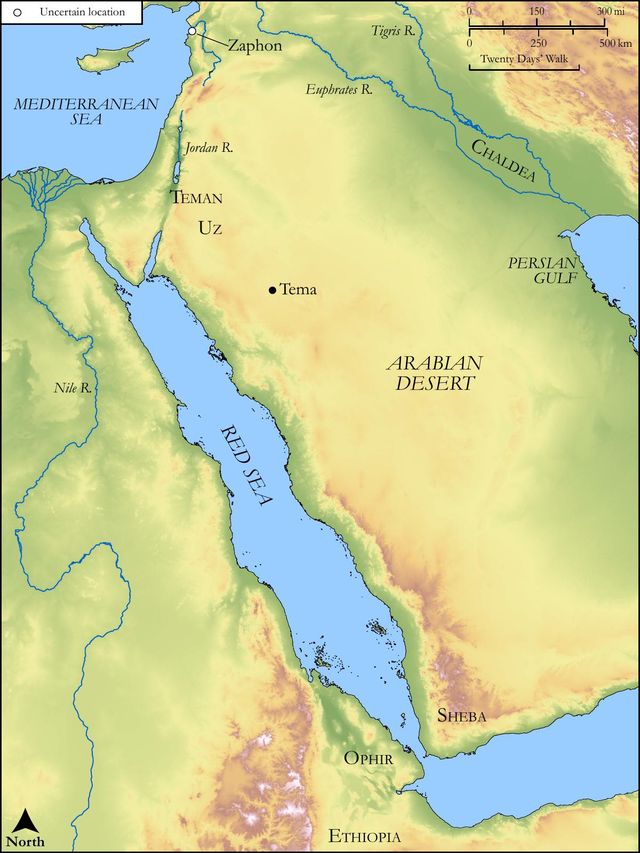
See on the biblical-era map
Study this verse
Public-domain commentary
Matthew Henry
From his Commentary on the Whole Bible. Henry comments on passages, not single verses — this entry covers Job 41:1–10. His two-level outline is real structure in the source text, so it is rendered as structure.
Whether this leviathan be a whale or a crocodile is a great dispute among the learned, which I will not undertake to determine; some of the particulars agree more easily to the one, others to the other; both are very strong and fierce, and the power of the Creator appears in them. The ingenious Sir Richard Blackmore, though he admits the more received opinion concerning the behemoth, that it must be meant of the elephant, yet agrees with the learned Bochart's notion of the leviathan, that it is the crocodile, which was so well known in the river of Egypt. I confess that that which inclines me rather to understand it of the whale is not only because it is much larger and a nobler animal, but because, in the history of the Creation, there is such an express notice taken of it as is not of any other species of animals whatsoever (Gen 1:21, God created great whales), by which it appears, not only that whales were well known in those parts in the time of Moses, who lived a little after Job, but that the creation of whales was generally looked upon as a most illustrious proof of the eternal power and godhead of the Creator; and we may conjecture that this was the reason (for otherwise it seems unaccountable) why Moses there so particularly mentions the creation of the whales, because God had so lately insisted upon the bulk and strength of that creature than of any other, as the proof of his power; and the leviathan is here spoken of as an inhabitant of the sea (Job 41:31), which the crocodile is not; and Psa 104:25, Psa 104:26, there in the great and wide sea, is that leviathan. Here in these verses,
I.He shows how unable Job was to master the leviathan.
1.That he could not catch him, as a little fish, with angling, Job 41:1, Job 41:2. He had no bait wherewith to deceive him, no hook wherewith to catch him, no fish-line wherewith to draw him out of the water, nor a thorn to run through his gills, on which to carry him home.
2.That he could not make him his prisoner, nor force him to cry for quarter, or surrender himself at discretion, Job 41:3, Job 41:4. "He knows his own strength too well to make many supplications to thee, and to make a covenant with thee to be thy servant on condition thou wilt save his life." 3. That he could not entice him into a cage, and keep him there as a bird for the children to play with, Job 41:5. There are creatures so little, so weak, as to be easily restrained thus, and triumphed over; but the leviathan is not one of these: he is made to be the terror, not the sport and diversion, of mankind. 4. That he could not have him served up to his table; he and his companions could not make a banquet of him; his flesh is too strong to be fit for food, and, if it were not, he is not easily caught. 5. That they could not enrich themselves with the spoil of him: Shall they part him among the merchants, the bones to one, the oil to another? If they can catch him, they will; but it is probable that the art of fishing for whales was not brought to perfection then, as it has been since. 6. That they could not destroy him, could not fill his head with fish-spears, Job 41:7. He kept out of the reach of their instruments of slaughter, or, if they touched him, they could not touch him to the quick. 7. That it was to no purpose to attempt it: The hope of taking him is in vain, Job 41:9. If men go about to seize him, so formidable is he that the very sight of him will appal them, and make a stout man ready to faint away: Shall not one be cast down even at the sight of him? and will not that deter the pursuers from their attempt? Job is told, at his peril, to lay his hand upon him, Job 41:8. "Touch him if thou dare; remember the battle, how unable thou art to encounter such a force, and what is therefore likely to be the issue of the battle, and do no more, but desist from the attempt." It is good to remember the battle before we engage in a war, and put off the harness in time if we foresee it will be to no purpose to gird it on. Job is hereby admonished not to proceed in his controversy with God, but to make his peace with him, remembering what the battle will certainly end in if he come to an engagement. See Isa 27:4, Isa 27:5.
II.Thence he infers how unable he was to contend with the Almighty.
None is so fierce, none so fool-hardy, that he dares to stir up the leviathan (Job 41:10), it being known that he will certainly be too hard for them; and who then is able to stand before God, either to impeach and arraign his proceedings or to out-face the power of his wrath? If the inferior creatures that are put under the feet of man, and over whom he has dominion, keep us in awe thus, how terrible must the majesty of our great Lord be, who has a sovereign dominion over us and against whom man has been so long in rebellion! Who can stand before him when once he is angry?
Historical interpretation
Historical reception
2 surviving comments on this verse. Each one is dated, so this reads as a timeline rather than a list.
Why is our enemy first called Behemoth, then Leviathan and finally is compared to a bird that God plays with in order to destroy it? Behemoth, as we have said, means “a huge beast,” a quadruped that eats grass like an ox. The Leviathan appears to be a serpent of the sea, because it is caught by hook. But now it takes on the guise of a bird, when God says, “Will you play with it as with a bird?” Let us see why it is called huge beast, dragon and bird. We can immediately understand the meaning of these names by examining the malice of his schemes. From heaven he descended on earth and cannot rise anymore on high as he has no aspiration to the hope of getting heavenly goods. Therefore, it is a quadruped deprived of reason because of the foolishness of its impure behavior, a dragon because of the malice through which it causes harm, a bird because of the agility of its spiritual nature.
33. This Leviathan is cut in pieces, as often as his members are severed from him by the sword of the Divine Word. For when wicked men hear the word of truth, and, smitten with holy fear, suspend their imitation of the ancient enemy, he, from whom those who wickedly adhered to him are withdrawn, is himself divided in his own body. But He terms those His ‘friends,’ whom before He calls ‘maidens,’ those also He calls ‘merchants,’ whom He had termed ‘friends.’ For holy preachers are first ‘maidens’ through their fear, afterwards ‘friends’ through faith, at last ‘merchants’ also through their actions. For it is said to them when weak; Fear not, little flock, for it hath pleased the Father to give you a kingdom. [Luke 12, 32] It is said to them again, growing strong, But I have called you friends, for all things that I have heard of My Father, I have made known unto you. [John 15, 15] Lastly, they are ordered when going forth to carry on their business; Go ye into all the world, and preach the Gospel to every creature. [Mark 16, 15] For in the preaching of the faith a kind of traffic is, as it were, carried on; when the word is given to, and faith received from, the hearers. They make as it were a kind of traffic, who make a venture [‘prærogant’] with their preaching, and bring back faith from the people. They impart to them faith, and immediately receive back their holy life. For if the preaching of the righteous had not been a traffic, the Psalmist surely would not be saying, Take a psalm, and give a timbrel. [Ps. 81, 2] For in a timbrel, leather is dried, in order that it may sound. What is meant then by saying, Take a psalm, and give a timbrel, except this? Take ye the spiritual song of the heart, and give back the temporal maceration of the body. If heavenly preaching had not been a traffic, Solomon would never say of Holy Church under the type of a virtuous woman, She made fine linen, and sold it, and delivered a girdle to the Canaanite. [Prov. 31, 24] For what is signified by a garment of fine linen, but the subtle texture of holy preaching? In which men rest softly, because the mind of the faithful is refreshed therein by heavenly hope. Whence also the animals are shown to Peter in a linen sheet, [Acts 10, 11. 12.] because the souls of sinners mercifully gathered together are inclosed in the gentle quiet of faith. The Church, therefore, made and sold this fine garment, because she imparted in words that faith which she had woven by belief; and received from unbelievers a life of upright conversation. And she delivered a girdle to the Canaanite, because by the might of the righteousness she displayed, she constrained the lax doings of the Gentile world, in order that that might be maintained in their doings which is commanded, Let your loins be girded about. [Luke 12, 35] The Lord, therefore, in searching out for His preachers finds them as ‘maidens,’ by changing them He makes them ‘friends,’ by enriching sets them forth as ‘merchants.’ For they who in their infirmity were at first afraid of the threats of the world, ascend afterwards to know the Divine counsels. But when enriched with virtues, they are led as far as to carry on the traffic of faith, in order that by their threats and persuasions they may smite the members of this Leviathan the more severely, the more truly, having become even friends, they unite themselves to the love of the Truth; and that they may withdraw from him more quickly the souls of sinners, the more, having become skilful traffickers, they display in themselves the most ample treasures of virtues. For that the possession of this Leviathan is, much to their praise, taken from him by the preachers of God, the voice of Truth promises by the Prophet, saying, And if thou wilt separate the precious from the vile, thou shall be as My mouth. [Jer. 15, 19] For he in truth separates the precious from the vile, who cuts off the minds of men from accursed [‘reproba’] imitation of the ancient enemy. He is rightly called the mouth of God, because by him doubtless the divine words are uttered.
Continue studying Job 41:6 across the web’s major study libraries — every link below opens this exact verse, chapter, or book on the destination site.
Read & Compare
 BibleGatewayThis verse in more than 200 translations and 70 languages.
 Bible.comThe YouVersion reader — hundreds of translations, reading plans, and highlights.
 ESV.orgCrossway's official English Standard Version reader.
 NET BibleThe NET translation with 60,000+ translators' notes on every rendering decision.
 STEP BibleTyndale House's free study tool — original text, vocabulary, and scholarly resources.
 BibliaLogos Bible Software's free web reader.
 USCCBThe New American Bible (Revised Edition) with the U.S. bishops' study notes.
Commentaries
 BibleHub CommentariesDozens of classic commentaries on this verse, gathered on one page.
 StudyLightMore than 100 commentary sets — the largest collection on the web.
 BibleRefPlain-English commentary on what this verse means, verse by verse.
 Enduring WordDavid Guzik's free commentary on this chapter, widely used by Bible teachers.
 Bible Study ToolsVerse commentary alongside Greek and Hebrew study aids.
Original Language & Research
- BibleHub InterlinearThe verse word by word — original language, transliteration, and English.
- BibleHub LexiconEvery word's original-language definition and Strong's entry.
 Blue Letter BibleDeep-study tools — Strong's numbers, concordance, and word studies.
 SefariaThe Hebrew text with Rashi and centuries of Jewish commentary.
Sermons, Hymns & Audio


TrulyRandomVerse is not affiliated with these sites and doesn’t control their content. They’re linked because they’re genuinely useful.
Summary
Job 41:6 presents two rhetorical questions from God to Job, continuing the divine discourse on the formidable Leviathan. These questions challenge the human capacity to capture, control, or commercially exploit such an untamable creature, specifically questioning whether a group of human companions could ever feast upon it or if merchants could divide and sell its parts. The verse powerfully underscores Leviathan's immense strength and invincibility, thereby magnifying God's own unchallengeable sovereignty and wisdom, which far surpass any human understanding or capability.
Context
ShowHideLiterary Context
Job 41:6 is deeply embedded within God's second major discourse to Job, which commences in Job 38. Following Job's renewed complaints and his desire to contend with the Almighty, God speaks from the whirlwind, not to provide direct answers to Job's suffering, but to confront his limited perspective and presumptuousness. After detailing the terrestrial Behemoth in Job 40:15-24, God shifts His focus to the aquatic Leviathan in Job 41. This particular section, especially Job 41:1-11, employs a series of rhetorical questions designed to highlight humanity's utter inability to subdue Leviathan. Verse 6 specifically builds upon the preceding descriptions of Leviathan's impenetrable scales and fearsome might, challenging the very notion of human collaboration for either capture or commercial gain.
Historical & Cultural Context
In Scripture's poetry, large, fearsome creatures such as "leviathan the piercing serpent" served as potent symbols of chaos and primordial forces that lay beyond human control. While the precise nature of Leviathan (whether a mythological creature, a real but exaggerated animal like a crocodile, or a symbolic representation of chaotic evil) remains debated, its portrayal here resonates with a cultural understanding of powerful beasts that defied human mastery. Hunting and fishing were not merely recreational pursuits but critical activities for sustenance and commerce, and the successful capture of large animals was a significant mark of strength and skill. The imagery of "companions" (a hunting party) and "merchants" (those who would profit from a catch) reflects the typical human interaction with the natural world – to subdue, consume, and trade. By depicting Leviathan as utterly immune to such human endeavors, God speaks directly into a context where human dominion over creation was understood, yet He demonstrates that His creation extends far beyond the reach of human enterprise or power. The specific mention of "Canaanites" (often translated as "merchants") further grounds the imagery in the commercial realities of the time, as Canaanites were renowned traders.
Key Themes
ShowHideThe overarching theme permeating this section of Job is God's unchallengeable sovereignty and wisdom. Through the elaborate descriptions of both Behemoth and Leviathan, God powerfully demonstrates that His power is not merely abstract but tangibly evident in the most fearsome and untamable aspects of His creation. This directly addresses the theme of human limitations and ignorance, serving to humble Job by illustrating that if he cannot even comprehend or control these creatures, how can he possibly grasp the intricate ways of their Creator? The series of rhetorical questions in Job 41:1-11 emphatically emphasizes Leviathan's invincibility, portraying it not as a mere animal but as a creature utterly beyond human subjugation or commercial exploitation. This reinforces the profound idea that some aspects of creation are uniquely God's domain, serving as a constant and awe-inspiring reminder of His power and wisdom, which are far beyond human questioning or manipulation, echoing the divine declaration found in Isaiah 55:8-9.
Exposition and Analysis
ShowHideKey Word Analysis
ShowHideThis term (H2271) refers to associates, partners, or a group of individuals working together. In this specific context, it denotes a collective of hunters, fishermen, or perhaps even enchanters/charmers who might attempt to subdue a powerful beast. The rhetorical question posits whether even a coordinated human effort, typically successful against formidable prey, could possibly overcome Leviathan to "make a banquet of him," implying a celebratory feast after a successful capture and kill. It highlights the creature's resistance to even the most organized human endeavors.
The verb (H3739, kârâh') is typically associated with the idea of purchasing or preparing, often in the context of a bargain or a meal. In the KJV's "make a banquet of him," it implies preparing a feast from the captured creature, a common practice after a successful hunt. The question thus asks if Leviathan could ever be reduced to mere game, providing sustenance or occasion for human celebration, powerfully asserting its untouchable status and its complete removal from the realm of human consumption.
This verb (H2673, châtsâh') means "to cut or split in two," "to halve," or "to divide." In the context of the verse, it refers to the act of dividing up the captured creature, either for consumption among a group or for sale. The question challenges the very possibility of such an act, implying that Leviathan is so formidable that it cannot even be physically "parted" by human hands, let alone commercially distributed.
This word (H3669, Kᵉnaʻanîy') literally means "Canaanite," who were famously known for their extensive trade and commercial activities. By using this term, God evokes the image of Leviathan being divided, sold, and profited from, much like any other valuable commodity or captured animal. The rhetorical question forcefully declares that Leviathan is beyond such commercial exploitation, unlike common fish or game that might be "parted among the merchants." This underscores the creature's unique, untamable, and non-commercial status, setting it apart from anything humans could hope to control or commodify.
Verse Breakdown
ShowHide"Shall the companions make a banquet of him?"
This initial clause challenges the very idea of a collective human effort, such as a hunting party or a group of associates, being able to capture Leviathan for their own consumption or a celebratory feast. It suggests that Leviathan is so formidable that it defies even the most organized and determined human attempts at subjugation for sustenance or sport. The implication is a resounding "No," emphasizing the creature's untamable nature and its complete separation from the realm of human dominion.
"shall they part him among the merchants?"
This second clause extends the challenge into the commercial realm. It questions whether Leviathan could ever be reduced to a commodity, its parts divided and sold for profit among traders. The use of "merchants" (literally "Canaanites," known for their commerce) highlights the absurdity of treating this creature as just another valuable item to be bought and sold. This reinforces Leviathan's invincibility, asserting that it is beyond human exploitation, trade, or economic gain, further solidifying its status as a unique testament to God's unparalleled power.
Literary Devices
ShowHideThe primary literary device employed in Job 41:6 is the Rhetorical Question. God poses two questions that are designed to elicit an obvious negative answer, thereby powerfully emphasizing the utter impossibility of humans subduing Leviathan. This technique serves to humble Job, compelling him to acknowledge his own profound limitations and God's incomprehensible power. The verse also utilizes Hyperbole in its vivid description of Leviathan's untamable nature; while perhaps based on real creatures, the portrayal is exaggerated to convey a creature of unparalleled might, serving as a symbol of forces utterly beyond human control. Furthermore, there is a clear Contrast established between human weakness and commercial ambition on one hand, and Leviathan's (and by extension God's) overwhelming, unexploitable power on the other. This contrast underscores the vast chasm between the Creator and His creation, and between human presumption and divine reality.
Theological and Thematic Connections
ShowHideJob 41:6 profoundly reinforces the biblical theme of God's absolute sovereignty over all creation, even its most fearsome and chaotic elements. If humanity cannot subdue Leviathan, a mere creature, how much less can they contend with or fully comprehend the God who created it? This verse serves as a powerful reminder that there are aspects of God's power and wisdom that remain utterly beyond human grasp or control, inviting a posture of humility and awe rather than questioning or complaint. It teaches us that true wisdom begins with acknowledging our limitations and God's boundless might, finding peace and trust in His ultimate dominion over all things, visible and invisible.
Reflection and Application
ShowHideJob 41:6, through its vivid depiction of Leviathan's untamable nature, offers profound and enduring lessons for contemporary believers. In a world that often prizes control, efficiency, and human ingenuity above all else, this verse serves as a vital corrective, reminding us that there are forces and realities far beyond our capacity to manage, understand, or exploit. It calls us to a posture of profound humility, acknowledging that our wisdom and strength are inherently finite, especially when confronted with the vastness and complexity of God's creation and His providential ways. When we encounter overwhelming challenges, seemingly insurmountable obstacles, or periods of profound uncertainty that feel like untamable "Leviathans" in our lives, this verse encourages us to release our need for control and instead lean into God's sovereign power. It fosters a deeper trust in the Creator who orchestrates even the most chaotic elements of the universe, assuring us that His wisdom and might are infinitely greater than our struggles and our limited understanding.
Questions for Reflection
ShowHideFAQ
ShowHideIs Leviathan a literal creature or a symbolic one?
ShowHideThe nature of Leviathan in Job 41 is a subject of ongoing debate among biblical scholars. Some interpret it as a literal, though perhaps hyperbolically described, real and fearsome creature known in that day, most commonly identified with a large crocodile. Others view Leviathan as primarily a symbolic representation of primordial chaos, evil, or forces beyond human control, drawing on Isaiah's "leviathan that crooked serpent," an image of the untamed aspects of creation. Regardless of its precise literal identity, its function in the text is undeniably symbolic: it serves as a powerful illustration of God's unchallengeable power and sovereignty over all creation, including its most fearsome and chaotic elements, effectively demonstrating to Job the limits of human understanding and power. The ultimate point is not merely the creature itself, but what it represents about God's absolute dominion.
Christ-Centered Fulfillment
ShowHideWhile Job 41:6 describes a creature utterly beyond human control, it ultimately points us to the One who possesses ultimate dominion over all things, including the "Leviathans" of chaos and evil: Jesus Christ. In the Old Testament, untamable creatures like Leviathan often symbolize the forces of chaos and rebellion against God, elements that humanity is utterly powerless to subdue or exploit. However, the New Testament reveals Jesus as the Lord of all creation, whose authority extends even over the most formidable natural and spiritual powers. We witness His power over the natural world when He calms the storm with a mere word, demonstrating a mastery that far surpasses any human attempt to "banquet" or "part" creation for their own ends. More profoundly, Jesus is the ultimate conqueror of the spiritual "Leviathan" – Satan and the forces of darkness. Through His sacrificial death and glorious resurrection, He disarmed the spiritual rulers and authorities, triumphing over them decisively. Unlike Leviathan, whom no human could exploit, Jesus willingly became the ultimate "commodity" for our salvation, the Lamb of God who takes away the sin of the world, offering Himself as the true spiritual "banquet" for those who believe, as He declared, "I am the bread of life" and invited His followers to partake of His flesh and blood for eternal life (John 6:53-56). Thus, Job 41:6, by highlighting humanity's inability to control creation, ultimately directs our gaze to Christ, the one true Lord who holds all creation, and all spiritual powers, firmly in His sovereign grasp.