


Job 39:26
- הֲמִבִּינָתְךָhami·bi·Na·te·kha¿ from your understandingH998Interrog ¦ Prep-m ¦ N-fsc ¦ 2msNoun Singular Feminine Constructהֲ¿מִfromבִּינָתְunderstandingךָyour
- יַאֲבֶרya·'a·verdoes it soarH82V-Hiphil-Imperf-3msVerb Hiphil Imperfect 3rd Singular Masculine
- נֵץNetza falconH5322N-msNoun Singular Masculine Absolute
- יִפְרֹשׂyif·Rosdoes it spread out?H6566V-Qal-Imperf-3msVerb Qal Imperfect 3rd Singular Masculine
- כְּנָפָיוke·na·fovits wingsH3671N-fdc ¦ 3msNoun Dual Feminine Constructכְּנָפָיwingsוits
- לְתֵימָןle·tei·Manto [the] southH8486Prep-l ¦ N-fsNoun Singular Feminine Absoluteלְtoתֵימָן[the] south
English is a literal word-by-word gloss of the Hebrew, not the KJV's wording. Why?
This is the original text the KJV's translators worked from — each Hebrew word with its own literal English meaning in this verse, prepared by scholars at Tyndale House, Cambridge. The KJV translates whole sentences, not word by word, so its wording differs: one Hebrew word can become several English words, and the KJV may choose “the LORD” where the gloss reads “Yahweh”. Both are faithful — they answer different questions. For the KJV's own rendering, switch to the KJV text.
Details
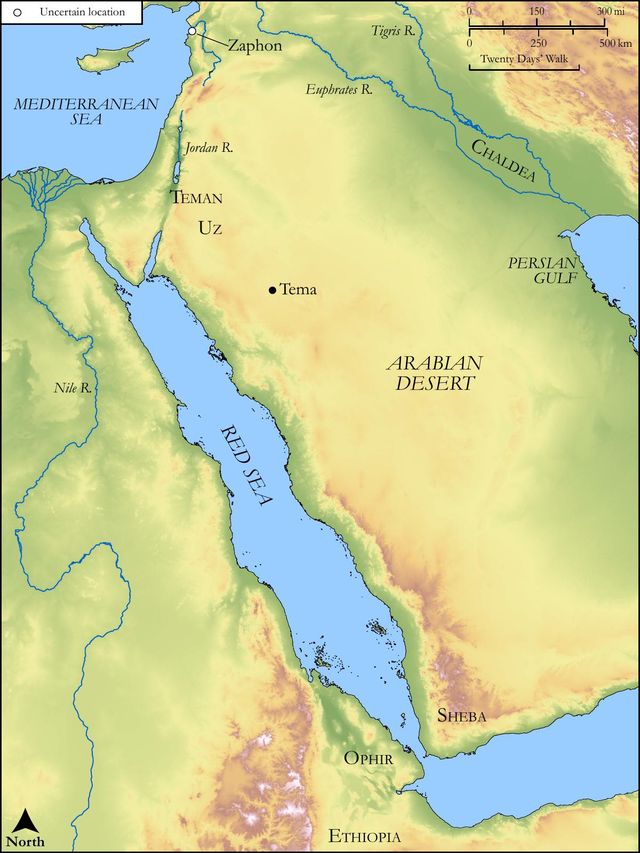
See on the biblical-era map
Study this verse
Public-domain commentary
Matthew Henry
From his Commentary on the Whole Bible. Henry comments on passages, not single verses — this entry covers Job 39:26–30.
The birds of the air are proofs of the wonderful power and providences of God, as well as the beasts of the earth; God here refers particularly to two stately ones: - 1. The hawk, a noble bird of great strength and sagacity, and yet a bird of prey, Job 39:26. This bird is here taken notice of for her flight, which is swift and strong, and especially for the course she steers towards the south, whither she follows the sun in winter, out of the colder countries in the north, especially when she is to cast her plumes and renew them. This is her wisdom, and it was God that gave her this wisdom, not man. Perhaps the extraordinary wisdom of the hawk's flight after her prey was not used then for men's diversion and recreation, as it has been since. It is a pity that the reclaimed hawk, which is taught to fly at man's command and to make him sport, should at any time be abused to the dishonour of God, since it is from God that she receives that wisdom which makes her flight entertaining and serviceable. 2. The eagle, a royal bird, and yet a bird of prey too, the permission of which, nay, the giving of power to which, may help to reconcile us to the prosperity of oppressors among men. The eagle is here taken notice of, (1.) For the height of her flight. No bird soars so high, has so strong a wind, nor can so well bear the light of the sun. Now, "Doth she mount at thy command? Job 39:27. Is it by any strength she has from thee? or dost thou direct her flight? No; it is by the natural power and instinct God has given her that she will soar out of thy sight, much more out of thy call." (2.) For the strength of her nest. Her house is her castle and strong-hold; she makes it on high and on the rock, the crag of the rock (Job 39:28), which sets her and her young out of the reach of danger. Secure sinners think themselves as safe in their sins as the eagle in her nest on high, in the clefts of the rock; but I will bring thee down thence, saith the Lord, Jer 49:16. The higher bad men sit above the resentments of the earth the nearer they ought to think themselves to the vengeance of Heaven. (3.) For her quicksightedness (Job 39:29): Her eyes behold afar off, not upwards, but downwards, in quest of her prey. In this she is an emblem of a hypocrite, who, while, in the profession of religion, he seems to rise towards heaven, keeps his eye and heart upon the prey on earth, some temporal advantage, some widow's house or other that he hopes to devour, under pretence of devotion. (4.) For the way she has of maintaining herself and her young. She preys upon living animals, which she seizes and tears to pieces, and thence carries to her young ones, which are taught to suck up blood; they do it by instinct, and know no better; but for men that have reason and conscience to thirst after blood is what could scarcely be believed if there had not been in every age wretched instances of it. She also preys upon the dead bodies of men: Where the slain are, there is she, These birds of prey (in another sense than the horse, Job 39:25) smell the battle afar off. Therefore, when a great slaughter is to be made among the enemies of the church, the fowls are invited to the supper of the great God, to eat the flesh of kings and captains, Rev 19:17, Rev 19:18. Our Saviour refers to this instinct of the eagle, Mat 24:28. Wheresoever the carcase is, there will the eagles be gathered together. Every creature will make towards that which is its proper food; for he that provides the creatures their food has implanted in them that inclination. These and many such instances of natural power and sagacity in the inferior creatures, which we cannot account for, oblige us to confess our own weakness and ignorance and to give glory to God as the fountain of all being, power, wisdom, and perfection.
Historical interpretation
Two Centuries of Reception
2 surviving comments on this verse. Each one is dated, so this reads as a timeline rather than a list.
Select a marker to jump to its quote. Markers stagger vertically where authors wrote within a few decades of each other.
How does God keep hawks hovering in the air? How does he provide them with nourishment? You can figure out all that he said from a small number of examples! Why did he not mention beefs or rams or other animals of this kind, but only those that are useless for us and seem to exist without reason? This is in order to show that if wisdom and providence appear in useful animals, they appear even more in those that seem to be useless, because you see that carnivorous birds of prey possess a certain reasonable wisdom that derives from the natural instinct living in each of them. So … some of them are inclined to fight, others scent the corpses, and the vulture remains still in the air.
92. That the hawk casts off its old feathers every year, as the new grow up, and gets a plumage without intermission, hardly any one is ignorant. But that time of plumage, when it is clothed in the nest, is not here spoken of; because, namely, at that time, being doubtless yet but young, it is not able to stretch its wings towards the South. But that annual plumage is described, which is renewed, as the old feathers become loose. And for domesticated hawks, moist and warm spots are sought out, for them to get their plumage the better. But it is the custom, with wild hawks, to stretch their wings, when the south wind blows, in order that by the mildness of the wind their limbs may become warm, so as to loosen the old feathers. But when there is no wind, they make for themselves a warm air by stretching and flapping their wings against the rays of the sun, and when the pores have thus been opened, either the old feathers fall out, or the new ones grow up. What is it then for the hawk to get its plumage in the south, except that every Saint glows, when he is touched by the breath of the Holy Spirit, and, casting off the habit of his old conversation, assumes the form of the new man? Which Paul advises, saying, Stripping yourselves of the old man with his deeds, and putting on the new man. [Col. 3, 9] And again; Though that outward man of ours be corrupted, yet that which is within is renewed day by day. [2 Cor. 4, 16] But to cast off the old feathers, is to give up the inveterate pursuit of crafty conduct; and to assume the new, is, by good living, to maintain a gentle and simple feeling. For the feather of old conversation weighs down, and the plumage of the new change raises up, to render it the lighter for flight, as it makes it newer.
93. And He well says, It stretches its wings towards the South. For to stretch out our wings towards the South, is, by the coming of the Holy Spirit, to open our hearts in confession, so as no longer to take pleasure in concealing ourselves by defence, but in exposing ourselves by accusation. The hawk, therefore, then gains its plumage, when it has stretched out its wings towards the South, because every one then clothes himself with the feathers of virtues, when, by confession, he subjects his thoughts to the Holy Spirit. For he, who lays not open his old deeds by confession, brings not forth the works of a new life. He who knows not how to lament that which weighs him down, is unable to produce that which raises him up. For the very power of compunction opens the pores of the heart, and pours forth the plumage of virtues. And, when the mind studiously convicts itself of a sluggish old age, it gains the fresh newness of youth. Let it be said then to blessed Job, Doth the hawk get plumage by thy wisdom, stretching her wings towards the South? That is, Hast thou conferred understanding on any of the Elect, to expand the wings of his thoughts, at the breath of the Holy Spirit, in order to cast off the weight of the old conversation, and assume the feathers of virtues for the purpose of a fresh flight? In order, namely, for him to gather from hence, that the vigilance of sense which is in him he has not of himself, who is unable to confer it from himself on others. But, by this hawk the renewed Gentile people can also be designated. As if it were plainly said to blessed Job; Behold the future plumage of virtues in the Gentiles, and cast off the old feathers of pride.
Continue studying Job 39:26 across the web’s major study libraries — every link below opens this exact verse, chapter, or book on the destination site.
Read & Compare
 BibleGatewayThis verse in more than 200 translations and 70 languages.
 Bible.comThe YouVersion reader — hundreds of translations, reading plans, and highlights.
 ESV.orgCrossway's official English Standard Version reader.
 NET BibleThe NET translation with 60,000+ translators' notes on every rendering decision.
 STEP BibleTyndale House's free study tool — original text, vocabulary, and scholarly resources.
 BibliaLogos Bible Software's free web reader.
 USCCBThe New American Bible (Revised Edition) with the U.S. bishops' study notes.
Commentaries
 BibleHub CommentariesDozens of classic commentaries on this verse, gathered on one page.
 StudyLightMore than 100 commentary sets — the largest collection on the web.
 BibleRefPlain-English commentary on what this verse means, verse by verse.
 Enduring WordDavid Guzik's free commentary on this chapter, widely used by Bible teachers.
 Bible Study ToolsVerse commentary alongside Greek and Hebrew study aids.
Original Language & Research
- BibleHub InterlinearThe verse word by word — original language, transliteration, and English.
- BibleHub LexiconEvery word's original-language definition and Strong's entry.
 Blue Letter BibleDeep-study tools — Strong's numbers, concordance, and word studies.
 SefariaThe Hebrew text with Rashi and centuries of Jewish commentary.
Sermons, Hymns & Audio


TrulyRandomVerse is not affiliated with these sites and doesn’t control their content. They’re linked because they’re genuinely useful.
Summary
Job 39:26 presents a profound rhetorical question from God to Job, challenging human wisdom and control by highlighting the divinely ordained, instinctual behavior of the hawk. As a pivotal part of God's majestic discourse from the whirlwind, this verse powerfully underscores the Creator's absolute sovereignty, intricate knowledge, and meticulous design over the natural world, humbling Job and all humanity by demonstrating that even the seemingly simple flight and migration of a bird are beyond human comprehension or direction, serving as an irrefutable testament to God's unparalleled and inscrutable wisdom.
Context
ShowHideLiterary Context
Job 39:26 is deeply embedded within God's climactic and extensive response to Job, which spans from Job 38:1 through chapter 41. Following Job's prolonged lamentations and his persistent questioning of divine justice, God does not offer a direct explanation for suffering but instead unveils His omnipotence and omniscience through a magnificent tour of creation. Each rhetorical question, including the one concerning the hawk, serves to illuminate the immense disparity between God's infinite wisdom and Job's finite understanding, thereby dismantling Job's presumption to judge the Almighty. The divine interrogation progresses from grand cosmic phenomena (light, darkness, the sea) to terrestrial wonders (snow, rain, ice) and then to the untamed animal kingdom, culminating in the detailed descriptions of Behemoth and Leviathan. The hawk's flight is a specific, tangible example within this broader argument for God's absolute dominion over all creation, demonstrating that even the most fundamental and seemingly simple natural instincts are meticulously programmed by divine wisdom.
Historical & Cultural Context
In the ancient Near East, birds of prey like the hawk were widely recognized for their remarkable swiftness, acute vision, and, notably, their predictable migratory patterns. The mention of "the south" (Hebrew: teiman) in this verse directly references the instinctual migration of birds towards warmer regions during colder seasons, a well-observed yet mysterious phenomenon to ancient observers. The rhetorical question, "Doth the hawk fly by thy wisdom?" directly challenges the prevailing anthropocentric view of knowledge and control. Unlike domesticated animals, wild creatures such as the hawk were perceived as truly free and untamed, making their predictable yet inexplicable behaviors even more awe-inspiring and indicative of a higher, ordering power. The ancient world, while keenly observing nature, lacked the scientific understanding of avian migration, thus attributing the hawk's journey solely to an incomprehensible divine wisdom, underscoring humanity's limited grasp of the natural world's intricate workings.
Key Themes
ShowHideThis verse powerfully contributes to several overarching themes central to the book of Job and the broader biblical narrative. Firstly, it profoundly illustrates Divine Wisdom and Omniscience. The hawk's innate ability to fly and its purposeful migration "toward the south" are presented as direct manifestations of God's intricate design and meticulous oversight. This demonstrates that His wisdom permeates every detail of creation, from the grandest cosmic structures to the smallest creature's instinct, echoing the praise found in Psalm 104:24. Secondly, it emphasizes Human Limitation and Humility. God's rhetorical question forces Job, and by extension, all humanity, to acknowledge the severe limits of human understanding and control. We cannot command the hawk, nor do we fully grasp the mechanisms of its instinctual journey, reinforcing the need for humility before the Creator, a theme powerfully articulated in Proverbs 3:5-7. Thirdly, the verse highlights God's Sovereignty Over Creation. The hawk's flight is not random or self-directed; it is guided by divine purpose and instinct. This underscores God's absolute dominion not only over humanity's affairs but over every aspect of His creation, reinforcing that He is the ultimate director and sustainer of all things, as beautifully depicted throughout Psalm 104.
Exposition and Analysis
ShowHideKey Word Analysis
ShowHideThe Hebrew word נֵץ (H5322, transliterated nêts') specifically refers to a hawk or falcon, a bird of prey renowned for its swift, powerful flight, exceptionally sharp vision, and predatory nature. In biblical literature, birds of prey often symbolize strength, speed, and sometimes, divine judgment or swift action. Here, the hawk's natural, instinctual behavior—its flight and migration—is presented as a phenomenon entirely outside human control or understanding, serving as a powerful example of God's sovereign design over the animal kingdom.
The Hebrew word בִּינָה (H998, transliterated bîynâh') denotes "understanding," "discernment," or "insight." It refers to the cognitive ability to comprehend, interpret, and make sense of complex information. God's question, "Doth the hawk fly by thy wisdom?" is a direct challenge to Job's (and humanity's) capacity for such profound understanding. It implies that the intricate, instinctual processes governing the hawk's flight and migration are far beyond human intellectual grasp or direction, belonging solely to God's infinite and unsearchable wisdom.
The Hebrew word כָּנָף (H3671, transliterated kânâph') refers to an "edge or extremity," specifically a "wing" of a bird. The act of "stretching her wings" (pâras kânâph) vividly describes the hawk's preparation for flight and its sustained movement. The inclusion of "wings" emphasizes the physical means by which the hawk executes its divinely programmed flight and migration, highlighting that even the very instruments of its movement are part of God's design, not subject to human command.
Verse Breakdown
ShowHide"Doth the hawk fly by thy wisdom"
This opening clause poses a direct and profoundly challenging rhetorical question to Job. It interrogates whether Job, with all his human wisdom and understanding, is the one who imparts the hawk its inherent ability to fly, or if he directs its flight path. The implied answer is a resounding "no," immediately establishing the vast, unbridgeable disparity between finite human knowledge and infinite divine omnipotence. It underscores that the very essence of the hawk's being and its fundamental actions are not a product of human design, instruction, or even full comprehension.
"and stretch her wings toward the south?"
This second clause specifies a particular, observable, and highly complex behavior of the hawk: its instinctual migratory journey southward. This seasonal movement is both purposeful and intricate, yet it occurs entirely autonomously from human command or intervention. The question further emphasizes that not only the ability to fly, but also the innate knowledge of direction and purpose in migration, is divinely endowed. It points to a deep, inherent programming within creation that operates independently of human will or comprehension, solely under God's meticulous superintendence and wisdom.
Literary Devices
ShowHideJob 39:26 primarily employs a powerful Rhetorical Question, a literary device where a question is posed not to elicit an answer, but to make a profound point or create a dramatic effect. By asking Job if the hawk flies by his wisdom, God underscores the obvious truth that it does not, thereby highlighting His own unparalleled wisdom and absolute sovereignty. This device serves to humble Job by exposing the severe limits of his knowledge and control compared to the Creator. Additionally, the verse uses vivid Imagery by evoking the majestic flight of the hawk and its purposeful journey southward. This imagery makes God's argument tangible and relatable, drawing on a common, observable phenomenon from the natural world to illustrate a profound theological truth about divine providence and the intricate order of creation. The hawk itself serves as a potent Symbol of wild, untamable nature, whose very existence and instinctual behavior are a constant testimony to a wisdom far surpassing human capacity.
Theological and Thematic Connections
ShowHideJob 39:26 stands as a powerful testament to God's absolute sovereignty and the profound limitations of human understanding. It asserts that the intricate order and instinctual behaviors observed throughout creation are not random occurrences or products of human design, but rather direct manifestations of divine wisdom and command. This truth serves to humble humanity, reminding us that our knowledge is finite and our control over the natural world is negligible. Just as God meticulously guides the hawk's migratory path, so too does He orchestrate the vast complexities of the cosmos and the intimate details of human life, often in ways that are far beyond our full comprehension. This verse invites us to cultivate a posture of profound humility and awe before the Creator, recognizing that His ways are infinitely higher than our ways, and His thoughts immeasurably deeper than our thoughts.
Reflection and Application
ShowHideJob 39:26 serves as a profound reminder that much of life, even the seemingly simple or routine, operates beyond our full comprehension or control. This verse encourages us to cultivate a deep sense of humility, recognizing that our knowledge and power are profoundly limited compared to God's infinite wisdom and omnipotence. In a world that often prizes human ingenuity, self-sufficiency, and the illusion of control, this passage calls us to a posture of awe, dependence, and trust in the Creator. Just as God guides the hawk in its intricate migratory flight with unseen wisdom, He also orchestrates the larger plan of our lives and the world, often through mysterious ways and an unseen hand. This understanding can bring immense peace and release from anxiety in situations we cannot control or fully comprehend, fostering a deeper trust in His perfect timing and sovereign will, even when circumstances are challenging or mysterious, much like Job experienced. It also invites us to marvel at the intricate beauty and order of the natural world, seeing it as a constant, living testimony to God's boundless wisdom, glory, and meticulous care for His creation, prompting us to worship the One who holds all things together by His powerful word.
Questions for Reflection
ShowHideFAQ
ShowHideWhy does God use examples from nature, like the hawk, to respond to Job's questioning?
ShowHideGod uses examples from nature, such as the hawk, throughout His discourse in Job 38-41 to powerfully demonstrate His unparalleled wisdom, boundless power, and absolute sovereignty over all creation. These examples are tangible, observable phenomena that Job (and indeed, all humanity) could readily see but could neither control nor fully comprehend. By pointing to the intricate design and instinctual behaviors of creatures like the hawk, God highlights the vast, unbridgeable chasm between His infinite knowledge and human limitations. He is essentially asking, "If you cannot even explain or direct the flight of a bird, how can you presume to understand or question My governance of the universe or My justice?" This approach serves to profoundly humble Job by revealing that the very world he inhabits operates by divine wisdom far beyond his grasp, thus shifting Job's focus from his personal suffering to the majestic, inscrutable nature of his Creator. It underscores that God's ways are beyond human scrutiny and His purposes are ultimately unfathomable, as eloquently expressed in Romans 11:33-36.
Christ-Centered Fulfillment
ShowHideWhile Job 39:26 speaks of God's inscrutable wisdom in creation, its ultimate fulfillment and deepest theological meaning are profoundly found in the person and work of Jesus Christ. The very divine wisdom that orchestrates the hawk's instinctual flight and guides its migratory path is perfectly embodied in the Son of God. Colossians 1:16-17 declares that "by him were all things created, that are in heaven, and that are in earth, visible and invisible... all things were created by him, and for him: And he is before all things, and by him all things consist." Thus, the intricate wisdom that programmed the hawk's instinctual journey is none other than Christ's wisdom. He is the active agent of creation and the divine sustainer of all things, upholding the entire universe by the word of His power (Hebrews 1:3). Furthermore, the profound humility demanded of Job in the face of God's incomprehensible wisdom finds its ultimate expression in Christ, who, though eternally God, "made himself of no reputation, and took upon him the form of a servant, and was made in the likeness of men" (Philippians 2:5-8). He is revealed as the "wisdom of God" (1 Corinthians 1:24), through whom we can begin to grasp the mysteries of God's creation and providence, not through our own limited understanding, but through faith and revelation in Him. The untamed hawk, flying by divine wisdom, beautifully foreshadows the untamable wisdom, sovereign power, and ultimate direction of Christ, who sovereignly directs all things for His glory and the good of His people.