


Job 39:25
Bible text: King James Version (1769 Blayney text) · Public domain
Bible text: Berean Standard Bible · Public domain
Bible text: American Standard Version (1901) · Public domain
Bible text: World English Bible, Messianic edition · Public domain
Bible text: Geneva Bible (1599) · Public domain
Bible text: Young's Literal Translation · Public domain
- בְּדֵיbe·Deiin [the] sufficiency ofH1767Prep-b ¦ N-mscNoun Singular Masculine Constructבְּinדֵי[the] sufficiency of
- שֹׁפָרsho·Fara hornH7782N-msNoun Singular Masculine Absolute
- יֹאמַרyo·Marit saysH559V-Qal-Imperf-3msVerb Qal Imperfect 3rd Singular Masculine
- הֶאָחhe·'Achaha!H1889PrtParticle Interjection
- וּמֵרָחוֹקU·me·ra·chokand from a distanceH7350Conj-w ¦ Prep-m ¦ Adj-msAdjective Singular Masculine Absoluteוּandמֵfromרָחוֹקa distance
- יָרִיחַya·Ri·achit smellsH7306V-Hiphil-Imperf-3msVerb Hiphil Imperfect 3rd Singular Masculine
- מִלְחָמָהmil·cha·MahbattleH4421N-fsNoun Singular Feminine Absolute
- רַעַםRa·'am[the] thunder ofH7482N-mscNoun Singular Masculine Construct
- שָׂרִיםSa·rimcommandersH8269N-mpNoun Plural Masculine Absolute
- וּתְרוּעָהu·te·ru·'Ahand [the] battle-cryH8643Conj-w ¦ N-fsNoun Singular Feminine Absoluteוּandתְרוּעָה[the] battle-cry
English is a literal word-by-word gloss of the Hebrew, not the KJV's wording. Why?
This is the original text the KJV's translators worked from — each Hebrew word with its own literal English meaning in this verse, prepared by scholars at Tyndale House, Cambridge. The KJV translates whole sentences, not word by word, so its wording differs: one Hebrew word can become several English words, and the KJV may choose “the LORD” where the gloss reads “Yahweh”. Both are faithful — they answer different questions. For the KJV's own rendering, switch to the KJV text.
Details
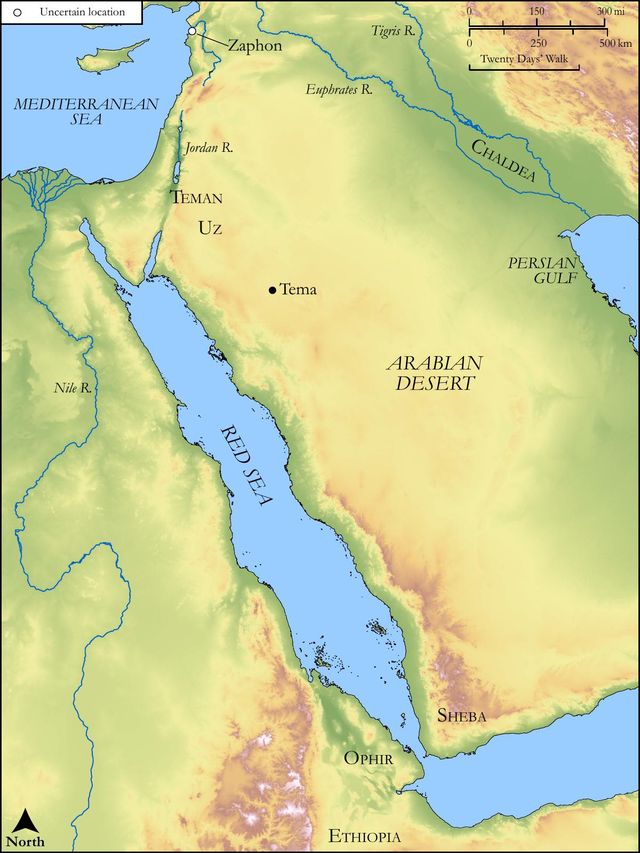
See on the biblical-era map
Study this verse
Public-domain commentary
Matthew Henry
From his Commentary on the Whole Bible. Henry comments on passages, not single verses — this entry covers Job 39:19–25.
God, having displayed his own power in those creatures that are strong and despise man, here shows it in one scarcely inferior to any of them in strength, and yet very tame and serviceable to man, and that is the horse, especially the horse that is prepared against the day of battle and is serviceable to man at a time when he has more than ordinary occasion for his service. It seems, there was, in Job's country, a noble generous breed of horses. Job, it is probable, kept many, though they are not mentioned among his possessions, cattle for use in husbandry being there valued more than those for state and war, which alone horses were then reserved for, and they were not then put to such mean services as with us they are commonly put to. Concerning the great horse, that stately beast, it is here observed, 1. That he has a great deal of strength and spirit (v. 19): Hast thou given the horse strength? He uses his strength for man, but has it not from him: God gave it to him, who is the fountain of all the powers of nature, and yet he himself delights not in the strength of the horse (Psa 147:10), but has told us that a horse is a vain thing for safety, Psa 33:17. For running, drawing, and carrying, no creature that is ordinarily in the service of man has so much strength as the horse has, nor is of so stout and bold a spirit, not to be made afraid as a grasshopper, but daring and forward to face danger. It is a mercy to man to have such a servant, which, though very strong, submits to the management of a child, and rebels not against his owner. But let not the strength of a horse be trusted to, Hos 14:3; Psa 20:7; Isa 31:1, Isa 31:3. 2. That his neck and nostrils look great. His neck is clothed with thunder, with a large and flowing mane, which makes him formidable and is an ornament to him. The glory of his nostrils, when he snorts, flings up his head, and throws foam about, is terrible, Job 39:20. Perhaps there might be at that time, and in that country, a more stately breed of horses than any we have now. 3. That he is very fierce and furious in battle, and charges with an undaunted courage, though he pushes on in imminent danger of his life. (1.) See how frolicsome he is (Job 39:21): He paws in the valley, scarcely knowing what ground he stands upon. He is proud of his strength, and he has much more reason to be so as using his strength in the service of man, and under his direction, than the wild ass that uses it in contempt of man, and in a revolt from him Job 39:8. (2.) See how forward he is to engage: He goes on to meet the armed men, animated, not by the goodness of the cause, or the prospect of honour, but only by the sound of the trumpet, the thunder of the captains, and the shouting of the soldiers, which are as bellows to the fire of his innate courage, and make him spring forward with the utmost eagerness, as if he cried, Ha! ha! Job 39:25. How wonderfully are the brute-creatures fitted for and inclined to the services for which they were designed. (3.) See how fearless he is, how he despises death and the most threatening dangers, (Job 39:22): He mocks at fear, and makes a jest of it; slash at him with a sword, rattle the quiver, brandish the spear, to drive him back, he will not retreat, but press forward, and even inspires courage into his rider. (4.) See how furious he is. He curvets and prances, and runs on with so much violence and heat against the enemy that one would think he even swallowed the ground with fierceness and rage, Job 39:24. High mettle is the praise of a horse rather than of a man, whom fierceness and rage ill become. This description of the war-horse will help to explain that character which is given of presumptuous sinners, Jer 8:6. Every one turneth to his course, as the horse rusheth into the battle. When a man's heart is fully set in him to do evil, and he is carried on in a wicked way by the violence of inordinate appetites and passions, there is no making him afraid of the wrath of God and the fatal consequences of sin. Let his own conscience set before him the curse of the law, the death that is the wages of sin, and all the terrors of the Almighty in battle-array; he mocks at this fear, and is not affrighted, neither turns he back from the flaming sword of the cherubim. Let ministers lift up their voice like a trumpet, to proclaim the wrath of God against him, he believes not that it is the sound of the trumpet, nor that God and his heralds are in earnest with him; but what will be in the end hereof it is easy to foresee.
Historical interpretation
Historical reception
2 surviving comments on this verse. Each one is dated, so this reads as a timeline rather than a list.
Concerning “the exhortation of the captains and the howling of the army,” the tempting vices that fight against us in invisible contest in behalf of the pride that reigns over them, some of them go first, like captains, others follow, after the manner of an army. For all faults do not occupy the heart with equal access. But while the greater and the few surprise a neglected mind, the smaller and the numberless pour themselves upon it in a whole body. For when pride, the queen of sins, has fully possessed a conquered heart, she surrenders it immediately to the seven principal sins, as if to some of her generals, to lay it waste. And an army in truth follows these generals, because doubtless there spring up from them importunate hosts of sins.
69. By which words this also is plainly shown, that, in this place, nothing is said by the Lord of the irrational horse. For a brute animal cannot say, ‘Vah;’ but while it is said to say that, which it is quite unable to say, it is pointed out whom it designates. For ‘Vah’ is a word of exultation. The horse, therefore, says ‘Vah,’ on hearing the trumpet, because every bold preacher, when he thinks the contest of suffering approaching, exults in the exercise of virtue: and is not alarmed at the peril of the contest, because he rejoices in the triumph of victory. For the horse, therefore, to say, ‘Vah,’ is for a holy preacher to rejoice in his approaching suffering. But if a bold preacher seeks the glory of suffering, if he seeks with joy to undergo the peril of death for the Lord’s sake; why is it that the Truth declared to Peter, that boldest preacher, who from his sturdy heart, adopted his virtue in his name; When thou shall be old, thou shall stretch forth thy hands, and another shall gird thee, and lead thee whither thou wouldest not? [John 21, 18] How does he rejoice in his suffering, who being girt by another, will not go whither he is led? But if we consider how the mind is shaken by the approach of suffering, and the fear of death, and yet rejoices at the coming reward of the kingdom, we understand how it is willingly unwilling to undergo the peril of a glorious contest: because it both considers in death what to endure and fear, and it beholds in the fruit of death what to long and seek for.
70. Let us see how Paul loves what he shrinks from, how he shrinks from what he loves. For he says, I have a desire to be dissolved, and to be with Christ. [Phil. 1, 23] And, To me to live is Christ, and to die is gain. [ib. 21] And yet he says, We that are in this tabernacle do groan, being burdened, not for that we would be unclothed, but clothed upon, that mortality might be swallowed up of life. [2 Cor. 5, 4] Behold he both longs to die, and yet is afraid of being stripped of the flesh. Why is this? Because, though victory makes him joyful for ever, punishment nevertheless disturbs him for the present: and though the love of the subsequent gift prevails, yet the blow of sorrow grazes the mind, not without pain. For as a bold man, when he girds himself with arms, as the strife of battle is now approaching, both palpitates, and is in haste, trembles, and is wroth; seems, through his paleness, as if afraid, but is urged on vehemently by his anger; in like manner a holy man, when he sees himself drawing near to his suffering, is both agitated by the weakness of his nature, and strengthened by the firmness of his hope; both trembles at approaching death, and yet exults at living, through his death, a truer life. For he cannot pass over to the kingdom, except by the intervention of death; and is therefore doubtful, as it were, in his confidence, and confident, as it were, in his doubts; both fears with joy, and rejoices with fear; because he knows that he cannot arrive at the prize of rest, without passing with labour that which intervenes. Thus we, when we wish to repel diseases from our body, take with sorrow, indeed, the bitter cup of purgation; but rejoice as being certain of subsequent health. For since our body cannot otherwise attain to health, we are pleased even with that which is offensive in the draught. And when the mind beholds that life dwells in the bitterness, it rejoices when agitated with sorrow. Let it be said then, when he heareth the trumpet, he saith, Vah; because a bold preacher, on hearing tidings of the contest, though, as a man, he trembles at the violence of persecution, yet, through the certainty of hope, exults at the reward of the recompense. But he would not remain unmoved at this contest of suffering, if he did not anticipate this same suffering by meditating intently in thought upon it. For an evil, which is anticipated by wisdom, is, by reason, overcome by the mind which is struggling against it. Because a person is less overcome by adversity the more he is found prepared against it, by knowing it beforehand. For a heavy burden of fear is frequently made lighter by habit. Death itself, as it frequently startles when unexpected, so does it give us joy when anticipated by deliberation. Whence it is also rightly subjoined concerning this horse;
He smelleth the battle afar off.
71. As if it were said more plainly; He overcomes in every contest whatsoever, because before the contest he prepares his mind for the contest. For to ‘smell the battle afar off,’ is so to foresee in thought misfortunes when yet far distant, that they may not, by being unexpected, be able to overcome him. Paul was admonishing his disciples to smell this battle afar off, when he was saying, Examine yourselves whether ye be in the faith, prove your own selves. [2 Cor. 13, 5] As if he were openly charging them, saying, Call to mind the contests of persecutions, and considering the inmost and secret thoughts of your hearts, discover, what ye are able to continue in the midst of sufferings. Holy men smell this battle from afar, when dwelling even in the peace of the Church Universal, they behold either contests with heretics, or the tortures of persecutions hanging over them from unbelievers. Who while they live uprightly, often receive evil for good, and bear contentedly the insults of detractions, in order that if an occasion of persecution should arise, their open enemies may find them the more resolute, the more the shafts of false brethren also within the Church overcome them not. For he, who falls from a state of patience before the wounds of tongues, witnesses for himself, that he stands not firm against the swords of open persecution. Because therefore a man of God, being exercised by present trials contends against future, and exercised by the smallest trials contends against greater; it is rightly said of the horse of God, that he smelleth the battle afar off. It follows;
The exhortation of the captains, and the howling of the army.
72. The captains of the adverse part are the authors of error, of whom it is said by the Psalmist, Contention is poured forth over their princes, and their vain things led them astray, and He caused them to wander in the pathless place, and not in the path. [Ps. 107, 40] Of whom the Truth says by Itself, If the blind lead the blind, both fall into the ditch. [Matt. 15, 14] But an army follows these captains, that is to say the crowd of the wicked, which obeys their unjust commands. It must also be observed, that He says that the captains exhort, and that the army howls; because, namely, they who rule over unbelievers or heretics enforce, as if by reason, the wicked practices they order to be observed. But the crowd subject to them, because it follows their commands without judgment, whilst it clamours through the madness of confusion, is said to howl with bestial mind. For howling properly belongs to wolves. And, because the bands of the reprobate are eager with rapacity alone, against the life and habits of the faithful, they shout as if with howling. The horse of God, therefore, smelleth afar off the exhortation of the captains, and the howling of the army, when each holy preacher considers long beforehand, either what the authors of errors are able to command against the Elect, or how fiercely the crowd which is subject to them can rage. Paul was smelling this exhortation of the captains, when saying, By sweet words and fair speeches they seduce the hearts of the innocent. [Rom. 16, 18] He was smelling this howling of the army, when saying, After my departure shall grievous wolves enter in among you. [Acts 20, 29] Peter had smelled out the exhortation of the captains, when he was warning the disciples against certain persons, saying, Through covetousness shall they with feigned words make merchandize of you. [2 Pet 2, 3] He was smelling the howling of the army, when he was premising, saying, And many will follow their lasciviousnesses, by whom the way of truth is evil spoken of. [ib. 2]
73. Because, therefore, we have related, what kind of person each holy preacher, and leader of the faith in the war of persecution, is able to display himself, let us now describe, under the figure of this horse, each single soldier of Christ: that he also, who considers that he has not yet arrived at the height of preaching, may yet know, that he is described by this voice of the Lord, if he has already begun to live aright; in order to infer from hence, how much he may be known to God, if he attain to greater things, if God omits not to speak of him significantly, even in his smallest deeds. Let us repeat, therefore, the particulars which have been mentioned of the horse, and make known how the soldier of God advances from his original conversation, how he increases, from the least to greater things, or by what steps he arrives from the lowest to the highest.
Continue studying Job 39:25 across the web’s major study libraries — every link below opens this exact verse, chapter, or book on the destination site.
Read & Compare
 BibleGatewayThis verse in more than 200 translations and 70 languages.
 Bible.comThe YouVersion reader — hundreds of translations, reading plans, and highlights.
 ESV.orgCrossway's official English Standard Version reader.
 NET BibleThe NET translation with 60,000+ translators' notes on every rendering decision.
 STEP BibleTyndale House's free study tool — original text, vocabulary, and scholarly resources.
 BibliaLogos Bible Software's free web reader.
 USCCBThe New American Bible (Revised Edition) with the U.S. bishops' study notes.
Commentaries
 BibleHub CommentariesDozens of classic commentaries on this verse, gathered on one page.
 StudyLightMore than 100 commentary sets — the largest collection on the web.
 BibleRefPlain-English commentary on what this verse means, verse by verse.
 Enduring WordDavid Guzik's free commentary on this chapter, widely used by Bible teachers.
 Bible Study ToolsVerse commentary alongside Greek and Hebrew study aids.
Original Language & Research
- BibleHub InterlinearThe verse word by word — original language, transliteration, and English.
- BibleHub LexiconEvery word's original-language definition and Strong's entry.
 Blue Letter BibleDeep-study tools — Strong's numbers, concordance, and word studies.
 SefariaThe Hebrew text with Rashi and centuries of Jewish commentary.
Sermons, Hymns & Audio


TrulyRandomVerse is not affiliated with these sites and doesn’t control their content. They’re linked because they’re genuinely useful.
Summary
Job 39:25 offers a breathtaking portrayal of the warhorse, showcasing its divinely instilled eagerness and acute senses for battle. This verse, embedded within God's profound discourse to Job, serves as a majestic illustration of divine omnipotence and meticulous design, emphasizing how even the wildness, ferocity, and instinctual responses of creation are perfectly orchestrated and sustained by God, far surpassing human understanding or control. It highlights the Creator's absolute sovereignty over all things, from the mightiest beast to the grandest conflict, designed to humble Job and underscore the vast chasm between human and divine wisdom.
Context
ShowHideLiterary Context
Job 39:25 is situated within the Lord's second major speech to Job, which commences in Job 38:1 and extends through Job 41:34. In this grand theological monologue, God challenges Job's limited human perspective and wisdom by unveiling a panoramic view of His creation, emphasizing His omnipotence, intricate design, and sovereign control over the natural world. Preceding the warhorse's description, God details various wild animals such as the lion, raven, wild goat, and wild ass, each serving as a testament to His unsearchable wisdom. The warhorse (Job 39:19-25) stands out as a creature of immense power, spirit, and beauty, presented as a prime example of God's engineering, whose very instincts are divinely instilled and perfectly suited for its purpose, far beyond human comprehension or ability to replicate. The ultimate aim is to humble Job, leading him to acknowledge the vast chasm between finite human understanding and infinite divine wisdom.
Historical & Cultural Context
Among the kings of that day, the warhorse was not merely an animal but a symbol of immense strategic importance and formidable power. Highly valued for its strength, speed, and courage, it was central to military might and frequently associated with kingship, divine favor, and national prestige. The training of warhorses was an arduous and highly skilled endeavor, requiring significant investment and expertise. However, the text here transcends human training, emphasizing that the horse's fundamental spirit, its inherent eagerness for battle, and its acute sensory perceptions are not merely products of human conditioning but are divinely imprinted characteristics. This highlights God's comprehensive control not only over the physical attributes of creation but also over the very instincts and dispositions of His creatures. The vivid imagery of "trumpets," "thunder of the captains," and "shouting" accurately reflects the sensory landscape of ancient warfare, where specific sounds served as crucial signals, igniting the horse's innate readiness for combat and demonstrating God's design even in the aural triggers of instinct.
Key Themes
ShowHideThis verse powerfully contributes to several overarching themes within the book of Job and the broader biblical narrative. Firstly, it profoundly underscores Divine Design and Instinct, illustrating that the warhorse's powerful instinct for battle, its enthusiastic response to the sounds of war ("Ha, ha"), and its ability to sense conflict from afar are not random occurrences but divinely imprinted characteristics, showcasing God's meticulous and purposeful design in creation. This theme is echoed in passages like Psalm 104:24, which marvels at the manifold wisdom of God's works. Secondly, the passage magnifies God's Majesty and Power. By describing such a magnificent and spirited creature, perfectly adapted for its formidable role, the passage implicitly magnifies the Creator. The warhorse's untamed spirit and eagerness for combat serve as a powerful metaphor for God's uncontainable power and wisdom, which far exceed human understanding or ability to replicate, a truth that humbles humanity and directs focus to the Almighty, as seen in Job 40:8-9. Finally, the vivid imagery emphasizes The Power of Sound to trigger profound, instinctual responses, a purpose instilled by the Maker. This divine orchestration of instinct highlights God's comprehensive sovereignty, even over the wild and seemingly untamable aspects of His creation, further challenging human pride and self-sufficiency.
Exposition and Analysis
ShowHideKey Word Analysis
ShowHideThis onomatopoeic exclamation (H1889) vividly captures the warhorse's excited snorting or neighing. It conveys a sense of triumph, eagerness, or defiant joy. It is not merely a sound but an expression of the horse's internal state—its unbridled spirit and innate enthusiasm for the impending conflict, a divinely programmed response to the signals of battle.
While literally meaning "to blow" or "breathe," and by extension "to smell" (H7306), in this context, it extends beyond mere olfactory perception to encompass a profound sensing or perceiving of the battle from a distance. It implies an acute, almost preternatural awareness and anticipation of the conflict, highlighting the horse's divinely endowed keen senses that enable it to discern the subtle cues of war long before humans might.
This term (H4421) refers to a specific engagement or, more generally, warfare. The warhorse's ability to "smell the battle afar off" underscores its inherent connection to conflict and its divinely appointed role within it, demonstrating its readiness for the very purpose for which it was created.
Verse Breakdown
ShowHide"He saith among the trumpets, Ha, ha;"
This clause personifies the warhorse, attributing human speech ("saith," from H559, 'âmar, "to say") to its vocalizations. The "trumpets" (H7782, shôwphâr) are the piercing signals of war, and the "Ha, ha" (H1889, heʼâch) is its enthusiastic, defiant, and eager response—a powerful snort or neigh that expresses its readiness and joy for the impending conflict. It illustrates the horse's immediate and passionate reaction to the call to battle, a divinely instilled instinct.
"and he smelleth the battle afar off,"
This emphasizes the warhorse's extraordinary sensory perception. The verb "smelleth" (H7306, rûwach) here signifies an acute, almost instinctual ability to sense the presence or approach of "battle" (H4421, milchâmâh) from a "far off" (H7350, râchôwq) distance, beyond what human senses could detect. This highlights its inherent preparedness and the depth of its divinely instilled instincts for its purpose.
"the thunder of the captains, and the shouting."
These phrases provide specific auditory cues that trigger the warhorse's profound response. "The thunder" (H7482, raʻam) of the "captains" (H8269, sar) refers to the authoritative commands, the deep, resonant sounds associated with military leaders, or the rumbling of chariots. "The shouting" (H8643, tᵉrûwʻâh) denotes the battle cries of soldiers, a clamor of acclamation or alarm. These sounds are not just noises to the horse; they are potent signals that ignite its very being and confirm the imminent engagement it so eagerly anticipates, revealing the intricate connection between God's design and the natural world's responses.
Literary Devices
ShowHideJob 39:25 is rich with literary devices that enhance its descriptive power and theological impact. Personification is strikingly evident in "He saith among the trumpets," attributing human speech and a conscious, joyful response to the warhorse, thereby emphasizing its spirited and almost volitional engagement with battle. The phrase "Ha, ha" functions as a powerful example of Onomatopoeia, directly imitating the sound of the horse's eager snort or neigh, immersing the reader in the sensory experience of the scene. The entire verse is a masterclass in Vivid Imagery, appealing to both auditory ("trumpets," "thunder of the captains," "shouting") and olfactory ("smelleth the battle") senses, creating a dynamic and immersive picture of the warhorse's anticipation and readiness. This sensory richness serves to underscore the profound and intricate design of God's creation, even in the raw, powerful instincts of a wild animal, highlighting a wisdom that transcends human comprehension.
Theological and Thematic Connections
ShowHideThe vivid depiction of the warhorse in Job 39:25 profoundly underscores God's intricate and awe-inspiring design in creation, particularly His sovereignty over the instincts and purposes of even the most powerful and untamed creatures. This passage serves to humble humanity, including Job, by showcasing a wisdom and power far beyond human comprehension or control. The horse's divinely instilled eagerness for battle, its acute senses, and its powerful response to the sounds of war are all testaments to a Creator who meticulously crafts every detail, ensuring each creature fulfills its intended role within the grand tapestry of His world. This challenges any notion of human autonomy or ultimate control, directing Job's (and our) focus back to the infinite majesty and wisdom of the Almighty, reinforcing the truth that God's ways are higher than our ways, and His thoughts than our thoughts.
Reflection and Application
ShowHideJob 39:25 invites us to pause and marvel at the incredible diversity, precision, and inherent purpose evident in God's creation, even in the raw, powerful instincts of an animal. Just as the warhorse is perfectly equipped by God for its unique and formidable purpose, this verse can serve as a profound reminder that God has also meticulously designed and equipped each person with specific gifts, inclinations, and a divine purpose. It calls us to a posture of deep humility, recognizing that God's wisdom and power, so vividly displayed in the natural world, are infinitely beyond our own understanding or ability to replicate. This awe-inspiring depiction of creation, particularly the warhorse's untamed spirit and eagerness, serves to humble Job—and us—before the infinite majesty and sovereignty of the Almighty, encouraging us to trust implicitly in God's comprehensive control over all things, even those aspects of life that seem chaotic or beyond our comprehension. It prompts us to consider how we might embrace the unique "design" God has placed within us, eagerly responding to His callings and purposes in our lives, rather than striving for control or questioning His ultimate plan.
Questions for Reflection
ShowHideFAQ
ShowHideWhat is the significance of the phrase "Ha, ha" in Job 39:25?
ShowHideThe phrase "Ha, ha" (Hebrew: הֶאָח, heʼâch) is an onomatopoeic exclamation that vividly captures the warhorse's enthusiastic snort or neigh. It signifies a profound sense of triumph, eagerness, and defiant joy in anticipation of battle. It's not merely a sound but an expression of the horse's divinely instilled, innate spirit and readiness for its purpose, highlighting its unbridled passion for the conflict. This unique vocalization underscores the horse's intrinsic connection to its role, a connection designed and sustained by God.
Why does God describe animals in such detail to Job, particularly the warhorse?
ShowHideGod's detailed descriptions of various wild animals, including the warhorse (Job 39:19-25), are central to His discourse aimed at humbling Job and demonstrating His incomprehensible wisdom, power, and sovereignty. The warhorse, a creature of immense strength, spirit, and untamed nature, serves as a powerful example of God's meticulous design and control over even the most formidable aspects of creation. By showcasing creatures whose instincts and power are beyond human understanding or control, God underscores the vast chasm between human wisdom and divine omnipotence, inviting Job (and us) to trust in His sovereign plan rather than questioning His justice or wisdom, as seen in Job 40:1-2. The descriptions highlight that if God can manage and sustain such wild and powerful creatures, He can certainly manage the complexities of human suffering and the universe.
Christ-Centered Fulfillment
ShowHideWhile Job 39:25 directly extols God's magnificent design in creation, particularly the warhorse's divinely instilled readiness for battle, it powerfully foreshadows aspects of Christ's character and mission. The warhorse's eager "Ha, ha" and its acute sensing of battle can be seen as a type of Christ's own divine zeal and perfect preparedness to accomplish the Father's will. Just as the horse is perfectly designed for its earthly purpose, Christ was perfectly designed and equipped for His redemptive mission, eagerly embracing the spiritual battle against sin and death. His unwavering resolve to go to Jerusalem and face the cross, as recounted in Luke 9:51, reflects a divine eagerness akin to the warhorse's anticipation of conflict. This intrinsic readiness culminated in His decisive victory over sin and death on the cross, a triumph foreshadowed by the horse's triumphant spirit. Ultimately, the warhorse's power and readiness for battle find their ultimate fulfillment in Christ as the conquering King, who will return on a white horse, leading the armies of heaven, to execute righteous judgment and establish His eternal reign, as vividly depicted in Revelation 19:11-16. He is the one whose "eyes are as a flame of fire, and on his head were many crowns," embodying the divine strength and purpose that the warhorse only dimly reflects, yet powerfully points to.