


Job 18:9
Bible text: King James Version (1769 Blayney text) · Public domain
Bible text: Berean Standard Bible · Public domain
Bible text: American Standard Version (1901) · Public domain
Bible text: World English Bible, Messianic edition · Public domain
Bible text: Geneva Bible (1599) · Public domain
Bible text: Young's Literal Translation · Public domain
- יֹאחֵזyo·Chezit takes holdH270V-Qal-Imperf-3msVerb Qal Imperfect 3rd Singular Masculine
- בְּעָקֵבbe·'a·Kevon a heelH6119Prep-b ¦ N-msNoun Singular Masculine Absoluteבְּonעָקֵבa heel
- פָּחPacha trapH6341N-msNoun Singular Masculine Absolute
- יַחֲזֵקya·cha·Zekit takes holdH2388V-Hiphil-Imperf-3msVerb Hiphil Imperfect 3rd Singular Masculine
- עָלָיו'a·Lavon himH5921Prep ¦ 3msPreposition Definiteעָלָיonוhim
- צַמִּיםtza·Mima snareH6782N-mpNoun Plural Masculine Absolute
English is a literal word-by-word gloss of the Hebrew, not the KJV's wording. Why?
This is the original text the KJV's translators worked from — each Hebrew word with its own literal English meaning in this verse, prepared by scholars at Tyndale House, Cambridge. The KJV translates whole sentences, not word by word, so its wording differs: one Hebrew word can become several English words, and the KJV may choose “the LORD” where the gloss reads “Yahweh”. Both are faithful — they answer different questions. For the KJV's own rendering, switch to the KJV text.
Details
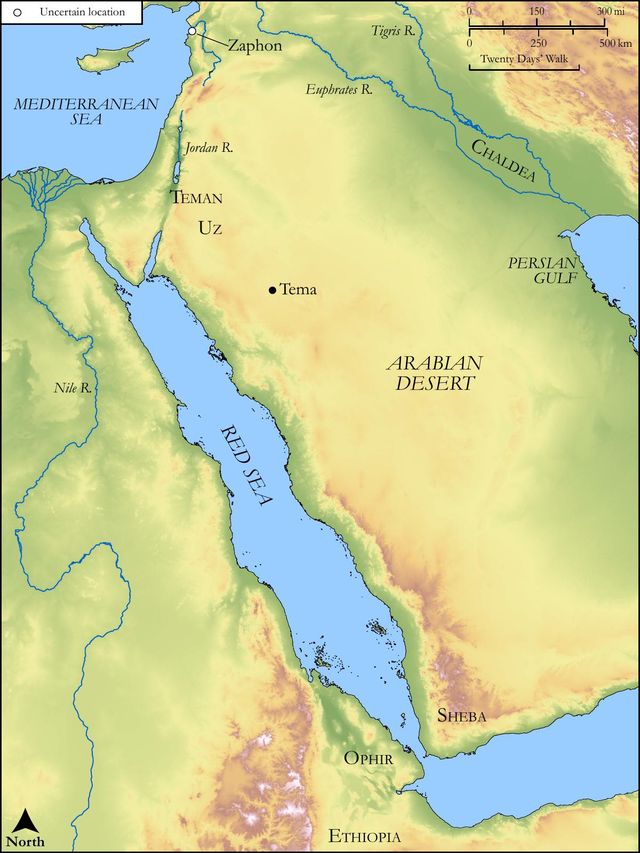
See on the biblical-era map
Study this verse
Public-domain commentary
Matthew Henry
From his Commentary on the Whole Bible. Henry comments on passages, not single verses — this entry covers Job 18:5–10. His three-level outline is real structure in the source text, so it is rendered as structure.
The rest of Bildad's discourse is entirely taken up in an elegant description of the miserable condition of a wicked man, in which there is a great deal of certain truth, and which will be of excellent use if duly considered - that a sinful condition is a sad condition, and that iniquity will be men's ruin if they do not repent of it. But it is not true that all wicked people are visibly and openly made thus miserable in this world; nor is it true that all who are brought into great distress and trouble in this world are therefore to be deemed and adjudged wicked men, when no other proof appears against them; and therefore, though Bildad thought the application of it to Job was easy, yet it was not safe nor just. In these verses we have,
I.The destruction of the wicked foreseen and foretold, under the similitude of darkness (Job 18:5, Job 18:6):
Yea, the light of the wicked shall be put out. Even his light, the best and brightest part of him, shall be put out; even that which he rejoiced in shall fail him. Or the yea may refer to Job's complaints of the great distress he was in and the darkness he should shortly make his bed in. "Yea," says Bildad, "So it is; thou art clouded, and straitened, and made miserable, and no better could be expected; for the light of the wicked shall be put out, and therefore thine shall." Observe here,
1.The wicked may have some light for a while, some pleasure, some joy, some hope within, as well as wealth, and honour, and power without. But his light is but a spark (Job 18:5), a little thing and soon extinguished. It is but a candle (Job 18:6), wasting, and burning down, and easily blown out. It is not the light of the Lord (that is sun-light), but the light of his own fire and sparks of his own kindling, Isa 50:11.
2.His light will certainly be put out at length, quite put out, so that not the least spark of it shall remain with which to kindle another fire. Even while he is in his tabernacle, while he is in the body, which is the tabernacle of the soul (Co2 5:1), the light shall be dark; he shall have no true solid comfort, no joy that is satisfying, no hope that is supporting. Even the light that is in him is darkness; and how great is that darkness! But, when he is put out of this tabernacle by death, his candle shall be put out with him. The period of his life will be the final period of all his days and will turn all his hopes into endless despair. When a wicked man dies his expectation shall perish, Pro 11:7. He shall lie down in sorrow.
II.The preparatives for that destruction represented under the similitude of a beast or bird caught in a snare, or a malefactor arrested and taken into custody in order to his punishment, Job 18:7-10.
1.Satan is preparing for his destruction. He is the robber that shall prevail against him (Job 18:9); for, as he was a murderer, so he was a robber, from the beginning. He, as the tempter, lays snares for sinners in the way, wherever they go, and he shall prevail. If he make them sinful like himself, he will make them miserable like himself. He hunts for the precious life.
2.He is himself preparing for his own destruction by going on in sin, and so treasuring up wrath against the day of wrath. God gives him up, as he deserves and desires, to his own counsels, and then his own counsels cast him down, Job 18:7. His sinful projects and pursuits bring him into mischief. He is cast into a net by his own feet (Job 18:8), runs upon his own destruction, is snared in the work of his own hands (Psa 9:16); his own tongue falls upon him, Psa 64:8. In the transgression of an evil man there is a snare.
3.God is preparing for his destruction. The sinner by his sin is preparing the fuel and then God by his wrath is preparing the fire. See here,
(1.)How the sinner is infatuated, to run himself into the snare; and whom God will destroy he infatuates.
(2.)How he is embarrassed: The steps of his strength, his mighty designs and efforts, shall be straitened, so that he shall not compass what he intended; and the more he strives to extricate himself the more will he be entangled. Evil men wax worse and worse.
(3.)How he is secured and kept from escaping the judgments of God that are in pursuit of him. The gin shall take him by the heel. He can no more escape the divine wrath that is in pursuit of him than a man, so held, can flee from the pursuer. God knows how to reserve the wicked for the day of judgment, Pe2 2:9.
Historical interpretation
Historical reception
2 surviving comments on this verse. Each one is dated, so this reads as a timeline rather than a list.
Select a marker to jump to its quote. Markers stagger vertically where authors wrote within a few decades of each other.
Bildad says these things using the metaphor of the birds or the animals that are captured in the hunt. In fact, as they can no longer escape after falling into snares and nets, so the impious are caught by inevitable calamities that overwhelm them. And what is worse, after all their schemes have been overturned and reversed, their riches are taken away from them not by the powerful but by people of the lowest class.
13. n that the end shall be made fast in sin. And because the enemy of mankind, when he binds up in sin the life of each individual, eagerly pants after his death, it is rightly added;
And thirst shall burn furiously against him.
14. For our old enemy, when he ensnares the life in sin, thirsts that he may drink the death of the sinner. Which however may also be understood in another sense. For the evil mind when it sees that it has been brought into sin, seeks with a certain superficialness of thought to escape out of the snares of sin; but fearing either the threats or reproaches of men, it chooses rather to die for ever, than to undergo a little of adversity for a season, whence it abandons itself wholly to evil ways, in which it perceives itself to be already once bound. And so he whose life is bound fast in sin even to the end, has his ‘heel held by the gin.’ But forasmuch as in the same degree that he minds that he is tied and bound with evil habits, he is in despair of his return, by that very despairing he henceforth kindles more fiercely to the lusts of this world, the heat of desire arises within him, and the mind having been ensnared by previous sins, is inflamed to even worse transgressions. And hence it is added; And thirst shall burn furiously against him. For in his mind there is a ‘thirst that burns out against him,’ in that in proportion as he is used to do wicked things, he is the more vehemently on fire to drink down evil. Since for the ungodly man to ‘thirst’ is to lust after the good things of this world. And hence our Redeemer cures the man with the dropsy before the Pharisee’s house, and when he was arguing against avarice, it is written, And the Pharisees also who were covetous heard all things; and they derided Him. [Luke 16, 14] What does it mean then that the man with the dropsy is cured before the house of the Pharisee, but that by the sickness of one man’s body the sickness of heart in another is represented? For one sick of a dropsy, the more he drinks, thirsts the more, and every covetous person redoubles his thirst by drinking, in that when he has got the things he desires, he pants the more in desiring others. For he that by getting is made to long for more, has his thirst increased by drinking.
Continue studying Job 18:9 across the web’s major study libraries — every link below opens this exact verse, chapter, or book on the destination site.
Read & Compare
 BibleGatewayThis verse in more than 200 translations and 70 languages.
 Bible.comThe YouVersion reader — hundreds of translations, reading plans, and highlights.
 ESV.orgCrossway's official English Standard Version reader.
 NET BibleThe NET translation with 60,000+ translators' notes on every rendering decision.
 STEP BibleTyndale House's free study tool — original text, vocabulary, and scholarly resources.
 BibliaLogos Bible Software's free web reader.
 USCCBThe New American Bible (Revised Edition) with the U.S. bishops' study notes.
Commentaries
 BibleHub CommentariesDozens of classic commentaries on this verse, gathered on one page.
 StudyLightMore than 100 commentary sets — the largest collection on the web.
 BibleRefPlain-English commentary on what this verse means, verse by verse.
 Enduring WordDavid Guzik's free commentary on this chapter, widely used by Bible teachers.
 Bible Study ToolsVerse commentary alongside Greek and Hebrew study aids.
Original Language & Research
- BibleHub InterlinearThe verse word by word — original language, transliteration, and English.
- BibleHub LexiconEvery word's original-language definition and Strong's entry.
 Blue Letter BibleDeep-study tools — Strong's numbers, concordance, and word studies.
 SefariaThe Hebrew text with Rashi and centuries of Jewish commentary.
Sermons, Hymns & Audio


TrulyRandomVerse is not affiliated with these sites and doesn’t control their content. They’re linked because they’re genuinely useful.
Summary
Job 18:9, spoken by Bildad the Shuhite, powerfully articulates the perceived inescapable doom of the wicked, employing the vivid imagery of a hunter's trap and an overwhelming assailant. It portrays the unrighteous as inevitably ensnared and overcome by adversity, reflecting Bildad's rigid adherence to a retributive theology where suffering is seen as a direct, punitive consequence of sin, and the wicked are destined for swift and comprehensive destruction.
Context
ShowHideLiterary Context
Job 18:9 is situated within Bildad's second discourse, a pointed and accusatory response to Job's profound lament in Job 17. Following Eliphaz's equally condemnatory second speech, Bildad intensifies the argument for conventional wisdom, asserting that God's unwavering justice ensures the wicked suffer, and their demise is an absolute certainty. Although Job is never explicitly named, Bildad's entire speech in Job 18 functions as a thinly veiled indictment, meticulously cataloging the myriad ways the unrighteous are undone—their light extinguished (Job 18:5-6), their dwelling annihilated (Job 18:15), and their memory erased (Job 18:17). Verse 9 specifically contributes to this grim catalogue of destruction by illustrating the sudden, deceptive, and unavoidable nature of their capture and defeat, serving as a concrete example of the universal principle of divine retribution that Bildad believes is irrevocably at play.
Historical & Cultural Context
The Book of Job is set in the ancient land of Uz, likely a region east of Palestine, suggesting a patriarchal society predating the Mosaic Law. Eliphaz, Bildad, and Zophar, Job's "friends," embody the dominant wisdom tradition of the men of the east, which frequently posited a direct, mechanistic correlation between righteousness and prosperity, and between wickedness and suffering. This "retribution theology" provided a common, albeit often oversimplified, framework for understanding divine justice. The imagery of a "gin" (a fowler's snare or trap) and a "robber" (an assailant or band of plunderers) would have been immediately comprehensible and deeply impactful in an agrarian and semi-nomadic society where hunting, trapping, and the constant threat of banditry were palpable dangers. The concept of being "taken by the heel" also carries significant cultural resonance, perhaps evoking the vulnerability of being tripped unexpectedly or caught unawares, a common tactic in ancient combat or hunting scenarios.
Key Themes
ShowHideThis verse, as part of Bildad's discourse, highlights several prominent themes, though from a perspective that the overarching narrative of Job ultimately challenges. The most central theme is the Inevitable Consequences of Wickedness, as Bildad adamantly asserts that divine justice will unfailingly bring about the downfall of the unrighteous. This is inextricably linked to Retribution Theology, the belief that God directly punishes sin with suffering and rewards righteousness with blessing—a view that the Book of Job systematically dismantles through Job's blameless suffering, as introduced in Job 1:1. The vivid imagery also underscores the theme of Traps and Snares, symbolizing the sudden, unforeseen, and inescapable nature of the wicked's doom, a concept echoed in other wisdom literature such as Proverbs 5:22 or Psalm 9:15. Finally, the "robber" signifies Overwhelming Adversity, suggesting that the wicked are utterly vulnerable to external forces that will ultimately overcome any resistance, symbolizing the relentless and irresistible nature of their impending destruction.
Exposition and Analysis
ShowHideKey Word Analysis
ShowHideThis term (H6341) refers to "a (metallic) sheet (as pounded thin); also a spring net (as spread out like a lamina); gin, (thin) plate, snare." It vividly describes a fowler's snare, a hidden trap designed to catch birds or small animals. The imagery emphasizes the sudden, unexpected, and inescapable nature of capture. It suggests that the wicked are caught entirely unawares, without any means of escape, much like an animal ensnared in a concealed trap, highlighting their vulnerability and the deceptive nature of the adversity that befalls them.
This word (H6119) means "a heel (as protuberant); hence, a track; figuratively, the rear (of an army); heel, (horse-) hoof, last, lier in wait, (foot-) step." The phrase "by the heel" (Hebrew: baʿăqēṿ) evokes the idea of being tripped, stumbled, or caught from behind. It signifies a swift, unexpected fall, often implying a position of vulnerability or being outmaneuvered. This imagery conveys pursuit and ensnarement, subtly echoing the narrative of Jacob, whose name is associated with "grasping the heel" or "supplanting" (Genesis 25:26).
This term (H6782) is derived from a root meaning "a noose (as fastening); figuratively, destruction; robber." While the KJV translates it as "robber," many modern translations (e.g., ESV, NIV, NASB) render it as "snare" or "noose," understanding it as a parallel term to "gin" (trap). This interpretation fits the strong parallelism of the verse, suggesting another type of binding or destructive device. If "robber" is maintained, it signifies an overwhelming, relentless, and destructive force that will overcome any resistance, reinforcing the idea of inevitable defeat and vulnerability to external, hostile powers.
Verse Breakdown
ShowHide"The gin shall take [him] by the heel"
This initial clause paints a stark picture of sudden and inescapable capture. The "gin," a hidden trap, symbolizes the unforeseen circumstances or divine judgment that ensnares the wicked. Being "taken by the heel" suggests that the wicked are caught off guard, tripped, or brought down from a position of apparent stability. This emphasizes their inherent vulnerability and the cunning, deceptive nature of their undoing, implying a swift and decisive capture from which there is no escape.
"[and] the robber shall prevail against him"
This second clause powerfully reinforces the inevitability of the wicked's downfall, adding a dimension of overwhelming force. Whether "robber" refers to a literal assailant or, more likely, another type of snare (as many modern translations suggest), it signifies an external, hostile power that is too strong to resist. The phrase "shall prevail against him" indicates a complete and decisive victory, where the wicked person's defenses are utterly overcome, leading to their ultimate defeat and destruction. This portrays a relentless and irresistible force that ensures their irreversible doom.
Literary Devices
ShowHideJob 18:9 is rich in Imagery, employing concrete pictures of a "gin" (snare) and a "robber" to convey abstract theological concepts of judgment and inevitability. The image of being "taken by the heel" is particularly vivid, suggesting a sudden, undignified, and unexpected fall. There is clear Parallelism between the two clauses, where the second clause ("the robber shall prevail against him") reinforces and expands upon the first ("the gin shall take him by the heel"). Both clauses describe an inescapable and overwhelming force leading to the wicked's downfall, creating a sense of poetic intensification and emphasizing the certainty of their fate. This verse also employs Metaphor, as the "gin" and "robber" are not literal entities but represent the various forms of adversity, judgment, or consequences that Bildad believes will inevitably befall the wicked. The overall effect is to create a powerful and terrifying portrayal of the unrighteous's ultimate fate.
Theological and Thematic Connections
ShowHideBildad's assertion in Job 18:9 reflects a common, yet ultimately flawed and simplistic, theological framework prevalent among the men of the east: a rigid retribution theology. He believes that God's justice operates on a straightforward cause-and-effect principle, where sin inevitably leads to suffering and destruction, and righteousness to blessing. While the broader biblical narrative affirms that sin does indeed have consequences and that God is just, the Book of Job profoundly challenges the simplistic and universal application of this principle, especially in the context of innocent suffering. Bildad's words, though harsh and misapplied to Job, do resonate with the broader biblical truth that those who persistently walk in rebellion against God's ways will ultimately face judgment and destruction. The imagery of being caught in a snare also connects to the idea that the wicked are often trapped by their own devices or the inescapable consequences of their own choices, rather than merely external forces.
Reflection and Application
ShowHideWhile we must critically evaluate Bildad's specific and erroneous application of this truth to Job's innocent suffering, Job 18:9 still carries a profound warning and offers an opportunity for deep spiritual reflection. It serves as a stark reminder that persistent rebellion against God's moral order and a life characterized by unrighteousness can indeed lead to self-inflicted harm, unforeseen consequences, and ultimately, divine judgment. The vivid imagery of the "gin" and "robber" speaks to the suddenness and overwhelming nature of such consequences, often catching individuals entirely off guard when they least expect it. This verse powerfully underscores the biblical principle that choices have profound consequences, and that true security and lasting peace are not found in human strength, cunning, or self-reliance, but in walking in humility, integrity, and obedience before God. For believers, this verse encourages a life of vigilance, sincere repentance, and unwavering reliance on God's abundant grace, rather than presuming upon His patience or attempting to outmaneuver the natural and spiritual laws He has established. It reminds us to pursue righteousness not out of a fearful avoidance of a "gin" or "robber," but out of a deep love, reverence, and gratitude for the Lord, trusting in His ultimate, perfect justice, which often unfolds in complex ways beyond our immediate comprehension.
Questions for Reflection
ShowHideFAQ
ShowHideDoes Job 18:9 mean that all suffering is a direct result of personal sin?
ShowHideNo, not necessarily. While Job 18:9, as part of Bildad's speech, strongly suggests a direct link between wickedness and suffering, the entire Book of Job serves to challenge and ultimately refute this simplistic "retribution theology." Job himself is presented as a righteous man who suffers immensely, demonstrating unequivocally that suffering is not always a direct punishment for personal sin (Job 1:1). While sin certainly has consequences, and God does bring judgment, Job's experience profoundly illustrates that God's ways are far more complex and mysterious than the friends' rigid framework allows. The verse reflects Bildad's limited and flawed perspective, not the full, nuanced biblical truth on the multifaceted nature of human suffering.
What is the significance of being "taken by the heel" in this verse?
ShowHideBeing "taken by the heel" signifies being caught unawares, tripped, or brought down from behind. It implies a sudden, unexpected, and often undignified downfall. This vivid imagery emphasizes the inherent vulnerability of the wicked and the cunning or unforeseen nature of the adversity that overtakes them. It suggests that their destruction is not something they can foresee or evade through their own strength or wisdom, but rather something that ambushes them when they least expect it, leading to a swift and decisive defeat from which there is no escape.
Christ-Centered Fulfillment
ShowHideWhile Job 18:9 graphically depicts the inevitable downfall of the wicked, its ultimate Christ-centered fulfillment is found not in the ensnarement of humanity, but in Christ's triumphant victory over the very forces that hold humanity captive. Humanity, caught in the "gin" of sin and under the tyrannical power of the "robber" of death and Satan, was utterly helpless and without hope. Yet, Jesus Christ, the perfectly righteous one, willingly allowed Himself to be "taken by the heel" on the cross, enduring the full, crushing weight of sin's consequences and death's sting (Isaiah 53:5). However, unlike the wicked described by Bildad, Christ did not succumb to the snare; rather, through His glorious resurrection, He decisively broke the power of the "gin" of death and utterly disarmed the "robber" (Satan) who held humanity captive through fear (Colossians 2:15). He became the ultimate deliverer, freeing those who were once enslaved by the fear of death and its dominion (Hebrews 2:14-15). Thus, for all who are in Christ, the "gin" and "robber" of sin and death no longer hold sway; instead, they find eternal refuge, security, and abundant life in the One who conquered all snares and overcame all adversaries, guaranteeing their ultimate triumph (John 10:28).