


Jeremiah 8:13
Bible text: King James Version (1769 Blayney text) · Public domain
Bible text: King James Version with Strong's numbers · Public domain
Bible text: Berean Standard Bible · Public domain
Bible text: American Standard Version (1901) · Public domain
Bible text: World English Bible, Messianic edition · Public domain
Bible text: Geneva Bible (1599) · Public domain
Bible text: Young's Literal Translation · Public domain
- אָסֹף'a·Sofsurely <gather>H622V-Qal-InfAbsVerb Qal Infinitive Absolute
- אֲסִיפֵם'a·si·FemI will make an end of themH5486V-Qal-Imperf-1cs ¦ 3mpVerb Qal Imperfect 1st Singular common genderאֲסִיפֵI will make an end ofםthem
- נְאֻםne·'um[the] utterance ofH5002N-mscNoun Singular Masculine Construct
- יְהֹוָהYah·wehYahwehH3068N-properNoun Proper Title
- אֵין'einthere notH369N-mscNoun Singular Masculine Construct
- עֲנָבִים'a·na·Vim[will be] grapesH6025N-mpNoun Plural Masculine Absolute
- בַּגֶּפֶןba·Ge·fenon the vineH1612Prep-b ¦ N-csNoun Singular common gender Absoluteבַּon theגֶּפֶןvine
- וְאֵיןve·'Einand there notH369Conj-w ¦ N-mscNoun Singular Masculine Constructוְandאֵיןthere not
- תְּאֵנִיםte·'e·Nim[will be] figsH8384N-mpNoun Plural Masculine Absolute
- בַּתְּאֵנָהba·te·'e·Nahon the fig treeH8384Prep-b ¦ N-fsNoun Singular Feminine Absoluteבַּon theתְּאֵנָהfig tree
- וְהֶעָלֶהve·he·'a·Lehand the leafageH5929Conj-w ¦ Art ¦ N-msNoun Singular Masculine Absoluteוְandהֶtheעָלֶהleafage
- נָבֵלna·Velit will witherH5034V-Qal-Perf-3msVerb Qal Perfect 3rd Singular Masculine
- וָאֶתֵּןva·'e·Tenand I gaveH5414Conj-w ¦ V-Qal-ConsecImperf-1csVerb Qal Consecutive Imperfect 1st Singular common genderוָandאֶתֵּןI gave
- לָהֶםla·Hemto <the> themPrep-l ¦ 3mpSuffix Personal 3rd Plural Masculineלָto <the>הֶםthem
- יַעַבְרוּםya·'av·Rumthey will pass away themH5674V-Qal-Imperf-3mp ¦ 3mpVerb Qal Imperfect 3rd Plural Masculineיַעַבְרוּthey will pass awayםthem
English is a literal word-by-word gloss of the Hebrew, not the KJV's wording. Why?
This is the original text the KJV's translators worked from — each Hebrew word with its own literal English meaning in this verse, prepared by scholars at Tyndale House, Cambridge. The KJV translates whole sentences, not word by word, so its wording differs: one Hebrew word can become several English words, and the KJV may choose “the LORD” where the gloss reads “Yahweh”. Both are faithful — they answer different questions. For the KJV's own rendering, switch to the KJV text.
Details
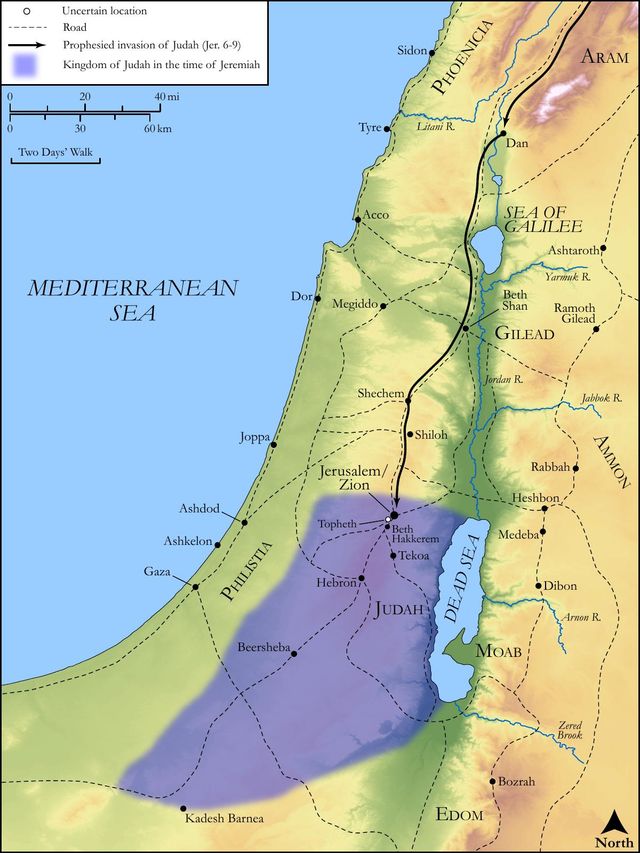
See on the biblical-era map
Study this verse
Public-domain commentary
Matthew Henry
From his Commentary on the Whole Bible. Henry comments on passages, not single verses — this entry covers Jeremiah 8:13–22. His three-level outline is real structure in the source text, so it is rendered as structure.
In these verses we have,
I.God threatening the destruction of a sinful people.
He has borne long with them, but they are still more and more provoking, and therefore now their ruin is resolved on: I will surely consume them (Jer 8:13), consuming I will consume them, not only surely, but utterly, consume them, will follow them with one judgment after another, till they are quite consumed; it is a consumption determined, Isa 10:23.
1.They shall be quite stripped of all their comforts (Jer 8:13): There shall be no grapes on the vine. Some understand this as intimating their sin; God came looking for grapes from this vineyard, seeking fruit upon this fig-tree, but he found none (as Isa 5:2, Luk 13:6); nay, they had not so much as leaves, Mat 21:19. But it is rather to be understood of God's judgments upon them, and may be meant literally - The enemy shall seize the fruits of the earth, shall pluck the grapes and figs for themselves and beat down the very leaves with them; or, rather, figuratively - They shall be deprived of all their comforts and shall have nothing left them wherewith to make glad their hearts. It is expounded in the last clause: The things that I have given them shall pass away from them. Note, God's gifts are upon condition, and revocable upon non-performance of the condition. Mercies abused are forfeited, and it is just with God to take the forfeiture.
2.They shall be set upon by all manner of grievances, and surrounded with calamities (Jer 8:17): I will send serpents among you, the Chaldean army, fiery serpents, flying serpents, cockatrices; these shall bite them with their venomous teeth, give them wounds that shall be mortal; and they shall not be charmed, as some serpents used to be, with music. These are serpents of another nature, that are not so wrought upon, or they are as the deaf adder, that stops her ear, and will not hear the voice of the charmer. The enemies are so intent upon making slaughter that it will be to no purpose to accost them gently, or offer any thing to pacify them, or mollify them, or to bring them to a better temper. No peace with God, therefore none with them.
II.The people sinking into despair under the pressure of those calamities.
Those that were void of fear (when the trouble was at a distance) and set it at defiance, are void of hope now that it breaks in upon them, and have no heart either to make head against it or to bear up under it, Jer 8:14. They cannot think themselves safe in the open villages: Why do we sit still here? Let us assemble, and go into a body into the defenced cities. Though they could expect no other than to be surely cut off there at last, yet not so soon as in the country, and therefore, "Let us go, and be silent there; let us attempt nothing, nor so much as make a complaint; for to what purpose?" It is not a submissive, but a sullen silence, that they here condemn themselves to. Those that are most jovial in their prosperity commonly despond most, and are most melancholy, in trouble. Now observe what it is that sinks them.
1.They are sensible that God is angry with them: "'The Lord our God has put us to silence, has struck us with astonishment, and given us water of gall to drink, which is both bitter and stupifying, or intoxicating. Psa 60:3, Thou hast made us to drink the wine of astonishment. We had better sit still than rise up and fall; better say nothing than say nothing to the purpose. To what purpose is it to contend with our fate when God himself has become our enemy and fights against us? Because we have sinned against the Lord, therefore we are brought to the plunge." This may be taken as the language,
(1.)Of their indignation. They seem to quarrel with God as if he had dealt hardly with them in putting them to silence, not permitting them to speak for themselves, and then telling them that it was because they had sinned against him. Thus men's foolishness perverts their way, and then their hearts fret against the Lord. Or rather,
(2.)Of their convictions. At length they begin to see the hand of God lifted up against them, and stretched out in the calamities under which they are now groaning, and to own that they have provoked him to contend with them. Note, Sooner or later God will bring the most obstinate to acknowledge both his providence and his justice in all the troubles they are brought into, to see and say both that it is his hand and that he is righteous.
2.They are sensible that the enemy is likely to be too hard for them, Jer 8:16. They are soon apprehensive that it is to no purpose to make head against such a mighty force; they and their people are quite dispirited; and, when the courage of a nation is gone, their numbers will stand them in little stead. The snorting of the horses was heard from Dan, that is, the report of the formidable strength of their cavalry was soon carried all the nation over and every body trembled at the sound of the neighing of his steeds; for they have devoured the land and all that is in the city; both town and country are laid waste before them, not only the wealth, but the inhabitants, of both, those that dwell therein. Note, When God appears against us, every thing else that is against us appears very formidable; whereas, if he be for us, every thing appears very despicable, Rom 8:31.
3.They are disappointed in their expectations of deliverance out of their troubles, as they had been surprised when their troubles came upon them; and this double disappointment very much aggravated their calamity.
(1.)The trouble came when they little expected it (Jer 8:15): We looked for peace, the continuance of our peace, but no good came, no good news from abroad; we looked for a time of health and prosperity to our nation, but, behold, trouble, the alarms of war; for, as it follows (Jer 8:16), the noise of the enemies' horses was heard from Dan. Their false prophets had cried Peace, peace, to them, which made it the more terrible when the scene of war opened on a sudden. This complaint will occur again, ch. 14:19.
(2.)The deliverance did not come when they had long expected it (Jer 8:20): The harvest is past, the summer is ended; that is, there is a great deal of time gone. Harvest and summer are parts of the year, and when they are gone the year draws towards a conclusion; so the meaning is, "One year passes after another, one campaign after another, and yet our affairs are in as bad a posture as ever they were; no relief comes, nor is any thing done towards it: We are not saved." Nay, there is a great deal of opportunity lost, the season of action is over and slipped, the summer and harvest are gone, and a cold and melancholy winter succeeds. Note, The salvation of God's church and people often goes on very slowly, and God keeps his people long in the expectation of it, for wise and holy ends. Nay, they stand in their own light, and put a bar in their own door, and are not saved because they are not ready for salvation.
4.They are deceived in those things which were their confidence and which they thought would have secured their peace to them (Jer 8:19): The daughter of my people cries, cries aloud, because of those that dwell in a far country, because of the foreign enemy that invades them, that comes from a far country to take possession of ours; this occasions the cry; and what is the cry? It is this: Is not the Lord in Zion? Is not her king in her? These were the two things that they had all along buoyed up themselves with and depended upon,
(1.)That they had among them the temple of God, and the tokens of his special presence with them. The common cant was, "Is not the Lord in Zion? What danger then need we fear?" And they held by this when the trouble was breaking in upon them. "Surely we shall do well enough, for have we not God among us?" But, when it grew to an extremity, it was an aggravation of their misery that they had thus flattered themselves.
(2.)That they had the throne of the house of David. As they had a temple, so they had a monarchy, jure divino - by divine right: Is not Zion's king in her? And will not Zion's God protect Zion's king and his kingdom? Surely he will; but why does he not? "What" (say they) "has Zion neither a God nor a king to stand by her and help her, that she is thus run down and likely to be ruined?" This outcry of theirs reflects upon God, as if his power and promise were broken or weakened; and therefore he returns an answer to it immediately: Why have they provoked me to anger with their graven images? They quarrel with God as if he had dealt unkindly by them in forsaking them, whereas they by their idolatry had driven him from them; they have withdrawn from their allegiance to him, and so have thrown themselves out of this protection. They fret themselves, and curse their king and their God (Isa 8:21), when it is their own sin that separates between them and God (Isa 59:2); they feared not the Lord, and then what can a king do for them? Hos 10:3.
III.We have here the prophet himself bewailing the calamity and ruin of his people; for there were more of the lamentations of Jeremiah than those we find in the book that bears that title. Observe here,
1.How great his griefs were. He was an eyewitness of the desolations of his country, and saw those things which by the spirit of prophecy he had foreseen. In the foresight, much more in the sight, of them, he cries out, "My heart is faint in me, I sink, I die away at the consideration of it, Jer 8:18. When I would comfort myself against my sorrow, I do but labour in vain; nay, every attempt to alleviate the grief does but aggravate it." It is our wisdom and duty, under mournful events, to do what we can to comfort ourselves against our sorrow, by suggesting to ourselves such considerations as are proper to allay the grief and balance the grievance. But sometimes the sorrow is such that the more it is repressed the more strongly it recoils. This may sometimes be the case of very good men, as of the prophet here, whose soul refused to be comforted and fainted at the cordial, Psa 77:2, Psa 77:3. He tells us (Jer 8:21) what was the matter: "It is for the hurt of the daughter of my people that I am thus hurt; it is for their sin, and the miseries they have brought upon themselves by it; it is for this that I am black, that I look black, that I go in black as mourners do, and that astonishment has taken hold on me, so that I know not what to do nor which way to turn." Note, The miseries of our country ought to be very much the grief of our souls. A gracious spirit will be a public spirit, a tender spirit, a mourning spirit. It becomes us to lament the miseries of our fellow-creatures, much more to lay to heart the calamities of our country, and especially of the church of God, to grieve for the affliction of Joseph. Jeremiah had prophesied the destruction of Jerusalem, and, though the truth of his prophecy was questioned, yet he did not rejoice in the proof of the truth of his prophecy was questioned, yet he did not rejoice in the proof of the truth of it by the accomplishment of it, preferring the welfare of his country before his own reputation. If Jerusalem had repented and been spared, he would have been far from fretting as Jonah did. Jeremiah had many enemies in Judah and Jerusalem, that hated, and reproached, and persecuted him; and in the judgments brought upon them God reckoned with them for it and pleaded his prophet's cause; yet he was far from rejoicing in it, so truly did he forgive his enemies and desire that God would forgive them.
2.How small his hopes were (Jer 8:22): "Is there no balm in Gilead - no medicine proper for a sick and dying kingdom? Is there no physician there - no skilful faithful hand to apply the medicine?" He looks upon the case to be deplorable and past relief. There is no balm in Gilead that can cure the disease of sin, no physician there that can restore the health of a nation quite overrun by such a foreign army as that of the Chaldeans. The desolations made are irreparable, and the disease has presently come to such a height that there is no checking it. Or this verse may be understood as laying all the blame of the incurableness of their disease upon themselves; and so the question must be answered affirmatively: Is there no balm in Gilead - no physician there? Yes, certainly there is; God is able to help and heal them, there is a sufficiency in him to redress all their grievances. Gilead was a place in their own land, not far off. They had among themselves God's law and his prophets, with the help of which they might have been brought to repentance, and their ruin might have been prevented. They had princes and priests, whose business it was to reform the nation and redress their grievances. What could have been done more than had been done for their recovery? Why then was not their health restored? Certainly it was not owing to God, but to themselves; it was not for want of balm and a physician, but because they would not admit the application nor submit to the methods of cure. The physician and physic were both ready, but the patient was wilful and irregular, would not be tied to rules, but must be humoured. Note, If sinners die of their wounds, their blood is upon their own heads. The blood of Christ is balm in Gilead, his Spirit is the physician there, both sufficient, all-sufficient, so that they might have been healed, but would not.
Historical interpretation
Historical reception
1 surviving comment on this verse from the historical church.
(Verse 13) I will gather them together, says the Lord. There are no grapes on the vines, and there are no figs on the fig tree; the leaf has fallen off, and I have given them what has passed by. The time of visitation, in which the transgressors will fall, is more clearly shown, saying: I will gather them together. Without a doubt, in Jerusalem, so that they will be besieged by the Chaldeans for a long time, and endure the evils of famine. When, he says, the seasons pass by, and summer turns into autumn, and the leaves of the trees fall in winter, you will see everything from afar, and from these things you will not obtain food. For there is no grape on your vines, from which you do not take the fruit (he will take): and there are no figs on the fig-tree, which the oppressed people sees the fruits of their trees devoured by enemies. The leaves, he says, will fall in the summer and autumn. For I have given them things that they would see passing by; and they would lose the abundance of all things with greater pain than they were not allowed to touch.
Continue studying Jeremiah 8:13 across the web’s major study libraries — every link below opens this exact verse, chapter, or book on the destination site.
Read & Compare
 BibleGatewayThis verse in more than 200 translations and 70 languages.
 Bible.comThe YouVersion reader — hundreds of translations, reading plans, and highlights.
 ESV.orgCrossway's official English Standard Version reader.
 NET BibleThe NET translation with 60,000+ translators' notes on every rendering decision.
 STEP BibleTyndale House's free study tool — original text, vocabulary, and scholarly resources.
 BibliaLogos Bible Software's free web reader.
 USCCBThe New American Bible (Revised Edition) with the U.S. bishops' study notes.
Commentaries
 BibleHub CommentariesDozens of classic commentaries on this verse, gathered on one page.
 StudyLightMore than 100 commentary sets — the largest collection on the web.
 BibleRefPlain-English commentary on what this verse means, verse by verse.
 Enduring WordDavid Guzik's free commentary on this chapter, widely used by Bible teachers.
 Bible Study ToolsVerse commentary alongside Greek and Hebrew study aids.
Original Language & Research
- BibleHub InterlinearThe verse word by word — original language, transliteration, and English.
- BibleHub LexiconEvery word's original-language definition and Strong's entry.
 Blue Letter BibleDeep-study tools — Strong's numbers, concordance, and word studies.
 SefariaThe Hebrew text with Rashi and centuries of Jewish commentary.
Sermons, Hymns & Audio


TrulyRandomVerse is not affiliated with these sites and doesn’t control their content. They’re linked because they’re genuinely useful.
Summary
Jeremiah 8:13 delivers a profound and severe prophetic declaration from the Lord, foretelling the complete and utter desolation of Judah as a consequence of their persistent rebellion. Through vivid agricultural metaphors, the prophecy illustrates a future devoid of sustenance and blessing: vines will bear no grapes, fig trees no figs, and even the leaves will wither, symbolizing a comprehensive spiritual and physical barrenness. This divine pronouncement underscores that all the good things God had graciously bestowed upon His covenant people—their land, prosperity, and unique identity—will be irrevocably stripped away, signifying a complete reversal of covenant blessings and the inevitable judgment for their profound unfaithfulness.
Context
ShowHideLiterary Context
Jeremiah 8:13 is embedded within a significant section of Jeremiah's prophecies (chapters 7-10), which directly challenges the people of Judah's misplaced confidence in the Temple and their superficial religious practices. This verse immediately follows Jeremiah's lament over Judah's spiritual sickness and their obstinate refusal to acknowledge God's truth, even as the shadow of impending destruction lengthens. It functions as a stark and definitive pronouncement of the judgment that awaits them, directly correlating their spiritual barrenness and lack of righteousness with the impending physical desolation of their land. The pervasive use of agricultural imagery throughout this passage is characteristic of Jeremiah's prophetic style, effectively illustrating profound spiritual realities through natural metaphors, thereby emphasizing the complete reversal of God's covenant blessings due to their persistent sin and idolatry.
Historical & Cultural Context
The prophetic message of Jeremiah 8:13 resonates within the turbulent historical landscape of the late 7th and early 6th centuries BCE, a period marked by Judah's decline towards Babylonian exile. Despite repeated and fervent warnings from prophets like Jeremiah, the populace—including their kings, priests, and false prophets—persisted in widespread idolatry, oppression, and a superficial adherence to the Mosaic Law. They erroneously placed their trust in precarious political alliances and the mere physical presence of the Temple in Jerusalem, believing in an inviolable divine protection over their city. In ancient Israel, grapes and figs were not merely staple crops but potent symbols of prosperity, divine blessing, and covenant faithfulness, as highlighted in passages like Deuteronomy 8:8. Consequently, the failure of these vital crops represented not only economic catastrophe but a profound spiritual curse, signifying the withdrawal of God's favor and mirroring the dire curses outlined in Deuteronomy 28.
Key Themes
ShowHideThis verse powerfully contributes to several overarching themes central to the book of Jeremiah. Foremost is the theme of Divine Judgment and Retribution, where God, as the righteous and sovereign judge, brings severe and just consequences upon His people for their profound covenant unfaithfulness. The vivid imagery of barrenness underscores the theme of Spiritual Barrenness and Futility, portraying Judah as a vine that has failed to yield the expected fruit of righteousness, thus rendering it deserving of being cut off and consumed. This directly relates to the pervasive theme of Covenant Disobedience and its Consequences, as the phrase "the things that I have given them shall pass away from them" directly references the forfeiture of the blessings of land, peace, and prosperity promised under the Mosaic Covenant, which were explicitly conditional upon obedience (see Leviticus 26). The passage emphatically highlights God's unwavering commitment to His covenant, demonstrating His faithfulness both in blessing and in executing judgment, and the ultimate futility of placing hope in anything other than genuine repentance and obedience in the face of persistent rebellion.
Exposition and Analysis
ShowHideKey Word Analysis
ShowHideA primitive root meaning "to snatch away, i.e. terminate; consume, have an end, perish, [idiom] be utterly." In Jeremiah 8:13, this word emphasizes the totality and finality of God's judgment. It signifies not merely a partial loss or a temporary setback but a complete removal, an absolute termination of Judah's status, blessings, and very existence as a productive nation in the land. The Lord's declaration is one of decisive, sovereign action, bringing an end to what once was.
A primitive root meaning "to wilt; generally, to fall away, fail, faint; figuratively, to be foolish or (morally) wicked; causatively, to despise, disgrace." This word vividly portrays the process of decay, decline, and ultimately, death. When applied to the leaf, it signifies the loss of vitality, beauty, and the life-sustaining capacity of the plant. Spiritually, it reflects Judah's profound moral and spiritual decay, leading to their eventual demise, disgrace, and utter worthlessness in the eyes of the nations and before God.
A primitive root meaning "to cross over; used very widely of any transition (literal or figurative; transitive, intransitive, intensive, causative); specifically, to cover (in copulation); alienate, alter... remove... take (away)... transgress." In this context, "pass away" signifies a complete and irreversible removal, a transition from possession to forfeiture. The blessings God had graciously given to His people will not merely diminish or be temporarily suspended; they will be utterly taken from them, highlighting the permanent and devastating nature of the judgment. It underscores a fundamental shift in their relationship with God and their privileged status.
Verse Breakdown
ShowHide"I will surely consume them, saith the LORD:"
This opening declaration establishes the divine origin and absolute certainty of the impending judgment. The phrase "saith the LORD" (Hebrew: nᵉʼum_ _Yᵉhôvâh' H5002, H3068) underscores that this is an authoritative oracle directly from Jehovah, the self-existent and covenant-keeping God. The emphatic repetition implied by "surely consume" (derived from H622 and H5486) highlights the absolute, comprehensive, and decisive nature of the destruction or removal that God intends to bring upon Judah. It is a declaration of sovereign, unyielding action against their rebellion.
"[there shall be] no grapes on the vine, nor figs on the fig tree,"
This segment introduces the central agricultural metaphor, depicting a scene of utter barrenness. Grapes (H6025) and figs (H8384) were quintessential symbols of prosperity, divine blessing, and the fruitfulness of the promised land. Their complete absence signifies a catastrophic reversal of all God's covenant blessings, leading to severe famine, economic ruin, and the devastating loss of national identity inextricably tied to the land's fertility. This physical desolation profoundly mirrors Judah's deep spiritual barrenness and unrighteousness.
"and the leaf shall fade;"
This clause extends and intensifies the agricultural metaphor, emphasizing decay, loss of vitality, and impending death. While fruit represents productivity and sustenance, the leaf (H5929) symbolizes vitality, health, and the very life of the plant. A fading leaf (H5034) indicates a tree that is dying, not merely unproductive. This imagery conveys the comprehensive nature of the judgment, affecting not just their output and sustenance but their very existence, health, and well-being as a nation.
"and [the things that] I have given them shall pass away from them."
This concluding clause summarizes the cumulative and devastating effect of the divine judgment. It refers to all the blessings, privileges, and inheritances that God had graciously bestowed upon Israel as His chosen people—the land (H5414), the covenant, the Temple, prosperity, security, and their unique identity. Their persistent unfaithfulness has led to the forfeiture of these divine gifts, signifying a complete loss of their privileged status and the withdrawal of God's protective and benevolent hand. The phrase "pass away" (H5674) indicates a permanent, irreversible removal, underscoring the finality of their judgment.
Literary Devices
ShowHideJeremiah 8:13 is replete with powerful literary devices that amplify its prophetic message and underscore the severity of God's judgment. The most prominent is Metaphor, where the nation of Judah is implicitly compared to a vine and a fig tree. The expected fruit, representing righteousness, obedience, and covenant faithfulness, is conspicuously absent, leading to the divine decision to "consume" or utterly destroy them. This agricultural imagery serves as potent Symbolism for spiritual barrenness and the withdrawal of divine blessing. Grapes and figs symbolize prosperity, abundance, and God's favor, while their absence symbolizes famine, judgment, and utter desolation. The declaration "I will surely consume them" employs Hyperbole to convey the absolute certainty, totality, and devastating scope of the impending destruction. The phrase "saith the LORD" functions as an Authoritative Pronouncement, lending divine weight, irrevocability, and unquestionable truth to the prophecy. The entire verse, through its vivid imagery and direct declaration, functions as a powerful Prophecy of Judgment, foretelling the dire consequences of Judah's persistent rebellion, specifically culminating in the Babylonian exile and the stripping away of their national identity and covenant blessings.
Theological and Thematic Connections
ShowHideJeremiah 8:13 profoundly articulates God's righteous judgment against persistent sin and unfaithfulness. It underscores the conditional nature of God's covenant blessings, demonstrating that while God is merciful and patient, His justice is an inherent and active part of His holy character. The stark imagery of barrenness reflects a deep theological truth: a people chosen by God, who consistently fail to bear the fruit of righteousness and obedience, will ultimately be stripped of their privileges and experience severe divine discipline. This passage highlights the devastating consequences of spiritual apostasy, where outward religious observance without inward transformation leads to utter desolation and the forfeiture of divine favor. It serves as a powerful and enduring reminder that God expects genuine fruit from His people, and that His gracious gifts, when abused, ignored, or taken for granted, can indeed be withdrawn.
Reflection and Application
ShowHideJeremiah 8:13 stands as a sobering and timeless warning to all who claim to be God's people, challenging us to move beyond superficial religiosity and to honestly examine the true fruit of our lives. Just as Judah's external rituals and temple worship could not mask their internal corruption and idolatry, so too can our outward expressions of faith be rendered meaningless if our hearts are far from God, lacking genuine transformation. This verse calls us to a radical self-assessment: Are we truly bearing the fruit of the Spirit—love, joy, peace, patience, kindness, goodness, faithfulness, gentleness, self-control—or are we spiritually barren, producing only the withered leaves of hypocrisy, complacency, and disobedience? The consequences of persistent rebellion against God's truth and His revealed will are severe, leading to a loss of divine favor and the very blessings He intends for us. This passage compels us to cultivate a vibrant, genuine faith, deeply rooted in obedient love for God and a sincere desire to honor Him in every aspect of our lives, lest we, too, experience a spiritual desolation where the "things that I have given them shall pass away."
Questions for Reflection
ShowHideFAQ
ShowHideWhat does the agricultural imagery of "no grapes on the vine, nor figs on the fig tree, and the leaf shall fade" signify?
ShowHideThis imagery is a powerful metaphor for complete desolation, famine, and the profound withdrawal of divine blessing. Grapes and figs were not just staple crops but potent symbols of prosperity, abundance, and God's covenant faithfulness in ancient Israel (e.g., Joel 2:22). Their complete absence signifies economic ruin, a reversal of God's promised abundance, and the loss of national identity tied to the land's fertility. The fading leaf further emphasizes decay, death, and the loss of vitality, indicating a comprehensive judgment that affects not just their produce but their very existence. Spiritually, it represents Judah's barrenness in righteousness and their failure to produce the expected fruit of obedience, despite their outward religious practices.
How does Jeremiah 8:13 relate to God's covenant with Israel?
ShowHideJeremiah 8:13 directly relates to God's covenant with Israel, particularly the Mosaic Covenant established at Sinai. Under this covenant, God promised abundant blessings, including a fruitful land, for obedience, and severe curses, such as famine and desolation, for disobedience. These conditions are explicitly outlined in passages like Leviticus 26 and Deuteronomy 28. The phrase "and the things that I have given them shall pass away from them" refers to the forfeiture of these covenant blessings—the land, prosperity, security, and their very status as God's chosen people—due to their persistent idolatry, oppression, and rebellion against the covenant stipulations. It powerfully demonstrates God's unwavering faithfulness to His covenant, even in executing its punitive clauses when His people prove unfaithful.
Christ-Centered Fulfillment
ShowHideJeremiah 8:13, with its stark imagery of a barren vine and a fading fig tree, finds profound Christ-centered fulfillment in the person and redemptive work of Jesus. While Jeremiah prophesied the judgment of a spiritually fruitless Israel, Jesus Himself came as the ultimate embodiment of Israel's purpose and the true vine. In John 15:1-6, Jesus declares, "I am the true vine, and my Father is the vinedresser." He warns that any branch (disciple) that does not bear fruit will be cut off and thrown away, directly echoing the judgment on barrenness seen in Jeremiah's prophecy. Furthermore, Jesus' dramatic cursing of the barren fig tree in Matthew 21:18-22 and Mark 11:12-25 serves as a powerful enacted parable of judgment against a religiously outwardly vibrant but spiritually fruitless Israel, a direct fulfillment and application of the prophetic warnings of the Old Testament. The "things that I have given them shall pass away from them" finds its ultimate historical expression in the destruction of Jerusalem and the Temple in AD 70, signifying the definitive end of the Old Covenant order and the transfer of God's blessings to those who are in Christ, who constitute the true Israel of God (Romans 9:6-8). Through Christ, a new and better covenant is established, where spiritual fruitfulness is made possible by abiding in Him, ensuring that those who are truly His will never be consumed or have His promised and eternal blessings pass away from them (Hebrews 8:6-13).