


Jeremiah 42:4
Bible text: King James Version (1769 Blayney text) · Public domain
Bible text: King James Version with Strong's numbers · Public domain
Bible text: Berean Standard Bible · Public domain
Bible text: American Standard Version (1901) · Public domain
Bible text: World English Bible, Messianic edition · Public domain
Bible text: Geneva Bible (1599) · Public domain
Bible text: Young's Literal Translation · Public domain
- וַיֹּאמֶרvai·Yo·merand he saidH559Conj-w ¦ V-Qal-ConsecImperf-3msVerb Qal Consecutive Imperfect 3rd Singular Masculineוַandיֹּאמֶרhe said
- אֲלֵיהֶם'a·lei·Hemto themH413Prep ¦ 3mpPreposition Definiteאֲלֵיtoהֶםthem
- יִרְמְיָהוּyir·me·Ya·huJeremiahH3414N-proper-mNoun Proper Masculine
- הַנָּבִיאha·na·Vi'the prophetH5030Art ¦ N-msNoun Singular Masculine Absoluteהַtheנָּבִיאprophet
- שָׁמַעְתִּיsha·Ma'·tiI have heardH8085V-Qal-Perf-1csVerb Qal Perfect 1st Singular common gender
- הִנְנִיhi·Nihere IH2005Prt ¦ 1csParticle InterjectionהִנְhereנִיI
- מִתְפַּלֵּלmit·pa·Lel[am] about to prayH6419V-Hithpael-Prtcpl-msVerb Hithpael Participle Singular Masculine Absolute
- אֶל'eltoH413PrepPreposition
- יְהוָהYah·wehYahwehH3068N-properNoun Proper Title
- אֱלֹהֵיכֶם'e·lo·hei·Khemyour GodH430N-mpc ¦ 2mpNoun Plural Masculine ConstructאֱלֹהֵיGodכֶםyour
- כְּדִבְרֵיכֶםke·div·rei·Khemaccording to your wordsH1697Prep-k ¦ N-mpc ¦ 2mpNoun Plural Masculine Constructכְּaccording toדִבְרֵיwordsכֶםyour
- וְהָיָהve·ha·Yahand it will beH1961Conj-w ¦ V-Qal-ConsecPerf-3msVerb Qal Consecutive Perfect 3rd Singular Masculineוְandהָיָהit will be
- כָּלkaleveryH3605N-mscNoun Singular Masculine Construct
- הַדָּבָרha·da·Var<the> wordH1697Art ¦ N-msNoun Singular Masculine Absoluteהַ<the>דָּבָרword
- אֲשֶׁר'a·SherwhichH834RelParticle Relative
- יַעֲנֶהya·'a·Nehhe will answerH6030V-Qal-Imperf-3msVerb Qal Imperfect 3rd Singular Masculine
- יְהוָהYah·wehYahwehH3068N-properNoun Proper Title
- אֶתְכֶם'et·Khem<obj.> youH853DirObjM ¦ 2mpParticle Object Indicatorאֶתְ<obj.>כֶםyou
- אַגִּיד'a·GidI will tellH5046V-Hiphil-Imperf-1csVerb Hiphil Imperfect 1st Singular common gender
- לָכֶםla·Khemto <the> youPrep-l ¦ 2mpSuffix Personal 2nd Plural Masculineלָto <the>כֶםyou
- לֹאlo'notH3808NegParticle Negative
- אֶמְנַע'em·Na'I will withholdH4513V-Qal-Imperf-1csVerb Qal Imperfect 1st Singular common gender
- מִכֶּםmi·Kemfrom <the> youPrep-m ¦ 2mpSuffix Personal 2nd Plural Masculineמִfrom <the>כֶּםyou
- דָּבָרda·Vara wordH1697N-msNoun Singular Masculine Absolute
English is a literal word-by-word gloss of the Hebrew, not the KJV's wording. Why?
This is the original text the KJV's translators worked from — each Hebrew word with its own literal English meaning in this verse, prepared by scholars at Tyndale House, Cambridge. The KJV translates whole sentences, not word by word, so its wording differs: one Hebrew word can become several English words, and the KJV may choose “the LORD” where the gloss reads “Yahweh”. Both are faithful — they answer different questions. For the KJV's own rendering, switch to the KJV text.
Details
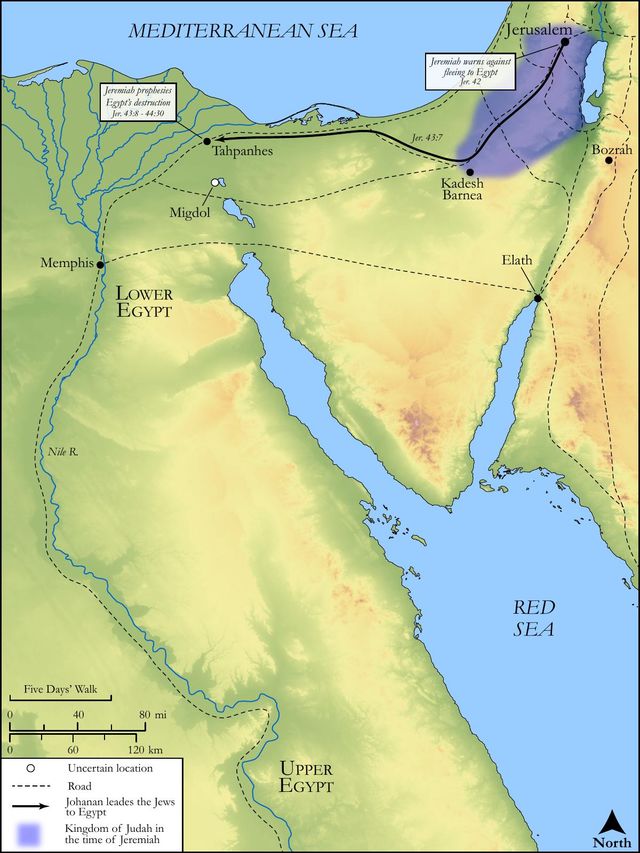
See on the biblical-era map
Study this verse
Public-domain commentary
Matthew Henry
From his Commentary on the Whole Bible. Henry comments on passages, not single verses — this entry covers Jeremiah 42:1–6. His two-level outline is real structure in the source text, so it is rendered as structure.
We have reason to wonder how Jeremiah the prophet escaped the sword of Ishmael; it seems he did escape, and it was not the first time that the Lord hid him. It is strange also that in these violent turns he was not consulted before now, and his advice asked and taken. But it should seem as if they knew not that a prophet was among them. Though this people were as brands plucked out of the fire, yet have they not returned to the Lord. This people has a revolting and a rebellious heart; and contempt of God and his providence, God and his prophets, is still the sin that most easily besets them. But now at length, to serve a turn, Jeremiah is sought out, and all the captains, Johanan himself not excepted, with all the people from the least to the greatest, make him a visit; they came near (Jer 42:1), which intimates that hitherto they had kept at a distance from the prophet and had been shy of him. Now here,
I.They desire him by prayer to ask direction from God what they should do in the present critical juncture, Jer 42:2, Jer 42:3. They express themselves wonderfully well.
1.With great respect to the prophet. Though he was poor and low, and under their command, yet they apply to him with humility and submissiveness, as petitioners for his assistance, which yet they intimate their own unworthiness of: Let, we beseech thee, our supplication be accepted before thee. They compliment him thus in hopes to persuade him to say as they would have him say.
2.With a great opinion of his interest in heaven: "Pray for us, who know not how to pray for ourselves. Pray to the Lord thy God, for we are unworthy to call him ours, nor have we reason to expect any favour from him." 3. With a great sense of their need of divine direction. They speak of themselves as objects of compassion: "We are but a remnant, but a few of many; how easily will such a remnant be swallowed up, and yet it is a pity that it should. Thy eyes see what distress we are in, what a plunge we are at; if thou canst do any thing, help us." 4. With desire of divine direction: "Let the Lord thy God take this ruin into his thoughts and under his hand, and show us the way wherein we may walk and may expect to have his presence with us, and the thing that we may do, the course we may take for our own safety." Note, In every difficult doubtful case our eye must be up to God for direction. They then might expect to be directed by a spirit of prophecy, which has now ceased; but we may still in faith pray to be guided by a spirit of wisdom in our hearts and the hints of Providence.
II.Jeremiah faithfully promises them to pray for direction for them, and, whatever message God should send to them by him, he would deliver it to them just as he received it without adding, altering, or diminishing, Jer 42:4. Ministers may hence learn,
1.Conscientiously to pray for those who desire their prayers: I will pray for you according to your words. Though they had slighted him, yet, like Samuel when he was slighted, he will not sin against the Lord in ceasing to pray for them, Sa1 12:23.
2.Conscientiously to advise those who desire their advice as near as they can to the mind of God, not keeping back any thing that is profitable for them, whether it be pleasing or no, but to declare to them the whole counsel of God, that they may approve themselves true to their trust.
III.They fairly promise that they will be governed by the will of God, as soon as they know what it is (Jer 42:5, Jer 42:6), and they had the impudence to appeal to God concerning their sincerity herein, though at the same time they dissembled: "The Lord be a true and faithful witness between us; do thou in the fear of God tell us truly what his mind is and then we will in the fear of God comply with it, and for this the Lord the Judge be Judge between us." Note, Those that expect to have the benefit of good ministers' prayers must conscientiously hearken to their preaching and be governed by it, as far as it agrees with the mind of God. Nothing could be better than this was: Whether it be good, or whether it be evil, we will obey the voice of the Lord our God, that it may be well with us.
1.They now call God their God, for Jeremiah had encouraged them to call him so (Jer 42:4): I will pray to the Lord your God. He is ours, and therefore we will obey his voice. Our relation to God strongly obliges us to obedience.
2.They promise to obey his voice because they sent the prophet to him to consult him. Note, We do not truly desire to know the mind of God if we do not fully resolve to comply with it when we do know it.
3.It is an implicit universal obedience that they here promise. They will do what God appoints them to do, whether it be good or whether it be evil: "Though it may seem evil to us, yet we will believe that if God command it it is certainly good, and we must not dispute it, but do it. Whatever God commands, whether it be easy or difficult, agreeable to our inclinations or contrary to them, whether it be cheap or costly, fashionable or unfashionable, whether we get or lose by it in our worldly interests, if it be our duty, we will do it." 4. It is upon a very good consideration that they promise this, a reasonable and powerful one, that it may be well with us, which intimates a conviction that they could not expect it should be well with them upon any other terms.
Continue studying Jeremiah 42:4 across the web’s major study libraries — every link below opens this exact verse, chapter, or book on the destination site.
Read & Compare
 BibleGatewayThis verse in more than 200 translations and 70 languages.
 Bible.comThe YouVersion reader — hundreds of translations, reading plans, and highlights.
 ESV.orgCrossway's official English Standard Version reader.
 NET BibleThe NET translation with 60,000+ translators' notes on every rendering decision.
 STEP BibleTyndale House's free study tool — original text, vocabulary, and scholarly resources.
 BibliaLogos Bible Software's free web reader.
 USCCBThe New American Bible (Revised Edition) with the U.S. bishops' study notes.
Commentaries
 BibleHub CommentariesDozens of classic commentaries on this verse, gathered on one page.
 StudyLightMore than 100 commentary sets — the largest collection on the web.
 BibleRefPlain-English commentary on what this verse means, verse by verse.
 Enduring WordDavid Guzik's free commentary on this chapter, widely used by Bible teachers.
 Bible Study ToolsVerse commentary alongside Greek and Hebrew study aids.
Original Language & Research
- BibleHub InterlinearThe verse word by word — original language, transliteration, and English.
- BibleHub LexiconEvery word's original-language definition and Strong's entry.
 Blue Letter BibleDeep-study tools — Strong's numbers, concordance, and word studies.
 SefariaThe Hebrew text with Rashi and centuries of Jewish commentary.
Sermons, Hymns & Audio


TrulyRandomVerse is not affiliated with these sites and doesn’t control their content. They’re linked because they’re genuinely useful.
Summary
Jeremiah 42:4 captures a pivotal moment of prophetic integrity as Jeremiah responds to the desperate plea of the Judean remnant. After the fall of Jerusalem and the assassination of Gedaliah, this vulnerable group seeks divine guidance concerning their future, promising obedience. Jeremiah, in turn, solemnly pledges to intercede on their behalf with the LORD their God and, crucially, commits to revealing the entirety of God's answer to them, promising to withhold no part of the divine message, regardless of its content or their potential reaction. This verse powerfully underscores Jeremiah's unwavering faithfulness to his prophetic calling and sets the stage for God's clear, though ultimately rejected, instruction.
Context
ShowHideLiterary Context
This verse serves as Jeremiah's direct and solemn reply to the remnant of Judah, who, following the assassination of Gedaliah by Ishmael (as detailed in Jeremiah 41:1-10), are gripped by fear of Babylonian reprisal. They approach Jeremiah, explicitly requesting him to "pray for us to the LORD your God" and making a seemingly sincere vow to "obey the voice of the LORD our God" (Jeremiah 42:2-3). Jeremiah 42:4 is his unequivocal acceptance of their request and, more significantly, his binding promise to deliver God's message without any alteration or omission. This pledge of transparency is critical, as it directly precedes the divine command not to go to Egypt and foreshadows the people's tragic disobedience, which unfolds immediately in Jeremiah 43, highlighting the stark contrast between Jeremiah's integrity and the remnant's duplicity.
Historical & Cultural Context
The historical backdrop for Jeremiah 42:4 is one of profound national trauma and existential uncertainty for the Judean remnant. Jerusalem has fallen, the Temple lies in ruins, and the majority of the population has been exiled to Babylon in 586 BCE. Those who remain are few, vulnerable, and living under the harsh reality of Babylonian imperial dominance. The recent assassination of Gedaliah, the Babylonian-appointed governor, has plunged them into even greater fear, anticipating further and possibly annihilating retribution from Babylon. In such a desperate and chaotic environment, seeking divine counsel through a recognized prophet like Jeremiah was a deeply ingrained cultural and religious practice. Prophets functioned as essential intermediaries, conveying God's will on matters ranging from personal conduct to national policy. The remnant's initial promise to obey, though ultimately broken, reflects the cultural expectation that divine pronouncements, once received, carried absolute authority and demanded implicit obedience.
Key Themes
ShowHideJeremiah 42:4 powerfully contributes to several overarching themes pervasive throughout the book of Jeremiah and the broader prophetic tradition. Firstly, it underscores Prophetic Integrity, showcasing Jeremiah's unwavering commitment to delivering God's word precisely as received, without fear, favor, or personal agenda. His solemn pledge to "keep nothing back" is a defining characteristic of a true prophet, standing in stark contrast to the pervasive problem of false prophets who often spoke "a vision of their own heart, and not out of the mouth of the LORD" (Jeremiah 23:16). Secondly, the verse highlights the critical theme of Seeking Divine Guidance in times of profound crisis. While the remnant's sincerity would later prove shallow, their initial appeal to Jeremiah demonstrates the universal human need for divine direction when confronted with overwhelming choices and an uncertain future. Lastly, it implicitly reveals God's Transparency and Faithfulness in His communication. Through His chosen prophet, God promises to reveal His will fully and clearly, emphasizing His desire for His people to know and understand His intentions, even when those intentions run counter to their own desires or perceived safety.
Exposition and Analysis
ShowHideKey Word Analysis
ShowHideMeaning "Jah will rise." The very name of the prophet is imbued with theological significance, pointing to God's active sovereignty and His ultimate vindication, even amidst the prophet's profound suffering and the nation's spiritual decline. It subtly reinforces Jeremiah's divine commission and the inherent authority behind his words, as he is one whom "Jah will rise" to speak on His behalf.
Referring to "(the) self-Existent or Eternal; Jehovah, Jewish national name of God." The use of this sacred covenant name (YHWH) emphasizes God's unchanging nature, His absolute sovereignty over all creation and human affairs, and His unique, personal relationship with Israel. Jeremiah is not praying to a generic deity but to the specific, covenant-keeping God of Israel, highlighting the immense weight and authoritative nature of the divine answer that is about to be revealed.
A primitive root meaning "to debar (negatively or positively) from benefit or injury; deny, keep (back), refrain, restrain, withhold." This phrase represents a powerful declaration of Jeremiah's unwavering commitment to complete transparency and fidelity to the divine message. It signifies that he will not filter, soften, omit, or alter any part of God's communication, regardless of how unpopular, difficult, or contrary to the people's desires it might prove to be. This absolute integrity is foundational to his authentic prophetic office.
Verse Breakdown
ShowHide"Then Jeremiah the prophet said unto them, I have heard [you];"
This opening clause establishes Jeremiah's immediate, direct, and empathetic response to the remnant's desperate plea. His affirmation, "I have heard [you]," conveys that he has attentively listened to their request for divine guidance, acknowledging their precarious situation and expressing a pastoral readiness to act on their behalf.
"behold, I will pray unto the LORD your God according to your words;"
Jeremiah explicitly states his intention to fulfill their request for intercession. The phrase "according to your words" underscores that his prayer will be specifically tailored to their expressed concerns and desires for guidance. His commitment to pray to "the LORD your God" reminds them of the enduring covenant relationship and the ultimate divine authority to whom they are appealing for their future.
"and it shall come to pass, [that] whatsoever thing the LORD shall answer you, I will declare [it] unto you;"
This is the core promise of prophetic mediation, laying out the process of divine communication. Jeremiah assures them that whatever divine message is received—"whatsoever thing" (Hebrew: dâbâr, encompassing word, matter, or message)—he will faithfully convey it. This highlights the prophet's essential role as a conduit, not a creator, of the divine message, emphasizing the certainty of God's response and Jeremiah's commitment to delivering it accurately.
"I will keep nothing back from you."
This concluding declaration is a powerful and solemn affirmation of Jeremiah's absolute prophetic integrity and transparency. It signifies that he will not withhold, alter, or soften any part of God's message, even if it is difficult, unpopular, or directly contradicts their preconceived notions or desires. This unequivocal pledge is crucial for establishing trust and validating the divine word that is about to be delivered, setting a standard for true prophecy.
Literary Devices
ShowHideJeremiah 42:4 primarily employs Direct Discourse, presenting Jeremiah's words verbatim, which immediately lends authority and authenticity to his solemn promise. His entire statement functions as a profound Pledge or Oath, emphasizing his unwavering commitment to his prophetic duty and the integrity of the divine message. The subtle yet significant Repetition of the concept of "words" or "thing" (Hebrew: dâbâr)—first in the people's request ("according to your words"), then in God's expected response ("whatsoever thing the LORD shall answer you"), and implicitly in Jeremiah's promise ("I will keep nothing back from you," referring to the dâbâr)—underscores the comprehensive nature of both the inquiry and the divine revelation. This repetition highlights that the entirety of the message will be received and delivered. Furthermore, the emphatic phrase "I will keep nothing back" serves as a powerful Antithesis to the deceptive practices of false prophets, clearly setting Jeremiah apart as a true and faithful messenger of the LORD.
Theological and Thematic Connections
ShowHideJeremiah 42:4 stands as a profound testament to the nature of true prophecy and the character of God's communication with humanity. It underscores the divine expectation for prophetic integrity—that God's messengers must deliver His word faithfully, without addition, subtraction, or alteration, regardless of personal cost or popular opinion. This commitment reflects God's own character as one who is truthful, transparent, and desires His people to know His will fully. It also highlights the inherent tension between human desire for a comfortable, self-serving answer and God's sovereign, often challenging, truth. The people's request, though seemingly pious, would ultimately expose their superficial commitment to obedience, a recurring theme in Israel's history that reveals the human tendency to seek divine validation for pre-determined paths rather than genuine submission.
Reflection and Application
ShowHideJeremiah's unwavering commitment in this verse offers profound and enduring lessons for believers today. In a world saturated with information, often lacking in genuine truth and integrity, Jeremiah's steadfastness stands as a powerful beacon. We are called to approach God's Word with the same earnestness with which Jeremiah sought it and the same humility and fidelity with which he delivered it. This means not only sincerely seeking God's will in our own lives, especially when facing fear, uncertainty, or difficult choices, but also being prepared to accept His answers fully, even when they challenge our comfort zones, contradict our desires, or demand a difficult, counter-cultural path. For those who teach, lead, or share their faith, Jeremiah's example is a powerful and convicting reminder to communicate God's truth without compromise, fear, or favor, ensuring that the full counsel of God is declared, not just the palatable or popular parts. Our spiritual growth and maturity are inextricably tied to our willingness to embrace the "whole counsel of God," not merely the portions we find agreeable or convenient.
Questions for Reflection
ShowHideFAQ
ShowHideWhy did the remnant specifically ask Jeremiah to pray for them, and what was their underlying motivation?
ShowHideThe remnant, led by Johanan, approached Jeremiah because he was a recognized and legitimate prophet of the LORD, known for faithfully delivering divine messages. They were in a desperate and fearful situation, anticipating severe Babylonian retribution after the assassination of Gedaliah, the governor appointed by Babylon. Their primary motivation was to seek divine guidance on whether they should flee to Egypt for safety, believing it was their only viable option. While they outwardly promised to obey whatever the LORD commanded (Jeremiah 42:2-3), their subsequent actions clearly reveal that their sincerity was conditional; they desired God's validation for a decision they had likely already made, rather than truly submitting to His sovereign will.
What does Jeremiah's promise, "I will keep nothing back from you," signify about his role as a prophet?
ShowHideJeremiah's promise to "keep nothing back" is a profound declaration of his prophetic integrity and unwavering fidelity to God's word. It signifies that he would deliver the divine message in its entirety, without filtering, softening, or omitting any part, regardless of how unpopular, challenging, or contrary to the people's desires it might be. This commitment was absolutely crucial for a true prophet, distinguishing him sharply from the numerous false prophets who often spoke only what the people wanted to hear or fabricated messages from their own imaginations (Jeremiah 23:16). It underscores that a true prophet is merely a messenger, a faithful conduit for God's unadulterated truth, whose primary loyalty is to the divine sender, not the human recipients.
Christ-Centered Fulfillment
ShowHideJeremiah's unwavering commitment to deliver God's "whole counsel" without keeping "nothing back" powerfully foreshadows the ultimate Prophet, Jesus Christ. While Jeremiah faithfully conveyed God's spoken word, Jesus is the very Word of God incarnate (John 1:1, John 1:14). He did not merely declare God's will; He perfectly embodied it, revealing the Father fully and completely in His person and ministry (John 14:9). Jesus held nothing back from humanity, not only in His teaching—proclaiming the challenging truths of the Kingdom, even when they were unpopular or demanded radical transformation (Matthew 5:17-48)—but also in His ultimate act of self-giving. He "did not shrink from declaring to you the whole purpose of God" (Acts 20:27, a sentiment perfectly fulfilled in Christ), culminating in His willingness to lay down His life on the cross, withholding nothing of Himself to accomplish redemption for a rebellious humanity (Philippians 2:5-8). Thus, Jeremiah's integrity as a faithful messenger points us to Christ, who is not just the messenger but the message itself, fully revealed and completely given for the salvation of the world.