


Isaiah 7:24
Bible text: King James Version (1769 Blayney text) · Public domain
Bible text: Berean Standard Bible · Public domain
Bible text: American Standard Version (1901) · Public domain
Bible text: World English Bible, Messianic edition · Public domain
Bible text: Geneva Bible (1599) · Public domain
Bible text: Young's Literal Translation · Public domain
- בַּחִצִּיםba·chi·Tzimwith <the> arrowsH2671Prep-b ¦ N-mpNoun Plural Masculine Absoluteבַּwith <the>חִצִּיםarrows
- וּבַקֶּשֶׁתu·va·Ke·shetand with <the> bowH7198Conj-w ¦ Prep-b ¦ N-fsNoun Singular Feminine Absoluteוּandבַwith <the>קֶּשֶׁתbow
- יָבוֹאYa·Vo'anyone will goH935V-Qal-Imperf-3msVerb Qal Imperfect 3rd Singular Masculine
- שָׁמָּהSha·mahthere <towards>H8033Adv ¦ SfxAdverbשָׁמָּthereה<towards>
- כִּיkiforH3588PrtParticle Conditional
- שָׁמִירsha·Mirthorn[s]H8068N-msNoun Singular Masculine Absolute
- וָשַׁיִתva·Sha·yitand bush[es]H7898Conj-w ¦ N-msNoun Singular Masculine Absoluteוָandשַׁיִתbush[es]
- תִּהְיֶהtih·Yehit will beH1961V-Qal-Imperf-3fsVerb Qal Imperfect 3rd Singular Feminine
- כָלkholallH3605N-mscNoun Singular Masculine Construct
- הָאָרֶץha·'A·retzthe landH776Art ¦ N-fsNoun Singular Feminine Absoluteהָtheאָרֶץland
English is a literal word-by-word gloss of the Hebrew, not the KJV's wording. Why?
This is the original text the KJV's translators worked from — each Hebrew word with its own literal English meaning in this verse, prepared by scholars at Tyndale House, Cambridge. The KJV translates whole sentences, not word by word, so its wording differs: one Hebrew word can become several English words, and the KJV may choose “the LORD” where the gloss reads “Yahweh”. Both are faithful — they answer different questions. For the KJV's own rendering, switch to the KJV text.
Details
See on the biblical-era map
Study this verse
Public-domain commentary
Matthew Henry
From his Commentary on the Whole Bible. Henry comments on passages, not single verses — this entry covers Isaiah 7:17–25. His three-level outline is real structure in the source text, so it is rendered as structure.
After the comfortable promises made to Ahaz as a branch of the house of David, here follow terrible threatenings against him, as a degenerate branch of that house; for though the loving-kindness of God shall not be utterly taken away, for the sake of David and the covenant made with him, yet his iniquity shall be chastened with the rod, and his sin with stripes. Let those that will not mix faith with the promises of God expect to hear the alarms of his threatenings.
I.The judgment threatened is very great, Isa 7:17.
It is very great, for it is general; it shall be brought upon the prince himself (high as he is, he shall not be out of the reach of it), and upon the people, the whole body of the nation, and upon the royal family, upon all thy father's house; it shall be a judgment entailed on posterity, and shall go along with the royal blood. It is very great, for it shall be unprecedented - days that have not come; so dark, so gloomy, so melancholy, as never were the like since the revolt of the ten tribes, when Ephraim departed from Judah, which was indeed a sad time to the house of David. Note, The longer men continue in sin the sorer punishments they have reason to expect. It is the Lord that will bring these days upon them, for our times are in his hand, and who can resist or escape the judgments he brings?
II.The enemy that should be employed as the instrument of this judgment is the king of Assyria.
Ahaz reposed great confidence in that prince for help against the confederate powers of Israel and Syria, and minded the less what God said to him by his prophet for his encouragement because he built much upon his interest in the king of Assyria, and had meanly promised to be his servant if he would send him some succours; he had also, made him a present of gold and silver, for which he drained the treasures both of church and state, Kg2 16:7, Kg2 16:8. Now God threatens that that king of Assyria whom he made his stay instead of God should become a scourge to him. He was so speedily; for, when he came to him, he distressed him, but strengthened him not (Ch2 28:20), the reed not only broke under him, but ran into his hand, and pierced it, and thenceforward the kings of Assyria were, for a long time, grieving thorns to Judah, and gave them a great deal of trouble. Note, The creature that we make our hope commonly proves our hurt. The king of Assyria, not long after this, made himself master of the ten tribes, carried them captive, and laid their country waste, so as fully to answer the prediction here; and perhaps it may refer to that, as an explication of Isa 7:8, where it is foretold that Ephraim shall be broken, that it shall not be a people; and it is easy to suppose that the prophet (at Isa 7:17) turns his speech to the king of Israel, denouncing God's judgments against him for invading Judah. But the expositors universally understand it of Ahaz and his kingdom. Now observe,
1.Summons given to the invaders (Isa 7:18): The Lord shall whistle for the fly and the bee. See Isa 5:26. Enemies that seem as contemptible as a fly or a bee, and are as easily crushed, shall yet, when God pleases, do his work as effectually as lions and young lions. Though they are as far distant from one another as the rivers of Egypt and the land of Assyria, yet they shall punctually meet to join in this work when God commands their attendance; for, when God has work to do, he will not be at a loss for instruments to do it with.
2.Possession taken by them, Isa 7:19. It should seem as if the country were in no condition to make resistance. They find no difficulties in forcing their way, but come and rest all of them in the desolate valleys, which the inhabitants had deserted upon the first alarm, and left them a cheap and easy prey to the invaders. They shall come and rest in the low grounds like swarms of flies and bees, and shall render themselves impregnable by taking shelter in the holes of the rocks, as bees often do, and showing themselves formidable by appearing openly upon all thorns and all bushes; so generally shall the land be overspread with them. These bees shall knit upon the thorns and bushes, and there rest undisturbed.
3.Great desolations made, and the country generally depopulated (Isa 7:20): The Lord shall shave the hair of the head, and beard, and feet; he shall sweep all away, as the leper, when he was cleansed, shaved off all his hair, Lev 14:8, Lev 14:9. This is done with a razor which is hired, either which God has hired (as if he had none of his own; but what he hires, and whom he employs in any service for him, he will pay for. See Eze 29:18, Eze 29:19), or which Ahaz has hired for his assistance. God will make that to be an instrument of his destruction which he hired into his service. Note, Many are beaten with that arm of flesh which they trusted to rather than to the arm of the Lord, and which they were at a great expense upon, when by faith and prayer they might have found cheap and easy succour in God.
4.The consequences of this general depopulation.
(1.)The flocks of cattle shall be all destroyed, so that a man who had herds and flocks in abundance shall be stripped of them all by the enemy, and shall with much ado save for his own use a young cow and two sheep - a poor stock (Isa 7:21), yet he shall think himself happy in having any left.
(2.)The few cattle that are left shall have such a large compass of ground to feed in that they shall give abundance of milk, and very good milk, such as shall produce butter enough, Isa 7:22. There shall also be such want of men that the milk of one cow and two sheep shall serve a whole family, which used to keep abundance of servants and consume a great deal, but is now reduced.
(3.)The breed of cattle shall be destroyed; so that those who used to eat flesh ( as the Jews commonly did) shall be necessitated to confine themselves to butter and honey, for there shall be no flesh for them; and the country shall be so depopulated that there shall be butter and honey enough for the few that are left in it.
(4.)Good land, that used to be let well, shall be all overrun with briers and thorns (Isa 7:23); where there used to be a thousand vines planted, for which the tenants used to pay a thousand shekels, or pieces of silver, yearly rent, there shall be nothing now but briers and thorns, no profit either for landlord or tenant, all being laid waste by the army of the invaders. Note, God can soon turn a fruitful land into barrenness; and it is just with him to turn vines into briers if we, instead of bringing forth grapes to him, bring forth wild grapes, Isa 5:4.
(5.)The implements of husbandry shall be turned into instruments of war, Isa 7:24. The whole land having become briers and thorns, the grounds that men used to come to with sickles and pruning-hooks to gather in the fruits they shall now come to with arrows and bows, to hunt for wild beasts in the thickets, or to defend themselves from the robbers that lurk in the bushes, seeking for prey, or to kill the serpents and venomous beasts that are hid there. This denotes a very sad change of the face of that pleasant land. But what melancholy change is there which sin will not make with a people?
(6.)Where briers and thorns were wont to be of use and to do good service, even in the hedges, for the defence of the enclosed grounds, they shall be plucked up, and all laid in common. There shall be briers and thorns in abundance where they should not be, but none where they should be, Isa 7:25. The hills that shall be digged with the mattock, for special use, from which the cattle used to be kept off with the fear of briers and thorns, shall now be thrown open, the hedges broken down for the boar out of the wood to waste it, Psa 80:12, Psa 80:13. It shall be left at large for oxen to run in and less cattle. See the effect of sin and the curse; it has made the earth a forest of thorns and thistles, except as it is forced into some order by the constant care and labour of man. And see what folly it is to set our hearts upon possessions of lands, be they every so fruitful, ever so pleasant; if they lie ever so little neglected and uncultivated, or if they be abused by a wasteful careless heir or tenant, or the country be laid waste by war, they will soon become frightful deserts. Heaven is a paradise not subject to such changes.
Historical interpretation
Historical reception
1 surviving comment on this verse from the historical church.
(Verse 21 onwards) And it shall come to pass on that day, a man shall nurture a cow of oxen, and two sheep, and because of the abundance of milk, he shall eat butter; for everyone who is left in the midst of the land shall eat butter and honey. And it shall come to pass on that day, every place where a thousand vines were worth a thousand silver shekels, there shall be thorns and briers. With arrows and bows they shall come there, for thorns and briers shall cover the whole land. And all the hills that were once cultivated with a hoe shall no longer be afraid of thistles and thorns; and they shall become pastures for cattle and a trampling ground for livestock. After the subversion of Jerusalem, the captivity of the people, and the burning of the Temple, Nabuzardan, the prince of the army whom the Seventy called the chief cook, left a few of the people, and those poor, in the land to till the vineyards and fields. Finally, Godolias, who had been appointed over them from the royal line, encourages them and says: Do not be afraid of the Chaldeans; dwell in the land and serve the king of Babylon, and it will be well with you (2 Kings 25:24). Therefore, at that time when all the wealth of the Jews had been transferred to Chaldea, there will be such a great desolation in the land of Judaea and such incredible devastation that they will by no means have herds of cattle or flocks of sheep as they used to have before: but scarcely a rare inhabitant will be able to support one cow and two sheep; not for plowing, but for food and clothing of milk and wool. Indeed, because of the scarcity of wheat and everything that the land produces for eating, they will subsist on milk, butter, and wild honey. And what he says: He will eat butter from the abundance of milk, signifies that the land will be more fertile due to the scarcity of farmers and more suitable for grazing. In that time, due to the scarcity of people, there will be such a shortage of wine from deserted vineyards, which will not be considered a concern for hostile fear, that each vine will barely be bought with silver sickles. For all the land will be reduced to brambles and thorns: and there will be such fear, with swords raging everywhere, that no one will dare to visit their own field without a bow and arrows, and abandoning the open fields, they will seek refuge in the mountains, and there, fortified by the difficulty of the location, they will barely dig rough mountains by hand: because they will not have oxen, plows, and plowshares. Therefore, if a rare inhabitant were found in the mountains, they would sustain a miserable life from there. The rest, however, will be open to pasture, and without any guardian, they will be trampled by wild animals. These things are accustomed to happen after captivity, would that we did not know! But now a large part of the Roman world is similar to once Judea: which we do not think was done without the anger of God, who avenges not at all the contempt of himself through the Assyrians and the Chaldeans; but through savage nations, and once unknown to us, whose faces and speech are terrifying, and they have feminine and cut faces (he means the Goths who shaved their beards), they pierce the fleeing backs of men, well-bearded. I have read in these places an extensive and intricate tropology: that everything, which we have discussed according to history, happened spiritually to the Jews, who barely had one cow and two sheep, namely clean animals: so that they might be nourished not with solid food, but with milk, like infants, and consume the honey of words, which drip from the lips of a prostitute; and they do not have wine, which gladdens the heart of man: but all their works are turned into thorns, so that they may be wounded by adversaries, who strike at the upright of heart (Psalm 10). But if at any time they desire to know something more deeply, and, exerting excessive effort, they seek to discover something mystical from the Holy Scriptures, nevertheless, they bring forth no fruits of doctrine, but rather their minds are filled with thorns and thistles, which arise in the hands of the drunk. And their land and doctrine are in no way cultivated by rational beings, but by cattle, of which God has no care, and are trampled upon by brute animals.
Continue studying Isaiah 7:24 across the web’s major study libraries — every link below opens this exact verse, chapter, or book on the destination site.
Read & Compare
 BibleGatewayThis verse in more than 200 translations and 70 languages.
 Bible.comThe YouVersion reader — hundreds of translations, reading plans, and highlights.
 ESV.orgCrossway's official English Standard Version reader.
 NET BibleThe NET translation with 60,000+ translators' notes on every rendering decision.
 STEP BibleTyndale House's free study tool — original text, vocabulary, and scholarly resources.
 BibliaLogos Bible Software's free web reader.
 USCCBThe New American Bible (Revised Edition) with the U.S. bishops' study notes.
Commentaries
 BibleHub CommentariesDozens of classic commentaries on this verse, gathered on one page.
 StudyLightMore than 100 commentary sets — the largest collection on the web.
 BibleRefPlain-English commentary on what this verse means, verse by verse.
 Enduring WordDavid Guzik's free commentary on this chapter, widely used by Bible teachers.
 Bible Study ToolsVerse commentary alongside Greek and Hebrew study aids.
Original Language & Research
- BibleHub InterlinearThe verse word by word — original language, transliteration, and English.
- BibleHub LexiconEvery word's original-language definition and Strong's entry.
 Blue Letter BibleDeep-study tools — Strong's numbers, concordance, and word studies.
 SefariaThe Hebrew text with Rashi and centuries of Jewish commentary.
Sermons, Hymns & Audio


TrulyRandomVerse is not affiliated with these sites and doesn’t control their content. They’re linked because they’re genuinely useful.
Summary
Isaiah 7:24 delivers a profound prophetic warning to Judah, vividly illustrating the severe consequences of King Ahaz's profound lack of trust in God during the Syro-Ephraimite War. This verse paints a stark picture of future desolation and economic collapse, where the once-fertile land will be so ravaged by divine judgment that it becomes an impenetrable wilderness of briers and thorns, forcing its inhabitants to abandon traditional agriculture for a primitive, survivalist existence reliant on hunting with bows and arrows.
Context
ShowHideLiterary Context
Isaiah 7:24 is situated within a pivotal prophetic oracle (Isaiah 7-12) concerning the Syro-Ephraimite War and the looming threat of Assyria. Specifically, it serves as a grim culmination of the warnings detailed in Isaiah 7:17-25, which describe the comprehensive judgment that will befall Judah due to King Ahaz's unbelief. The preceding verses introduce the Assyrian invasion as a "razor" God will use to shave the land, leading to widespread devastation, including the loss of agricultural prosperity and the reversion of cultivated areas to wilderness, as first hinted in Isaiah 7:23. This verse powerfully reinforces and expands upon that imagery, emphasizing the total and irreversible nature of the coming desolation, where society is stripped of its agricultural foundation and forced into a primitive mode of survival.
Historical & Cultural Context
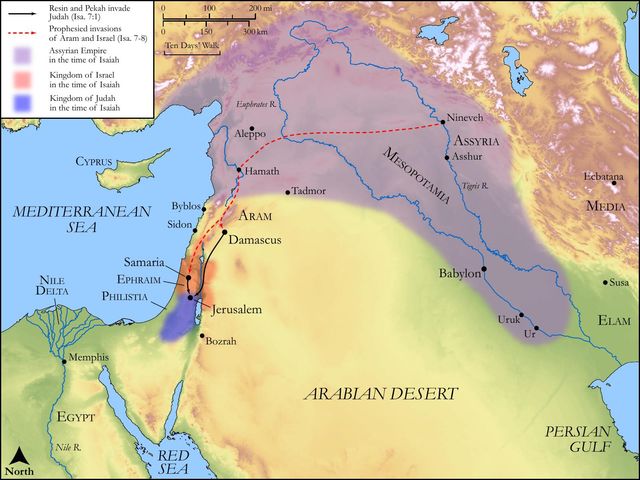
The historical setting is the tumultuous late 8th century BCE, a period marked by intense geopolitical instability among the nations round about Judah. King Ahaz of Judah faced an existential threat from a coalition of Aram (Syria) and Israel (Ephraim), who sought to depose him. God, through the prophet Isaiah, offered Ahaz a divine sign and urged him to trust in the Lord's protection, assuring him that the allied threat would fail. However, Ahaz, demonstrating a profound lack of faith, refused God's offer and instead sought an alliance with the formidable Assyrian Empire, a decision that directly contravened divine counsel. This rejection of divine providence set the stage for God's judgment. Culturally, Judah was an agrarian society, where land fertility and agricultural abundance were deeply intertwined with God's blessing and covenant faithfulness. The prophecy of the land becoming "briers and thorns" would have been particularly terrifying, signifying a complete reversal of their way of life and a return to a wild, untamed state, reminiscent of the curse pronounced in Genesis 3:18.
Key Themes
ShowHideThis verse powerfully contributes to several key themes prevalent in the book of Isaiah. Foremost is the theme of Divine Judgment and Retribution, vividly portraying the just consequences of human sin and unbelief, particularly Ahaz's refusal to trust God, which directly leads to the prophesied desolation. Another significant theme is Desolation and Reversal of Blessing, as the once-productive land is cursed to become a wilderness, symbolizing a complete collapse of societal order, economic stability, and the covenant blessings promised for obedience. This stands in stark contrast to the promises of fruitfulness found throughout the Old Testament for those who walk in God's ways, such as those described in Deuteronomy 28:1-14. Furthermore, the imagery underscores the theme of Insecurity and Primitive Survival, as the necessity of "arrows and bows" implies a drastic shift from settled agriculture to a dangerous, subsistence-based existence, highlighting the profound insecurity that will engulf the land due to their spiritual rebellion.
Exposition and Analysis
ShowHideKey Word Analysis
ShowHideFrom a root meaning "to pierce," this word denotes a projectile, an arrow, or dart. In this context, it signifies a tool primarily for hunting or, secondarily, for warfare. Its mention emphasizes a drastic shift from an agricultural economy to a more primitive, survival-based existence. The presence of arrows indicates a dangerous environment where traditional farming is no longer possible, necessitating hunting for food or defense against wild animals or hostile forces.
This broad term refers to the earth at large, or more specifically, a particular country or territory. Here, it specifically denotes the land of Judah. The prophecy that "all the land" will become briers and thorns underscores the comprehensive and pervasive nature of the desolation. It is not merely isolated fields but the entire region that will be rendered unproductive and dangerous, signifying a complete reversal of the land's blessed and cultivated status.
From a root meaning "to prick," this word denotes a thorny plant, often associated with wild, uncultivated growth. It can also refer to a hard, sharp stone like a diamond, highlighting its piercing quality. In this context, "briers" symbolize the wild, untamed, and unproductive state of the land, making it difficult to traverse and impossible to cultivate. Paired with "thorns," it intensifies the image of an overgrown, neglected, and hostile environment, signifying the complete abandonment of agriculture and the triumph of wilderness over cultivation.
Verse Breakdown
ShowHide"With arrows and with bows shall [men] come thither"
This initial clause vividly describes the future mode of existence for the inhabitants of Judah. Instead of farming implements, their primary tools will be weapons for hunting and defense. The phrase "come thither" implies movement into or through this desolate land, not for cultivation, but for mere survival. It paints a stark picture of a dangerous, wild environment where people must be armed to navigate and sustain themselves, signifying a drastic economic and social regression from a settled, agrarian society to a primitive, subsistence-based existence.
"because all the land shall become briers and thorns"
This second clause provides the dire reason for the first. The desolation is so complete that the entire agricultural landscape will revert to an uncultivated wilderness. "Briers and thorns" are potent symbols of God's judgment, unproductive ground, and the curse of the Fall (as seen in Genesis 3:18). This transformation means the definitive end of settled, agrarian life, forcing people to abandon their farms and resort to a more primitive, nomadic, or hunter-gatherer existence in a hostile and unforgiving environment.
Literary Devices
ShowHideIsaiah 7:24 employs several powerful literary devices to convey its prophetic message. Symbolism is paramount, with "arrows and bows" symbolizing a stark return to a primitive, survivalist existence, replacing the agricultural tools of a settled, prosperous society. The "briers and thorns" are potent symbols of desolation, divine judgment, and the reversal of blessing, directly contrasting with earlier images of fruitful vineyards and cultivated fields. This imagery also creates a strong sense of Irony, as the very land promised to Abraham, flowing with milk and honey, will become barren and hostile due to the people's unfaithfulness and Ahaz's unbelief. The verse uses Foreshadowing to hint at the widespread destruction and societal collapse that the Assyrian invasion, God's instrument of judgment, will bring upon Judah. The vivid imagery also creates powerful Sensory Language, allowing the reader to almost feel the prick of the thorns and the tension of the bowstring, immersing them in the grim reality of the prophecy and underscoring the severity of the coming hardship.
Theological and Thematic Connections
ShowHideIsaiah 7:24 stands as a stark testament to the severe consequences of rejecting God's counsel and relying on human strength rather than divine providence. The theological message is clear: profound disobedience and persistent unbelief lead to desolation and a reversal of blessing. Just as the ground was cursed with thorns and thistles after humanity's initial Fall, Judah's spiritual rebellion and King Ahaz's specific act of unbelief bring about a similar curse upon their physical environment, transforming their fertile fields into an impenetrable wilderness. This serves as a powerful reminder that true security, prosperity, and societal well-being are deeply rooted in a right relationship with God and unwavering trust in His provision. Turning away from Him inevitably leads to hardship, insecurity, and a loss of the blessings He intends for His people. The prophetic shift from agriculture to hunting symbolizes a profound societal regression, highlighting the comprehensive nature of divine judgment that impacts every aspect of life.
Reflection and Application
ShowHideIsaiah 7:24 offers a profound and sobering lesson for believers today, underscoring the critical importance of unwavering faith and radical obedience in the face of adversity. King Ahaz's refusal to trust God's explicit promise, opting instead for a human alliance with Assyria, led to a prophesied period of severe hardship and national decline. For us, this verse highlights that when we choose self-reliance, worldly strategies, or compromise over radical trust in God's wisdom and provision, we invite a form of "desolation" into our lives. This might manifest as spiritual barrenness, moral decay, relational strife, emotional turmoil, or even practical difficulties, where our "land" – our spiritual and relational landscape – becomes overgrown with "briers and thorns" – unproductive, difficult to navigate, and painful. It challenges us to examine where our trust truly lies, reminding us that genuine peace, security, and fruitfulness are found only in aligning our will with God's and seeking His guidance above all else. It calls us to actively cultivate a life of deep faith and obedience, lest our spiritual landscape become a wilderness incapable of bearing fruit for His glory.
Questions for Reflection
ShowHideFAQ
ShowHideWhat is the significance of "briers and thorns" in this verse?
ShowHideThe "briers and thorns" (Hebrew: shamir vashayith) in Isaiah 7:24 are highly symbolic and deeply significant. They represent the complete desolation and uncultivated state of the land, a direct and severe consequence of divine judgment on Judah's unfaithfulness and King Ahaz's unbelief. This imagery powerfully echoes the curse pronounced in Genesis 3:18 after the Fall, where the ground would produce thorns and thistles as a consequence of humanity's sin. Here, it signifies a profound reversal of blessing, transforming once fertile agricultural land into a dangerous, unproductive wilderness, making settled farming impossible and forcing the inhabitants into a primitive, survivalist existence. It underscores the severity of God's displeasure and the comprehensive nature of the coming hardship that would engulf Judah.
How does this verse relate to King Ahaz's decision?
ShowHideIsaiah 7:24 is a direct prophetic consequence of King Ahaz's profound lack of faith and his pivotal decision to reject God's gracious offer of a sign and divine protection during the Syro-Ephraimite War. Instead of trusting the Lord, Ahaz defiantly sought an alliance with the powerful Assyrian Empire, as detailed in 2 Kings 16 and within the broader narrative of Isaiah 7. This verse, along with others in the chapter, reveals that the very Assyrian power Ahaz relied upon would become the instrument of God's judgment, bringing widespread devastation to Judah. The desolation described in Isaiah 7:24 is the direct, bitter fruit of Ahaz's unbelief, his turning away from God's promised deliverance, and his embrace of humanistic solutions over divine faithfulness.
Christ-Centered Fulfillment
ShowHideWhile Isaiah 7:24 speaks powerfully of judgment and desolation resulting from unbelief, it also subtly points forward to Christ in its broader theological context, offering a profound contrast and ultimate reversal. The "briers and thorns" that curse the land, a direct consequence of sin and divine judgment, find their ultimate reversal and redemption in Jesus Christ. He is the one who, in His perfect obedience and sacrificial love, broke the power of the curse of the Fall. Most profoundly, Jesus wore a crown of thorns (as recounted in Matthew 27:29 and John 19:2), literally taking upon Himself the very symbol of humanity's sin, the earth's curse, and the suffering it entails. His suffering and death on the cross, the ultimate act of trust and obedience to the Father, broke the power of sin and its accompanying desolation, transforming the landscape of humanity's spiritual condition. Through Him, the spiritual wilderness of our hearts, once overgrown with the "briers and thorns" of sin and rebellion, can be transformed into a fruitful garden, as the Holy Spirit cultivates the "fruit of the Spirit" (beautifully described in Galatians 5:22-23). The judgment foreshadowed in Isaiah 7:24, a judgment for unbelief, was fully borne by Christ, allowing those who trust in Him to inherit not a land of briers and thorns, but the promised new heavens and new earth, where "there will no longer be any curse" (Revelation 22:3).