


Hosea 7:2
Bible text: King James Version (1769 Blayney text) · Public domain
Bible text: Berean Standard Bible · Public domain
Bible text: American Standard Version (1901) · Public domain
Bible text: World English Bible, Messianic edition · Public domain
Bible text: Geneva Bible (1599) · Public domain
Bible text: Young's Literal Translation · Public domain
- וּבַלu·valand notH1077Conj-w ¦ NegParticle Negativeוּandבַלnot
- יֹאמְרוּyo·me·Ruthey sayH559V-Qal-Imperf-3mpVerb Qal Imperfect 3rd Plural Masculine
- לִלְבָבָםlil·va·Vamto their heartH3824Prep-l ¦ N-msc ¦ 3mpNoun Singular Masculine Constructלִtoלְבָבָheartםtheir
- כָּלkolallH3605N-mscNoun Singular Masculine Construct
- רָעָתָםra·'a·Tamtheir evilH7451N-fsc ¦ 3mpNoun Singular Feminine Constructרָעָתָevilםtheir
- זָכָרְתִּיza·Kha·re·tiI rememberH2142V-Qal-Perf-1csVerb Qal Perfect 1st Singular common gender
- עַתָּה'a·TahnowH6258AdvAdverb
- סְבָבוּםse·va·Vumthey have surrounded themH5437V-Qal-Perf-3cp ¦ 3mpVerb Qal Perfect 3rd Plural common genderסְבָבוּthey have surroundedםthem
- מַעַלְלֵיהֶםma·'a·lei·Hemtheir deedsH4611N-mpc ¦ 3mpNoun Plural Masculine Constructמַעַלְלֵיdeedsהֶםtheir
- נֶגֶדNe·gedbeforeH5048Adj-mscAdjective Numerical Singular Masculine Construct
- פָּנַיpa·Naimy faceH6440N-mpc ¦ 1csNoun Plural Masculine Constructפָּנַfaceיmy
- הָיוּha·Yuthey areH1961V-Qal-Perf-3cpVerb Qal Perfect 3rd Plural common gender
English is a literal word-by-word gloss of the Hebrew, not the KJV's wording. Why?
This is the original text the KJV's translators worked from — each Hebrew word with its own literal English meaning in this verse, prepared by scholars at Tyndale House, Cambridge. The KJV translates whole sentences, not word by word, so its wording differs: one Hebrew word can become several English words, and the KJV may choose “the LORD” where the gloss reads “Yahweh”. Both are faithful — they answer different questions. For the KJV's own rendering, switch to the KJV text.
Details
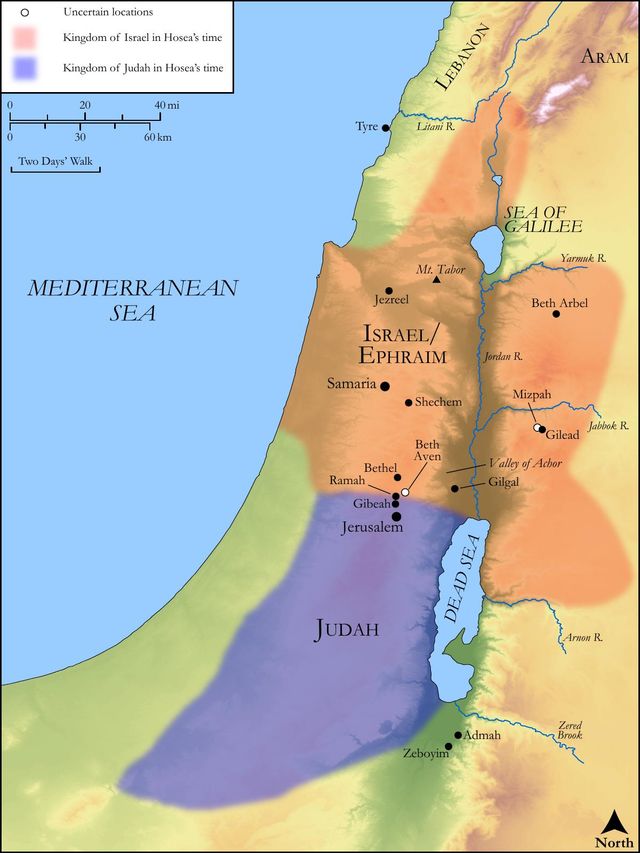
See on the biblical-era map
Study this verse
Public-domain commentary
Matthew Henry
From his Commentary on the Whole Bible. Henry comments on passages, not single verses — this entry covers Hosea 7:1–7. His four-level outline is real structure in the source text, so it is rendered as structure.
Some take away the last words of the foregoing chapter, and make them the beginning of this: "When I returned, or would have returned, the captivity of my people, when I was about to come towards them in ways of mercy, even when I would have healed Israel, then the iniquity of Ephraim (the country and common people) was discovered, and the wickedness of Samaria, the court and the chief city." Now, in these verses, we may observe,
I.A general idea given of the present state of Israel, Hos 7:1, Hos 7:2. See how the case now stood with them.
1.God graciously designed to do well for them: I would have healed Israel. Israel were sick and wounded; their disease was dangerous and malignant, and likely to be fatal, Isa 1:6. But God offered to be their physician, to undertake the cure, and there was balm in Gilead sufficient to recover the health of the daughter of his people; their case was bad, but it was not desperate, nay, it was hopeful, when God would have healed Israel.
(1.)He would have reformed them, would have separated between them and their sins, would have purged out the corruptions that were among them, by his laws and prophets.
(2.)He would have delivered them out of their troubles, and restored to them their peace and prosperity. Several healing attempts were made, and their declining state seemed sometimes to be in a hopeful way of recovery; but their own folly put them back again. Note, If sinful miserable souls be not healed and helped, but perish in their sin and misery, they cannot lay the blame on God, for he both could and would have healed them; he offered to take the ruin under his hand. And there are some special seasons when God manifests his readiness to heal a distempered church and nation, now and then a hopeful crisis, which, if carefully watched and improved, might, even when the case is very bad, turn the scale for life and health.
2.They stood in their own light and put a bar in their own door. When God would have healed them, when they bade fair for reformation and peace, then their iniquity was discovered and their wickedness, which stopped that current of God's favours, and undid all again.
(1.)Then, when their case came to be examined and enquired into, in order to their cure, that wickedness which had been concealed and palliated was found out; not that it was ever hid from God, but he speaks after the manner of men; as a surgeon, when he probes a wound in order to the cure of it and finds that it touches the vitals and is incurable, goes no further in his endeavour to cure it, so, when God came down to see the case of Israel (as the expression is, Gen 18:21), with kind intentions towards them, he found their wickedness so very flagrant, and them so hardened in it, so impudent and impenitent, that he could not in honour show them the favour he designed them. Note, Sinners are not healed because they would not be healed. Christ would have gathered them, and they would not.
(2.)Then, when some endeavours were used to reform and reclaim them, that wickedness which had been restrained and kept under broke out; and from God's steps towards the healing of them they took occasion to be so much the more provoking. When endeavours were used to reform them vice grew more impetuous, more outrageous, and swelled so much the higher, as a stream when it is damned up. When they began to prosper they grew more proud, wanton, and secure, and so stopped the progress of their cure. Note, It is sin that turns away good things from us when they are coming towards us; and it is the folly and ruin of multitudes that, when God would do well for them, they do ill for themselves. And what was it that did them this mischief? In one word, they commit falsehood; they worship idols (so some), defraud one another (so others), or, rather, they dissemble with God in their professions of repentance and regard to him. They say that they are desirous to be healed by him, and, in order to that, willing to be ruled by him; but they lie unto him with their mouth and flatter him with their tongue.
3.A practical disbelief of God's omniscience and government was at the bottom of all their wickedness (Hos 7:2): "They consider not in their hearts, they never say it to their own hearts, never think of this, that I remember all their wickedness." As if God could not see it, though he is all eye, or did not heed it, though his name is Jealous, or had forgotten it, though he is an eternal mind that can never be unmindful, or would not reckon for it, though he is the Judge of heaven and earth. This is the sinner's atheism; as good say that there is no God as say that he is either ignorant or forgetful, that there is none that judges in the earth as that he remembers not the things he is to give judgment upon. It is a high affront they put upon God; it is a damning cheat they put upon themselves; they say, The Lord shall not see, Psa 94:7. They cannot but know that God remembers all their works; they have been told it many a time; nay, if you ask them, they cannot but own it, and yet they do not consider it; they do not think of it when they should, and with application to themselves and their own works, else they would not, they durst not, do as they do. But the time will come when those who thus deceive themselves shall be undeceived: "Now their own doings have beset them about, that is, they have come at length to such a pitch of wickedness that their sins appear on every side of them; all their neighbours see how bad they are, and can they think that God does not see it?" Or, rather, "The punishment of their doings besets them about; they are surrounded and embarrassed with troubles, so that they cannot get out, by which it appears that the sins they smart for are before my face, not only that I have seen them, but that I am displeased at them;" for, till God by pardoning our sins has cast them behind his back, they are still before his face. Note, Sooner or later, God will convince those who do not now consider it that he remembers all their works.
4.God had begun to contend with them by his judgments, in earnest of what was further coming: The thief comes in, and the troop of robbers spoils without. Some take this as an instance of their wickedness, that they robbed and spoiled one another. Nec hospes ab hospite tutus - The host and the guest stand in fear of each other. It seems rather to be a punishment of their sin; they were infested with secret thieves among themselves, that robbed their houses and shops and picked their pockets, and troops of robbers, foreign invaders, that with open violence spoiled abroad; so far was Israel from being healed that they had fresh wounds given them daily by robbers and spoilers; and all this the effect of sin, all to punish them for robbing God, Isa 42:24; Mal 3:8, Mal 3:11.
II.A particular account of the sins of the court, of the king and princes, and those about them, and the tokens of God's displeasure that they were under for them.
1.Their king and princes were pleased with the wickedness and profaneness of their subjects, who were emboldened thereby to be so much them ore wicked (Hos 7:3): They make the king and princes glad with their wickedness. It pleased them to see the people conform to their wicked laws and examples, in the worship of their idols, and other instances of impiety and immorality, and to hear them flatter and applaud them in their wicked ways. When Herod saw that his wickedness pleased the people he proceeded further in it, much more will the people do so when they see that it pleases the prince, Act 12:3. Particularly, they made them glad with their lies, with the lying praises with which they crowned the favourites of the prince and the lying calumnies and censures with which they blackened those whom they knew the princes had a dislike to. Those who show themselves pleased with slanders and ill-natured stories shall never want those about them who will fill their ears with such stories. Pro 29:12, If a ruler hearken to lies, all his servants are wicked, and will make him glad with their lies.
2.Drunkenness and revelling abound much at the court, Hos 7:5. The day of our king was a merry day with them, either his birthday or his inauguration-day, of which it is probable that they had an anniversary observation, or perhaps it was some holiday of his appointing, which was therefore called his day; on that day the princes met to drink the king's health, and got him among them, to be merry, and made him sick with bottles of wine. It should seem the king did not ordinarily drink to excess, but he was not upon a high day brought to it by the artifices of the princes, tempted by the goodness of the wine, the gaiety of the company, or the healths they urged; and so little was he used to it that it made him sick; and it is justly charged as a crime, as crimen laesae majestatis - treason, upon those who thus imposed upon him and made him sick; nor would it serve for an excuse that it was the day of their king, but was rather an aggravation of the crime, that, whey they pretended to do him honour, they dishonoured him to the highest degree. If it is a great affront and injury to a common person to make him drunk, and there is a woe to those that do it (Hab 2:15), much more to a crowned head; for the greater any man's dignity is the greater disgrace it is to him to be drunk. It is not for kings, O Lemuel! it is not for kings, to drink wine, Pro 31:4, Pro 31:5. See what a prejudice the sin of drunkenness is to a man, to a king.
(1.)In his health; it made him sick. It is a force upon nature; and strange it is by what charms men, otherwise rational enough, can be drawn to that which besides the offence it gives to God, and the damage it does to their spiritual and eternal welfare, is a present disorder and distemper to their own bodies.
(2.)In his honour; for, when he was thus intoxicated, he stretched out his hand with scorners; then he that was entrusted with the government of a kingdom lost the government of himself, and so far forgot,
[1.]The dignity of a king that he made himself familiar with players and buffoons, and those whose company was a scandal.
[2.]The duty of a king that he joined in confederacy with atheists, and the profane scoffers at religion, whom he ought to have silenced and put to shame; he sat in the seat of the scornful, of those that had arrived at the highest pitch of impiety; he struck in with them, said as they said, did as they did, and exerted his power, and stretched forth the hand of his government, in concurrence with them. Goodness and good men are often made the song of the drunkards (Psa 69:12; Psa 35:16); but woe unto thee, O land! when thy king is such a child as to stretch forth his hand with those that make them so, Ecc 10:16.
3.Adultery and uncleanness prevailed much among the courtiers. This is spoken of Hos 7:4, Hos 7:6, Hos 7:7, and the charge of drunkenness comes in in the midst of this article; for wine is oil to the fire of lust, Pro 23:33. Those that are inflamed with fleshly lusts, that are adulterers (Hos 7:4), are here again and again compared to an oven heated by the baker (Hos 7:4): They have made ready their heart like an oven (Hos 7:6); they are all hot as an oven, Hos 7:7. Note, [1.] An unclean heart is like an oven heated; and the unclean lusts and affections of it are as the fuel that makes it hot. It is an inward fire, it keeps the heat within itself; so adulterers and fornicators secretly burn in lust, as the expression is, Rom 1:27. The heat of the oven is an intense heat, especially as it is here described; he that heats it stirs up the fire, and ceases not from raising it up, till the bread is ready to be put in, being kneaded and leavened, all which only signifies that they are like an oven when it is at the hottest; nay, when it is too hot for the baker (so the learned Dr. Pocock), when it is hotter than he would have it, so that the raiser up of the fire ceases as long as while the dough that is kneaded is in the fermenting, that the heat may abate a little. Thus fiery hot are the lusts of an unclean heart. (2.) The unclean wait for an opportunity to compass their wicked desires; having made ready their heart like an oven, they lie in wait to catch their prey. The eye of the adulterer waits for the twilight, Job 24:15. Their baker sleeps all the night, but in the morning it burns as a flaming fire. As the baker, having kindled a fire in his oven and laid sufficient fuel to it, goes to bed, and sleeps all night, and in the morning finds his oven well heated, and ready for his purpose, so these wicked people, when they have laid some wicked plot, and formed a design for the gratifying of some covetous, ambitious, revengeful, or unclean lusts, have their hearts so fully set in them to do evil that, though they may stifle them for a while, yet the fire of corrupt affections is still glowing within, and, as soon as ever there is an opportunity for it, their purposes which they have compassed and imagined break out into overt acts, as a fire flames out when it has vent given it. Thus they are all hot as an oven. Note, Lust in the heart is like fire in an oven, puts it into a heat; but the day is coming when those who thus make themselves like a fiery oven with their own vile affections, if that fire be not extinguished by divine grace, shall be made as a fiery oven by divine wrath (Psa 21:9), when the day comes that shall burn as an oven, Mal 4:1.
4.They resist the proper methods of reformation and redress: They have devoured their judges, those few good judges that were among them, that would have put out these fires with which they were heated; they fell foul upon them, and would not suffer them to do justice, but were ready to stone them, and perhaps did so; or, as some think, they provoked God to deprive them of the blessing of magistracy and to leave all in confusion: All their kings have fallen one after another, and their families with them, which could not but put the kingdom into confusion, crumble it into contending parties, and occasion a great deal of bloodshed. There are heart-burnings among them; they are hot as an oven with rage and malice at one another, and this occasions the devouring of their judges, the falling of their kings. For the transgressions of a land many are the princes thereof, Pro 28:2. But in the midst of all this trouble and disorder there is none among them that calls unto God, that sees his hand stretched out against them in these judgments, and deprecates the strokes of it, none, or next to none, that stir up themselves to take hold on God, Isa 64:7. Note, Those are not only heated with sin, but hardened in sin, that continue to live without prayer even when they are in trouble and distress.
Historical interpretation
Two Centuries of Reception
2 surviving comments on this verse. Each one is dated, so this reads as a timeline rather than a list.
Select a marker to jump to its quote. Markers stagger vertically where authors wrote within a few decades of each other.
Therefore each one must keep his heart with all watchfulness, for when the Lord comes in the day of judgment, “He will bring to light the hidden things of darkness and will make manifest the counsels of the hearts,” “all the thoughts of men meanwhile accusing or else excusing them,” “when their own devices have beset them about.” But of such a nature are the evil thoughts that sometimes they make worthy of censure even those things which seem good and which, so far as the popular judgment is concerned, are indeed worthy of praise.
"And lest perhaps they should say in their hearts: all their wickedness (all wickedness Vulg.) I have remembered, they have encompassed me in the inventions of their own thoughts, before my face they are made." LXX: "That they may sing as it were a new song in their hearts, all their wickedness I have remembered." "Now their own devices have encompassed them about, they have been executed in my sight." Lest perhaps, they say in their hearts: God hath restored to us, our ancient sins, we have repaid the iniquities of our fathers: they have eaten a sour grape, and their teeth are set on edge. (Jeremiah 31); therefore, I will recount to them, what they have done both now and in the present, in my sight, and daily, and I will show them their own inventions, and the thoughts by which they have most studiously pursued mischief, and what they have done in my presence, not fearing my face. But what we read in the Septuagint, 'that they sing together as if singing in their hearts,' refers to the fact that if a thief has entered, or a robber stripped them of their possessions outside, they would not repel the thief's and robber's agreement by staying in their former riches and clothing; but when they have been stripped, they sing together with them, and become of one heart (Dist. 4, de Poenit., cap. Cum ita): therefore they will receive what they have done, and all their thoughts and deeds will not deserve my sight. Heretics also cannot be accused of old sins against God, since every day they add new impiety to their old deeds, and when they perish in destruction, they are abandoned by their own errors, and when they think they can hide from God, they cannot avoid his eyes.
Continue studying Hosea 7:2 across the web’s major study libraries — every link below opens this exact verse, chapter, or book on the destination site.
Read & Compare
 BibleGatewayThis verse in more than 200 translations and 70 languages.
 Bible.comThe YouVersion reader — hundreds of translations, reading plans, and highlights.
 ESV.orgCrossway's official English Standard Version reader.
 NET BibleThe NET translation with 60,000+ translators' notes on every rendering decision.
 STEP BibleTyndale House's free study tool — original text, vocabulary, and scholarly resources.
 BibliaLogos Bible Software's free web reader.
 USCCBThe New American Bible (Revised Edition) with the U.S. bishops' study notes.
Commentaries
 BibleHub CommentariesDozens of classic commentaries on this verse, gathered on one page.
 StudyLightMore than 100 commentary sets — the largest collection on the web.
 BibleRefPlain-English commentary on what this verse means, verse by verse.
 Enduring WordDavid Guzik's free commentary on this chapter, widely used by Bible teachers.
 Bible Study ToolsVerse commentary alongside Greek and Hebrew study aids.
Original Language & Research
- BibleHub InterlinearThe verse word by word — original language, transliteration, and English.
- BibleHub LexiconEvery word's original-language definition and Strong's entry.
 Blue Letter BibleDeep-study tools — Strong's numbers, concordance, and word studies.
 SefariaThe Hebrew text with Rashi and centuries of Jewish commentary.
Sermons, Hymns & Audio


TrulyRandomVerse is not affiliated with these sites and doesn’t control their content. They’re linked because they’re genuinely useful.
Summary
Hosea 7:2 reveals the profound spiritual blindness and moral apathy of the northern kingdom of Israel (Ephraim), who willfully disregard God's omnipresent awareness of their pervasive wickedness. Despite their attempts to conceal their sins, the Lord unequivocally declares His perfect remembrance of every transgression. Consequently, their own corrupt actions have inexorably surrounded and entrapped them, leaving them exposed and accountable before the divine presence, underscoring the inescapable nature of divine judgment for unrepentant sin.
Context
ShowHideLiterary Context
This verse is situated within a broader indictment of Israel's spiritual decay and political instability in Hosea chapters 7-8. Immediately preceding it, Hosea 7:1 describes God's desire to heal Israel, yet their actions are characterized by deceit, theft, and banditry. The nation is depicted as a "heated oven" of lust and plotting in Hosea 7:4-7, consumed by internal corruption and external alliances. Verse 2 specifically highlights the internal disposition that fuels this outward sin: a deliberate refusal to acknowledge God's perspective and their own culpability. This spiritual amnesia is a cornerstone of their covenant unfaithfulness, leading directly to the inevitable consequences detailed in the subsequent verses, where their reliance on foreign powers rather than the Lord is condemned (Hosea 7:8-11).
Historical & Cultural Context
Hosea prophesied during the turbulent final decades of the Northern Kingdom of Israel (Ephraim), roughly 750-722 BC, leading up to its destruction by Assyria. This period was marked by rapid succession of kings, political assassinations, and a desperate, often contradictory, foreign policy that vacillated between alliances with Egypt and Assyria. Culturally, the people had deeply syncretized their worship, blending the worship of Yahweh with Canaanite Baal worship, leading to widespread idolatry, moral decay, and oppression. The phrase "they consider not in their hearts" reflects a profound spiritual and intellectual negligence, a failure to internalize the covenant stipulations or God's warnings. Their "doings" included not just religious apostasy but also social oppression, political intrigue, and international duplicity, all of which were "before God's face," meaning they were under His direct observation and subject to His righteous judgment, a concept deeply rooted in the law and covenant of Israel, where the LORD was the ultimate witness.
Key Themes
ShowHideThis verse powerfully contributes to several overarching themes in Hosea. The theme of Israel's spiritual blindness and ignorance is central, as highlighted by their failure to "consider not in their hearts" God's remembrance of their sin, a profound spiritual apathy that prevents repentance. This willful ignorance is a recurring motif, contrasting sharply with God's perfect knowledge and remembrance of all their deeds, emphasizing the theme of ** divine omniscience and justice**. God's declaration, "I remember all their wickedness," underscores that no sin is hidden from Him, and His memory is not passive but active, leading to accountability. Furthermore, the consequence that "their own doings have beset them about" illustrates the theme of inevitable consequences and divine judgment, where sin carries its own punitive results, trapping the sinner in a web of their own making. Finally, the phrase "they are before my face" reinforces the theme of God's inescapable presence and the certainty of judgment, signifying that their actions are directly witnessed by the holy God, making escape from His justice impossible.
Exposition and Analysis
ShowHideKey Word Analysis
ShowHideWhile often translated "to say," in this context, it carries the broader sense of "to say to oneself," "to think," or "to take to heart." The negative "consider not" therefore implies a profound internal failure to reflect, acknowledge, or internalize the reality of their actions and God's view of them. It's a deliberate intellectual and spiritual blindness, a refusal to process the truth.
This word refers to the innermost being, the seat of intellect, will, emotion, and moral character. The phrase "consider not in their hearts" emphasizes that their failure is not merely superficial or external, but a deep-seated spiritual and cognitive indifference. It signifies a fundamental corruption of their moral compass and a deliberate choice to ignore divine truth at the core of their being.
This primitive root means "to revolve, surround, or border." Here, it vividly portrays the inescapable nature of the consequences of Israel's actions. Their "doings" (H4611, maʻălâl, meaning "an act, good or bad") have literally encircled them, creating a trap or a snare from which they cannot escape. It illustrates the principle that sin, once committed, often creates its own self-perpetuating cycle of judgment and bondage.
Verse Breakdown
ShowHide"And they consider not in their hearts"
This opening clause immediately highlights the core problem: Israel's profound spiritual apathy and willful ignorance. It is not merely a lack of knowledge, but a deliberate refusal to acknowledge, reflect upon, or internalize the truth of their situation before God. Their moral and intellectual faculties are disengaged from divine reality.
"[that] I remember all their wickedness"
In stark contrast to Israel's forgetfulness, God declares His perfect and active memory. "Wickedness" (H7451, raʻ) encompasses all their evil, moral depravity, and harmful actions. This divine remembrance is not passive recollection but an active awareness that serves as the basis for His righteous judgment and accountability. Nothing they have done is hidden or forgotten by Him.
"now their own doings have beset them about"
This phrase describes the inevitable consequence of their unacknowledged sin. Their "doings" – their evil acts and choices – have become a snare, surrounding them like an inescapable net. They are trapped by the very patterns of sin they have cultivated, leading to a self-inflicted state of bondage and distress. The consequences are not external impositions but the natural outgrowth of their own actions.
"they are before my face."
This final declaration emphasizes God's direct and inescapable presence. Their sins are not committed in secret; they are openly and continually observed by the omniscient God. This signifies the certainty of judgment, as the divine witness is ever-present, ensuring that justice will be meted out for every unrepentant act.
Literary Devices
ShowHideHosea 7:2 employs several powerful literary devices. Anthropomorphism is evident in God's declaration, "I remember all their wickedness" and "they are before my face." While God does not possess a physical face or a human memory, these phrases convey His active awareness, perfect knowledge, and personal engagement with humanity's actions, emphasizing His omniscience and omnipresence. The phrase "their own doings have beset them about" functions as a Metaphor or a vivid Imagery, portraying sin not as an isolated act but as a surrounding, entrapping force, like a besieging army or a tightening net. This imagery powerfully communicates the self-destructive and inescapable nature of unrepentant sin. Furthermore, there is a subtle Irony at play: Israel "considers not in their hearts" God's remembrance, yet their actions are undeniably "before His face." Their willful blindness stands in stark contrast to God's perfect sight, highlighting their delusion and the ultimate futility of attempting to hide from divine scrutiny.
Theological and Thematic Connections
ShowHideHosea 7:2 profoundly underscores the biblical truth of God's perfect knowledge and the inescapable accountability of humanity. It teaches that sin, however concealed or ignored by the perpetrator, is always known to God and carries inherent, often self-inflicted, consequences. This verse resonates with the broader biblical theme that God is a God of justice who sees all things and will bring every deed into judgment. It highlights the danger of spiritual apathy and the delusion that one can escape the ramifications of their choices simply by ignoring them. The divine memory is not passive but active, serving as the basis for righteous judgment, reminding us that true repentance begins with acknowledging the truth of our sin before a holy God.
Reflection and Application
ShowHideHosea 7:2 serves as a stark mirror, reflecting the human tendency to ignore or rationalize our own failings, believing that what we do not acknowledge ceases to exist or be remembered. This verse shatters that illusion, reminding us that God's perspective is the ultimate reality. Our actions, whether hidden or overt, are perpetually "before His face," and He "remembers all our wickedness." This truth should not lead to despair but to a profound sense of sober self-examination. It calls us to abandon spiritual apathy and embrace honest introspection, recognizing that the "doings" we sow will inevitably "beset us about" in the form of natural consequences, broken relationships, spiritual bondage, or divine discipline. True freedom and healing begin not with denial, but with humble confession and a turning towards the God who sees all, yet offers forgiveness to those who genuinely seek it. This verse compels us to live with an acute awareness of God's omnipresence and to align our hearts and actions with His righteous standards.
Questions for Reflection
ShowHideFAQ
ShowHideDoes God truly "remember" our sins, or does He forget them after forgiveness?
ShowHideHosea 7:2 speaks of God remembering Israel's unrepented wickedness, which forms the basis for their judgment. When it comes to sins that are genuinely confessed and repented of, the Bible assures us that God chooses not to remember them against us. For instance, Isaiah 43:25 states, "I, even I, am he that blotteth out thy transgressions for mine own sake, and will not remember thy sins." Similarly, Hebrews 8:12 promises, "For I will be merciful to their unrighteousness, and their sins and their iniquities will I remember no more." This signifies a divine act of judicial forgetting, where the guilt and penalty of sin are removed, and the sin is no longer held against the believer. God's perfect memory means He can remember, but His grace means He chooses not to, for those who are in Christ.
What does it mean for our "doings" to "beset us about"?
ShowHideThis vivid imagery means that our actions, particularly our sinful ones, can surround us, entangle us, and create a trap from which it is difficult to escape. It speaks to the natural and spiritual consequences of sin. For example, a person who habitually lies may find themselves caught in a web of deceit, losing trust and credibility. Someone who engages in addiction may find their life consumed and controlled by that behavior. As Galatians 6:7 famously puts it, "Be not deceived; God is not mocked: for whatsoever a man soweth, that shall he also reap." Our "doings" create the circumstances and character that define our lives, and unrepentant sin inevitably leads to bondage and negative outcomes, which are "before God's face" as a testament to our choices.
Christ-Centered Fulfillment
ShowHideHosea 7:2, with its stark declaration of Israel's unacknowledged wickedness and God's perfect remembrance, finds its ultimate fulfillment and resolution in the person and work of Jesus Christ. The "wickedness" that "beset" Israel, and indeed all humanity, is the sin that separates us from a holy God. Humanity, like Israel, consistently "considers not in their hearts" the gravity of their sin or the omnipresent gaze of God, living in a state of spiritual blindness and self-deception. However, Christ came precisely because our "doings" had "beset" us, trapping us in a cycle of sin and death (Romans 7:24). He is the Lamb of God who takes away the sin of the world (John 1:29), offering a way out of the inescapable snare of our own iniquities. Through His atoning sacrifice on the cross, Jesus bore the full weight of the "wickedness" that was "before God's face," satisfying divine justice and making it possible for God to "remember" our sins no more when we place our faith in Him (Colossians 2:13-14). He provides the true spiritual sight that Israel lacked, enabling us to see our sin for what it is and to turn to the One who frees us from its power and consequences, bringing us into a right relationship with the God whose face is now turned towards us in grace, not judgment (2 Corinthians 5:21).