


Hosea 11:11
Bible text: King James Version (1769 Blayney text) · Public domain
Bible text: Berean Standard Bible · Public domain
Bible text: American Standard Version (1901) · Public domain
Bible text: World English Bible, Messianic edition · Public domain
Bible text: Geneva Bible (1599) · Public domain
Bible text: Young's Literal Translation · Public domain
- יֶחֶרְדוּye·cher·Duthey will trembleH2729V-Qal-Imperf-3mpVerb Qal Imperfect 3rd Plural Masculine
- כְצִפּוֹרkhe·tzi·pOrlike a birdH6833Prep-k ¦ N-csNoun Singular common gender Absoluteכְlikeצִפּוֹרa bird
- מִמִּצְרַיִםmi·mitz·Ra·yimfrom EgyptH4714Prep-m ¦ N-properNoun Proper LocationמִfromמִּצְרַיִםEgypt
- וּכְיוֹנָהu·khe·yo·Nahand like a doveH3123Conj-w ¦ Prep-k ¦ N-fsNoun Singular Feminine Absoluteוּandכְlikeיוֹנָהa dove
- מֵאֶרֶץme·'E·retzfrom [the] land ofH776Prep-m ¦ N-fscNoun Singular Feminine Constructמֵfromאֶרֶץ[the] land of
- אַשּׁוּר'a·ShurAssyriaH804N-properNoun Proper Location
- וְהוֹשַׁבְתִּיםve·ho·shav·Timand I will cause to dwell themH3427Conj-w ¦ V-Hiphil-ConsecPerf-1cs ¦ 3mpVerb Hiphil Consecutive Perfect 1st Singular common genderוְandהוֹשַׁבְתִּיI will cause to dwellםthem
- עַל'alatH5921PrepPreposition
- בָּתֵּיהֶםba·tei·Hemtheir housesH1004N-mpc ¦ 3mpNoun Plural Masculine Constructבָּתֵּיhousesהֶםtheir
- נְאֻםne·'um[the] utterance ofH5002N-mscNoun Singular Masculine Construct
- יְהוָהYah·wehYahwehH3068N-properNoun Proper Title
English is a literal word-by-word gloss of the Hebrew, not the KJV's wording. Why?
This is the original text the KJV's translators worked from — each Hebrew word with its own literal English meaning in this verse, prepared by scholars at Tyndale House, Cambridge. The KJV translates whole sentences, not word by word, so its wording differs: one Hebrew word can become several English words, and the KJV may choose “the LORD” where the gloss reads “Yahweh”. Both are faithful — they answer different questions. For the KJV's own rendering, switch to the KJV text.
Details
See on the biblical-era map
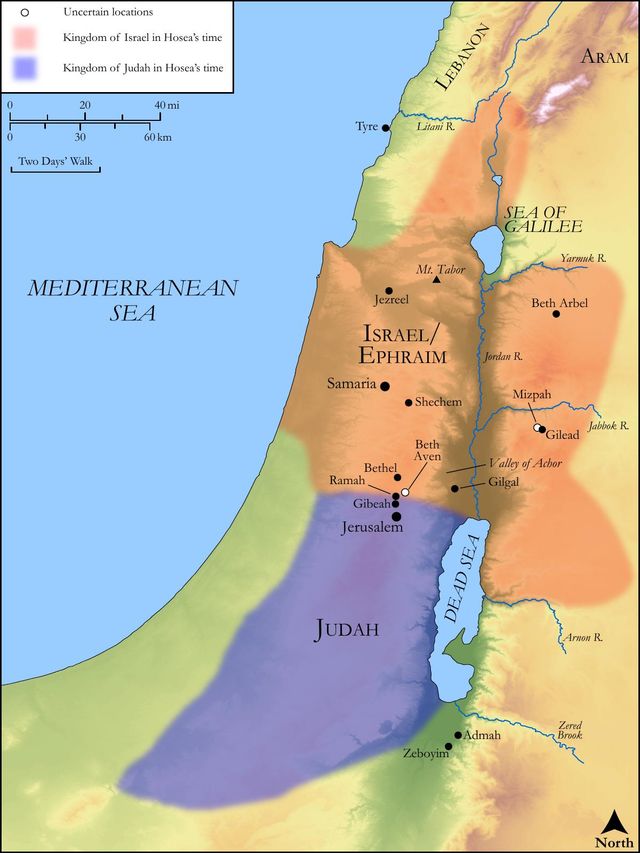
Study this verse
Public-domain commentary
Matthew Henry
From his Commentary on the Whole Bible. Henry comments on passages, not single verses — this entry covers Hosea 11:8–12. His three-level outline is real structure in the source text, so it is rendered as structure.
In these verses we have,
I.God's wonderful backwardness to destroy Israel (Hos 11:8, Hos 11:9): How shall I give thee up? Here observe,
1.God's gracious debate within himself concerning Israel's case, a debate between justice and mercy, in which victory plainly inclines to mercy's side. Be astonished, O heavens! at this, and wonder, O earth! at the glory of God's goodness. Not that there are any such struggles in God as there are in us, or that he is ever fluctuating or unresolved; no, he is in one mind, and knows it; but they are expressions after the manner of men, designed to show what severity the sin of Israel had deserved, and yet how divine grace would be glorified in sparing them notwithstanding. The connexion of this with what goes before is very surprising; it was said of Israel (Hos 11:7) that they were bent to backslide from God, that though they were called to him they would not exalt him, upon which, one would think, it should have followed, "Now I am determined to destroy them, and never show them mercy any more." No, such is the sovereignty of mercy, such the freeness, the fulness, of divine grace, that it follows immediately, How shall I give thee up? See here,
(1.)The proposals that justice makes concerning Israel, the suggestion of which is here implied. Let Ephraim be given up, as an incorrigible son is given up to be disinherited, as an incurable patient is given over by his physician. Let him be given up to ruin. Let Israel be delivered into the enemy's hand, as a lamb to the lion to be torn in pieces; let them be made as Admah and set as Zeboim, the two cities that with Sodom and Gomorrah were destroyed by fire and brimstone rained from heaven upon them; let them be utterly and irreparably ruined, and be made as like these cities in desolation as they have been in sin. Let that curse which is written in the law be executed upon them, that the whole land shall be brimstone and salt, like the overthrow of Sodom and Gomorrah, Admah and Zeboim, Deu 29:23. Ephraim and Israel deserve to be thus abandoned, and God will do them no wrong if he deal thus with them.
(2.)The opposition that mercy makes to these proposals: How shall I do it? As the tender father reasons with himself, "How can I cast off my untoward son? for he is my son, though he be untoward; how can I find in my heart to do it?" Thus, "Ephraim has been a dear son, a pleasant child: How can I do it? He is ripe for ruin; judgments stand ready to seize him; there wants nothing but giving him up, but I cannot do it. They have been a people near unto me; there are yet some good among them; theirs are the children of the covenant; if they be ruined, the enemy will triumph; it may be they will yet repent and reform; and therefore how can I do it?" Note, The God of heaven is slow to anger, and is especially loth to abandon a people to utter ruin that have been in special relation to him. See how mercy works upon the mention of those severe proceedings: My heart is turned within me, as we say, Our heart fails us, when we come to do a thing that is against the grain with us. God speaks as if he were conscious to himself of a strange striving of affections in compassion to Israel: as Lam 1:20, My bowels are troubled; my heart is turned within me. As it follows here, My repentings are kindled together. His bowels yearned towards them, and his soul was grieved for their sin and misery, Jdg 10:16. Compare Jer 31:20. Since I spoke against him my bowels are troubled for him. When God was to give up his Son to be a sacrifice for sin, and a Saviour for sinners, he did not say, How shall I give him up? No, he spared not his own Son; it pleased the Lord to bruise him; and therefore God spared not him, that he might spare us. But this is only the language of the day of his patience; when men have sinned that away, and the great day of his wrath comes, then no difficulty is made of it; nay, I will laugh at their calamity.
2.His gracious determination of this debate. After a long contest mercy in the issue rejoices against judgment, has the last word, and carries the day, Hos 11:9. It is decreed that the reprieve shall be lengthened out yet longer, and I will not now execute the fierceness of my anger, though I am angry; though they shall not go altogether unpunished, yet he will mitigate the sentence and abate the rigour of it. He will show himself to be justly angry, but not implacably so; they shall be corrected, but not consumed. I will not return to destroy Ephraim; the judgments that have been inflicted shall not be repeated, shall not go so deep as they have deserved. He will not return to destroy, as soldiers, when they have pillaged a town once, return a second time, to take more, as when what the palmer-worm has left the locust has eaten. It is added, in the close of the verse, "I will not enter into the city, into Samaria, or any other of their cities; I will not enter into them as an enemy, utterly to destroy them, and lay them waste, as I did the cities of Admah and Zeboim."
3.The ground and reason of this determination: For I am God and not man, the Holy One of Israel. To encourage them, to hope that they shall find mercy, consider,
(1.)What he is in himself: He is God, and not man, as in other things, so in pardoning sin and sparing sinners. If they had offended a man like themselves, he would not, he could not have borne it; his passion would have overpowered his compassion, and he would have executed the fierceness of his anger; but I am God, and not man. He is Lord of his anger, whereas men's anger commonly lords it over them. If an earthly prince were in such a strait between justice and mercy, he would be at a loss how to compromise the matter between them; but he who is God, and not man, knows how to find out an expedient to secure the honour of his justice and yet advance the honour of his mercy. Man's compassions are nothing in comparison with the tender mercies of our God, whose thoughts and ways, in receiving returning sinners, are as much above ours as heaven is above the earth, Isa 55:9. Note, It is a great encouragement to our hope in God's mercies to remember that he is God, and not man. He is the Holy One. One would think this were a reason why he should reject such a provoking people. No; God knows how to spare and pardon poor sinners, not only without any reproach to his holiness, but very much to the honour of it, as he is faithful and just to forgive us our sins, and therein declares his righteousness, now Christ has purchased the pardon and he has promised it.
(2.)What he is to them; he is the Holy One in the midst of thee; his holiness is engaged for the good of his church, and even in this corrupt and degenerate land and age there were some that gave thanks at the remembrance of his holiness, and he required of them all to be holy as he is, Lev 19:2. As long as we have the Holy One in the midst of us we are safe and well; but woe to us when he leaves us! Note, Those who submit to the influence may take the comfort of God's holiness.
II.Here is his wonderful forwardness to do good for Israel, which appears in this, that he will qualify them to receive the good he designs for them (Hos 11:10, Hos 11:11): They shall walk after the Lord. This respects the same favour with that (Hos 3:5), They shall return, and seek the Lord their God; it is spoken of the ten tribes, and had its accomplishment, in part, in the return of some of them with those of the two tribes in Ezra's time; but it had its more full accomplishment in God's spiritual Israel, the gospel-church, brought together and incorporated by the gospel of Christ. The ancient Jews referred it to the time of the Messiah; the learned Dr. Pocock looks upon it as a prophecy of Christ's coming to preach the gospel to the dispersed children of Israel, the children of God that were scattered abroad. And then observe,
1.How they were to be called and brought together: The Lord shall roar like a lion. The word of the Lord (so says the Chaldee) shall be as a lion that roars. Christ is called the lion of the tribe of Judah, and his gospel, in the beginning of it, was the voice of one crying in the wilderness. When Christ cried with a loud voice it was as when a lion roared, Rev 10:3. The voice of the gospel was heard afar, as the roaring of a lion, and it was a mighty voice. See Joe 3:16.
2.What impression this call should make upon them, such an impression as the roaring of a lion makes upon all the beasts of the forest: When he shall roar then the children shall tremble. See Amo 3:8, The lion has roared; the Lord God has spoken; and then who will not fear? When those whose hearts the gospel reached trembled, and were astonished, and cried out, What shall we do? - when they were by it put upon working out their salvation, and worshipping God with fear and trembling, then this promise was fulfilled. The children shall tremble from the west. The dispersed Jews were carried eastward, to Assyria and Babylon, and those that returned came from the east; therefore this seems to have reference to the calling of the Gentiles that lay westward from Canaan, for that way especially the gospel spread. They shall tremble; they shall move and come with trembling, with care and haste, from the west, from the nations that lay that way, to the mountain of the Lord (Isa 2:3), to the gospel-Jerusalem, upon hearing the alarm of the gospel. The apostle speaks of mighty signs and wonders that were wrought by the preaching of the gospel from Jerusalem round about to Illyricum, Rom 15:19. Then the children trembled from the west. And, whereas Israel after the flesh was dispersed in Egypt and Assyria, it is promised that they shall be effectually summoned thence (Hos 11:11): They shall tremble; they shall come trembling, and with all haste, as a bird upon the wing, out of Egypt, and as a dove out of the land of Assyria; a dove is noted for swift and constant flight, especially when she flies to her windows, which the flocking of Jews and Gentiles to the church is here compared to, as it is Isa 60:8. Wherever those are that belong to the election of grace - east, west, north, or south - they shall hear the joyful sound, and be wrought upon by it; those of Egypt and Assyria shall come together; those that lay most remote from each other shall meet in Christ, and be incorporated in the church. Of the uniting of Egypt and Assyria, it was prophesied, Isa 19:23.
3.What effect these impressions should have upon them. Being moved with fear, they shall flee to the ark: They shall walk after the Lord, after the service of the Lord (so the Chaldee); they shall take the Lord Christ for their leader and commander; they shall enlist themselves under him as the captain of their salvation, and give up themselves to the direction of the Spirit as their guide by the word; they shall leave all to follow Christ, as becomes disciples. Note, Our holy trembling at the word of Christ will draw us to him, not drive us from him. When he roars like a lion the slaves tremble and flee from him, the children tremble and flee to him.
4.What entertainment they shall meet with at their return (Hos 11:11): I will place them in their houses (all those that come at the gospel-call shall have a place and a name in the gospel-church, in the particular churches which are their houses, to which they pertain; they shall dwell in God, and be at home in him, both easy and safe, as a man in his own house; they shall have mansions, for there are many in our Father's house), in his tabernacle on earth and his temple in heaven, in everlasting habitations, which may be called their houses, for they are the lot they shall stand in at the end of the days.
III.Here is a sad complaint of the treachery of Ephraim and Israel, which may be an intimation that it is not Israel after the flesh, but the spiritual Israel, to whom the foregoing promises belong, for as for this Ephraim, this Israel, they compass God about with lies and deceit; all their services of him, when they pretended to compass his altar, were feigned and hypocritical; when they surrounded him with their prayers and praises, every one having a petition to present to him, they lied to him with their mouth and flattered him with their tongue; their pretensions were so fair, and yet their intentions so foul, that they would, if possible, have imposed upon God himself. Their professions and promises were all a cheat, and yet with these they thought to compass God about, to enclose him as it were, to keep him among them, and prevent his leaving them.
IV.Here is a pleasant commendation of the integrity of the two tribes, which they held fast, and this comes in as an aggravation of the perfidiousness of the ten tribes, and a reason why God had that mercy in store for Judah which he had not for Israel (Hos 1:6, Hos 1:7), for Judah yet rules with God and is faithful with the saints, or with the Most Holy.
1.Judah rules with God, that is, he serves God, and the service of God is not only true liberty and freedom, but it is dignity and dominion. Judah rules, that is, the princes and governors of Judah rule with God; they use their power for him, for his honour, and the support of his interest. Those rule with God that rule in the fear of God (Sa2 23:3), and it is their honour to do so, and their praise shall be of God, as Judah's here is. Judah is Israel - a prince with God.
2.He is faithful with the holy God, keeps close to his worship and to his saints, with Abraham, Isaac, and Jacob, whose steps they faithfully tread in. They walk in the way of good men; and those that do so rule with God, they have a mighty interest in Heaven. Judah yet does thus, which intimates that the time would come when Judah also would revolt and degenerate. Note, When we see how many there are that compass God about with lies and deceit it may be a comfort to us to think that God has his remnant that cleave to him with purpose of heart, and are faithful to his saints; and for those who are thus faithful unto death is reserved a crown of life, when hypocrites and all liars shall have their portion without.
Historical interpretation
Historical reception
1 surviving comment on this verse from the historical church.
"After the Lord they shall walk: He shall roar like a lion: for He shall roar, and the children of the sea shall fear, and shall fly away like a bird out of Egypt, and like a dove out of the land of the Assyrians: and I will place them in their houses, saith the Lord." LXX: "After the Lord I will walk; he will roar like a lion, because he will roar, and the sons of water will be afraid and fly like birds from Egypt, and like a dove from the land of the Assyrians, and I will place them in their houses, says the Lord." With the Lord promising success, the people will turn to Him: and they shall walk after the Lord, for the Lord shall roar like a lion. Of which also the prophet Amos recalls: 'The Lord will roar from Zion, and from Jerusalem He shall give His voice' (Amos 1:2). And He will roar when He says: 'I will make you like Sodom.' And when He roars, then the sons of the sea, or of the waters, will tremble, as the LXX translated. For the word Maim, which is written with three letters Mem, Yod, Mem: if it is read Maim, it means 'waters'; if Mejam, it is understood as 'from the sea.' The Hebrews refer these things to the coming of Christ, whom they hope will come. "We have now become convinced that from Egypt and Assyria, that is, from the East and the West, and from the North and the South, those who recline with Abraham, Isaac, and Jacob have come, and come daily (Matthew 8). However, we can call the sons of the sea or the waters those who have been caught in the Lord's dragnet and taken from the sea of this world (Matthew 13:47). And when they have been taken from death to life, they will be placed in their own houses, which the Gospel calls granaries, in which selected and separated wheat is stored." (Matthew 13) It is said that it is the nature of lions that when they roar and roar, all animals tremble, and they cannot move with fixed steps: such is the terror and so great the fear. And so, when the Lord roars like a lion, and thunders, and gives his voice, all the birds and all flying things will tremble: and they will go to their nests, that is, to their homes where the Lord will dwell with them. Let us also say this differently: When a true lion roars, the false lion, who is our adversary according to the Apostle Peter, will immediately be silent, and he will not be able to open his perverse mouth to any doctrine: and those who were previously captured by him, loosened by the roar of the lion and terrible threats, will follow their Lord God. Then the sons of the sea or waters will fear, who were born in bitterness and salty waters of heretics; and having taken wings, they will fly like birds from Egypt and like doves from Assyrian land, and will say: "Who will give me wings like doves, and I will fly and rest"(Ps. LIV, 7)? So those who had labored among the heretics may rest in the Church and dwell in their homes from which they were seduced by error. Egypt, that is, we know as "trouble" and "distress"; likewise, concerning Assyrians, we recognize as "leaders" or, as we think better, "accusers." Therefore, heretics will be freed from them when they start living in their own homes and say to their wicked parents, "Your house will be left empty to you" (Matt. 23).
Continue studying Hosea 11:11 across the web’s major study libraries — every link below opens this exact verse, chapter, or book on the destination site.
Read & Compare
 BibleGatewayThis verse in more than 200 translations and 70 languages.
 Bible.comThe YouVersion reader — hundreds of translations, reading plans, and highlights.
 ESV.orgCrossway's official English Standard Version reader.
 NET BibleThe NET translation with 60,000+ translators' notes on every rendering decision.
 STEP BibleTyndale House's free study tool — original text, vocabulary, and scholarly resources.
 BibliaLogos Bible Software's free web reader.
 USCCBThe New American Bible (Revised Edition) with the U.S. bishops' study notes.
Commentaries
 BibleHub CommentariesDozens of classic commentaries on this verse, gathered on one page.
 StudyLightMore than 100 commentary sets — the largest collection on the web.
 BibleRefPlain-English commentary on what this verse means, verse by verse.
 Enduring WordDavid Guzik's free commentary on this chapter, widely used by Bible teachers.
 Bible Study ToolsVerse commentary alongside Greek and Hebrew study aids.
Original Language & Research
- BibleHub InterlinearThe verse word by word — original language, transliteration, and English.
- BibleHub LexiconEvery word's original-language definition and Strong's entry.
 Blue Letter BibleDeep-study tools — Strong's numbers, concordance, and word studies.
 SefariaThe Hebrew text with Rashi and centuries of Jewish commentary.
Sermons, Hymns & Audio


TrulyRandomVerse is not affiliated with these sites and doesn’t control their content. They’re linked because they’re genuinely useful.
Summary
Hosea 11:11 presents a profound declaration of God's unwavering commitment to restore His covenant people, Israel. Despite their persistent unfaithfulness and dispersion into exile under the oppressive powers of Egypt and Assyria, the Lord promises to sovereignly gather them back to their homeland, settling them securely in their own houses. This verse stands as a powerful testament to divine mercy triumphing over judgment, highlighting God's faithfulness to His promises even when His people have failed.
Context
ShowHideLiterary Context
Hosea 11 marks a pivotal shift in the prophet's message, moving from stern pronouncements of judgment to an outpouring of divine compassion. Verses 1-7 recount God's tender, fatherly love for Israel from their infancy, recalling how He "called My son out of Egypt" (Hosea 11:1) and patiently taught them. Yet, Israel continually rebelled, pursuing idolatry and foreign alliances. The impending judgment is severe, but in a dramatic turn, verses 8-9 reveal God's internal struggle and profound reluctance to unleash His full wrath, stating, "My heart is turned within Me; My compassions are kindled together." This profound expression of divine pathos sets the stage for the promise of restoration in verses 10-11, where the roaring of the Lord leads not to destruction but to the trembling, swift return of His scattered children.
Historical & Cultural Context
The book of Hosea primarily addresses the Northern Kingdom of Israel (Ephraim) during the 8th century BCE, a period marked by political instability, moral decay, and rampant idolatry. Israel had a long history of seeking alliances with powerful nations like Egypt for protection, often at the expense of trusting God. Assyria, on the other hand, represented the dominant imperial power that ultimately conquered the Northern Kingdom in 722 BCE, leading to their exile and dispersion (2 Kings 17:6). The imagery of "bird out of Egypt" and "dove out of the land of Assyria" vividly portrays the scattered exiles returning from these specific regions of historical oppression and dispersion. Birds, particularly doves, were known for their migratory instincts and ability to find their way home, making them a fitting metaphor for a divinely guided, urgent return.
Key Themes
ShowHideThis verse powerfully contributes to several overarching themes in Hosea and the broader biblical narrative. Firstly, it underscores Divine Restoration, emphasizing God's active and sovereign role in gathering His dispersed people and re-establishing them securely in their land. Secondly, it highlights God's Sovereignty and Faithfulness to His Covenant, demonstrating that His promises endure even when human faithfulness falters; the declaration "saith the LORD" affirms His ultimate authority and commitment to His word (2 Timothy 2:13). Finally, it exemplifies the theme of Mercy Triumphs Over Judgment, revealing God's compassionate heart that longs for reconciliation and restoration, choosing to relent from full destruction and instead offer a path to homecoming, reflecting the truth that His "mercies are new every morning" (Lamentations 3:22).
Exposition and Analysis
ShowHideKey Word Analysis
ShowHideThis verb signifies to shudder with terror, to fear, or to hasten with anxiety. In this context, it suggests a swift, perhaps urgent or even fearful, but divinely compelled movement. The exiles will not leisurely return but will come with a sense of urgency, possibly out of a newfound reverence for God's power or a desire to escape their current circumstances.
This root means to sit down, to dwell, to remain, or to settle. Causatively, it implies to establish or make to abide. Here, it denotes God's active role in settling His people securely and permanently in their homes, signifying rest, stability, and restoration after their period of wandering and exile.
This noun refers to a house, home, or dwelling, but it also carries broader connotations of family, household, and even temple. In this verse, "their houses" represents not merely physical structures but a return to national identity, security, and communal life within their own land, signifying a complete and intimate restoration.
Verse Breakdown
ShowHide"They shall tremble as a bird out of Egypt,"
This clause vividly portrays the swift and urgent return of the exiles. The imagery of a "bird" suggests a rapid, perhaps disoriented, but ultimately directed flight. "Out of Egypt" refers to those who had sought refuge or were dispersed in the land of Israel's original bondage, indicating that God's restorative reach extends even to those in historical places of oppression.
"and as a dove out of the land of Assyria:"
This parallel clause reinforces the imagery of a rapid, homeward bound return. The "dove" further emphasizes the natural homing instinct and perhaps a sense of peace or security associated with their return. "Out of the land of Assyria" specifically points to the primary region of the Northern Kingdom's exile, promising their liberation from the very power that had scattered them.
"and I will place them in their houses, saith the LORD."
This concluding declaration is the climax of the promise, underscoring God's sovereign agency and the certainty of the restoration. The phrase "I will place them" highlights God's direct, personal intervention to resettle His people. "In their houses" signifies a return to security, stability, and their rightful inheritance within the promised land, confirming that this is a complete and divinely orchestrated homecoming, sealed by the authoritative declaration, "saith the LORD."
Literary Devices
ShowHideHosea 11:11 employs several powerful literary devices to convey its message of divine restoration. The most prominent is Simile, seen in "tremble as a bird" and "as a dove," which vividly compares the swift and urgent return of the exiles to the instinctive flight of birds. This comparison evokes a sense of natural, almost inevitable movement towards home. Symbolism is also heavily at play: "Egypt" and "Assyria" symbolize the historical powers of oppression and exile, representing the places from which God will miraculously gather His people. The "bird" and "dove" not only symbolize swift return but also purity, peace, and the homing instinct, suggesting a divinely guided, peaceful resettlement. The phrase "saith the LORD" functions as a Divine Fiat or Authoritative Declaration, lending absolute certainty and irrefutable power to the promise, emphasizing God's sovereignty and faithfulness to His word. This direct address also serves as a form of Anthropomorphism, attributing human speech to God to make His promise more relatable and impactful.
Theological and Thematic Connections
ShowHideHosea 11:11 is a profound expression of God's covenant faithfulness and His enduring love for His people, even in the face of their persistent rebellion. It reveals a God who, despite His righteous anger, is ultimately moved by compassion to redeem and restore. This verse underscores the biblical theme of divine election and the unbreakable nature of God's promises to Israel. It demonstrates that God's redemptive plan is not thwarted by human sin but is accomplished through His sovereign power and unwavering commitment to His covenant. The return from exile, symbolized by the birds, points to a future hope where God gathers His scattered ones, fulfilling His ancient promises of a secure dwelling in their land. This divine initiative of gathering and settling reflects God's desire for His people to experience shalom—peace, wholeness, and security—in His presence.
Reflection and Application
ShowHideHosea 11:11 offers a powerful message of hope and reassurance for believers today. In a world often marked by displacement, spiritual wandering, and the consequences of our own unfaithfulness, this verse reminds us that God's love and commitment to our restoration are unwavering. Just as He promised to bring Israel back from their physical and spiritual exile, He promises to gather us when we feel lost, alienated, or far from our spiritual home. This is a God who does not abandon His children but actively works to "place them in their houses"—to bring us into a place of security, belonging, and peace in His presence. It encourages us to trust in His sovereign power to redeem even the most broken situations and to find our ultimate rest and identity in Him, knowing that His plans for us are always for hope and a future (Jeremiah 29:11). Our response should be one of eager anticipation and humble submission, like the trembling bird hastening home.
Questions for Reflection
ShowHideFAQ
ShowHideWhy are "Egypt" and "Assyria" specifically mentioned in this verse?
ShowHideThe mention of "Egypt" and "Assyria" is highly significant, representing the dual historical experiences of Israel's oppression and dispersion. Egypt was the land of Israel's initial bondage, from which God miraculously delivered them in the Exodus. It also served as a place of refuge for some Israelites during times of political turmoil, but often led to idolatrous influences. Assyria, conversely, was the imperial power that conquered the Northern Kingdom of Israel (Ephraim) in 722 BCE, leading to their forced exile and scattering among the nations (2 Kings 17:6). By naming these two specific nations, Hosea emphasizes the comprehensive nature of God's promised restoration: He will gather His people from all the places where they have been scattered, whether from ancient places of bondage or recent lands of exile, demonstrating His complete sovereignty over their history and destiny.
Does this prophecy apply to modern Israel or is it fulfilled?
ShowHideThe fulfillment of this prophecy is understood in various ways within theological traditions. Historically, it saw a partial fulfillment in the return of some Israelites from exile, particularly after the Babylonian captivity, though the Northern Kingdom's return was less consolidated. Theologically, many Christians view its ultimate fulfillment in the person and work of Jesus Christ, who embodies the true Israel and through whom all of God's people (Jew and Gentile) are gathered into His spiritual "house" (see Christ-Centered Fulfillment section). However, many dispensational and some covenant theologians also believe in a future, literal gathering and restoration of ethnic Israel to their land, seeing this verse as a promise that still awaits its complete physical manifestation in the end times. Therefore, it can be seen as having multiple layers of fulfillment—historical, spiritual, and eschatological.
Christ-Centered Fulfillment
ShowHideHosea 11:11, with its promise of divine restoration and homecoming for Israel, finds its ultimate and most profound fulfillment in Jesus Christ. Jesus is the true Son of God, the embodiment of Israel, who was Himself called "out of Egypt" (Matthew 2:15), fulfilling Hosea 11:1 and establishing a new Exodus. Through His atoning work, Christ gathers all of God's scattered people—both believing Jews and Gentiles—into one spiritual flock under one Shepherd (John 10:16). He is the one who "places them in their houses," not merely physical dwellings, but into the spiritual "household of God," built on the foundation of the apostles and prophets, with Christ Jesus Himself as the cornerstone (Ephesians 2:19-22). The trembling return of the birds symbolizes the eager, Spirit-empowered turning of hearts to Christ, finding rest and security in Him. Ultimately, our truest "house" and "homeland" is not merely an earthly one, but the heavenly city prepared by God, where we will dwell eternally with Him in the new heavens and new earth, a complete and glorious restoration of all things in Christ (Hebrews 11:13-16; Revelation 21:1-4).