


Genesis 36:36
Bible text: King James Version (1769 Blayney text) · Public domain
Bible text: Berean Standard Bible · Public domain
Bible text: American Standard Version (1901) · Public domain
Bible text: World English Bible, Messianic edition · Public domain
Bible text: Geneva Bible (1599) · Public domain
Bible text: Young's Literal Translation · Public domain
- וַיָּמָתvai·Ya·motand he diedH4191Conj-w ¦ V-Qal-ConsecImperf-3msVerb Qal Consecutive Imperfect 3rd Singular Masculineוַandיָּמָתhe died
- הֲדָדha·DadHadadH1908N-proper-mNoun Proper Masculine
- וַיִּמְלֹךְvai·yim·Lokhand he reignedH4427Conj-w ¦ V-Qal-ConsecImperf-3msVerb Qal Consecutive Imperfect 3rd Singular Masculineוַandיִּמְלֹךְhe reigned
- תַּחְתָּיוtach·Tavin place of himH8478N-mpc ¦ 3msNoun Plural Masculine Constructתַּחְתָּיin place ofוhim
- שַׂמְלָהsam·LahSamlahH8072N-proper-mNoun Proper Masculine
- מִמַּשְׂרֵקָהmi·mas·re·Kahfrom MasrekahH4957Prep-m ¦ N-properNoun Proper LocationמִfromמַּשְׂרֵקָהMasrekah
English is a literal word-by-word gloss of the Hebrew, not the KJV's wording. Why?
This is the original text the KJV's translators worked from — each Hebrew word with its own literal English meaning in this verse, prepared by scholars at Tyndale House, Cambridge. The KJV translates whole sentences, not word by word, so its wording differs: one Hebrew word can become several English words, and the KJV may choose “the LORD” where the gloss reads “Yahweh”. Both are faithful — they answer different questions. For the KJV's own rendering, switch to the KJV text.
Details
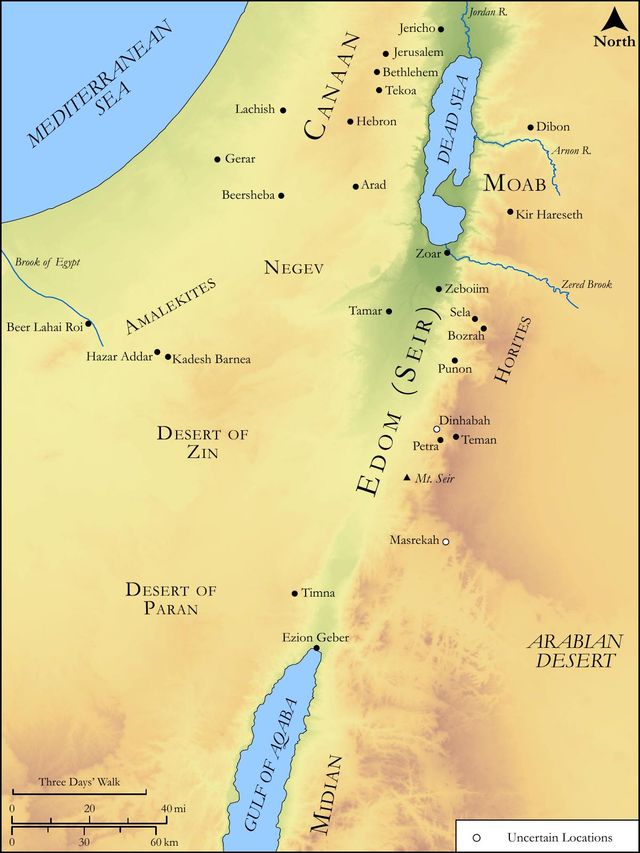
See on the biblical-era maps


Study this verse
Public-domain commentary
Matthew Henry
From his Commentary on the Whole Bible. Henry comments on passages, not single verses — this entry covers Genesis 36:31–43.
By degrees, it seems, the Edomites wormed out the Horites, obtained full possession of the country, and had a government of their own. 1. They were ruled by kings, who governed the whole country, and seem to have come to the throne by election, and not by lineal descent; so bishop Patrick observes. These kings reigned in Edom before there reigned any king over the children of Israel, that is, before Moses's time, for he was king in Jeshurun, Gen 36:3. God had lately promised Jacob that kings should come out of his loins (Gen 35:11), yet Esau's blood becomes royal long before any of Jacob's did. Note, In external prosperity and honour, the children of the covenant are often cast behind, and those that are out of covenant get the start. The triumphing of the wicked may be quick, but it is short; soon ripe, and as soon rotten: but the products of the promise, though they are slow, are sure and lasting; at the end it shall speak, and not lie. We may suppose it was a great trial to the faith of God's Israel to hear of the pomp and power of the kings of Edom, while they were bond-slaves in Egypt; but those that look for great things from God must be content to wait for them; God's time is the best time. 2. They were afterwards governed by dukes, again here named, who, I suppose, ruled all at the same time in several places in the country. Either they set up this form of government in conformity to the Horites, who had used it (Gen 36:29), or God's providence reduced them to it, as some conjecture, to correct them for their unkindness to Israel, in refusing them a passage though their country, Num 20:18. Note, When power is abused, it is just with God to weaken it, by turning it into divers channels. For the transgression of a land, many are the princes thereof. Sin brought Edom from kings to dukes, from crowns to coronets. We read of the dukes of Edom (Exo 15:15), yet, long afterwards, of their kings again. 3. Mount Seir is called the land of their possession, Gen 36:43. While the Israelites dwelt in the house of bondage, and their Canaan was only the land of promise, the Edomites dwelt in their own habitations, and Seir was in their possession. Note, The children of this world have their all in hand, and nothing in hope (Luk 16:25); while the children of God have their all in hope, and next to nothing in hand. But, all things considered, it is better to have Canaan in promise than mount Seir in possession.
Continue studying Genesis 36:36 across the web’s major study libraries — every link below opens this exact verse, chapter, or book on the destination site.
Read & Compare
 BibleGatewayThis verse in more than 200 translations and 70 languages.
 Bible.comThe YouVersion reader — hundreds of translations, reading plans, and highlights.
 ESV.orgCrossway's official English Standard Version reader.
 NET BibleThe NET translation with 60,000+ translators' notes on every rendering decision.
 STEP BibleTyndale House's free study tool — original text, vocabulary, and scholarly resources.
 BibliaLogos Bible Software's free web reader.
 USCCBThe New American Bible (Revised Edition) with the U.S. bishops' study notes.
Commentaries
 BibleHub CommentariesDozens of classic commentaries on this verse, gathered on one page.
 StudyLightMore than 100 commentary sets — the largest collection on the web.
 BibleRefPlain-English commentary on what this verse means, verse by verse.
 Enduring WordDavid Guzik's free commentary on this chapter, widely used by Bible teachers.
 Bible Study ToolsVerse commentary alongside Greek and Hebrew study aids.
Original Language & Research
- BibleHub InterlinearThe verse word by word — original language, transliteration, and English.
- BibleHub LexiconEvery word's original-language definition and Strong's entry.
 Blue Letter BibleDeep-study tools — Strong's numbers, concordance, and word studies.
 SefariaThe Hebrew text with Rashi and centuries of Jewish commentary.
Sermons, Hymns & Audio


TrulyRandomVerse is not affiliated with these sites and doesn’t control their content. They’re linked because they’re genuinely useful.
Summary
Genesis 36:36 succinctly records a pivotal moment in the lineage of Esau, detailing the death of King Hadad and the subsequent ascension of Samlah of Masrekah to the Edomite throne. This brief historical entry, embedded within the extensive genealogies of Esau, serves as a stark reminder of universal human mortality and the continuous cycle of earthly leadership, while implicitly testifying to God's meticulous sovereign orchestration of all nations and the precise unfolding of His historical purposes, even among those outside the direct covenant line.
Context
ShowHideLiterary Context
Genesis chapter 36 is an extensive genealogical record, primarily focusing on Esau (also known as Edom) and his descendants. This chapter meticulously charts the chiefs and kings who ruled in the land of Edom, providing a detailed account of the nation's early formation and political structure. Verse 36 specifically details a royal succession within this Edomite line, following the list of "kings that reigned in the land of Edom, before there reigned any king over the children of Israel" (Genesis 36:31). This particular verse, along with others in the sequence, underscores the reality of a stable, successive monarchy in Edom long before Israel established its own kingdom, providing a historical framework for understanding future interactions between the two nations. The inclusion of such specific details highlights the Bible's commitment to historical accuracy and its comprehensive scope in recording the histories of peoples beyond just the covenant line.
Historical & Cultural Context
The Edomites were descendants of Esau, Jacob's twin brother, whose territory was primarily in the mountainous region south-east of the Dead Sea, known as Seir. This region was strategically important, controlling trade routes, and its inhabitants developed a sophisticated societal structure, including a monarchy, earlier than many surrounding peoples. The mention of specific kings and their hometowns (like Masrekah) grounds the narrative in concrete geographical and political realities of the land of Edom. The succession of kings was a common feature of ancient monarchies, often involving a peaceful transfer of power upon a king's death, or sometimes violent usurpation. The concise recording of "Hadad died, and Samlah... reigned in his stead" suggests a normative, perhaps peaceful, transition, typical of established royal lines. This early establishment of a monarchy among the Edomites contrasts sharply with Israel's later, divinely appointed monarchy, as seen in the narratives of 1 Samuel.
Key Themes
ShowHideGenesis 36:36 contributes to several key themes within the broader book of Genesis and the Pentateuch. Firstly, it reinforces the theme of Divine Sovereignty, demonstrating God's oversight not only of His chosen people, Israel, but also of other nations, including their political structures and successions. The meticulous record of Edomite kings shows God's comprehensive knowledge and control over the unfolding of human history, even for those outside the direct covenant line of Abraham, fulfilling the prophecy that Esau would become a great nation. Secondly, the verse highlights the Universal Reality of Mortality and the Transience of Earthly Power. Even kings, wielding immense authority, are subject to death, underscoring that all human life and power are temporary. This theme is echoed throughout Scripture, from the earliest narratives to the wisdom literature, reminding humanity of its finite nature and the ultimate authority of God (e.g., Psalm 90:3-10). Finally, it speaks to the Continuity of History and God's Plan, illustrating that while individuals and leaders pass away, the divine plan continues unbroken, with one era giving way to the next within the framework of God's enduring providence.
Exposition and Analysis
ShowHideGenesis 36:36 offers a concise yet profound statement regarding the Edomite monarchy: "And Hadad died, and Samlah of Masrekah reigned in his stead."
Key Word Analysis
ShowHideThis name, likely of foreign origin, identifies the specific king whose reign concludes. The Strong's data notes its connection to an idol and several Edomite kings, suggesting its significance within the region. In this context, it simply names the individual whose life and rule came to an end.
A primitive root verb meaning "to die" (literally or figuratively), or causatively, "to kill." In this verse, it signifies the cessation of life and, by extension, the end of Hadad's reign. This word is a stark reminder of the universal human condition, that all, regardless of status, are subject to death.
A primitive root meaning "to reign" or, inceptively, "to ascend the throne." This verb denotes the exercise of royal authority and the establishment of a new monarch. Its use here signifies the transfer of power and the continuation of the Edomite monarchy through Samlah.
Verse Breakdown
ShowHide"And Hadad died"
This opening clause is a blunt declaration of mortality. It signifies the end of a specific reign and a specific life. In the context of a genealogical list of kings, it marks the completion of one monarch's contribution to the nation's history, emphasizing the finite nature of human authority and existence. The simplicity of the statement belies its profound theological implications regarding life, death, and the transience of all earthly power.
"and Samlah of Masrekah reigned in his stead"
This clause immediately introduces the successor and the continuity of the Edomite monarchy. "Samlah" is the name of the new king, and "Masrekah" serves as a geographical identifier, likely indicating his origin, tribal affiliation, or perhaps the location of his capital city within Edomite territory. This detail anchors the biblical narrative in specific historical and geographical realities, affirming the historicity of these accounts and providing a concrete link to the nations of that day. The phrase "reigned in his stead" explicitly states the transfer of power and the continuation of the royal line.
Literary Devices
ShowHideThe brevity and directness of Genesis 36:36 employ several literary devices. The primary device is Conciseness, where a momentous event—the death of a king and the succession of another—is conveyed in a remarkably terse manner. This brevity, characteristic of genealogical records, serves to advance the narrative efficiently, focusing on the lineage rather than the drama of individual reigns. The verse also functions as a form of Memento Mori, a reminder of the universality of death, even for those in positions of power. The repeated structure of king-died-successor-reigned throughout Genesis 36 acts as a subtle form of Repetition or Patterning, reinforcing the theme of continuous succession and the passing of generations. Finally, the inclusion of a specific place name, "Masrekah," serves as a Geographical Anchor, grounding the narrative in a verifiable historical and geographical reality, enhancing the sense of authenticity and historical truth within the biblical record.
Theological and Thematic Connections
ShowHideGenesis 36:36, though brief, offers rich theological and thematic insights. It implicitly asserts God's overarching Divine Sovereignty over all nations, not just Israel. The meticulous recording of Edomite kings, their lives, and their successions, demonstrates that God orchestrates the rise and fall of leaders and kingdoms, even those seemingly outside His direct covenant focus. This highlights His comprehensive involvement in all of human history, assuring us that His grand plan will unfailingly come to fruition, regardless of individual human lifespans or political shifts. The stark declaration "Hadad died" serves as a profound theological truth about Universal Mortality and the Transience of Earthly Power. No earthly position, however exalted, exempts one from death, urging a focus on eternal realities over temporal achievements. The continuity of leadership, with Samlah reigning in Hadad's stead, reflects God's faithfulness in sustaining His purposes through changing generations and leaders, illustrating that while individuals pass away, God's overarching plan and purposes continue unbroken.
Reflection and Application
ShowHideFrom this brief historical note in Genesis 36:36, we can glean several enduring truths relevant for contemporary reflection and application. The simple declaration that "Hadad died" serves as a powerful reminder of the transience of all earthly life and power. It encourages humility, prompting us to hold lightly to worldly positions, prestige, and possessions, and instead to invest in what is eternal. Our lives, like Hadad's reign, are finite, and our ultimate legacy is not found in earthly accomplishments or titles, but in our relationship with God and our obedience to His will. Furthermore, the continuity of leadership, with Samlah reigning in Hadad's stead, reflects God's faithfulness in sustaining His purposes through changing generations and leaders. This assures us that even in times of transition or uncertainty, God remains on His throne, actively working out His plan. We are called to trust in His unchanging nature and His sovereign control over all history, finding peace in the knowledge that His kingdom is eternal, unlike the fleeting reigns of human monarchs. This perspective fosters a deeper reliance on divine providence rather than human strength or political stability.
Questions for Reflection
ShowHideFAQ
ShowHideWhy does the Bible meticulously record the kings of Edom?
ShowHideThe Bible meticulously records the kings of Edom primarily to demonstrate the fulfillment of God's prophecy that Esau would become a great nation with kings, as stated in Genesis 17:6 and implicitly reiterated in Genesis 36:31. This detailed record also showcases God's sovereign oversight of all nations, not just Israel, and provides a crucial historical backdrop for future interactions, conflicts, and prophecies concerning Israel and Edom throughout the biblical narrative, such as in Numbers 20:14-21.
What is the significance of "Masrekah" in this verse?
ShowHide"Masrekah" is a geographical place name, likely indicating the specific origin, capital city, or tribal affiliation of King Samlah within the territory of Edom. Its inclusion provides historical and geographical specificity, anchoring the biblical account in the verifiable realities of Edom and its kings. Such details lend credence to the historical accuracy of the biblical narrative, demonstrating that these are not mythical tales but accounts rooted in real places and real people. While its exact location is debated by modern scholars, its mention serves to particularize the historical record.
Christ-Centered Fulfillment
ShowHideThe transient nature of Hadad's reign and the subsequent succession of Samlah, like all earthly kingships recorded in history, ultimately points to the eternal and perfect reign of Jesus Christ. While human kings rise and fall, subject to mortality, limitations, and the imperfections of their rule, Christ's kingdom is everlasting, and His dominion knows no end. Every earthly succession, even in a non-covenant nation like Edom, serves as a shadow or a stark contrast to the ultimate, unbroken, and righteous reign of the Messiah. The meticulous historical record, including the details of Edomite kings, testifies to God's sovereign plan unfolding throughout history, a plan that culminates in the establishment of Christ's eternal kingdom. He is the true King of kings, whose reign is not limited by death or succession, but is everlasting, bringing true justice, peace, and life to all who believe, as prophesied in Isaiah 9:6-7 and affirmed in the New Testament (e.g., Revelation 11:15). Unlike Hadad, who "died," Jesus Christ conquered death, rising to reign forever, offering eternal life to His subjects (John 11:25-26).