


Ezra 8:5
Bible text: King James Version (1769 Blayney text) · Public domain
Bible text: Berean Standard Bible · Public domain
Bible text: American Standard Version (1901) · Public domain
Bible text: World English Bible, Messianic edition · Public domain
Bible text: Geneva Bible (1599) · Public domain
Bible text: Young's Literal Translation · Public domain
- מִבְּנֵיmi·be·Neiof [the] descendants ofH1121Prep-m ¦ N-mpcNoun Plural Masculine Constructמִofבְּנֵי[the] descendants of
- שְׁכַנְיָהshe·khan·YahShecaniahH7935N-proper-mNoun Proper Masculine
- בֶּןben[the] son ofH1121N-mscNoun Singular Masculine Construct
- יַחֲזִיאֵלya·cha·zi·'ElJahazielH3166N-proper-mNoun Proper Masculine
- וְעִמּוֹve·'i·Moand with himH5973Conj-w ¦ Prep ¦ 3msPrepositionוְandעִמּwithוֹhim
- שְׁלֹשׁshe·Losh[were] threeH7969Adj-cscAdjective Numerical Singular common gender Construct
- מֵאוֹתme·'othundred<s>H3967Adj-fpAdjective Numerical Plural Feminine Absolute
- הַזְּכָרִיםha·ze·kha·Rimthe malesH2145Art ¦ Adj-mpAdjective Plural Masculine Absoluteהַtheזְּכָרִיםmales
- זַתּוּאza·Tu'ZattuH2240N-proper-mNoun Proper Masculine
English is a literal word-by-word gloss of the Hebrew, not the KJV's wording. Why?
This is the original text the KJV's translators worked from — each Hebrew word with its own literal English meaning in this verse, prepared by scholars at Tyndale House, Cambridge. The KJV translates whole sentences, not word by word, so its wording differs: one Hebrew word can become several English words, and the KJV may choose “the LORD” where the gloss reads “Yahweh”. Both are faithful — they answer different questions. For the KJV's own rendering, switch to the KJV text.
Details
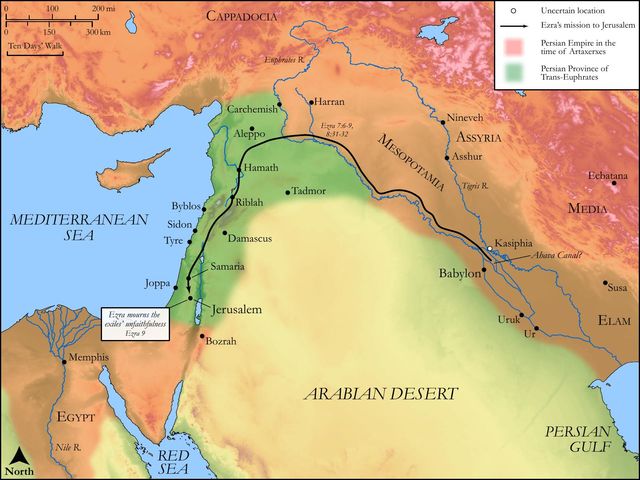
See on the biblical-era map
Study this verse
Public-domain commentary
Matthew Henry
From his Commentary on the Whole Bible. Henry comments on passages, not single verses — this entry covers Ezra 8:1–20. His two-level outline is real structure in the source text, so it is rendered as structure.
Ezra, having received his commission from the king, beats up for volunteers, as it were, sets up an ensign to assemble the outcasts of Israel and the dispersed of Judah, Isa 11:12. "Whoever of the sons of Sion, that swell with the daughters of Babylon, is disposed to go to Jerusalem, now that the temple there is finished and the temple-service set a-going, now is their time." Now one would think that under such a leader, with such encouragements, all the Jews should at length have shaken themselves from their dust, and loosed the bands of their neck, according to that call, Isa 52:1, Isa 52:2, etc. I wonder how any of them could read that chapter and yet stay behind. But multitudes did. They loved their ease better than their religion, thought themselves well off where they were, and either believed not that Jerusalem would better their condition or durst not go thither through any difficulties. But here we are told,
I.That some offered themselves willingly to go with Ezra.
The heads of the several families are here named, for their honour, and the numbers of the males that each brought in, amounting in all to 1496. Two priests are named (Ezr 8:2) and one of the sons of David; but, it should seem, they came without their families, probably intending to see how they liked Jerusalem and then either to send for their families or return to them as they saw cause. Several of their families, or clans, here named, we had before, ch. 2. Some went up from them at that time, more went up now, as God inclined their hearts; some were called into the vineyard at the third hour, others not till the eleventh, yet even those were not rejected. But here we read of the last sons of Adonikam (Ezr 8:13), which some understand to their dispraise, that they were the last that enlisted themselves under Ezra; I rather understand it to their honour, that now all the sons of that family returned and none staid behind.
II.That the Levites who went in this company were in a manner pressed into the service.
Ezra appointed a general rendezvous of all his company at a certain place upon new-year's day, the first day of the first month. Ezr 7:9. Then and there he took a view of them, and mustered them, and (which was strange) found there none of the sons of Levi, Ezr 8:15. Some priests there were, but no others that were Levites. Where was the spirit of that sacred tribe? Ezra, a priest, like Moses proclaims, Who is on the Lord's side? They, unlike to Levi, shrink, and desire to abide among the sheep-folds to hear the bleatings of the flock. Synagogues we suppose they had in Babylon, in which they prayed, and preached, and kept sabbaths (and, when they could not have better, they had reason to be thankful for them); but now that the temple at Jerusalem was opened, to the service of which they were ordained, they ought to have preferred the gates of Zion before all those synagogues. It is upon record here, to their reproach; but tell it not in Gath. Ezra, when he observed that he had no Levites in his retinue, was much at a loss. He had money enough for the service of the temple, but wanted men. The king and princes had more than done their part, but the sons of Levi had not half done theirs. Eleven men, chief men, and men of understanding, he chooses out of his company, to be employed for the filling up of this lamentable vacancy; and here we are informed,
1.Of their being sent. Ezra sent them to a proper place, where there as a college of Levites, the place Casiphia, probably a street or square in Babylon allowed for that purpose - Silver Street one may call it, for ceseph signifies silver. He sent them to a proper person, to Iddo, the chief president of the college, not to urge him to come himself (we will suppose him to be old and unfit for such a remove), but to send some of the juniors, ministers for the house of our God, Ezr 8:17. The furnishing of God's house with good ministers is a good work, which will redound to the comfort and credit of all that have a hand in it.
2.Of their success. They did not return without their errand, but, though the warning was short, they brought about forty Levites to attend Ezra, Sherebiah, noted as a very intelligent man, and eighteen with him (Ezr 8:18). Hashabiah, and Jeshaiah, and twenty with them, Ezr 8:19. By this it appears that they were not averse to go, but were slothful and inattentive, and only wanted to be called upon and excited to go. What a pity it is that good men should omit a good work, merely for want of being spoken to! What a pity that they should need it, but, if they do, what a pity that they should be left without it! Of the Nethinim, the servitors of the sacred college, the species infima - the lowest order of the temple ministers, more appeared forward to go than of the Levites themselves. Of them 220, upon this hasty summons, enlisted themselves, and had the honour to be expressed by name in Ezra's muster-roll, Ezr 8:20. "Thus," says Ezra, "were we furnished with Levites, by the good hand of our God upon us." If, where ministers have been wanting, the vacancies are well supplied, let God have the glory, and his good hand be acknowledged as qualifying them for the service, inclining them to it, and then opening a door of opportunity for them.
Continue studying Ezra 8:5 across the web’s major study libraries — every link below opens this exact verse, chapter, or book on the destination site.
Read & Compare
 BibleGatewayThis verse in more than 200 translations and 70 languages.
 Bible.comThe YouVersion reader — hundreds of translations, reading plans, and highlights.
 ESV.orgCrossway's official English Standard Version reader.
 NET BibleThe NET translation with 60,000+ translators' notes on every rendering decision.
 STEP BibleTyndale House's free study tool — original text, vocabulary, and scholarly resources.
 BibliaLogos Bible Software's free web reader.
 USCCBThe New American Bible (Revised Edition) with the U.S. bishops' study notes.
Commentaries
 BibleHub CommentariesDozens of classic commentaries on this verse, gathered on one page.
 StudyLightMore than 100 commentary sets — the largest collection on the web.
 BibleRefPlain-English commentary on what this verse means, verse by verse.
 Enduring WordDavid Guzik's free commentary on this chapter, widely used by Bible teachers.
 Bible Study ToolsVerse commentary alongside Greek and Hebrew study aids.
Original Language & Research
- BibleHub InterlinearThe verse word by word — original language, transliteration, and English.
- BibleHub LexiconEvery word's original-language definition and Strong's entry.
 Blue Letter BibleDeep-study tools — Strong's numbers, concordance, and word studies.
 SefariaThe Hebrew text with Rashi and centuries of Jewish commentary.
Sermons, Hymns & Audio


TrulyRandomVerse is not affiliated with these sites and doesn’t control their content. They’re linked because they’re genuinely useful.
Summary
Ezra 8:5 is a concise yet profoundly significant entry within the meticulous roster of Jewish families and their leaders who accompanied Ezra on the second major return from Babylonian exile to Jerusalem. This verse specifically identifies a contingent "Of the sons of Shechaniah" led by "the son of Jahaziel," noting that this particular family group comprised three hundred males. It underscores the vital importance of meticulous record-keeping for the post-exilic community, highlighting the ordered, purposeful, and divinely orchestrated nature of Israel's restoration.
Context
ShowHideLiterary Context
Ezra 8:5 is situated within a crucial section (Ezra 8:1-14) that meticulously lists the heads of ancestral houses and the number of males accompanying them on the second major return to Jerusalem from Babylonian exile. This detailed enumeration immediately follows Ezra's account of his divine commission by King Artaxerxes to lead this return and enforce the Law of God in Judah (Ezra 7). The precision of these records serves as a vital historical and theological testament, demonstrating the organized and purposeful nature of this spiritual endeavor. It sets the stage for the arduous journey itself, emphasizing the human commitment and divine orchestration required for the rebuilding of Jerusalem, the Temple, and the spiritual life of the nation. The meticulousness of these records reflects the paramount importance of identity, lineage, and accountability within the returning community, laying a foundational administrative and spiritual framework for the re-establishment of Israelite society.
Historical & Cultural Context
The return described in Ezra 8 occurred in the seventh year of King Artaxerxes I (circa 458 BC), approximately 80 years after the initial return led by Zerubbabel and Jeshua. The Jewish people had endured seventy years of exile in Babylon, a period precisely prophesied by Jeremiah (e.g., Jeremiah 29:10). Persian imperial policy, initiated by Cyrus the Great, generally permitted conquered peoples to return to their homelands and rebuild their temples, a strategy designed to foster stability within the vast empire. For the Jews, however, this was not merely a political concession but a profound fulfillment of divine promise and covenant faithfulness. Genealogies and meticulous record-keeping were absolutely paramount in ancient Israelite society, serving to establish tribal identity, verify claims to land, ensure proper inheritance, and, critically, confirm priestly and Levitical lineage for temple service (as explicitly seen in Ezra 2:62). The journey itself was fraught with danger, making the commitment of these "males" a significant act of faith, courage, and dedication to God's redemptive plan for His people.
Key Themes
ShowHideEzra 8:5 contributes to several overarching themes within the book of Ezra and the broader post-exilic narrative, highlighting God's faithfulness and the community's response. Firstly, it underscores Meticulous Record-Keeping and Genealogy, emphasizing the divine and human importance of lineage and identity. The detailed enumeration, including specific names like Shechaniah and Jahaziel, was crucial for maintaining tribal distinctions, verifying claims, and ensuring proper temple service, reflecting God's attention to order and the identity of His covenant people. This is further reinforced by the challenges faced by those whose lineage was uncertain, as noted in Ezra 2:59-63. Secondly, this verse powerfully illustrates Divine Providence and Human Organization. While the return was undeniably divinely orchestrated, Ezra's meticulous cataloging of participants demonstrates the practical and responsible steps taken by human leaders to ensure a successful and orderly journey. This partnership between God's sovereign will and human responsibility is a recurring motif throughout the book, from the decree of Cyrus (Ezra 1:1-4) to Ezra's own preparations (Ezra 7:6-10). Finally, this verse, as part of the larger list of returnees, powerfully contributes to the overarching theme of Restoration and Renewal. Each name and number represents families committed to rebuilding Jerusalem, the temple, and the spiritual life of the nation after generations in captivity, embodying the enduring hope of a renewed covenant relationship with God (Ezra 9:8-9).
Exposition and Analysis
ShowHideKey Word Analysis
ShowHideDerived from a root meaning "to build," this word primarily denotes a "son" but is used in the widest sense to include descendants, members of a family or clan, or even those belonging to a particular group or condition. In Ezra 8:5, "sons of Shechaniah" signifies not merely direct offspring but the entire family or clan originating from Shechaniah, emphasizing their collective identity and continuity through generations, particularly as they participated in the rebuilding of the community.
This personal name, meaning "Jah has dwelt" or "Dweller with Yah," appears multiple times in the Old Testament, often associated with prominent families or priestly lines. In this context, it identifies a foundational ancestor or the head of a significant family line that persisted through the Babylonian exile and remained committed to their heritage and the call to return. The name itself carries a theological resonance, suggesting a family whose identity was tied to God's abiding presence among His people, even during their diaspora.
Meaning "beheld of God" or "God sees," Jahaziel is presented here as a direct descendant or a prominent leader within the family of Shechaniah. The name is evocative, perhaps hinting at divine oversight or recognition of this individual's specific role in the return. While not as famous as other biblical figures, his inclusion by name emphasizes the personal nature of God's involvement in the lives of those who participated in His redemptive plan, acknowledging their specific contributions to the restoration.
This term, properly meaning "remembered" or "noteworthy," refers to a male (of man or animals), often implying the most noteworthy or productive sex in Hebrew thought. Its specification here is significant; in Israel, especially for journeys or communal undertakings, it referred to adult men capable of contributing labor, defense, and leadership. This count would typically exclude women, children, and the elderly, focusing on the productive and protective strength of the returning contingent, highlighting the physical and logistical capacity brought by each family unit for the arduous journey and the subsequent rebuilding efforts in Jerusalem.
Verse Breakdown
ShowHide"Of the sons of Shechaniah;"
This phrase establishes the primary family or clan identification for the group. The idiom "sons of" (Hebrew: בְּנֵי, b'nei) in biblical usage refers not only to direct offspring but broadly to descendants, members of a particular family, clan, or even a professional group. Here, it indicates that the subsequent individual, Jahaziel, belongs to or represents the household originating from Shechaniah, establishing a clear line of family affiliation that was central to Israelite society and religious practice, particularly in the post-exilic period where lineage was crucial for identity and privilege.
"the son of Jahaziel,"
This clause specifies the individual leader or representative of this particular branch of the Shechaniah family. While the King James Version translates it as "the son of Jahaziel," suggesting Jahaziel is the father, a more common understanding in such lists is that "Jahaziel" is the individual head of the household, and the phrase "the son of" (or "of the sons of") refers to his ancestral line through Shechaniah. Regardless of the precise genealogical relationship, it pinpoints the individual responsible for leading this contingent, underscoring the importance of designated leadership in Ezra's meticulously organized return.
"and with him three hundred males."
This final clause provides the quantitative detail of the contingent led by Jahaziel. The number "three hundred" represents a substantial group of adult men, signifying a significant contribution to the overall strength and workforce of the returning exiles. This precise enumeration highlights Ezra's meticulous record-keeping and the tangible commitment of these families to the perilous journey and the monumental task of rebuilding Jerusalem and the temple, emphasizing the collective effort required for national restoration.
Literary Devices
ShowHideThe primary literary device at play in Ezra 8:5, and indeed throughout Ezra 8:1-14, is Genealogy and List-Making. This meticulous enumeration of family heads and the number of males accompanying them serves multiple crucial purposes. It provides historical authenticity and verifiable data, grounding the narrative in concrete reality and demonstrating the historical veracity of the return. Furthermore, it underscores the profound importance of Identity and Lineage within the Israelite community, which were crucial for maintaining tribal distinctions, verifying priestly claims, and ensuring proper inheritance and social order after the disruption of exile. The repetitive structure of these entries also creates a powerful sense of Order and Deliberation, emphasizing the careful planning, human commitment, and divine orchestration behind the return. While seemingly a dry administrative record, this detailed listing subtly communicates God's attention to individual lives within His grand redemptive plan, ensuring that no one committed to His purposes is overlooked and that the community's restoration is built on a foundation of known and accounted-for individuals.
Theological and Thematic Connections
ShowHideEzra 8:5, though a simple genealogical entry, powerfully illustrates several profound theological truths. It highlights God's meticulous care for His covenant people, demonstrating that even in a large-scale historical movement, individual families and their contributions are known and valued by Him. The emphasis on lineage and the careful counting of individuals underscore the divine importance of identity and belonging within God's chosen community. This verse reminds us that God's grand narrative of redemption often unfolds through the specific, sometimes seemingly mundane, details of individual lives and family histories, each playing a vital role in His overarching purposes. It also speaks to the necessary human organization and commitment that partners with divine providence in the outworking of God's will, revealing a God who calls His people to active participation in His plans.
Reflection and Application
ShowHideEzra 8:5 invites us to consider the profound significance of seemingly small details in God's larger plan. Just as Ezra meticulously recorded each family and their contribution to the return, so too does God value every individual and their unique role in His kingdom. This verse encourages us to embrace our own identity within the family of God, recognizing that our lineage, whether physical or spiritual, connects us to a rich heritage of faith and a divine purpose. It challenges us to approach our callings with diligence, accountability, and a spirit of cooperation, understanding that our participation, no matter how humble, contributes to the grand narrative of God's redemptive work in the world. Furthermore, the faithfulness of families like Shechaniah's, who endured generations of exile and still committed to the perilous journey back to Jerusalem, serves as a powerful testament to generational faithfulness and the enduring hope of restoration. We are called to be faithful stewards of the legacy passed down to us, actively participating in God's ongoing work of rebuilding and renewal in our own time and context, trusting that our names, too, are known and valued by the Divine Architect.
Questions for Reflection
ShowHideFAQ
ShowHideWhy is such a detailed list of names and numbers important in the Bible, especially in a book like Ezra?
ShowHideDetailed lists of names, genealogies, and numbers, like the one found in Ezra 8:1-14, serve several crucial and multifaceted purposes within the biblical narrative. Firstly, they establish historical authenticity and provide verifiable records, grounding the biblical account in real events and people, demonstrating its reliability. Secondly, for the Israelite community, these lists were vital for maintaining tribal distinctions, verifying lineage (especially for priestly and Levitical service, as explicitly seen in Ezra 2:62), confirming land inheritance, and ensuring proper social and religious order after the disruption of exile. Theologically, such meticulous detail underscores God's personal knowledge and meticulous attention to every individual involved in His redemptive plans. They demonstrate that God's grand purposes unfold not just through sweeping historical movements but also through the specific lives and contributions of individuals and families, emphasizing His intimate care for each person within the larger covenant community and ensuring that their commitment is recognized and remembered.
Christ-Centered Fulfillment
ShowHideWhile Ezra 8:5 is a historical record of Old Testament lineage and a physical return, it finds its ultimate Christ-centered fulfillment in the person and work of Jesus and the spiritual family He establishes. The meticulous genealogies presented throughout the Old Testament, culminating in lists like Ezra's, underscore the profound importance of physical lineage for the coming of the Messiah, tracing the promised "seed" through Abraham, Isaac, Jacob, and David, as comprehensively detailed in the opening chapters of the Gospels (e.g., Matthew 1:1-17 and Luke 3:23-38). Jesus Christ is the ultimate "son" who perfectly fulfills all the promises made to Israel and to humanity. Furthermore, the concept of a "family" or "sons" returning to their homeland from exile powerfully foreshadows the spiritual return and glorious restoration offered through Christ. Through faith in Him, believers are adopted into God's eternal family, becoming "sons and daughters" of God (e.g., Galatians 3:26-29, Romans 8:14-17). The meticulous counting of individuals in Ezra's day points to God's intimate knowledge and sovereign care for every single member of His new covenant people, the Church, which is the very body of Christ (e.g., 1 Corinthians 12:27). Just as these individuals committed to a perilous physical return, believers are called to a spiritual journey back to God, finding their true home, identity, and eternal inheritance in Christ, who is the ultimate restorer and the head of a new, eternal family (e.g., Hebrews 12:22-24).