


Exodus 7:24
Bible text: King James Version (1769 Blayney text) · Public domain
Bible text: Berean Standard Bible · Public domain
Bible text: American Standard Version (1901) · Public domain
Bible text: World English Bible, Messianic edition · Public domain
Bible text: Geneva Bible (1599) · Public domain
Bible text: Young's Literal Translation · Public domain
- וַיַּחְפְּרוּvai·yach·pe·Ruand they dugH2658Conj-w ¦ V-Qal-ConsecImperf-3mpVerb Qal Consecutive Imperfect 3rd Plural Masculineוַandיַּחְפְּרוּthey dug
- כָלkholallH3605N-mscNoun Singular Masculine Construct
- מִצְרַיִםmitz·Ra·yimEgyptH4713N-properNoun Proper Location
- סְבִיבֹתse·vi·VotaroundH5439N-cpcNoun Plural common gender Construct
- הַיְאֹרhay·'Orthe RiverH2975Art ¦ N-properNoun Proper LocationהַtheיְאֹרRiver
- מַיִםMa·yimwaterH4325N-mpNoun Plural Masculine Absolute
- לִשְׁתּוֹתlish·Totto drinkH8354Prep-l ¦ V-Qal-InfVerb Qal Infinitive Constructלִtoשְׁתּוֹתdrink
- כִּיkiforH3588PrtParticle Conditional
- לֹאlo'notH3808NegParticle Negative
- יָכְלוּya·khe·Luthey were ableH3201V-Qal-Perf-3cpVerb Qal Perfect 3rd Plural common gender
- לִשְׁתֹּתlish·Totto drinkH8354Prep-l ¦ V-Qal-InfVerb Qal Infinitive Constructלִtoשְׁתֹּתdrink
- מִמֵּימֵיmi·mei·Meiany of [the] water ofH4325Prep-m ¦ N-mpcNoun Plural Masculine Constructמִany ofמֵּימֵי[the] water of
- הַיְאֹרhay·'Orthe RiverH2975Art ¦ N-properNoun Proper LocationהַtheיְאֹרRiver
English is a literal word-by-word gloss of the Hebrew, not the KJV's wording. Why?
This is the original text the KJV's translators worked from — each Hebrew word with its own literal English meaning in this verse, prepared by scholars at Tyndale House, Cambridge. The KJV translates whole sentences, not word by word, so its wording differs: one Hebrew word can become several English words, and the KJV may choose “the LORD” where the gloss reads “Yahweh”. Both are faithful — they answer different questions. For the KJV's own rendering, switch to the KJV text.
Details
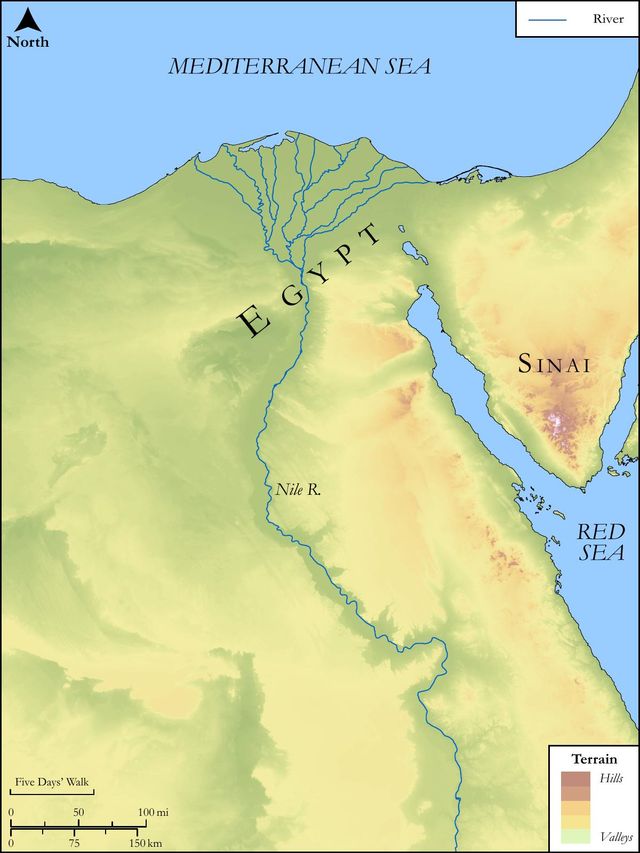
See on the biblical-era maps

Study this verse
Public-domain commentary
Matthew Henry
From his Commentary on the Whole Bible. Henry comments on passages, not single verses — this entry covers Exodus 7:14–25. His two-level outline is real structure in the source text, so it is rendered as structure.
Here is the first of the ten plagues, the turning of the water into blood, which was, 1. A dreadful plague, and very grievous. The very sight of such vast rolling streams of blood, pure blood no doubt, florid and high-colored, could not but strike a horror upon people: much more afflictive were the consequences of it. Nothing more common than water: so wisely has Providence ordered it, and so kindly, that that which is so needful and serviceable to the comfort of human life should be cheap, and almost every where to be had; but now the Egyptians must either drink blood, or die for thirst. Fish was much of their food (Num 11:5), but the changing of the waters was the death of the fish; it was a pestilence in that element (Exo 7:21): The fish died. In the general deluge they escaped, because perhaps they had not then contributed so much to the luxury of man as they have since; but in this particular judgment they perished (Psa 105:29): He slew their fish; and when another destruction of Egypt, long afterwards, is threatened, the disappointment of those that make sluices and ponds for fish is particularly noticed, Isa 19:10. Egypt was a pleasant land, but the noisome stench of dead fish and blood, which by degrees would grow putrid, now rendered it very unpleasant. 2. It was a righteous plague, and justly inflicted upon the Egyptians. For, (1.) Nilus, the river of Egypt, was their idol; they and their land derived so much benefit from it that they served and worshipped it more than the Creator. The true fountain of the Nile being unknown to them, they paid all their devotions to its streams: here therefore God punished them, and turned that into blood which they had turned into a god. Note, That creature which we idolize God justly removes from us, or embitters to us. He makes that a scourge to us which we make a competitor with him. (2.) They had stained the river with the blood of the Hebrews' children, and now God made that river all bloody. Thus he gave them blood to drink, for they were worthy, Rev 16:6. Note, Never any thirsted after blood, but, sooner or later, they had enough of it. 3. It was a significant plague. Egypt had a great dependence upon their river (Zac 14:18), so that in smiting the river they were warned of the destruction of all the productions of their country, till it came at last to their firstborn; and this red river proved a direful omen of the ruin of Pharaoh and all his forces in the Red Sea. This plague of Egypt is alluded to in the prediction of the ruin of the enemies of the New Testament church, Rev 16:3, Rev 16:4. But there the sea, as well as the rivers and fountains of water, is turned into blood; for spiritual judgments reach further, and strike deeper, than temporal judgments do. And, lastly, let me observe in general concerning this plague that one of the first miracles Moses wrought was turning water into blood, but one of the first miracles our Lord Jesus wrought was turning water into wine; for the law was given by Moses, and it was a dispensation of death and terror; but grace and truth, which, like wine, make glad the heart, came by Jesus Christ. Observe,
I.Moses is directed to give Pharaoh warning of this plague.
"Pharaoh's heart is hardened (Exo 7:14), therefore go and try what this will do to soften it," Exo 7:15. Moses perhaps may not be admitted into Pharaoh's presence-chamber, or the room of state where he used to give audience to ambassadors; and therefore he is directed to meet him by the river's brink, whither God foresaw he would come in the morning, either for the pleasure of a morning's walk or to pay his morning devotions to the river: for thus all people will walk, every one in the name of his god; they will not fail to worship their god every morning. There Moses must be ready to give him a new summons to surrender, and, in case of a refusal, to tell him of the judgment that was coming upon that very river on the banks of which they were now standing. Notice is thus given him of it beforehand, that they might have no colour to say it was a chance, or to attribute it to any other cause, but that it might appear to be done by the power of the God of the Hebrews, and as a punishment upon him for his obstinacy. Moses is expressly ordered to take the rod with him, that Pharaoh might be alarmed at the sight of that rod which had so lately triumphed over the rods of the magicians. Now learn hence,
1.That the judgments of God are all known to himself beforehand. He knows what he will do in wrath as well as in mercy. Every consumption is a consumption determined, Isa 10:23.
2.That men cannot escape the alarms of God's wrath, because they cannot go out of the hearing of their own consciences: he that made their hearts can make his sword to approach them.
3.That God warns before he wounds; for he is long-suffering, not willing that any should perish, but that all should come to repentance.
II.Aaron (who carried the mace) is directed to summon the plague by smiting the river with his rod, Exo 7:19, Exo 7:20.
It was done in the sight of Pharaoh and his attendants; for God's true miracles were not performed, as Satan's lying wonders were, by those that peeped and muttered: truth seeks no corners. An amazing change was immediately wrought; all the waters, not only in the rivers but in all their ponds, were turned into blood.
1.See here the almighty power of God. Every creature is that to us which he makes it to be, water or blood.
2.See the mutability of all things under the sun, and what changes we may meet with in them. That which is water today may be blood tomorrow; what is always vain may soon become vexatious. A river, at the best, is transient; but divine justice can quickly make it malignant.
3.See what mischievous work sin makes. if the things that have been our comforts prove our crosses, we must thank ourselves: it is sin that turns our waters into blood.
III.Pharaoh endeavours to confront the miracle, because he resolves not to humble himself under the plague.
He sends for the magicians, and, by God's permission, they ape the miracle with their enchantments (Exo 7:22), and this serves Pharaoh for an excuse not to set his heart to this also (Exo 7:23), and a pitiful excuse it was. Could they have turned the river of blood into water again, this would have been something to the purpose; then they would have proved their power, and Pharaoh would have been obliged to them as his benefactors. But for them, when there was such scarcity of water, to turn more of it into blood, only to show their art, plainly intimates that the design of the devil is only to delude his devotees and amuse them, not to do them any real kindness, but to keep them from doing a real kindness to themselves by repenting and returning to their God.
IV.The Egyptians, in the mean time, are seeking for relief against the plague, digging round about the river for water to drink, Exo 7:24.
Probably they found some, with much ado, God remembering mercy in the midst of wrath; for he is full of compassion, and would not let the subjects smart too much for the obstinacy of their prince.
V.The plague continued seven days (Exo 7:25), and, in all that time, Pharaoh's proud heart would not let him so much as desire Moses to intercede for the removal of it. Thus the hypocrites in heart heap up wrath; they cry not when he binds them (Job 36:13); and then no wonder that his anger is not turned away, but his hand is stretched out still.
Historical interpretation
Historical reception
1 surviving comment on this verse from the historical church.
You asked … how, when all the water of Egypt was turned into blood, the magicians of Pharaoh found any [water] with which they could transform in like manner. This difficulty is usually solved in two ways. They did it either because some sea water could be brought or, what is more likely, because in that part of the country where the children of Israel were those plagues did not take place. In certain passages of that Scripture this is very clearly expressed, and it warns us what is to be understood even when it is not expressed.
Continue studying Exodus 7:24 across the web’s major study libraries — every link below opens this exact verse, chapter, or book on the destination site.
Read & Compare
 BibleGatewayThis verse in more than 200 translations and 70 languages.
 Bible.comThe YouVersion reader — hundreds of translations, reading plans, and highlights.
 ESV.orgCrossway's official English Standard Version reader.
 NET BibleThe NET translation with 60,000+ translators' notes on every rendering decision.
 STEP BibleTyndale House's free study tool — original text, vocabulary, and scholarly resources.
 BibliaLogos Bible Software's free web reader.
 USCCBThe New American Bible (Revised Edition) with the U.S. bishops' study notes.
Commentaries
 BibleHub CommentariesDozens of classic commentaries on this verse, gathered on one page.
 StudyLightMore than 100 commentary sets — the largest collection on the web.
 BibleRefPlain-English commentary on what this verse means, verse by verse.
 Enduring WordDavid Guzik's free commentary on this chapter, widely used by Bible teachers.
 Bible Study ToolsVerse commentary alongside Greek and Hebrew study aids.
Original Language & Research
- BibleHub InterlinearThe verse word by word — original language, transliteration, and English.
- BibleHub LexiconEvery word's original-language definition and Strong's entry.
 Blue Letter BibleDeep-study tools — Strong's numbers, concordance, and word studies.
 SefariaThe Hebrew text with Rashi and centuries of Jewish commentary.
Sermons, Hymns & Audio


TrulyRandomVerse is not affiliated with these sites and doesn’t control their content. They’re linked because they’re genuinely useful.
Summary
Exodus 7:24 vividly portrays the immediate and devastating impact of the first plague on ancient Egypt, where the life-giving Nile River was miraculously transformed into blood. This verse highlights the desperate measures taken by the Egyptians, who, unable to drink from their primary water source, were forced to dig around the riverbanks in a futile search for potable water. This action underscores the plague's profound disruption of daily life, the nation's utter helplessness before divine judgment, and the direct assault on their most vital resource and a central object of their worship.
Context
ShowHideLiterary Context
This verse immediately follows the dramatic fulfillment of God's command to Moses and Aaron, where Aaron strikes the Nile with his rod, causing all the waters in Egypt to turn to blood (Exodus 7:20). The preceding verses established the initial confrontation between Moses and Pharaoh, Pharaoh's hardened heart, and God's declaration of His intent to demonstrate His power over Egypt's gods (Exodus 7:1-19). Verse 24, therefore, serves as a crucial narrative bridge, illustrating the direct, immediate, and widespread consequences of the plague. It sets the stage for the duration of the plague, which lasted seven days (Exodus 7:25), and the subsequent plagues that would further escalate God's judgment against Pharaoh and Egypt.
Historical & Cultural Context
The Nile River was the absolute lifeblood of ancient Egypt, sustaining its agriculture, transportation, and daily existence. It was not merely a geographical feature but was deeply integrated into their religious worldview, revered as a deity itself, particularly associated with gods like Hapi (god of the Nile's annual inundation and fertility) and Osiris (god of the underworld and fertility, whose body was believed to be the Nile). The transformation of the Nile into blood was thus a direct, targeted assault on the very foundation of Egyptian civilization and their pantheon of gods. The act of "digging round about the river" for water highlights the profound and immediate crisis, as the Egyptians were utterly dependent on the Nile's waters for survival, and alternative sources were either non-existent or quickly contaminated.
Key Themes
ShowHideExodus 7:24 powerfully contributes to several overarching themes within the book of Exodus and the broader Pentateuch. It vividly illustrates the theme of Divine Judgment and Sovereignty, demonstrating God's absolute control over creation and His readiness to judge those who oppress His people and defy His will. The futility of the Egyptians' efforts to find water underscores the Futility of Human Resistance against divine power, contrasting sharply with God's effortless display of might. Furthermore, the plague highlights the Impotence of False Gods, as the revered Nile god and other Egyptian deities were powerless to prevent or reverse the defilement of their most sacred and vital resource, thereby proving the supremacy of the Lord, the God of Israel, over all other alleged gods, a theme echoed throughout the account of the plagues.
Exposition and Analysis
ShowHideKey Word Analysis
ShowHideThis primitive root means "to pry into; by implication, to delve, to explore; dig, paw, search out, seek." The use of this word emphasizes the laborious, desperate, and widespread effort undertaken by the Egyptians. It's not a casual search but an intense, physically demanding act, indicative of their dire need and the complete failure of their usual water sources.
Of Egyptian origin, this term specifically refers to "a channel, e.g. a fosse, canal, shaft; specifically the Nile, as the one river of Egypt, including its collateral trenches." Its repeated use in the verse (and throughout the plague narrative) underscores that the judgment was precisely targeted at the Nile, the very lifeblood and object of worship for the Egyptians, making the impact personal, cultural, and existential.
This primitive root means "to be able, literally (can, could) or morally (may, might)." The negative "could not" (לא יכלו, lo yakhelu) conveys an absolute and utter inability. It signifies that despite all their resources, ingenuity, and desperate efforts, the Egyptians were completely powerless to overcome the divinely imposed crisis, highlighting their helplessness before the Lord's omnipotence.
Verse Breakdown
ShowHide"And all the Egyptians digged round about the river for water to drink"
This clause paints a vivid picture of widespread panic and desperate action. The phrase "all the Egyptians" emphasizes the universal impact of the plague, affecting every segment of society. Their act of "digging round about the river" suggests a frantic, laborious search for any untainted groundwater that might have filtered through the soil, perhaps hoping for shallow wells or pockets of water unaffected by the direct contamination of the main river and its visible tributaries. This demonstrates the immediate and profound disruption to their daily lives and the severity of their thirst.
"for they could not drink of the water of the river."
This second clause provides the stark, undeniable reason for their desperate actions. It underscores the complete and utter defilement of the Nile, rendering it entirely undrinkable. The repetition of "water of the river" emphasizes that their primary, abundant, and life-sustaining source had become unusable, leading to a crisis of survival. This statement highlights the absolute efficacy of God's judgment and the devastating consequences for a nation that had relied so heavily on this particular body of water.
Literary Devices
ShowHideThe verse employs several powerful literary devices to convey its message. Irony is prominent, as the Nile, the very source of life and fertility for Egypt, becomes a source of death and defilement, forcing its inhabitants into a desperate search for water. This reversal of expectation underscores the severity of God's judgment. There is also an element of Hyperbole or vivid description in "all the Egyptians digged round about the river," which, while perhaps not literally every single person, effectively conveys the widespread and frantic nature of the search for water, emphasizing the plague's universal impact. Finally, the narrative employs powerful Symbolism: the turning of the Nile to blood symbolizes not only divine judgment but also the defilement of Egypt's gods and the breaking of their reliance on false sources of life, preparing the way for the recognition of the one true God.
Theological and Thematic Connections
ShowHideExodus 7:24 serves as a profound theological statement, illustrating God's absolute sovereignty over creation and His unwavering commitment to justice. The desperate plight of the Egyptians, driven to dig for water, reveals the futility of human self-reliance and the impotence of false gods when confronted with the power of the Almighty. This plague was not merely a natural disaster but a targeted divine act designed to humble Pharaoh, liberate Israel, and demonstrate to all nations that the Lord alone is God. It underscores that true life and sustenance come only from Him, and defiance leads to desolation.
Reflection and Application
ShowHideExodus 7:24 offers a profound lesson for contemporary believers, reminding us of God's ultimate sovereignty and the consequences of resisting His will. Just as the Egyptians frantically dug for water, we often expend immense energy seeking satisfaction, security, and life from worldly sources that ultimately prove to be empty or defiled. This verse prompts us to examine where we place our trust and derive our sustenance. Are we desperately digging in the dry ground of human effort and worldly pursuits, or are we drawing from the inexhaustible wellspring of God's grace and provision? It calls us to recognize that true life and lasting satisfaction are found only in Christ, the living water, who promises that those who drink of Him will never thirst again (John 4:13-14 and John 7:37-38). The Egyptians' desperation serves as a stark warning against spiritual idolatry and a powerful invitation to turn to the one true God for all our needs.
Questions for Reflection
ShowHideFAQ
ShowHideWhy did the Egyptians dig for water "round about the river" instead of just away from it?
ShowHideThe phrase "round about the river" (Hebrew: סָבִיב, sâbîyb) suggests they were digging shallow wells or attempting to access groundwater in the immediate vicinity of the Nile. This indicates a desperate hope that water filtered through the soil might be untainted by the blood, or that they were trying to tap into the water table that the Nile itself fed. It highlights the profound and widespread nature of the plague, as their usual, easily accessible water sources were completely unusable, forcing them into laborious and increasingly futile efforts for survival.
How long did the plague of blood last?
ShowHideWhile Exodus 7:24 describes the immediate aftermath, Exodus 7:25 explicitly states that "seven days were fulfilled, after that the LORD had smitten the river." This indicates that the plague of blood lasted for a full week, a duration that would have caused immense suffering, widespread thirst, and significant economic disruption, intensifying the Egyptians' desperation and the impact of God's judgment on their daily lives and their very civilization.
What does this plague reveal about God's power over false gods?
ShowHideThis plague directly challenged and humiliated the Egyptian pantheon, particularly the deities associated with the Nile River, which was central to their life and worship. Gods such as Hapi (god of the Nile's annual inundation), Khnum (guardian of the Nile's source), and Osiris (god of the underworld and fertility, whose body was said to be the Nile) were rendered utterly impotent. By turning the very source of Egyptian life and worship into a source of death and defilement, God demonstrated His absolute supremacy over these impotent idols, proving that He alone controls creation and destiny, and that the gods of Egypt were nothing before Him.
Christ-Centered Fulfillment
ShowHideThe desperate search for water in Exodus 7:24 powerfully foreshadows humanity's spiritual thirst and the futility of seeking life and satisfaction from earthly sources or false gods. Just as the Nile, the source of physical life for Egypt, became a source of death and defilement, so too do the world's promises and idols ultimately fail to quench the deepest human longings, leading to spiritual desolation. Christ is presented as the ultimate fulfillment of this profound need, the true "living water" who satisfies spiritual thirst eternally (John 4:10-14 and John 7:37-38). The judgment on the Nile, a symbol of Egyptian power and idolatry, also points to Christ's ultimate victory over all opposing powers and false deities, establishing His reign as the sole source of life, salvation, and true worship. His sacrifice on the cross, where He poured out His blood, ultimately cleanses and provides access to the "river of the water of life" (Revelation 22:1), contrasting sharply with the defiled waters of Egypt and offering eternal sustenance to all who believe.