


Exodus 37:14
Bible text: King James Version (1769 Blayney text) · Public domain
Bible text: Berean Standard Bible · Public domain
Bible text: American Standard Version (1901) · Public domain
Bible text: World English Bible, Messianic edition · Public domain
Bible text: Geneva Bible (1599) · Public domain
Bible text: Young's Literal Translation · Public domain
- לְעֻמַּתle·'u·Mat<to> close toH5980Prep-l ¦ N-fscNoun Singular Feminine Constructלְ<to>עֻמַּתclose to
- הַמִּסְגֶּרֶתha·mis·Ge·retthe rimH4526Art ¦ N-fsNoun Singular Feminine Absoluteהַtheמִּסְגֶּרֶתrim
- הָיוּha·Yuthey wereH1961V-Qal-Perf-3cpVerb Qal Perfect 3rd Plural common gender
- הַטַּבָּעֹתha·ta·ba·'Otthe ringsH2885Art ¦ N-fpNoun Plural Feminine Absoluteהַtheטַּבָּעֹתrings
- בָּתִּיםba·TimholdersH1004N-mpNoun Plural Masculine Absolute
- לַבַּדִּיםla·ba·Dimfor the polesH905Prep-l ¦ N-mpNoun Plural Masculine Absoluteלַfor theבַּדִּיםpoles
- לָשֵׂאתla·Setto carryH5375Prep-l ¦ V-Qal-InfVerb Qal Infinitive Constructלָtoשֵׂאתcarry
- אֶת'et<obj.>H853DirObjMParticle Object Indicator
- הַשֻּׁלְחָןha·shul·Chanthe tableH7979Art ¦ N-msNoun Singular Masculine Absoluteהַtheשֻּׁלְחָןtable
English is a literal word-by-word gloss of the Hebrew, not the KJV's wording. Why?
This is the original text the KJV's translators worked from — each Hebrew word with its own literal English meaning in this verse, prepared by scholars at Tyndale House, Cambridge. The KJV translates whole sentences, not word by word, so its wording differs: one Hebrew word can become several English words, and the KJV may choose “the LORD” where the gloss reads “Yahweh”. Both are faithful — they answer different questions. For the KJV's own rendering, switch to the KJV text.
Details
See on the biblical-era maps

Study this verse
Public-domain commentary
Matthew Henry
From his Commentary on the Whole Bible. Henry comments on passages, not single verses — this entry covers Exodus 37:10–24.
Here is, 1. The making of the table on which the show-bread was to be continually placed. God is a good householder, that always keeps a plentiful table. Is the world his tabernacle? His providence in it spreads a table for all the creatures: he provides food for all flesh. Is the church his tabernacle? His grace in it spreads a table for all believers, furnished with the bread of life. But observe how much the dispensation of the gospel exceeds that of the law. Though here was a table furnished, it was only with show-bread, bread to be looked upon, not to be fed upon, while it was on this table, and afterwards only by the priests; but to the table which Christ has spread in the new covenant all real Christians are invited guests; and to them it is said, Eat, O friends, come eat of my bread. What the law gave but a sight of at a distance, the gospel gives the enjoyment of, and a hearty welcome to. 2. The making of the candlestick, which was not of wood overlaid with gold, but all beaten work of pure gold only, Exo 37:17, Exo 37:22. This signified that light of divine revelation with which God's church upon earth (which is his tabernacle among men) has always been enlightened, being always supplied with fresh oil from Christ the good Olive, Zac 4:2, Zac 4:3. God's manifestations of himself in this world are but candle-light compared with the daylight of the future state. The Bible is a golden candlestick; it is of pure gold, Psa 19:10. From it light is diffused to every part of God's tabernacle, that by it his spiritual priests may see to minister unto the Lord, and to do the service of his sanctuary. This candlestick has not only its bowls for necessary use, but its knops and flowers for ornament; there are many things which God saw fit to beautify his word with which we can no more give a reason for than for these knops and flowers, and yet we are sure that they were added for a good purpose. Let us bless God for this candlestick, have an eye to it continually, and dread the removal of it out of its place.
Continue studying Exodus 37:14 across the web’s major study libraries — every link below opens this exact verse, chapter, or book on the destination site.
Read & Compare
 BibleGatewayThis verse in more than 200 translations and 70 languages.
 Bible.comThe YouVersion reader — hundreds of translations, reading plans, and highlights.
 ESV.orgCrossway's official English Standard Version reader.
 NET BibleThe NET translation with 60,000+ translators' notes on every rendering decision.
 STEP BibleTyndale House's free study tool — original text, vocabulary, and scholarly resources.
 BibliaLogos Bible Software's free web reader.
 USCCBThe New American Bible (Revised Edition) with the U.S. bishops' study notes.
Commentaries
 BibleHub CommentariesDozens of classic commentaries on this verse, gathered on one page.
 StudyLightMore than 100 commentary sets — the largest collection on the web.
 BibleRefPlain-English commentary on what this verse means, verse by verse.
 Enduring WordDavid Guzik's free commentary on this chapter, widely used by Bible teachers.
 Bible Study ToolsVerse commentary alongside Greek and Hebrew study aids.
Original Language & Research
- BibleHub InterlinearThe verse word by word — original language, transliteration, and English.
- BibleHub LexiconEvery word's original-language definition and Strong's entry.
 Blue Letter BibleDeep-study tools — Strong's numbers, concordance, and word studies.
 SefariaThe Hebrew text with Rashi and centuries of Jewish commentary.
Sermons, Hymns & Audio


TrulyRandomVerse is not affiliated with these sites and doesn’t control their content. They’re linked because they’re genuinely useful.
Summary
Exodus 37:14 provides a precise architectural detail of the Table of Showbread within the Tabernacle, specifying the placement of rings "over against the border" to securely hold the carrying staves. This seemingly minor detail is profoundly significant, underscoring the Table's essential portability, a design imperative for the nomadic Israelites. It highlights God's intention to accompany His people through the wilderness, emphasizing both the functional necessity of the Tabernacle's components and the divine precision required in handling and transporting sacred objects, thereby reflecting the holiness of God's dwelling place.
Context
ShowHideLiterary Context
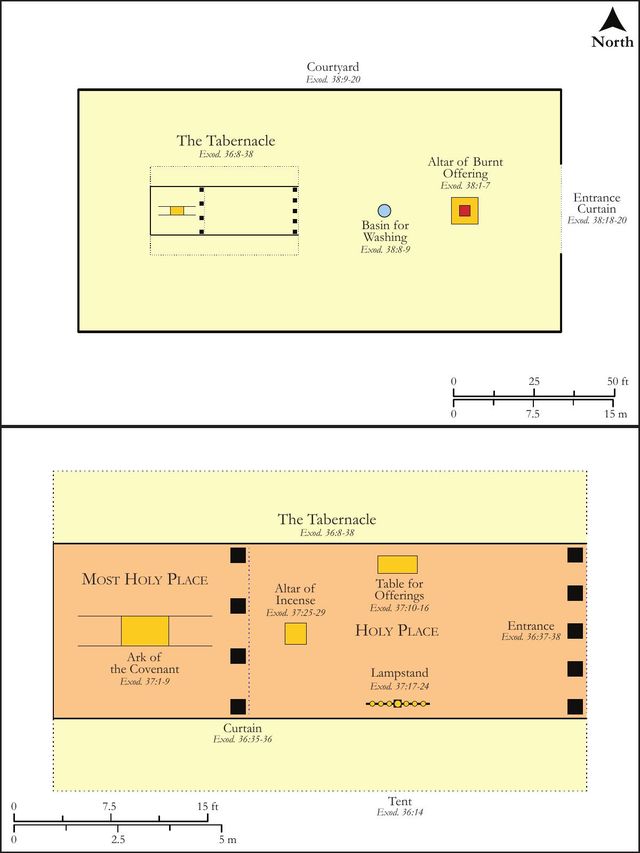
This verse is embedded within the detailed account of the Tabernacle's construction in Exodus 35-40, which meticulously describes the fulfillment of the divine blueprint given to Moses on Mount Sinai in Exodus 25-31. The repetition of instructions, first as command and then as execution, serves to emphasize the Israelites' faithful obedience and the divine origin of every aspect of the sanctuary. Bezalel and Oholiab, divinely endowed with wisdom and skill for this sacred work, oversee the craftsmanship, ensuring adherence to God's precise specifications (as detailed in Exodus 35:30-35). The Table of Showbread, along with the Ark of the Covenant and the Menorah, was positioned in the Holy Place, the initial chamber of the Tabernacle, symbolizing God's provision and light for His people.
Historical & Cultural Context
The construction of the Tabernacle took place during Israel's forty-year sojourn in the wilderness, a period of nomadic existence following their miraculous liberation from Egypt. In this transient environment, a permanent, stationary temple was impractical. Thus, God commanded the construction of a portable sanctuary, a tent that could be disassembled, transported, and reassembled. The design elements, such as the rings and staves described for the Table of Showbread (and similarly for the Ark and Altars), were crucial for facilitating this mobility. This portability profoundly symbolized God's commitment to dwelling among His people and accompanying them on their journey, a stark contrast to the localized, static temples of surrounding pagan nations. The Table, perpetually bearing the "bread of presence," also vividly illustrated God's covenantal provision and sustained fellowship with Israel, a vital theme for a people utterly dependent on divine sustenance in the desert, reminiscent of the miraculous provision of manna found in Exodus 16.
Key Themes
ShowHideExodus 37:14 contributes significantly to several overarching themes within the book of Exodus and the Pentateuch. Primarily, it underscores the theme of Divine Presence and Immanence, demonstrating God's desire to dwell among His people and journey with them, rather than remaining distant. The Tabernacle's portability, facilitated by these carrying mechanisms, is a tangible expression of this dynamic relationship. Secondly, the verse highlights Divine Precision and Holiness. Every detail of the Tabernacle's construction, even the placement of rings, was divinely ordained, emphasizing God's absolute sovereignty and His demand for meticulous obedience and reverence in worship. This precision ensured the holiness of the sacred objects and the proper, reverent handling required, preventing defilement or unauthorized contact, a principle later tragically illustrated in 2 Samuel 6:6-7. Finally, it speaks to God's Provision and Fellowship, as the Table of Showbread itself, which was carried, symbolized God's continuous sustenance and communion with Israel.
Exposition and Analysis
ShowHideKey Word Analysis
ShowHideThis noun (H2885) refers to a circular attachment, loop, or fixture, derived from a root meaning "to sink" (as a seal into wax). In the context of the Tabernacle furnishings, these rings were specifically designed to receive the carrying poles or staves. Their precise placement, as described in this verse, ensured structural integrity and balance during transport, indicating a highly functional and divinely ordained design for mobility.
This noun (H4526) is derived from a root meaning "to shut in" or "to enclose," referring to a frame, rim, or margin. In Exodus 37:14, "over against the border" specifies the exact location where the rings were attached—to the structural and often decorative framework of the table. This detail underscores the meticulousness of the divine blueprint, ensuring that every component was perfectly integrated into the overall design, not merely for aesthetics but for functional stability.
This noun (H905), in its plural form (baddîm), refers to poles, bars, or shafts. These were the long, sturdy poles inserted through the rings of the sacred furnishings, allowing the priests or Levites to carry them without directly touching the holy objects themselves. The use of staves underscored the profound sacredness of the items and the absolute necessity for reverent handling, as direct contact could lead to defilement or even death, a principle later tragically exemplified by Uzzah in 2 Samuel 6:6-7.
Verse Breakdown
ShowHide"Over against the border were the rings"
This clause precisely locates the rings on the Table of Showbread. The phrase "over against" (מִמּוּל, mi-mmūl) implies a position directly opposite or alongside the designated "border" or frame of the table. This divine architectural exactitude ensured structural integrity and proper function, highlighting that the rings were not randomly affixed but strategically integrated into the table's design for its intended portable use.
"the places for the staves"
This clause clarifies the explicit purpose of the rings. They were not merely decorative but served as functional receptacles, specifically designed to accommodate the "staves" or carrying poles. This detail reveals the foresight embedded within the divine blueprint, anticipating the necessity of the table's movement and providing the precise means for its transport. The rings were the divinely ordained interface between the sacred object and its designated carriers.
"to bear the table"
This final phrase articulates the ultimate objective of the rings and staves: to enable the Table of Showbread to be lifted and transported. The verb "to bear" (לָשֵׂאת, lāśēʾt) signifies lifting and carrying. This function was paramount for the Tabernacle, which was designed to be mobile, accompanying the Israelites throughout their wilderness journey. The divinely prescribed means of transport were as sacred as the table itself, emphasizing the holiness of its movement and its continuous presence with God's people.
Literary Devices
ShowHideExodus 37:14, like the broader Tabernacle narrative, masterfully employs Precision and Detail as its primary literary devices. The exhaustive description of every component, down to the exact placement of rings for carrying poles, serves to emphasize the divine origin and perfect order of the Tabernacle. This meticulousness is not merely for architectural accuracy but functions to instill profound reverence and underscore the paramount importance of exact obedience in worship. Furthermore, the rings and staves themselves function as powerful Symbolism for the portability of God's presence. They visually represent the dynamic nature of God's dwelling among His people, demonstrating that He is not confined to a static structure but actively moves with them. The very act of carrying the table, along with other sacred objects, also embodies Ritual Significance, where the prescribed method of handling is as crucial as the object itself, reinforcing the holiness and absolute separation of divine things from the common or profane.
Theological and Thematic Connections
ShowHideExodus 37:14, though a seemingly minor architectural detail, profoundly reinforces several core theological themes vital to understanding God's relationship with Israel. It vividly illustrates God's desire for an intimate, accompanying presence with His people, even in their transient, nomadic state. The inherent portability of the Tabernacle and its sacred furnishings, facilitated by elements like these rings and staves, signifies that God is not a localized, static deity, but one who actively journeys with His covenant community. Moreover, the extreme precision in the divine instructions underscores God's absolute sovereignty and His demand for holiness and exact obedience in worship. Every detail, no matter how small, was divinely ordained and held profound significance, reflecting the perfect order of God's character and His meticulous provision for His people's spiritual and physical sustenance throughout their wilderness journey.
Reflection and Application
ShowHideThe detailed instructions for the rings and staves on the Table of Showbread, while rooted in ancient Israel's wilderness experience, offer profound and enduring lessons for contemporary believers. They serve as a powerful reminder that God's presence is neither static nor confined to physical structures; rather, it is dynamic, personal, and profoundly accompanies His people wherever they go. Just as the Tabernacle was meticulously designed to move with Israel, we, as the New Testament temple of the Holy Spirit, are called to embody and carry God's presence into every sphere of our lives. This demands intentionality in living out our faith, recognizing that our daily activities, relationships, and professional endeavors can all become sacred avenues through which God's transformative presence is made manifest. Furthermore, the meticulousness of the Tabernacle's design challenges us to approach our service to God with diligence, precision, and profound reverence. It is not sufficient merely to "do" ministry; we are called to execute it with excellence, according to God's revealed will, understanding that even the smallest details of our obedience can contribute significantly to the grand tapestry of His divine plan and purpose.
Questions for Reflection
ShowHideFAQ
ShowHideWhy were the rings and staves so important for the Table of Showbread?
ShowHideThe rings and staves were absolutely crucial because they enabled the Table of Showbread, along with other highly sacred Tabernacle furnishings, to be transported. As the Israelites were a nomadic people, journeying through the wilderness for forty years, their central place of worship, the Tabernacle, had to be fully portable. The staves, inserted through the precisely placed rings, allowed the priests or Levites to carry the table without directly touching the holy object itself, thereby preserving its sacredness and preventing defilement, as explicitly commanded by God (see Numbers 4:15). This ingenious design underscored God's unwavering commitment to accompany His people wherever they went, symbolizing His dynamic and ever-present dwelling among them.
Did all the Tabernacle furnishings have rings and staves for carrying?
ShowHideNot all, but the most sacred and significant furnishings that were specifically designated for transport did. Specifically, the Ark of the Covenant (as detailed in Exodus 25:12-15), the Table of Showbread (as described in Exodus 25:26-28), and the Altar of Burnt Offering (as specified in Exodus 27:6-7) were designed with rings and permanently affixed staves. The Menorah, though profoundly sacred, was carried directly or placed on a special litter, as it did not have rings for staves. This distinction highlights the specific requirements and profound reverence for handling different sacred objects according to divine command.
Christ-Centered Fulfillment
ShowHideExodus 37:14, with its meticulous detail concerning the portability of the Table of Showbread, finds its profound Christ-centered fulfillment in the person and work of Jesus Christ. The Table, perpetually bearing the "bread of presence," was a powerful symbol of God's continuous provision and sustained fellowship with His people. Jesus Himself declares, "I am the bread of life; whoever comes to me shall not hunger, and whoever believes in me shall never thirst," thereby revealing Himself as the ultimate divine provision that satisfies spiritual hunger and offers eternal life. Furthermore, just as the Tabernacle was designed to move with Israel, symbolizing God's accompanying presence, Jesus is the ultimate fulfillment of God's portable and accessible presence. Through the Incarnation, God literally "tabernacled" among us (as profoundly stated in John 1:14), making His divine presence tangible and intimately accessible to humanity. After His ascension, Christ sent the Holy Spirit, who now indwells every believer, making each one a "temple of the Holy Spirit" (as taught in 1 Corinthians 6:19). This means that God's presence is no longer confined to a physical structure or carried by external staves, but is carried within us, empowering us to bear His transformative presence into every corner of the world, thereby fulfilling the ultimate purpose and dynamic nature foreshadowed by the portable Tabernacle. The meticulousness of the Tabernacle's design also foreshadows Christ's perfect obedience and His flawless execution of God's redemptive plan, ensuring that every detail of our salvation was perfectly and divinely accomplished.