


2 Kings 16:13
Bible text: King James Version (1769 Blayney text) · Public domain
Bible text: Berean Standard Bible · Public domain
Bible text: American Standard Version (1901) · Public domain
Bible text: World English Bible, Messianic edition · Public domain
Bible text: Geneva Bible (1599) · Public domain
Bible text: Young's Literal Translation · Public domain
- וַיַּקְטֵרvai·yak·Terand he made smokeH6999Conj-w ¦ V-Hiphil-ConsecImperf-3msVerb Hiphil Consecutive Imperfect 3rd Singular Masculineוַandיַּקְטֵרhe made smoke
- אֶת'et<obj.>H853DirObjMParticle Object Indicator
- עֹלָתוֹo·la·Tohis burnt offeringH5930N-fsc ¦ 3msNoun Singular Feminine Constructעֹלָתburnt offeringוֹhis
- וְאֶתve·'Etand <obj.>H853Conj-w ¦ DirObjMParticle Object Indicatorוְandאֶת<obj.>
- מִנְחָתוֹmin·cha·Tohis grain offeringH4503N-fsc ¦ 3msNoun Singular Feminine Constructמִנְחָתgrain offeringוֹhis
- וַיַּסֵּךְvai·ya·Sekhand he poured outH5258Conj-w ¦ V-Hiphil-ConsecImperf-3msVerb Hiphil Consecutive Imperfect 3rd Singular Masculineוַandיַּסֵּךְhe poured out
- אֶת'et<obj.>H853DirObjMParticle Object Indicator
- נִסְכּוֹnis·Kohis drink offeringH5262N-msc ¦ 3msNoun Singular Masculine Constructנִסְכּdrink offeringוֹhis
- וַיִּזְרֹקvai·yiz·Rokand he sprinkledH2236Conj-w ¦ V-Qal-ConsecImperf-3msVerb Qal Consecutive Imperfect 3rd Singular Masculineוַandיִּזְרֹקhe sprinkled
- אֶת'et<obj.>H853DirObjMParticle Object Indicator
- דַּםdam[the] blood ofH1818N-mscNoun Singular Masculine Construct
- הַשְּׁלָמִיםha·she·la·Mimthe peace offeringsH8002Art ¦ N-mpNoun Plural Masculine Absoluteהַtheשְּׁלָמִיםpeace offerings
- אֲשֶׁר'a·SherwhichH834RelParticle Relative
- לוֹlo[belonged] to himPrep-l ¦ 3msSuffix Personal 3rd Singular Masculineל[belonged] toוֹhim
- עַל'alonH5921PrepPreposition
- הַמִּזְבֵּחַha·miz·Be·achthe altarH4196Art ¦ N-msNoun Singular Masculine Absoluteהַtheמִּזְבֵּחַaltar
English is a literal word-by-word gloss of the Hebrew, not the KJV's wording. Why?
This is the original text the KJV's translators worked from — each Hebrew word with its own literal English meaning in this verse, prepared by scholars at Tyndale House, Cambridge. The KJV translates whole sentences, not word by word, so its wording differs: one Hebrew word can become several English words, and the KJV may choose “the LORD” where the gloss reads “Yahweh”. Both are faithful — they answer different questions. For the KJV's own rendering, switch to the KJV text.
Details
See on the biblical-era maps
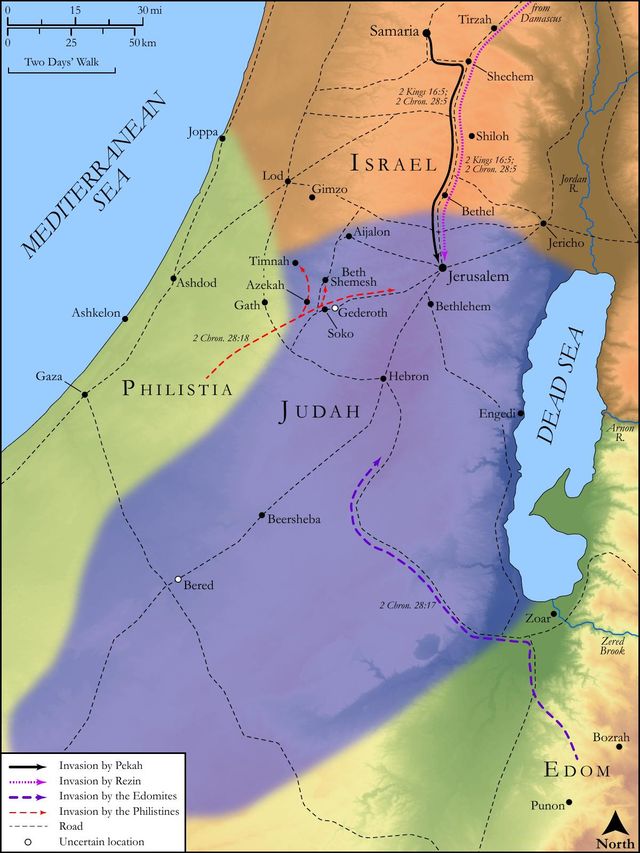
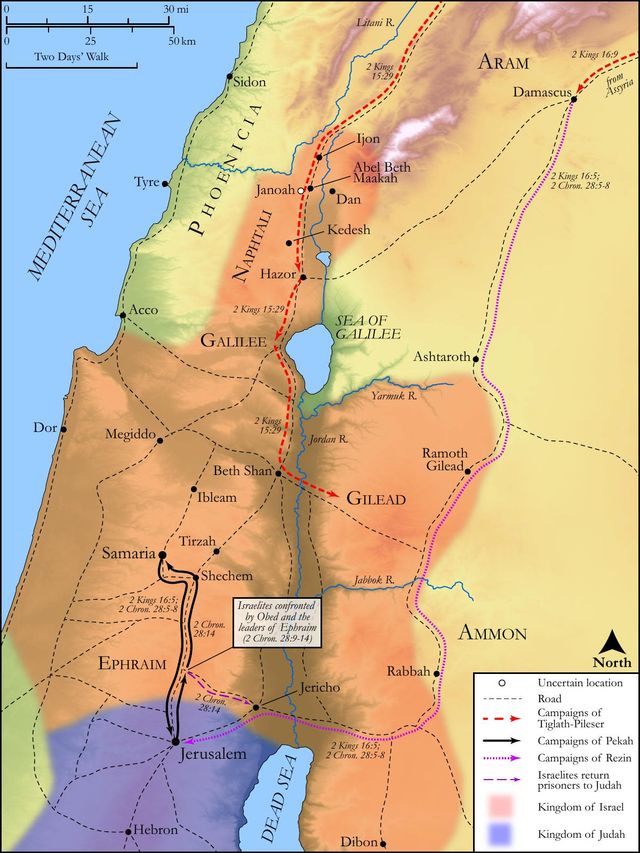
Study this verse
Public-domain commentary
Matthew Henry
From his Commentary on the Whole Bible. Henry comments on passages, not single verses — this entry covers 2 Kings 16:10–16. His two-level outline is real structure in the source text, so it is rendered as structure.
Though Ahaz had himself sacrificed in high places, on hills, and under every green tree (Kg2 16:4), yet God's altar had hitherto continued in its place and in use, and the king's burnt-offering and his meat-offering (Kg2 16:15) had been offered upon it by the priests that attended it; but here we have it taken away by wicked Ahaz, and another altar, an idolatrous one, put in the room of it - a bolder stroke than the worst of the kings had yet given to religion. We have here,
I.The model of this new altar, taken from one at Damascus, by the king himself, Kg2 16:10.
The king of Assyria having taken Damascus, thither Ahaz went, to congratulate him on his success, to return him thanks for the kindness he had done him by this expedition, and, as his servant and son, to receive his commands. Had he been faithful to his God, he would not have needed to crouch thus meanly to a foreign power. At Damascus, either while viewing the rarities of the place, or rather while joining with them in their devotions (for, when he was there, he thought it no harm to do as they did), he saw an altar that pleased his fancy extremely, not such a plain old-fashioned one as that which he had been trained up in attendance upon at Jerusalem, but curiously carved, it is likely, and adorned with image-work; there were many pretty things about it which he thought significant, surprising, very charming, and calculated to excite his devotion. Solomon had but a dull fancy, he thought, compared with the ingenious artist that made this altar. Nothing will serve him but he must have an altar just like this: a pattern of it must be taken immediately; he cannot stay till he returns himself, but sends it before him in all haste, with orders to Urijah the priest to get one made exactly according to this model and have it ready against he came home. The pattern God showed to Moses in the mount or to David by the Spirit was not comparable to this pattern sent from Damascus. The hearts of idolaters walked after their eyes, which are therefore said to go a whoring after their idols; but the true worshippers worship the true God by faith.
II.The making of it by Urijah the priests, Kg2 16:11.
This Urijah, it is likely, was the chief priest who at this time presided in the temple-service. To him Ahaz sent an intimation of his mind (for we read not of any express orders he gave him), to get an altar made by this pattern. And, without any dispute or objection, he put it in hand immediately, being perhaps as fond of it as the king was, at least being very willing to humour the king and desirous to curry favour with him. Perhaps he might have this excuse for gratifying the king herein, that, by this means, he might keep him to the temple at Jerusalem and prevent his totally deserting it for the high places and the groves. "Let us oblige him in this," thinks Urijah, "and then he will bring all his sacrifices to us; for by this craft we get our living." But, whatever pretence he had, it was a most base wicked thing for him that was a priest, a chief priest, to make this altar, in compliance with an idolatrous prince, for hereby,
1.He prostituted his authority and profaned the crown of his priesthood, making himself a servant to the lusts of men. There is not a greater disgrace to the ministry than obsequiousness to such wicked commands as this was.
2.He betrayed his trust. As priest, he was bound to maintain and defend God's institutions, and to oppose and witness against all innovations; and, for him to assist and serve the king in setting up an altar to confront the altar which by divine appointment he was consecrated to minister at, was such a piece of treachery and perfidiousness as may justly render him infamous to all posterity. Had he only connived at the doing of it, - had he been frightened into it by menaces, - had he endeavoured to dissuade the king from it, or but delayed the doing of it till he came home, that he might first talk with him about it, - it would not have been so bad; but so willingly to walk after his commandment, as if he were glad of the opportunity to oblige him, was such an affront to the God he served as was utterly inexcusable.
III.The dedicating of it.
Urijah, perceiving that the king's heart was much upon it, took care to have it ready against he came down, and set it near the brazen altar, but somewhat lower and further from the door of the temple. The king was exceedingly pleased with it, approached it with all possible veneration, and offered thereon his burnt-offering, etc., Kg2 16:12, Kg2 16:13. His sacrifices were not offered to the God of Israel, but to the gods of Damascus (as we find Ch2 28:23), and, when he borrowed the Syrians' altar, no marvel that he borrowed their gods. Naaman, the Syrian, embraced the God of Israel when he got earth from the land of Israel to make an altar of.
IV.The removal of God's altar, to make room for it.
Urijah was so modest that he put this altar at the lower end of the court, and left God's altar in its place, between this and the house of the Lord, Kg2 16:14. But that would not satisfy Ahaz; he removed God's altar to an obscure corner in the north side of the court, and put his own before the sanctuary, in the place of it. He thinks his new altar is much more stately, and much more sightly, and disgraces that; and therefore "let that be laid aside as a vessel in which there is no pleasure." His superstitious invention, at first, jostled with God's sacred institution, but at length jostled it out. Note, Those will soon come to make nothing of God that will not be content to make him their all. Ahaz durst not (perhaps for fear of the people) quite demolish the brazen altar and knock it to pieces; but, while he ordered all the sacrifices to be offered upon this new altar (Kg2 16:15), The brazen altar (says he) shall be for me to enquire by. Having thrust it out from the use for which it was instituted, which was to sanctify the gifts offered upon it, he pretends to advance it above its institution, which it is common for superstitious people to do. The altar was never designed for an oracle, yet Ahaz will have it for that use. The Romish church seemingly magnifies Christ's sacraments, yet wretchedly corrupts them. But some give another sense of Ahaz's purpose: "As for the brazen altar, I will consider what to do with it, and give order about it." The Jews say that, afterwards, of the brass of it he made that famous dial which was called the dial of Ahaz, Kg2 20:11. The base compliance of the poor-spirited priest with the presumptuous usurpations of an ill-spirited king is again taken notice of (Kg2 16:16): Urijah the priest did according to all that king Ahaz commanded. Miserable is the case of great men when those that should reprove them for their sins strengthen and serve them in their sins.
Historical interpretation
Historical reception
1 surviving comment on this verse from the historical church.
“And when you say, ‘Why did the Lord God do all of these bad things to us?’ And you will say to them, ‘As you have forsaken me and served other gods in your land, so you shall serve in a land not your own.’ ” Let one consider the literal sense, and it will suffice at the present to refresh the memory from the literal sense for those who can understand. Surely then, the people of Israel possessed the holy land, the temple, the house of prayer. They ought to have served God, but when they transgressed the divine commandments they served idols, both the idols acquired from Damascus, as it is written in Kings, and the other idols brought from other pagan nations into the holy land. Due to the fact that they received these pagan idols, they made themselves worthy to be rejected to the land of the idols, to dwell there where they worship the idols.
Continue studying 2 Kings 16:13 across the web’s major study libraries — every link below opens this exact verse, chapter, or book on the destination site.
Read & Compare
 BibleGatewayThis verse in more than 200 translations and 70 languages.
 Bible.comThe YouVersion reader — hundreds of translations, reading plans, and highlights.
 ESV.orgCrossway's official English Standard Version reader.
 NET BibleThe NET translation with 60,000+ translators' notes on every rendering decision.
 STEP BibleTyndale House's free study tool — original text, vocabulary, and scholarly resources.
 BibliaLogos Bible Software's free web reader.
 USCCBThe New American Bible (Revised Edition) with the U.S. bishops' study notes.
Commentaries
 BibleHub CommentariesDozens of classic commentaries on this verse, gathered on one page.
 StudyLightMore than 100 commentary sets — the largest collection on the web.
 BibleRefPlain-English commentary on what this verse means, verse by verse.
 Enduring WordDavid Guzik's free commentary on this chapter, widely used by Bible teachers.
 Bible Study ToolsVerse commentary alongside Greek and Hebrew study aids.
Original Language & Research
- BibleHub InterlinearThe verse word by word — original language, transliteration, and English.
- BibleHub LexiconEvery word's original-language definition and Strong's entry.
 Blue Letter BibleDeep-study tools — Strong's numbers, concordance, and word studies.
 SefariaThe Hebrew text with Rashi and centuries of Jewish commentary.
Sermons, Hymns & Audio


TrulyRandomVerse is not affiliated with these sites and doesn’t control their content. They’re linked because they’re genuinely useful.
Summary
King Ahaz of Judah, in a profound act of apostasy and defiance against the Lord, personally performed various prescribed sacrifices—burnt offerings, grain offerings, drink offerings, and peace offerings—upon a newly constructed altar in Jerusalem. This altar, however, was not the divinely ordained bronze altar of the Lord, but a replica of a pagan altar he had admired in Damascus, symbolizing his complete rejection of Yahweh's exclusive claim to worship and his embrace of syncretism.
Context
ShowHideLiterary Context
This verse is situated at a critical juncture in the narrative of King Ahaz's reign, immediately following his diplomatic visit to Damascus to meet with Tiglath-Pileser III of Assyria. While in Damascus, Ahaz was captivated by a foreign altar and sent its precise specifications back to Urijah the priest in Jerusalem, commanding him to construct an exact replica, as detailed in 2 Kings 16:10-11. Upon his return, Ahaz found the new altar completed and immediately usurped the priestly function by personally initiating worship upon it. This act is a direct continuation of his earlier unfaithfulness, which included the horrific act of sacrificing his own son, a practice abhorrent to Yahweh, as recounted in 2 Kings 16:3. The narrative highlights Ahaz's deliberate displacement of the legitimate bronze altar of the Lord, moving it to a less prominent position to accommodate his new, unauthorized structure, a move described in 2 Kings 16:12. Verse 13, therefore, depicts the culmination of Ahaz's architectural and theological rebellion, showcasing his personal endorsement and participation in this profoundly defiled worship.
Historical & Cultural Context
King Ahaz reigned over Judah from approximately 735-715 BC, a period of immense geopolitical instability dominated by the rising power of the Assyrian Empire under Tiglath-Pileser III. Judah faced existential threats from the Syro-Ephraimite coalition (Aram and Israel), prompting Ahaz to seek an alliance with Assyria rather than trusting in the Lord, despite the prophet Isaiah's direct exhortations and offer of a divine sign, as recorded in Isaiah 7:11-12. Culturally, the nations round about were characterized by pervasive polytheism and syncretism, where kings often adopted the religious practices of more powerful empires or integrated foreign deities into their own pantheons for political or perceived spiritual benefit. Ahaz's actions reflect this widespread cultural trend, but within Israel, such practices were a direct violation of the Mosaic Covenant, which demanded exclusive worship of Yahweh and prescribed specific, divinely revealed methods for worship, including the precise design and use of the altar, as outlined in Exodus 27:1-8. His personal performance of priestly duties, which were strictly reserved for the Levitical priesthood, further underscores his profound disregard for established religious order and divine law.
Key Themes
ShowHideThe actions of King Ahaz in this chapter, culminating in verse 13, powerfully illustrate several critical themes. Foremost among them is Idolatry and Syncretism, as Ahaz introduces pagan worship practices directly into the Jerusalem Temple complex, blending foreign rituals with the worship of Yahweh. This act is a stark manifestation of Disobedience and Unfaithfulness to the covenant God, demonstrating a deliberate turning away from divine law and trust in God's provision. Ahaz's role as king meant he was responsible for leading his people in righteousness, yet his choices exemplify Corrupt Leadership, setting a devastating precedent for the nation of Judah and actively contributing to its spiritual decline. Finally, by replacing the divinely ordained altar with one of his own choosing, Ahaz demonstrates a profound Rejection of Divine Authority over worship and over his kingdom, asserting his own will above God's explicit commands. This rejection of God's authority would have severe consequences for Judah, ultimately leading to its judgment and exile, as seen in later narratives, particularly throughout 2 Kings 17.
Exposition and Analysis
ShowHideKey Word Analysis
ShowHideFrom a root meaning "to ascend," this sacrifice was entirely consumed by fire on the altar, symbolizing complete dedication to God and serving as a general atonement for sin. The smoke ascending to God represented the worshipper's total surrender and the acceptance of the offering. Ahaz performing this on a foreign altar perverted its very meaning and intent.
More accurately translated as "grain offering" or "meal offering," this bloodless offering typically consisted of flour, oil, and frankincense. It was a donation, often an act of tribute, thanksgiving, or devotion, frequently accompanying other sacrifices. Its inclusion highlights Ahaz's attempt to mimic legitimate worship forms, even while fundamentally corrupting their context and purpose.
From the root shalom (peace, wholeness), these offerings were properly a requital or voluntary sacrifice in thanks. Portions were burnt for God, given to the priests, and eaten by the worshipper, symbolizing fellowship, communion, and reconciliation with God. The profound irony here is that Ahaz offered "peace offerings" on an altar that represented deep spiritual rebellion and a complete rupture of peace with God.
Verse Breakdown
ShowHide"And he burnt his burnt offering"
This clause describes Ahaz personally performing the act of burning the whole offering. This was a priestly function, not a royal one, further demonstrating Ahaz's usurpation of religious authority and his profound disregard for the divinely appointed Levitical priesthood. The emphasis is on "his" offering, implying a personal appropriation and perversion of sacred ritual, making it an act of self-will rather than divine obedience.
"and his meat offering"
Following the burnt offering, Ahaz also offered the accompanying grain offering. This indicates a comprehensive attempt to replicate the full spectrum of Israelite sacrificial worship, but on an illegitimate altar, thereby rendering the acts null and void in God's eyes, and indeed, an abomination due to the defiled context.
"and poured his drink offering"
The pouring out of a libation (Hebrew: neçek), typically wine, was another element of Israelite worship, often accompanying burnt and grain offerings. This act, too, was performed by Ahaz on the foreign altar, completing the suite of standard offerings he was presenting, yet doing so in a context of profound spiritual rebellion.
"and sprinkled the blood of his peace offerings"
The sprinkling of blood (Hebrew: dâm) was the most sacred act in the sacrificial system, symbolizing atonement and the life given back to God. Ahaz's personal involvement in this act, especially with the blood of "peace offerings," underscores the depth of his sacrilege. The blood, meant to mediate peace and reconciliation, was instead profaned on an altar of rebellion, turning an act of communion into one of confrontation with God.
"upon the altar"
This concluding phrase is crucial. It specifies the location of these offerings – not the legitimate bronze altar of the Lord (Hebrew: mizbêach), but the foreign, unauthorized altar Ahaz had built. This detail transforms what would otherwise be acts of worship into acts of profound apostasy and defiance, as the very locus of worship was defiled, making the offerings an affront to Yahweh.
Literary Devices
ShowHideThe passage employs several potent Literary Devices to underscore Ahaz's apostasy. Irony is prominent, particularly in Ahaz offering "peace offerings" on an altar that signifies his complete spiritual rebellion and rupture of peace with God. The very act meant to foster communion becomes a symbol of alienation. Symbolism is central, with the new altar serving as a powerful symbol of Ahaz's allegiance to foreign powers and deities over Yahweh. It represents the king's heart and the nation's spiritual direction, embodying his rejection of divine exclusivity. The narrative also uses Contrast, juxtaposing Ahaz's actions with the Mosaic Law's strictures on worship and the Temple's sanctity. This contrast highlights the severity of his sin, as he deliberately chooses human innovation and foreign influence over divine command. Furthermore, Ahaz's personal involvement in the sacrifices, a role reserved for priests, demonstrates Usurpation, a literary and theological device emphasizing his overreach and profound disregard for established divine order and the sanctity of the priesthood.
Theological and Thematic Connections
ShowHideKing Ahaz's actions in 2 Kings 16:13 represent a profound theological statement of rebellion against Yahweh's exclusive claim to worship and sovereignty. By building and sacrificing on an altar modeled after a pagan design, Ahaz not only violated the clear commands of the Mosaic Law but also implicitly declared that God's prescribed worship was insufficient or inferior. This act of syncretism, blending foreign religious practices with the worship of Yahweh, directly challenged the uniqueness and holiness of God, who had explicitly forbidden such mixtures. It undermined the very foundation of the covenant, which demanded unwavering fidelity and purity in worship. Ahaz's personal participation in these sacrifices, a role reserved for the Levitical priesthood, further compounded his sin, demonstrating a complete disregard for divine order and the sanctity of the sacred. His actions set a dangerous precedent for Judah, illustrating how corrupt leadership could lead an entire nation astray from true worship and into spiritual compromise.
Reflection and Application
ShowHideThe account of King Ahaz's perverted worship in 2 Kings 16:13 serves as a powerful and enduring cautionary tale for believers today. It vividly illustrates the insidious dangers of spiritual compromise, where worldly influences, cultural trends, or even personal preferences begin to dictate our approach to God. Ahaz's desire for a "better" or more impressive altar, inspired by foreign practices, led him to defile the very heart of Israelite worship. This challenges us to critically examine our own worship practices, both individually and corporately: Are we seeking to worship God according to His revealed will, or are we subtly incorporating elements that are appealing to the world but antithetical to biblical truth? The narrative also underscores the immense responsibility of leadership. Ahaz, as king, wielded significant influence, and his unfaithfulness had devastating consequences for the spiritual health of his nation. This calls all leaders—in homes, churches, and communities—to a profound commitment to integrity, biblical fidelity, and courageous obedience, recognizing that their choices have far-reaching implications for those they lead. Ultimately, Ahaz's story reminds us that true security and blessing come not from human alliances or syncretistic practices, but from unwavering trust in God alone and faithful adherence to His commands.
Questions for Reflection
ShowHideFAQ
ShowHideWhy was Ahaz's action of sacrificing on the new altar considered so offensive to God, given that he was still offering traditional sacrifices?
ShowHideAhaz's actions were profoundly offensive not merely because he offered sacrifices, but because he did so on an altar of his own design, modeled after a pagan one, and displaced the divinely ordained altar of the Lord. This was a direct violation of God's explicit commands regarding the purity and exclusivity of worship. God had meticulously prescribed the design and location of His altar, as detailed in Exodus 27:1-8, emphasizing that worship must be conducted according to His terms, not human preference or foreign influence. By introducing a foreign altar, Ahaz was essentially declaring that God's way was insufficient, thereby challenging God's authority, holiness, and unique identity as the only true God. It was an act of syncretism and idolatry, directly undermining the covenant relationship and turning what should have been an act of devotion into an act of rebellion.
What was the "meat offering" mentioned in the KJV, and why is it now often translated differently?
ShowHideIn the King James Version, "meat offering" (Hebrew: minchâh) refers to a grain or meal offering, not an offering of animal flesh. The word "meat" in 17th-century English was a general term for "food" or "meal," encompassing various provisions, not exclusively animal flesh as it does today. Therefore, the KJV's translation was accurate for its time. Modern translations typically render it as "grain offering" or "meal offering" (e.g., NIV, ESV, NASB) to avoid confusion for contemporary readers, as this offering primarily consisted of flour, oil, and frankincense, and was bloodless, often serving as a tribute or thanksgiving offering.
Christ-Centered Fulfillment
ShowHideThe narrative of King Ahaz's perverted worship on a foreign altar in 2 Kings 16:13, while a stark warning against apostasy, ultimately points to the perfect and true worship established in Jesus Christ. Ahaz, a flawed earthly king, defiled the physical altar and corrupted the sacrificial system, demonstrating humanity's inability to maintain pure worship or achieve true reconciliation with God through its own efforts. In contrast, Jesus Christ is the ultimate and perfect High Priest, who offered Himself as the one true, unblemished sacrifice, fulfilling and transcending all Old Testament offerings, as powerfully articulated in Hebrews 9:11-14. Unlike Ahaz, who introduced a foreign altar, Christ is Himself the altar, the sacrifice, and the priest, establishing a new and living way to God through His own body, as revealed in Hebrews 10:19-20. His sacrifice on the cross was not a syncretistic blend of practices but the singular, definitive act that atoned for sin once for all, bringing true peace with God, as celebrated in Romans 5:1. Through Christ, believers are now called to worship God not in physical temples or on specific altars, but "in spirit and truth," recognizing God's nature as Spirit, as taught in John 4:23-24, becoming living sacrifices themselves, holy and pleasing to God, as exhorted in Romans 12:1. Thus, Ahaz's tragic failure to maintain pure worship underscores the desperate need for a Savior who would perfectly bridge the gap between God and humanity and inaugurate an era of authentic, unblemished worship.