


2 Chronicles 11:22
- וַיַּעֲמֵדvai·ya·'a·Medand he appointedH5975Conj-w ¦ V-Hiphil-ConsecImperf-3msVerb Hiphil Consecutive Imperfect 3rd Singular Masculineוַandיַּעֲמֵדhe appointed
- לָרֹאשׁla·Roshto the chiefH7218Prep-l ¦ N-msNoun Singular Masculine Absoluteלָto theרֹאשׁchief
- רְחַבְעָםre·chav·'AmRehoboamH7346N-proper-mNoun Proper Masculine
- אֶת'et<obj.>H853DirObjMParticle Object Indicator
- אֲבִיָּה'a·vi·YahAbijahH29N-proper-mNoun Proper Masculine
- בֶןven[the] son ofH1121N-mscNoun Singular Masculine Construct
- מַעֲכָהma·'a·KhahMaacahH4601N-proper-mNoun Proper Masculine
- לְנָגִידle·na·Gidto leaderH5057Prep-l ¦ N-msNoun Singular Masculine Absoluteלְtoנָגִידleader
- בְּאֶחָיוbe·'e·Chavamong his brothersH251Prep-b ¦ N-mpc ¦ 3msNoun Plural Masculine Constructבְּamongאֶחָיbrothersוhis
- כִּיkiforH3588PrtParticle Conditional
- לְהַמְלִיכוֹle·ham·li·Khoto make king himH4427Prep-l ¦ V-Hiphil-Inf ¦ 3msVerb Hiphil Infinitive Constructלְtoהַמְלִיכmake kingוֹhim
English is a literal word-by-word gloss of the Hebrew, not the KJV's wording. Why?
This is the original text the KJV's translators worked from — each Hebrew word with its own literal English meaning in this verse, prepared by scholars at Tyndale House, Cambridge. The KJV translates whole sentences, not word by word, so its wording differs: one Hebrew word can become several English words, and the KJV may choose “the LORD” where the gloss reads “Yahweh”. Both are faithful — they answer different questions. For the KJV's own rendering, switch to the KJV text.
Details
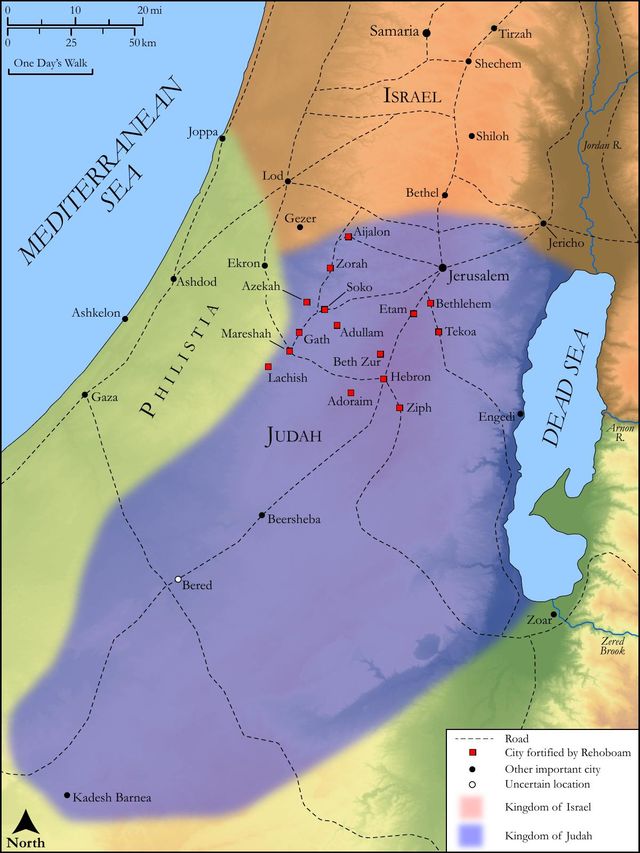
See on the biblical-era map
Study this verse
Public-domain commentary
Matthew Henry
From his Commentary on the Whole Bible. Henry comments on passages, not single verses — this entry covers 2 Chronicles 11:13–23. His three-level outline is real structure in the source text, so it is rendered as structure.
See here,
I.How Rehoboam was strengthened by the accession of the priests and Levites, and all the devout and pious Israelites, to him, even all that were true to their God and their religion.
1.Jeroboam cast them off, that is, he set up such a way of worship as he knew they could not in conscience comply with, which obliged them to withdraw from his altar, and at the same time he would not allow them to go up to Jerusalem to worship at the altar there; so that he totally cast them off from executing the priest's office, Ch2 11:14. And very willing he was that they should turn themselves out of their places, that room might be made for those mean and scandalous persons whom he ordained priests for the high places, Ch2 11:15. Compare Kg1 12:31. No marvel if he that cast off God cast off his ministers; they were not for his purpose, would not do whatever he might bid them do, would not serve his gods, nor worship the golden image which he had set up.
2.They thereupon left their suburbs and possessions, Ch2 11:14. Out of the lot of each tribe the Levites had cities allowed them, where they were comfortable provided for and had opportunity of doing much good. But now they were driven out of all their cities except those in Judah and Benjamin. One would think their maintenance well settled, and yet they lost it. It was a comfort to them that the law so often reminded them that the Lord was their inheritance, and so they should find him when they were turned out of their house and possessions. But why did they leave their possessions?
(1.)Because they saw they could do no good among their neighbours, in whom (now that Jeroboam set up his calves) the old proneness to idolatry revived.
(2.)Because they themselves would be in continual temptation to some base compliances, and in danger of being drawn insensibly to that which was evil. If we pray, in sincerity, not to be led into temptation, we shall get and keep as far as we can out of the way of it.
(3.)Because, if they retained their integrity, they had reason to expect persecution from Jeroboam and his sons. The priests they made for the devils would not let the Lord's priests be long among them. No secular advantages whatsoever should draw us thither, or detain us there, where we are in danger of making shipwreck of faith and a good conscience.
3.They came to Judah and Jerusalem (Ch2 11:14) and presented themselves to Rehoboam, Ch2 11:13, margin. Where should God's priests and Levites be, but where his altar was? Thither they came because it was their business to attend at the times appointed.
(1.)It was a mercy to them that they had a place of refuge to flee to, and that when Jeroboam cast them off there were those so near that would entertain them, and bid them welcome, and they were not forced into the lands of the heathen.
(2.)It was an evidence that they loved their work better than their maintenance, in that they left their suburbs and possessions in the country (where they might have lived at ease upon their own), because they were restrained from serving God there, and cast themselves upon God's providence and the charity of their brethren in coming to a place where they might have the free enjoyment of God's ordinances, according to his institution. Poverty in the way of duty is to be chosen rather than plenty in the way of sin. Better live upon alms, or die in a prison, with a good conscience, than roll in wealth and pleasure with a prostituted one.
(3.)It was the wisdom and praise of Rehoboam and his people that they bade them welcome, though they crowded themselves perhaps to make room for them. Conscientious refugees will bring a blessing along with them to the countries that entertain them, as they leave a curse behind them with those that expel them. Open the gates, that the righteous nation, which keepeth truth, may enter in; it will be good policy. See Isa 26:1, Isa 26:2.
4.When the priests and Levites came to Jerusalem all the devout pious Israelites of every tribe followed them. Such as set their hearts to seek the Lord God of Israel, that made conscience of their duty to God and were sincere and resolute in it, left the inheritance of their fathers and went and took houses in Jerusalem, that they might have free access to the altar of God and be out of the temptation to worship the calves, Ch2 11:16. Note,
(1.)That is best for us which is best for our souls; and, in all our choices, advantages for religion must take place of all outward conveniences.
(2.)Where God's faithful priests are his faithful people should be. If Jeroboam cast off God's ministers, every true-born Israelite will think himself obliged to own them and stand by them. Forsake not the Levite, the out-cast Levite, as long as thou livest. When the ark removes do you remove and go after it, Jos 3:3.
5.They strengthened the kingdom of Judah (Ch2 11:17), not only by the addition of so many persons to it, who, it is likely, brought what they could of their effects with them, but by their piety and their prayers they procured a blessing upon the kingdom which was a sanctuary to them. See Zac 12:5. It is the interest of a nation to protect and encourage religion and religious people, and adds more than any thing to its strength. They made him and his people strong three years; for so long they walked in the way of David and Solomon, their good way. But when they forsook that, and so threw themselves out of God's favour and protection, the best friends they had could no longer help to strengthen them. We retain our strength while we cleave to God and our duty, and no longer.
II.How Rehoboam was weakened by indulging himself in his pleasures. He desired many wives, as his father did (Ch2 11:23), yet,
1.In this he was more wise than his father, that he does not appear to have married strange wives. The wives mentioned here were not only daughters of Israel, but of the family of David; one was a descendant from Eliab, David's brother (Ch2 11:18), another from Absalom, probably that Absalom who was David's son (Ch2 11:20), another from Jerimoth, David's son.
2.In this he was more happy than his father, that he had many sons and daughters; whereas we read not of more than one son that his father had. One can scarcely imagine that he had no more; but, if he had, they were not worth mentioning; whereas several of Rehoboam's sons are here named (Ch2 11:19, Ch2 11:20) as men of note, and such active men that he thought it his wisdom to disperse them throughout the countries of Judah and Benjamin (Ch2 11:23), either,
(1.)That they might not be rivals with his son Abijah, whom he designed for his successor, or rather,
(2.)Because he could repose a confidence in them for the preserving of the public peace and safety, could trust them with fenced cities, which he took care to have well victualled, that they might stand him in stead in case of an invasion. After-wisdom is better than none at all; nay, they say, "Wit is never good till it is bought;" though he was dearly bought with the loss of a kingdom.
Continue studying 2 Chronicles 11:22 across the web’s major study libraries — every link below opens this exact verse, chapter, or book on the destination site.
Read & Compare
 BibleGatewayThis verse in more than 200 translations and 70 languages.
 Bible.comThe YouVersion reader — hundreds of translations, reading plans, and highlights.
 ESV.orgCrossway's official English Standard Version reader.
 NET BibleThe NET translation with 60,000+ translators' notes on every rendering decision.
 STEP BibleTyndale House's free study tool — original text, vocabulary, and scholarly resources.
 BibliaLogos Bible Software's free web reader.
 USCCBThe New American Bible (Revised Edition) with the U.S. bishops' study notes.
Commentaries
 BibleHub CommentariesDozens of classic commentaries on this verse, gathered on one page.
 StudyLightMore than 100 commentary sets — the largest collection on the web.
 BibleRefPlain-English commentary on what this verse means, verse by verse.
 Enduring WordDavid Guzik's free commentary on this chapter, widely used by Bible teachers.
 Bible Study ToolsVerse commentary alongside Greek and Hebrew study aids.
Original Language & Research
- BibleHub InterlinearThe verse word by word — original language, transliteration, and English.
- BibleHub LexiconEvery word's original-language definition and Strong's entry.
 Blue Letter BibleDeep-study tools — Strong's numbers, concordance, and word studies.
 SefariaThe Hebrew text with Rashi and centuries of Jewish commentary.
Sermons, Hymns & Audio


TrulyRandomVerse is not affiliated with these sites and doesn’t control their content. They’re linked because they’re genuinely useful.
Summary
King Rehoboam, having established his reign over Judah and expanded his family significantly, strategically elevated Abijah, the son of his favorite wife Maachah, to a position of preeminence among his many brothers. This appointment as "chief" and "ruler" clearly signaled Rehoboam's intention to designate Abijah as his chosen successor to the throne, aiming to secure the dynastic line and ensure a stable transfer of power within the southern kingdom.
Context
ShowHideLiterary Context
This verse is situated within a broader narrative in 2 Chronicles detailing the reign of Rehoboam, following the tragic division of the united monarchy after Solomon's death. Chapters 10-12 primarily focus on Rehoboam's initial foolish decisions that led to the schism, his subsequent fortification of Judah, and his family life. 2 Chronicles 11:18-21 immediately precedes this verse, listing Rehoboam's numerous wives, concubines, and children, explicitly highlighting his profound affection for Maachah, the mother of Abijah. This favoritism sets the stage for Abijah's elevation, emphasizing that his appointment was not based on primogeniture but on royal prerogative and personal preference. The Chronicler often includes such details about royal families to underscore themes of dynastic continuity, divine blessing (or judgment), and the human element in leadership.
Historical & Cultural Context
Ancient Near Eastern monarchies placed immense importance on succession planning to prevent civil strife and maintain dynastic stability. Kings often had multiple wives and concubines, leading to numerous sons, which could create complex challenges for succession. While primogeniture (the right of the firstborn son to inherit) was common, kings frequently exercised their prerogative to choose a younger or more favored son, or one deemed more capable, to be their heir. This act of designating a "chief" or "ruler" among the royal princes was a formal way of signaling the chosen successor, often involving special privileges, training, and public recognition. Rehoboam's actions here reflect typical royal practices of the era, where a king's personal affections and political considerations heavily influenced the choice of heir.
Key Themes
ShowHideThe verse significantly contributes to several key themes within 2 Chronicles. Dynastic Continuity is paramount, as the Chronicler consistently emphasizes the unbroken line of Davidic kings in Judah, even after the northern kingdom's apostasy. Rehoboam's explicit intention to make Abijah king underscores the human effort to maintain this line, even as the divine covenant with David ultimately guarantees its endurance (see 2 Samuel 7:12-16). Another theme is Royal Authority and Prerogative, demonstrating the king's absolute power to choose his successor, often overriding traditional norms like primogeniture, as seen in David's choice of Solomon over Adonijah (1 Kings 1:28-30). Finally, Favoritism and its Consequences are subtly highlighted; Rehoboam's love for Maachah (2 Chronicles 11:21) directly influences his decision, a pattern seen throughout biblical narratives where parental favoritism often leads to familial tension or unexpected outcomes.
Exposition and Analysis
ShowHideKey Word Analysis
ShowHideThis term (רֹאשׁ, H7218) signifies "the head" or "top," extending metaphorically to denote preeminence, leadership, or the most important position. In this context, making Abijah "the chief" formally elevated him as the principal figure among his brethren, establishing him as first in rank and signifying a public declaration of his elevated status and authority, much like a "captain" or "principal" among his peers.
This word (נָגִיד, H5057) refers to a "commander," "leader," "prince," or "appointed official." It denotes one who occupies a front position, often implying a delegated authority rather than an inherent kingship (מֶלֶךְ, melek). By making Abijah a "ruler," Rehoboam formally invested him with a significant, preparatory role for future kingship, establishing him as a "chief governor" or "noble" among his siblings. This term underscores that Abijah was not merely favored but was formally given a position of tangible authority and leadership.
Verse Breakdown
ShowHide"And Rehoboam made Abijah the son of Maachah the chief,"
This clause establishes the central action of the verse: King Rehoboam's deliberate and formal elevation of Abijah. The phrase "made...the chief" (וַיַּעֲמֵד לְרֹאשׁ, wayyaʿămēḏ lero'sh) implies that Rehoboam "caused him to stand as head" or "appointed him as chief." This was not a passive observation but an active, authoritative decree. The identification of Abijah as "the son of Maachah" is crucial, linking his elevation directly to Rehoboam's explicit favoritism towards Maachah, as noted in the preceding verse.
"[to be] ruler among his brethren:"
This phrase further clarifies the nature of Abijah's elevated status. He was not just "chief" in a general sense, but specifically designated as the "ruler" (נָגִיד, nâgîyd) within the royal family, among his many siblings. This positioned him as the de facto leader and heir apparent, distinguishing him from the other twenty-seven sons Rehoboam had fathered. The KJV's bracketed "to be" correctly interprets the implied purpose of his appointment.
"for [he thought] to make him king."
This final clause reveals Rehoboam's explicit motivation and long-term intention. The Hebrew phrase (לְהַמְלִיכוֹ, lehamlikho) literally means "to make him king" or "to cause him to reign." The KJV's "he thought" accurately captures the nuance of intention or purpose. Rehoboam was not merely giving Abijah a temporary position of honor but was actively preparing him and signaling to the court and kingdom that Abijah was his chosen successor, the next in line for the Davidic throne in Judah.
Literary Devices
ShowHideThe Chronicler employs several literary devices to convey the significance of Rehoboam's decision. Emphasis is achieved through the dual titles "chief" (rôʼsh) and "ruler" (nâgîyd), both pointing to Abijah's preeminent status and the king's clear intention. This Repetition of similar concepts reinforces the idea that Abijah's elevation was deliberate and significant. The verse also utilizes Foreshadowing, as Rehoboam's stated intention to "make him king" directly anticipates Abijah's actual succession to the throne, which is recounted in 2 Chronicles 13:1. This narrative technique builds anticipation and highlights the fulfillment of human plans, albeit always within the greater framework of divine sovereignty.
Theological and Thematic Connections
ShowHideThis verse, while seemingly a straightforward account of royal succession, subtly highlights the interplay between human planning and divine sovereignty within the Davidic covenant. Rehoboam's meticulous efforts to secure his dynasty by appointing Abijah as his chosen heir reflect a natural human desire for control and continuity. However, biblical history consistently demonstrates that while kings make their plans, it is God who ultimately establishes or removes rulers, often working through or even despite human intentions. The stability of the Davidic line in Judah was not solely dependent on Rehoboam's foresight but on God's unwavering covenant promise to David. This serves as a powerful reminder that all human authority and plans are ultimately subject to the sovereign will of the Lord.
Reflection and Application
ShowHideRehoboam's strategic appointment of Abijah offers valuable insights into leadership, succession, and the nature of human planning. In any sphere of influence—family, church, business, or community—the intentional identification and preparation of future leaders is crucial for long-term stability and flourishing. While favoritism, as seen with Maachah and Abijah, can be problematic if it compromises merit or justice, the principle of mentorship and deliberate succession planning remains vital. This verse challenges us to consider our own roles in preparing the next generation of leaders, not just by hoping for the best, but by actively investing in, training, and empowering those who will carry the torch. Ultimately, it also calls us to humility, recognizing that while we may plan our ways, the Lord is the one who directs our steps and establishes the outcomes, reminding us to align our plans with His divine will and purposes.
Questions for Reflection
ShowHideFAQ
ShowHideWhy did Rehoboam choose Abijah over his other sons, especially if Abijah wasn't the firstborn?
ShowHideThe text explicitly states in 2 Chronicles 11:21 that Rehoboam "loved Maachah the daughter of Absalom above all his wives and his concubines." This strong personal affection for Abijah's mother was the primary reason for his elevation. While primogeniture was a common practice, kings in the ancient Near East often exercised their prerogative to choose a favored son, or one they deemed most capable, as their heir, regardless of birth order. This was a common practice to secure the most stable or desirable succession.
What does "chief" and "ruler" imply about Abijah's position before he became king?
ShowHideThe terms "chief" (רֹאשׁ, rôʼsh) and "ruler" (נָגִיד, nâgîyd) indicate that Abijah was given a formal, preeminent position among his many brothers. He was not just a prince but was designated as the leader or head of the royal household, likely with specific responsibilities and authority. This was a clear public signal of Rehoboam's intention to make him the next king, effectively grooming him for the throne and establishing him as the heir apparent, thereby minimizing potential disputes among his numerous sons.
Did Abijah actually become king after Rehoboam?
ShowHideYes, Abijah did indeed succeed Rehoboam as king of Judah. His reign is detailed in 2 Chronicles 13 and also briefly mentioned in 1 Kings 15:1-8. This verse, 2 Chronicles 11:22, therefore serves as a direct foreshadowing of the fulfillment of Rehoboam's intention.
Christ-Centered Fulfillment
ShowHideThe earthly kings of Israel, even those of the Davidic line like Rehoboam and Abijah, served as imperfect shadows and types of the ultimate King to come. Rehoboam's act of designating Abijah as "chief" and "ruler" among his brethren, with the explicit intention of making him king, powerfully foreshadows the unique and divine appointment of Jesus Christ. Unlike Abijah, who was chosen by human preference and succeeded a flawed earthly monarch, Jesus is the eternally begotten Son, uniquely designated by God the Father as the ultimate "chief" and "ruler" over all creation. He is the King of Kings and Lord of Lords, the true heir of David's throne, whose kingdom is not of this world and will have no end (John 18:36). While Rehoboam sought to secure his dynasty through human means, God's plan for His Son's eternal reign was established before the foundation of the world, culminating in Christ's ultimate sacrifice and resurrection, through which He was declared Lord and Christ, the one to whom all authority in heaven and on earth has been given. He is the appointed head over the church, His body, truly the "chief" and "ruler" whose reign brings eternal life and perfect justice.