


1 Samuel 22:12
Bible text: King James Version (1769 Blayney text) · Public domain
Bible text: Berean Standard Bible · Public domain
Bible text: American Standard Version (1901) · Public domain
Bible text: World English Bible, Messianic edition · Public domain
Bible text: Geneva Bible (1599) · Public domain
Bible text: Young's Literal Translation · Public domain
- וַיֹּאמֶרvai·Yo·merand he saidH559Conj-w ¦ V-Qal-ConsecImperf-3msVerb Qal Consecutive Imperfect 3rd Singular Masculineוַandיֹּאמֶרhe said
- שָׁאוּלsha·'UlSaulH7586N-proper-mNoun Proper Masculine
- שְׁמַעshe·ma'listenH8085V-Qal-Imp-2msVerb Qal Imperative 2nd Singular Masculine
- נָאna'pleaseH4994PrtParticle Interjection
- בֶּןbenO son ofH1121N-mscNoun Singular Masculine Construct
- אֲחִיטוּב'a·chi·TuvAhitubH285N-proper-mNoun Proper Masculine
- וַיֹּאמֶרvai·Yo·merand he saidH559Conj-w ¦ V-Qal-ConsecImperf-3msVerb Qal Consecutive Imperfect 3rd Singular Masculineוַandיֹּאמֶרhe said
- הִנְנִיhi·Nihere [am] IH2005Prt ¦ 1csParticle Interjectionהִנְhere [am]נִיI
- אֲדֹנִי'a·do·Nimy O lordH113N-msc ¦ 1csNoun Singular Masculine ConstructאֲדֹנִO lordיmy
English is a literal word-by-word gloss of the Hebrew, not the KJV's wording. Why?
This is the original text the KJV's translators worked from — each Hebrew word with its own literal English meaning in this verse, prepared by scholars at Tyndale House, Cambridge. The KJV translates whole sentences, not word by word, so its wording differs: one Hebrew word can become several English words, and the KJV may choose “the LORD” where the gloss reads “Yahweh”. Both are faithful — they answer different questions. For the KJV's own rendering, switch to the KJV text.
Details
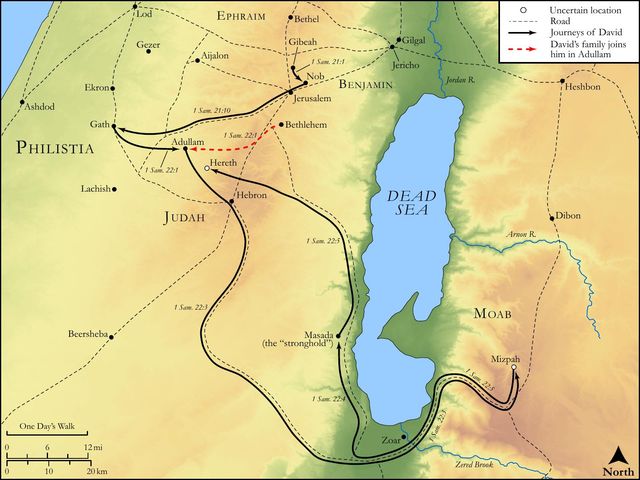
See on the biblical-era map
Study this verse
Public-domain commentary
Matthew Henry
From his Commentary on the Whole Bible. Henry comments on passages, not single verses — this entry covers 1 Samuel 22:6–19. His four-level outline is real structure in the source text, so it is rendered as structure.
We have seen the progress of David's troubles; now here we have the progress of Saul's wickedness. He seems to have laid aside the thoughts of all other business and to have devoted himself wholly to the pursuit of David. He heard at length, by the common fame of the country, that David was discovered (that is, that he appeared publicly and enlisted men into his service); and hereupon he called all his servants about him, and sat down under a tree, or grove, in the high place at Gibeah, with his spear in his hand for a sceptre, intimating the force by which he designed to rule, and the present temper of his spirit, or its distemper rather, which was to kill all that stood in his way. In this bloody court of inquisition,
I.Saul seeks for information against David and Jonathan, Sa1 22:7, Sa1 22:8.
Two things he was willing to suspect and desirous to see proved, that he might wreak his malice upon two of the best and most excellent men he had about him: - 1. That his servant David did lie in wait for him and seek his life, which was utterly false. He really sought David's life, and therefore pretended that David sought his life, though he could not charge him with any overt act that gave the least shadow of suspicion. 2. That his son Jonathan stirred him up to do so, and was confederate with him in compassing and imagining the death of the king. This also was notoriously false. A league of friendship there was between David and Jonathan, but no conspiracy in any evil thing; none of the articles of their covenant carried any mischief to Saul. If Jonathan had agreed, after the death of Saul, to resign to David, in compliance with the revealed will of God, what harm would that do to Saul? Yet thus the best friends to their prince and country have often been odiously represented as enemies to both; even Christ himself was so. Saul took it for granted that Jonathan and David were in a plot against him, his crown and dignity, and was displeased with his servants that they did not give him information of it, supposing that they could not but know it; whereas really there was no such thing. See the nature of a jealous malice, and its pitiful arts to extort discoveries of things that are not. He looked upon all about him as his enemies because they did not say just as he said; and told them, (1.) That they were very unwise, and acted against the interest both of their tribe (for they were Benjamites, and David, if he were advanced, would bring the honour into Judah which was now in Benjamin) and of their families; for David would never be able to give them such rewards as he had for them, of fields and vineyards, and such preferments, to be colonels and captains. (2.) That they were unfaithful: You have conspired against me. What a continual agitation and torment are those in that give way to a spirit of jealousy! If a ruler hearken to lies, all his servants are wicked (Pro 29:12), that is, they seem to be so in his eyes. (3.) That they were very unkind. He thought to work upon their good nature with that word: There is none of you that is so much as sorry for me, or solicitous for me, as some read it. By these reasonings he stirred them up to act vigorously, as the instruments of his malice, that they might take away his suspicions of them.
II.Though he could not learn any thing from his servants against David or Jonathan, yet he got information from Doeg against Ahimelech the priest.
1.An indictment is brought against Ahimelech by Doeg, and he himself is evidence against him, Sa1 22:9, Sa1 22:10. Perhaps Doeg, as bad as he was, would not have given this information if Saul had not extorted it, for had he been very forward to it he would have done it sooner: but now he thinks they must be all deemed traitors if none of them be accusers, and therefore tells Saul what kindness Ahimelech had shown to David, which he himself happened to be an eye-witness of. He had enquired of God for him (which the priest used not to do but for public persons and about public affairs) and he had furnished him with bread and a sword. All this was true; but it was not the whole truth. He ought to have told Saul further that David had made Ahimelech believe he was then going upon the king's business; so that what service he did to David, however it proved, was designed in honour to Saul, and this would have cleared Ahimelech, whom Saul had in his power, and would have thrown all the blame upon David, who was out of his reach.
2.Ahimelech is seized, or summoned rather to appear before the king, and upon this indictment he is arraigned. The king sent for him and all the priests who then attended the sanctuary, whom he supposed to be aiding and abetting; and they, not being conscious of any guilt, and therefore not apprehensive of any danger, came all of them to the king (Sa1 22:11), and none of them attempted to make an escape, or to flee to David for shelter, as they would have done now that he had set up his standard if they had been as much in his interests as Saul suspected they were. Saul arraigns Ahimelech himself with the utmost disdain and indignation (Sa1 22:12): Hear now, thou son of Ahitub; not so much as calling him by his name, much less giving him his title of distinction. By this it appears that he had cast off the fear of God, that he showed no respect at all to his priests, but took a pleasure in affronting them and insulting them. Ahimelech holds up his hand at the bar in those words: "Here I am, my lord, ready to hear my charge, knowing I have done no wrong." He does not object to the jurisdiction of Saul's court, nor insist upon an exemption as a priest, no, not though he is a high priest, to which office that of the judge, or chief magistrate, had not long since been annexed; but Saul having now the sovereignty vested in him, in things pertaining to the king, even the high priest sets himself on a level with common Israelites. Let every soul be subject (even clergymen) to the higher powers.
3.His indictment is read to him (Sa1 22:13), that he, as a false traitor, had joined himself with the son of Jesse in a plot to depose and murder the king. "His design" (says Saul) "was to rise up against me, and thou didst assist him with victuals and arms." See what bad constructions the most innocent actions are liable to, how unsafe those are that live under a tyrannical government, and what reason we have to be thankful for the happy constitution and administration of the government we are under.
4.To this indictment he pleads, Not guilty, Sa1 22:14, Sa1 22:15. He owns the fact, but denies that he did it traitorously or maliciously, or with any design against the king. He pleads that he was so far from knowing of any quarrel between Saul and David that he really took David to have been then as much in favour at court as ever he had been. Observe, He does not plead that David had told him an untruth, and with that had imposed upon him, though really it was so, because he would not proclaim the weakness of so good a man, no, not for his own vindication, especially to Saul, who sought all occasions against him; but he insists upon the settled reputation David had as the most faithful of all the servants of Saul, the honour the king had put upon him in marrying his daughter to him, the use the king had often made of him, and the trust he had reposed on him: "He goes at thy bidding, and is honourable in thy house, and therefore any one would think it a meritorious piece of service to the crown to show him respect, so far from apprehending it to be a crime." He pleads that he had been wont to enquire of God for him when he was sent by Saul upon any expedition, and did it now as innocently as ever he had done it. He protests his abhorrence of the thought of being in a plot against the king: "Be it far from me. I mind my own business, and meddle not with state matters." He begs the king's favour: "Let him not impute any crime to us;" and concludes with a declaration of his innocency: Thy servant knew nothing of all this. Could any man plead with more evidences of sincerity? Had he been tried by a jury of honest Israelites, he would certainly have been acquitted, for who can find any fault in him? But,
5.Saul himself gives judgment against him (Sa1 22:16): Thou shalt surely die, Ahimelech, as a rebel, thou and all thy father's house. What could be more unjust? I saw under the sun the place of judgment, that wickedness was there, Ecc 3:16.
(1.)It was unjust that Saul should himself, himself alone, give judgment in his own cause, without any appeal to judge or prophet, to his privy council, or to a council of war.
(2.)That so fair a plea should be overruled and rejected without any reason given, or any attempt to disprove the allegations of it, but purely with a high hand.
(3.)That sentence should be passed so hastily and with so much precipitation, the judge taking no time himself to consider of it, nor allowing the prisoner any time to move in arrest of judgment.
(4.)That the sentence should be passed not only on Ahimelech, himself, who was the only person accused by Doeg, but on all his father's house, against whom nothing was alleged: must the children be put to death for the fathers?
(5.)That the sentence should be pronounced in passion, not for the support of justice, but for the gratification of his brutish rage.
6.He issues out a warrant (a verbal warrant only) for the immediate execution of this bloody sentence.
(1.)He ordered his footmen to be the executioners of this sentence, but they refused, Sa1 22:17. Hereby he intended to put a further disgrace upon the priests; they may not die by the hands of the men of war (as Kg1 2:29) or his usual ministers of justice, but his footmen must triumph over them, and wash their hands in their blood.
[1.]Never was the command of a prince more barbarously given: Turn and slay the priests of the Lord. This is spoken with such an air of impiety as can scarcely be paralleled. Had he seemed to forget their sacred office or relation to God, and taken no notice of that, he would thereby have intimated some regret that men of that character should fall under his displeasure; but to call them the priests of the Lord, when he ordered his footmen to cut their throats, looked as if, upon that very account, he hated them. God having rejected him, and ordered another to be anointed in his room, he seems well pleased with this opportunity of being revenged on the priests of the Lord, since God himself was out of his reach. What wickedness will not the evil spirit hurry men to, when he gets the dominion! He alleged, in his order that which was utterly false and unproved to him, that they knew when David fled; whereas they knew nothing of the matter. But malice and murder are commonly supported with lies.
[2.]Never was the command of a prince more honourably disobeyed. The footmen had more sense and grace than their master. Though they might expect to be turned out of their places, if not punished and put to death for their refusal, yet, come on them what would, they would not offer to fall upon the priests of the Lord, such a reverence had they for their office, and such a conviction of their innocence.
(2.)He ordered Doeg (the accuser) to be the executioner, and he obeyed. One would have thought that the footmen's refusal would awaken Saul's conscience, and that he would not insist upon the doing of a thing so barbarous as that his footmen startled at the thought of it. But his mind was blinded and his heart hardened, and, if they will not do it, the hands of the witness shall be upon the victims, Deu 17:7. The most bloody tyrants have found out instruments of their cruelty as barbarous as themselves. Doeg is no sooner commanded to fall upon the priests than he does it willingly enough, and, meeting with no resistance, slays with his own hand (for aught that appears) on that same day eighty-five priests that were of the age of ministration, between twenty and fifty, for they wore a linen ephod (Sa1 22:18), and perhaps appeared at this time before Saul in their habits, and were slain in them. This (one would think) was enough to satiate the most blood-thirsty; but the horseleech of persecution still cries, "Give, give." Doeg, by Saul's order no doubt, having murdered the priests, went to their city Nob, and put all to the sword there (Sa1 22:19), men, women, and children, and the cattle too. Barbarous cruelty, and such as one cannot think of without horror! Strange that ever it should enter into the heart of man to be so impious, so inhuman! We may see in this,
[1.]The desperate wickedness of Saul when the Spirit of the Lord had departed from him. Nothing so vile but those may be hurried to it who have provoked God to give them up to their hearts' lusts. He that was so compassionate as to spare Agag and the cattle of the Amalekites, in disobedience to the command of God, could now, with unrelenting bowels, see the priests of the Lord murdered, and nothing spared of all that belonged to them. For that sin God left him to this.
[2.]The accomplishment of the threatenings long since pronounced against the house of Eli; for Ahimelech and his family were descendants from him. Though Saul was unrighteous in doing this, yet God was righteous in permitting it. Now God performed against Eli that at which the ears of those that heard it must needs tingle, as he had told him that he would judge his house for ever Sa1 3:11-13. No word of God shall fall to the ground.
[3.]This may be considered as a great judgment upon Israel, and the just punishment of their desiring a king before the time God intended them one. How deplorable was the state of religion at this time in Israel! Though the ark had long been in obscurity, yet it was some comfort to them that they had the altar, and priests to serve at it; but now to see their priests weltering in their own blood, and the heirs of the priesthood too, and the city of the priests made a desolation, so that the altar of God must needs be neglected for want of attendants, and this by the unjust and cruel order of their own king to satisfy his brutish rage - this could not but go to the heart of all pious Israelites, and make them wish a thousand times they had been satisfied with the government of Samuel and his sons. The worst enemies of their nation could not have done them a greater mischief.
Historical interpretation
Historical reception
1 surviving comment on this verse from the historical church.
And Abimelech answering the king, said: And who, etc.? The sacred order of commandments, fighting for the kingdom of Christ, will respond to the Jewish people, who consider the faith and love of Christ a crime: And who among all the prophets and saints, whom it is known from their words, prayers, and examples, served your interests greatly, could equate to the apostle and high priest of our confession, Jesus, who is faithful to Him who made Him (Hebrews III), just as Moses was in all His house? For he has been deemed worthy of greater glory than Moses, by how much greater honor the one who built it has than the house; he who joined to himself in the covenant of a bride the church of the Gentiles, begotten from the ancient faith of your fathers. Nor is he proven to have done or taught anything else in the flesh than what you yourselves learned according to the words of the prophets, indeed you have always desired that Christ, when He came, would do. Do we begin today to have this faith in Him and to seek the divine oracles of the word for the state of His Church, and did we not rather receive, venerate, and worship it as passed down and commended to us by the ancient tradition of the patriarchs and prophets?
Continue studying 1 Samuel 22:12 across the web’s major study libraries — every link below opens this exact verse, chapter, or book on the destination site.
Read & Compare
 BibleGatewayThis verse in more than 200 translations and 70 languages.
 Bible.comThe YouVersion reader — hundreds of translations, reading plans, and highlights.
 ESV.orgCrossway's official English Standard Version reader.
 NET BibleThe NET translation with 60,000+ translators' notes on every rendering decision.
 STEP BibleTyndale House's free study tool — original text, vocabulary, and scholarly resources.
 BibliaLogos Bible Software's free web reader.
 USCCBThe New American Bible (Revised Edition) with the U.S. bishops' study notes.
Commentaries
 BibleHub CommentariesDozens of classic commentaries on this verse, gathered on one page.
 StudyLightMore than 100 commentary sets — the largest collection on the web.
 BibleRefPlain-English commentary on what this verse means, verse by verse.
 Enduring WordDavid Guzik's free commentary on this chapter, widely used by Bible teachers.
 Bible Study ToolsVerse commentary alongside Greek and Hebrew study aids.
Original Language & Research
- BibleHub InterlinearThe verse word by word — original language, transliteration, and English.
- BibleHub LexiconEvery word's original-language definition and Strong's entry.
 Blue Letter BibleDeep-study tools — Strong's numbers, concordance, and word studies.
 SefariaThe Hebrew text with Rashi and centuries of Jewish commentary.
Sermons, Hymns & Audio


TrulyRandomVerse is not affiliated with these sites and doesn’t control their content. They’re linked because they’re genuinely useful.
Summary
1 Samuel 22:12 captures a chilling and pivotal moment where King Saul, consumed by escalating paranoia and rage, directly confronts Ahimelech, the high priest, at Gibeah. This verse records Saul's accusatory summons, addressing Ahimelech formally as "thou son of Ahitub," and the priest's immediate, deferential reply, "Here I [am], my lord." This brief exchange sets the stage for a tragic confrontation, underscoring the perilous position of those caught in the crosshairs of unchecked royal wrath and the devastating consequences of false accusation.
Context
ShowHideLiterary Context
This verse is a critical turning point within the broader narrative of Saul's tragic decline and David's providential ascent. It immediately follows David's desperate flight from Saul, during which he sought refuge and provisions at the sanctuary in Nob. There, Ahimelech, the high priest, unknowingly provided David with consecrated bread and Goliath's sword, believing David was on a secret royal mission for Saul (1 Samuel 21:1-9). This seemingly innocuous act was witnessed by Doeg the Edomite, Saul's chief herdsman, who then reported it to the king. Enraged and convinced of a widespread conspiracy against his throne, Saul summons Ahimelech and the entire priestly house of Nob to Gibeah, his capital, to face his accusations. Verse 12 marks the dramatic beginning of this direct interrogation, vividly highlighting the immediate tension and the immense power imbalance between the king and the high priest.
Historical & Cultural Context
The setting is the nascent monarchy in Israel, a period of significant transition from a loose tribal confederacy to a centralized kingdom. Saul, as Israel's first king, wielded immense, though often unstable, power, frequently acting on impulse rather than divine counsel. The high priest, represented by Ahimelech, held a position of profound spiritual authority, responsible for the tabernacle, sacred rituals, and consulting God through the Urim and Thummim. Nob was a recognized city of priests, serving as a vital religious center. The custom of addressing someone by their patronymic, "son of Ahitub," was a common, formal, and respectful way to identify and summon an individual, particularly in official or legal contexts. Ahimelech's immediate and deferential response, "Here I [am], my lord," reflects the expected protocol when a subject, even a high-ranking priest, was summoned by the king, signifying readiness to hear and obey royal decree.
Key Themes
ShowHideThis verse powerfully contributes to several overarching themes within the book of 1 Samuel. It vividly illustrates Saul's escalating paranoia and the abuse of royal authority, demonstrating how his deep-seated insecurity transforms into tyrannical behavior. His actions here show a king who perceives loyalty as treason and innocent acts as conspiracy, leading to devastating injustice. The exchange also highlights Ahimelech's vulnerability and the precarious position of those serving God under a corrupt human authority. His immediate submission, though respectful and innocent, ultimately places him in mortal danger. Furthermore, the scene underscores the tragic consequences of false accusation and unchecked rage, setting the stage for the horrific slaughter of the priests of Nob, a stark example of the devastating effects of sin and unrighteous leadership, a theme powerfully echoed in the later judgment upon Saul's house and the subsequent events of 1 Samuel 22:18-19.
Exposition and Analysis
ShowHideKey Word Analysis
ShowHideThis imperative verb, often translated as "listen" or "pay attention," is not merely a polite request but a commanding summons. In the context of a king addressing a subject, especially one suspected of wrongdoing, it carries an authoritative and often ominous tone, demanding immediate and undivided attention to the accusation that is about to follow. It signals the gravity of the moment and the king's expectation of a direct and truthful response, leaving no room for equivocation.
This common Hebrew noun, meaning "son" or "child," is used here in a formal patronymic construction, "son of Ahitub." While a standard way to identify someone by their lineage, in Saul's mouth, it might also serve to underscore the perceived betrayal of Ahimelech's priestly office. It emphasizes his familial and official role, perhaps subtly stripping him of his personal name and reducing him to his position before the king's judgment, implying that as a descendant of a prominent priestly line, he should have known better than to "aid" Saul's enemy.
This term signifies "sovereign," "master," or "owner," and is used to denote a superior, whether human or divine. Ahimelech's use of "my lord" in addressing Saul is a profound act of deference and submission, acknowledging the king's supreme authority. It reflects the expected protocol for a subject, even a high priest, when summoned by the monarch. This respectful address, however, tragically contrasts with Saul's unrighteous accusations, highlighting Ahimelech's innocence and his unsuspecting loyalty to a king who has lost his moral compass.
Verse Breakdown
ShowHide"And Saul said, Hear now, thou son of Ahitub."
This opening clause immediately establishes the power dynamic and the confrontational nature of the scene. Saul, as the reigning king, initiates the dialogue with a direct, authoritative, and implicitly accusatory command. His use of the formal address "thou son of Ahitub" highlights Ahimelech's priestly lineage, but in this context, it carries a tone of stern summons and impending judgment. The phrase "Hear now" sets a tone of urgency and demands immediate, undivided attention, signaling that a serious matter, likely an accusation of treason, is about to be laid before the priest.
"And he answered, Here I [am], my lord."
Ahimelech's response is swift, submissive, and deeply respectful. His use of the Hebrew hinnēnî (rendered "Here I [am]") conveys his ready availability, attentive presence, and willingness to respond to the king's summons, a posture of obedience to authority. The addition of "my lord" further emphasizes his profound deference to Saul's royal position, despite the palpable tension and the implicit danger of the situation. This immediate and deferential reply underscores Ahimelech's innocence and his complete unawareness of the depth of Saul's paranoia and the false accusations he is about to face.
Literary Devices
ShowHideThe brevity of 1 Samuel 22:12 belies its rich use of literary devices, which amplify its dramatic impact. The most prominent is Dialogue, presenting a direct exchange that immediately establishes the power dynamic and the impending conflict. There is significant Dramatic Irony, as Ahimelech's respectful and submissive "Here I [am], my lord" is uttered by a man who is entirely innocent of any conspiracy, yet stands accused by a king consumed by paranoid delusion. The audience, fully aware of David's true circumstances and Ahimelech's unwitting aid, understands the tragic misunderstanding that Saul, in his rage, refuses to acknowledge. This exchange also serves as powerful Foreshadowing, as Ahimelech's immediate and obedient response, intended to show loyalty, ironically seals his fate and that of the priests of Nob, leading to their brutal slaughter later in the chapter. Finally, the Juxtaposition of Saul's harsh, commanding tone with Ahimelech's humble and deferential reply highlights the stark contrast between the king's unrighteous wrath and the priest's unsuspecting integrity.
Theological and Thematic Connections
ShowHideThis brief exchange powerfully encapsulates themes of divine sovereignty versus human will, the dangers of unchecked power, and the tragic consequences of false accusation. Saul's tyrannical behavior here is a stark contrast to the righteous leadership God desires, demonstrating how a heart alienated from God can lead to paranoia, injustice, and the shedding of innocent blood. Ahimelech's innocent suffering raises profound questions about the nature of loyalty, the cost of integrity, and the vulnerability of the righteous in a fallen world. The scene serves as a somber reminder that even those who serve God faithfully can become victims of human sin and political machinations, forcing us to consider where our ultimate allegiance lies and how we navigate commands from human authorities that conflict with truth or justice.
Reflection and Application
ShowHide1 Samuel 22:12, though concise, is a profound moment that invites deep reflection on leadership, authority, and personal integrity. It serves as a chilling reminder of how unchecked power, fueled by paranoia and insecurity, can lead to devastating injustice. Saul's descent into tyranny, vividly displayed in this confrontation, illustrates the spiritual and moral decay that occurs when a leader prioritizes personal ambition and fear over righteousness and truth. For us today, this passage challenges us to critically evaluate those in authority over us, discerning whether their commands align with justice and truth. It also prompts us to consider our own responses when caught in difficult situations where loyalty to human institutions might conflict with a higher moral or divine calling. Ahimelech's tragic fate, despite his innocence and deference, underscores the reality that faithfulness does not always guarantee safety or worldly protection in a fallen world, but it does preserve integrity before God. We are called to be wise as serpents and innocent as doves, navigating complex situations with both discernment and unwavering commitment to what is right, even when it comes at a personal cost.
Questions for Reflection
ShowHideFAQ
ShowHideWhat was Ahimelech's relationship to David, and why was Saul so angry with him?
ShowHideAhimelech was the high priest at Nob, a city of priests. David, fleeing from Saul's relentless pursuit, came to Nob and requested provisions from Ahimelech. Unaware of the true nature of David's flight and believing David was on a secret mission for Saul, Ahimelech provided him with consecrated bread (the showbread, normally reserved for priests) and Goliath's sword (1 Samuel 21:1-9). Saul's intense anger stemmed from his deep-seated paranoia and his conviction that David was conspiring to overthrow him. When Doeg the Edomite reported Ahimelech's assistance to David, Saul interpreted it as an act of treason and conspiracy, accusing Ahimelech of actively aiding his perceived enemy.
What happened to Ahimelech and the priests of Nob after this confrontation?
ShowHideFollowing this confrontation, Saul, in an uncontrolled fit of rage and tyrannical abuse of power, commanded his guards to kill Ahimelech and all the priests of Nob. When his own servants refused to lay hands on the Lord's priests, Saul ordered Doeg the Edomite to carry out the horrific deed. Doeg then slaughtered eighty-five priests who wore the linen ephod, and he also put the entire city of Nob, including its men, women, children, and livestock, to the sword (1 Samuel 22:18-19). Only Abiathar, one of Ahimelech's sons, managed to escape the massacre and fled to David, bringing news of the tragedy.
Christ-Centered Fulfillment
ShowHideThe tragic confrontation between Saul and Ahimelech, marked by false accusation and the innocent suffering of the high priest, serves as a poignant foreshadowing of the ultimate High Priest, Jesus Christ. Ahimelech, though innocent of any wrongdoing against Saul, was unjustly condemned and executed by a paranoid king, becoming a victim of human injustice and sin. This mirrors the unjust condemnation and crucifixion of Jesus, the true and perfect High Priest, who was innocent of all charges yet suffered at the hands of earthly authorities (Matthew 27:11-26). Unlike Ahimelech, whose priestly lineage was earthly and whose life was taken, Christ's priesthood is eternal and unassailable, established by an oath from God Himself, making Him a superior and lasting mediator (Hebrews 7:23-28). He willingly offered Himself as the spotless Lamb of God who takes away the sin of the world, not as an unwitting victim, but as a sovereign and redemptive sacrifice for humanity. Saul's tyrannical abuse of power stands in stark contrast to Christ's humble, servant leadership, who came not to be served, but to serve and to give His life as a ransom for many (Philippians 2:5-8). Thus, Ahimelech's plight, while tragic, points forward to the greater suffering and ultimate triumph of Christ, who, through His sacrifice and resurrection, became our compassionate and faithful High Priest, able to sympathize with our weaknesses and intercede for us before God (Hebrews 4:14-16).