


Zechariah 11:3
Bible text: King James Version (1769 Blayney text) · Public domain
Bible text: King James Version with Strong's numbers · Public domain
Bible text: Berean Standard Bible · Public domain
Bible text: American Standard Version (1901) · Public domain
Bible text: World English Bible, Messianic edition · Public domain
Bible text: Geneva Bible (1599) · Public domain
Bible text: Young's Literal Translation · Public domain
- קוֹלKol[the] sound ofH6963N-mscNoun Singular Masculine Construct
- יִלְלַתyi·Lat[the] wailing ofH3215N-fscNoun Singular Feminine Construct
- הָרֹעִיםha·ro·'Imthe shepherdsH7462Art ¦ V-Qal-Prtcpl-mpVerb Qal Participle Plural Masculine Absoluteהָtheרֹעִיםshepherds
- כִּיkiforH3588PrtParticle Conditional
- שֻׁדְּדָהshu·de·Dahit has been devastatedH7703V-Pual-Perf-3fsVerb Pual Perfect 3rd Singular Feminine
- אַדַּרְתָּם'a·dar·Tamtheir splendorH155N-fsc ¦ 3mpNoun Singular Feminine Constructאַדַּרְתָּsplendorםtheir
- קוֹלKol[the] sound ofH6963N-mscNoun Singular Masculine Construct
- שַׁאֲגַתsha·'a·Gat[the] roaring ofH7581N-fscNoun Singular Feminine Construct
- כְּפִירִיםke·fi·Rimyoung lionsH3715N-mpNoun Plural Masculine Absolute
- כִּיkiforH3588PrtParticle Conditional
- שֻׁדַּדshu·Dadit has been devastatedH7703V-Pual-Perf-3msVerb Pual Perfect 3rd Singular Masculine
- גְּאוֹןge·'on[the] thicket[s] ofH1347N-mscNoun Singular Masculine Construct
- הַיַּרְדֵּןhai·yar·Denthe JordanH3383Art ¦ N-properNoun Proper LocationהַtheיַּרְדֵּןJordan
English is a literal word-by-word gloss of the Hebrew, not the KJV's wording. Why?
This is the original text the KJV's translators worked from — each Hebrew word with its own literal English meaning in this verse, prepared by scholars at Tyndale House, Cambridge. The KJV translates whole sentences, not word by word, so its wording differs: one Hebrew word can become several English words, and the KJV may choose “the LORD” where the gloss reads “Yahweh”. Both are faithful — they answer different questions. For the KJV's own rendering, switch to the KJV text.
Details
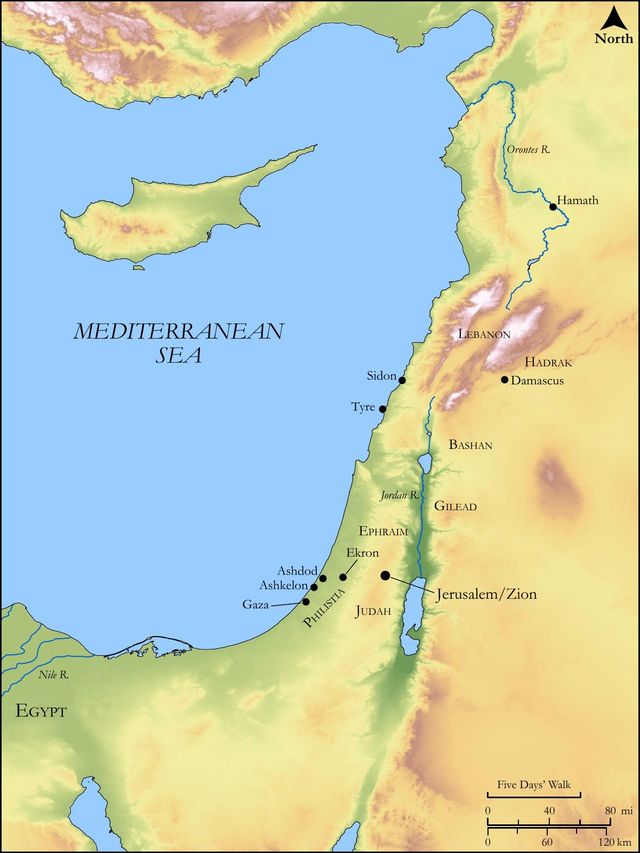
See on the biblical-era map
Study this verse
Public-domain commentary
Matthew Henry
From his Commentary on the Whole Bible. Henry comments on passages, not single verses — this entry covers Zechariah 11:1–3.
In dark and figurative expressions, as is usual in the scripture predictions of things at a great distance, that destruction of Jerusalem and of the Jewish church and nation is here foretold which our Lord Jesus, when the time was at hand, prophesied of very plainly and expressly. We have here, 1. Preparation made for that destruction (Zac 11:1): "Open thy doors, O Lebanon! Thou wouldst not open them to let thy king in - he came to his own and his own received him not; now thou must open them to let thy ruin in. Let the gates of the forest, and all the avenues to it, be thrown open, and let the fire come in and devour its glory." Some by Lebanon here understand the temple, which was built of cedars from Lebanon, and the stones of it white as the snow of Lebanon. It was burnt with fire by the Romans, and its gates were forced open by the fury of the soldiers. To confirm this, they tell a story, that forty years before the destruction of the second temple the gates of it opened of their own accord, upon which prodigy Rabbi Johanan made this remark (as it is found in one of the Jewish authors), "Now I know," said he, "that the destruction of the temple is at hand, according to the prophecy of Zechariah, Open thy doors, O Lebanon! that the fire may devour thy cedars." Others understand it of Jerusalem, or rather of the whole land of Canaan, to which Lebanon was an inlet on the north. All shall lie open to the invader, and the cedars, the mighty and eminent men, shall be devoured, which cannot but alarm those of an inferior rank, Zac 11:2. If the cedars have fallen (if all the mighty are spoiled, and brought to ruin), let the fir-tree howl. How can the slender fir-trees stand if stately cedars fall? If cedars are devoured by fire, it is time for the fir-trees to howl; for no wood is so combustible as that of the fir. And let the oaks of Bashan, that lie exposed to every injury, howl, for the forest of the vintage (or the flourishing vineyard, that used to be guarded with a particular care) has come down, or (as some read it) when the defenced forests, such as Lebanon was, have come down. Note, The falls of the wise and good into sin, and the falls of the rich and great into trouble, are loud alarms to those that are every way their inferiors not to be secure. 2. Lamentation made for the destruction (Zac 11:3): There is a voice of howling. Those who have fallen howl for grief and shame, and those who see their own turn coming howl for fear. But the great men especially receive the alarm with the utmost confusion. Those who were roaring in the day of their revels and triumphs are howling in the day of their terrors; for now they are tormented more than others. Those great men were by office shepherds, and such should have protected God's flock committed to their charge; it is the duty both of princes and priests. But they were as young lions, that made themselves a terror to the flock with their roaring and the flock a prey to themselves with their tearing. Note, It is sad with a people when those who should be as shepherds to them are as young lions to them. But what is the issue? The shepherds howl, for their glory is spoiled. Their pastures, and the flocks which covered them, which were the glory of the swains, are laid waste. The young lions howl, for the pride of Jordan is spoiled. The pride of Jordan was the thickets on the banks, in which the lions reposed themselves; and therefore, when the river overflowed and spoiled them, the lions came up from them (as we read Jer 49:19), and they came up roaring. Note, When those who have power proudly abuse their power, and, instead of being shepherds, are as young lions, they may expect that the righteous God will humble their pride and break their power.
Historical interpretation
Historical reception
1 surviving comment on this verse from the historical church.
(Verse 3) The voice of the shepherds howls, because their magnificence has been laid waste. The voice of the lions' roar, because the pride of the Jordan has been laid waste. LXX: The voice of the mourners of the shepherds, because their magnificence has become miserable. The voice of the roaring lions, because the roaring of the Jordan has been subdued. This is the upper part of the chapter, and it is contained in these verses. Those he had called cedars, spruce trees, pines, and oaks of Bashan, and explaining what these trees represented, he said: Because the magnificent ones have been laid waste, now in another figure of speech he says that the shepherds, that is, the leaders and teachers, and those who were first among the people, ought to weep and mourn, because their magnificence and beauty and glory have been laid waste and destroyed: namely, the temple in which they boasted. And the voice, he says, is the roaring of lions, whom he now calls the same lions, the lofty trees, and again the shepherds. And because he had mentioned lions, he preserves the translation that he may infer: For the pride of the Jordan is laid waste, or the roaring and sound of the flowing water, which is called Gaon in Hebrew. And just as he compared the height of the temple to the elevation of the land of Judea near the height of Lebanon (for nothing is higher in the land of promise than Lebanon, nor more wooded and dense), so he joined the roar of lions to the Jordan river, which is the largest in Judea, near which the lions dwell, because of their burning thirst, and because of the proximity and wideness of the vast desert, and the reeds, and the marshes. And through the prophet it is said: The lion has come up from the Jordan (Jer. IV, 7), desiring to show that Nebuchadnezzar had left his abode, like a lion coming out of its den, against Jerusalem. Alternatively: The voice of the roaring lions, for the pride of the Jordan is laid waste. The voice, he says, of the nobles, because the temple has been destroyed, from which they always hoped for help, and which once nourished righteous ones and warriors and the powerful lions.
Continue studying Zechariah 11:3 across the web’s major study libraries — every link below opens this exact verse, chapter, or book on the destination site.
Read & Compare
 BibleGatewayThis verse in more than 200 translations and 70 languages.
 Bible.comThe YouVersion reader — hundreds of translations, reading plans, and highlights.
 ESV.orgCrossway's official English Standard Version reader.
 NET BibleThe NET translation with 60,000+ translators' notes on every rendering decision.
 STEP BibleTyndale House's free study tool — original text, vocabulary, and scholarly resources.
 BibliaLogos Bible Software's free web reader.
 USCCBThe New American Bible (Revised Edition) with the U.S. bishops' study notes.
Commentaries
 BibleHub CommentariesDozens of classic commentaries on this verse, gathered on one page.
 StudyLightMore than 100 commentary sets — the largest collection on the web.
 BibleRefPlain-English commentary on what this verse means, verse by verse.
 Enduring WordDavid Guzik's free commentary on this chapter, widely used by Bible teachers.
 Bible Study ToolsVerse commentary alongside Greek and Hebrew study aids.
Original Language & Research
- BibleHub InterlinearThe verse word by word — original language, transliteration, and English.
- BibleHub LexiconEvery word's original-language definition and Strong's entry.
 Blue Letter BibleDeep-study tools — Strong's numbers, concordance, and word studies.
 SefariaThe Hebrew text with Rashi and centuries of Jewish commentary.
Sermons, Hymns & Audio


TrulyRandomVerse is not affiliated with these sites and doesn’t control their content. They’re linked because they’re genuinely useful.
Summary
Zechariah 11:3 vividly portrays a scene of intense lament and desolation, marked by the cries of "howling shepherds" and "roaring young lions," signifying the catastrophic ruin and loss of prestige for corrupt leaders and the land of Israel. This prophetic utterance underscores the severe consequences of failed leadership and the divine judgment that befalls those who exploit rather than shepherd God's flock, leading to the stripping away of their power, glory, and the very abundance of the land.
Context
ShowHideLiterary Context
Zechariah 11 is a pivotal and highly symbolic chapter within the latter half of the book (chapters 9-14), which shifts from post-exilic rebuilding to a series of prophetic oracles concerning Israel's future, often with messianic overtones. This chapter, in particular, introduces a prophetic drama where Zechariah himself acts as a shepherd of a flock destined for slaughter, symbolizing God's people. The "shepherds" in verse 3 are the unfaithful leaders of Israel—both political and religious—who have failed to care for God's flock, leading to their abandonment and subsequent judgment. This verse sets the stage for the dramatic rejection of the "Good Shepherd" (foreshadowing Christ) later in the chapter, specifically in Zechariah 11:12-13. The lament described here is a direct consequence of the flock's mistreatment and the shepherds' dereliction of duty, leading to a state of utter desolation.
Historical & Cultural Context
In Israel and among the nations, the metaphor of a shepherd for a ruler or leader was ubiquitous, signifying protection, provision, and guidance. Kings, priests, and elders were often seen as shepherds of their people. The "shepherds" in Zechariah 11:3 therefore represent the ruling elite of Israel, whose failure to uphold their covenant responsibilities led to the nation's spiritual and physical decay. The "pride of Jordan" refers to the lush, fertile thickets and plains along the Jordan River, historically a place of natural beauty, abundance, and even a strategic barrier. Its "spoiling" would signify a profound loss of national prosperity, security, and natural splendor. The imagery of "young lions" could refer to powerful, predatory figures within the leadership or external threats that would contribute to the desolation, or even the lament of these powerful figures themselves as their dominion is destroyed. The post-exilic period, though marked by the return from Babylon, was still fraught with challenges, including internal corruption and external pressures, making the theme of faithful leadership particularly poignant.
Key Themes
ShowHideZechariah 11:3 contributes significantly to several overarching themes. The most prominent is the Failure of Leadership and Divine Judgment. The "howling of the shepherds" directly indicts Israel's corrupt leaders, whose "glory is spoiled" as a consequence of their neglect and exploitation of the flock. This theme resonates throughout the prophetic books, condemning those who lead God's people astray, as seen in Jeremiah 23:1-4. Another key theme is Desolation and Loss. The repeated phrase "is spoiled" (Hebrew: shâdad) emphasizes a complete plundering and devastation, not just of material wealth but of national pride and natural beauty, symbolized by the "pride of Jordan." This imagery powerfully conveys a state of utter ruin and the profound suffering that results from a nation's spiritual decline. Finally, the verse highlights Intense Lament and Consequence, with the vivid auditory imagery of "howling" and "roaring" underscoring the depth of despair and the severe repercussions for a people who have rejected righteous governance and divine guidance. This lament serves as a stark warning of the inevitable decline when a nation or people abandon their divine covenant, echoing the warnings found in Deuteronomy 28.
Exposition and Analysis
ShowHideKey Word Analysis
ShowHideFrom the root yalal, meaning "to howl" or "to wail," this feminine noun signifies a loud cry of distress, grief, or lamentation. It depicts an intense, audible expression of pain and despair, often associated with mourning or catastrophic loss. In this context, it vividly conveys the deep anguish experienced by the shepherds (leaders) as their power and position are stripped away.
A primitive root meaning "to be burly" or "powerful," but more commonly used in the passive sense to mean "to be ravaged," "plundered," "devastated," or "laid waste." It implies a complete and violent destruction or despoliation, emphasizing the utter ruin and loss of what was once possessed or valued. Its repetition underscores the totality of the destruction.
Derived from a root meaning "to be high" or "exalted," this noun can denote arrogance, haughtiness, or majesty. By implication, it can also refer to something that is a source of pride, excellency, or ornament—a cherished possession or a symbol of strength and beauty. Here, "the pride of Jordan" refers to the luxuriant and formidable thickets along the Jordan River, which were a source of natural beauty, abundance, and perhaps even a defensive barrier, now utterly destroyed.
Verse Breakdown
ShowHide"There is a voice of the howling of the shepherds"
This opening phrase immediately establishes a scene of profound distress. The "voice" (Hebrew: qôwl) indicates an audible, widespread lament. The "howling" (Hebrew: yᵉlâlâh) is a cry of deep anguish and despair, specifically attributed to the "shepherds." These shepherds are symbolic of the corrupt and failed leaders of Israel, whose cries signify their suffering as their authority and influence crumble.
"for their glory is spoiled"
This clause provides the reason for the shepherds' lament. Their "glory" (Hebrew: ʼaddereth), which can mean their mantle, robe, or goodly garment—symbolizing their authority, honor, wealth, or even their very being—has been "spoiled" (Hebrew: shâdad). This indicates a complete plundering, devastation, or stripping away of their prestige, power, and possessions, a direct consequence of their unfaithfulness.
"a voice of the roaring of young lions"
This parallel phrase introduces another powerful auditory image of distress. The "roaring" (Hebrew: shᵉʼâgâh) of "young lions" (Hebrew: kᵉphîyr) suggests a fierce, guttural sound, perhaps of pain, anger, or despair. "Young lions" can symbolize powerful, predatory figures, possibly referring to the very leaders who once exploited the flock, now themselves in anguish, or perhaps external forces that contribute to the desolation. The imagery intensifies the sense of widespread catastrophe.
"for the pride of Jordan is spoiled"
Mirroring the previous clause, this provides the reason for the "roaring." The "pride of Jordan" (Hebrew: gâʼôwn Yardên), referring to the dense, lush thickets and fertile lands along the Jordan River, symbolizes the natural beauty, abundance, and perhaps even the protective strength of the land of Israel. Its being "spoiled" signifies the utter desolation and destruction of the nation's prosperity and natural defenses, completing the picture of national ruin.
Literary Devices
ShowHideZechariah 11:3 is rich in Imagery, particularly Auditory Imagery, with the repeated "voice of the howling" and "voice of the roaring," which vividly convey a soundscape of intense suffering and despair. The verse employs striking Symbolism: "shepherds" represent the unfaithful leaders of Israel, while "young lions" likely symbolize powerful, perhaps predatory, figures either among the leaders or external forces of destruction. The "glory" of the shepherds symbolizes their authority, wealth, and honor, while the "pride of Jordan" symbolizes the natural beauty, fertility, and security of the land. The structure of the verse itself demonstrates clear Parallelism, specifically Synonymous Parallelism in its two main clauses: "a voice of the howling of the shepherds; for their glory is spoiled" is mirrored by "a voice of the roaring of young lions; for the pride of Jordan is spoiled." This repetition with variation emphasizes the widespread nature and the dual impact—on leadership and on the land—of the impending judgment. The use of Metaphor is also evident, as the abstract concepts of leadership and national well-being are presented through concrete, vivid images of shepherds, lions, and the landscape.
Theological and Thematic Connections
ShowHideZechariah 11:3 serves as a stark prophetic warning against the perils of unrighteous leadership and the inevitable divine judgment that follows the exploitation and abandonment of God's people. The lamentable cries of the "howling shepherds" and the "roaring young lions" underscore the profound consequences when those entrusted with spiritual and national care prioritize self-interest over the well-being of the flock. This passage highlights God's unwavering commitment to justice, demonstrating that even those in positions of power are not exempt from accountability. The desolation of the "pride of Jordan" further emphasizes that the spiritual decay of a nation's leadership inevitably leads to widespread suffering and the loss of its very essence and prosperity. This prophetic scene is a powerful reminder that true glory and security are found not in worldly power or material abundance, but in faithful stewardship and adherence to God's covenant.
Reflection and Application
ShowHideZechariah 11:3 offers a sobering reflection for all generations, particularly concerning the nature of leadership and the consequences of its failure. It challenges us to consider the profound responsibility inherent in any position of influence, whether in the church, family, or society. The "howling of the shepherds" reminds us that those who prioritize personal gain over the welfare of those they lead will ultimately face a stripping away of their "glory," experiencing deep lament and loss. For believers, this verse underscores the critical importance of discerning and supporting righteous leadership, as well as the solemn duty of those called to shepherd God's flock to do so with integrity, sacrifice, and genuine care, rather than exploiting or neglecting them. It serves as a potent warning against spiritual and moral decay, which invariably leads to widespread desolation and despair, not just for the leaders but for the entire community. Our true security and flourishing are tied to faithful adherence to God's ways and the pursuit of justice and righteousness in all spheres of life.
Questions for Reflection
ShowHideFAQ
ShowHideWho are the "shepherds" and "young lions" in this verse, and what do they represent?
ShowHideIn Zechariah 11:3, the "shepherds" primarily represent the unfaithful and corrupt leaders of Israel, encompassing both political and religious authorities (e.g., kings, priests, elders). They are those entrusted with the care and guidance of God's people, but who have instead exploited or abandoned them. The "young lions" (Hebrew: kᵉphîyr) are symbolic of powerful, often predatory figures. They could represent the very same corrupt leaders, whose "roaring" signifies their own anguish as their power is destroyed, or they could symbolize external forces, like invading armies, that contribute to the desolation, or even internal factions that prey upon the people. The imagery emphasizes the destructive nature of unrighteous authority and the resulting chaos.
What is meant by "their glory is spoiled" and "the pride of Jordan is spoiled"?
ShowHide"Their glory is spoiled" refers to the stripping away of the honor, authority, wealth, and prestige of the unfaithful shepherds. The Hebrew word for "glory" (ʼaddereth) can also mean a "mantle" or "robe," symbolizing their office or status. So, their power and position are utterly destroyed. "The pride of Jordan" is spoiled" refers to the devastation of the lush, fertile, and beautiful region along the Jordan River. This area was known for its dense thickets and abundant vegetation, symbolizing the natural beauty, prosperity, and perhaps even the protective strength of the land of Israel. Its "spoiling" signifies a complete desolation and loss of national abundance and security, emphasizing the widespread impact of divine judgment.
Christ-Centered Fulfillment
ShowHideZechariah 11:3, with its lament over failed shepherds and spoiled glory, finds its profound Christ-centered fulfillment in the coming of Jesus, the true and Good Shepherd. The "howling of the shepherds" and the "roaring of young lions" vividly depict the tragic state of Israel under corrupt leadership, a condition that persisted into the time of Christ, where the religious leaders (Pharisees, Sadducees) were often blind guides who exploited the flock rather than nourishing them (as seen in Matthew 23:1-36). Jesus, however, stands in stark contrast to these failed shepherds. He is the one who lays down His life for the sheep, gathering the scattered flock (as prophesied in Ezekiel 34:23). The "spoiling" of the shepherds' glory and the "pride of Jordan" foreshadows the judgment that would come upon Jerusalem and its leadership for rejecting their Messiah, culminating in the destruction of the temple and the city in A.D. 70, a direct consequence of their refusal to recognize the time of their visitation (as lamented by Jesus in Luke 19:41-44). Thus, Zechariah 11:3 not only highlights the failure of human leadership but also sets the stage for the ultimate, perfect, and self-sacrificing leadership of Christ, whose coming brings true restoration and whose rejection brings ultimate judgment.