


Numbers 15:37
Bible text: King James Version (1769 Blayney text) · Public domain
Bible text: Berean Standard Bible · Public domain
Bible text: American Standard Version (1901) · Public domain
Bible text: World English Bible, Messianic edition · Public domain
Bible text: Geneva Bible (1599) · Public domain
Bible text: Young's Literal Translation · Public domain
- וַיֹּאמֶרvai·Yo·merand he saidH559Conj-w ¦ V-Qal-ConsecImperf-3msVerb Qal Consecutive Imperfect 3rd Singular Masculineוַandיֹּאמֶרhe said
- יְהוָהYah·wehYahwehH3068N-properNoun Proper Title
- אֶל'eltoH413PrepPreposition
- מֹשֶׁהmo·ShehMosesH4872N-proper-mNoun Proper Masculine
- לֵּאמֹרle·Mor<to> sayingH559Prep-l ¦ V-Qal-InfVerb Qal Infinitive Constructלֵּ<to>אמֹרsaying
English is a literal word-by-word gloss of the Hebrew, not the KJV's wording. Why?
This is the original text the KJV's translators worked from — each Hebrew word with its own literal English meaning in this verse, prepared by scholars at Tyndale House, Cambridge. The KJV translates whole sentences, not word by word, so its wording differs: one Hebrew word can become several English words, and the KJV may choose “the LORD” where the gloss reads “Yahweh”. Both are faithful — they answer different questions. For the KJV's own rendering, switch to the KJV text.
Details
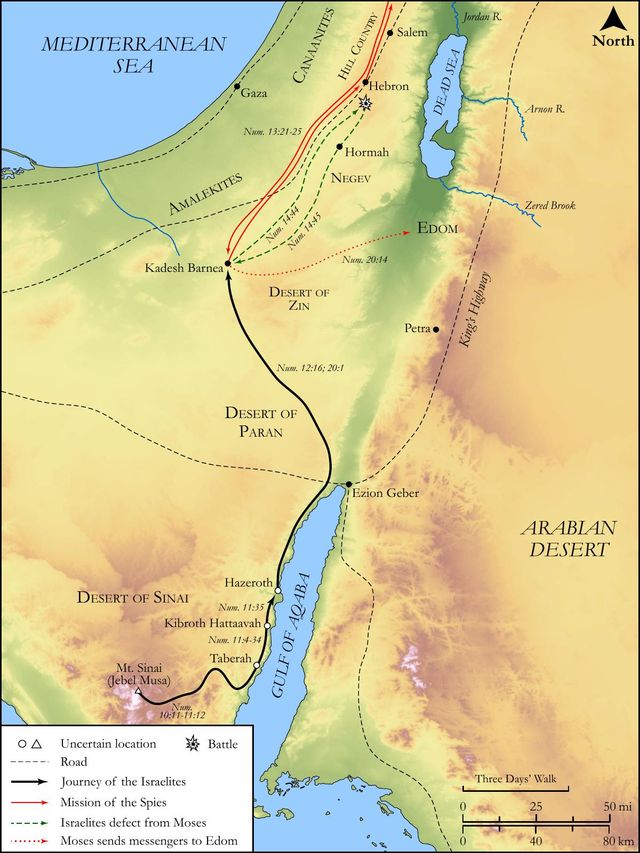
See on the biblical-era map
Study this verse
Public-domain commentary
Matthew Henry
From his Commentary on the Whole Bible. Henry comments on passages, not single verses — this entry covers Numbers 15:37–41.
Provision had been just now made by the law for the pardon of sins of ignorance and infirmity; now here is an expedient provided for the preventing of such sins. They are ordered to make fringes upon the borders of their garments, which were to be memorandums to them of their duty, that they might not sin through forgetfulness. 1. The sign appointed is a fringe of silk, or thread, or worsted, or the garment itself ravelled at the bottom, and a blue riband bound on the top of it to keep it tight, Num 15:38. The Jews being a peculiar people, they were thus distinguished from their neighbours in their dress, as well as in their diet, and taught by such little instances of singularity not to be conformed to the way of the heathen in greater things. Thus likewise they proclaimed themselves Jews wherever they were, as those that were not ashamed of God and his law. Our Saviour, being made under the law, wore these fringes; hence we read of the hem or border, of his garment, Mat 9:20. These borders the Pharisees enlarged, that they might be thought more holy and devout than other people. The phylacteries were different things; these were their own invention, the fringes were a divine institution. The Jews at this day wear them, saying, when they put them on, Blessed be he who has sanctified us unto himself, and commanded us to wear fringes. 2. The intention of it was to remind them that they were a peculiar people. They were not appointed for the trimming and adorning of their clothes, but to stir up their pure minds by way of remembrance (Pe2 3:1), that they might look upon the fringe and remember the commandments. Many look upon their ornaments to feed their pride, but they must look upon these ornaments to awaken their consciences to a sense of their duty, that their religion might constantly beset them, and that they might carry it about with them, as they did their clothes, wherever they went. If they were tempted to sin, the fringe would be a monitor to them not to break God's commandments: If a duty was forgotten to be done in its season, the fringe would remind them of it. This institution, though it is not an imposition upon us, is an instruction to us, always to remember the commandments of the Lord our God, that we may do them, to treasure them up in our memories, and to apply them to particular cases as there is occasion to use them. It was intended particularly to be a preservative from idolatry: that you seek not after your own heart, and your own eyes, in your religious worship. Yet it may extend also to the whole conversation, for nothing is more contrary to God's honour, and our own true interest, than to walk in the way of our heart and in the sight of our eyes; for the imagination of the heart is evil, and so is the lust of the eyes.
After the repetition of some ceremonial appointments, the chapter closes with that great and fundamental law of religion, Be holy unto your God, purged from sin, and sincerely devoted to his service; and that great reason for all the commandments is again and again inculcated, I am the Lord your God. Did we more firmly believe, and more frequently and seriously consider, that God is the Lord, and our God and Redeemer, we should see ourselves bound in duty, interest, and gratitude, to keep all his commandments.
Continue studying Numbers 15:37 across the web’s major study libraries — every link below opens this exact verse, chapter, or book on the destination site.
Read & Compare
 BibleGatewayThis verse in more than 200 translations and 70 languages.
 Bible.comThe YouVersion reader — hundreds of translations, reading plans, and highlights.
 ESV.orgCrossway's official English Standard Version reader.
 NET BibleThe NET translation with 60,000+ translators' notes on every rendering decision.
 STEP BibleTyndale House's free study tool — original text, vocabulary, and scholarly resources.
 BibliaLogos Bible Software's free web reader.
 USCCBThe New American Bible (Revised Edition) with the U.S. bishops' study notes.
Commentaries
 BibleHub CommentariesDozens of classic commentaries on this verse, gathered on one page.
 StudyLightMore than 100 commentary sets — the largest collection on the web.
 BibleRefPlain-English commentary on what this verse means, verse by verse.
 Enduring WordDavid Guzik's free commentary on this chapter, widely used by Bible teachers.
 Bible Study ToolsVerse commentary alongside Greek and Hebrew study aids.
Original Language & Research
- BibleHub InterlinearThe verse word by word — original language, transliteration, and English.
- BibleHub LexiconEvery word's original-language definition and Strong's entry.
 Blue Letter BibleDeep-study tools — Strong's numbers, concordance, and word studies.
 SefariaThe Hebrew text with Rashi and centuries of Jewish commentary.
Sermons, Hymns & Audio


TrulyRandomVerse is not affiliated with these sites and doesn’t control their content. They’re linked because they’re genuinely useful.
Summary
Numbers 15:37 serves as a classic introductory formula within the Pentateuch, signaling the direct, authoritative communication of God to Moses. Though brief, this verse carries profound theological weight, establishing the divine origin of the subsequent commands regarding the wearing of tzitzit (fringes) and underscoring God's ongoing initiative in revealing His will and covenant expectations to the Israelite community during their wilderness journey. It is a foundational statement affirming divine revelation and Moses' unique role as mediator.
Context
ShowHideLiterary Context
Numbers 15:37 introduces a new segment of divine law, specifically the command concerning the tzitzit (fringes) on the corners of garments, detailed in Numbers 15:38-41. This command follows a series of laws primarily focused on offerings for unintentional sins and the consequences of defiant sin, as well as the incident of the Sabbath-breaker (Numbers 15:32-36). The shift from specific sacrificial laws and judicial matters to a visible, daily reminder of God's commandments highlights a transition in focus from atonement for sin to proactive obedience and remembrance. The formulaic opening "And the LORD spake unto Moses, saying" acts as a clear demarcation, indicating a new, distinct divine instruction, reinforcing its importance and direct divine origin within the ongoing narrative of Israel's wilderness journey.
Historical & Cultural Context
The book of Numbers chronicles Israel's forty-year wilderness wandering, a period marked by divine provision, repeated rebellion, and the continuous giving of the Mosaic Law. The Israelites were a nomadic people, preparing to enter the Promised Land, and their daily lives were to be saturated with reminders of their covenant relationship with Yahweh. The command for tzitzit, introduced by this verse, would have been a tangible, visible marker distinguishing them from surrounding pagan nations, whose religious practices often involved idolatry and immorality. The direct communication from God to Moses was the established mode of divine governance during this period, with Moses serving as the sole intermediary between the Holy God and the often-rebellious nation. This context underscores the necessity of clear, undeniable divine mandates for a people prone to forgetfulness and disobedience.
Key Themes
ShowHideNumbers 15:37 powerfully encapsulates several overarching themes prevalent throughout the Pentateuch and the book of Numbers. Firstly, it emphasizes Divine Revelation, asserting that the laws and instructions governing Israel's life originated directly from God Himself, not from human wisdom or tradition. This recurring phrase underscores God's active involvement in His people's lives and His desire to communicate His will. Secondly, it highlights Moses' Role as Mediator, portraying him as God's chosen prophet and the unique conduit through whom divine instructions were conveyed to the Israelites. His unparalleled access to God, often described as God speaking to him "face to face" as seen in Exodus 33:11, made him indispensable for establishing the covenant. Thirdly, this introductory formula reinforces the Divine Authority of every subsequent command. Each law introduced by "And the LORD spake unto Moses, saying" carries the full, binding weight of God's absolute sovereignty, demanding Israel's complete obedience and shaping their identity as a covenant people set apart by God's holy word (Deuteronomy 4:1-2).
Exposition and Analysis
ShowHideKey Word Analysis
ShowHideRepresented by the capitalized "LORD" in the KJV, this refers to the sacred, personal covenant name of God (H3068, יְהוָה, Yᵉhôvâh). Derived from the verb "to be," this name signifies "the self-Existent or Eternal." Its use here is profoundly significant; it is not merely a generic deity but the specific God who entered into covenant with Israel, delivered them from Egypt, and continues to guide them in the wilderness. This name emphasizes God's faithfulness, His unchanging nature, and His unique relationship with His chosen people, lending immense weight and personal authority to His words.
This verb (H559, אָמַר, ʼâmar) is a primitive root meaning "to say," but used with great latitude. It denotes a direct, intentional, and often authoritative utterance. It implies more than mere conversation; it signifies a declaration, a command, or a solemn pronouncement. When applied to God, it emphasizes His active will being communicated, often with the intent to create, command, or establish. In this context, it underscores the divine initiative and the binding nature of the ensuing instruction, indicating a deliberate and purposeful communication from God.
Moses (H4872, מֹשֶׁה, Môsheh) is consistently portrayed as God's chosen prophet and the primary human recipient of divine revelation for Israel. His name, meaning "drawing out" (of the water), hints at his rescue and subsequent role. The phrase "unto Moses" highlights his unique mediatorial role. God chose to speak through Moses to His people, establishing a clear channel of communication and authority. This emphasizes the structured nature of divine revelation in the Old Covenant, where God appointed specific individuals to convey His truth.
Verse Breakdown
ShowHide"And the LORD spake unto Moses, saying"
This entire phrase functions as a standard, formulaic introduction throughout the Pentateuch, particularly in legal and instructional passages. It immediately establishes the divine origin and absolute authority of the subsequent commands. The initial "And" (וַיְדַבֵּר, Vayedaber) connects this new divine utterance to the ongoing narrative of God's interaction with Israel, indicating a continuous flow of revelation. The subject, "the LORD" (YHWH), identifies the speaker as the covenant God of Israel, lending ultimate weight to the message. The recipient, "unto Moses," confirms Moses' unique and indispensable role as the divinely appointed mediator. Finally, "saying" (לֵּאמֹר, lemor) signals that the direct words of God are about to follow, preparing the hearer for a divine mandate. This formula serves as a theological stamp, ensuring that the Israelites understood these were not human suggestions but divine imperatives.
Literary Devices
ShowHideThe most prominent literary device in Numbers 15:37 is Formulaic Language or Stock Phrase. The precise wording, "And the LORD spake unto Moses, saying," is a highly repetitive and recognizable introductory formula found hundreds of times throughout the Pentateuch (e.g., Exodus 6:10, Leviticus 1:1, Numbers 1:1). This repetition serves several crucial functions: it consistently identifies the source of the law as God Himself, thereby establishing absolute divine authority; it reinforces Moses' unique role as the divinely appointed mediator; and it provides a clear structural marker, signaling the beginning of a new divine instruction or narrative segment. The consistent use of this formula underscores the unwavering nature of God's communication and the continuity of His covenant relationship with Israel.
Theological and Thematic Connections
ShowHideNumbers 15:37, though brief, is profoundly significant as it undergirds the entire edifice of Old Covenant law with divine authority. It asserts the fundamental theological truth that God is a communicating God, actively engaged with His creation and specifically with His chosen people. The consistent use of this formula throughout the Pentateuch emphasizes that the Mosaic Law is not a human construct but a direct revelation of God's character, will, and moral standards. This divine initiative in revelation establishes the basis for Israel's covenant relationship, demanding obedience rooted in reverence for the One who speaks. The authority of God's Word, introduced by this phrase, becomes the bedrock for all Israelite life, worship, and ethical conduct, shaping their identity as a people set apart by divine decree.
Reflection and Application
ShowHideNumbers 15:37, a seemingly simple introductory phrase, serves as a powerful reminder of the foundational truth that our faith is rooted in a God who speaks. In a world saturated with human opinions and fleeting ideologies, this verse anchors us to the unchanging reality of divine revelation. It calls us to recognize the Bible not merely as ancient literature or human wisdom, but as the very words of God, breathed out by Him and conveyed through His chosen instruments. Just as ancient Israel was called to listen attentively to Moses because God spoke through him, so too are we called to approach Scripture with reverence, humility, and a readiness to obey. This verse challenges us to ask: Do I truly believe that God speaks through His Word? Am I listening with an open heart and a submissive spirit? Our spiritual growth and obedience are directly proportional to our conviction in the divine authority of Scripture and our willingness to heed its commands, knowing they originate from the all-wise, all-loving, and all-powerful God.
Questions for Reflection
ShowHideFAQ
ShowHideWhy is this verse so short, and what is its significance?
ShowHideNumbers 15:37 is indeed very short, serving as a formulaic introductory phrase: "And the LORD spake unto Moses, saying." Its significance lies precisely in its brevity and repetitive nature. This phrase, appearing hundreds of times throughout the Pentateuch, acts as a crucial theological and literary marker. It immediately establishes the divine origin and absolute authority of the commands or narratives that follow. It signals that what is about to be revealed comes directly from God (YHWH), the covenant-keeping Lord, and is communicated through His chosen mediator, Moses. Far from being insignificant, it is a foundational statement affirming divine revelation, ensuring that the Israelites (and subsequent readers) understood that these were not human traditions or suggestions, but binding divine mandates for their lives and worship. It underscores the bedrock principle that God actively communicates His will to humanity, laying the groundwork for all subsequent divine instruction and covenant relationship, as seen in passages like Deuteronomy 6:4-9.
Christ-Centered Fulfillment
ShowHideNumbers 15:37, with its emphasis on God speaking directly to Moses, finds its ultimate fulfillment in the person of Jesus Christ. While God spoke "at various times and in various ways" through prophets like Moses in the Old Testament, Hebrews 1:1-2 declares that "in these last days he has spoken to us by his Son." Jesus is the living Word of God, the perfect and complete revelation of the Father, as John 1:1 states, "In the beginning was the Word, and the Word was with God, and the Word was God." Moses was a mediator who conveyed God's words; Jesus is God's Word incarnate, embodying and perfectly revealing the divine will and character. He is the greater Prophet whom Moses foretold in Deuteronomy 18:15, the one to whom all people are now called to listen. Through Christ, God has spoken His final, most glorious word, offering not merely laws but the very life of God and the way of salvation, making Him the ultimate source of divine truth and authority for all who believe, as John 14:6 proclaims, "I am the way, and the truth, and the life; no one comes to the Father except through me." His words are spirit and life, bringing eternal salvation, as affirmed in John 6:68.