


Numbers 14:14
Bible text: King James Version (1769 Blayney text) · Public domain
Bible text: King James Version with Strong's numbers · Public domain
Bible text: Berean Standard Bible · Public domain
Bible text: American Standard Version (1901) · Public domain
Bible text: World English Bible, Messianic edition · Public domain
Bible text: Geneva Bible (1599) · Public domain
Bible text: Young's Literal Translation · Public domain
- וְאָמְרוּve·'a·me·Ruand they will sayH559Conj-w ¦ V-Qal-ConsecPerf-3cpVerb Qal Consecutive Perfect 3rd Plural common genderוְandאָמְרוּthey will say
- אֶל'eltoH413PrepPreposition
- יוֹשֵׁבyo·Shev[the] inhabitant[s] ofH3427V-Qal-Prtcpl-msVerb Qal Participle Singular Masculine Construct
- הָאָרֶץha·'A·retzthe landH776Art ¦ N-fsNoun Singular Feminine Absoluteהָtheאָרֶץland
- הַזֹּאתha·zoT<the> thisH2063Art ¦ PrtParticle Demonstrativeהַ<the>זֹּאתthis
- שָׁמְעוּsha·me·'Uthey have heardH8085V-Qal-Perf-3cpVerb Qal Perfect 3rd Plural common gender
- כִּיkithatH3588PrtParticle Conditional
- אַתָּה'a·TahyouH859Pro-2msPronoun Personal 2nd Singular Masculine
- יְהוָהYah·wehO YahwehH3068N-properNoun Proper Title
- בְּקֶרֶבbe·Ke·rev[are] in [the] midst ofH7130Prep-b ¦ N-mscNoun Singular Masculine Constructבְּ[are] inקֶרֶב[the] midst of
- הָעָםha·'Amthe peopleH5971Art ¦ N-msNoun Singular Masculine Absoluteהָtheעָםpeople
- הַזֶּהha·Zeh<the> thisH2088Art ¦ PrtParticle Demonstrativeהַ<the>זֶּהthis
- אֲשֶׁר'a·SherwhoH834RelParticle Relative
- עַיִן'A·yineyeH5869N-fsNoun Singular Feminine Absolute
- בְּעַיִןbe·'A·yinin eyeH5869Prep-b ¦ N-fsNoun Singular Feminine Absoluteבְּinעַיִןeye
- נִרְאָהnir·'Ahhe was seenH7200V-Niphal-Perf-3msVerb Niphal Perfect 3rd Singular Masculine
- אַתָּה'a·TahyouH859Pro-2msPronoun Personal 2nd Singular Masculine
- יְהוָהYah·wehO YahwehH3068N-properNoun Proper Title
- וַעֲנָנְךָva·'a·na·ne·Khaand your cloudH6051Conj-w ¦ N-msc ¦ 2msNoun Singular Masculine Constructוַandעֲנָנְcloudךָyour
- עֹמֵד'o·Med[is] standingH5975V-Qal-Prtcpl-msVerb Qal Participle Singular Masculine Absolute
- עֲלֵהֶם'a·le·Hemover themH5921Prep ¦ 3mpPreposition Definiteעֲלֵoverהֶםthem
- וּבְעַמֻּדu·ve·'a·Mudand in a pillar ofH5982Conj-w ¦ Prep-b ¦ N-mscNoun Singular Masculine Constructוּandבְinעַמֻּדa pillar of
- עָנָן'a·NancloudH6051N-msNoun Singular Masculine Absolute
- אַתָּה'a·TahyouH859Pro-2msPronoun Personal 2nd Singular Masculine
- הֹלֵךְho·Lekh[are] goingH1980V-Qal-Prtcpl-msVerb Qal Participle Singular Masculine Absolute
- לִפְנֵיהֶםlif·nei·Hem<to> before themH6440Prep-l ¦ N-mpc ¦ 3mpNoun Plural Masculine Constructלִ<to>פְנֵיbeforeהֶםthem
- יוֹמָםyo·Mamby dayH3119AdvAdverb
- וּבְעַמּוּדu·ve·'a·Mudand in a pillar ofH5982Conj-w ¦ Prep-b ¦ N-mscNoun Singular Masculine Constructוּandבְinעַמּוּדa pillar of
- אֵשׁ'eshfireH784N-csNoun Singular common gender Absolute
- לָיְלָהLa·ye·lahnightH3915N-msNoun Singular Masculine Absolute
English is a literal word-by-word gloss of the Hebrew, not the KJV's wording. Why?
This is the original text the KJV's translators worked from — each Hebrew word with its own literal English meaning in this verse, prepared by scholars at Tyndale House, Cambridge. The KJV translates whole sentences, not word by word, so its wording differs: one Hebrew word can become several English words, and the KJV may choose “the LORD” where the gloss reads “Yahweh”. Both are faithful — they answer different questions. For the KJV's own rendering, switch to the KJV text.
Details
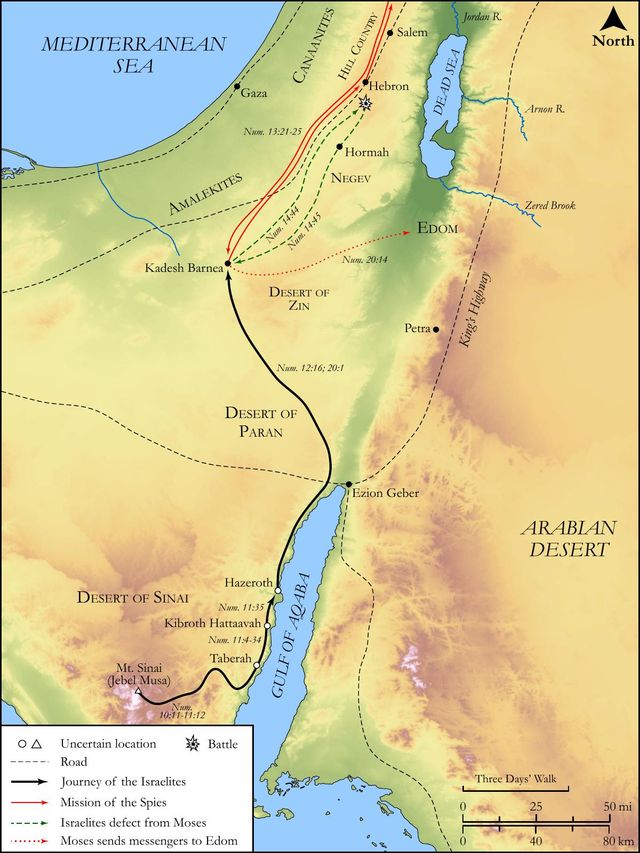
See on the biblical-era map
Study this verse
Public-domain commentary
Matthew Henry
From his Commentary on the Whole Bible. Henry comments on passages, not single verses — this entry covers Numbers 14:11–19. His four-level outline is real structure in the source text, so it is rendered as structure.
Here is, I. The righteous sentence which God gave against Israel for their murmuring and unbelief, which, though afterwards mitigated, showed what was the desert of their sin and the demand of injured justice, and what would have been done if Moses had not interposed. When the glory of the Lord appeared in the tabernacle we may suppose that Moses took it for a call to him immediately to come and attend there, as before the tabernacle was erected he went up to the mount in a similar case, Exo 32:30. Thus, while the people were studying to disgrace him, God publicly put honour upon him, as the man of his counsel. Now here we are told what God said to him there.
1.He showed him the great evil of the people's sin, Num 14:11. What passed between God and Israel went through the hands of Moses: when they were displeased with God they told Moses of it (Num 14:2); when God was displeased with them he told Moses too, revealing his secret to his servant the prophet, Amo 3:7. Two things God justly complains of to Moses: - (1.) Their sin. They provoke me, or (as the word signifies) they reject, reproach, despise me, for they will not believe me. This was the bitter root which bore the gall and wormwood. It was their unbelief that made this a day of provocation in the wilderness, Heb 3:8. Note, Distrust of God, of his power and promise, is itself a very great provocation, and at the bottom of many other provocations. Unbelief is a great sin (Jo1 5:10), and a root sin, Heb 3:12. (2.) Their continuance in it: How long will they do so? Note, The God of heaven keeps an account how long sinners persist in their provocations; and the longer they persist the more he is displeased. The aggravations of their sin were, [1.] Their relation to God: This people, a peculiar people, a professing people. The nearer any are to God in name and profession, the more he is provoked by their sins, especially their unbelief. [2.] The experience they had had of God's power and goodness, in all the signs which he had shown among them, by which, one would think, he had effectually obliged them to trust him and follow him. The more God has done for us the greater is the provocation if we distrust him.
2.He showed him the sentence which justice passed upon them for it, Num 14:12. "What remains now but that I should make a full end of them? It will soon be done. I will smite them with the pestilence, not leave a man of them alive, but wholly blot out their name and race, and so disinherit them, and be no more troubled with them. Ah, I will ease me of my adversaries. They wish to die; and let them die, and neither root nor branch be left of them. Such rebellious children deserve to be disinherited." And if it be asked, "What will become of God's covenant with Abraham then?" here is an answer, "I shall be preserved in the family of Moses: I will make of thee a greater nation." Thus,
(1.)God would try Moses, whether he still continued that affection for Israel which he formerly expressed upon a like occasion, in preferring their interests before the advancement of his own family; and it is proved that Moses was still of the same public spirit, and could not bear the thought of raising his own name upon the ruin of the name of Israel.
(2.)God would teach us that he will not be a loser by the ruin of sinners. If Adam and Eve had been cut off and disinherited, he could have made another Adam and another Eve, and have glorified his mercy in them, as here he could have glorified his mercy in Moses, though Israel had been ruined.
II.The humble intercession Moses made for them.
Their sin had made a fatal breach in the wall of their defence, at which destruction would certainly have entered if Moses had not seasonably stepped in and made it good. Here he was a type of Christ, who interceded for his persecutors, and prayed for those that despitefully used him, leaving us an example to his own rule, Mat 5:44.
1.The prayer of his petition is, in one word, Pardon, I beseech thee, the iniquity of this people (Num 14:19), that is, "Do not bring upon them the ruin they deserve." This was Christ's prayer for those that crucified him, Father forgive them. The pardon of a national sin, as such, consists in the turning away of the national punishment; and that is it for which Moses is here so earnest.
2.The pleas are many, and strongly urged.
(1.)He insists most upon the plea that is taken from the glory of God, Num 14:13-16. With this he begins, and somewhat abruptly, taking occasion from that dreadful word, I will disinherit them. Lord (says he), then the Egyptians shall hear it. God's honour lay nearer to his heart than any interests of his own. Observe how he orders this cause before God. He pleads,
[1.]That the eyes both of Egypt and Canaan were upon them, and great expectations were raised concerning them. They could not but have heard that thou, Lord, art among this people, Num 14:14. The neighbouring countries rang of it, how much this people were the particular care of heaven, so as never any people under the sun were.
[2.]That if they should be cut off great notice would be taken of it. "The Egyptians will hear it (Num 14:13), for they have their spies among us, and they will tell it to the inhabitants of the land" (Num 14:14); for there was great correspondence between Egypt and Canaan, although not by the way of this wilderness. "If this people that have made so great a noise be all consumed, if their mighty pretensions come to nothing, and their light go out in a snuff, it will be told with pleasure in Gath, and published in the streets of Askelon; and what construction will the heathen put upon it? It will be impossible to make them understand it as an act of God's justice, and as such redounding to God's honour; brutish men know not this (Psa 92:6): but they will impute it to the failing of God's power, and so turn it to his reproach, Num 14:16. They will say, He slew them in the wilderness because he was not able to bring them to Canaan, his arm being shortened, and his stock of miracles being spent. Now, Lord, let not one attribute be glorified at the expense of another; rather let mercy rejoice against judgment than that almighty power should be impeached." Note, The best pleas in prayer are those that are taken from God's honour; for they agree with the first petition of the Lord's Prayer, Hallowed be thy name. Do not disgrace the throne of thy glory. God pleads it with himself (Deu 32:27), I feareth the wrath of the enemy; and we should use it as an argument with ourselves to walk so in every thing as to give no occasion to the enemies of the Lord to blaspheme, Ti1 6:1.
(2.)He pleads God's proclamation of his name at Horeb (Num 14:17, Num 14:18): Let the power of the Lord be great. Power is here put for pardoning mercy; it is his power over his own anger. If he should destroy them, God's power would be questioned; if he should continue and complete their salvation, notwithstanding the difficulties that arose, not only from the strength of their enemies, but from their own provocations, this would greatly magnify the divine power: what cannot he do who could make so weak a people conquerors and such an unworthy people favourites? The more danger there is of others reproaching God's power the more desirous we should be to see it glorified. To enforce this petition, he refers to the word which God had spoken: The Lord is long-suffering and of great mercy. God's goodness had there been spoken of as his glory; God gloried in it, Exo 34:6, Exo 34:7. Now here he prays that upon this occasion he would glorify it. Note, We must take our encouragement in prayer from the word of God, upon which he has caused us to hope, Psa 119:49. "Lord, be and do according as thou hast spoken; for hast thou spoken, and wilt thou not make it good?" Three things God had solemnly made a declaration of, which Moses here fastens upon, and improves for the enforcing of his petition: - [1.] The goodness of God's nature in general, that he is long-suffering, or slow to anger, and of great mercy; not soon provoked, but tender and compassionate towards offenders. [2.] His readiness in particular to pardon sin: Forgiving iniquity and transgression, sins of all sorts. [3.] His unwillingness to proceed to extremity, even when he does punish. For in this sense the following words may be read: That will by no means make quite desolate, in visiting the iniquity of the fathers upon the children. God had indeed said in the second commandment that he would thus visit, but here he promises not to make a full end of families, churches, and nations, at once; and so it is very applicable to this occasion, for Moses cannot beg that God would not at all punish this sin (it would be too great an encouragement to rebellion if he should set no mark of his displeasure upon it), but that he would not kill all this people as one man, Num 14:15. He does not ask that they may not be corrected, but that they may not be disinherited. And this proclamation of God's name was the more apposite to his purpose because it was made upon occasion of the pardoning of their sin in making the golden calf. This sin which they had now fallen into was bad enough, but it was not idolatry.
(3.)He pleads past experience: As thou hast forgiven this people from Egypt, Num 14:19. This seemed to make against him. Why should those be forgiven any more who, after they had been so often forgiven, revolted yet more and more, and seemed hardened and encouraged in their rebellion by the lenity and patience of their God, and the frequent pardons they had obtained? Among men it would have been thought impolitic to take notice of such a circumstance in a request of this nature, as it might operate to the prejudice of the petitioner: but, as in other things so in pardoning sin, God's thoughts and ways are infinitely above ours, Isa 55:9. Moses looks upon it as a good plea, Lord, forgive, as thou hast forgiven. It will be no more a reproach to thy justice, nor any less the praise of thy mercy, to forgive now, than it has been formerly. Therefore the sons of Jacob are not consumed, because they have to do with a God that changes not, Mal 3:6.
Continue studying Numbers 14:14 across the web’s major study libraries — every link below opens this exact verse, chapter, or book on the destination site.
Read & Compare
 BibleGatewayThis verse in more than 200 translations and 70 languages.
 Bible.comThe YouVersion reader — hundreds of translations, reading plans, and highlights.
 ESV.orgCrossway's official English Standard Version reader.
 NET BibleThe NET translation with 60,000+ translators' notes on every rendering decision.
 STEP BibleTyndale House's free study tool — original text, vocabulary, and scholarly resources.
 BibliaLogos Bible Software's free web reader.
 USCCBThe New American Bible (Revised Edition) with the U.S. bishops' study notes.
Commentaries
 BibleHub CommentariesDozens of classic commentaries on this verse, gathered on one page.
 StudyLightMore than 100 commentary sets — the largest collection on the web.
 BibleRefPlain-English commentary on what this verse means, verse by verse.
 Enduring WordDavid Guzik's free commentary on this chapter, widely used by Bible teachers.
 Bible Study ToolsVerse commentary alongside Greek and Hebrew study aids.
Original Language & Research
- BibleHub InterlinearThe verse word by word — original language, transliteration, and English.
- BibleHub LexiconEvery word's original-language definition and Strong's entry.
 Blue Letter BibleDeep-study tools — Strong's numbers, concordance, and word studies.
 SefariaThe Hebrew text with Rashi and centuries of Jewish commentary.
Sermons, Hymns & Audio


TrulyRandomVerse is not affiliated with these sites and doesn’t control their content. They’re linked because they’re genuinely useful.
Summary
Numbers 14:14 encapsulates a critical moment in Moses' fervent appeal to God after Israel's profound rebellion at Kadesh-Barnea. It highlights God's established and widely recognized reputation among the surrounding nations, particularly the Egyptians, as a God who is intimately present with His people, visibly guiding them through the wilderness. Moses strategically reminds the Lord of His undeniable, tangible presence and continuous leadership, arguing that any act of destroying Israel would inevitably diminish God's glory and cause the nations to question His power and character, thereby undermining His holy name in the world.
Context
ShowHideLiterary Context
This verse is situated within Moses' powerful intercession for the nation of Israel, immediately following their catastrophic rebellion at Kadesh-Barnea. After receiving the discouraging report from ten of the twelve spies sent to scout Canaan, the Israelites succumbed to fear and despair, openly weeping, complaining against the Lord and Moses, and even proposing to appoint a new leader to return to the perceived security of Egypt, thereby rejecting God's promised land and His divine leadership (Numbers 14:1-4). This egregious act of faithlessness provoked God's righteous wrath, leading Him to threaten to disinherit the entire nation and raise up a greater nation from Moses alone (Numbers 14:11-12). Numbers 14:14 forms a pivotal part of Moses' deeply persuasive argument, where he masterfully appeals not to Israel's merit or innocence, but solely to God's own character, His unblemished reputation, and His covenant faithfulness, seeking to avert the impending divine judgment by reminding God of His visible glory and the far-reaching implications of His actions for His name among the Gentile nations.
Historical & Cultural Context
The historical backdrop is the arduous wilderness wandering period, specifically occurring after the momentous Exodus from Egyptian bondage and before the eventual entry into the Promised Land of Canaan. The Israelites had recently witnessed and experienced God's awe-inspiring acts of deliverance, from the devastating plagues upon Egypt to the miraculous parting of the Red Sea and the solemn covenant establishment at Mount Sinai. Consequently, the surrounding nations, particularly the Egyptians, were acutely aware of the God of Israel and His unparalleled power, as attested by the widespread reports of these supernatural events. Moses' argument in this verse skillfully leverages this existing awareness, appealing to God's inherent concern for His reputation among these powerful and observant nations. The "pillar of cloud" by day and the "pillar of fire" by night were not mere abstract symbols but tangible, visible, and continuous manifestations of God's presence and guidance. They served as constant, undeniable reminders to Israel of God's immanence and acted as a potent, public testimony to any who observed them from afar. This unprecedented and public display of divine presence was profoundly significant among the nations, whose gods were typically associated with specific localized shrines or limited, often unseen, manifestations.
Key Themes
ShowHideNumbers 14:14 profoundly articulates several foundational themes central to the book of Numbers and the broader Pentateuch. Firstly, it powerfully underscores God's Manifest Presence, highlighting the tangible and undeniable way God chose to dwell among His people. The constant "cloud" and "fire" were visible, dynamic reminders of His dwelling with and actively leading Israel, demonstrating His immanence, His commitment to His covenant people, and His unique relationship with them, distinguishing them from all other nations (Exodus 33:16). Secondly, the verse emphasizes Divine Guidance, as God "goest before them," signifying His active, protective, and directive role in their perilous journey through the wilderness. This guidance was not passive but dynamic, dictating their movements and encampments (Numbers 9:15-23). Thirdly, and perhaps most prominently, it reveals God's profound concern for His Reputation and Glory among the nations. Moses' appeal is deeply rooted in the understanding that God's actions would be meticulously observed and interpreted by those outside Israel. If God were to destroy His people, the nations would inevitably conclude that He was either unable or unwilling to fulfill His promise to bring them into the land, thereby diminishing His glory and power in the eyes of the world (Exodus 32:12). Finally, the passage exemplifies Intercession, showcasing Moses as the quintessential intercessor, courageously standing in the gap for a sinful and rebellious people, appealing to God's character and promises rather than their deservingness, and thereby influencing divine action.
Exposition and Analysis
ShowHideKey Word Analysis
ShowHideThe capitalized "LORD" in the KJV consistently translates the Hebrew tetragrammaton, YHWH (Yahweh), which is God's personal, covenant name. This name, derived from the verb "to be," emphasizes God's self-existence, His eternal nature, His unwavering faithfulness, and His unchanging character as the God who keeps His promises. Moses' repeated appeal to "YHWH" in this context is a profound theological statement, reminding God of His unique covenant relationship with Israel and the far-reaching implications for His holy name and reputation if He were to abandon His people.
This word, translated as "face" in the phrase "face to face," denotes a direct, intimate, and undeniable encounter or manifestation. While it does not imply a literal, unveiled vision of God's full glory (which is impossible for mortals to behold and live, as stated in Exodus 33:20), in the context of Numbers, it signifies the unique, personal, and unmediated communication God had with Moses (Deuteronomy 34:10), which the people perceived as God being uniquely present and accessible among them. This unparalleled intimacy distinguished Israel from all other nations, highlighting the directness of God's relationship with His covenant people.
Translated as "pillar," this term refers to the visible, supernatural manifestations of God's presence—the pillar of cloud by day and the pillar of fire by night. These pillars were not merely symbolic but tangible, continuous proofs of God's immanent presence, His protective care, and His active leadership throughout Israel's wilderness journey. They provided shade by day and light and warmth by night, serving as the physical embodiment of the divine Shekinah glory, a continuous miracle demonstrating God's faithfulness to His covenant promises and His active, daily involvement in the lives of His people.
Verse Breakdown
ShowHide"And they will tell [it] to the inhabitants of this land"
Moses initiates his impassioned appeal by underscoring the widespread knowledge of God's mighty acts. The "inhabitants of this land" (referring to Canaan) and, by extension, the Egyptians, are fully aware of the divine power that delivered Israel from bondage. Moses subtly implies that God's actions are not confined to Israel but have global repercussions, directly impacting His reputation among the nations.
"[for] they have heard that thou LORD [art] among this people,"
This clause establishes the foundational premise of Moses' argument: God's unique and undeniable presence among Israel is not a secret but a well-known and widely reported fact among the surrounding nations. This divine presence is presented as the very foundation of Israel's distinct identity and the ultimate source of God's widespread renown.
"that thou LORD art seen face to face,"
This emphasizes the extraordinary intimacy, directness, and uniqueness of God's manifestation to Israel, particularly through His unmediated communication with Moses. It speaks to the unparalleled revelation of God's character and will, making Israel profoundly distinct from all other nations who had not experienced such a direct and visible divine encounter.
"and [that] thy cloud standeth over them,"
This refers to the continuous, visible presence of the pillar of cloud, which perpetually hovered over the Tabernacle and the camp of Israel. It signifies God's constant protection, His unwavering guidance, and His abiding dwelling among His people, serving as a tangible and unmistakable sign of His immanence and commitment.
"and [that] thou goest before them, by day time in a pillar of a cloud, and in a pillar of fire by night."
This final clause powerfully reiterates God's active, dynamic, and consistent leadership. The pillars not only symbolized His presence but also served as the precise means of divine direction for their entire journey. God's leading was unwavering, consistent, and visibly evident, day and night, underscoring His profound commitment to bringing His people to their promised destination.
Literary Devices
ShowHideNumbers 14:14 is profoundly rich in literary and rhetorical force, primarily serving as a masterclass in Moses' powerful intercession. The verse employs strategic repetition of "thou LORD" to emphatically underscore the divine subject and the critical covenant relationship at stake. The explicit mention of the "pillar of a cloud" and "pillar of fire" functions as potent symbolism for God's manifest presence, His protective care, and His unwavering guidance, effectively acting as a visual metonymy for God Himself. The phrase "seen face to face" could be interpreted as a form of hyperbole or synecdoche, emphasizing the unparalleled intimacy and directness of God's revelation to Israel, particularly through Moses, even if a full, unveiled vision of God's glory was not literally granted to every Israelite. Moses' entire argument is a masterful use of pathos, appealing to God's emotional concern for His own glory, and logos, highlighting the logical consequences of His actions on His reputation among the nations, demonstrating a profound understanding of divine character.
Theological and Thematic Connections
ShowHideNumbers 14:14 stands as a profound declaration of God's immanence, His unwavering commitment to His covenant people, and His supreme concern for His own glory in the eyes of the entire world. It unveils a God who is neither distant nor detached but actively present, intimately leading, and powerfully protecting His people in a visible and undeniable manner. Moses' strategic appeal reminds us that God's holy reputation is intrinsically and inextricably linked to the destiny of His chosen people. When God acts, He does so not only for the immediate benefit and salvation of His people but also, and perhaps more fundamentally, for the vindication and magnification of His holy name among the nations. This passage powerfully highlights the tension between God's righteous justice and His boundless mercy, ultimately demonstrating His willingness to extend grace in response to faithful and fervent intercession, even when His people are profoundly undeserving, all for the sake of His greater redemptive plan and the eternal renown of His glorious name.
Reflection and Application
ShowHideNumbers 14:14 serves as a powerful and enduring reminder of God's profound desire to be known, seen, and ultimately glorified, not just by His covenant people, but by the entire world. Just as God's visible presence in the pillar of cloud and fire served as a constant, undeniable testimony to both Israel and the surrounding nations, so too are the lives of believers today meant to be a tangible, living witness to God's unchanging character and omnipotent power. Our faithfulness, our unwavering reliance on God's divine guidance, and our steadfast commitment to His ways, even amidst life's most challenging trials and temptations, should powerfully reflect His glory to a watching world. This verse also profoundly underscores the transformative power of intercessory prayer. Moses' courageous willingness to stand in the gap for a rebellious nation, appealing solely to God's character and His promises rather than Israel's merit, successfully averted immediate divine judgment. This calls us, as modern believers, to adopt a similar posture of earnest prayer, not only for our own needs but for our communities, our nations, and for all who are lost, trusting that our fervent pleas can indeed influence divine action and uphold God's glory in the earth. We are called to live in such a way that God's name is magnified, and the world might truly know of His power, His boundless love, and His unwavering faithfulness through our lives.
Questions for Reflection
ShowHideFAQ
ShowHideDoes "seen face to face" in Numbers 14:14 contradict other biblical passages that state no one can see God's face and live?
ShowHideNo, it does not contradict. The phrase "seen face to face" (panim el panim) in Numbers 14:14 when referring to God's presence among Israel, signifies a direct, intimate, and undeniable manifestation of God's presence and communication, rather than a literal, unveiled vision of God's full glory. Other passages, such as Exodus 33:20, explicitly clarify that no human can see God's unmediated glory and survive. In the context of Numbers, it primarily refers to the unique, unmediated communication God had with Moses (Deuteronomy 34:10), which the people perceived as God being uniquely present and accessible among them. It highlights the unparalleled intimacy of God's relationship with Israel compared to other nations, where His presence was visibly and audibly evident through the pillars, the Tabernacle, and His direct communication with their chosen leader.
What was the purpose of the pillar of cloud by day and pillar of fire by night?
ShowHideThe pillars of cloud and fire served multiple crucial purposes for the Israelites during their wilderness journey, as vividly highlighted in Exodus 13:21-22. Firstly, they were visible manifestations of God's presence (the Shekinah glory), constantly assuring Israel that God was indeed with them and had not abandoned them. Secondly, they provided divine guidance, moving ahead of the camp to clearly indicate when and where the people should move or encamp, ensuring they followed God's perfect timing and direction. Thirdly, they offered protection and comfort: the cloud provided essential shade from the intense desert sun by day, and the fire provided light and warmth by night, while also acting as a defensive barrier against enemies, as seen in Exodus 14:19-20. Finally, they served as a constant testimony to surrounding nations of the unique and powerful relationship between Yahweh and His chosen people, demonstrating His power, faithfulness, and distinctiveness among all deities.
Christ-Centered Fulfillment
ShowHideNumbers 14:14, with its profound emphasis on God's manifest presence and direct, visible guidance, finds its ultimate and most glorious fulfillment in the person of Jesus Christ. The visible "pillar of cloud" and "pillar of fire" in the wilderness were powerful, yet temporary, symbols of God's dwelling among His people, serving as a shadow pointing to the infinitely greater reality of the Incarnation. In Jesus, God truly "dwelt among us" (John 1:14), not as an ephemeral cloud or fire, but as a human being, making the invisible God perfectly visible and comprehensible. He is the ultimate "face to face" revelation of God, for as Jesus Himself declared, "He who has seen Me has seen the Father" (John 14:9). Christ is also the quintessential divine guide, leading His new covenant people not through a physical pillar, but through His authoritative Word and the indwelling power of the Holy Spirit (John 16:13). Just as Moses courageously interceded for a rebellious Israel, Jesus serves as our Great High Priest, perpetually interceding for His church at the right hand of God (Hebrews 7:25). His perfect life, atoning death, and glorious resurrection fully vindicated God's name and character before all nations, achieving what the wilderness journey could only foreshadow: the bringing of God's people into eternal rest and perfect fellowship with Him, all for the supreme glory of God the Father (Philippians 2:9-11).