


Matthew 26:74
Bible text: King James Version (1769 Blayney text) · Public domain
Bible text: Berean Standard Bible · Public domain
Bible text: American Standard Version (1901) · Public domain
Bible text: World English Bible, Messianic edition · Public domain
Bible text: Geneva Bible (1599) · Public domain
Bible text: Young's Literal Translation · Public domain
- τότεtoteThenG5119ADVAdverb
- ἤρξατοērxatohe beganG757V-ADI-3SVerb Aorist Middle Deponent Indicative 3rd Singular
- καταθεματίζεινkatathematizeinto curseG2653V-PANVerb Present Active Infinitive
- καὶkaiandG2532CONJConjunction
- ὀμνύεινomnueinto swearG3660V-PANVerb Present Active Infinitive
- ὅτιhotithatG3754CONJConjunction
- οὐκoukNotG3756PRT-NNegative Particle Negative
- οἶδαoidaI knowG1492V-RAI-1SVerb Perfect Active Indicative 1st Singular
- τὸνtontheG3588T-ASMDefinite article Accusative Singular Masculine
- ἄνθρωπονanthrōponman!G444N-ASMNoun Accusative Singular Masculine
- καὶkaiAndG2532CONJConjunction
- εὐθέωςeutheōsimmediatelyG2112ADVAdverb
- ἀλέκτωρalektōra roosterG220N-NSMNoun Nominative Singular Masculine
- ἐφώνησενephōnēsencrowedG5455V-AAI-3SVerb Aorist Active Indicative 3rd Singular
English is a literal word-by-word gloss of the Greek, not the KJV's wording. Why?
This is the original text the KJV's translators worked from — each Greek word with its own literal English meaning in this verse, prepared by scholars at Tyndale House, Cambridge. The KJV translates whole sentences, not word by word, so its wording differs: one Greek word can become several English words, and the KJV may choose “charity” where the gloss reads “love”. Both are faithful — they answer different questions. For the KJV's own rendering, switch to the KJV text.
Details
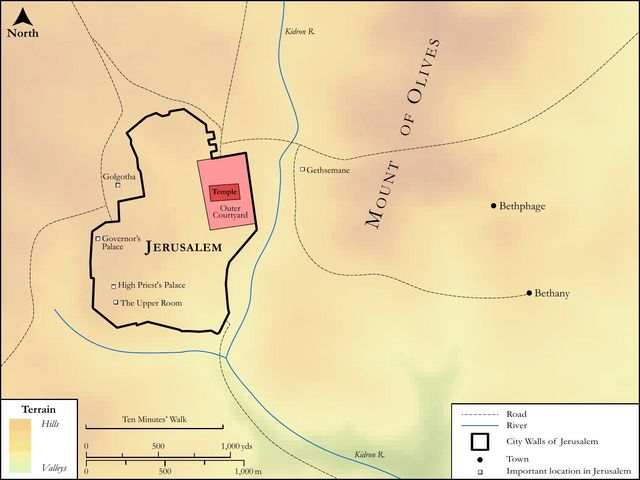
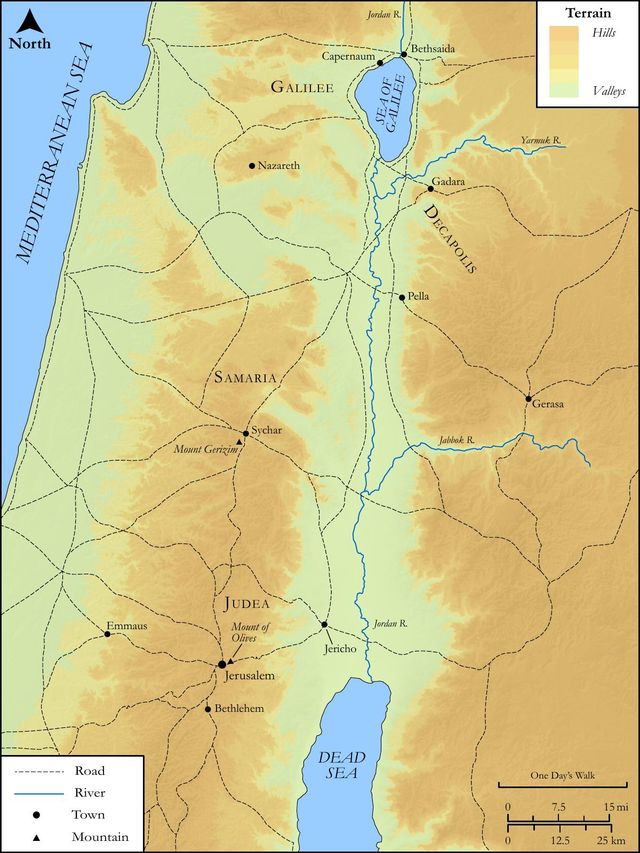
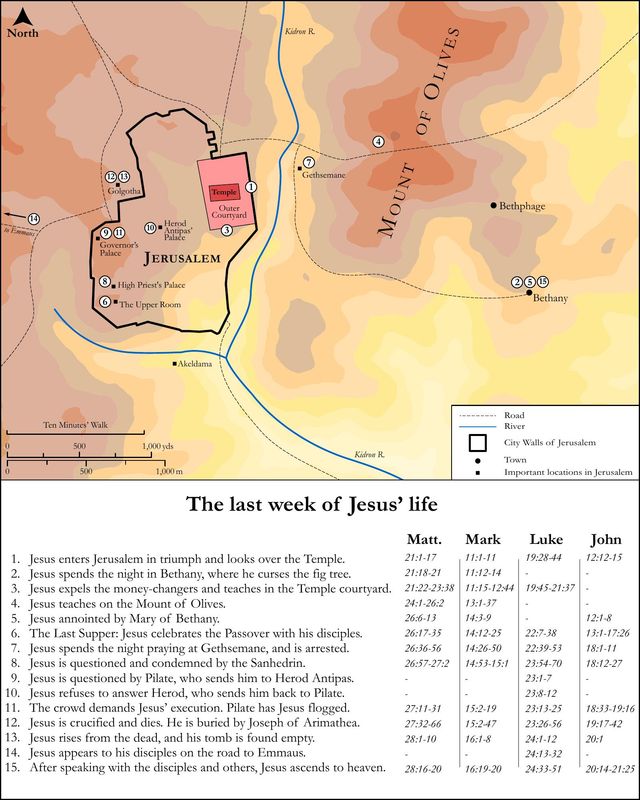
See on the biblical-era maps
Study this verse
Historical interpretation
Six Centuries of Reception
12 surviving comments on this verse. Each one is dated, so this reads as a timeline rather than a list.
Select a marker to jump to its quote. Markers stagger vertically where authors wrote within a few decades of each other.
Upon examining Peter’s denial, we note that “as yet the Spirit had not been given, because Jesus was not yet glorified.” For this reason, neither was it possible for Peter at the time to profess belief in Jesus nor was he to be criticized for not professing belief in him, since it is said to those who profess belief: “It is not you who speak, but the Spirit of your Father speaking through you.” We … since the Spirit of the Father has the power to speak in us and since it is in our power to “make room” in us for the Holy Spirit and not “for the devil,” if we should deny Christ, we would have no excuse.It may be that whoever is in the courtyard of Caiaphas “the high priest” cannot admit knowing the Lord Jesus unless he has gone outside his courtyard and has been brought outside of every teaching contrary to Jesus and outside of Jewish traditions handed down, not according to the Spirit of the Scriptures but according to the “commands and teachings of men.” Consider how Peter, seated outside at a distance from Jesus and in the high priest’s courtyard, denied Jesus before them all; and again, for the second time, going out to the porch and wishing to leave but not yet outside the gateway, he denied the Lord. Then, for the third time, “while the bystanders came and said, ‘Certainly you are also one of them,’ ” when “he began to invoke a curse on himself and to swear ‘I do not know the man,’?” he was not yet outside. Furthermore, all the denials were made at night and in the darkness, before the break of dawn and the sign of the new day, that is, the crowing of the cock that bestirs the early risers. And if, by way of hypothesis, Peter had denied after the crowing of the cock, as was said, “The night is far gone, the day is at hand … let us conduct ourselves becomingly as in the day,” he would have had no excuse for his actions.
Perhaps all people when they deny Jesus … seemingly deny him before the crowing of the cock, when the sun of justice has not yet risen for them and its rising is not yet at hand. But if upon the rising of the sun for the soul “we sin deliberately after receiving the knowledge of the truth, there no longer remains a sacrifice for sins but a fearful prospect of judgment and a fury of fire which will consume the adversaries.”
I believe that the first servant girl who caused Christ’s disciples to deny him stands for the synagogue of the Jews “according to the flesh,” who have frequently coerced the faithful to deny him. The second maidservant stands for the assembly of Gentiles, who also in persecuting Christians has forced them to deny the Lord. And third were the bystanders in the courtyard, who are ministers of the different heresies and who also compel others to deny the truth of Christ.
(in Luc. 22, 57.) I had rather that Peter deny, than that the Lord be made out false.
Oh strange and wonderful acts! When indeed he saw his master seized only, he was so fervent as both to draw his sword, and to cut off the man's ear; but when it was natural for him to be more indignant, and to be inflamed and to burn, hearing such revilings, then he becomes a denier. For who would not have been inflamed to madness by the things that were then doing? yet the disciple, overcome by fears, so far from showing indignation, even denies, and endures not the threat of a miserable and mean girl, and not once only, but a second and third time doth he deny Him; and in a short period, and not so much as before judges, for it was without for "when he had gone out into the porch," they asked him, and he did not even readily come to a sense of his fall. And this Luke saith, namely, that Christ looked on him showing that he not only denied Him, but was not even brought to remembrance from within, and this though the cock had crowed; but he needed a further remembrance from his master, and His look was to him instead of a voice; so exceedingly was he full of fear.
But Mark saith, that when he had once denied, then first the cock crew, but when thrice, then for the second time; for he declares more particularly the weakness of the disciple, and that he was utterly dead with fear; having learnt these things of his masters himself, for he was a follower of Peter. In which respect one would most marvel at him, that so far from hiding his teacher's faults, he declared it more distinctly than the rest, on this very account, that he was his disciple.
How then is what is said true, when Matthew affirms that Christ said, "Verily I say unto thee, that before the cock crow thou shalt deny me thrice;" and Mark declares after the third denial, that "The cock crew the second time?" Nay, most certainly is it both true and in harmony. For because at each crowing the cock is wont to crow both a third and a fourth time, Mark, to show that not even the sound checked him, and brought him to recollection saith this. So that both things are true. For before the cock had finished the one crowing, he had denied a third time. And not even when reminded of his sin by Christ did he dare to weep openly, lest he should be betrayed by his tears, but "he went out, and wept bitterly."
And he, who, when he saw his Master laid hands on, drew his sword and cut off the ear, now when he sees Him enduring such insults becomes a denier, and cannot withstand the taunts of a mean servant girl. A damsel came unto him, saying, Thou also wast with Jesus of Galilee.
But not once, but twice and thrice did he deny within a short time.
To show that the sound did not keep him from denial, nor bring his promise to mind.
Peter sat without, that he might see the event, and not excite suspicion by any approach to Jesus.
And again he denied with an oath, I do not know the man. I know that some out of a feeling of piety towards the Apostle Peter have interpreted this place to signify that Peter denied the Man and not the God, as though he meant, 'I do not know the Man, because I know the God.'x But the intelligent reader will see that this is trifling, for if he denied not, the Lord spoke falsely when He said, Thou shalt deny me thrice.
Not that Peter was of a different speech or nation, but a Hebrew as his accusers were; but every province and every district has its peculiarities, and he could not disguise his native pronunciation.
In another Gospel we read, that after Peter's denial and the cock-crow, the Saviour looked upon Peter, (Luke 22:61.) and by His look called forth those bitter tears; for it might not be that he on whom the Light of the world had looked should continue in the darkness of denial, wherefore, he went out, and wept bitterly. For he could not do penitence sitting in Caiaphas' hall, but went forth from the assembly of the wicked, that he might wash away in bitter tears the pollution of his timid denial.
(Verse 74, 75.) Then he began to curse and swear, saying that he did not know the man. And immediately the rooster crowed. And Peter remembered the word of Jesus that he had said: Before the rooster crows, you will deny me three times. In another Gospel, we read that after Peter's denial and the rooster's crowing, the Savior looked at Peter and with his gaze, he caused him to burst into bitter tears. It was not possible for him to remain in the darkness of denial, whom the light of the world had looked upon.
And going out, he wept bitterly. Sitting in the courtyard of Caiaphas, he could not do penance. He goes out from the wicked council to wash the fearful filth of his denials with bitter tears.
“And again he denied it with an oath, ‘I do not know the man.’ ” I know that some people with a soft spot in their hearts for the apostle Peter have interpreted this passage to the effect that Peter did not deny God but man, and what he meant was “I do not know the man, because I know God.” The wise reader realizes how frivolous this interpretation is, for those who thus defend the apostle make the Lord guilty of a lie. If Peter did not deny him, then the Lord lied in saying, “Truly, I say to you, this very night, before the cock crows twice, you will deny me three times.” Notice what he says: “You will deny me”—not “the man.”“Certainly you are also one of them, for your accent betrays you.” Not that Peter spoke a different language or belonged to a foreign nation … but since each province and region had their own characteristics and vernacular, one could not help having a certain sound to his speech. For instance, the Ephrathites in the book of Judges cannot pronounce the word synthema.
“Then he began to invoke a curse on himself and to swear that he did not know the man. And immediately the cock crowed.” In the other Gospel we read that after Peter’s denial and the crowing of the cock, the Savior looked at Peter and, by his very gaze, aroused bitter tears in him. It could not be that Peter, on whom the light of the world had gazed, should remain in the darkness of denial.
(Quæst. Ev. i. 44.) That, they did spit in his face, signifies those who reject His proffered grace. They likewise buffet Him who prefer their own honour to Him; and they smite Him on the face, who, blinded with unbelief, affirm that He is not yet come, disowning and rejecting His person.
(de Cons. Ev. iii. 6.) Among the other insults offered to our Lord was the threefold denial of Peter, which the several Evangelists relate in different order. Luke puts Peter's trial first, and the ill usage of the Lord after that; Matthew and Mark reverse the order.
(ubi sup.) We understand that having gone out after his first denial, the cock crowed the first time as Mark relates.
(ubi sup.) The second denial was not outside the door, but after he had returned to the fire; for the second maid did not see him after he had gone out, but as he was going out; his getting up to go out drew her attention, and she said to them that were there, that is, to those that were standing round the fire in the hall, Tins fellow also was with Jesus of Nazareth. He who had gone out, haying heard this returned, that he might by denial vindicate himself. Or, as is more likely, he did not hear what was said of him as he went out, but it was after he came back that the maid, and the other man whom Luke mentions, said to him, And thou also art one of them.
(ubi sup.) Let us now come to the third denial; And after a while came they that stood by, and said to Peter, Surely thou also art one of them, (Luke's words are, About the space of one hour after,) for thy speech bewrayeth thee. (Luke 22:59.)
(Quæst. Ev. i. 45.) Also Peter thrice denied, because heretical error concerning Christ is limited to three kinds; they are in error respecting His divinity, His humanity, or both.
(Serm. 60, 4.) For this reason it should seem he was permitted to waver, that the remedy of penitence might be exhibited in the head of the Church, and that none should dare to trust in his own strength, when even the blessed Peter could not escape the danger of frailty.
(Serm. 60. 4.) Blessed tears, O holy Apostle, which had the virtue of holy Baptism in washing off the sin of thy denial. The right hand of the Lord Jesus Christ was with thee to hold thee up before thou wast quite thrown down, and in the midst of thy perilous fall, thou receivedst strength to stand. The Rock quickly returned to its stability, recovering so great fortitude, that he who in Christ's passion had quailed, should endure his own subsequent suffering with fearlessness and constancy.
Observe how baneful are communications with evil men; they even drove Peter to deny the Lord whom he had before confessed to be the Son of God.
Spiritually; By Peter's denial before the cock-crow, are denoted those who before Christ's resurrection did not believe Him to be God, being perplexed by His death. In his denial after the first cock-crow, are denoted those who are in error concerning both Christ's natures, His human and divine. By the first handmaid is signified desire; by the second, carnal delight; by them that stood by, the dæmons; for by them men are led to a denial of Christ.
What means this, that a handmaid is the first to tax him, when men would be more likely to recognise him, except that this sex might seem to sin somewhat in the Lord's death, that they might be redeemed by His passion? He denied before them all, because he was afraid to reveal himself; that he said, I know not, shows that he was not yet willing to die for the Saviour.
In this denial of Peter we affirm that Christ is denied not only by him who denies that He is Christ, but who denies himself to be a Christian.
Observe, that he said the first time, I know not what thou sayest; the second time, He denied with an oath; the third time, He began to curse and to swear that he knew not the man. For to persevere in sinning increases sinfulness, and he who disregards light sins, falls into greater.
After the third denial comes the cock-crow; by which we may understand a Doctor of the Church who with chiding rouses the slumbering, saying, Awake, ye righteous, and sin not. (1 Cor. 15:14.) Thus Holy Scripture uses to denote the merit of divers cases by fixed periods, as Peter sinned at midnight and repented at cock-crow.
Continue studying Matthew 26:74 across the web’s major study libraries — every link below opens this exact verse, chapter, or book on the destination site.
Read & Compare
 BibleGatewayThis verse in more than 200 translations and 70 languages.
 Bible.comThe YouVersion reader — hundreds of translations, reading plans, and highlights.
 ESV.orgCrossway's official English Standard Version reader.
 NET BibleThe NET translation with 60,000+ translators' notes on every rendering decision.
 STEP BibleTyndale House's free study tool — original text, vocabulary, and scholarly resources.
 BibliaLogos Bible Software's free web reader.
 USCCBThe New American Bible (Revised Edition) with the U.S. bishops' study notes.
Commentaries
 BibleHub CommentariesDozens of classic commentaries on this verse, gathered on one page.
 StudyLightMore than 100 commentary sets — the largest collection on the web.
 BibleRefPlain-English commentary on what this verse means, verse by verse.
 Enduring WordDavid Guzik's free commentary on this chapter, widely used by Bible teachers.
 Bible Study ToolsVerse commentary alongside Greek and Hebrew study aids.
Original Language & Research
- BibleHub InterlinearThe verse word by word — original language, transliteration, and English.
- BibleHub LexiconEvery word's original-language definition and Strong's entry.
 Blue Letter BibleDeep-study tools — Strong's numbers, concordance, and word studies.
 CNTR CollationThe earliest Greek manuscripts of this verse, collated letter by letter.
Sermons, Hymns & Audio


TrulyRandomVerse is not affiliated with these sites and doesn’t control their content. They’re linked because they’re genuinely useful.
Summary
Matthew 26:74 vividly portrays the climactic moment of Peter's third and most vehement denial of Jesus. Under intense pressure in the high priest's courtyard, Peter not only disavowed any knowledge of Jesus but reinforced his denial with curses and oaths, attempting to completely distance himself from his Master. Immediately upon his final, desperate declaration, the crow of a rooster pierced the night, serving as a stark and immediate fulfillment of Jesus' earlier prophecy, bringing Peter's profound failure into sharp, painful focus.
Context
ShowHideLiterary Context
This verse is the culmination of Peter's three denials, which are strategically placed within the broader narrative of Jesus' arrest and trial before the Sanhedrin. Following Jesus' confident prediction of Peter's betrayal in Matthew 26:34, Peter had followed Jesus to the high priest's courtyard after the arrest in Gethsemane (Matthew 26:57-58). There, while Jesus was being interrogated, Peter was repeatedly confronted by various individuals who recognized him as a follower of Jesus. His first denial came in Matthew 26:69-70, a simple denial to a servant girl. His second, more emphatic denial, occurred in Matthew 26:71-72. Matthew 26:74 marks the third and final denial, characterized by its extreme vehemence, leading directly to the prophetic sign of the cock crowing and Peter's subsequent bitter repentance recounted in Matthew 26:75.
Historical & Cultural Context
The setting is the courtyard of the High Priest Caiaphas, likely late at night or in the very early hours of the morning, a time when many would be sleeping, but also when the activity of a high-profile arrest and trial would draw a crowd. Jewish law prohibited trials at night, making Jesus' trial illegal and rushed, further contributing to the chaotic and tense atmosphere. Peter, a Galilean, would have been identifiable by his accent, as noted in Matthew 26:73. Swearing and cursing were serious matters in Jewish culture, often involving invoking God's name or divine judgment. For Peter to "curse and swear" in this context meant he was not merely denying casually but was attempting to add a layer of solemnity and finality to his denial, potentially invoking a curse upon himself if he were lying, thereby convincing his accusers of his sincerity and disassociation from Jesus. The cock crowing was a common sound at dawn, but in this instance, it was also a specific signal, perhaps referring to a particular watch of the night (the "cockcrow" watch, around 3 AM), or simply the actual crowing of a rooster, which was a common animal in courtyards.
Key Themes
ShowHideThis pivotal moment in Peter's story contributes significantly to several overarching themes in Matthew's Gospel and the broader biblical narrative. It powerfully illustrates human frailty and the reality of temptation, even for those with strong faith and close proximity to Jesus. Peter, who had boldly declared his unwavering loyalty in Matthew 26:33, succumbs to fear and self-preservation, revealing the limits of human resolve without divine strength. The immediate crowing of the cock underscores the theme of the unfailing accuracy of Jesus' prophecies and divine sovereignty. Jesus' words, spoken hours earlier, are fulfilled with precise timing, demonstrating His foreknowledge and control over events, even in His moment of apparent weakness. Finally, this event sets the stage for the theme of divine grace and restoration, as Peter's profound failure is not his final chapter. His bitter repentance (Matthew 26:75) foreshadows his later reconciliation and recommissioning by Jesus, highlighting God's capacity to forgive and restore even after significant spiritual failure, a theme beautifully developed in John 21.
Exposition and Analysis
ShowHideKey Word Analysis
ShowHideMeaning "to imprecate." This is an intensified form of "to curse," indicating a strong, solemn invocation of divine judgment upon oneself if one is lying. Peter was not merely using profanity; he was calling down a curse upon himself, asserting the truth of his denial with the utmost gravity and desperation, seeking to convince his interrogators of his complete disassociation from Jesus.
Meaning "to swear, i.e., take (or declare on) oath." This refers to the act of taking a solemn oath, often invoking God or some sacred entity as a witness, to affirm the truth of one's statement. Coupled with "to curse," it demonstrates Peter's extreme effort to persuade his accusers, placing himself under a binding commitment that he was speaking the truth, despite knowing he was lying.
(eídō), meaning "to see (literally or figuratively); by implication, to know," combined with G3756 (ou), the absolute negative. Peter's emphatic declaration, "I know not the man," is a complete and absolute denial of any acquaintance or relationship with Jesus. This is not merely a lack of recognition but a forceful rejection of any association, a stark contrast to his earlier boast of unwavering loyalty.
Verse Breakdown
ShowHide"Then began he to curse and to swear,"
This clause marks the escalation of Peter's denial. His previous denials were less forceful, but here, under increasing pressure and fear of exposure, he resorts to extreme measures. The act of cursing and swearing was a desperate attempt to add credibility to his lie, invoking divine judgment upon himself if he were speaking falsely, thereby severing any perceived connection to Jesus in the eyes of his accusers.
"saying, I know not the man."
This is the content of his vehement denial. Peter explicitly states his complete lack of knowledge or association with Jesus. The phrase "the man" (G444, ánthrōpos) can be seen as a dehumanizing term, further distancing himself from Jesus, perhaps even implying that Jesus was just an ordinary man, not the Messiah he had confessed Him to be. This is the ultimate betrayal of his Lord through words.
"And immediately the cock crew."
This is the climactic moment of the prophecy's fulfillment. The word "immediately" (G2112, euthéōs) emphasizes the swiftness and precision of the event, leaving no doubt that Jesus' words were true. The sound of the cock crowing served as an auditory alarm, a direct and undeniable sign to Peter that he had just fulfilled the very prophecy he had vowed he would never fulfill. This sound would have pierced his heart, bringing the full weight of his failure crashing down upon him.
Literary Devices
ShowHideMatthew 26:74 is rich with dramatic irony, as the audience is fully aware of Jesus' prophecy in Matthew 26:34, while Peter, in his moment of desperate denial, is seemingly oblivious to the immediate fulfillment of his Lord's words until the cock crows. This creates a poignant tension. The verse also employs foreshadowing, as Jesus' earlier prediction is brought to a precise and undeniable conclusion. The symbolism of the cock crowing is profound; it is not merely a sound but a potent, divinely ordained sign that marks the exact moment of Peter's ultimate failure and the truth of Jesus' omniscience. Furthermore, there is a stark contrast between Peter's earlier confident declaration of loyalty ("Though all men shall be offended because of thee, yet will I never be offended," Matthew 26:33) and his current, fearful, and vehement denial, highlighting the depth of human weakness under pressure.
Theological and Thematic Connections
ShowHideThe profound significance of Matthew 26:74 extends beyond Peter's personal failure, serving as a powerful theological statement about the nature of humanity, the reliability of God's word, and the depth of divine grace. Peter's denial, marked by curses and oaths, exposes the inherent weakness of even the most devoted followers when confronted with fear and self-preservation. It is a stark reminder that human strength and resolve are insufficient without reliance on God's sustaining power. Yet, the immediate fulfillment of Jesus' prophecy through the cock's crow underscores the absolute sovereignty and prophetic accuracy of Christ. Even amidst His own trial and suffering, Jesus' words prove true, demonstrating His divine knowledge and control over all events. This moment, while painful, is not the end of Peter's story; it is a necessary crucible that leads to his profound repentance and ultimately, his restoration, revealing God's boundless mercy and His ability to redeem even our most grievous failures for His greater purposes.
Reflection and Application
ShowHidePeter's dramatic denial in Matthew 26:74 serves as a timeless and sobering mirror for all believers. It powerfully illustrates that even those with deep faith and strong intentions can falter under pressure, revealing the inherent fragility of human resolve when confronted with fear, social ostracism, or the threat of suffering. This passage calls us to profound humility, reminding us never to overestimate our own spiritual strength or underestimate the insidious power of temptation. Instead of relying on self-confidence, we are called to cultivate a deep dependence on God's sustaining grace and the power of the Holy Spirit, recognizing that true strength comes from Him alone. Peter's bitter tears immediately following the cock's crow underscore the pain of realizing one's failure and the weight of having denied Christ. Yet, his story does not end in despair; it is a testament to the transformative power of repentance and the boundless grace of God, who is always ready to forgive and restore those who genuinely turn back to Him, offering hope and a path to renewed purpose even after significant spiritual setbacks.
Questions for Reflection
ShowHideFAQ
ShowHideWhy did Peter "curse and swear" to deny Jesus?
ShowHidePeter's use of "curse and swear" (Greek: katanathematízō and omnýō) was not merely casual profanity but a solemn, desperate attempt to convince his accusers of his sincerity. In that cultural context, to "curse" meant to call down a divine judgment upon oneself if one was lying, and to "swear" meant to take a binding oath, often invoking God as a witness. By doing this, Peter was trying to put an emphatic, undeniable stamp on his lie, making it seem utterly convincing that he had no association with Jesus, thereby attempting to protect himself from the perceived danger of being identified as a disciple. This extreme measure highlights the depth of his fear and the intense pressure he felt in that moment.
What is the significance of the cock crowing immediately after Peter's denial?
ShowHideThe immediate crowing of the cock is profoundly significant because it serves as the precise and undeniable fulfillment of Jesus' prophecy to Peter in Matthew 26:34. Jesus had told Peter, "Truly, I tell you, this very night, before the cock crows, you will deny me three times." The instant sound of the rooster, appearing at the exact moment of Peter's third denial, was a divinely orchestrated sign. It was not merely a coincidental sound but a poignant, audible reminder to Peter of his failure and, more importantly, of the absolute truth and foreknowledge of Jesus' words. This moment would have brought the weight of his actions crashing down on Peter, leading to his bitter weeping as recorded in Matthew 26:75.
Christ-Centered Fulfillment
ShowHideMatthew 26:74, while a heartbreaking account of Peter's failure, ultimately points to the unwavering sovereignty and redemptive grace of Christ. Peter's vehement denial, punctuated by the cock's crow, underscores the perfect accuracy of Jesus' prophecy. This is not merely a testament to Jesus' ability to predict the future, but a profound demonstration of His divine knowledge and control, even as He stood on trial, seemingly powerless. In this moment of Peter's profound weakness, Christ's strength and truth are magnified. Furthermore, Peter's denial and subsequent bitter weeping (Luke 22:62) set the stage for the glorious truth of Christ's restorative power. Just as Jesus had prayed for Peter that his faith would not fail (Luke 22:32), His ultimate sacrifice on the cross would provide the very forgiveness and grace necessary for Peter's restoration. The Risen Christ would later tenderly reinstate Peter, asking him three times, "Do you love me?" (John 21:15-17), mirroring his three denials and demonstrating the boundless compassion of the Savior who redeems even the most profound failures. Thus, Peter's denial, rather than being an end, becomes a powerful illustration of the gospel: human sin met by divine grace, weakness transformed by Christ's power, and brokenness healed by His unfailing love.