


Mark 13:21
Bible text: King James Version (1769 Blayney text) · Public domain
Bible text: Berean Standard Bible · Public domain
Bible text: American Standard Version (1901) · Public domain
Bible text: World English Bible, Messianic edition · Public domain
Bible text: Geneva Bible (1599) · Public domain
Bible text: Young's Literal Translation · Public domain
- καὶkaiAndG2532CONJConjunction
- τότεtotethenG5119ADVAdverb
- ἐάνeanifG1437CONDConjunction
- τιςtisanyoneG5100X-NSMIndefinite pronoun Nominative Singular Masculine
- ὑμῖνhuminto youG4771P-2DPPersonal pronoun Dative 2nd Plural
- εἴπῃ·eipēshall sayG2036V-2AAS-3SVerb 2nd Aorist Active Subjunctive 3rd Singular
- ἴδεidebeholdG2396INJInterjection
- ὧδεhōdehere [is]G5602ADVAdverb
- ὁhotheG3588T-NSMDefinite article Nominative Singular Masculine
- χριστόςchristosChristG5547N-NSM-TNoun Nominative Singular Masculine Title
- ἢēorG2228CONJConjunction
- ἴδεidebeholdG2396INJInterjection
- ἐκεῖekeithere!G1563ADVAdverb
- μὴmēnotG3361PRT-NNegative Particle Negative
- πιστεύετεpisteueteyou do believe [it]G4100V-PAM-2PVerb Present Active Imperative 2nd Plural
English is a literal word-by-word gloss of the Greek, not the KJV's wording. Why?
This is the original text the KJV's translators worked from — each Greek word with its own literal English meaning in this verse, prepared by scholars at Tyndale House, Cambridge. The KJV translates whole sentences, not word by word, so its wording differs: one Greek word can become several English words, and the KJV may choose “charity” where the gloss reads “love”. Both are faithful — they answer different questions. For the KJV's own rendering, switch to the KJV text.
Details
See on the biblical-era maps
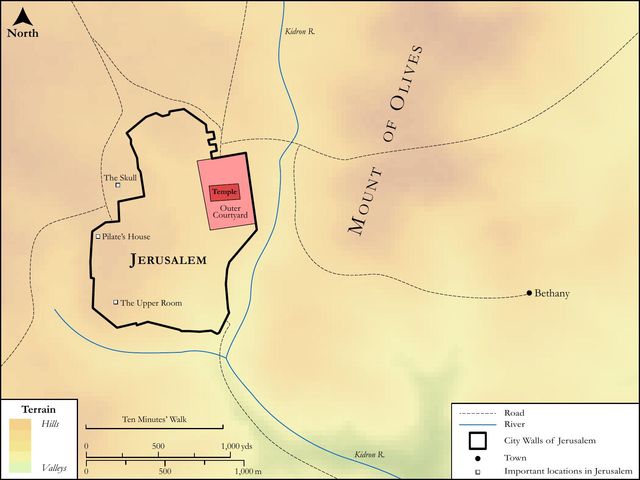
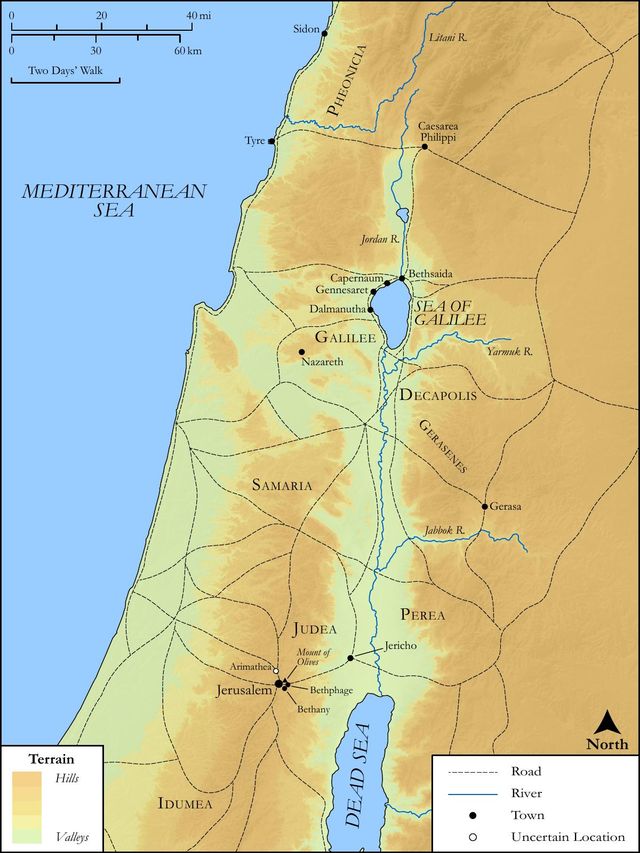
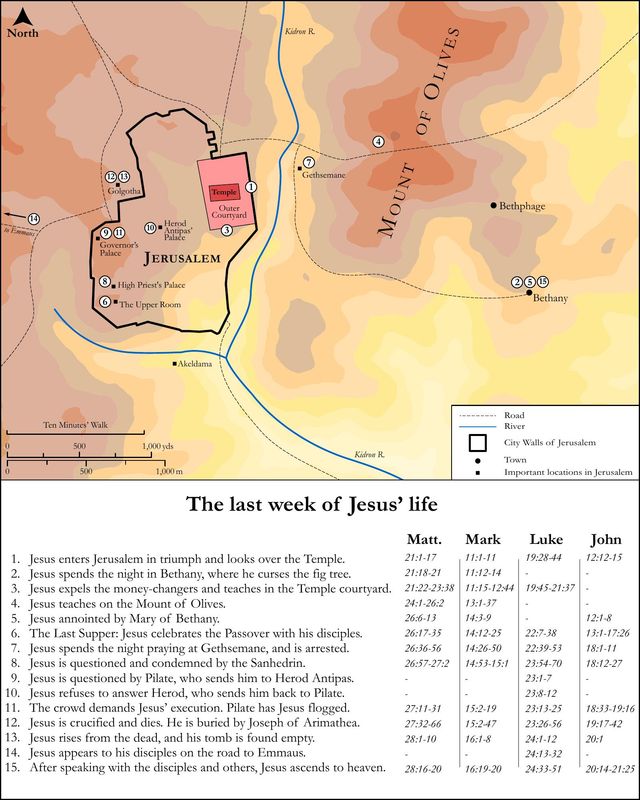
Study this verse
Public-domain commentary
Matthew Henry
From his Commentary on the Whole Bible. Henry comments on passages, not single verses — this entry covers Mark 13:14–23. His two-level outline is real structure in the source text, so it is rendered as structure.
The Jews, in rebelling against the Romans, and in persecuting the Christians, were hastening to their own ruin apace, both efficiently and meritoriously, were setting both God and man against them; see Th1 2:15. Now here we have a prediction of that ruin which came upon them within less than forty years after this: we had it before, Mat 24:15, etc. Observe,
I.What is here foretold concerning it.
1.That the Roman armies should make a descent upon Judea, and invest Jerusalem, the holy city. These were the abomination of desolation, which the Jews did abominate, and by which they should be made desolate. The country of thine enemy is called the land which thou abhorrest, Isa 7:16. Therefore it was an abomination, because it brought with it nothing but desolation. They had rejected Christ as an abomination, who would have been their salvation; and now God brought upon them an abomination that would be their desolation, thus spoken of by Daniel the prophet (Dan 9:27), as that by which this sacrifice and offering should be made to cease. This army stood where it ought not, in and about the holy city, which the heathen ought not to have approached, nor would have been suffered to approach, if Jerusalem had not first profaned the crown of their holiness. This the church complains of, Lam 1:10, The heathen entered into her sanctuary, whom thou didst command that they should not enter into the congregation; but sin made the breach, at which the glory went out, and the abomination of desolation broke in, and stood where it ought not. Now, let him that readeth this, understand it, and endeavor to take it right. Prophecies should not be too plain, and yet intelligible to those that search them; and they are best understood by comparing them first with one another, and at last with the event.
2.That when the Roman army should come into the country, there would be no safety any where but by quitting the country, and that with all possible expedition. It will be in vain to fight, the enemies will be too hard for them; in vain to abscond, the enemies will find them out; and in vain to capitulate, the enemies will give them no quarter; a man cannot have so much as his life given him for a prey, but by fleeing to the mountains out of Judea; and let him take the first alarm, and make the best of his way. If he be on the house-top, trying from thence to discover the motions of the enemy, and spies them coming, let him not go down, to take any thing out of the house, for it will occasion his losing of time, which is more precious than his best goods, and will but encumber him, and embarrass his flight. If he be in the field, and there discover the approach of the enemy, let him get away as he is, and not turn back again, to take up his garment, Mar 13:16. If he can save his life, let him reckon it is a good bargain, though he can save nothing else, and be thankful to God, that, though he is cut short, he is not cut off.
3.That it would go very hard at that time with poor mothers and nurses (Mar 13:17); "Woe to them that are with child, that dare not go into strange places, that cannot shift for themselves, nor make haste as others can. And woe to them that give suck, that know not how either to leave the tender infants behind them, or to carry them along with them." Such is the vanity of the creature, that the time may often be, when the greatest comforts may prove the greatest burthens. It would likewise be very uncomfortable, if they should be forced to flee in the winter (Mar 13:18), when the weather and ways were bad, when the roads would be scarcely passable, especially in the mountains to which they must flee. If there be no remedy but that trouble must come, yet we may desire and pray that, if it be God's will, the circumstances of it may be so ordered as to be a mitigation of the trouble; and when things are bad, we ought to consider they might have been worse. It is bad to be forced to flee, but it would have been worse if it had been in the winter.
4.That throughout all the country of the Jews, there should be such destruction and desolation made, as could not be paralleled in any history (Mar 13:19); In those days shall be affliction, such as was not from the beginning of time; that is, of the creation which God created, for time and the creation are of equal date, unto this day, neither shall be to the end of time; such a complication of miseries, and of such continuance. The destruction of Jerusalem by the Chaldeans was very terrible, but this exceeded it. It threatened a universal slaughter of all the people of the Jews; so barbarously did they devour one another, and the Romans devour them all, that, if their wars had continued a little longer, no flesh could have been saved, not one Jew could have been left alive; but in the midst of wrath God remembered mercy; and, (1.) He shortened the days; he let fall his controversy before he had made a full end. As a church and nation the ruin was complete, but many particular persons had their lives given them for a prey, by the storm's subsiding when it did. 2. It was for the elects' sake that those days were shortened; many among them fared the better for the sake of the few among them that believed in Christ, and were faithful to him. There was a promise, that a remnant should be saved (Isa 10:22), and that God would not, for his servants' sakes, destroy them all (Isa 65:8); and these promises must be fulfilled. God's own elect cry day and night to him, and their prayers must be answered, Luk 18:7.
II.What directions are given to the disciples with reference to it.
1.They must shift for the safety of their lives; "When you see the country invaded, and the city invested, flatter not yourselves with thoughts that the enemy will retire, or that you may be able to make your part good with them; but, without further deliberation or delay, let them that are in Judea, flee to the mountains, Mar 13:14. Meddle not with the strife that belongs not to you; let the potsherds strive with the potsherds of the earth, but do you go out of the ship when you see it sinking, that you die not the death of the uncircumcised in heart."
2.They must provide for the safety of their souls; "Seducers will be busy at that time, for they love to fish in troubled waters, and therefore then you must double your guard; then, if any man shall say unto you, Lo, here is Christ, or, Lo, he is there, you know he is in heaven, and will come again at the end of time, to judge the world, and therefore believe them not; having received Christ, be not drawn into the snares of any antichrist; for false Christs, and false prophets, shall arise," Mar 13:22. When the gospel kingdom was in the setting up, Satan mustered all his force, to oppose it, and made use of all his wiles; and God permitted it, for the trial of sincerity of some, and the discovery of the hypocrisy of others, and the confusion of those who rejected Christ, when he was offered to them. False Christs shall rise, and false prophets that shall preach them up; or such, as, though they pretend not to be Christs, set up for prophets, and undertake to foretel things to come, and they shall show signs and lying wonders; so early did the mystery of iniquity begin to work, Th2 2:7. They shall seduce, if it were possible, the very elect; so plausible shall their pretences be, and so industrious shall they be to impose upon people, that they shall drawn away many that were forward and zealous professors of religion, many that were very likely to have persevered; for nothing will be effectual to secure men but that foundation of God which stands immovably sure, The Lord knoweth them that are his, who shall be preserved when the faith of some is overthrown, Ti2 2:18, Ti2 2:19. They shall seduce, if it were possible, the very elect; but it is not possible to seduce them; the election shall obtain, whoever are blinded, Rom 11:7. But, in consideration hereof, let the disciples be cautious whom they give credit to (Mar 13:23); But take ye heed. Christ knew that they were of the elect, who could not possibly be seduced, and yet he said to them, Take heed. An assurance of persevering, and cautions against apostasy, will very well consist with each other. Though Christ said to them, Take heed, it doth not therefore follow, that their perseverance was doubtful, for they were kept by the power of God; and though their perseverance was secured, yet it doth not therefore follow, that this caution was needless, because they must be kept in the use of proper means. God will keep them, but they must keep themselves. "I have foretold you all things; have foretold you of this danger, that, being fore-warned, you may be fore-armed; I have foretold all things which you needed to have foretold to you, and therefore take heed of hearkening to such as pretend to be prophets, and to foretel more than I have foretold." The sufficiency of the scripture is good argument against listening to such as pretend to inspiration.
Historical interpretation
Eight Centuries of Reception
6 surviving comments on this verse. Each one is dated, so this reads as a timeline rather than a list.
Select a marker to jump to its quote. Markers stagger vertically where authors wrote within a few decades of each other.
But the tribulation shall be great, and the days short, for the sake of the elect, lest the evil of this time should change their understanding.
Or else, the sun shall be darkened, at the coldness of their hearts, as in the winter time. And the moon shall not give her light with serenity, in this time of quarrel, and the stars of heaven shall fail in their light, when the seed of Abraham shall all but disappear, for to it they are likened. (Gen. 22:17) And the powers of heaven shall be stirred up to the wrath of vengeance, when they shall be sent by the Son of Man at His coming, of whose Advent it is said, And then shall they see the Son of Man coming in the clouds with great power and glory, He, that is, who first came down like rain into the fleece of Gideon in all lowliness.
As corn winnowed from the threshing-floor of the whole earth.
"And I saw another angel ascending from the east, having the seal of the living God" He speaks of Elias the prophet, who is the precursor of the times of Antichrist, for the restoration and establishment of the churches from the great and intolerable persecution. We read that these things are predicted in the opening of the Old and New Testament; for He says by Malachi: "Lo, I will send to you Elias the Tishbite, to turn the hearts of the fathers to the children, according to the time of calling, to recall the Jews to the faith of the people that succeed them." And to that end He shows, as we have said, that the number of those that shall believe, of the Jews and of the nations, is a great multitude which no man was able to number. Moreover, we read in the Gospel that the prayers of the Church are sent from heaven by an angel, and that they are received against wrath, and that the kingdom of Antichrist is cast out and extinguished by holy angels; for He says: "Pray that ye enter not into temptation: for there shall be a great affliction, such as has not been from the beginning of the world; and except the Lord had shortened those days, no flesh should be saved." Therefore He shall send these seven great archangels to smite the kingdom of Antichrist; for He Himself also thus said: "Then the Son of man shall send His messengers; and they shall gather together His elect from the four corners of the wind, from the one end of heaven even to the other end thereof." For, moreover, He previously says by the prophet: "Then shall there be peace for our land, when there shall arise in it seven shepherds and eight attacks of men; and they shall encircle Assur," that is, Antichrist, "in the trench of Nimrod," that is, in the nation of the devil, by the spirit of the Church. Similarly when the keepers of the house shall be moved. Moreover, the Lord Himself, in the parable to the apostles, when the labourers had come to Him and said, "Lord, did not we sow good seed in Thy field? whence, then, hath it tares? answered them, An enemy hath done this. And they said to Him, Lord, wilt Thou, then, that we go and root them up? And He said, Nay, but let both grow together until the harvest; and in the time of the harvest I will say to the reapers, that they gather the tares and make bundles of them, and burn them with fire everlasting, but that they gather the wheat into my barns." The Apocalypse here shows, therefore, that these reapers, and shepherds, and labourers, are the angels. And the trumpet is the word of power. And although the same thing recurs in the phials, still it is not said as if it occurred twice, but because what is decreed by the Lord to happen shall be once for all; for this cause it is said twice. What, therefore, He said too little in the trumpets, is here found in the phials. We must not regard the order of what is said, because frequently the Holy Spirit, when He has traversed even to the end of the last times, returns again to the same times, and fills up what He had before failed to say. Nor must we look for order in the Apocalypse; but we must follow the meaning of those things which are prophesied. Therefore in the trumpets and phials is signified either the desolation of the plagues that are sent upon the earth, or the madness of Antichrist himself, or the cutting off of the peoples, or the diversity of the plagues, or the hope in the kingdom of the saints, or the ruin of states, or the great overthrow of Babylon, that is, the Roman state.
(v. Greg Hom. in Ezech. lib. i. 9) Why however is it said with a doubt if it were possible, when the Lord knows beforehand what is to be? One of two things is implied; that if they are elect, it is not possible; and if it is possible, they are not elect. (non potest, ap. Cat.) This doubt therefore in our Lord's discourse expresses the trembling in the mind of the elect. And He calls them elect, because He sees that they will persevere in faith and good works; for those who are chosen to remain firm are to be tempted to fall by the signs of the preachers of Antichrist.
And then if anyone says to you: Here is Christ, here there, do not believe it. For false Christs and false prophets will arise and will give signs and wonders to seduce, if it were possible, even the elect. Some refer this to the time of the Jewish captivity, where many, saying they were Christs, led astray crowds of people after them. But it should be noted that in that siege of the miserable and wretched city, there was no faithful one to whom the divine exhortation, not to follow perverse teachers, should be made: rather, all equally, both the lesser and the greater, both the besieged and the besieging, persisted alien to Christ. Hence, it is better to be understood about heretics, who, coming against the Church, would lie about being Christs. The first of whom was Simon Magus; but the last, greater than the others, is the Antichrist.
(ubi sup.) Some however refer this to the time of the Jewish captivity, where many, declaring themselves to be Christs, drew after them crowds of deluded persons; but during the siege of the city there was no Christian to whom the Divine exhortation, not to follow false teachers, could apply. Wherefore it is better to understand it of heretics, who, coming to oppose the Church, pretended to be Christs; the first of whom was Simon Magus, but that last one, greater than the rest, is Antichrist. It goes on: But take ye heed: behold, I have foretold you all things.
(ubi sup.) For the stars in the day of judgment shall appear obscure, not by any lessening of their own light, but because of the brightness of the true light, that is, of the most high Judge coming upon them; although there is nothing to prevent its being taken to mean, that the sun and moon with all the other heavenly bodies then for a time are really to lose their light, just as we are told was the case with the sun at the time of our Lord's Passion. But after the day of judgment, when there shall be a new sky and a new earth, then shall happen what Isaiah says: Moreover, the light of the moon shall be as the light of the sun, and the light of the sun shall be sevenfold. (Isa. 30:26) There follows, And the powers of heaven shall be shaken.
(ubi sup.) What wonder is it that men should be troubled at this judgment, the sight of which makes the very Angelic powers to tremble? What will the stories of the house do when the pillars shake? What does the shrub of the wilderness undergo, when the cedar of paradise is moved?
By the four winds, He means the four parts of the world, the east, the west, the north, and the south. And lest any one should think that the elect are to be gathered together only from the four edges of the world, and not from the midland regions as well as the borders, He has fitly added, From the uttermost part of earth, to the uttermost part of heaven, that is, from the extremities of the earth to its utmost bounds, where the circle of the heavens appears to those who look from afar to rest upon the boundaries of the earth. No one therefore shall be elect in that day who remains behind and does not meet the Lord in the air, when He comes to judgment. The reprobate also shall come to judgment, that when it is finished they may be scattered abroad and perish from before the face of God.
After that the Lord had finished all that concerned Jerusalem, He now speaks of the coming of Antichrist, saying, Then if any man shall say to you, Lo, here is Christ; or, lo, he is there; believe him not. But when He says, then, think not that it means immediately after these things are fulfilled about Jerusalem; as Matthew also says after the birth of Christ, In those days came John the Baptist; (Matt. 3:1) does he mean immediately after the birth of Christ? No, but he speaks indefinitely and without precision. So also here, then may be taken to mean not when Jerusalem shall be made desolate, but about the time of the coming of Antichrist. It goes on: For false Christs and false prophets shall arise, and shall show signs and wonders, to seduce, if it were possible, even the elect. For many shall take upon them the name of Christ, so as to seduce even the faithful.
But after the coming of Antichrist, the frame of the world shall be altered and changed, for the stars shall be obscured on account of the abundance of the brightness of Christ. Wherefore it goes on: But in those days, after that tribulation, the sun shall be darkened, and the moon shall not give her light; and the stars of heaven shall fall.
That is, the Angelic virtues shall be astonished, seeing that such great things are done, and that their fellow-servants are judged.
But they shall see the Lord as the Son of Man, that is, in the body, for that which is seen is body.
Observe that Christ sends the Angels as well as the Father; where then are they who say that He is not equal to the Father? For the Angels go forth to gather together the faithful, who are chosen, that they may be carried into the air to meet Jesus Christ. Wherefore it goes on: And gather together his elect from the four winds.
Continue studying Mark 13:21 across the web’s major study libraries — every link below opens this exact verse, chapter, or book on the destination site.
Read & Compare
 BibleGatewayThis verse in more than 200 translations and 70 languages.
 Bible.comThe YouVersion reader — hundreds of translations, reading plans, and highlights.
 ESV.orgCrossway's official English Standard Version reader.
 NET BibleThe NET translation with 60,000+ translators' notes on every rendering decision.
 STEP BibleTyndale House's free study tool — original text, vocabulary, and scholarly resources.
 BibliaLogos Bible Software's free web reader.
 USCCBThe New American Bible (Revised Edition) with the U.S. bishops' study notes.
Commentaries
 BibleHub CommentariesDozens of classic commentaries on this verse, gathered on one page.
 StudyLightMore than 100 commentary sets — the largest collection on the web.
 BibleRefPlain-English commentary on what this verse means, verse by verse.
 Enduring WordDavid Guzik's free commentary on this chapter, widely used by Bible teachers.
 Bible Study ToolsVerse commentary alongside Greek and Hebrew study aids.
Original Language & Research
- BibleHub InterlinearThe verse word by word — original language, transliteration, and English.
- BibleHub LexiconEvery word's original-language definition and Strong's entry.
 Blue Letter BibleDeep-study tools — Strong's numbers, concordance, and word studies.
 CNTR CollationThe earliest Greek manuscripts of this verse, collated letter by letter.
Sermons, Hymns & Audio


TrulyRandomVerse is not affiliated with these sites and doesn’t control their content. They’re linked because they’re genuinely useful.
Summary
In Mark 13:21, Jesus issues a crucial warning to His disciples regarding the deceptive claims that will arise concerning His return during the tumultuous period leading up to the end times. He explicitly instructs them not to believe anyone who asserts that the Christ is present in a specific, localized, or hidden place, thereby emphasizing the public and unmistakable nature of His true advent and safeguarding His followers from false messianic movements.
Context
ShowHideLiterary Context
Mark 13, often referred to as the "Olivet Discourse," is Jesus' comprehensive prophecy concerning the destruction of the Jerusalem Temple, the signs of the end of the age, and His second coming. This chapter begins with the disciples marveling at the Temple's grandeur, prompting Jesus' stark prediction of its complete demolition (Mark 13:1-2). Following this, Peter, James, John, and Andrew privately ask Him when these things will happen and what signs will precede them (Mark 13:3-4). Jesus' discourse then unfolds, detailing a series of escalating tribulations, including false Christs and prophets (Mark 13:5-6), wars, earthquakes, and famines (Mark 13:7-8), and persecution of believers (Mark 13:9-13). Verse 21 falls within the section where Jesus specifically warns against the intense deception that will characterize the "great tribulation" (Mark 13:19), immediately after His instruction to flee Judea when the "abomination of desolation" appears (Mark 13:14-20). The warning in Mark 13:21 serves as a direct counterpoint to the allure of secret or localized messianic claims, setting the stage for His description of His undeniably public return in Mark 13:24-27.
Historical & Cultural Context
First-century Judea was a volatile region under Roman occupation, rife with messianic expectations and nationalistic fervor. Many Jews longed for a political deliverer who would overthrow Roman rule and restore the Davidic kingdom. This environment naturally fostered the emergence of various individuals claiming to be the Messiah or prophetic figures, often gathering followings in specific locales or through secret movements. The Jewish people, having experienced centuries of foreign domination and yearning for liberation, were particularly susceptible to such claims, especially during times of political instability or religious persecution. Jesus' warning in Mark 13:21 directly addresses this cultural predisposition, cautioning His disciples against the temptation to follow such localized or clandestine messianic figures, which would inevitably lead to deception and spiritual ruin. The emphasis on "here" or "there" reflects the common practice of such movements operating in specific, often remote, areas or claiming a hidden presence.
Key Themes
ShowHideThis verse significantly contributes to several overarching themes within Mark's Gospel and the Olivet Discourse. Firstly, it underscores the theme of Discernment and Vigilance, urging believers to be spiritually alert and not easily swayed by sensational claims, especially concerning the end times. Jesus repeatedly emphasizes the need for His followers to "watch out" (Mark 13:5) and "stay awake" (Mark 13:37). Secondly, it reinforces the theme of The Nature of Christ's Return, clearly distinguishing His true, universally visible Second Coming from any false, localized, or secret appearances. This theme is further developed in Mark 13:24-27, where His return is depicted as an event that all shall see. Thirdly, the verse highlights the pervasive theme of Deception and False Prophets, a recurring concern throughout the discourse (Mark 13:6 and Mark 13:22). Jesus' explicit command "believe him not" serves as a protective measure against the spiritual dangers posed by those who would lead His followers astray with false claims about His presence or identity.
Exposition and Analysis
ShowHideKey Word Analysis
ShowHideFrom χρίω (chrio), meaning "anointed." This term is the Greek equivalent of the Hebrew "Messiah." It refers to the promised deliverer, the "Anointed One" of God, who would fulfill the Old Testament prophecies. In this context, Jesus is warning against false claimants to this title, those who would present themselves as the true Messiah or claim to know His hidden whereabouts. The very use of "Christ" here highlights the ultimate deception: usurping the identity of the true Anointed One.
The second person singular imperative middle voice of εἴδω (eidō), meaning "to see." Used as an imperative, it functions as an exclamation: "Behold!" or "Look!" Its presence in the false claims ("Lo, here is Christ; or, lo, he is there") indicates a dramatic, attention-grabbing announcement, often implying a special, exclusive revelation or discovery. Jesus' warning to "believe him not" directly counters the persuasive power of such exclamations.
From πίστις (pistis), meaning "faith." To have faith, to credit, to entrust one's spiritual well-being. Jesus' command "believe him not" is a strong negation, instructing His disciples to withhold their trust and conviction from such claims. It's not merely a suggestion to doubt, but a direct imperative to reject outright any assertion that Christ is present in a secret or localized manner, emphasizing the spiritual danger of such misplaced belief.
Verse Breakdown
ShowHide"And then if any man shall say to you,"
This introductory clause sets the stage for a future scenario. The "then" (tóte) indicates a specific time, likely referring to the period of tribulation Jesus has just described. The conditional "if" (eán) suggests a strong possibility, almost a certainty, that such claims will indeed arise. It implies a direct address to the disciples, and by extension, to all believers, indicating that they will personally encounter these deceptive messages.
"Lo, here [is] Christ;"
This is the first of two specific deceptive claims. "Lo" (idoú) is an exclamation designed to draw immediate attention, pointing to a supposed physical presence. The claim "here is Christ" suggests a localized, perhaps hidden or exclusive, manifestation of the Messiah. It implies that His presence is not universally evident but requires special knowledge or proximity to discover.
"or, lo, [he is] there;"
This clause presents an alternative, yet equally deceptive, claim. The repetition of "lo" (idoú) reinforces the attention-grabbing nature of the announcement. "There" (ekeî) broadens the scope of the localized claim, indicating another specific, limited location. Together, "here" and "there" cover the range of specific, non-universal claims about Christ's presence, whether nearby or at a distance.
"believe [him] not:"
This is Jesus' unequivocal and emphatic command. The Greek mḗ (μή) is a strong particle of qualified negation, used here to prohibit an action. It's not merely a suggestion to be cautious, but a direct and absolute prohibition against giving credence or faith to such claims. This command serves as a vital safeguard for His followers against spiritual deception and false messianic movements.
Literary Devices
ShowHideMark 13:21 employs several key literary devices to convey its urgent message. The most prominent is Direct Command, as Jesus unequivocally states, "believe him not." This imperative mood leaves no room for ambiguity, demanding immediate and absolute obedience from His disciples. Repetition is also evident in the phrase "Lo, here... or, lo, there," which highlights the deceptive nature of these claims by presenting them as two sides of the same coin – both pointing to a localized, hidden Christ. This repetition serves to emphasize the specific type of false teaching Jesus is warning against. Furthermore, the verse functions as a Warning, a pervasive literary and thematic element throughout the Olivet Discourse, preparing the disciples for the spiritual dangers they will face. Finally, there is an implicit Antithesis between the false, localized claims of Christ's presence and the true, universally visible nature of His Second Coming, which Jesus describes immediately after this warning.
Theological and Thematic Connections
ShowHideMark 13:21 serves as a critical theological anchor, emphasizing the distinct and public nature of Christ's true return, in stark contrast to any localized or secret manifestations. It underscores the divine imperative for believers to exercise spiritual discernment, especially in times of eschatological fervor or tribulation. The theological implication is that God's ultimate redemptive act, the return of His Son, will not be a clandestine event requiring special revelation or hidden knowledge, but a universally undeniable display of divine power and glory. This warning protects against the spiritual dangers of cults and false messianic movements that prey on human longing for immediate solutions or exclusive access to truth, redirecting faith towards the clear, prophetic word of Christ.
Reflection and Application
ShowHideIn an age saturated with information and competing truth claims, Jesus' warning in Mark 13:21 remains profoundly relevant. It calls believers to cultivate a robust spiritual discernment, rooted in the unchanging truth of God's Word, rather than being swayed by sensational claims or charismatic personalities. We are reminded that authentic spiritual experience and the true coming of Christ are not found in secret gatherings, exclusive knowledge, or localized phenomena, but in the public, historical revelation of Jesus Christ and His promised return. This verse challenges us to test every spirit and every teaching against the clear declarations of Scripture, guarding our hearts and minds against deception. It encourages us to find our security not in fleeting signs or human pronouncements, but in the steadfast character and revealed plan of God, patiently waiting for the undeniable and glorious appearing of our Lord.
Questions for Reflection
ShowHideFAQ
ShowHideWhy is Jesus so emphatic about not believing these claims?
ShowHideJesus is emphatic because believing such claims would lead to profound spiritual deception and ultimately, apostasy. His true return will be a universally visible event, not a localized or secret appearance that requires special knowledge or a specific pilgrimage to find. False claims of His hidden presence are designed to mislead and gather followers to false messiahs, diverting people from the truth and the true hope of His glorious Second Coming. The danger is so great that Jesus issues a direct and absolute command to "believe him not," protecting His disciples from falling prey to these powerful deceptions during a time of intense tribulation.
Christ-Centered Fulfillment
ShowHideMark 13:21, while a warning against deception, ultimately points to the unique and unparalleled nature of Christ's true advent. The very necessity of the warning highlights that the genuine return of the Messiah will be fundamentally different from any localized or secret appearance. This prophecy finds its ultimate fulfillment in the New Testament's consistent portrayal of Jesus' Second Coming as a universally visible and undeniable event. Unlike the false Christs who claim to be "here" or "there," the Son of Man will come "with great power and glory" (Mark 13:26), "like lightning that flashes from the east to the west" (Matthew 24:27). Every eye will see Him, even those who pierced Him (Revelation 1:7). This public return of Christ ensures that no one will need to be told "Lo, here is Christ!" for His presence will be unmistakable to all. Thus, Jesus' warning in Mark 13:21 not only protects His followers from imposters but also implicitly affirms the glorious, public, and universally acknowledged nature of His final, triumphant return as the King of kings and Lord of lords (Revelation 19:11-16).