


Matthew 24:23
- ΤότεToteThenG5119ADVAdverb
- ἐάνeanifG1437CONDConjunction
- τιςtisanyoneG5100X-NSMIndefinite pronoun Nominative Singular Masculine
- ὑμῖνhuminto youG4771P-2DPPersonal pronoun Dative 2nd Plural
- εἴπῃ·eipēmay sayG2036V-2AAS-3SVerb 2nd Aorist Active Subjunctive 3rd Singular
- ἰδοὺidouBeholdG2400INJInterjection
- ὧδεhōdehere [is]G5602ADVAdverb
- ὁhotheG3588T-NSMDefinite article Nominative Singular Masculine
- χριστὸςchristosChristG5547N-NSM-TNoun Nominative Singular Masculine Title
- ἢēorG2228CONJConjunction
- ὧδεhōdeHereG5602ADVAdverb
- μὴmēnotG3361PRT-NNegative Particle Negative
- πιστεύσητεpisteusēteshall believe [it]G4100V-AAS-2PVerb Aorist Active Subjunctive 2nd Plural
English is a literal word-by-word gloss of the Greek, not the KJV's wording. Why?
This is the original text the KJV's translators worked from — each Greek word with its own literal English meaning in this verse, prepared by scholars at Tyndale House, Cambridge. The KJV translates whole sentences, not word by word, so its wording differs: one Greek word can become several English words, and the KJV may choose “charity” where the gloss reads “love”. Both are faithful — they answer different questions. For the KJV's own rendering, switch to the KJV text.
Details
See on the biblical-era map

Study this verse
Historical interpretation
Eight Centuries of Reception
13 surviving comments on this verse. Each one is dated, so this reads as a timeline rather than a list.
Select a marker to jump to its quote. Markers stagger vertically where authors wrote within a few decades of each other.
Watch for your life's sake. Let not your lamps be quenched, nor your loins unloosed; but be ye ready, for ye know not the hour in which our Lord cometh. But often shall ye come together, seeking the things which are befitting to your souls: for the whole time of your faith will not profit you, if ye be not made perfect in the last time. For in the last days false prophets and corrupters shall be multiplied, and the sheep shall be turned into wolves, and love shall be turned into hate; for when lawlessness increaseth, they shall hate and persecute and betray one another, and then shall appear the world-deceiver as Son of God, and shall do signs and wonders, and the earth shall be delivered into his hands, and he shall do iniquitous things which have never yet come to pass since the beginning. Then shall the creation of men come into the fire of trial, and many shall be made to stumble and shall perish; but they that endure in their faith shall be saved from under the curse itself. And then shall appear the signs of the truth; first, the sign of an out-spreading in heaven; then the sign of the sound of the trumpet; and the third, the resurrection of the dead; yet not of all, but as it is said: The Lord shall come and all His saints with Him. Then shall the world see the Lord coming upon the clouds of heaven.
The genus of Antichrist is one, the species many, just as all lies are of one sort. As all the holy Prophets were Prophets of the true Christ, so understand that each false Christ shall have his own false Prophets, who shall preach as true the false teachings of some Antichrist. When then one shall say, Lo, here is Christ, or lo, there, we need not look abroad out of the Scriptures, for out of the Law, the Prophets, and the Apostles, they bring the things which seem to favour their lie. Or by this, Lo, here is Christ, or lo, there, they show that it was not Christ, but some impostor under the same title, such for example as Marcion, or Valentinus, or Basilides taught.
Notwithstanding, by reason of the great tribulation in which men shall be cast, false prophets promising to show aid present from Christ, will falsely affirm that Christ is present in divers places, that they may draw into the service of Antichrist men discouraged and distracted.
The false prophets, of whom He had spoken above, shall say of Christ one while, Lo, He is in the desert, in order that they may cause men to wander astray; another while, Lo, He is in the secret chambers, that they may enthral men under the dominion of Antichrist. But the Lord declares Himself to be neither lurking in a remote corner, nor shut up to be visited singly, but that He shall be exhibited to the view of all, and in every place, As the lightning cometh out of the east, and shineth even unto the west, so shall the coming of the Son of Man be.
That we might not be ignorant of the place in which He should come, He adds this, Wheresoever the carcase, &c. He calls the Saints eagles, from the spiritual flight of their bodies, and shows that their gathering shall be to the place of His passion, the Angels guiding them thither; and rightly should we look for His coming in glory there, where He wrought for us eternal glory by the suffering of His bodily humiliation.
For in the last days false prophets shall be multiplied, and such as corrupt the word; and the sheep shall be changed into wolves, and love into hatred: for through the abounding of iniquity the love of many shall wax cold. For men shall hate, and persecute, and betray one another. And then shall appear the deceiver of the world, the enemy of the truth, the prince of lies, [2 Thessalonians 2:3-12] whom the Lord Jesus "shall destroy with the spirit of His mouth, who takes away the wicked with His lips; and many shall be offended at Him. But they that endure to the end, the same shall be saved. And then shall appear the sign of the Son of man in heaven;" [Isaiah 11:4; Matthew 24:1-51] and afterwards shall be the voice of a trumpet by the archangel; and in that interval shall be the revival of those that were asleep. And then shall the Lord come, and all His saints with Him, with a great concussion above the clouds, with the angels of His power, [Matthew 16:27] in the throne of His kingdom, to condemn the devil, the deceiver of the world, and to render to every one according to his deeds. "Then shall the wicked go away into everlasting punishment, but the righteous shall go into life eternal," [Matthew 25:46] to inherit those things "which eye has not seen, nor ear heard, nor have entered into the heart of man, such things as God has prepared for them that love Him;" [1 Corinthians 2:9] and they shall rejoice in the kingdom of God, which is in Christ Jesus.
"Then, if any man shall say unto you, Lo, here is Christ, or there; believe it not: for there shall arise false Christs, and false prophets, and shall show signs and wonders, so as to deceive, if possible, the very elect. Behold, I have told you before. Wherefore if they shall say unto you, Behold, He is in the desert, go not forth: behold, He is in the secret chambers, believe it not. For as the lightning cometh out of the east, and shineth even unto the west, so shall also the coming of the Son of Man be. For wheresoever the carcase is, there shall the eagles be gathered together."
Having finished what concerned Jerusalem, He passes on to His own coming, and tells the signs of it, not for their use only, but for us also, and for all that shall come after us.
"Then." When? Here, as I have often said, the word, "then," relates not to the connection in order of time with the things before mentioned. At least, when He was minded to express the connection of time, He added, "Immediately after the tribulation of those days," but here not so, but, "then," not meaning what should follow straightway after these things, but what should be in the time, when these things were to be done, of which He was about to speak.
Awhile He secures them by the place, mentioning the distinguishing marks of His second coming, and the indications of the deceivers. For not, as when at His former coming He appeared in Bethlehem, and in a small corner of the world, and no one knew Him at the beginning, so doth He say it shall be then too; but openly and with all circumstance, and so as not to need one to tell these things. And this is no small sign that He will not come secretly.
But mark how here He saith nothing of war (for He is interpreting the doctrine concerning His advent), but of them that attempt to deceive. For some in the days of the apostles deceived the multitude, "for they shall come," saith He, "and shall deceive many;" and others shall do so before His second coming, who shall also be more grievous than the former. "For they shall show," He saith, "signs and wonders, so as to deceive if possible the very elect:" here He is speaking of Antichrist, and indicates that some also shall minister to him. Of him Paul too speaks on this wise. Having called him "man of sin," and "son of perdition," He added, "Whose coming is after the working of Satan, with all power and signs and lying wonders; and with all deceivableness of unrighteousness in them that perish."
And see how He secures them; "Go not forth into the deserts, enter not into the secret chambers." He did not say, "Go, and do not believe;" but, "Go not forth, neither depart thither." For great then will be the deceiving, because that even deceiving miracles are wrought.
Having told them how Antichrist cometh, as, for instance, that it will be in a place; He saith how Himself also cometh. How then doth He Himself come? "As the lightning cometh out of the east, and shineth even unto the west, so shall also the coming of the Son of Man be. For wheresoever the carcase is, there also will the eagles be gathered together."
How then shineth the lightning? It needs not one to talk of it, it needs not a herald, but even to them that sit in houses, and to them in chambers it shows itself in an instant of time throughout the whole world. So shall that coming be, showing itself at once everywhere by reason of the shining forth of His glory. But He mentions also another sign, "where the carcase is, there also shall the eagles be;" meaning the multitude of the angels, of the martyrs, of all the saints.
When the Lord had finished all that related to Jerusalem, He came in the rest to His own coming, and gives them signs thereof, useful not for them only, but for us and for all who shall be after us. As above, the Evangelist said, In those days came John the Baptist, (Mat. 3:1.) not implying immediately after what had gone before, but thirty years after; so here, when He says Then, He passes over the whole interval of time between the taking of Jerusalem and the beginnings of the consummation of the world. Among the signs which He gives of His second coming He certifies them concerning the place, and the deceivers. For it shall not be then as at His former coming, when He appeared in Bethlehem, in a corner of the world, unknown of any; but He shall come openly so as not to need any to announce His approach, wherefore, If any man shall say unto you, Lo, here is Christ, or there, believe not.
He speaks here of Antichrist, and of certain his ministers, whom He calls false Christs and false prophets, such as were many in the time of the Apostles; but before Christ's second coming there shall come others more bitter than the former, And they shall show great signs and wonders. (cf. 2 Thes. 2:8.)
As He had above described in what guise Antichrist should come, so here He describes how He Himself shall come. For as the lightning needeth none to herald or announce it, but is in an instant of time visible throughout the whole world, even to those that are sitting in their chambers, so the coming of Christ shall be seen every where at once, because of the brightness of His glory. Another sign He adds of His coming, Wheresoever the body is, thither will the eagles be gathered together. The eagles denote the company of the Angels, Martyrs, and Saints.
Wherein He shows that His second coming shall be not in lowliness as His first, but in glory; and therefore it is folly to seek in places little and obscure for Him who is the Light of the whole world. (John 8:12.)
By an instance from nature, which we daily see, we are instructed in a sacrament of Christ. Eagles and vultures are said to scent dead bodies even beyond sea, and to flock to feed upon them. If then birds, not having the gift of reason, by instinct alone find out where lays a dead body, separated by so great space of country, how much more ought the whole multitude of believers to hasten to Christ, whose lightning goeth forth out of the east, and shines even to the west? We may understand by the carcase here, or corpse, which in the Latin is more expressively 'cadaver,' an allusion to the passion of Christ's death.
They are called eagles whose youth is renewed as the eagle's, and who take to themselves wings that they may come to Christ's passion. (Ps. 103:5. Is. 40:31.)
Or otherwise; This may be understood of the false prophets. At the time of the Jewish captivity, there were many leaders who declared themselves to be Christs, (Joseph B.J. v. 1) so that while the Romans were actually besieging them, there were three factions within. But it is better taken as we expounded it above, of the end of the world. Thirdly, it may be understood of the warfare of the heretics against the Church, and of those Antichrists, who under pretext of false science, fight against Christ.
If then any one assert to you that Christ tarries in the desert of the Gentiles, or in the teaching of the Philosophers, or in the secret chambers of the heretics, who promise the hidden things of God, believe Him not, but believe that the Catholic Faith shines from east to west in the Churches.
Or by this, in the desert, or in the secret chambers, He means that in times of persecution and distress, the false Prophets always find place for deceiving.
We are invited to flock to Christ's passion wheresoever in Scripture it is read of, that through it we may be able to come to God's word.
“If anyone says to you, ‘Behold, here is the Christ,’ or ‘There is the Christ,’ do not believe him.” At the time of the Jewish captivity by Rome, many Jewish elders claimed to be the Christ. There were so many, in fact, that there were three distinct camps of them when the Romans besieged Jerusalem. This saying is better understood as referring to the end of the world, however.“False Christs and false prophets will arise and perform great signs and wonders so that even the elect might be led into error. Behold, I told you.” As I have already noted, this passage is to be explained in one of three ways. It refers either to the Roman siege of Jerusalem or to the end of the world or to the war waged by heretics against the church and by antichrists who oppose Christ under the pretext of false knowledge.
“If, therefore, they say to you, ‘Behold, he is in the desert,’ do not go out. And if they say ‘Behold, he is inside,’ don’t believe it.” If anyone were to tell you that Christ dwells in the wilderness of the pagans or in the doctrine of the philosophers or within the inner chambers of heretics who promise to reveal the secrets of God, do not go out and do not believe them. And lest false prophets find an opportunity for deceiving you at a time of persecution and anxiety, you should not trust just anyone who claims to speak in the name of Christ.
(Verse 23.) Then if anyone says to you, 'Look, here is the Christ!' or 'There!' do not believe it. Many leaders arose during the time of the Jewish captivity who claimed to be the Christ, to the extent that there were three factions inside the besieged Romans. But the end of the world is better understood.
(Lib. 83 Quæst. q. 79.) Here the Lord forewarns us that even wicked men shall do some miracles which the saints cannot do, yet are they not therefore to be thought to have a higher place in the sight of God. For the Egyptian magi were not more acceptable to God than the people of Israel, because they could do what the Israelites could not; yet did Moses, by the power of God, work greater things. This gift is not bestowed on all the saints, lest the weak should be led astray by a most destructive error, supposing such powers to be higher gifts than those works of righteousness by which eternal life is secured. And though magi do the same miracles that the saints do, yet are they done with a different end, and through a different authority; for the one do them seeking the glory of God, the others seeking their own glory; these do them by some special compact or privilege granted to the Powers, within their sphere, those by the public dispensation and the command of Him to whom all creation is subject. For it is one thing for the owner of a horse to be compelled to give it up to a soldier, another for him to hand it over to a purchaser, or to give or lend it to a friend; and as those evil soldiers, who are condemned by the imperial discipline, employ the imperial ensigns to terrify the owners of any property, and to extort from them what is not required by the public service; so some evil Christians, by means of the name of Christ, or by words or sacraments Christian, compel somewhat from the Powers; yet these, when thus at the bidding of evil men, they depart from their purpose, they depart in order to deceive men in whose wanderings they rejoice. It is one way then in which magi, another in which good Christians, another in which bad Christians, work miracles; the magi by a private compact, good Christians by the public righteousness, evil Christians by the signs of public righteousness. And we ought not to wonder at this when we believe not unreasonably that all that we see happen is wrought by the agency of the inferior powers of this air.
(de Trin. iii. 8.) Yet are we not therefore to think that this visible material world attends the nod of the disobedient angels, but rather the power is given them of God. Nor are we to suppose that such evil angels have creative power, but by their spirituality they know the seeds of things which are hidden from us, and these they secretly scatter by suitable adaptations of the elements, and so they give occasion both to the whole being, and the more rapid increase of substances. For so there are many men who know what sort of creatures use to be generated out of certain herbs, meats, juices and humours, bruised and mingled together in a certain fashion; save only that it is harder for men to do these things, inasmuch as they lack that subtlety of sense, and penetrativeness of body in their limbs dull and of earthly mould.
(Quæst. Ev. i. 38.) By the east and west, He signifies the whole world, throughout which the Church should be. In the same way as He said below, Hereafter shall ye see the Son of Man coming in the clouds of heaven, (Mat. 26:64.) so now He likens His coming to lightning, which uses to flash out of the clouds. When then the authority of the Church is set up clear and manifest throughout the whole world, He suitably warns His disciples that they should not believe schismatics and heretics. Each schism and heresy holds its own place, either occupying some important position in the earth, or ensnaring men's curiosity in obscure and remote conventicles. Lo, here is Christ, or lo, there, refers to some district or province of the earth; the secret chambers, or the desert, signify the obscure and lurking conventicles of heretics.
The demons, wanting to tempt a hermit, said to him, ‘Would you like to see Christ?’ He said, ‘A curse be upon you and him by whom you speak. I believe my Christ when He said, “If anyone says to you, ‘Lo, here is Christ,’ or ‘Lo, there,’ do not believe him” (Matt. 24:23).’ They vanished at the words.
(Mor. xv. 61.) When then Antichrist shall have wrought wonderful prodigies before the eyes of the carnal, he shall draw men after him, all such as delight in present goods, surrendering themselves irrevocably to his sway, Insomuch that if it were possible the very elect should be led astray.
(Hom. in Ev. xxxv. i.) Or, because the heart of the elect is assailed with fearful thoughts, yet their faithfulness is not shaken, the Lord comprehends both under the same sentence, for to waver in thought is to err. He adds, If it were possible, because it is not possible that the elect should be taken in error
And as darts, when foreseen, are less likely to hit, He adds, Lo, I have told you. Our Lord announces the woes which are to precede the destruction of the world, that when they come they may alarm the less from having been foreknown.
(Mor. xxxi. 53.) We may understand this, Wheresoever the carcase is, as meaning, I who incarnate sit on the throne of heaven, as soon as I shall have loosed the souls of the elect from the flesh, will exalt them to heavenly places.
He says not this because it is possible for the divine election to be defeated, but because they, who to men's judgment seemed elect, shall be led into error.
Continue studying Matthew 24:23 across the web’s major study libraries — every link below opens this exact verse, chapter, or book on the destination site.
Read & Compare
 BibleGatewayThis verse in more than 200 translations and 70 languages.
 Bible.comThe YouVersion reader — hundreds of translations, reading plans, and highlights.
 ESV.orgCrossway's official English Standard Version reader.
 NET BibleThe NET translation with 60,000+ translators' notes on every rendering decision.
 STEP BibleTyndale House's free study tool — original text, vocabulary, and scholarly resources.
 BibliaLogos Bible Software's free web reader.
 USCCBThe New American Bible (Revised Edition) with the U.S. bishops' study notes.
Commentaries
 BibleHub CommentariesDozens of classic commentaries on this verse, gathered on one page.
 StudyLightMore than 100 commentary sets — the largest collection on the web.
 BibleRefPlain-English commentary on what this verse means, verse by verse.
 Enduring WordDavid Guzik's free commentary on this chapter, widely used by Bible teachers.
 Bible Study ToolsVerse commentary alongside Greek and Hebrew study aids.
Original Language & Research
- BibleHub InterlinearThe verse word by word — original language, transliteration, and English.
- BibleHub LexiconEvery word's original-language definition and Strong's entry.
 Blue Letter BibleDeep-study tools — Strong's numbers, concordance, and word studies.
 CNTR CollationThe earliest Greek manuscripts of this verse, collated letter by letter.
Sermons, Hymns & Audio


TrulyRandomVerse is not affiliated with these sites and doesn’t control their content. They’re linked because they’re genuinely useful.
Summary
In Matthew 24:23, Jesus delivers a critical warning to His disciples within the broader context of the Olivet Discourse, cautioning them against believing any claims that He has appeared in a localized or secret manner. This verse underscores the pervasive deception that will precede His second coming, emphasizing the need for spiritual discernment and a clear understanding of the true nature of His glorious and universally visible return.
Context
ShowHideLiterary Context
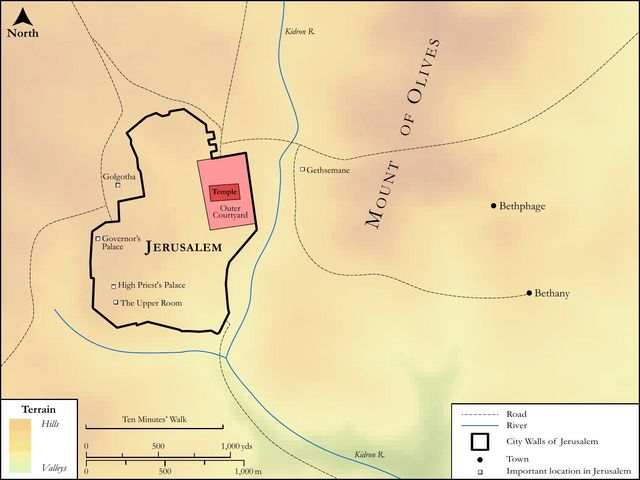
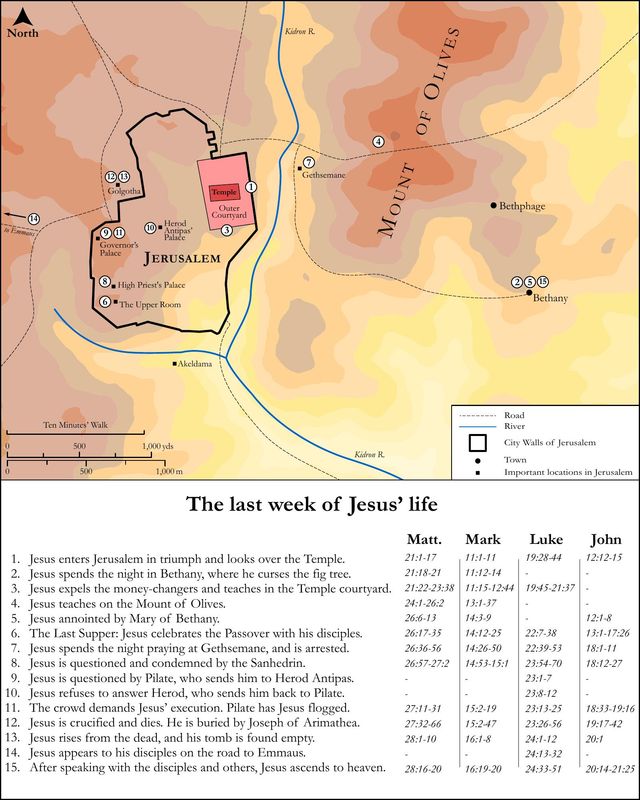
This verse is deeply embedded within Jesus' extensive prophetic discourse known as the Olivet Discourse, delivered on the Mount of Olives in response to His disciples' questions about the destruction of the Temple and the signs of His coming and the end of the age (Matthew 24:3). Following His initial general warning against deception (Matthew 24:4), and descriptions of various tribulations like wars, famines, and persecutions, Jesus narrows His focus in Matthew 24:23-28 to specific, intense forms of deception concerning His personal presence. This particular warning sets the stage for His subsequent, unmistakable description of His true, universally visible return in Matthew 24:27.
Historical & Cultural Context
First-century Judea was a hotbed of messianic expectation, often intertwined with political aspirations for liberation from Roman rule. Numerous individuals had arisen claiming to be the Messiah or messianic figures, leading to various movements and uprisings. This environment made the populace susceptible to charismatic leaders and sensational claims. Jesus' warning in Matthew 24:23 directly addresses this cultural predisposition, preparing His disciples for a future where false Christs would exploit such hopes, especially in times of distress and upheaval, such as the impending destruction of Jerusalem and the Temple, which Jesus had just predicted (Matthew 24:2).
Key Themes
ShowHideMatthew 24:23 contributes significantly to several overarching themes within the Olivet Discourse and the broader New Testament. The most prominent is the Warning Against Deception, which Jesus emphasizes repeatedly, urging His followers to exercise extreme spiritual discernment in the end times. This verse highlights the insidious nature of false claims about Christ's presence. Relatedly, it implicitly teaches about the Nature of Christ's Second Coming, contrasting the secretive, localized claims with the true, glorious, and universally visible return of the Son of Man, which will be unmistakable, like lightning flashing across the sky (Matthew 24:27). Finally, the verse introduces the theme of False Christs and False Prophets, a danger echoed throughout the New Testament, reminding believers to be grounded in the truth of God's Word rather than swayed by sensational or unbiblical assertions (2 Peter 2:1).
Exposition and Analysis
ShowHideKey Word Analysis
ShowHideThis interjection, often translated "behold" or "see," is used to draw immediate and emphatic attention to something. In this context, it signifies a sensational, attention-grabbing declaration, as if someone is pointing to a specific location or person with an urgent, exclusive revelation. Jesus uses it to highlight the dramatic and deceptive nature of such false claims.
Derived from the verb "to anoint," this term means "Anointed One" or "Messiah." It refers specifically to the promised deliverer and king of Israel, the central figure of God's redemptive plan. Jesus' warning is against those who would claim that this unique, divine figure has appeared in a specific, limited, or secret location, thereby usurping His true identity and mission.
This verb means "to have faith (in, upon, or with respect to, a person or thing)," or "to credit." Coupled with the negation "not" (Greek, mḗ), Jesus issues a direct command to withhold belief or trust from such claims. It underscores the critical importance of discernment and adherence to revealed truth, rather than credulity towards deceptive assertions.
Verse Breakdown
ShowHide"Then if any man shall say unto you,"
This introductory clause sets the stage for a conditional warning. "Then" (G5119, tóte) indicates a future time, specifically within the context of the end-time events Jesus is describing. "If any man" (G1437, eán G5100, tìs) suggests the possibility, even likelihood, of such claims arising from various individuals. The phrase "shall say unto you" (G2036, épō G5213, hymîn) indicates a direct communication, likely a persuasive or authoritative declaration aimed at the disciples or future believers.
"Lo, here [is] Christ, or there;"
This is the core deceptive claim Jesus warns against. "Lo" (G2400, idoú) highlights the sensational and attention-seeking nature of the assertion. The phrases "here" (G5602, hōde) and "or there" (G2228, ḗ G5602, hōde) emphasize the localized, specific, and potentially secretive nature of the alleged appearance of Christ. These claims suggest that the Messiah has arrived in a particular place, implying a limited, perhaps exclusive, access to His presence or revelation, contrary to the universal and public nature of His true return.
"believe [it] not."
This is Jesus' unequivocal command. "Believe it not" (G4100, pisteúō G3361, mḗ) is an emphatic negative imperative, instructing His followers to absolutely reject such claims. It highlights the danger of these deceptions and the necessity of spiritual discernment. The command implies that these claims are fundamentally false and antithetical to the truth of His coming, which will not be a secret or localized event.
Literary Devices
ShowHideMatthew 24:23 employs several potent literary devices. The most prominent is Admonition, as Jesus issues a direct and emphatic command ("believe it not") to His disciples, signaling the critical importance of the warning. This is reinforced by Antithesis, implicitly contrasting the false, localized, and secretive claims of "here or there" with the true, universal, and undeniably public nature of His second coming, which He describes later as being like lightning flashing across the sky (Matthew 24:27). The use of the interjection "Lo" (Greek: idoú) functions as a form of Exclamation, drawing immediate attention to the sensational and deceptive nature of the false claims. Furthermore, the verse serves as a powerful Foreshadowing, preparing the disciples for the widespread spiritual deception that would characterize the period leading up to His return, a theme consistently reiterated throughout the New Testament epistles.
Theological and Thematic Connections
ShowHideMatthew 24:23 is a profound theological statement on the nature of truth, divine revelation, and the character of Christ's return. It asserts that God's ultimate revelation in Christ will not be confined to secret gatherings or hidden locations but will be universally manifest. The warning against localized claims of Christ's presence underscores the importance of discerning between genuine divine activity and human-initiated deception, which often preys on sensationalism and exclusivity. Theologically, it reinforces the concept of God's sovereignty over history and prophetic fulfillment, assuring believers that Christ's return will occur according to His divine timetable and in a manner consistent with His revealed Word, not through human manipulation or false declarations. This necessitates a robust faith grounded in biblical truth rather than fleeting spiritual fads or charismatic personalities.
Reflection and Application
ShowHideIn an age saturated with information, misinformation, and diverse spiritual claims, Matthew 24:23 remains profoundly relevant for believers today. Jesus' warning against sensational and localized claims about His presence serves as a timeless call to spiritual discernment. We are constantly bombarded with narratives, both secular and spiritual, that promise exclusive knowledge, hidden truths, or a "new" way to experience Christ. This verse reminds us that the true Christ, as revealed in Scripture, is not found in secret societies, obscure locations, or through charismatic leaders making extraordinary, unbiblical claims. Instead, our faith must be anchored in the historical Jesus Christ and the unchanging truth of His Word. Cultivating a deep understanding of biblical prophecy and the character of God is our best defense against deception, enabling us to test all claims against the plumb line of Scripture and to patiently await the glorious, unmistakable return of our Lord.
Questions for Reflection
ShowHideFAQ
ShowHideWhy does Jesus specifically warn against claims of Him being "here or there"?
ShowHideJesus specifically warns against claims of Him being "here or there" to counter the idea that His second coming would be a localized, secret, or exclusive event. In the first century, many false messiahs arose, often gathering followers in specific locations or wilderness areas. Jesus' warning directly addresses this common form of deception, emphasizing that His true return will not be hidden, confined to a particular place, or accessible only to a select few. Instead, His return will be a universally visible and unmistakable event, as He later describes in Matthew 24:27, comparing it to lightning flashing across the sky. This warning protects believers from being misled by cults or movements that claim special access to Christ's presence or a secret revelation.
Does this verse imply that believers should not look for signs of Christ's return?
ShowHideNo, this verse does not imply that believers should not look for signs of Christ's return. Rather, it warns against believing false claims about His presence. Throughout the Olivet Discourse, Jesus actually provides numerous signs that will precede His return, such as wars, famines, earthquakes, and the persecution of believers (Matthew 24:6-9). He even encourages His disciples to "learn the parable from the fig tree" (Matthew 24:32), indicating that they should discern the times. The warning in Matthew 24:23 is specifically against deceptive claims of His personal, localized presence, not against observing the broader biblical signs that point to the nearness of His glorious, public return.
Christ-Centered Fulfillment
ShowHideMatthew 24:23, while a warning against deception, ultimately points to the unique and glorious nature of Christ Himself. The very necessity of this warning underscores the profound truth that there is only one true Christ, the Son of God, whose identity and mission are clearly revealed in Scripture. False claims of "here is Christ, or there" are rendered impotent by the reality of the Incarnation, where the Word became flesh and dwelt among us, full of grace and truth (John 1:14). Jesus' first coming was humble, yet public, fulfilling ancient prophecies. His second coming, to which this warning points, will be equally public, but gloriously triumphant, not a secret or localized event. This warning protects believers from diverting their hope and allegiance to any other figure or false revelation, continually directing their gaze to the one true Lamb of God who takes away the sin of the world (John 1:29). It reminds us that the Christ we await is the same Jesus who ascended into heaven and will return in the same way He left—visibly and undeniably (Acts 1:11), not in a hidden corner or a private revelation, but as King of kings and Lord of lords, whose coming every eye will see (Revelation 1:7).