


Luke 17:23
Bible text: King James Version (1769 Blayney text) · Public domain
Bible text: Berean Standard Bible · Public domain
Bible text: American Standard Version (1901) · Public domain
Bible text: World English Bible, Messianic edition · Public domain
Bible text: Geneva Bible (1599) · Public domain
Bible text: Young's Literal Translation · Public domain
- καὶkaiAndG2532CONJConjunction
- ἐροῦσινerousinthey will sayG4483V-FAI-3PVerb Future Active Indicative 3rd Plural
- ὑμῖν·huminto youG4771P-2DPPersonal pronoun Dative 2nd Plural
- ἰδοὺidouBeholdG2400INJInterjection
- ἐκεῖekeithereG1563ADVAdverb
- ἢēorG2228CONJConjunction
- ἰδοὺidouBeholdG2400INJInterjection
- ὧδεhōdehereG5602ADVAdverb
- μὴmēNotG3361PRT-NNegative Particle Negative
- ἀπέλθητεapelthētemay go forthG565V-2AAS-2PVerb 2nd Aorist Active Subjunctive 2nd Plural
- μηδὲmēdenorG3366CONJ-NConjunction Negative
- διώξητεdiōxētemay followG1377V-AAS-2PVerb Aorist Active Subjunctive 2nd Plural
English is a literal word-by-word gloss of the Greek, not the KJV's wording. Why?
This is the original text the KJV's translators worked from — each Greek word with its own literal English meaning in this verse, prepared by scholars at Tyndale House, Cambridge. The KJV translates whole sentences, not word by word, so its wording differs: one Greek word can become several English words, and the KJV may choose “charity” where the gloss reads “love”. Both are faithful — they answer different questions. For the KJV's own rendering, switch to the KJV text.
Details
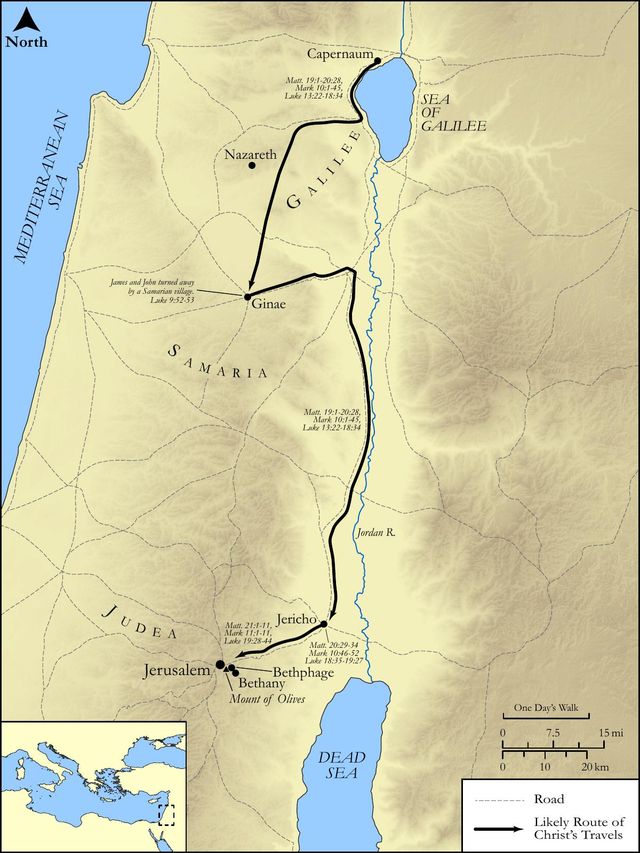
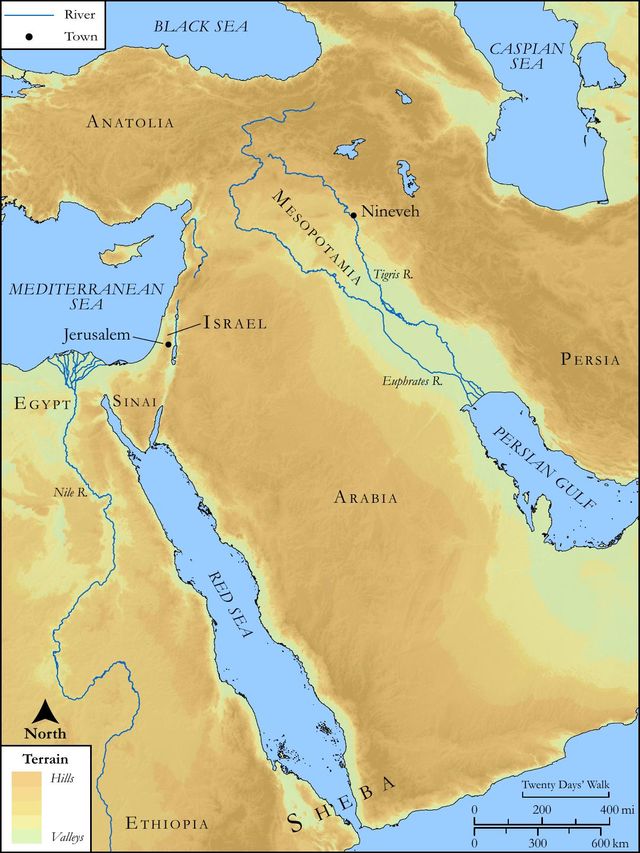
See on the biblical-era maps

Study this verse
Public-domain commentary
Matthew Henry
From his Commentary on the Whole Bible. Henry comments on passages, not single verses — this entry covers Luke 17:20–37. His four-level outline is real structure in the source text, so it is rendered as structure.
We have here a discourse of Christ's concerning the kingdom of God, that is, the kingdom of the Messiah, which was now shortly to be set up, and of which there was great expectation.
I.Here is the demand of the Pharisees concerning it, which occasioned this discourse.
They asked when the kingdom of God should come, forming a notion of it as a temporal kingdom, which should advance the Jewish nation above the nations of the earth. They were impatient to hear some tidings of its approach; they understood, perhaps, that Christ had taught his disciples to pray for the coming of it, and they had long preached that it was at hand. "Now," say the Pharisees, "when will that glorious view open? When shall we see this long-looked-for kingdom?"
II.Christ's reply to this demand, directed to the Pharisees first, and afterwards to his own disciples, who knew better how to understand it (Luk 17:22); what he said to both, he saith to us.
1.That the kingdom of the Messiah was to be a spiritual kingdom, and not temporal and external. They asked when it would come. "You know not what you ask," saith Christ; "it may come, and you not be aware of it." For it has not an external show, as other kingdoms have, the advancements and revolutions of which are taken notice of by the nations of the earth, and fill the newspapers; so they expected this kingdom of God would do. "No," saith Christ, (1.) "It will have a silent entrance, without pomp, without noise; it cometh not with observation," meta paratērēseōs - with outward show. They desired to have their curiosity satisfied concerning the time of it, to which Christ does not give them any answer, but will have their mistakes rectified concerning the nature of it: "It is not for you to know the times of this kingdom, these are secret things, which belong not to you; but the great intentions of this kingdom, these are things revealed." When Messiah the Prince comes to set up his kingdom, they shall not say, Lo here, or Lo there, as when a prince goes in progress to visit his territories it is in every body's mouth, he is here, or he is there; for where the king is there is the court. Christ will not come with all this talk; it will not be set up in this or that particular place; nor will the court of that kingdom be here or there; nor will it be here or there as it respects the country men are of, or the place they dwell in, as if that would place them nearer to, or further fRom. that kingdom. Those who confine Christianity and the church to this place or that party, cry, Lo here, or Lo there, than which nothing is more contrary to the designs of catholic Christianity; so do they who make prosperity and external pomp a mark of the true church. (2.) "It has a spiritual influence: The kingdom of God is within you." It is not of this world, Joh 18:36. Its glory does not strike men's fancies, but affects their spirits, and its power is over their souls and consciences; from them it receives homage, and not from their bodies only. The kingdom of God will not change men's outward condition, but their hearts and lives. Then it comes when it makes those humble, and serious, and heavenly, that were proud, and vain, and carnal, - when it weans those from the world that were wedded to the world; and therefore look for the kingdom of God in the revolutions of the heart, not of the civil government. The kingdom of God is among you; so some read it. "You enquire when it will come, and are not aware that it is already begun to be set up in the midst of you. The gospel is preached, it is confirmed by miracles, it is embraced by multitudes, so that it is in your nation, though not in your hearts." Note, It is the folly of many curious enquirers concerning the times to come that they look for that before them which is already among them.
2.That the setting up of this kingdom was a work that would meet with a great deal of opposition and interruption, Luk 17:22. The disciples thought they should carry all before them, and expected a constant series of success in their work; but Christ tells them it would be otherwise: "The days will come, before you have finished your testimony and done your work, when you shall desire to see one of the days of the Son of man" (one such a day as we now have), "of the prosperity and progress of the gospel, and shall not see it. At first, indeed, you will have wonderful success" (so they had, when thousands were added to the church in a day); "but do not think it will be always so; no, you will be persecuted and scattered, silenced and imprisoned, so that you will not have opportunities of preaching the gospel without fear, as you now have; people will grow cool to it, when they have enjoyed it awhile, so that you will not see such harvests of souls gathered in to Christ afterwards as at first, nor such multitudes flocking to him as doves to their windows." This looks forward to his disciples in after-ages; they must expect much disappointment; the gospel will not be always preached with equal liberty and success. Ministers and churches will sometimes be under outward restraints. Teachers will be removed into corners, and solemn assemblies scattered. Then they will wish to see such days of opportunity as they have formerly enjoyed, sabbath days, sacrament days, preaching days, praying days; these are days of the Son of man, in which we hear from him, and converse with him. The time may come when we may in vain wish for such days. God teaches us to know the worth of such mercies by the want of them. It concerns us, while they are continued, to improve them, and in the years of plenty to lay up in store for the years of famine. Sometimes they will be under inward restraints, will not have such tokens of the presence of the Son of man with them as they have had. The Spirit is withdrawn from them; they see not their signs; the angel comes not down to stir the waters; there is a great stupidity among the children of men, and a great lukewarmness among the children of God; then they shall wish to see such victorious triumphant days of the Son of man as they have sometimes seen, when he has ridden forth with his bow and his crown, conquering and to conquer, but they will not see them. Note, We must not think that Christ's church and cause are lost because not always alike visible and prevailing.
3.That Christ and his kingdom are not to be looked for in this or that particular place, but his appearance will be general in all places at once (Luk 17:23, Luk 17:24): "They will say to you, See here, or, See there; here is one that will deliver the Jews out of the hands of the oppressing Romans, or there is one that will deliver the Christians out of the hands of the oppressing Jews; here is the Messiah, and there is his prophet; here in this mountain, or there at Jerusalem, you will find the true church. Go not after them, nor follow them; do not heed such suggestions. The kingdom of God was not designed to be the glory of one people only, but to give light to the Gentiles; for as the lightning that lightens out of one part under heaven, and shines all on a sudden irresistibly to the other part under heaven, so shall also the Son of man be in his day." (1.) "The judgments that are to destroy the Jewish nation, to lay them waste, and to deliver the Christians from them, shall fly like lightning through the land, shall lay all waste from one end of it to another; and those that are marked for this destruction can no more avoid it, nor oppose it, than they can a flash of lightning." (2.) "The gospel that is to set up Christ's kingdom in the world shall fly like lightning through the nations. The kingdom of the Messiah is not to be a local thing, but is to be dispersed far and wide over the face of the whole earth; it shall shine from Jerusalem to all parts about, and that in a moment. The kingdoms of the earth shall be leavened by the gospel ere they are aware of it." The trophies of Christ's victories shall be erected on the ruins of the devil's kingdom, even in those countries that could never be subdued to the Roman yoke. The design of the setting up of Christ's kingdom was not to make one nation great, but to make all nations good - some, at least, of all nations; and this point shall be gained, though the nations rage, and the kings of the earth set themselves with all their might against it.
4.That the Messiah must suffer before he must reign (Luk 17:25): "First must he suffer many things, many hard things, and be rejected of this generation; and, if he be thus treated, his disciples must expect no other than to suffer and be rejected too for his sake." They thought of having the kingdom of the Messiah set up in external splendour: "No," saith Christ, "we must go by the cross to the crown. The Son of man must suffer many things. Pain, and shame, and death, are those many things. He must be rejected by this generation of unbelieving Jews, before he be embraced by another generation of believing Gentiles, that his gospel may have the honour of triumphing over the greatest opposition from those who ought to have given it the greatest assistance; and thus the excellency of the power will appear to be of God, and not of man; for, though Israel be not gathered, yet he will be glorious to the ends of the earth."
5.That the setting up of the kingdom of the Messiah would introduce the destruction of the Jewish nation, whom it would find in a deep sleep of security, and drowned in sensuality, as the old world was in the days of Noah, and Sodom in the days of Lot, Luk 17:26, etc. Observe,
(1.)How it had been with sinners formerly, and in what posture the judgments of God, of which they had been fairly warned, did at length find them. Look as far back as the old world, when all flesh had corrupted their way, and the earth was filled with violence. Come a little lower, and think how it was with the men of Sodom, who were wicked, and sinners before the Lord exceedingly. Now observe concerning both these,
[1.]That they had fair warning given them of the ruin that was coming upon them for their sins. Noah was a preacher of righteousness to the old world; so was Lot to the Sodomites. They gave them timely notice of what would be in the end of their wicked ways, and that it was not far off.
[2.]That they did not regard the warning given them, and gave no credit, no heed to it. They were very secure, went on in their business as unconcerned as you could imagine; they did eat, they drank, indulged themselves in their pleasures, and took no care of any thing else, but to make provision for the flesh, counted upon the perpetuity of their present flourishing state, and therefore married wives, and were given in marriage, that their families might be built up. They were all very merry; so were the men of Sodom, and yet very busy too: they bought, they sold, they planted, they builded. These were lawful things, but the fault was that they minded these inordinately, and their hearts were entirely set upon them, as that they had no heart at all to prepare against the threatened judgments. When they should have been, as the men of Nineveh, fasting and praying, repenting and reforming, upon warning given them of an approaching judgment, they were going on securely, eating flesh, and drinking wine, when God called to weeping and to mourning, Isa 22:12, Isa 22:13.
[3.]That they continued in their security and sensuality, till the threatened judgment came. Until the day that Noah entered into the ark, and Lot went out of Sodom, nothing said or done to them served to alarm or awaken them. Note, Though the stupidity of sinners in a sinful way is as strange as it is without excuse, yet we are not to think it strange, for it is not without example. It is the old way that wicked men have trodden, that have gone slumbering to hell, as if their damnation slumbered while they did.
[4.]That God took care for the preservation of those that were his, who believed and feared, and took the warning themselves which they gave to others. Noah entered into the ark, and there he was safe; Lot went out of Sodom, and so went out of harm's way. If some run on heedless and headlong into destruction, that shall be no prejudice to the salvation of those that believe.
[5.]That they were surprised with the ruin which they would not fear, and were swallowed up in it, to their unspeakable horror and amazement. The flood came, and destroyed all the sinners of the old world; fire and brimstone came, and destroyed all the sinners of Sodom. God has many arrows in his quiver, and uses which he will in making war upon his rebellious subjects, for he can make which he will effectual. But that which is especially intended here is to show what a dreadful surprise destruction will be to those who are secure and sensual.
(2.)How it will be with sinners still (Luk 17:30): Thus shall it be in the day when the Son of man is revealed. When Christ comes to destroy the Jewish nation, by the Roman armies, the generality of that nation will be found under such a reigning security and stupidity as this. They have warning given by Christ now, and will have it repeated to them by the apostles after him, as they had by Noah and Lot; but it will be all in vain. They will continue secure, will go on in their neglect and opposition of Christ and his gospel, till all the Christians are withdrawn from among them and gone to the place of refuge. God will provide for them on the other side Jordan, and then a deluge of judgments shall flow in upon them, which will destroy all the unbelieving Jews. One would have thought that this discourse of our Saviour's, which was public, and not long after published to the world, should have awakened them; but it did not, for the hearts of that people were hardened, to their destruction. In like manner, when Jesus Christ shall come to judge the world, at the end of time, sinners will be found in the same secure and careless posture, altogether regardless of the judgment approaching, which will therefore come upon them as a snare; and in like manner the sinners of every age go on securely in their evil ways, and remember not their latter end, nor the account that they must give. Woe to them that are thus at ease in Zion.
6.That it ought to be the care of his disciples and followers to distinguish themselves from the unbelieving Jews in that day, and, leaving them, their city and country, to themselves, to flee at the signal given, according to the direction that should be given. Let them retire, as Noah to his ark, and Lot to his Zoar. You would have healed Jerusalem, as of old Babylon, but she is not healed, and therefore forsake her, flee out of the midst of her, and deliver every man his soul, Jer 51:6, Jer 51:9. This flight of theirs from Jerusalem must be expeditious, and must not be retarded by any concern about their worldly affairs (Luk 17:31): "He that shall be on the house-top, when the alarm is given, let him not come down, to take his stuff away, both because he cannot spare so much time, and because the carrying away of his effects will but encumber him and retard his flight." Let him not regard his stuff at such a time, when it will be next to a miracle of mercy if he have his life given him for a prey. It will be better to leave his stuff behind him than to stay to look after it, and perish with them that believe not. It will be their concern to do as Lot and his family were charged to do: Escape for thy life. Save yourselves from this untoward generation. (2.) When they have made their escape, they must not think of returning (Luk 17:32): "Remember Lot's wife; and take warning by her not only to flee from this Sodom (for so Jerusalem is become, Isa 1:10), but to persevere in your flight, and do not look back, as she did; be not loth to leave a place marked for destruction, whomsoever or whatsoever you leave behind you, that is ever so dear to you." Those who have left the Sodom of a natural state, let them go forward, and not so much as look a kind look towards it again. Let them not look back, lest they should be tempted to go back; nay, lest that be construed a going back in heart, or an evidence that the heart was left behind. Lot's wife was turned into a pillar of salt, that she might remain a lasting monument of God's displeasure against apostates, who begin in the spirit and end in the flesh. (3.) There would be no other way of saving their lives than by quitting the Jews, and, if they thought to save themselves by a coalition with them, they would find themselves mistaken (Luk 17:33): "Whosoever shall seek to save his life, by declining from his Christianity and complying with the Jews, he shall lose it with them and perish in the common calamity; but whosoever is willing to venture his life with the Christians, upon the same bottom on which they venture, to take his lot with them in life and in death, he shall preserve his life, for he shall make sure of eternal life, and is in a likelier way at that time to save his life than those who embark in a Jewish bottom, or ensure upon their securities." Note, Those do best themselves that trust God in the way of duty.
7.That all good Christians should certainly escape, but many of them very narrowly, from that destruction, Luk 17:34-36. When God's judgments are laying all waste, he will take an effectual course to preserve those that are his, by remarkable providences distinguishing between them and others that were nearest to them: two in a bed, one taken and the other left; one snatched out of the burning and taken into a place of safety, while the other is left to perish in the common ruin. Note, Though the sword devours one as well as another, and all things seem to come alike to all, yet sooner or later it shall be made to appear that the Lord knows them that are his and them that are not, and how to take out the precious from the vile. We are sure that the Judge of all the earth will do right; and therefore, when he sends a judgment on purpose to avenge the death of his Son upon those that crucified him, he will take care that none of those who glorified him, and gloried in his cross, shall be taken away by that judgment.
8.That this distinguishing, dividing, discriminating work shall be done in all places, as far as the kingdom of God shall extend, Luk 17:37. Where, Lord? They had enquired concerning the time, and he would not gratify their curiosity with any information concerning that; they therefore tried him with another question: "Where, Lord? Where shall those be safe that are taken? Where shall those perish that are left?" The answer is proverbial, and may be explained so as to answer each side of the question: Wheresoever the body is, thither will the eagles be gathered together.
(1.)Wherever the wicked are, who are marked for perdition, they shall be found out by the judgments of God; as wherever a dead carcase is, the birds of prey will smell it out, and make a prey of it. The Jews having made themselves a dead and putrefied carcase, odious to God's holiness and obnoxious to his justice, wherever any of that unbelieving generation is, the judgments of God shall fasten upon them, as the eagles do upon the prey: Thine hand shall find out all thine enemies (Psa 21:8), though they set their nests among the stars, Oba 1:4. The Roman soldiers will hunt the Jews out of all their recesses and fastnesses, and none shall escape.
(2.)Wherever the godly are, who are marked for preservation, they shall be found happy in the enjoyment of Christ. As the dissolution of the Jewish church shall be extended to all parts, so shall the constitution of the Christian church. Wherever Christ is, believers will flock to him, and meet in him, as eagles about the prey, without being directed or shown the way, by the instinct of the new nature. Now Christ is where his gospel, and his ordinances, and his church are: For where two or three are gathered in his name there is he in the midst of them, and thither therefore others will be gathered to him. The kingdom of the Messiah is not to have one particular place for its metropolis, such as Jerusalem was to the Jewish church, to which all Jews were to resort; but, wherever the body is, wherever the gospel is preached and ordinances are ministered, thither will pious souls resort, there they will find Christ, and by faith feast upon him. Wherever Christ records his name he will meet his people, and bless them, Joh 4:21, etc.; Ti1 2:8. Many good interpreters understand it of the gathering of the saints together to Christ in the kingdom of glory: "Ask not where the carcase will be, and how they shall find the way to it, for they shall be under infallible direction; to him who is their living, quickening Head, and the centre of their unity, to him shall the gathering of the people be."
Historical interpretation
Eight Centuries of Reception
7 surviving comments on this verse. Each one is dated, so this reads as a timeline rather than a list.
Select a marker to jump to its quote. Markers stagger vertically where authors wrote within a few decades of each other.
As if he said, If at the coming of Antichrist, his fame shall be spread abroad, as though Christ had appeared, go not out, nor follow him. For it cannot be that He who was once seen on earth, shall any more dwell in the corners of the earth. It will therefore be he of whom we speak, not the true Christ. For this is the clear sign of the second coming of our Saviour, that suddenly the lustre of His coming shall fill the whole world; and so it follows, For as the lightning that lighteneth, &c. For He will not appear walking upon the earth, as any common man, but will illuminate our whole universe, manifesting to all men the radiance of His divinity.
He who knows the signs of the coming judgment also knows the end. Why would he not know? He is like flashing lightning, since as the Light, the Son of God illumines the inner part of the heavenly mystery. “In that hour,” it says. He also knows the hour, but he knows it for himself, he does not know it for me. He then suitably asserts that the cause of the flood, fire and of the judgment proceeded from our sins, because God did not create evil, but our actions devised it for themselves.
He now speaks to the holy disciples as his true companions. He says, "The days will come when you will desire to see one of the days of the Son of man, and will not see it." … He would have them prepared for all that can cause people grief. He wants them ready to endure patiently so that approved they may enter the kingdom of God. He warns them that before his coming from heaven at the consummation of the world, tribulation and persecution will precede him. They will wish to see one of the days of the Son of man, such as those when they were still going around with Christ and speaking with him.
When our Lord said, The kingdom of God is within you, He would fain prepare His disciples for suffering, that being made strong they might be able to enter the kingdom of God; He therefore foretells to them, that before His coming from heaven at the end of the world, persecution will break out upon them. Hence it follows, And he said unto the disciples, The days will come, &c. meaning that so terrible will be the persecution, that they would desire to see one of His days, that is, of that time when they yet walked with Christ. Truly the Jews ofttimes beset Christ with reproaches and insults, and sought to stone Him, and ofttimes would have hurled Him down from the mountain; but even these seem to be looked upon as slight in comparison of greater evils that are to come.
And they will say to you: Look, there. Do not go, do not hurry. Although this sentence can be understood not only for a time, but also for a person. And indeed for a time, because there arose some who, calculating the courses of ages, would say they had found the certain year, day, and hour of the end of the world, against the authority of the Lord saying: It is not for you to know the times or the moments (Acts I). As for the person, because many heretics came against the Church, and many will come, who assert themselves to be Christs, the first of whom is Simon Magus, and the last, greater than others, is the Antichrist. Therefore, if anyone says to you, Look here, look there, that is, that in this or that person, or hour, the kingdom of God is coming or is going to come, they are not to be followed, who do not fear to seek higher things and to say unspeakable things.
Or, by the day of Christ He signifies His kingdom, which we hope will come, and He rightly says, one day, because there shall no darkness disturb the glory of that blessed time. It is right then to long for the day of Christ, yet from the earnestness of our longing, let us not vision to ourselves as though the day were at hand. Hence it follows, And they shall say to you, Lo here! and, Lo there!
And he well says, that lighteneth out of the one part under heaven, because the judgment will be given under the heaven, that is, in the midst of the air, as the Apostle says, We shall be caught up together with them in the clouds. (1 Thess. 4:17.) But if the Lord shall appear at the Judgment like lightning, then shall no one remain hidden in the deep of his heart, for the very brightness of the Judge pierces through him; we may also take this answer of our Lord to refer to His coming, whereby He comes daily into His Church. For ofttimes have heretics so vexed the Church, by saying that the faith of Christ stands in their own dogma, that the faithful in those times longed that the Lord would if it were possible even for one day return to the earth, and Himself make known what was the true faith. And you shall not see it, because it need not that the Lord should again testify by a bodily presence that which has been spiritually declared by the light of the Gospel, once scattered and diffused throughout the whole world.
He means the generation not only of the Jews, but also of all wicked men, by whom even now in His own body, that is, His Church, the Son of man suffers many things, and is rejected. But while He spake many things of His coming in glory, He inserts something also concerning His Passion, that when men saw Him dying, whom they had heard would be glorified, they might both soothe their sorrow for His sufferings by the hope of the promised glory, and at the same time prepare themselves, if they love the glories of His kingdom, to look without alarm upon the horrors of death.
For their life was then without trouble, for Christ took care of them and protected them. But the time was coming when Christ should be taken away, and they should be exposed to perils, being brought before kings and princes, and then they should long for the first time and its tranquillity.
Continue studying Luke 17:23 across the web’s major study libraries — every link below opens this exact verse, chapter, or book on the destination site.
Read & Compare
 BibleGatewayThis verse in more than 200 translations and 70 languages.
 Bible.comThe YouVersion reader — hundreds of translations, reading plans, and highlights.
 ESV.orgCrossway's official English Standard Version reader.
 NET BibleThe NET translation with 60,000+ translators' notes on every rendering decision.
 STEP BibleTyndale House's free study tool — original text, vocabulary, and scholarly resources.
 BibliaLogos Bible Software's free web reader.
 USCCBThe New American Bible (Revised Edition) with the U.S. bishops' study notes.
Commentaries
 BibleHub CommentariesDozens of classic commentaries on this verse, gathered on one page.
 StudyLightMore than 100 commentary sets — the largest collection on the web.
 BibleRefPlain-English commentary on what this verse means, verse by verse.
 Enduring WordDavid Guzik's free commentary on this chapter, widely used by Bible teachers.
 Bible Study ToolsVerse commentary alongside Greek and Hebrew study aids.
Original Language & Research
- BibleHub InterlinearThe verse word by word — original language, transliteration, and English.
- BibleHub LexiconEvery word's original-language definition and Strong's entry.
 Blue Letter BibleDeep-study tools — Strong's numbers, concordance, and word studies.
 CNTR CollationThe earliest Greek manuscripts of this verse, collated letter by letter.
Sermons, Hymns & Audio


TrulyRandomVerse is not affiliated with these sites and doesn’t control their content. They’re linked because they’re genuinely useful.
Summary
Luke 17:23 presents a crucial warning from Jesus to His disciples concerning the deceptive claims that would precede and accompany His future return as the Son of Man. This verse, embedded within a discourse on the nature of the Kingdom of God and the eschatological events, emphasizes the absolute necessity of spiritual discernment and steadfastness in the face of false reports and localized messianic claims, highlighting that His true coming will be a universally undeniable and visible event.
Context
ShowHideLiterary Context
This verse is situated within a broader discourse by Jesus on the coming of the Kingdom of God and the Son of Man, specifically following His pronouncements that the Kingdom does not come with observable signs or in a specific location (as stated in Luke 17:20-21). Having clarified that the Kingdom is already present "within you" or "among you," Jesus pivots to address His future, visible return. He first laments the suffering He must endure (Luke 17:25), then provides a stark contrast between His first, humble coming and His glorious, unmistakable Second Coming. The warning in Luke 17:23 serves as a critical prelude to the dramatic imagery of His return, which He compares to "lightning, that flashes and lights up the sky from one end to the other" in Luke 17:24, underscoring its universal visibility and suddenness.
Historical & Cultural Context
First-century Judea was a volatile environment, rife with messianic expectations and political unrest under Roman occupation. Various individuals had emerged claiming to be the Messiah or prophetic figures, leading to movements and insurrections. The Jewish people, longing for deliverance, were susceptible to charismatic leaders who promised immediate liberation or the establishment of a visible, earthly kingdom. Jesus' warning in Luke 17:23 directly addresses this cultural susceptibility to false messiahs and localized spiritual movements. His caution against "See here; or, see there" would have resonated with the disciples, who were familiar with such claims and the tendency for people to gather around purported saviors in specific locations. This historical backdrop underscores the practical and urgent nature of Jesus' admonition, preparing His followers not only for His future return but also for the immediate challenges of spiritual deception.
Key Themes
ShowHideThis verse contributes significantly to several key themes within Luke's Gospel and broader New Testament eschatology. Firstly, it highlights the theme of Spiritual Discernment, urging believers to exercise caution and wisdom in evaluating claims about Christ's presence or return. Secondly, it profoundly shapes the understanding of the Nature of Christ's Return, emphasizing that the Second Coming will not be a secret, localized, or ambiguous event, but rather a universally visible and undeniable manifestation of divine power and glory. This stands in stark contrast to the claims of false prophets, a theme echoed powerfully in Matthew 24:23-27. Thirdly, it speaks to the theme of End-Times Preparedness, not through chasing after signs or specific locations, but through steadfast faith and adherence to biblical truth. Finally, it reinforces the Sovereignty of God over eschatological events, ensuring that Christ's return will unfold according to His divine timing and manner, beyond human manipulation or prediction.
Exposition and Analysis
ShowHideKey Word Analysis
ShowHideMeaning "to utter, i.e. speak or say." In this context, it signifies the verbal pronouncements or declarations that will be made by deceptive individuals. The verb implies a direct communication, making the warning immediate and personal to the disciples.
An imperative meaning "behold, lo, see." This word functions as an attention-grabbing interjection, often used to introduce something significant or surprising. Here, it highlights the deceptive nature of the claims, as they will be presented with urgency and an appeal to immediate observation, drawing people's attention to a false localized presence.
Meaning "to pursue (literally or figuratively); by implication, to persecute." While often translated "follow," its root meaning of "pursue" or "press forward" suggests a more active and potentially zealous adherence. Jesus' command "nor follow them" prohibits not just passive observation but active engagement and allegiance to these false movements, warning against being drawn into their sphere of influence or adopting their teachings.
Verse Breakdown
ShowHide"And they shall say to you"
This opening clause immediately establishes the context of a future warning. The indefinite "they" refers to those who will arise with false claims about Christ's presence or return. Jesus is preparing His disciples for a specific type of deception that will target them directly.
"See here; or, see there:"
This is the core of the deceptive claim. The repeated imperative "See" (idoú) emphasizes the urgency and localized nature of the false reports. It suggests that deceivers will attempt to point to a specific geographical spot or a secret gathering as the place where Christ's presence or return can be found. This highlights the contrast with the true, universally visible nature of His coming.
"go not after [them], nor follow [them]."
This is Jesus' unequivocal command, a double negative in the Greek (mḗ apérchomai... mēdé diṓkō) that conveys a strong prohibition. "Go not after them" (apérchomai) implies not being led astray or drawn away by their claims, while "nor follow them" (diṓkō) speaks to not pursuing or adhering to their movements or teachings. It's a call to spiritual steadfastness and discernment, warning against any form of allegiance to these false messianic or prophetic movements.
Literary Devices
ShowHideLuke 17:23 employs several potent literary devices to convey Jesus' urgent warning. The most prominent is Imperative Mood, seen in the repeated "See here; or, see there" (idoú hōde; ē idoú ekeî) and the subsequent "go not after [them], nor follow [them]." This direct command structure underscores the critical importance of the message and demands immediate obedience from the disciples. The phrase "See here; or, see there" also functions as Antithesis or Contrast, setting up a clear opposition between localized, secretive claims and the universally visible, undeniable nature of Christ's true return, which is further elaborated in the subsequent verses. The use of Repetition ("See here; or, see there") emphasizes the pervasive and alluring nature of such false claims, highlighting how they might attempt to pinpoint Christ's presence in various specific locations. Finally, the overall tone is one of Warning, serving as a prophetic caution against spiritual deception that would arise in the future, instructing believers on how to navigate such misleading pronouncements.
Theological and Thematic Connections
ShowHideLuke 17:23 serves as a foundational text for understanding the nature of Christ's Second Coming and the necessity of spiritual vigilance. Theologically, it asserts that the return of the Son of Man will not be a clandestine event, accessible only to a select few or confined to a specific geographical location. Instead, it will be a public, unmistakable, and glorious manifestation, akin to lightning flashing across the sky. This truth safeguards believers against the allure of sensationalism and the dangers of false prophets who prey on eschatological curiosity or anxiety. It calls the church to a posture of discernment, grounding its hope and understanding of future events firmly in the clear, consistent teaching of Scripture rather than in human speculation or deceptive claims. The warning ensures that true faith is rooted in the character of God and the revealed Word, rather than in signs and wonders that can be manipulated or counterfeited.
Reflection and Application
ShowHideJesus' warning in Luke 17:23 remains profoundly relevant for believers in every generation, particularly in an age characterized by rapid information dissemination and a proliferation of spiritual claims. The call to "go not after [them], nor follow [them]" is a timeless directive to exercise profound spiritual discernment. In a world where new spiritual movements, prophetic declarations, and sensational interpretations of end-time events frequently emerge, believers are challenged to critically evaluate all claims against the unchanging truth of God's Word. This verse encourages us to cultivate a mature faith that is not easily swayed by charismatic personalities or extraordinary claims, but rather is anchored in the clear, consistent biblical description of Christ's return as a universally visible and undeniable event. Our focus should be on living faithfully, being prepared through spiritual readiness and obedience, rather than chasing after signs or localized predictions. It reminds us that true readiness for Christ's return is found in abiding in Him, not in pursuing speculative or deceptive paths.
Questions for Reflection
ShowHideFAQ
ShowHideWhy would people claim "See here; or, see there" about Christ's return?
ShowHideSuch claims typically arise from a desire to gain followers, establish a new movement, or capitalize on people's longing for the Messiah or the end of the age. Historically, false prophets and messianic figures have often pointed to specific locations (e.g., a wilderness, a secret chamber) where they claim a special manifestation or presence of God or the Messiah. Jesus' warning anticipates these attempts to localize or privatize His return, which will be a public and universal event. These claims often appeal to a sense of exclusivity or special knowledge, drawing people away from the clear biblical teaching.
What does "go not after [them], nor follow [them]" mean practically for believers today?
ShowHideThis command means that believers should not be swayed by, investigate, or align themselves with any claims that contradict the biblical description of Christ's return. Practically, this involves:
Christ-Centered Fulfillment
ShowHideLuke 17:23, while a warning against deception, powerfully points to the unique and glorious nature of Christ's true identity and ultimate triumph. Jesus, the Son of Man, is not a localized deity or a secret figure to be found in hidden places. His first coming, though humble, culminated in His public crucifixion, resurrection, and ascension, witnessed by many (Acts 1:9-11). This verse foreshadows His Second Coming, which will be equally, if not more, public and unmistakable. He is the Lord of all creation, and when He returns, "every eye will see him" (Revelation 1:7). This universal visibility underscores His sovereignty and divine authority, contrasting sharply with the limited, deceptive claims of false messiahs. The warning to "go not after [them], nor follow [them]" is a call to remain faithful to the one true Christ, whose return is guaranteed and whose character is consistently revealed in Scripture. Our hope is not in a hidden Christ, but in the glorious King who promised to return for His own, just as He said, "I will come again and will take you to myself, that where I am you may be also" (John 14:3). Thus, the verse, by warning against the false, magnifies the truth of who Christ is and how He will ultimately fulfill His redemptive plan.