


Luke 9:59
- ΕἶπενEipenHe saidG2036V-2AAI-3SVerb 2nd Aorist Active Indicative 3rd Singular
- δὲdethenG1161CONJConjunction
- πρὸςprostoG4314PREPPreposition
- ἕτερον·heteronanotherG2087A-ASMAdjective Accusative Singular Masculine
- ἀκολούθειakoloutheido followG190V-PAM-2SVerb Present Active Imperative 2nd Singular
- μοιmoiMeG3165P-1DSPersonal pronoun Dative 1st Singular
- ὁho<the>G3588T-NSMDefinite article Nominative Singular Masculine
- δὲdeButG1161CONJConjunction
- εἶπεν·eipenhe saidG2036V-2AAI-3SVerb 2nd Aorist Active Indicative 3rd Singular
- κύριεkurieLordG2962N-VSM-TNoun Vocative Singular Masculine Person Gentilic
- ἐπίτρεψόνepitrepsondo allowG2010V-AAM-2SVerb Aorist Active Imperative 2nd Singular
- μοιmoimeG3165P-1DSPersonal pronoun Dative 1st Singular
- ἀπελθόντιapelthontihaving gone awayG565V-2AAP-DSMVerb 2nd Aorist Active Participle Dative Singular Masculine
- πρῶτονprōtonfirstG4413A-ASNAdjective Accusative Singular Neuter
- θάψαιthapsaito buryG2290V-AANVerb Aorist Active Infinitive
- τὸνtontheG3588T-ASMDefinite article Accusative Singular Masculine
- πατέραpaterafatherG3962N-ASMNoun Accusative Singular Masculine
- μουmouof mineG3165P-1GSPersonal pronoun Genitive 1st Singular
English is a literal word-by-word gloss of the Greek, not the KJV's wording. Why?
This is the original text the KJV's translators worked from — each Greek word with its own literal English meaning in this verse, prepared by scholars at Tyndale House, Cambridge. The KJV translates whole sentences, not word by word, so its wording differs: one Greek word can become several English words, and the KJV may choose “charity” where the gloss reads “love”. Both are faithful — they answer different questions. For the KJV's own rendering, switch to the KJV text.
Details
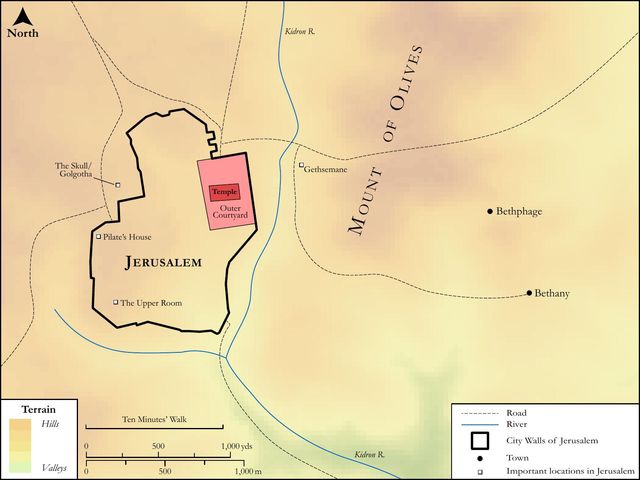
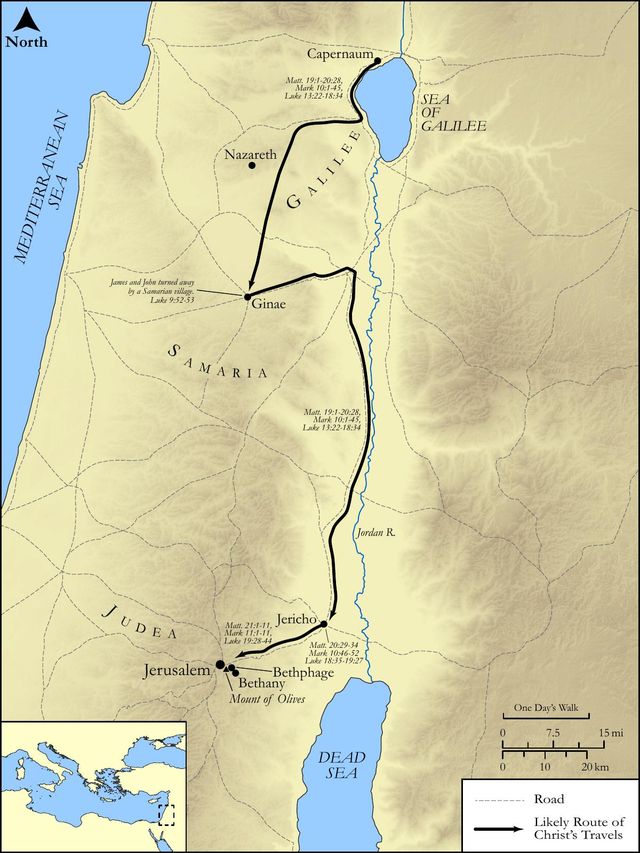
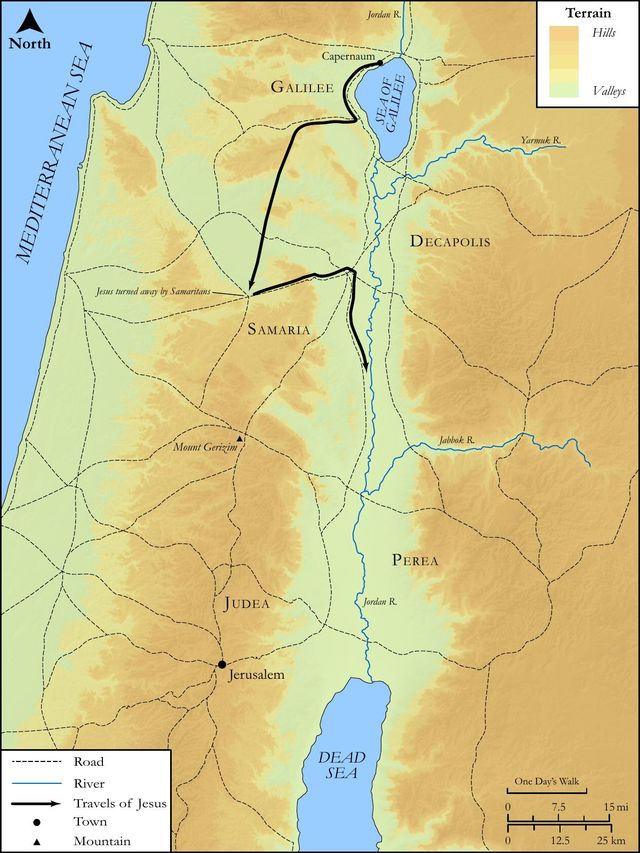
See on the biblical-era map
Study this verse
Public-domain commentary
Matthew Henry
From his Commentary on the Whole Bible. Henry comments on passages, not single verses — this entry covers Luke 9:57–62. His two-level outline is real structure in the source text, so it is rendered as structure.
We have here an account of three several persons that offered themselves to follow Christ, and the answers that Christ gave to each of them. The two former we had an account of in Mat 19:21.
I.Here is one that is extremely forward to follow Christ immediately, but seems to have been too rash, hasty, and inconsiderate, and not to have set down and counted the cost.
1.He makes Christ a very large promise (Luk 9:57): As they went in the way, going up to Jerusalem, where it was expected Christ would first appear in his glory, one said to him, Lord, I will follow thee withersoever thou goest. This must be the resolution of all that will be found Christ's disciples indeed; they follow the Lamb whithersoever he goes (Rev 14:4), though it be through fire and water, to prisons and deaths.
2.Christ gives him a necessary caution, not to promise himself great things in the world, in following him, but, on the contrary, to count upon poverty and meanness; for the Son of man has not where to lay his head.
We may look upon this, (1.) As setting forth the very low condition that our Lord Jesus was in, in this world. He not only wanted the delights and ornaments that great princes usually have, but even such accommodations for mere necessity as the foxes have, and the birds of the air. See what a depth of poverty our Lord Jesus submitted to for us, to increase the worth and merit of his satisfaction, and to purchase for us a larger allowance of grace, that we through his poverty might be rich, Co2 8:9. He that made all did not make a dwelling-place for himself, not a house of his own to put his head in, but what he was beholden to others for. He here calls himself the Son of man, a Son of Adam, partaker of flesh and blood. He glories in his condescension towards us, not only to the meanness of our nature, but to the meanest condition in that nature, to testify his love to us, and to teach us a holy contempt of the world and of great things in it, and a continual regard to another world. Christ was thus poor, to sanctify and sweeten poverty to his people; the apostles had not certain dwelling-place (Co1 4:11), which they might the better bear when they knew their Master had not; see Sa2 11:11. We may well be content to fare as Christ did. (2.) As proposing this to the consideration of those who intend to be his disciples. If we mean to follow Christ, we must lay aside the thoughts of great things in the world, and not reckon upon making any thing more than heaven of our religion, as we must resolve not to take up with any thing less. Let us not go about to compound the profession of Christianity with secular advantages; Christ has put them asunder, let us not think of joining them together; on the contrary, we must expect to enter into the kingdom of heaven through many tribulations, must deny ourselves, and take up our cross. Christ tells this man what he must count upon if he followed him, to lie cold and uneasy, to fare hard, and live in contempt; if he could not submit to this, let him not pretend to follow Christ. This word sent him back, for aught that appears; but it will be no discouragement to any that know what there is in Christ and heaven to set in the scale against this.
II.Here is another, that seems resolved to follow Christ, but he begs a day, Luk 9:59.
To this man Christ first gave the call; he said to him, Follow me. He that proposed the thing of himself fled off when he heard of the difficulties that attended it; but this man to whom Christ gave a call, though he hesitated at first, yet, as it should seem, afterwards yielded; so true was that of Christ, You have not chosen me, but I have chosen you, Joh 15:16. It is not of him that willeth, nor of him that runneth (as that forward spark in the foregoing verses), but of God that showeth mercy, that gives the call, and makes it effectual, as to this man here. Observe,
1.The excuse he made: "Lord, suffer me first to go and bury my father. I have an aged father at home, who cannot live long, and will need me while he does live; let me go and attend on him until he is dead, and I have performed my last office of love to him, and then I will do any thing." We may here see three temptations, by which we are in danger of being drawn and kept from following Christ, which therefore we should guard against: - (1.) We are tempted to rest in a discipleship at large, in which we may be at a loose end, and not to come close, and give up ourselves to be strict and constant. (2.) We are tempted to defer the doing of that which we know to be our duty, and to put if off to some other time. When we have got clear of such a care and difficulty, when we have despatched such a business, raised an estate to such a pitch, then we will begin to think of being religious; and so we are cozened out of all our time, by being cozened out of the present time. (3.) We are tempted to think that our duty to our relations will excuse us from our duty to Christ. It is a plausible excuse indeed: "Let me go and bury my father, - let me take care of my family, and provide for my children, and then I will think of serving Christ;" whereas the kingdom of God and the righteousness thereof must be sought ad minded in the first place.
2.Christ's answer to it (Luk 9:60): "Let the dead bury their dead. Suppose (which is not likely) that there are none but the dead to bury their dead, or none but those who are themselves aged and dying, who are as good as dead, and fit for no other service, yet thou hast other work to do; go thou, and preach the kingdom of God." Not that Christ would have his followers or his ministers to be unnatural; our religion teaches us to be kind and good in every relation, to show piety at home, and to requite our parents. But we must not make these offices an excuse from our duty to God. If the nearest and dearest relation we have in the world stand in our way to keep us from Christ, it is necessary that we have a zeal that will make us forget father and mother, as Levi did, Deu 33:9. This disciple was called to be a minister, and therefore must not entangle himself with the affairs of this world, Ti2 2:4. And it is a rule that, whenever Christ calls to any duty, we must not consult with flesh and blood, Gal 1:15, Gal 1:16. No excuses must be admitted against a present obedience to the call of Christ.
III.Here is another that is willing to follow Christ, but he must have a little time to talk with his friends about it.
Observe, 1. His request for a dispensation, Luk 9:61. He said, "Lord, I will follow thee; I design no other, I am determined to do it: but let me first go bid them farewell that are at home." This seemed reasonable; it was what Elisha desired when Elijah called him,Let me kiss my father and my mother; and it was allowed him: but the ministry of the gospel is preferable, and the service of it more urgent than that of the prophets; and therefore here it would not be allowed. Suffer me apotaxasthai tois eis ton oikon mou - Let me go and set in order my household affairs, and give direction concerning them; so some understand it. Now that which was amiss in this is, (1.) That he looked upon his following Christ as a melancholy, troublesome, dangerous thing; it was to him as if he were going to die and therefore he must take leave of all his friends, never to see them again, or never with any comfort; whereas, in following Christ, he might be more a comfort and blessing to them than if he had continued with them. (2.) That he seemed to have his worldly concerns more upon his heart than he ought to have, and than would consist with a close attendance to his duty as a follower of Christ. He seemed to hanker after his relations and family concerns, and he could not part easily and suitably from them, but they stuck to him. It may be he had bidden them farewell once, but Loth to depart bids oft farewell, and therefore he must bid them farewell once more, for they are at home at his house. (3.) That he was willing to enter into a temptation from his purpose of following Christ. To go and bid them farewell that were at home at his house would be to expose himself to the strongest solicitations imaginable to alter his resolution; for they would all be against it, and would beg and pray that he would not leave them. Now it was presumption in him to thrust himself into such a temptation. Those that resolve to walk with their Maker, and follow their Redeemer, must resolve that they will not so much as parley with their tempter.
2.The rebuke which Christ gave him for this request (Luk 9:62): "No man, having put his hand to the plough, and designing to make good work of his ploughing, will look back, or look behind him, for then he makes balks with his plough, and the ground he ploughs is not fit to be sown; so thou, if thou hast a design to follow me and to reap the advantages of those that do so, yet if thou lookest back to a worldly life again and hankerest after that, if thou lookest back as Lot's wife did to Sodom, which seems to be alluded to here, thou art not fit for the kingdom of God." (1.) "Thou art not soil fit to receive the good seed of the kingdom of God if thou art thus ploughed by the halves, and not gone through with." (2.) "Thou art not a sower fit to scatter the good seed of the kingdom if thou canst hold the plough no better." Ploughing is in order to sowing. As those are not fit to be sown with divine comforts whose fallow ground is not first broken up, so those are not fit to be employed in sowing who know not how to break up the fallow ground, but, when they have laid their hand to the plough, upon every occasion look back and think of quitting it. Note, Those who begin with the work of God must resolve to go on with it, or they will make nothing of it. Looking back inclines to drawing back, and drawing back is to perdition. Those are not fit for heaven who, having set their faces heavenward, face about. But he, and he only, that endures to the end, shall be saved.
Historical interpretation
Eleven Centuries of Reception
15 surviving comments on this verse. Each one is dated, so this reads as a timeline rather than a list.
Select a marker to jump to its quote. Markers stagger vertically where authors wrote within a few decades of each other.
When, however, He answers the man, who alleged as an excuse his father's burial, "Let the dead bury their dead, but go thou and preach the kingdom of God," He gave a clear confirmation to those two laws of the Creator-that in Leviticus, which concerns the sacerdotal office, and forbids the priests to be present at the funerals even of their parents.
Us, moreover, Jesus, the Father's Highest and Great Priest, clothing us from His own store -inasmuch as they "who are baptized in Christ have put on Christ"-has made "priests to God His Father," according to John. For the reason why He recalls that young man who was hastening to his father's obsequies, is that He may show that we are called priests by Him; (priests) whom the Law used to forbid to be present at the sepulture of parents: "Over every dead soul," it says, "the priest shall not enter, and over his own father and over his own mother he shall not be contaminated.
Do you hesitate about arts, and trades, and about professions likewise, for the sake of children and parents? Even there was it demonstrated to us, that both "dear pledges," and handicrafts, and trades, are to be quite left behind for the Lord's sake; while James and John, called by the Lord, do leave quite behind both father and ship; while Matthew is roused up from the toll-booth; while even burying a father was too tardy a business for faith. None of them whom the Lord chose to Him said, "I have no means to live.
If that was wanting to the apostles, I know not in the faith of what things it was, that, roused by one word of the Lord, one left the toll-booth behind for ever; another deserted father and ship, and the craft by which he gained his living; a third, who disdained his father's obsequies, fulfilled, before he heard it, that highest precept of the Lord, "He who prefers father or mother to me, is not worthy of me.
The Lord warns us of this in his gospel lest we return to the devil again and to the world, which we have renounced and from which we have escaped. He says, “No one, having put his hand to the plow and looking back, is fit for the kingdom of God.” Again he says, “And let him who is in the field not turn back. Remember Lot’s wife.” Lest anyone, either because of some desire for wealth or by his own charm be persuaded from following Christ, he added, “He that does not renounce all that he possesses, cannot be my disciple.”
(non occ.) He dared also to match himself with the incomprehensible power of the Saviour, saying, I will follow thee whithersoever thou goest; for to follow the Saviour simply to hear His teaching is possible to human nature, as it directs itself towards men, but it is not possible to go with Him wherever He is; for He is incomprehensible, and is not confined by place.
Or herein our Lord teaches the greatness of His gift, as if He said, All created things may be confined by place, but the Word of God has incomprehensible power. Say not then, I will follow thee whithersoever thou goest. But if thou wouldest be a disciple, cast off 1 foolish things, for it is impossible for him who remains in foolishness to become a disciple of the Word.
The man said, “Allow me first to go and bury my father.” The Lord replied, “Let the dead bury their dead; but go and preach the kingdom of God.” Another man said, “Let me first arrange my affairs at home.” He rebuked him with a stern threat, saying, “No man, putting his hand to the plow and looking back, is fit for the kingdom of God.” A person who wishes to become the Lord’s disciple must repudiate a human obligation, however honorable it may appear, if it slows us ever so slightly in giving the wholehearted obedience we owe to God.
For we must not always punish the offender, since mercy sometimes does more good, leading thee to patience, the sinner to repentance. Lastly, those Samaritans believed the sooner, who were in this place saved from fire.
Or, He compares foxes to heretics, because they are indeed a wily animal, and, ever intent upon fraud, commit their robberies by stealth. They let nothing be safe, nothing be at rest, nothing secure, for they hunt their prey into the very abodes of men. The fox again, an animal full of craft, makes no hole for itself, yet likes to lie always concealed in a hole. So the heretics, who know not how to construct a house for themselves, circumscribe and deceive others. This animal is never tamed, nor is it of use to man. Hence the Apostle, A heretic after the first and second admonition reject. (Tit. 3:10.) But the birds of the air, which are frequently brought in to represent spiritual wickedness, build as it were their nests in the breasts of the wicked, and as long as deceit reigns over the affections, the divine principle has no opportunity to take possession. But when a man has proved his heart to be innocent, upon him Christ leans in some measure the weight of His greatness, for by a more abundant shedding of grace He is planted in the breasts of good men. So then it does not seem reasonable that we should think him faithful and simple, who is rejected by the judgment of the Lord, notwithstanding that he promised the service of unwearied attendance; but our Lord cares not for this kind of service, but only purity of affection, nor is his attendance accepted whose sense of duty is not proved. For the hospitality of faith should be given with circumspection, lest while opening the interior of our house to the unbelieving, through our imprudent credulity we fall a snare to the treachery of others. Therefore that you may be aware that God despises not attendance upon him but deceit, He who rejected the deceitful man chose the innocent. For it follows, And he said unto another, Follow me. But He says this to him, whose father He knew to be dead. Hence it follows, But he said, Lord, suffer me first to go and bury my father.
But the Lord calls those upon whom He has compassion. Hence it follows, And Jesus said, Let the dead bury their dead. Since we have received as a religious duty the burial of the human body, how is it thus that the burial even of a father's dead body is forbidden, unless you are to understand that human things are to be postponed to divine? It is a good employment, but the hindrance is greater, for he who divides his pursuits, draws down his affections; he who divides his care, delays his advances. We must first set about the things which are most important. For the Apostles also, that they might not be occupied in the office of distributing alms, ordained ministers for the poor.
The performance of a father's burial is not then prohibited, but the observance of religious duty is preferred to the ties of relationship. The one is left to those in like condition, the other is commanded to those who are left. But how can the dead bury the dead? unless you here understand a twofold death, one a natural death, the other the death of sin. (Rom. 9:11.) There is also a third death, by which we die unto sin, live unto God.
Or because the throat of the ungodly is an open sepulchre, their memory is ordered to be forgotten whose services die together with their bodies. Nor is the son recalled from his duty to his father, but the faithful is separated from the communion of the unbelieving; there is no prohibition of duty, but a mystery of religion, that is, that we should have no fellowship with the dead Gentiles.
See how our Lord sets forth by his works the poverty which he taught. For him was no table spread, no lights, no house, nor any such thing.
(Hom. 27. in Matt.) But what more necessary than the burial of his father, what more easy, seeing that there would not be much time given to it? We are then hereby taught that it becomes us not to spend even the slightest portion of our time in vain, although we have a thousand things to compel us, nay to prefer spiritual things to even our greatest necessities. For the devil watchfully presses close upon us, wishing to find any opening, and if he causes a slight negligence, he ends in producing a great weakness.
(ubi sup.) By thus saying, their dead, he shows that this man's father was not his dead, for I suppose that the deceased was of the number of the unbelieving.
Or else, his father was borne down with years, and he thought he was doing an honourable act in proposing to pay the kind offices which were due to him, according to Exodus, Honour thy father and thy mother. (Exod. 20:12.) Hence when calling him to the ministry of the Gospel, our Lord said, Follow me, he sought for a time of respite, which should suffice for the support of his decrepit father, saying, Permit me first to go and bury my father, not that he asked to bury his deceased father, for Christ would not have hindered the wish to do this, but he said, Bury, that is, support in old age even till death. But the Lord said to him, Let the dead bury their dead. For there were other attendants also bound by the same tie of relationship, but as I consider dead, because they had not yet believed Christ. Learn from this, that our duty to God is to be preferred to our love for our parents, to whom we show reverence, because through them have we been born. But the God of all, when as yet we were not, brought us into being, our parents were made the ministers of our introduction.
"Leave the dead burying their dead, but go, preach the kingdom of God." There were, no doubt, other guardians and relatives of his father. I consider them dead, because they had not yet believed in Christ nor been able to receive the new birth by holy baptism to incorruptible life. "Let them," he says, "bury their dead, because they also have within them a dead mind and still have not been numbered among those who possess the life that is in Christ." We learn from this that the fear of God is to be set even above the reverence and love due to parents. The law of Moses, in the first place, commanded that you shall love the Lord God with all your soul, all your might and all your heart. It put as second to it the honor due to parents, saying, "Honor your father and your mother."
Therefore it is said to him, Why do you seek to follow Me for the riches and gain of this world, when so great is My poverty that I have not even a place of rest, and take shelter under another man's roof.
He did not refuse the discipleship, but his wish was, having fulfilled the filial duty of burying his father, to follow Christ more freely.
BEDE.: To put one's hand to the plough, is also, (as it were by a certain sharp instrument,) by the wood and iron of our Lord's passion, to wear away the hardness of our heart, and to open it to bring forth the fruits of good works. But if any one, having begun to exercise this, delights to look back with Lot's wife to the things which he had left, he is deprived of the gift of the kingdom to come.
But if the disciple about to follow our Lord is reproved for wishing even to bid farewell at home, what will be done to such as for no advantage-sake frequently visit the houses of those whom they have left in the world?
But he said to another: Follow me. But he said: Lord, allow me first to go and bury my father. He did not reject discipleship, but first, with the piety of completing his father's funeral, he desired to follow him more freely, worthy in all things in whom the Son of Man may lay his head, that is, in whose humble heart divinity may rest with a certain familiar dwelling.
For having seen our Lord drawing much people to Him, he thought that he received reward from them, and that if he followed our Lord, he might obtain money.
(Nilus Monac.) For the frequent looking upon the things which we have forsaken, through the force of habit draws us back to our past way of life. For practice has great power to retain to itself. Is not habit generated of use, and nature of habit? But to get rid of or change nature is difficult; for although when compelled it for a while turns aside, it very rapidly returns to itself.
Continue studying Luke 9:59 across the web’s major study libraries — every link below opens this exact verse, chapter, or book on the destination site.
Read & Compare
 BibleGatewayThis verse in more than 200 translations and 70 languages.
 Bible.comThe YouVersion reader — hundreds of translations, reading plans, and highlights.
 ESV.orgCrossway's official English Standard Version reader.
 NET BibleThe NET translation with 60,000+ translators' notes on every rendering decision.
 STEP BibleTyndale House's free study tool — original text, vocabulary, and scholarly resources.
 BibliaLogos Bible Software's free web reader.
 USCCBThe New American Bible (Revised Edition) with the U.S. bishops' study notes.
Commentaries
 BibleHub CommentariesDozens of classic commentaries on this verse, gathered on one page.
 StudyLightMore than 100 commentary sets — the largest collection on the web.
 BibleRefPlain-English commentary on what this verse means, verse by verse.
 Enduring WordDavid Guzik's free commentary on this chapter, widely used by Bible teachers.
 Bible Study ToolsVerse commentary alongside Greek and Hebrew study aids.
Original Language & Research
- BibleHub InterlinearThe verse word by word — original language, transliteration, and English.
- BibleHub LexiconEvery word's original-language definition and Strong's entry.
 Blue Letter BibleDeep-study tools — Strong's numbers, concordance, and word studies.
 CNTR CollationThe earliest Greek manuscripts of this verse, collated letter by letter.
Sermons, Hymns & Audio


TrulyRandomVerse is not affiliated with these sites and doesn’t control their content. They’re linked because they’re genuinely useful.
Summary
Luke 9:59 captures a pivotal exchange where Jesus issues an immediate call to discipleship, only to be met with a potential follower's request for delay, citing the sacred duty of burying his father. This encounter, part of a series illustrating the radical demands of kingdom citizenship, profoundly underscores the absolute and urgent priority Jesus places on following Him, challenging conventional societal and familial obligations in light of the Kingdom of God.
Context
ShowHideLiterary Context
This verse is situated within a crucial section of Luke's Gospel, specifically Luke 9:57-62. Immediately preceding this interaction, Jesus has just declared that the "Son of Man has nowhere to lay His head" (Luke 9:58), setting a tone of self-denial and radical commitment for those who would follow Him. Following this verse, another potential disciple requests to bid farewell to his family, further emphasizing the theme of immediate and unconditional surrender to Christ's call. This trio of encounters serves as a powerful literary device, highlighting the escalating demands of discipleship and contrasting worldly priorities with the urgent call of the Kingdom. The narrative here is not merely descriptive but prescriptive, challenging the reader to consider their own readiness for radical obedience.
Historical & Cultural Context
In ancient Jewish society, the duty of burying one's parents was considered one of the most sacred and non-negotiable filial responsibilities, often referred to as "hesed shel emet" (true kindness) because it could not be repaid. It involved not only the immediate burial but also a period of mourning and care for the deceased's estate, which could extend for a significant time. The phrase "bury my father" could mean either that the father had just died, or more likely, that the father was elderly and the son wished to wait until his father's natural death to fulfill this duty before committing to Jesus. This cultural expectation made the man's request seem entirely reasonable, even pious, from a human perspective. Jesus's response, therefore, would have been profoundly shocking and counter-cultural, challenging the very foundations of societal and familial obligation in favor of an unprecedented spiritual priority.
Key Themes
ShowHideLuke 9:59 contributes significantly to several overarching themes in Luke's Gospel. Foremost is the Radical Priority of Discipleship, emphasizing that following Jesus demands an immediate and unreserved commitment that transcends all earthly ties, even those considered sacred. This passage reinforces the Urgency of the Kingdom of God, portraying Jesus's mission as one that cannot be delayed by personal affairs or cultural expectations. The call to "Follow me" (Luke 9:59) is presented as an urgent summons to participate in the proclamation of God's reign, echoing the broader theme of the Kingdom's imminence found throughout Jesus's ministry (e.g., Luke 4:43). Furthermore, the verse highlights the Primacy of Spiritual Over Earthly Obligations, illustrating a profound tension between deeply ingrained filial duty and the higher calling of God's will. Jesus's implicit message, made explicit in the parallel account in Matthew 8:22, is that the spiritual mission of the Kingdom takes precedence over even the most weighty familial responsibilities.
Exposition and Analysis
ShowHideKey Word Analysis
ShowHideFrom a root meaning "to be in the same way with," this word properly signifies to accompany, specifically as a disciple. It implies not just physical proximity but a commitment to adopt the master's way of life, teachings, and mission. In this context, Jesus's command is an invitation to active, imitative discipleship, a complete alignment with His purpose and journey.
This verb means "to turn over (transfer), i.e., allow, give leave, permit." The man's use of this word is a plea for permission to delay his response to Jesus's call. It highlights his desire to fulfill a perceived obligation before fully committing, seeking a temporary deferment of the divine command.
A primary verb meaning "to celebrate funeral rites, i.e., inter." While seemingly straightforward, the cultural context suggests this could refer to either an immediate funeral or, more likely, the long-term responsibility of caring for an aging parent until their death and then performing the burial rites. The man's request is rooted in a deeply ingrained cultural and familial duty, which he believes takes precedence.
Verse Breakdown
ShowHide"And he said unto another, 'Follow me.'"
Jesus, having just clarified the demanding nature of His itinerant ministry, extends a direct and personal invitation to another individual to become His disciple. The command "Follow me" (ἀκολούθει μοι) is a present imperative, implying an immediate and continuous action, a call to join His mission and lifestyle without delay. This is a divine summons, requiring a decisive response.
"But he said, 'Lord, suffer me first to go and bury my father.'"
The man acknowledges Jesus's authority by addressing Him as "Lord" (Κύριε), yet he immediately presents a condition. His request to be "suffered" (ἐπίτρεψόν) or permitted to go "first" (πρῶτον) before following Jesus reveals a prioritization of a deeply ingrained cultural and familial duty over the immediate call of the Kingdom. The phrase "to go and bury my father" (ἀπελθόντι θάψαι τὸν πατέρα μου) signifies a commitment to fulfill this sacred filial obligation, which, as discussed in the context, could imply waiting for an elderly father to die naturally. This response sets up a direct conflict between the man's perceived responsibilities and Jesus's radical demand for immediate allegiance.
Literary Devices
ShowHideLuke 9:59 powerfully employs Contrast and Irony. The immediate, unconditional call of Jesus to "Follow me" stands in stark contrast to the man's conditional, delayed response, "suffer me first to go and bury my father." This highlights the fundamental tension between the demands of the Kingdom of God and the legitimate, yet ultimately subordinate, claims of earthly life. There is also a subtle Irony in the man addressing Jesus as "Lord" (acknowledging His authority) while simultaneously attempting to dictate the terms of his obedience. This reveals a common human tendency to acknowledge divine authority in principle but hesitate in practice, seeking to reconcile divine commands with personal convenience or cultural expectations.
Theological and Thematic Connections
ShowHideThis encounter in Luke 9:59 profoundly illustrates the radical nature of discipleship, asserting that the Kingdom of God demands an unreserved and immediate commitment that transcends all other loyalties, even those as sacred as familial duties. Jesus's call to "follow me" is not an invitation to a casual affiliation but a summons to a new order of priorities where allegiance to Him and His mission takes absolute precedence. This challenges the deeply ingrained human tendency to prioritize comfort, security, or even culturally revered obligations over the urgent and immediate demands of God's will. The theological implication is clear: true discipleship requires a reordering of one's entire life around Christ, recognizing that the spiritual realities of the Kingdom outweigh all temporal concerns.
Reflection and Application
ShowHideLuke 9:59 serves as a profound mirror for contemporary believers, challenging us to honestly examine the "fathers to bury" in our own lives – those seemingly legitimate, noble, or even pious obligations, desires, or comforts that we allow to delay or diminish our full obedience to Christ's call. This passage forces us to confront the reality that discipleship is not merely an addition to our existing lives but a complete reorientation of our priorities around Jesus and His Kingdom. It calls us to embrace an urgent, radical commitment, recognizing that the work of God's Kingdom is paramount and cannot be postponed for personal convenience, cultural expectations, or even deeply cherished relationships. True faith demands a willingness to lay aside all competing claims, no matter how valid they may seem, in favor of the immediate and absolute call of Christ.
Questions for Reflection
ShowHideFAQ
ShowHideWhat did Jesus mean by "let the dead bury their dead" in the parallel account, and how does it relate to Luke 9:59?
ShowHideWhile not explicitly stated in Luke 9:59, the parallel account in Matthew 8:22 (and implied in Luke's broader context) clarifies Jesus's radical response: "Let the dead bury their dead: but go thou and preach the kingdom of God." This saying is a powerful example of hyperbole and paradox, characteristic of Jesus's teaching. It does not literally mean to abandon one's deceased family members. Instead, "the dead" refers to two distinct groups:
Jesus's point is that the urgent, life-giving mission of proclaiming the Kingdom of God takes absolute precedence over even the most sacred and time-consuming earthly duties. He is calling the man to prioritize the spiritual, eternal work of the Kingdom over the temporal, though culturally important, obligations of the world. The spiritual urgency of following Christ and proclaiming the gospel outweighs all other concerns.
Christ-Centered Fulfillment
ShowHideLuke 9:59, with its stark demand for immediate and absolute allegiance, finds its ultimate fulfillment in the person and work of Jesus Christ Himself. Jesus is the embodiment of the radical commitment He demands from His followers. He perfectly exemplified placing the Father's will above all earthly ties and comforts, even to the point of having "nowhere to lay His head" (Luke 9:58). His entire life was a singular, unwavering pursuit of His redemptive mission, culminating in His sacrificial death on the cross. The "burying of the father" represents any earthly claim that competes with the divine call, and Christ Himself, by His perfect obedience, demonstrates the path of ultimate submission. Through His death and resurrection, Jesus inaugurated the new covenant, calling believers into a spiritual family and a Kingdom whose priorities supersede all earthly allegiances (Mark 3:31-35). Therefore, to "follow me" in Luke 9:59 is to participate in Christ's own radical obedience, to die to self and live for Him (Galatians 2:20), recognizing that our ultimate identity and purpose are found in Him, the "firstborn among many brethren" (Romans 8:29), who calls us to share in His glorious, eternal mission.